University Of Maryland Warns Trump’s Four-Year Visa Cap Could Crush Graduate Enrollment By 30%
The Trump administration is overhauling rules governing the length of stay for international students and exchange visitors, replacing a decades-old system with a fixed period of up to four years.
Beginning Sept. 15, most people entering on F-1 and J-1 visas will no longer be admitted for “duration of status,” which generally allows them to remain in the country as long as they maintain their academic or exchange programs.
Instead, students and scholars will receive predetermined admission periods based on the length of their programs, capped at four years. Any extension needed to complete a degree, including for many doctoral candidates, will require an application to U.S. Citizenship and Immigration Services.
The new four-year visa cap could be damning for some colleges and universities that rely heavily on international students.
A new report from local outlet The Baltimore Banner warns that the University of Maryland “could face a decline of as much as 30% of its newly admitted graduate students this fall, thanks to a new visa restriction proposed by the Trump administration this summer.”
University officials disclosed a new estimate in court filings supporting a federal lawsuit seeking to block the four-year visa cap. The University of Maryland and University of Baltimore face similar contractions in international enrollment.
According to the report, international students contributed an estimated $240.4 million to the University of Maryland and the surrounding economy during the 2024-25 academic year. At the University of Maryland, Baltimore, that figure was around $14 million.
Whether the four-year visa cap proves to be the final pin that finally punctures America’s higher-education bubble remains to be seen. But certaintly may cause hardships for universities that heavily rely on foreign enrollment.
As a narrow waterway through which roughly one-fifth of the world’s oil and a substantial share of liquefied natural gas had historically passed, it appeared to be a chokepoint Iran could close or severely disrupt at will. It did not need to destroy every tanker. Hitting a small percentage with drones, cruise missiles, speedboats, or mines would spike insurance rates, deter crews and companies, and effectively shut the strait without continuous physical control.
This idea was not new for 2026. It had long been a feature of the Iranian strategic posture, treated as both a military instrument and a political myth-proof that even under pressure Tehran retained a decisive lever over the global energy system. Parts of the Western media and independent analysts amplified the same narrative.
Relying on incomplete open-source shipping data, especially once vessels began sailing dark, many concluded that the United States had been caught unprepared and lacked a realistic path to reopen the waterway. Hormuz, they argued, was effectively closed or closable at Iran’s discretion. That framing was powerful, but also incomplete.
How the Threat Has Been Eroded
The assumption that Iran’s detection and targeting system could not be dismantled without dramatic escalation proved wrong. Under the U.S. Central Command, also known as CENTCOM, and with significant involvement from the Fifth Fleet and Air Force components, the United States ran a sustained effort to degrade the sensors Iran needed to find and hit ships.
Iran relied on mobile truck-mounted radars, drones, cruise missiles, Islamic Revolutionary Guard Corps (IRGC) speedboats, and naval mines. Inside the narrow strait, ships move in relatively predictable lanes. Iran combined active radars with passive electro-optical and infrared cameras on elevated terrain and islands such as Qeshm, Larak, and Abu Musa.
Mobile radars would radiate briefly to locate shipping, then shut down and move before anti-radiation missiles could arrive. Once a ship’s approximate position was known, strike systems could be sent to search.
The vulnerability was that every radar emission could be detected. American aircraft responded systematically with anti-radiation missiles while visual and intelligence efforts located the passive sensors. This was the core of what some involved called “draining the swamp.”
Iran had redundancy, but the number of sensors was finite. Hundreds of precision strikes gradually reduced Iran’s ability to see traffic in the strait. As the detection layer thinned, the effectiveness of the strike systems declined with it.
Parallel efforts neutralized mines with unmanned vessels and declared the southern lane near Oman largely clear. Convoys moved under escort, often at night with the automated information system (AIS) off. Arleigh Burke-class destroyers with Aegis radars and standard missile (SM)-family interceptors formed the backbone; drones and Apache helicopters armed with laser-guided rockets provided additional cover. American ships also engaged IRGC speedboats that closed on the convoys.
On the commercial side, the United States addressed insurance barriers. In early March, President Donald Trump directed the U.S. International Development Finance Corporation (DFC) to provide political risk insurance and guarantees for maritime trade.
The DFC, working with the Treasury and CENTCOM, established a revolving reinsurance facility of roughly $20 billion-later expanded with private partners including Chubb-focused on hull, machinery, and cargo cover. Early uptake was limited. As Iranian success rates fell, more vessels joined.
Results have been significant. CENTCOM has reported assisting well over a thousand commercial vessels and moving hundreds of millions of barrels since the spring. Independent trackers often showed lower numbers because much of the traffic sailed dark. Pre-war throughput was 20 million to 21 million barrels per day.
Flows through Hormuz remain below that, but combined with the Abu Dhabi-Fujairah pipeline and Saudi Arabia’s pipeline to Yanbu in the Red Sea, volumes recovered enough to keep oil prices in the $85 to $95 range-elevated, but far from the predicted catastrophe.
Not Seeing the True Picture
Public data lagged for both technical and psychological reasons. Ships that went dark during transit normally turned their AIS trackers back on afterward, so theoretically they could have been tracked and counted, yet matching was imperfect amid overlapping night movements, incomplete satellite reception, intermittent signals, and ship-to-ship transfers.
Commercial trackers attempt corrections using imagery and other data, but confidence thresholds still produce undercounts relative to what escorting forces could see.
There was also a narrative reason. The story of Iranian success and American failure fit expectations many already held. Contradictory evidence produced cognitive dissonance. The common response was to protect the original frame-by applying greater skepticism to inconvenient details and treating quieter progress as temporary.
In a contested information environment, narratives that confirm prior expectations often outlast those that require revision.
The General Principle
Hormuz illustrates a broader pattern. Leverage is often strongest while latent. The threat shapes behavior; the target hedges or hopes the card is never played. Once used at scale, incentives change. Real costs appear, and the value of neutralizing the threat rises sharply.
Adaptation follows: sensors are hunted, escorts are organized, alternative routes are accelerated, commercial workarounds are found. Over time, the original leverage delivers diminishing returns. The coercer frequently ends up weaker than before.
The pattern is not unique. In 1973, Arab oil producers cut exports and raised prices. The short-term shock was severe; the longer-term response included efficiency gains, strategic reserves, non-OPEC production, and the shale revolution.
Russia’s gas cut-offs against Europe from 2021 to 2022 produced a similar arc: LNG expansion, storage, demand reduction, and alternative suppliers collapsed Moscow’s share of the European market, forcing it to sell more of its supply with heavy discounts to China and others.
China’s 2010 rare-earth restrictions against Japan spurred alternative mining, recycling, and substitution. In recent years, the United States has also accelerated the shift with CHIPS Act funding, Department of Defense equity stakes and loans, price-floor and offtake arrangements, and Project Vault, which includes equity stakes in key producers and a strategic minerals reserve, while expanding cooperation with partners such as Australia.
Remaining Levers and Their Limits
If the Hormuz card is already delivering diminishing returns, what options remain for Iran?
The most consequential underused lever is a more systematic campaign against Gulf energy production itself-fields, processing plants, refineries, and downstream industries. Iran has already struck these targets at a meaningful scale. What has not been fully attempted is a sustained multi-country effort at lasting destruction of capacity.
Other potential levers include intensified proxies, cyber operations, pressure on Bab el-Mandeb, residual nuclear signaling, and heavier strikes on U.S. bases or critical infrastructure. Each retains some potential.
Yet the same logic applies. Further large-scale use would accelerate the responses that reduce effectiveness. At the same time, the regime faces continuous economic pressure from the U.S. naval blockade, oil-export enforcement, and broader “Operation Economic Outcast” sanctions. Escalation under that siege significantly raises costs and shortens the runway.
Another option might be a distraction elsewhere, perhaps initiated by another country in the emerging axis of Chinese Communist Party-dependent countries, such as Russia, North Korea, or China itself.
The battle for the strait is not the entire war. It has, however, illustrated a recurring feature of strategy: geographic and resource levers look most formidable while they remain latent. Once put into continuous action, they often set in motion the forces that ultimately reduce their power.
The Pennsylvania Department of Health said the deaths were “related to measles.” Both individuals lived in Lancaster County and had not received a measles vaccine. Officials declined to release further details, citing the need to protect the privacy of the deceased and their families.
Nationally, measles cases in 2026 have already surpassed the total recorded in 2025 and stand at the highest level since 1991. Pennsylvania has confirmed 393 cases so far this year. These are the first measles-related deaths reported in the United States in 2026, and Pennsylvania’s first in 35 years, The Epoch Timesreports.
In 2025, three people died from measles, according to the Centers for Disease Control and Prevention. Health Secretary Robert F. Kennedy Jr. and others have said medical records showed those patients died from unrelated conditions or from health problems that were worsened by measles. Texas health officials attributed both children’s deaths to measles and said neither had underlying conditions.
Kennedy and health officials have encouraged people to receive the measles, mumps, and rubella (MMR) vaccine. At the same time, Kennedy has stressed that vaccination should not be mandatory and that doctors should be prepared to treat measles cases.
Asked about the current measles situation earlier this month, Kennedy told reporters: “We’ve done better than any country in the world in controlling it.” He also said that the outbreak has been almost entirely confined to religious communities that decline vaccination.
The federal deficit will be $2.1 trillion when fiscal year 2026 ends on Sept. 30, the Congressional Budget Office projected in its monthly budget review.
The deficit – the gap between what the government spends and what it collects from taxes and other revenue – has never surpassed $1.8 trillion, except during the Covid-19 pandemic.
Key facts: Federal revenues are up 3% in 2026 compared to last year. Even though corporate income tax revenue has declined, income and payroll tax collections increased.
But federal spending is up 5%, according to the CBO. Interest on the national debt increased 14% compared to last year. Social Security, Medicare, Medicaid, and defense are also facing increased costs.
The CBO originally projected this year’s deficit would be $1.9 trillion. The estimate was changed “mostly because of smaller-than-expected collections of tariff duties” after the Supreme Court struck down tariffs imposed by President Donald Trump in February.
Though Trump later imposed new tariffs, the CBO still expects federal revenue to be $250 billion less than originally anticipated. About $100 billion has been refunded to companies so far, under an order from the U.S. Court of International Trade.
Critical quote: “We’ve borrowed an astounding $1.8 trillion this fiscal year, with $431 billion in the month of July alone, and equating to nearly $6 billion per day,” said Maya MacGuineas, president of the Committee for a Responsible Federal Budget. “We’re on track to surpass $2 trillion in borrowing this fiscal year despite not being in a recession. That is not normal.”
Background: The University of Pennsylvania recently estimated that under current policy, it will likely be mathematically impossible for the U.S. to pay off its debt by the year 2048.
That was before Trump asked Congress to increase discretionary spending by 19% next year, which would be the second-largest spending increase in at least 60 years.
Summary: America’s affordability crisis is the most prominent political issue in the country, yet neither party has committed to reducing government deficits. Until then, the crisis is likely to only worsen.
The #WasteOfTheDay is brought to you by the forensic auditors at Open the Books. Search all federal, state and local salaries and vendor spending with the world’s largest government spending database at OpenTheBooks.com.
Another Major Russian Refinery Up In Flames As Diesel Nears Historic Highs
On Wednesday Ukrainian forces struck a Wildberries facility deep inside of Russian territory for the second time this summer.
The warehouse in the central Tambov region city of Kotovsk was first targeted in July, but this time the large complex has been “completely” destroyed in the resulting fire, Governor Yevgeny Pervyshov confirmed.
The city’s mayor, Alexey Plakhotnikov, wrote on social media that “A massive fire at the Wildberries warehouse complex, smoke and smog are quickly spreading throughout the city.”
He urged residents to shelter in place as a massive black cloud of smoke has reached high into sky, and enveloped the city and its environs.
“To avoid carbon monoxide poisoning and combustion products, I strongly urge you to refrain from active movement around the city for the next two days. Keep your windows and balconies closed,” he instructed.
Regional media recounts of the same site, “The Ukrainian Armed Forces previously attacked the Wildberries logistics center in Kotovsk. On July 18, seven employees were killed and 23 more were hospitalized.”
At this point over a dozen key Wildberries logistics hubs have been hit. The online retailer is considered to be the Amazon of Russia, but Ukraine has argued it is assisting the Russian military with supplies and so is fair game for targeting. The latest overnight drone onslaught across Russia killed three people overnight.
Ukraine also struckRussia’s NORSI oil refinery in Kstovo, Nizhny Novgorod region in the overnight attack. It is a Lukoil refinery that is one of the most important in Russia, and Ukraine’s military says it is now up in flames.
President Zelensky is vowing to keep up these punishing long-range drones strikes, but also as residents of the Ukrainian capital brace for potential Russian ballistic missiles.
Regional unconfirmed reports say the Norsi complex has suffered a forced shut down as diesel prices soar near all time highs. DropSite News reviews of the significance:
Ukraine’s General Staff said its forces struck Lukoil’s Kstovo (NORSI) refinery in Russia’s Nizhny Novgorod region about 250 miles east of Moscow.
It is Russia’s 4th-largest oil refinery and 2nd-largest gasoline producer, and can process roughly 125 million barrels annually, or about 320,000–340,000 barrels per day. The strike sparked a fire and forced the refinery to suspend crude oil processing, according to Reuters.
U.S. retail diesel prices meanwhile have surged near historic highs, reaching a national average of $5.62 to $5.65 per gallon.
Prices jumped by 20 cents per gallon this week alone, driven by a global supply crunch linked to the Middle East conflict and refinery disruptions there and in Russia.
Current diesel prices are nearly $2.00 per gallon higher than they were at this time last year.
While there’s still yet to be official Kremlin confirmation of the Norsi refinery attack and destruction, videos like the below have been spreading quickly online:
🔥 15 to 17 million metric tons.
That’s the annual crude throughput at Lukoil’s NORSI refinery in Kstovo, Nizhny Novgorod Oblast, which is now burning after local Telegram channels and residents reported an air raid alert, drones overhead, and then a drone strike overnight.… pic.twitter.com/t5kwRxEbGA
“The war must return to where it came from. Ukraine responds to Russian strikes, and we do so in a way that ensures the cost of the war for the aggressor inevitably rises.” Zelensky wrote in a post on X.
Israel is currently prepared to begin development of offensive space capabilities, including systems designed to defend Israeli satellites from hostile spacecraft, and weapons (including lasers) capable of striking targets from space.
It is part of the Defense Ministry’s multiyear budget plan for the space sector, which will include upgrading and expanding IDF (Israel Defense Forces) intelligence and communications capabilities. The plan will also dedicate a budget to support offensive space operations, which will focus on weapons designed to protect Israeli satellites as well as weapons designed to strike targets on Earth.
Defense Minister Israel Katz spoke earlier this summer about Israel’s commitment to becoming the world leader in space-attack capabilities, a realm of warfare that has experienced a surge in Israeli military interest given its extensive use for intelligence gathering in Iran.
“One of the central goals that the prime minister [Benjamin Netanyahu] and I set is that we are recruiting the best minds,” he said. “As of today, no country has the ability to mount attacks in space. We must be the leading country in the world with this capability.”
“If we achieve this, it will ensure the advantage of deterrence, of the ability to attack, destroy, and all of the other matters versus our enemies with large resources.”
Global space warfare development has been on the rise in recent years, and some speculate that Israel’s recent activity is an effort to catch up with China and Russia, who have been testing their own offensive space capabilities. US President Donald Trump has also expressed his desire for America to do the same, by signing Executive Order 14369, “Ensuring American Space Superiority.”
However, experts warn that Israel and others’ offensive space weapon programs have increased proliferation concerns. Satellite miniaturization, falling launch costs, and the commercialization of the space industry have also allowed more countries to create their own space programs, and not all of them are peaceful. Furthermore, space weaponry not only threatens satellites and other non-military technologies operating in space, but the growing prevalence of and reliance on the latter will make cyberattacks all the more dangerous.
Chinese Hackers Broke Into NASA, Federal Reserve, DOJ & Senate: FBI Announces
The United States Department of Justice has on Wednesday announced US authorities thwarted a major state-sponsored hack which saw a temporary intrusion into NASA, the Federal Reserve, Senate, the DOJ, Department of Energy, and the Department of Health and Human services, along with four unnamed companies in the US and South Korea.
“Today we announced the disruption of a global botnet and hacking platform used by Chinese state-sponsored hackers to target U.S. critical infrastructure,” said FBI Director Kash Patel.
“These tools were used by PRC cyber actors to hide the origin of their attacks. Thanks to the work of FBI San Diego, FBI Cyber Division, and DOJ partners, we seized adversary infrastructure and shut these platforms down,” he added.
Domains utilized by two hacking platforms identified as “QScan” and “QTRouter” were seized by the DOJ in the large scale counter-cyberespionage operation.
Describing a pervasive botnet which was ultimately believed to be backed by Chinese state actors,The Wall Street Journal details that the “goal was to blend in with legitimate networking traffic, making the hacking activity hard to trace, federal officials say.”
“The group exploited software vulnerabilities to launch cyberattacks against U.S. government agencies, power companies and hospital systems, and operated a worldwide network of hacked devices—known as a botnet—to conduct its hacking campaigns, according to Brett Leatherman, the Federal Bureau of Investigation’s top cyber official,” WSJ continues.
As for the specific allegation that this had state backing, the DOJ press release states:
People’s Republic of China (PRC) state-sponsored group known as “QTFY,” employed by China-based Nanjing Xinjiuwei Network Technology Company, created and operated QScan and QTRouter.
The DOJ announcement additionally outlines efforts at concealment and ‘plausible deniability’ in the following:
QTRouter consists of these compromised IoT devices, as well as commercial proxy service devices and leased virtual private servers. QTRouter then serves as an “obfuscation network” – meaning it allows QTFY and other malicious cyber actors to conceal the PRC-origin of their computer intrusion activities because the malicious communications appear to originate from computers (such as those compromised by QScan) that are outside of the PRC and may even be local to the targeted networks. Because the seized domains were hard-coded into both the QScan and QTRouter malware and used for essential tasks such as communication and authentication, the court-authorized seizures made QScan and QTRouter inoperable.
Neither Beijing’s foreign ministry nor the Chinese embassy in Washington have officially responded to the allegations, and as has been the pattern in the past is likely to reject the US charge altogether.
Earlier this year Google was among those warning of imminent stepped-up Chinese and Russian targeting of US defense companies.
Google’s prior report seemed to preview some of the techniques on display in this latest hack. The report cited observations of “more China-nexus cyber espionage missions directly targeting defense and aerospace industry than from any other state-sponsored actors over the last two years.”
“But the hallmark of many operations has been their exploitation of edge devices to gain initial access,” it said, referring to hardware components positioned at the edge of a network. “We have also observed China-nexus threat groups leverage ORB networks for reconnaissance against defense industrial targets, which complicates detection and attribution.”
Texas Governor Greg Abbott is escalating the fight against what he calls discriminatory religious facilities at two of the state’s busiest airports.
After DFW Airport scrapped plans for more Islamic ablution stations under pressure, Abbott has referred both Dallas-Fort Worth International Airport and Houston’s George Bush Intercontinental Airport to the U.S. Department of Justice, demanding investigation and corrective action over existing foot-washing stations and an adjoining prayer room.
“These ablution stations single out one subset of the population for special treatment based on religion,” Abbott said. “They are not interfaith chapels open to all. They exist to benefit the Muslim population alone. Government-owned airports cannot favor one religion over all others.”
? JUST IN: TX Gov. Greg Abbott has referred Islamic foot washing stations at Dallas-Ft. Worth and Houston Airports to the DOJ for INVESTIGATION and ENFORCEMENT
In his letter to Attorney General Todd Blanche and Assistant Attorney General Harmeet Dhillon, Abbott noted that DFW has two such stations already operating and that IAH installed one facility plus an interconnecting prayer room stocked with copies of the Quran, prayer rugs, prayer beads, and a turbah.
He previously referred the airports to Transportation Secretary Sean Duffy, directed a review of state grants for possible revocation, and warned that if the facilities sit on city-owned property, Texas will pursue litigation for religious discrimination at taxpayer-funded sites.
“Airports can no more offer Muslim-only bathroom spaces than they can maintain white-only bathrooms,” Abbott wrote. DFW abandoned plans for additional stations in Terminal D after the initial threat. Airport officials said they accelerated review due to public attention and determined the anticipated benefits might not materialize.
?Here Are The Ritual Muslim Foot Washing Stations Inside the Dallas Ft. Worth Airport…
Yes, they are real, this is not fake news.
I’m at DFW right now and went to the interfaith chapel near Gate D40. Two massive showers greet you when you enter the small chapel. But they’re… pic.twitter.com/xkpXNaauOl
Houston Mayor John Whitmire defended the IAH facilities, saying they are open to all travelers regardless of faith and were funded by fees from international airlines rather than direct taxpayer grants.
Critics of Abbott’s move, including the Texas chapter of CAIR, called it an anti-Muslim political stunt. Abbott and Texas leaders frame the issue differently: government-owned airports receiving public and federal funds cannot create spaces designed around one faith’s ritual requirements while ignoring others.
This latest action fits a clear pattern of pushback against what many Texans see as the steady advance of parallel Islamic institutions and preferential accommodations across the state.
Residents in McKinney recently packed City Hall and voiced fierce opposition as the council approved a major expansion for the McKinney Islamic Association. The 5.5-acre site plan includes a large sanctuary, classroom building, and gym.
More than 150 speakers signed up for the marathon session that stretched past midnight. An Iranian Christian refugee told the council, “I’m a Sharia law survivor from Iran, and I’m here to tell you, this is a dangerous ideology you’re allowing in the country.”
U.S. Rep. Keith Self warned of risks including child marriage and honor killings under political Islam, stating the freedom to choose one’s faith “does not exist in political Islam.” The council still voted 7-0 to approve after staff confirmed the plan met zoning rules.
Public schools have also drawn outrage. Students from Humble ISD’s Kingwood High School and Atascocita High School were bused to Centro Islamico, operated by IslamInSpanish in the Houston area, so they could “experience Islam.”
The visit included a tour, halal lunch, observation of prayer, and presentations. Parents and online commentators noted the absence of similar taxpayer-funded trips to churches or other houses of worship, calling the episode one-sided indoctrination.
Congressman Keith Self has repeatedly highlighted existing Muslim-only enclaves operating as parallel societies. He pointed to the East Plano Islamic Center, which has functioned for years adjacent to police facilities, and a similar pattern in Irving.
“Sharia is alive, well, and operating in Plano, Texas,” Self said. “This is not a hypothetical or future threat. It is here, now and operational.”
NEW: ‘Muslim City’ in Texas gets legal win after a judge ordered that the state must comply with developers.
The East Plano Islamic Community (EPIC), which has now been rebranded to The Meadow, will feature 1,000 homes, a mosque, schools, and more.
He described these as de facto Sharia enclaves situated next to the law enforcement facilities meant to protect communities, calling the proximity a form of intimidation.
Texas authorities have also moved against unauthorized institutions. The Texas Higher Education Coordinating Board, at Abbott’s direction, issued a cease-and-desist order to Texas American Muslim University (TexAM) in the Dallas area.
The school was operating without required state approval, marketing degree programs that included mandatory Islamic studies courses, and using the term “university” illegally.
Abbott stated Texas will not allow illegal educational institutions to operate and that legal action would follow noncompliance.
Taxpayer-funded venues have faced similar scrutiny. Epic Waters Indoor Waterpark in Grand Prairie, built with public sales tax money, advertised a private Eid event initially promoted as “Muslim only,” complete with modest dress codes, halal options, and a prayer room.
After backlash the language was softened, but the episode reinforced concerns that public facilities were being reserved for exclusive religious use.
Taken together, the airport ablution stations, school field trips, city council approvals, unauthorized schools, exclusive events, and residential developments form a consistent picture.
Abbott’s referral of the airports to the DOJ is the latest concrete step to enforce the principle that government facilities and public money cannot favor one religion. Texas under Abbott continues to treat equal application of the law as non-negotiable, rejecting special privileges that create two-tier systems on public property.
Your support is crucial in helping us defeat mass censorship. Please consider donating via Locals or check out our unique merch. Follow us on X @ModernityNews.
Nvidia Rises After Solid Earnings, Reversing Margin Concerns As Company Guides To 70% 2028 Revenue Growth
Update (5:10pm): NVDA stock is very volatile, and after sliding 3% at first on solid earnings but weak margin guidance, the stock has since recovered and is up over 5% as the earnings call begins, on the following comments from Jensen Huang:
*NVIDIA CFO SAYS SEEING DEMAND ACCELERATION EVEN AT OUR SCALE
*NVIDIA CFO SAYS REVENUE TO GROW ABOUT 70% IN FISCAL 2028
*NVIDIA CFO SAYS SEEING DEMAND ACCELERATION EVEN AT OUR SCALE
As Bloomberg notes, Amazon’s commitment to use a lot more Nvidia products and a strong prediction for growth in revenue of about 70%, well above whispers of about 40-50%, next year has shoved aside the naysayers. The 2028 guidance, which came unexpectedly and was intended precisely the spark a buying spree in the stock, did just that, and has pushed the shares about 5% after hours.
* * *
Earlier:
In our preview of NVDA earnings we said that “Nvidia will beat FQ2 (July) revenue estimates by approximately $3-4 billion, with revenue potentially reaching $94-95 bn. The stock, however, will not respond to the beat…. recall revenue guidance has beaten Street consensus by an average of 4% over the past four quarters, while the stock has traded down 3%/5% on average over the subsequent 7/30 days.” It seems we were we right: despite blowout beats on the top and bottom line, the stock is sliding after hours, in what will be the 6th of the past 7 earnings reports the stock has tumbled despite beating bigly.
Here is what NVDA just reported for Q2:
Adjusted EPS $2.22, beating est $2.09
Revenue $96.22 billion, beating estimates of $92.38 billion
Data center revenue $89.02 billion, beating estimate $85.86 billion
Adjusted operating income $63.96 billion, beating estimate $61.19 billion
While revenue numbers were impressive, don’t forget the circular financing. Almost half of the company’s record $96BN in revenue, or $40.3 BN, came from hyperscaler customers who can’t fund their own buildout without outside capital, and without Nvidia handing them cash to buy its own products. As we have extensively reported, Nvidia sells the chips and simultaneously guarantees the leases and invests in the builders so the orders keep coming, helping create a massive $3 trillion off-balance sheet funding hold. Two of the companies which are supposed to generate revenue in the AI ecosystem, OpenAI and Anthropic, both lost gobs of money last year. Both are heading to IPO to raise more cash to keep buying.
Looking ahead, the company shared the following Q3 Guidance
Revenue $108 billion (+/- 2%), beating estimate of $104 billion; the company also said it does not assume any Data Center compute revenue from China in its outlook.
Gross Margin 73.5-74.5%, missing estimates of 75%
GAAP and non-GAAP operating expenses are expected to be approximately $9.2 billion and $9.0 billion, respectively.
While the guidance was solid, and well above the sellside, it may not have been solid enough with some buysiders throwing around numbers as high as $109 billion.
Commenting on the quarter, CEO Jensen Huang said that “AI has reached its inflection point. It’s doing useful work. Its tokens are productive and profitable. Now, compute is revenue. And demand is accelerating. This time last year, one lab alone was driving the buildout; today, we have a golden age of new AI labs and startups, multiple frontier labs scaling in parallel, a thriving open-model ecosystem and physical AI coming online — with strong momentum across the U.S. and around the world. The AI infrastructure buildout is at full steam. Vera Rubin, now in full production, was built to power exactly this moment.”
Nvidia’s latest quarter was still about the Blackwell Ultra. The company said its 117% jump in Data Center revenue was driven by the ramp of Blackwell Ultra infrastructure. The extremely expensive Vera Rubin is next (recall “Nvidia’s Vera Rubin Rack Will Cost $7.8MM: Here’s What’s In It“). Nvidia built inventory to prepare for Rubin’s introduction in the fiscal third quarter, while saying the new platform is now ramping into full production. That means the $108 billion revenue outlook Nvidia just gave investors is the first quarter where Rubin should begin contributing meaningfully to sales.
The other problem is that Vera Rubin needs massive amounts of memory at a time when memory prices, unlike a year ago, are absolutely stratospheric.
Which bring us to the next point: Nvidia forecast a margin between 73.5% and 74.5%, versus analyst estimates of about 75% and estimates as high as 76.5%. Needless to say, that won’t help worries about increasing component costs, especially after the company is raising prices on many of its customers.
To be sure, there is a growing focus on Nvidia’s gross margin, which is where competition is starting to manifest in the form of more aggressive pricing cuts. Recall that Nvidia’s recently told customers its prices are going up because of costs; so the questions about whether it can maintain the 75% margin level it’s guided to will continue.
Another concern, and a reason why the stock is dumping: Nvidia’s future supply commitments have more than doubled in a single quarter, jumping to $279 billion from $119 billion. The reason, as Bloomberg notes, is striking: Nvidia says the increase is primarily related to securing memory. These aren’t costs already incurred, but commitments to suppliers to lock in the components and capacity needed to meet AI demand over the next several years. Nvidia has $92 billion committed for the rest of this fiscal year, $87 billion for FY28 and $88 billion for FY29
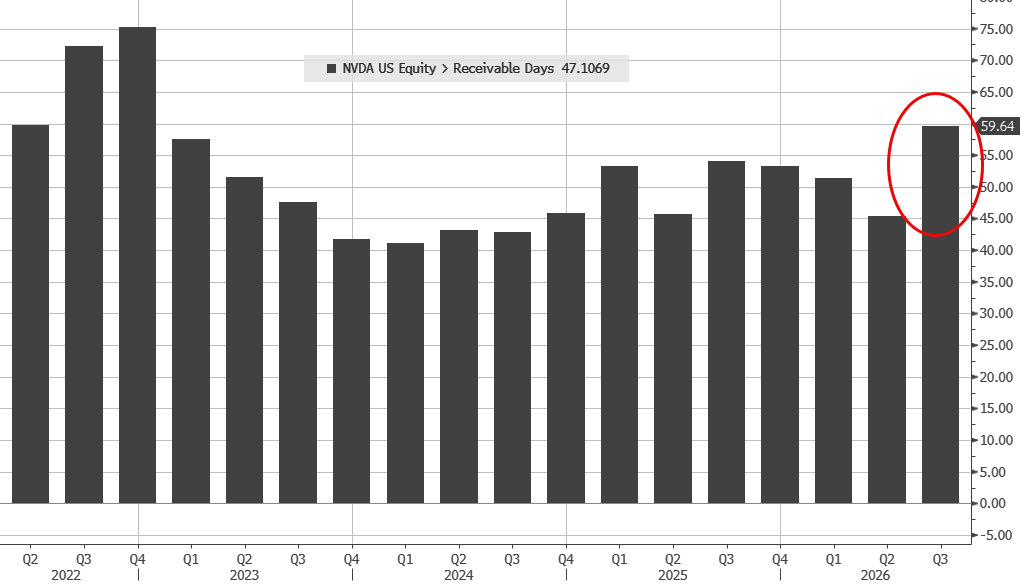
And while most concerns focus on the income and cash flow statement, according to Vital Knowledge, this is going to be the most talked about part of the Nvidia report: “Accounts receivable was $63.1B with 60 days sales outstanding (DSO), up from 45 days sequentially, due to extended payment terms on large, multi-quarter agreements with certain investment-grade customers.“
It appears that we may not even get to the off balance sheet bubble (discussed overnight): net working capital alone is starting to be a huge issue for the company and its clients.
China also remains a giant question mark for Nvidia. There have been signs that Beijing is allowing limited purchases of its chips by Chinese companies. That’s after the Asian nation had earlier retaliated against Washington’s restrictions with its own soft of imports of US technology. Nvidia’s Huang was able to get Washington to ease some restrictions on exports, in the form of limited licenses to some companies in China willing to take older Nvidia products.
The net effect persists: Nvidia is largely locked out of the biggest market for semiconductors, a country that’s actively trying to foster competition for its products, and judging by recent performance from open-weight models, is succeeding.
And lets not forget growing competition: OpenAI is just one of a growing group of customers and rivals who are touting their own chip efforts and claiming parity or performance leads over Nvidia’s offerings. Until there’s enough supply to fill every order, that remains a moot point. But there are growing concerns that Nvidia’s utter dominance is facing more serious challenges. As reported earlier, OpenAI said its new Jalapeño processor outperformed Blackwell systems in two areas in its tests. So does specialized AI compute eventually chip away at Nvidia’s dominance, or does explosive growth in overall compute demand leave room for everyone?
Putting it all together, despite another blowout quarter, the stock is once again down on results in what is becoming a habit…
… and it is only a matter of time before increasingly impatient investors start asking just what will it take for the stock to actually go up on earnings, for once.
This is a lightly edited transcript of an Aug. 24 segment of the “Victor Davis Hanson: In His Own Words” podcast.
Let’s have a periodic check on the status of the midterms that we’re now less than 80 days away from. The Democrats are riding high. They feel that historical trends, i.e., 39 out of the last 41 midterms, the party in the White House loses seats, and there’s not very many seats Republicans can afford to lose, and they may lose the House and Senate.
They’re already, I guess you’d call it, measuring their drapes, but in the sense that they’re already explaining how they’re going to go after the Trump family, the Trump family associates, cryptocurrency concerns, any hangers-on, people going to the Middle East and investing. They’re gonna open it wide open.
These are the people, of course, who never investigated the Biden family or Hunter Biden. That’s no excuse if there’s culpability, but nonetheless, you can count on a two-year investigation of Donald Trump and a never-ending impeachment inquiry, and the end of the MAGA agenda should he lose the House and the Senate.
Donald Trump is strangely confident. He now has finally hit on a strategy that he feels will work. Earlier, I called it the “Anaconda Strategy,” the idea that he is squeezing a debilitated Iran. In other words, the kinetic 40 days of bombing have left the nuclear military-industrial complex in shambles.
And this time, he’s not just blockading, he’s not just having an embargo on goods. He is not just freezing the bank accounts of Iranian grandees. He’s not just debanking the entire country. He’s going to third parties and saying, “You and China and Russia and Europe have been trading with this country even while we were bearing the burden of defanging a potential nuclear renegade nation, and we’re going to isolate you. We’re not gonna do business with you if you do business with Iran.”
And the Iranians now are crying foul. They’re saying we’re colonialists. But what I’m getting at, after all that military damage from Feb. 28 for the next 40 days, and after all the blockades, they’re not able to withstand a renewed squeezing.
And so, time is actually on our side.
The second part of this strategy is Donald Trump has now put the war on the back burner. He is saying that we don’t need to have ground troops. We might not even go in and bomb them again unless they egregiously attack an ally of ours or one of our carriers or ships.
We have managed it now. The strait is mostly open, and whatever the status of the nuclear stockpile or enriched uranium of the theocracy, it’s pretty clear they can’t get at it.
Hamas, the Houthis, and Hezbollah don’t seem to be getting money. They don’t seem to have enough rockets to threaten the Gulf States or Israel, at least to get through their missile defenses.
And so, we’re just going to concentrate, Trump thinks, on the economy.
So, what he is doing now is he and JD Vance are barnstorming the country, and they’re starting to make headway. They’re not worried about the polls that show a generic 7 percent Democratic advantage and betting odds and polls that say they’re gonna lose the House because they looked at the recent primaries.
Abdul El-Sayed, the Democratic candidate for the Democratic senatorial seat in Michigan, was polling ahead 10 points, and he scarcely won by a point and a half.
Francesca Hong, the Wisconsin Democratic candidate for governor, was polling ahead 10 or 15 or 20 points. She lost and lost handily.
Mr. [Alexander] Vindman, who was running for Senate in Florida, was polling ahead. He lost to Ms. [Angie] Nixon, a democratic socialist.
So, what I’m getting at is the polls are worthless. And what we need to look at is what the status is right now.
The war is starting to wane. If it should end or if the Iranians crack in the next 60 to 70 days, that would be a spectacular achievement that Donald Trump – you know, we’ve tragically lost 17 Americans – but at a tolerable cost in blood and treasure, he ended a 50-year problem that seven presidents said was existential.
You could not allow Iran to have a nuclear weapon, and the pressure that he’s put on them and the damage he’s inflicted would probably, in the next year or two, prompt a renewal of internal opposition against a theocracy that is bleeding.
The second thing to remember very carefully is, as I said earlier, the redistricting, the red state redistricting and the Supreme Court prohibition on racial gerrymandering might give him an additional four or five seats.
But the most important developments are money and the agenda of the new Democratic Party.
Very quickly, Donald Trump has got a war chest of about $400 million, and he’s now going to use it.
He says he’s going to use it all in his political action committees to help save the Republicans in the midterms.
Elon Musk said that he is going to match dollar for dollar the Democratic oligarchic class that if they start to donate in great amounts to Democratic candidates.
So, the money issue probably favors also, like, the redistricting and maybe the course of the Iran war that could wane and be not an issue.
But the most important thing to conclude is the Democratic Party. No one thought that the Democratic socialists would ever try to absorb and even seem to succeed in absorbing the Democratic Party. I mean, Nancy Pelosi, Hakeem Jeffries, Chuck Schumer, they’ve all said they have no problem with the Democratic socialists.
It’s a big tent party, and they’re going to help them win their seats.
But the problem is, once you have the money and the effort and the attention, and you show what the democratic socialists are, like, defunding the Pentagon, defunding the police, opening the border, mass amnesties, warring on fossil fuels, isolationist foreign policy, the transgender issue reopened with biological men now by statute free to compete in women’s sports. I could go on and on.
They even want to destroy the Senate and the Electoral College, not to mention packing the Supreme Court, ending the filibuster, and bringing in new seats in the Senate by admitting new blue states such as Washington, D.C., and Puerto Rico.
And so, what I’m getting at is, the more we learn about the democratic socialists, and the more that the Democratic Party feels they’ve already taken over the apparatus of the party and they’re going to join them, or at least they’re not going to oppose them, they’re gonna be culpable or responsible for what these people say.
And they’re saying all sorts of stuff, not just anti-Semitic venom, not just anti-Israel venom, but questioning the very legitimacy of the United States government, the way that our Founders created a legislative, judicial, and executive branch, the Declaration of Independence. Our entire traditions, they’re saying, are flawed at their origins.
They got worse during our maturity, and now they’re god-awful right now. That’s not a winning message.
So, the midterms are very much up in the air.
Contrary to historical precedent, there’s still a chance that the Republicans can save both the Senate and the House.
We publish a variety of perspectives. Nothing written here is to be construed as representing the views of ZeroHedge.