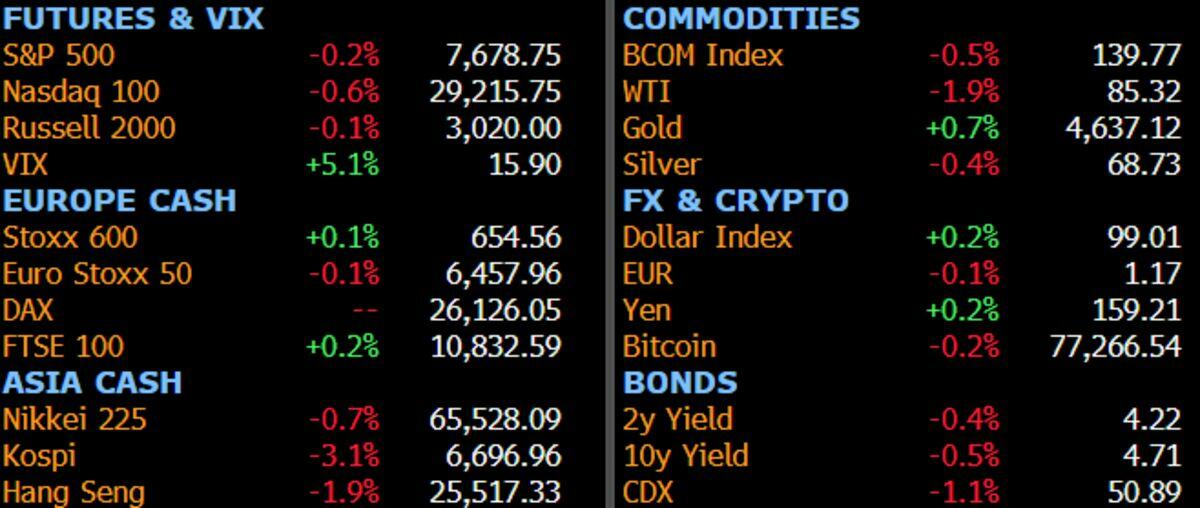
Futures are lower with Tech underperforming as the market focuses on NVDA / MRVL earnings this week; while the AI theme is pressured globally and memory stocks slump driven by a slide in the Kospi. Futures got a boost just after 7am when CNBC reported that the Treasury could use the General Account ($935BN as of today) to fund bond buybacks. As of 8:00am ET, S&P futures are down 0.2%, rising from a session low hit this morning around -0.4%. Nasdaq futures are down 0.4% with Mag7 names mixed and Software up. In premarket trading, Memory/Semis are weaker, dragging down the Tech tape. Defensives are leading Cyclicals ex-Materials as Metals/Miners look to extend their bullish run. European stocks are lower, dragged down by tech whileSouth Korea’s Kospi was once again Asia’s top loser, sliding 3.1%. Shares of SK Hynix also lost more than 3%. Bond yields are lower, down 3-4bp as the curve shifts lower and USD is bid with the Dollar stronger versus G7. In commodities, oil and ags are pulling the group lower on reports of more than 15mm bbl leaving SoH over the weekend; gold / base are bid as silver sells off as part of AI weakness. Warsh’s speech Friday at 10am is the macro focus for the week but we also get updates on PCE, which has been de-risked with the CPI/PPI prints, income / spending, housing data, and some regional Fed activity indicators. US session has few scheduled events Monday; ahead this week are coupon auctions, July personal income and spending data including PCE price indexes, and Federal Reserve Chairman Kevin Warsh speech at Jackson Hole Symposium.

In premarket trading, Mag 7 stocks are mixed (Alphabet -0.3%, Amazon +0.3%, Apple +0.4%, Meta +0.2%, Microsoft unchanged, Nvidia -0.2%, Tesla -0.3)
- Watch US and Canadian metals, lumber, dairy, automotive and equipment maker stocks as Canada is set to apply counter-tariffs on $20 billion of US products on Sept. 8 after the US implemented a new 50% tax on imports of hundreds of Canadian items.
- Alibaba ADRs (BABA) fall 2% after raising $10.2 billion in Hong Kong’s biggest follow-on offering, underscoring its willingness to amass and spend vast sums to take the lead in global artificial intelligence.
- Applied Optoelectronics (AAOI) tumbles 12% after the company filed for a possible offering of shares.
- NVent Electric (NVT) slips 1% the maker of cabinets and racks for data centers agreed to buy Maverick Power for $1.75 billion.
- PDD Holdings ADRs (PDD) rise 2% after the owner of Temu reported second quarter earnings that beat the average analyst estimate.
- Regenxbio (RGNX) tumbles 25% after the drug developer said the FDA placed a clinical hold on its investigational gene therapy RGX-121 for Hunter Syndrome. The hold follows the discovery of either a small nodules or a cystic mass in spine MRIs of five trial participants.
In other corporate news, Alibaba raised HK$80 billion ($10.2 billion) in Hong Kong’s biggest secondary share sale, underscoring its willingness to amass and spend vast sums to take the lead in global AI. Nvidia is discussing investing in Perplexity in an equity round valuing the AI startup at more than $30 billion, The Information reported. QXO, the building products conglomerate founded and led by billionaire Brad Jacobs, is hiring a onetime contender for the top job at Honeywell International.
Brent snapped a six-day run of gains, falling to around $93 a barrel as traders waited for details of Treasury Secretary Scott Bessent’s plan to economically isolate Iran. Treasury yields declined, with the longer end extending the move after CNBC reported Bessent could tap the near-$1 trillion Treasury General Account to fund bond buybacks. The greenback firmed, while the Canadian dollar was the worst-performing major currency after the country rejected a US tariff deal.
Traders are prepping for Fed Chair Kevin Warsh to speak at Jackson Hole on Friday, an event that takes on added significance after concerns over ballooning budget deficits and persistent inflation sent long-dated yields to multi-decade highs. The yield surge has already prompted an intervention by Bessent, who also pledged measures to shore up US finances. Meanwhile, Wednesday’s release of the Fed’s preferred inflation gauge will shape expectations for near-term interest-rate decisions after some officials recently reaffirmed concerns about stubborn price pressures. AI bellwether Nvidia Corp. is scheduled to report earnings the same day.
“This is set to be a pivotal week for asset markets, since there is still a chance the US Treasury selloff becomes a full-blown crisis,” wrote Kathleen Brooks, research director at XTB.
Bessent “is highly likely to underwhelm” given the scale of fiscal consolidation needed, said Emma Moriarty at CG Asset Management. Traders are unsure what to expect from Warsh given his reluctance to issue guidance and the view that Bessent’s intervention encroached on the Fed chief’s remit, she said.
Besides the Fed, we also have the most important AI company reporting earnings on Wednesday. For Nvidia, options markets are pricing in a 4.6% move following its results. The firm is not only a key pillar of the global buildout of artificial intelligence but is also increasingly orchestrating funding for AI projects.
“Nvidia is now so powerful and cash-rich that it is almost like a central bank to the tech industry,” Brooks noted.
Elsewhere, as we reported on Sunday, clients of Goldman Sachs’ Prime Services desk net sold global equities in the week through Thursday for the first time in a month and at the fastest pace in two months, a -2.3 standard deviation move against the past year.

The relentless rise of the momentum factor had been a core tenant of factor investing, but a rapid unwind has pressured the strategy, Bloomberg warns. If this continues, value investing may come back into vogue, index rebalancing trades could become difficult and retail traders might need to slow down. In an astonishing change of fortunes, the tortoise pulls ahead of the hare, with the equal weighted S&P 500 Index outperforming momentum over the last year.

The absence of a spot-up/vol-up dynamic in chips may have two causes, according to Liquidnet Alpha cross-asset sales specialist Anthony Benichou. TMT hedge funds badly bruised in July are unlikely to redeploy leverage with the same aggression and momentum has broadened elsewhere, particularly into gold, gold miners and Bitcoin, which is “competing for marginal capital,” writes Benichou.
But while stock volatility takes a breather, bond traders are getting more than their share. Bessent’s bold intervention to stem a rise in yields last week has yet to pay off and could confuse the signal that markets send to the Fed. As noted earlier, investors are looking for Warsh to clarify his views on how the US central bank should react to stubborn inflation when he speaks on Friday at the annual gathering in Jackson Hole, Wyoming.
Credit spreads of hyperscalers also underscore growing costs for the AI buildout. JPMorgan strategists including Bram Kaplan note that on several AI-linked names, the left-tail of the implied volatility surface has “repriced lower even as CDS has moved wider.” That’s as prices of servers with Nvidia chips could be set for a 15% hike. Junk bond “tourists” are adding to the volatile mix as they wade into the financing splurge on data center projects.
In other assets, Pimco continues to view bonds as attractive and “would look to add if yields continue to rise, given the opportunity higher yields present for income, carry, and rolling down a steeper yield curve.”
Tech names have underperformed in Europe too where the Stoxx 600 is little changed with the macro outlook back in focus as traders looked to data for clues about the health of the region’s economy. Here are the biggest movers Monday:
- European steel firm SSAB and aluminum supplier Norsk Hydro traded higher after the US and Canada failed to agree on a tariff deal, which analysts say leaves the status-quo intact and is positive for the two companies
- Trainline gained as much as 2.8%, rising for a second session, as Shore Capital says the recent stock weakness due to the UK competition watchdog’s investigation is “overdone”
- Siegfried shares fell as much as 8.3%, erasing gains made after earnings on Friday, as analysts lowered their estimates
- BW Offshore fell as much as 16%, the most since March 2020, after the Norwegian offshore services firm cut its full-year guidance for Ebitda
Asian stocks fell at the start of what’s set to be the busiest week for earnings this reporting season, dragged down by losses in some tech heavyweights. The MSCI Asia Pacific Index dropped as much as 1.2%. Samsung’s shares tumbled nearly 9% as investors were underwhelmed by its plans to return as much as 110 trillion won ($80 billion) to shareholders this year. Alibaba’s stock plunged 8.5% after it raised HK$80 billion ($10.2 billion) in Hong Kong’s biggest secondary offering, selling shares at a discount. That spurred a broader selloff in Chinese tech stocks. About 370 of the MSCI Asia Pacific Index’s more than 1,200 constituents are due to report results this week, putting the durability of the AI rally and China’s consumption recovery in focus. Globally, Nvidia’s results and Federal Reserve Chair Kevin Warsh’s commentary at the annual gathering in Jackson Hole, Wyoming are the two major events this week. South Korea’s Kospi was once again the region’s top loser, sliding 3.1%. Shares of SK Hynix also lost more than 3%. Vietnam’s stock benchmark was the leading gainer after securing a bigger-than-expected weighting in FTSE Russell’s semi-annual index review.
In FX, the Bloomberg Dollar Spot Index rises 0.2%. The Canadian dollar is the weakest of the G-10 currencies, falling 0.6% against the greenback after Canada announced counter-tariffs on the US.
In rates, treasuries advance, pulling US 10-year borrowing costs down 2 bps to 4.71% with oil prices lower ahead of the expected release of a US economic isolation plan for Iran. Yields are lower by as much as 2bp with curve flatter; Friday’s selloff lifted 2-year yields by nearly 5bp to first close above 50-day average level in more than a week, where it remained near 4.24%. Treasury coupon auction cycle begins Tuesday with $69 billion 2-year note; $70 billion 5-year and $44 billion seven year follow over next two days. IG credit new-issue calendar is anticipated to be light through month-end. US session has few scheduled events Monday; ahead this week are coupon auctions, July personal income and spending data including PCE price indexes, and Federal Reserve Chairman Kevin Warsh speech at Jackson Hole Symposium.
In commodities, Brent crude futures fall 1.5% to around $93 a barrel and that has likely limited any downside in European equities. It’s helped bonds too with UK and German 10-year yields down 1 bp each. Gold headed for $4,650 an ounce. Bitcoin edged past $78,000.
US economic data calendar includes only July Chicago Fed National Activity Index at 8:30 a.m. New York time. Fed speaker slate is blank for Monday; ahead of Warsh’s address at Jackson Hole Symposium Friday, the only scheduled appearances are three by Richmond Fed’s Tom Barkin over Aug. 25-26
Market Snapshot

Top Overnight News
- Iran has granted permission for a number of Iraqi oil tankers to pass through the Strait of Hormuz following repeated requests from Baghdad through various channels, Iran’s state news agency IRNA reported on Saturday. IRNA said obtaining special permission for Iraqi tankers was one of Baghdad’s main requests during Iranian parliament speaker Mohammad Baqer Qalibaf’s visit to Iraq. RTRS
- Saudi Arabia has held talks with London brokers about a state-backed scheme for war and political risk insurance that could provide cover for ships in the region, according to people familiar with discussions, as conflict threatens the kingdom’s trade. FT
- Scott Bessent’s set to announce details of the US effort to economically isolate Iran later today. Tehran threatened to halt all crude exports through the Strait of Hormuz and Persian Gulf if the US campaign continues. BBG
- Trade talks between the U.S. and Canada broke down on Friday, officials from both countries said, paving the way for the U.S. to impose 50% tariffs on about $20 billion worth of Canadian goods early on Saturday and risking escalation into an all-out trade war. WSJ
- US President Trump said in a pre-taped interview on 77 WABC that communities not taking data centres are making mistakes and that data centres provide tremendous amount of jobs and money. said:. Chinese President Xi comes to the White House, we’ll be using the East Room.
- Softbank plans to issue a record volume of retail bonds to partly fund its expanding artificial intelligence investments, as the company deepens its multibillion-dollar commitments to OpenAI and related infrastructure projects. WSJ
- Some of Nvidia’s biggest clients have been told AI server prices will rise more than 15%, people familiar said. The hikes will go into effect on systems shipped early next year. BBG
- Perplexity is in talks to raise money at a ~$30B valuation (up ~50% from its last finding round a year ago), and Nvidia could participate. The Information
- China’s $387 billion quant hedge-fund sector is rebounding from its steep July rout, with the most popular strategies outperforming benchmarks. BBG
- Demand for debasement hedges is increasingly finding its way into Bitcoin, with US ETFs for the digital currency recording $1.9 billion of net inflows last week, the strongest haul since October 2025.
- Mutual funds and hedge funds each carry equity market exposures that are elevated relative to the last few years but below recent peaks. Hedge fund returns, leverage, and crowding all surged in Q2, but July witnessed one of the sharpest deleveraging episodes of the past decade. GS Prime Services estimates now show hedge funds carrying net and gross leverage that rank below 12-month averages but remain elevated relative to the last few years. Similarly, mutual fund cash balances register 1.2% of assets, above the record low of 1.1% reached in December 2025 but otherwise one of the lowest levels on record. Goldman
A more detailed look at global markets courtesy of Newsquawk
APAC stocks traded mixed, albeit with a mostly negative bias amid a US-Canada trade war and following quiet geopolitical headlines over the weekend, while participants await this week’s key events, including the US announcing the ‘toughest sanctions in history’ against Iran later, in what is described as economic D-Day, NVIDIA earnings due mid-week and the Jackson Hole Symposium on August 27th-29th. ASX 200 was higher amid strength in the mining, materials, resources and tech sectors, while participants digested another deluge of earnings releases from Australian companies. Nikkei 225 was choppy and traded on both sides of the 66,000 level amid strength in the heavy industries, while tech-related stocks lagged with Kioxia and SoftBank among the worst hit. KOSPI underperformed amid weakness in its tech giants, with Samsung Electronics and affiliates suffering heavy losses despite the recent announcement of its largest-ever shareholder return plan. Hang Seng and Shanghai Comp were pressured amid selling in tech, with Alibaba suffering heavily after it announced a USD 10bln Hong Kong share sale, while ‘Big Short’s’ Michael Burry said he sold his Alibaba shares to build a large position in JD.com (9618 HK) and suggested Alibaba was overvalued.
Top Asian News
- South Korean President Lee is said to be expected to meet Samsung Electronics (005930 KS) Chairman this week for possible talks on major semiconductor and AI investment projects, Yonhap sources say.
- SoftBank (9984 JT) plans a JPY 1tln retail bond sale, according to Bloomberg.
- Shein offers HK IPO shares at HKD 47.60-49.50/shr with total number of shares at 280mln Class B shares, while total number of shares under global offering is 252mln Class B shares. Hong Kong public offering period will begin at 09:00 am local time on August 24th and end at 12:00 noon on August 27th. Final offer price will be announced no later than 23:00 pm on August 31st.
European bourses (STOXX 600 +0.1%) kicked off the trading week on the backfoot. However, as the morning progressed sentiment has picked up off worst levels to currently trade with a slight positive bias. European sectors hold a slight positive bias. Basic Resources leads, buoyed by gains in underlying metals prices; Travel & Leisure benefits from lower energy prices and Media completes the top three. Autos reside at the top of the pile, joined closely by Healthcare and Tech. Key movers: Evolution (+1%) rejects Candle Lake’s SEK 695/shr offer, saying it does not reflect fair market value. Shell (-0.2%) fairs a touch better vs peers (BP/TotalEnergies -0.9%). Focus has been on an FT sources piece, which noted that Shell draws interest from bidders for its USD 8bln US chemicals assets. However, the piece highlighted that the USD 8bln valuation would be a “steep discount” to the amount that Shell had invested in its US chemicals facilities
Top European News
- French Economy Minister Lescure said it is not easy to cut taxes on large companies.
FX
- USD is firmer against all G10 peers to varying degrees, with moves vs CAD most pronounced after trade updates. DXY is at session highs just above 99.00 after breaking out of 98.90 resistance, the next level is the 200DMA @ 99.17.
- A lot of focus on USD “debasement” after alternative assets BTC and Gold outperformed last week, the market today is clawing back some of these losses with DXY edging higher and BTC off Friday’s highs, however gold is firmer, potentially signalling a haven bid with global equities mostly weaker. In terms of developments over the weekend, Bessent wrote a hawkish FT piece, while Iran returned the language noting “not a single drop of oil” would leave the Persian Gulf. On that note, we expect Bessent to explain the latest sanctions in a presser this evening. Oil is not convinced by these developments with Brent down ~1%. A busy week ahead sees PCE, GDP, and Nvidia earnings hit Wednesday; Jackson Hole and US supply data land Thursday. Friday brings the NFP Annual Revision Prelim and remarks from Fed Chair Warsh. While we do not have a specific time yet, Bessent could also announce “increased focus on fiscal consolidation”; which most desks have been sceptical on over the past week.
- CAD is the clear G10 underperformer after the unexpected breakdown of trade negotiations between the US and Canada, with the latter imposing dollar-for-dollar 50% tariffs on US goods. To remind, the updates we had on Friday said that their respective trade officials would meet in Washington to finalise the deal. USD/CAD looks to return to the 200DMA which it fell beneath on Wednesday, however a renewed trade war could lead to some USD weakness. MUFG reckons the CAD sell-off does not have legs, noting it targets just 5% of Canada’s exports.
- Action elsewhere is quiet, Antipodeans are lower amid the risk tone, AUD/NZD +0.1%, supported at 1.20, Scandis are also weaker with NOK suffering from the dull tone and weaker oil prices, while EUR/USD and GBP/USD are a touch weaker against the Buck around 1.1660 and 1.3630 respectively.
- PBoC injected CNY 340bln via 7-day reverse repos with the rate maintained at 1.40%.
Fixed Income
- A modestly firmer start to the week for fixed income. Today, the docket is dominated by US Treasury Secretary Bessent on Iran at 19:00BST, a speech followed by a Q&A which will likely feature questions on last week’s long-end intervention.
- As it stands, USTs are at the upper-end of 108-08+ to 108-15 parameters. Despite the action taken to essentially pullback long-end yields last Wednesday, USTs themselves are towards the lower-end of that week’s 108-07+ to 108-30 parameters. Given this, Bessent may give commentary to verbally support the action taken.
- Note, the week also features the BLS preliminary benchmark revision, where any downward revision could knock the Fed from its assessment around the labour market; at the July FOMC, Chair Warsh described it as “solid”, “steady” and “more or less at equilibrium”, commentary that underscored the near-term focus on inflation over jobs. An update is also due from Warsh at Jackson Hole on Friday. However, given his distaste for forward guidance, it remains to be seen whether he will materially update on the economy and/or monetary situation.
- From a yield perspective, the US 10yr is holding around 4.71%, in the upper half of last week’s 4.63-4.75% band. For the 30yr, the same picture, currently around 5.25% vs 5.17-5.34% from last week.
- EGBs also bid, but only modestly. Europe is partaking in the Coalition of the Willing meeting in Kyiv, though the French and German leaders are remote due to a Saudi Arabia meeting and domestic political matters, respectively. Currently, Bunds are firmer by around 10 ticks and holding just below the 124.00 handle, toward the mid-point of last week’s 123.60 to 124.44 parameters.
- Gilts in-fitting, UK specifics light as the focus is on Ukraine and, more pertinently, the above US events. Note, the UK is set to pledge missile support to Ukraine, the financial details of which could be pertinent to the benchmark. As above, Gilts are firmer by about 10 ticks in c. 30 tick parameters, within last week’s 85.81 to 86.73 band.
- Caterpillar (CAT) files to sell EUR denominated 2yr FRN and 3yr noted. 2yr FRN guidance seen +55-60bps to 3m Euribor. 3yr noted seen MS +65bps.
- Japan sold JPY 250bln in 10yr Climate Transition Bonds b/c 3.51 (Prev. 3.42). Price at the highest accepted yield 99.46 (prev. 99.17). Highest accepted yield 2.863% (Prev. 2.195%).
Commodities
- The weekend lacked any major updates. Focus is on US Treasury Secretary Bessent’s update later today at 14:00 EDT (19:00 BST). Market focus will be on the promised escalation of sanctions against Iran and further details regarding last week’s Treasury action at the long end. On Iran, focus will be on secondary sanctions, possible action against major Chinese entities and any retaliation through the Strait of Hormuz. Tehran has threatened to prevent oil exports from leaving the Persian Gulf if the pressure continues (Full preview available at 07:40 BST on the Newsquawk feed). Notable updates today include separate visits by the Omani foreign minister and Pakistani army chief to Tehran, with the latter reportedly speaking to US President Trump before his visit to Iran. Further, UKMTO reported an incident near Yanbu, Saudi Arabia, which prompted modest upticks in crude. As a reminder, the Yemeni Houthis recently expanded their “blockade-for-blockade” policy against Saudi Arabia to the northern Red Sea.
- WTI Oct and Brent Nov futures remain softer but off lows, with the former within USD 84.69-86.57/bbl (vs Friday’s 85.80-87.51/bbl range) and the latter towards the middle of a USD 90.30-92.06/bbl range (vs Friday’s 91.15-92.98/bbl range). Dutch TTF bucks the trend and trades firmer by ~1% intraday at the time of writing, buoyed by European storage replenishment ahead of winter, with the front-month contract trading on either side of EUR 66/MWh.
- Precious metals are mixed whilst DXY remains firmer following its recent selloff, and notwithstanding lower energy prices and yields today. Spot gold is higher in tandem with the Buck and bonds, which could potentially suggest some haven positioning ahead of this week’s risk events and the aforementioned Bessent announcement at 19:00 BST, with the yellow metal currently in a USD 4,594-4,660/oz range. Spot silver is flat/slow but found support this morning at its 100 DMA (USD 68.41/oz) but remains within Friday’s USD 67.91-70.02/oz range.
- Base metals are similarly mixed and relatively resilient to the firmer Buck, with the complex continuing to be underpinned by hopes of Chinese stimulus following a recent string of disappointing Chinese data, in turn triggering widespread market expectation that Beijing will have to deploy aggressive stimulus to meet its annual targets. 3M LME copper resides towards the upper end of a narrow USD 14,141.60- 14,279.78/t range.
- Sinopec (600028 CH) executive said it is very likely that China oil demand peaked last year.
- An unusual fire alert was detected near Iraq’s Kirkuk oil field (450k BPD) with an intense thermal anomaly recorded 21 km away at 07:18 UTC.
- Norway said it will proceed with development of its Barents Sea oil and gas reserves, regardless of the EU’s proposed Arctic drilling moratorium.
- Thailand’s Finance Ministry considers taxing gold transactions in which it will consider a tax on gold trade and gold imports, while it will discuss tax with the Gold Association this week. said:. – Gold tax is aimed at curbing illicit funds and there is no plan for a high gold tax.
Trade/Tariffs
- Trade discussions between the US and Canada collapsed on Friday partly due to a last-minute stand-off regarding cutting US tariffs on Canadian medium and heavy-duty vehicles, according to people familiar with the matter cited by Bloomberg. This means the 50% US tariffs on some Canadian goods have taken effect, while Canadian PM Carney vowed to retaliate by matching tariffs dollar for dollar on US goods from September 8th.
- Canadian PM Carney said Canada was in a trade war with the US and that President Trump “miscalculated” by escalating his tariff attack, according to FT.
- US Transportation Secretary Duffy said Canadian PM Carney is going to “come to the table” on trade because tariffs will be “devastating”, while he suggested Canada is foolish to think it could win a trade war with US President Trump.
- Canada sees a long trade war with the US that could last beyond the Midterms.
Central Banks
- Fed’s Kashkari (2026 voter, hawkish dissenter) said the Treasury market is functioning as it should and that the recent surge is unlikely to impact monetary policy deliberations.
- ECB’s Cipollone said that monetary policy needs to be well calibrated; inflation is far from adverse & severe scenarios. No signs pointing to a scenario of stagflation.
- SNB Sight Deposits w/e Aug 21st (CHF): Domestic 437.11bln (prev. 433.52bln), Total 462.66bln (prev. 458.75bln).
Geopolitics: Middle East
- US Treasury Secretary Bessent writes in FT that economic D-Day is coming for Iran, and countries that calculate appeasement of the regime to be a safer choice should reconsider. said:. “At dawn begins an economic D-Day — the single greatest financial offensive ever marshalled against an adversary.”. “Those who sever Iran’s remaining financial and commercial connectivity will reinvigorate their own. They will deepen their access to global capital, reinforce confidence in their markets and attain the standing they seek in the world economy.”. “The alternative for those who tether themselves to Tehran is the foreclosure of any path to lasting prosperity…And any nation that serves as a financial artery of a withering regime should expect to share in its isolation.”
- US President Trump said on Friday that Washington was observing what happens in the conflict with Iran, and he reiterated a warning against any country that provides a lifeline to Iran, while he said Iran would love to make a deal but isn’t ready to make the right deal in his opinion.
- UKMTO has received a report of an incident 63NM west of Yanbu, Saudi Arabia; tanker was struck by an unknown projectile.
- Pakistan’s Army Chef Munir spoke with US President Trump ahead of his visit to Tehran, according to Pakistani sources.
- The Pakistan Army Chief Field Marshal Syed Asim Munir left Islamabad for Tehran a few minutes ago to meet with high-ranking officials of Iran, ISNA reported citing sources.
- Iranian Foreign Ministry Spokesperson Baghaei criticised a looming US announcement of sanctions on Iran, which he said was an assertion of extraterritorial sovereignty over independent member states of the UN and that such secondary sanctions have no foundation in international law.
- Iranian Parliamentary Speaker Ghalibaf said they have received messages from neighbours about forming new security arrangements and economic cooperation, while he also stated that the US has put its allies at such risk through bullying and pure disregard of their interests for the sake of Israel that they briefly saw their entire existence on the line.
- Iran’s Foreign Ministry said the security of the Strait of Hormuz will be discussed during the Omani foreign minister’s visit, Al Arabiya reported. Adds, they would strike at any source of aggression.
- Iran’s Persian Gulf Strait Authority said vessels violating Iran’s rules for passage through the Strait of Hormuz could face fines, detention, or confiscation.
- Iran’s Foreign Ministry spokesperson said Oman’s Foreign Minister will visit Tehran on Tuesday as part of ongoing consultations regarding maritime security and freedom of navigation in the Strait of Hormuz.
- Iran’s Foreign Minister Araghchi noted in Etelaat newspaper regarding new perspective on the horizon of Iran-China strategic partnership, stating they have been friends in difficult times and have many capabilities to strengthen friendship and cooperation.
- Iran’s Persian Gulf Strait Authority issues new rules for ships transiting through the Strait of Hormuz and warns vessels that violate Iranian protocols could face restrictions on subsequent voyages, including fines, detention or seizure. Cargo owners are being told to check Iran’s non-compliant vessels list before chartering ships, while any vessel conducting ship-to-ship transfers or other transactions with a blacklisted vessel will itself be added to the list.
- Iranian Foreign Ministry spokesperson Baghaei said the Omani foreign minister’s visit to Tehran is not linked to the Pakistani army chief’s visit.
- Yemen’s armed forces launched several missiles toward Saudi Arabia, while a powerful explosion was heard at a headquarters of Saudi-linked militias in the southern Yemeni city of Aden, ISNA reported.
- Israel conducts an airstrike on the central Gaza Strip, according to Al Arabiya.
- Shipping data showed fewer than 20 commodity vessels transited the Strait of Hormuz over the weekend.
Geopolitics: Middle East
- US administration officials, including Witkoff and Kushner, are now no longer expected in Ukraine, Politico reported.
- Russia said its forces struck a tanker carrying fuel near Ukraine’s Odessa.
- UK PM Burnham arrived in Kyiv, Ukraine on Monday morning.
- South Korea said that North Korea is preparing further Russia troop deployments, although no sign of an imminent move.
- Russia repels a drone attack on an industrial zone of Nevinnomyssk in southern Stavropol region, according to the governor.
US Event Calendar
- 8:30 am: Jul Chicago Fed Nat Activity Index, est. -0.05, prior -0.02
DB’s Jim Reid concludes the overnight wrap
As we go to press this morning, the upward pressure on long-end bond yields from last week has shown initial signs of easing. Indeed, the 30yr Treasury yield is down -2.4bps overnight to 5.25%, whilst the 10yr yield is down by the same amount to 4.71%. That’s been supported by a pullback in oil prices, with Brent crude oil (-1.37%) finally reversing course after a run of 6 consecutive gains to trade at $93.10/bbl. But even as there’s been some relief on the rates and inflation side overnight, the negative momentum in equities has continued, with S&P 500 futures down another -0.10% after the index fell -1.43% last week. Meanwhile in Asia this morning, there’s also been a decent pullback across the board, including declines for the KOSPI (-3.15%), the Hang Seng (-2.09%), the CSI 300 (-1.26%), Shanghai Comp (-0.71%) and the Nikkei (-0.52%).
That pullback in Treasury yields this morning follows last week’s surprise announcement that the US Treasury will increase its buyback operations for longer-dated Treasuries. That briefly eased the pressure on yields when it was announced, with the 30yr yield down -9.2bps on Wednesday to 5.19%, after reaching a post-2007 high of 5.31% last Monday. But even with that intervention, yields then crept back up into the weekend, with the 30yr yield closing at 5.27% on Friday, less than 4bps beneath its closing peak earlier in the week. Moreover, investor concern about wider financial repression led to clear effects in other asset classes, with the dollar index down -0.87% last week, whilst gold rose +5.18%. And this morning, gold is up another +0.72% to a 3-month high of $4,636/oz.
One reason why yields moved higher into the weekend was the ongoing rise in oil prices last week, which added to fears about inflation. Indeed, if we look at the oil futures curve, it’s clear that markets are starting to price in a longer closure of the Strait of Hormuz again. For instance, the 12-month Brent future hit a 2-month high of $79.16/bbl on Friday, which isn’t far off its peak in the Iran conflict of $83.58/bbl back in May. So those expectations of higher oil prices put upward pressure on yields as well, and the weekend newsflow hasn’t shown any sign of progress towards a US-Iran deal either.
The conflict is set to stay in the headlines this week, as US Treasury Secretary Bessent has said that he’ll be holding a press conference today to outline what he described as “the greatest coordinated economic isolation in the history of the world”. That follows President Trump’s post last week that “ANY country that allows its financial institutions, businesses, airports, or government entities to provide any type of lifeline to Iran will itself face TREMENDOUS Economic Consequences.” Bessent also wrote an article in the FT overnight, in which he referred to an “economic D-Day”.
Elsewhere, tariffs were also back in the headlines over the weekend, after the trade talks between the US and Canada broke down. Canadian PM Mark Carney said they were “walking away from a bad deal”, and would now “match Washington’s new tariffs dollar for dollar”. So that means Canada will now face 50% tariffs on around $20bn worth of goods, and Carney said that their own retaliatory tariffs would take effect on September 8. Meanwhile on the US side, President Trump posted that “Canada wants the benefits of being a State, without being one!!! They have also charged our great farmers, for many years, massive amounts of Tariffs. No more!!!” There’s already been a market reaction this morning to the breakdown of the talks, with the Canadian dollar weakening against every other G10 currency, including a -0.26% fall against the US Dollar. Otherwise, Bloomberg also reported overnight that Canada saw little chance of the talks resuming before the midterm elections.
Looking forward, the week ahead has several other events, with a big one set to be Fed Chair Warsh’s speech at Jackson Hole on Friday. This is a speech that’s often used by Fed Chairs to make big announcements or send policy signals, and last year saw former Chair Powell acknowledge that policy might need adjusting, shortly before they cut rates again the following month. We’ll have to see what Warsh discusses this time, but he said at the July press conference that he hadn’t yet decided “whether it’s going to be a big-picture speech or whether it’s going to be a more traditional set up for all the action we’re going to have between September and December”.
Our US economists have a preview of the event (link here), and their view is that if Warsh goes for the “big-picture” speech, then his options include a discussion of the Fed’s taskforces he set up, or possibly a speech on AI’s impact on the economy and his thinking. Alternatively, if he goes for the “more traditional” speech, they think Warsh could do a “cleanup” of the July press conference, and he may wish to counter one market narrative that Fed policy actions could be delayed until the task forces have completed their work. Otherwise, he might also discuss how officials are viewing inflation dynamics, or how the FOMC views the monetary policy implications of evolving financial conditions and recent volatility in long-term interest rates. But whatever he decides, market pricing is still very much in the balance for the next meeting in 3 weeks’ time, with futures currently pricing in a 39% chance of a hike. So investors are keeping an eye out for anything that could shift this in either direction.
Elsewhere this week, earnings season is winding down, but we do have a few releases left including Nvidia on Wednesday. In the last few years, Nvidia’s earnings have often been a big macro event in their own right, with reactions on a par with US jobs reports and CPI prints. But in the most recent quarters, the positive earnings surprises haven’t been as big as we saw in 2023-24, and after each of the last 4 earnings reports, Nvidia’s share price actually fell the next day. Speaking of Nvidia, Bloomberg also reported over the weekend that some of their biggest customers had been told about price hikes for servers containing its AI chips. So that adds to the signs that AI is having inflationary consequences, and isn’t a straightforward positive supply shock.
Otherwise, the data calendar is fairly light next week, with a few inflation reports likely to be the main focus. That includes the US PCE reading for July on Wednesday, which is the Fed’s target measure, for which our US economists expect core PCE at a monthly 0.18%. Then in Europe, we’ll start to get some of the flash CPI prints for August, including from France and Spain on Friday, ahead of the Euro Area-wide number next week.
Recapping last week now, it was generally a rough week for markets, as the lack of any US-Iran talks meant that oil prices kept moving higher, leading to fresh concerns about inflation. So that meant Brent crude rose +6.63% last week to $94.39/bbl. And in turn, the US 1yr inflation swap rose +34.5bps to 2.24%, its biggest weekly jump since March, whilst the 1yr Euro inflation swap rose +25bps to 2.71%.
That backdrop kept up the pressure on sovereign bonds, with the 10yr Treasury yield up +4.2bps to 4.73%, whilst the 10yr bund yield was up +5.4bps to 3.26%. Admittedly, there was a bit of a rally after the Treasury buyback announcement, but that began to unwind into the weekend. Moreover, there was a bit more of a risk-on tone on Friday after the flash PMIs for August were generally better than expected. For instance, the Eurozone composite PMI moved up to a 9-month high of 52.1 (vs. 51.7 expected), whilst the US composite PMI moved up to a 4-year high of 56.0 (vs. 54.0 expected).
That backdrop helped equities to recover into the weekend, but it wasn’t enough to outweigh the losses from earlier in the week. So ultimately, the S&P 500 (-1.43%), the STOXX 600 (-0.56%) and the Nikkei (-3.93%) were all down on the week. And that weakness in risk assets was also clear in US credit, where IG (+1bp) and HY (+3bps) spreads both widened last week. However, the performance in Euro credit was more subdued, with both IG and HY spreads unchanged over the week.