Top Iranian Cleric Issues Fatwah Calling For All Muslims To Seek Vengeance On US, Israel
In a new fatwah which appears clearly aimed at the United States, Israel, and their respective leaders Donald Trump and Benjamin Netanyahu, a top Iranian Shia cleric has called on Muslims to take vengeance as Islamic ‘warriors’.
Ayatollah Naser Makarem Shirazi, a longtime prominent Shia religious authority, said in the new edict that any individual or government that threatens or assaults the the leaders of the Islamic Republic of Iran, and the Shia nation’s religious authority in an effort to harm the ‘Islamic Ummah’ and its governance is considered an enemy of Islam, or one who wages war against God.
Grand Ayatollah Makarem was reportedly responding in the edict to question put forward by his followers is as follows:
“Any person or regime that threatens the Leader or Marja (May God forbid) is considered an enemy of God,” Grand Ayatollah Makarem said in his Fatwa, according to Iranian state media.
His rank and authority within the Iranian religious establishment is at the highest level for a Twelver Shia religious cleric, under the Supreme Leader.
He added according to a translation that “any cooperation or support for that enemy by Muslims or Islamic states is haram or forbidden. It is necessary for all Muslims around the world to make these enemies regret their words and mistakes.”
He also described that if a Muslim who “does his duty suffers hardship or loss in their campaign, they will be rewarded a fighter in the way of God, God willing.”
While he didn’t specifically mention US President Trump in his fatwah, this is precisely how some are taking it.
IRAN: Grand Ayatollah tells “Muslims of world” to kill POTUS Trump.
Makarem Shirazi: “Anyone threatening or acting against Supreme Leader is Mohareb (enemy of Allah, designated for killing)… If harm comes to you in this mission, you will be recognized as (warriors) of Allah.” pic.twitter.com/nwofafw7Zp
The White House has already alleged there was a prior plot to assassinate Trump, in a case last year; however, Supreme Ayatollah Ali Khamenei has never actually directly called for the American leader’s death. But likely, more minor clerics within Iran have done so.
This past week Trump directed a series of Truth Social messages at the Khamenei. For example, he said “Look, you’re a man of great faith. A man who’s highly respected in his country. You have to tell the truth.” Trump then told Khamenei: “You got beat to hell.” This was of course in reference to the major B-2 bombing raids on Iran’s nuclear facilities.
The promise, peril and possibilities of artificial intelligence continue to capture the cultural and business zeitgeist worldwide. Hardly a conference or long-form interview can be held these days without a panelist or pundit commenting on the technology’s implications for their profession.
Yet despite being the hottest topic in every circle, AI’s ultimate challenge isn’t technological but physical. After years of breathless speculation and prediction, the issue remains the same: AI needs more energy.
Amidst this backdrop, the oil and gas industry faces a similarly fundamental challenge: a shifting production frontier and evolving path to continued growth. After a decade of efficiency-driven growth, the era of easy barrels is waning. Diamondback Energy CEO Travis Stice captured the new reality in a recent letter, warning of the increasingly dim prospects for expanding production amid geological constraints and rising costs. Other energy majors have issued similar cautions, a sharp departure from the boom years of the shale revolution when abundant, low-cost reserves, followed by shareholder-focused production, made the industry a market favorite.
Now, with resource intensity rising, global volatility accelerating and economic conditions tightening, the industry is under pressure to find its next value horizon.
That horizon may be converging with AI.
The pairing makes increasing sense. While initially circling one another warily, major players in energy and technology have become increasingly intertwined. At major gatherings like CERAWeek, energy executives and tech leaders now share the same stage — and increasingly, the same strategic questions. How do we scale the infrastructure to match exponential AI growth? Who will supply the energy to power it? And how do we do so fast enough while dealing with rising environmental, social and regulatory concerns?
These challenges come amid a stark reality: AI’s computational appetite isn’t just increasing — it’s exploding. Several recent studies demonstrate that power demand will soar by the end of the decade, presenting real challenges for utilities and their customers who are already grappling with rising costs.
That creates both a dilemma and an opportunity. As federal and state incentives for clean energy projects face legal and political headwinds — even amid substantial private investment — the timeline to deliver renewable power at scale is getting longer. Grid interconnection queues, permitting delays and community opposition remain real barriers. At the same time, nuclear and geothermal technologies hold promise, but even under the best-case scenarios, their rollout will take years to materially shift supply.
Which brings us (again) to the topic of natural gas.
Few would dispute that a diverse portfolio of renewables, firm power, storage, nuclear and emerging technologies must meet long-term AI energy needs. But without a tectonic shift, an “all of the above” solution is no longer the political reality. Natural gas is abundant, dispatchable, and backed by a sector with proven experience in infrastructure delivery, supply chain integration and stakeholder engagement.
Granted, natural gas has its share of controversies. Building new pipelines has become increasingly complex, with communities hostile to natural gas infrastructure and deployment nationwide. Yet, despite these challenges, Exxon and Chevron have already announced serious interest in powering data centers. This partnership is not simply one of convenience but of practicality. It is not about reviving old debates but utilizing practical solutions to solve deeper issues for two pillars of the American economy.
The bottom line is that natural gas offers a workable solution for technology companies racing to deploy AI capabilities and energy companies looking to maintain shareholder value amidst a transitional time in the sector. With nuclear and geothermal both gaining political and investment momentum, gas is unlikely to be a permanent panacea but a critical bridge across a widening gap (yes, the old “bridge fuel” talking point is yet again en vogue).
This convergence between oil, technology, and ultimately, utilities isn’t simply a tactical alignment of convenience; instead, there’s a more profound structural shift — energy and compute are no longer parallel industries but mutually dependent pillars of modern innovation. If you need evidence, look no further than the recent announcement that Open AI and the United Arab Emirates will open a massive new data center in the country by 2026. Even traditional oil powers are hedging their bet and looking to participate in the changes AI will bring.
However, amidst the race to satisfy shareholders, inventors and policymakers, both industries would do well to remember customers. With concern about AI technology continuing to linger and economic challenges only growing, the political and social environment is ripe for a full-throated pushback from households already frustrated by rising energy bills, service disruptions and increasing skepticism toward unchecked tech expansion in their communities and states.
Many companies are already making significant strides on this front, with investment in local communities, building dialogue, relationships and trust. Yet just as AI’s technological promise can be limited by something practical like where to plug it in, this growing union between energy and technology sectors can be thwarted by unhappy voters.
Ultimately, the moment demands coordination and innovation, not competition. Only with pragmatic collaboration between energy developers of all kinds, grid operators and the communities where they operate can we build an energy strategy as dynamic as the technology it supports. In the end, like those paradigm-shifting endeavors, the future of AI won’t be decided by what’s possible in silicon. It will be determined by what’s deliverable in steel, concrete and kilowatt-hours.
A Third Of American Households Are Over-Burdened By Housing Costs
U.S. Census data analyzed by Harvard University shows that a third of all U.S. households, whether they are buying or renting, spend more than the recommended one third of their income on housing and utilities and therefore qualify as cost-burdened.
California, known for its high cost of living, came in at 41.7 percent of burdened households, followed by Hawaii at 39.5 percent, Florida at 38.6 percent and New York at 38.2 percent.
In general, West Coast states and those in the country’s populous Northeast showed the highest burdens, with the addition of sunshine locations Florida and Hawaii.
The least burdened households were found in the interior of the country, in West Virginia, North Dakota and Iowa, where fewer than a quarter of households felt an outsized financial burden because of housing costs. Colorado and Texas came in 11th and 12th.
The report published this week shows that renters are more often overburdened by their costs that homeowners, but that the gap has been closing in recent years.
Before and after the Great Recession, homeowners were still more overburdened than renters in the country, but this equilibrium changed in 2012 when renters began to be burdened more by rising rent costs while homeowners were profiting from zero interest rates.
With the end of the no-interest era in 2022, homeowners’ burden jumped up, while the economic hardships of the inflation crisis affected both types of households.
The researchers also identified higher insurance premiums and property taxes as an issue for homeowners, while saying that more than half of renters were spending more than 50 percent of household income on renting in 50 out of the 100 largest metro areas in the United States.
Famed “Harry Potter” author J.K. Rowling became a vocal critic of transgender ideology back in 2019, when she supported a woman who lost her job for saying that biological sex is immutable. In 2020, Rowling’s tweets and essay argued that prioritizing “gender identity” over biological sex threatens women’s rights and safety, drawing from her experience as an abuse survivor. She faced fierce backlash, was branded a “TERF” by activists, and even endured death threats, but stood firm.
Rowling’s stance has only grown more defiant as she continues to call out the bullying tactics of trans activism and the erasure of women. Despite relentless attacks from activists, media outlets, and even cast members from “Harry Potter,” her unapologetic wit and unwavering resolve have made her a leading voice of resistance against a radical ideology that silences dissent. This week, she once again proved why she remains a formidable force in the culture war over gender, giving courage to countless women who’ve been too afraid to speak out.
Apparently some people have been attacking Rowling by saying she looks like a “trans woman.” Her response to such attacks says it all:
Attention all men telling me I look like a trans woman: I’m sensing that this isn’t meant as a compliment. In fact, the implication seems to be that trans women look male, or odd, or ugly. This is appallingly transphobic and I’ll thank you to take your bigotry off my timeline.
Talk about a masterclass in rhetorical jiu-jitsu. She takes the intended insult of her critics and flips it right back on them, exposing the hypocrisy at the heart of so much of the pro-trans activist rhetoric.
Rowling’s critics, who claim to be the champions of tolerance and inclusion, routinely stoop to personal attacks and misogynistic insults whenever a woman dares to challenge their orthodoxy. The latest trend is to hurl accusations that Rowling “looks like a trans woman,” a jab that is supposed to be both an insult to her and a defense of trans women. But Rowling, with her trademark wit and clarity, called their bluff.
She pointed out the obvious: If you’re accusing someone of looking like “trans woman” in the pejorative sense, you’re essentially admitting what most people already know: that “trans women” don’t look like real women. Let’s face it, men can grow out their hair, get breast implants, and take whatever drugs they want, but everyone knows what they really are. Calling Richard “Rachel” Levine a woman doesn’t make him a woman. Using female pronouns to refer to Bruce “Caitlyn” Jenner doesn’t change the fact that he is a man. Letting Will “Lia” Thomas compete against real women doesn’t erase what he is.
Rowling refuses to apologize, refuses to play by the ever-changing rules of the woke mob, and instead shines a spotlight on the contradictions baked into their rhetoric, like how calling someone a “trans woman” is supposedly empowering until it’s used as a slur. Her wit, clarity, and refusal to back down force her critics to confront the ugliness of their tactics.
Through years of smears, threats, and public pressure campaigns, Rowling has stood firm, using every attack as an opportunity to expose the movement’s double standards and moral incoherence. In an era when most public figures wilt under pressure, she’s become a symbol of courage for women everywhere who are tired of being silenced. She’s not just defending herself; she’s defending reality, and doing it with a fearlessness that leaves her critics sputtering.
Just because trans activists demand that we all pretend that men who grow their hair out and play dress up are women doesn’t mean that the rest of us have to play along. And when those same activists who have spent years lobbing insults and even death threats at Rowling try to mock her by saying she “looks like a trans woman,” they don’t expose her bigotry; they expose their own hypocrisy. If comparing her to a “trans woman” is meant as an insult, then it’s not Rowling degrading “trans women”; it’s the so-called allies who use the comparison as a punchline. In doing so, they don’t validate their ideology; they reinforce the biological truth they insist everyone ignore.
The attacks on J.K. Rowling reveal just how desperate the radical left has become to crush dissent.
Meet The Dystopian Startups Making ‘Biological Computers’ From Human Cells
Picture a dystopian future where computers don’t just mimic human thinking – they’re powered by actual human brain cells. That future is taking shape in a Cambridge, England, lab, where a groundbreaking device called CL1 is blending biology and technology in ways that could transform how we compute. Developed by Australian startup Cortical Labs and U.K.-based bit.bio, this shoebox-sized machine houses 200,000 lab-grown brain cells wired to silicon circuits, creating a “biological computer” that’s already turning heads.
Unlike traditional computers, which guzzle energy, CL1 operates with the efficiency of a human brain. “Our brains process information using a fraction of the power that modern electronics need,” Hon Weng Chong, CEO of Cortical Labs, told FT. “This could open doors to smarter robots, stronger cybersecurity, and immersive virtual worlds.”
Oh, joy.
Low-energy computing has fueled a race to develop biological systems, with Cortical Labs leading alongside competitors like FinalSpark in Switzerland and Biological Black Box in the U.S.CL1’s brain cells, grown from human skin-derived stem cells, are carefully arranged in layers: one type sparks electrical activity, while another keeps it in check. “It’s like balancing a gas pedal and brakes,” Chong explains. This precision, says bit.bio’s Tony Oosterveen, gives CL1 an edge over rival approaches using less uniform “mini-brains.” The result is a platform for testing how brain cells handle information, with early experiments already yielding insights for neuroscience and drug development.
One of CL1’s quirkiest feats? Playing the classic video game Pong. Its predecessor, DishBrain, learned to move a virtual paddle by receiving electrical “rewards” for good moves and disruptive noise for mistakes. CL1 has taken this further, revealing how substances like alcohol impair performance or how epilepsy drugs, like carbamazepine, boost it. “We’re learning how to ‘program’ these cells,” Chong says, noting that his team is even teaching them to recognize numbers, like distinguishing a nine from a four.
“This is the first device that can consistently measure what neurons can do,” says Mark Kotter, a Cambridge professor and bit.bio founder. Karl Friston, a neuroscientist at University College London, sees it as a tool for groundbreaking experiments, while Johns Hopkins’ Thomas Hartung praises its use of games like Pong to benchmark biological computing.
Chong recognizes the ethical challenges that could emerge if biological computers and neuron cultures begin to show early signs of consciousness.
“[T]hese systems are sentient because they respond to stimuli and learn from them but they are not conscious. We will learn more about how the human brain works but we do not intend to create a brain in a vat.”
Greenland, despite possessing vast mineral reserves and past ambitions from the U.S. to acquire it for these resources, is not interested in becoming a major mining superpower.
The country’s minister for business and mineral resources emphasized a desire for only 5 to 10 active mines at any given time, prioritizing high environmental, social, and governance standards.
Concerns about the environmental impact and the uncertain economic return from mining activities, particularly with an unstable market for rare earths, contribute to Greenland’s cautious approach.
Early in Donald Trump’s presidency, he announced his ambitions to acquire Greenland. In March, Trump said, “We need Greenland for international safety and security. We need it. We have to have it.” As well as stating ambitions to counter Russia’s presence in the Arctic, taking control of Greenland would put vast quantities of rare earth minerals and rare earth elements in the possession of the United States. However, Denmark quickly shot down the idea of Trump’s acquisition, saying that Greenland was not for sale. Meanwhile, Trump’s announcement led several political figures in Greenland to suggest that Greenland should be independent, rather than under the ownership of Denmark or the U.S.
International powers have long eyed Greenland for its vast mineral potential. As several countries around the world strive to undergo a green transition, the demand for critical minerals is expected to grow dramatically in the coming years. Demand for critical energy transition minerals like lithium, cobalt, and copper could increase almost fourfold by 2030, according to United Nations estimates.
At present, China dominates the global mineral mining market. According to International Energy Agency (IEA) data, China contributes around 80 percent of the world’s natural graphite and 60 percent of mined magnet rare earths. In 2024, it produced more than 60 percent of the world’s lithium, 40 percent of refined copper, and 70 percent of refined cobalt. As the U.S. looks to reduce its reliance on China for energy, critical minerals, and other goods, President Trump sees Greenland as the potential solution.
Greenland holds vast mineral reserves, including rare earth metals, coal, graphite, uranium, copper, lead, and zinc. A 2023 Geological Survey of Denmark and Greenland survey found that 25 of the 34 critical raw materials recognised by the European Commission are present in Greenland. In addition, as ice sheets melt due to climate change, Greenland’s previously hard-to-retrieve mineral reserves are expected to become more accessible.
Caroline Kennedy-Pipe, a professor of war studies and Arctic security specialist at the U.K.’s Loughborough University, explained, “The fight for infrastructure in the Arctic is incredibly important. Plus, because Greenland’s ice sheet is melting, and melting fast, those rare earth minerals will become cheaper to access. So, these are seen as long-term investments for America.”
To date, mining activity in Greenland has been limited, as investors have avoided financing mining operations due to the harsh conditions and environmental pushback from community groups. Developing the country’s mining industry would require significant funding, as well as support from local groups.
Around a decade ago, a team of geologists published a paper that warned of unrealistic expectations for Greenland’s mineral potential. It states, “Even if estimates of the quantity and quality of ore in a geological deposit are well documented… it is difficult to translate this into economic potential and even more difficult to predict a specific revenue for Greenlandic society.”
Minik Thorleif Rosing, one of the authors of the report, said that the situation remains relatively unchanged since the date of publication. “There is a misconception that Greenland will be like a new Saudi Arabia, only at the size of a small British town,” Rosing said. He blamed the uncertainty on global market conditions for rare earth metals. There has been significant pushback against mining operations, as many Greenlanders believe the cost of mining will far outweigh the benefit. It is unclear just how much of a return on investment Greenland would see from mining activities, as there is no stable market for rare earths, according to Rosing. However, many are more concerned about the environmental impact of mining in the Arctic.
In June, Naaja Nathanielsen, Greenland’s minister for business and mineral resources, said that while some mining operations are already underway in the country, there is little interest in Greenland becoming a major mining power. “For Greenland, we are not necessarily interested in becoming a really great mining country. We just really want 5 or 10 active mines at any given time,”said Nathanielsen. “We are a very small population, so for us, we don’t need the entire country to be covered in mines. We are happy with managing a few, and I think that is feasible,” she added.
Nathanielsen emphasised the “very high” environmental, social and governance (ESG) standards held by Greenland. She said, “I think the people of Greenland really support the mining industry, which is quite kind of rare when you look at other jurisdictions. But they do so because they have faith in us having a high environmental standard and taking care of local communities.” Nathanielsen went on to say that if the government compromises its environmental standards, it could lead Greenlanders to no longer support the mining industry, which could be highly detrimental for future projects.
Oceania recorded by far the highest cocaine use prevalence among 15- to 64-year-olds of any region in the world in 2023, according to the latest report by the United Nations Office on Drugs and Crime.
In the Americas, 1.64 percent of the age group had taken it, with a more detailed breakdown showing that 1.92 percent had used cocaine in North America, versus 1.55 percent in South America and 0.94 percent in Central America.
The UNODC reports that 1.1 percent of Europeans had used cocaine in 2023, with prevalence far higher in Western and Central Europe (1.66 percent), compared to Eastern and South-Eastern Europe (0.28 percent).
In Africa and Asia, far lower shares of people are thought to have used the drug that year, at 0.38 percent and 0.11 percent, respectively.
The global average was 0.47 percent.
By absolute number, it is a different story.
On this metric, the Americas rank first with an estimated 11.41 million people having taken cocaine. It is followed by Europe with 5.97 million, Asia with 3.37 million, Africa with 3.22 million and Oceania with 880,000 people.
Between 2019 and 2023, there was a 68 percent increase in the amount of cocaine seized worldwide. Production of the drug also increased, jumping up nearly 34 percent between 2022 and 2023 to 3,708 tons.
According to the UNODC, global cocaine production “has hit an all-time high once again, accompanied by significant increases in cocaine seizures, cocaine users and – most tragically – cocaine-related deaths in many countries in recent years.”
Kremlin spokesman Dmitry Peskov confirmed last week that the US’ bombing of several nuclear sites in Iran won’t affect their bilateral dialogue, declaring that “These are independent processes.”
This is significant since many observers speculated that Trump duped Iran with diplomacy while supposedly plotting to attack it this entire time. If true, then it would follow that he might also be duping Russia too, albeit not in preparation of a direct US attack but in pursuit of some other nebulous goal.
Putin doesn’t adhere to that interpretation, however, which is also proven by him later talking about his “great respect” for Trump and praising his “sincere commitment” to peace in Ukraine.
Skeptics might speculate that he’s playing “5D chess” as part of some “master plan” to “psyche out” the US but that doesn’t make much sense.
There’s no point in continuing a dialogue if one of the parties is convinced that the other isn’t negotiating in good faith. That would be a total waste of time and resources.
Their polemics don’t equate to Putin supposedly suspecting Trump of foul play in the US’ talks with Iran, however, but they do show that Russia was very displeased with what he ended up doing even though it later expressed cautious optimism about the ceasefire that he claimed credit for brokering. All of this is consistent with Russian policy.
On that topic, Russia is also interested in a ceasefire with Ukraine, but only on its terms. These include Ukraine withdrawing from the entirety of the disputed regions, declaring that it’ll no longer pursue NATO membership, and Western countries cutting off arms shipments to it, among other demands. Russia believes that continued dialogue with the US can lead to Trump ultimately coercing Zelensky into these concessions, to which end Putin offered him a strategic resource-centric partnership as an incentive.
The idea is that the US could invest in Russia’s rare earth and Arctic energy industries, with the first providing the US with its sought-after minerals and the second leading to them jointly managing the global oil and natural gas markets, thus giving each of them stakes in the other’s success. This could then in turn help ensure that relations remain manageable even if another crisis unexpectedly erupts. With time, Russia and the US would then reshape the world order, but only if their détente remains on track.
Therein lies the importance of continued Russian-US dialogue, which Putin is committed to in spite of speculation that Trump duped Iran with diplomacy ahead of attacking it. From his perspective, Trump isn’t just saying the right things about the conflict (most of the time at least), but he more importantly hasn’t doubled down on military-intelligence aid to Ukraine. Simply put, it’s Trump’s actions (or lack thereof in this case) that impress Putin, not his words, which he’d be foolish to take at face value.
That said, there’s no guarantee that Putin can convince Trump to coerce Zelensky into his demanded concessions, and the potential failure of their talks could indeed lead to the US escalating its involvement in Ukraine and therefore worsening tensions with Russia. Even so, Putin won’t prematurely abandon diplomacy just because some speculate that the US never truly intended to reach a deal with Iran, the assessment of which he doesn’t share as confirmed by his own and Peskov’s recent statements.
Does President Trump have any legal basis for his foreign policy actions aside from his personal entitlement to absolute power? Presidents have been scorning congressional leashes on their foreign interventions since at least the Korean War. But Trump’s erratic behavior and fevered comments almost make President Richard Nixon look mild-mannered.
Democratic members of Congress and Rep. Thomas Massie (R-KY) are pushing for a vote on a War Powers Act resolution to put a leash on Trump. But in the same way that President George W. Bush found lawyers that assured him the president was authorized to order torture, so Trump supporters are denying the validity of any law restricting the White House’s warring. House Speaker Mike Johnson (R-LA) declared on Tuesday: “Many respected constitutional experts argue that the War Powers Act is itself unconstitutional. I’m persuaded by that argument. They think it’s a violation of the Article 2 powers of the commander in chief.” Johnson is blocking any vote in the House of Representatives on that resolution.
Some Trump apologists are claiming that the 2001 Authorization for Use of Military Force (AUMF), enacted in response to the 9/11 attacks, provides all the legal justification that Trump needed. Since President George W. Bush listed Iran as part of the “axis of evil” in his 2002 State of the Union address, that entitles subsequent presidents to scourge Iran forever. There was no justification for putting Iran in that 2002 trifecta, but lack of evidence rarely impedes presidential prattle.
Besides, the AUMF seems as archaic nowadays as a balanced budget amendment. In the same way that congressmen can perpetuate deficit spending by promising decades hence to balance the budget, so the AUMF allows politicians to perpetually pummel any group or nation accused of wrongdoing.
Trump appears to be claiming unlimited power to intervene abroad. In February, Trump posted on Truth Social a saying attributed to Napoleon: “He who saves his country does not violate any law.” Sounding like he was entitled to rule the world, Trump proclaimed in February: “We’ll own Gaza.” Trump signaled support for forcibly expelling more than a million Palestinian refugees in order to create “a Riviera of the Middle East.” In 2023, he boasted to Jewish donors that “I gave you Golan Heights,” signaling his prerogative to dispose of Syrian territory and redraw national boundaries as he pleased.
Trump’s pattern of issuing sweeping demands is driving his response to the Israel–Iran clash. Trump demanded “unconditional surrender” from Iran, as if he were General Ulysses S. Grant in 1862 waiting outside a fort commanded by a dimwitted Confederate general. Trump decreed that Iran must completely end all its efforts to enrich uranium, regardless of prior international approval and the lack of evidence for an active weapons program. At one point, Trump ominously warned Tehran’s 10 million residents to “immediately evacuate”—though he didn’t specify any locale where they would be safe from Israeli bombing. Perhaps Trump’s most bizarre utterance was his Truth Social post Saturday night. After announcing that the U.S. had bombed three sites in Iran, Trump concluded, “NOW IS THE TIME FOR PEACE! Thank you for your attention to this matter.” On Wednesday morning at the NATO summit, Trump scoffed at Defense Intelligence Agency doubts on knocking out Iran’s program and compared his bombing attack with Hiroshima and Nagasaki that were “essentially the same thing that ended that war.” That comparison is not expected to boost Trump’s popularity in Japan.
Turn back the clock two decades, and defenders of a bellicose president insisted that George W. Bush was smarter than he sounded. But many Trump supporters seem to think 47 is omniscient. Trump’s posts on Truth Social are now presumed to be vastly more accurate than any U.S. government intelligence report. As Vice President J.D. Vance said on Sunday on Meet the Press, “Of course we trust our intelligence community, but we also trust our instincts.” But what if the strongest instinct is to gratify pro-Israel donors? Secretary of State Marco Rubio provided the lodestar for Trumpian foreign policy: “Forget about intelligence.” DOGE missed a great chance to save over $80 billion a year by abolishing the intelligence agencies that the White House is determined to scorn. (Meanwhile, both the Washington Post and New York Times reported that Trump actually made the final decision to bomb Iran after seeing Fox News hosts lauding Israeli successes attacking Tehran.)
Presumed presidential omniscience is razing constraints on the Oval Office. Trump’s lawyers are touting the same legal nitroglycerine that helped destroy George W. Bush’s presidency. The Trump administration is echoing Bush’s “unitary executive theory” to assert that the president effectively has untrammeled power over almost everything in the solar system. Bush issued more than a hundred signing statements announcing that he would disregard specific provisions in legislation, thanks to “the President’s constitutional authority to supervise the unitary executive branch and to withhold information” from Congress and the American people. Bush used that invocation to justify scorning congressional prohibitions on torture. His administration presumed that “checks and balances” were archaic. But Bush’s legal power-grabs helped make him intensely unpopular by the end of his reign and opened the door for Barack Obama to win the presidency by masquerading as a civil-liberties savior.
Trump-style legal absolutism appears to be the mirror image of tolerance—if not also common sense. Trump’s National Park Service wants to delete any material at national parks that “inappropriately disparages Americans past or living,” so official history will become an even bigger fairy tale.
These legal doctrines are not a hypothetical threat to freedom. On March 25, masked ICE agents seizedRümeysa Öztürk, a Turkish graduate student, off the streets outside Boston. Öztürk was locked up for 45 days and her student visa covertly canceled because she coauthored an op-ed criticizing Tufts University for failing to divest from Israel in response to its actions in Gaza. Rubio vilified her as a “lunatic” and implied that the feds had ample evidence of her crimes and abuses. A leak to the Washington Post revealed that the feds had nothing on her—except that op-ed. Federal Judge William Sessions ordered Öztürk released because her arrest “potentially chills the speech of the millions and millions of people in this country who are not citizens.” Uh, judge… maybe that was the whole point.
No matter how many bombs Trump drops or how many freedoms he skewers, he will retain an iron core of MAGA supporters who view Trump’s own power as the best hope for America. The New York Timesnoted a similar pattern in 1973 at the start of Nixon’s second term: “Conservatives who have traditionally favored a strong Congress and a weakened Presidency are now advocating the reverse.” Nixon’s attempt to “fix” Washington by radically centralizing power in the White House did not survive the Watergate scandal.
On Monday, Trump proclaimed a ceasefire between Iran and Israel. On Tuesday morning, after ceasefire violations, Trump raged: “We have two countries that have been fighting so long that they don’t know what the f*ck their doing.” Millions of Americans reached the same conclusion about Trump’s own foreign policy. Unfortunately, citizens cannot rely on Congress, the Constitution, or federal law to curb Trump’s interventions at home or abroad.
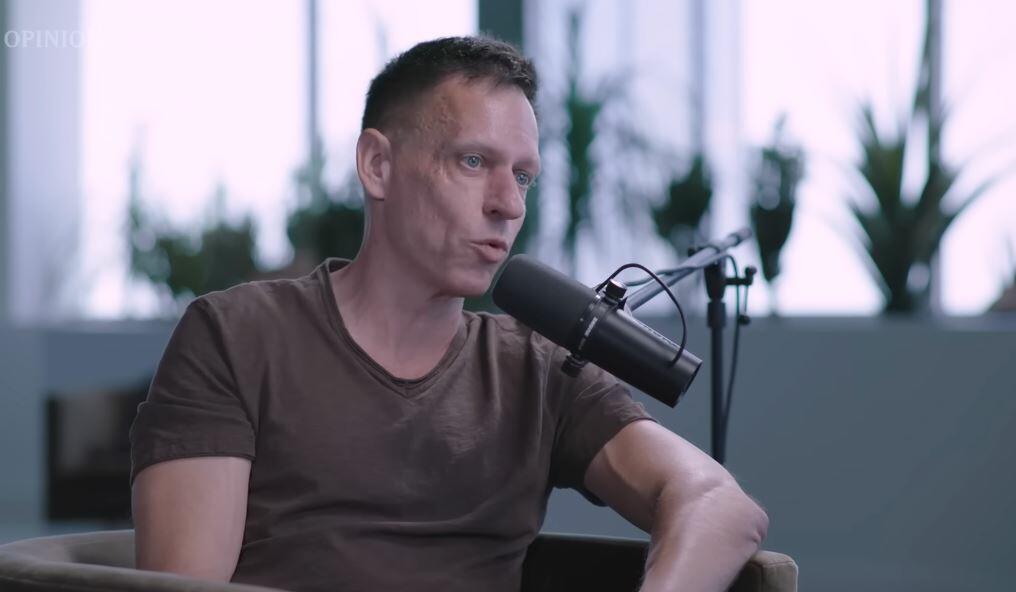
Peter Thiel Warns: One-World Government A Greater Threat Than AI Or Climate Change
In a wide-ranging interview on the future and global existential risks, billionaire technology investor Peter Thiel raised alarms not only about familiar threats like nuclear war, climate change, and artificial intelligence but also about what he sees as a more insidious danger: the rise of a one-world totalitarian state. Speaking to the New York Times’ Ross Douthat, Thiel argued that the default political response to global crises—centralized, supranational governance—could plunge humanity into authoritarianism.
Thiel, co-founder of PayPal and Palantir, shared his worries using examples from dystopian sci-fi stories. “There’s a risk of nuclear war, environmental disaster, bioweapons, and certain types of risks with AI,” Thiel explained to Douthat, suggesting that the push for global governance as a solution to these threats could culminate in a “bad singularity” – a one-world state that stifles freedom under the guise of safety.
Thiel critiqued what he described as a reflexive call for centralized control in times of peril.
“The default political solution people have for all these existential risks is one-world governance,” Thiel observed, pointing to proposals for a strengthened United Nations to control nuclear arsenals or global compute governance to regulate AI development, including measures to “log every single keystroke” to prevent dangerous programming. Such solutions, the investor warned, risk creating a surveillance state that sacrifices individual liberty for security.
Drawing on historical and philosophical analogies, Thiel referenced a 1940s Federation of American Scientists film, One World or None, which argued that only global governance could prevent nuclear annihilation. Thiel juxtaposed this with a Christian theological framing: “Antichrist or Armageddon?” In both, the billionaire said he sees a binary choice between centralized control and catastrophic collapse. Yet, Thiel questioned the plausibility of a charismatic “Antichrist” figure seizing power through hypnotic rhetoric, as depicted in apocalyptic literature. Instead, he offered a modern twist: the path to global control lies in relentless fearmongering about existential risks.
“The way the Antichrist would take over the world is you talk about Armageddon nonstop,” Thiel explained. The billionaire contrasted this with earlier visions of scientific progress, like those of 17th- and 18th-century Baconian science, where the threat was an evil genius wielding technology. Presently, Thiel argued, the greater political resonance lies in halting scientific advancement altogether. “In our world, it’s far more likely to be Greta Thunberg than Dr. Strangelove,” he quipped, invoking the radical Swedish climate activist as a symbol of anti-progress sentiment.
On AI specifically, Thiel struck a balanced tone, tempering both utopian and apocalyptic predictions.
“One question we can frame is: Just how big a thing do I think AI is?” he asked himself. “My stupid answer is: It’s more than a nothing burger, and it’s less than the total transformation of our society.”
Thiel compared AI’s potential impact to the internet in the late 1990s, suggesting it could create “some great companies” and add “a few percentage points” to GDP, perhaps boosting growth by 1% annually for a decade or more. However, the billionaire expressed skepticism that AI alone could end economic stagnation, viewing it as a significant but not revolutionary force.
While Thiel expressed nuanced views on artificial intelligence, his venture capital firm, Founders Fund, is aggressively backing the technology. Namely, it recently led a $600 million investment in Crusoe, a vertically integrated AI infrastructure provider.
“The biggest risk with AI is that we don’t go big enough. Crusoe is here to liberate us from the island of limited ambition,” Thiel said at the time.