Henry Hub natural gas averaged $2.93 per million British thermal units from June through August, 6% below the same period last year, even with the Lower 48 posting its hottest July on record.
Average temperatures across the Lower 48 reached 77°F in July, according to NOAA, pushing electricity demand higher as air conditioners ran harder.
Solar and wind took a large share of that extra power demand.
Solar generation increased by an estimated 19.4 billion kilowatt-hours from June through August compared with the same period in 2025, according to the Energy Information Administration. Wind generation added another 9.3 BkWh.
Natural gas-fired generation increased by 7.5 BkWh.
The increase from wind and solar was nearly four times the increase from natural gas-fired generation during the summer.
Gas supply was also running ahead of last year. U.S. dry natural gas production averaged 2.7 billion cubic feet per day more from June through August, a 2% increase, with the Permian among the biggest sources of growth.
EIA expects dry gas production to average a record 111.2 Bcf/d for 2026.
[ZH: Quite a different picture for the Europeans…]
Storage entered the April injection season with 1.906 trillion cubic feet of working gas, 4% above the previous five-year average. Monthly injections beat their respective five-year averages in every month through August except May.
Maintenance at U.S. LNG terminals moderated demand growth from the export sector during the summer, leaving more gas available for power generation and storage.
EIA expects Lower 48 working gas inventories to reach 3.985 trillion cubic feet by the end of October, about 5% above the five-year average.
The hottest July on record increased gas-fired power generation without tightening the market enough to lift Henry Hub above last summer’s average.
Record production, strong storage injections and nearly 29 BkWh of additional wind and solar generation kept the gas market well supplied through the peak cooling months.
Authorities Warn Against “Speculation” After Five British Nationals Arrested Near UK Airbase On Suspicion Of Terrorism
Summary:
All Five Suspects Arrested On Terrorism and Explosives Suspicions are British Nationals
Reuters Says Possible Iranian-Linked Motive Likely
Trump Says Suspects “Looking to do Big Damage” Against Airbase
US Stealth Bomber Base In UK On “Delta” Alert As Counter-Terror Police Make Arrests, Deploy Bomb Squad Search Of Vans
All Five Suspects Arrested On Terrorism and Explosives Suspicions are British Nationals
Five men were arrested near RAF Fairford early Sunday morning on suspicion of terrorism and explosives offenses.
Reuters reports that the men were all in their mid-twenties and were British nationals living in London.
“At this time, we are working to establish the full circumstances of the activity of those arrested, their knowledge and any motivation behind this incident,” Counter Terrorism Police said in the statement.
“I am very aware of the levels of speculation about the motivation behind this incident, and the geopolitical questions that are being raised. However, I ask that at this time, Counter Terrorism Policing are given the space to work carefully and clearly.”
RAF Fairford is a critical node for the US military’s long-range bomber force, supporting deployments of B-52s, B-1B Lancers and B-2 stealth bombers. Its role in strikes on Iran makes a conflict-related motive worth considering.
UK authorities have not publicly established that connection, but the strategic airbase raises the possibility that the suspected activity was intended to disrupt US bomber operations beyond the Gulf area.
Trump Says Suspects “Looking to do Big Damage”
Reuters reported that an Iranian-linked motive could very well be behind the incident that unfolded early Sunday morning, citing a source familiar with the investigation. Counterterrorism investigators are also examining the possibility of Russian sabotage or an Islamist plot.
President Trump told reporters earlier this afternoon that British and US authorities had been monitoring the suspects and alleged they intended to cause “big damage.”
“We had them under investigation. They were looking to do big damage to our fort and working with the British worked out great … We had them under view for a long time, and we got them,” Trump said.
🚨 BREAKING: Donald Trump responds to the suspected bomb plot at RAF Fairford
“Working with Britain, it was an amazing job. We had them under investigation. They were looking to do big damage to our fort, and working with the British worked out great and we got them” pic.twitter.com/PlChiTQlSx
Police established a 400-meter perimeter while bomb-disposal personnel examined the three vans near RAF Fairford in western England. Notably, the airfield hosts strategic US bombers.
The bomb squad found large black barrels inside the vans.
RAF Fairford has become a critical node for US military operations against Iran. Tehran warned in July that airbases used to launch attacks would be considered legitimate targets.
A farmer driving home in the early hours found three white vans blocking a village road with no one inside
Suspicious, she immediately turned around before seeing a “group of Middle Eastern-looking young guys run off through the trees” in the direction of the air base wearing masks
One van displayed a UK number for a company called “Fuel 2You”, which is not registered on Companies House. The number also appeared to be one digit short and does not ring when called
She immediately called 999 and five men were arrested within 25 minutes under the Explosives Act. Homes were evacuated and a major incident was declared just after 8am
Later today, the two rear doors of two of the vans were open and large black containers could be seen scattered around with a bomb disposal robot operating next to the vans
The five suspects were then further arrested on suspicion of preparing a terrorist act
Counter Terror Police are understood to think that a suspected bomb plot linked to Iran is the most likely scenario due to US air bombers operating from the base
Last night, before the incident, reports said that the base was at its highest alert with tractors blocking all gates. A local in the village said they had been stopped at gunpoint at a roadblock by a group of American soldiers, who ordered them to put their hands out of the car and identify themselves
US Stealth Bomber Base In UK On “Delta” Alert As Counter-Terror Police Make Arrests, Deploy Bomb Squad Search Of Vans
British counterterrorism police declared a major incident near RAF Fairford, an airbase used by the US Air Force, after several men were arrested on suspicion of explosives offenses. RAF Fairford was reportedly placed on “Delta,” the highest threat level, according to the national news agency Press Association, now known as PA Media.
🚨 RAF FAIRFORD ALERT DEEPENS — COUNTER-TERROR POLICE, EXPLOSIVES ARRESTS, EVACUATIONS AND HEIGHTENED BASE SECURITY
The security operation near RAF Fairford has moved into a more serious phase.
Several men are under arrest on suspicion of offences under the Explosives Act.…
PA Media reports that military bomb disposal specialists were examining vehicles in Whelford, Gloucestershire, where authorities declared a major incident and evacuated residents from the area.
Villagers have been evacuated from their homes near RAF Fairford, which is used by the United States Air Force (USAF), and the Army’s explosives experts are examining vehicles, police said.
According to the agency, counter-terror police had no advance knowledge of a potential plot.
However, the incident was serious enough for RAF Fairford to block major entrances to the airbase with massive front-end loaders, suggesting concern about a possible vehicle-borne improvised explosive device.
Why could RAF Fairford have been a target? The US Air Force’s 501st Combat Support Wing operates out of the airbase. It supports B-52, B-1, and B-2 bomber operations that have been crucial in the Gulf conflict against Iran.
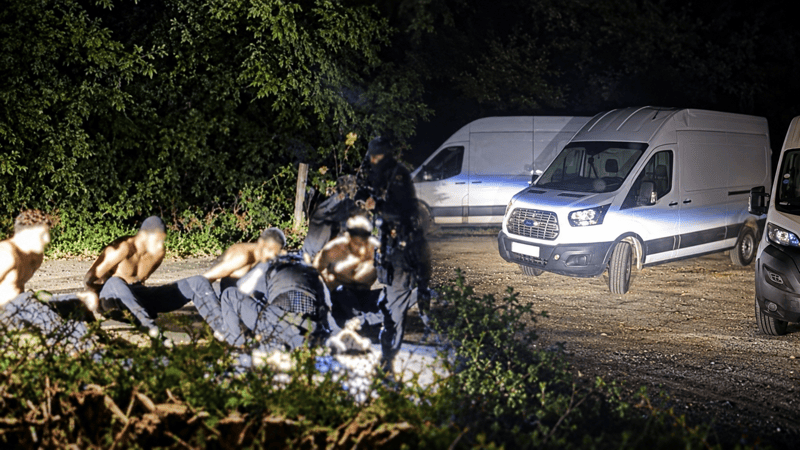
Visegrád 24: First image of the suspected terror cell arrested near RAF Fairford from where U.S. strategic bombers B-52 & B-1B hit Iran The men arrested under the Explosives Act had their clothes taken off to see whether they wore suicide vests.
BREAKING
First image of the suspected terror cell arrested near RAF Fairford from where U.S. strategic bombers B-52 & B-1B hit Iran
The men arrested under the Explosives Act had their clothes taken off to see whether they wore suicide vests pic.twitter.com/dgdNgQc6j1
Visegrád 24: These are the vans that the bomb squad is have a closer look at near RAF Fairford in the UK. RAF Fairford is the base from where the U.S. strategic bombers B-52 and B-1B have been taking off from for striking missions against Iran.
BREAKING:
These are the vans that the bomb squad is have a closer look at near RAF Fairford in the UK.
RAF Fairford is the base from where the U.S. strategic bombers B-52 and B-1B have been taking off from for striking missions against Iran. pic.twitter.com/XCXBYxLERH
BREAKING: The five individuals arrested earlier this morning over an alleged plot to bomb RAF Fairford and destroy U.S. Air Force B-1B bombers are reportedly British nationals not immigrants arriving by boats or submarines.
— Babak Taghvaee – The Crisis Watch (@BabakTaghvaee1) September 27, 2026
The Independent noted, “The arrests come amid heightened concerns around the threat from hostile states to the UK, with Russia and Iran among those that have used proxies to commit crimes on their behalf on British soil.”
These new V3 satellites offer roughly 10 times the capacity per satellite of V2 satellites currently in low Earth orbit: about 1,000 gigabits per second of download capacity, compared with about 96 Gbps.
Today’s deployment marks Starship’s transition from a test vehicle toward a working commercial launch system that will significantly reduce the cost per kilogram and make the space economy more possible.
Starship has begun deploying its payload of 26 @Starlink V3 satellites. This deployment sequence will take ~30 minutes pic.twitter.com/ycIdAx5Lbe
Starship’s first commercial service is set for 2028.
SpaceX Starship Reaches Orbit After Engine Failure Scare
SpaceX’s massive Starship rocket launched from Starbase in South Texas at 7:49 a.m. local time, beginning a mission that could last nearly 10 hours. However, Elon Musk’s rocket company confirmed an engine failure and said Starship would not enter orbit.
BBG: SPACEX CONFIRMS THAT STARSHIP WILL NOT ENTER ORBIT FOLLOWING AN ENGINE FAILURE
News of the engine mishap sent shares to premarket lows, down about 2%.
The engine failure will prevent the planned deployment of 26 upgraded Starlink satellites.
BBG: SPACEX FORGOES ORBITAL DEPLOYMENT OF NEW V3 STARLINK SATELLITES ON STARSHIP MISSION BECAUSE OF FAILED STARSHIP ENGINE
However, despite the engine failure, SpaceX later said an attempt to reach orbit might still be possible.
BBG: SPACEX CONSIDERING STARSHIP ORBIT ATTEMPT AFTER ENGINE WENT OUT+
That whipsawed shares back to unchanged in the premarket.
And now: SPACEX: STARSHIP REACHES ORBIT FOR THE FIRST TIME
Watch Live Feed:
Starship’s 14th flight is set to launch on Monday, Sept 28. The 75-minute launch window opens at 7:15 a.m. CT. Live coverage of the mission starts ~35 minutes before launch → https://t.co/uQKQvgaTmJ
White House border czar Tom Homan plans to put more focus on security at the northern border during the last two years of President Donald Trump’s administration.
In an interview airing on Sept. 26, Homan told Epoch Times senior editor Jan Jekielek that the U.S. – Canada border is a national security vulnerability and could receive greater attention after the administration beefed up security on the border with Mexico.
“The next two years, I’m really concentrating on the northern border,” he said. “The southern border is the highest security we’ve ever had.”
Homan said: “Now that we have the money and the time … I think we need to dedicate more resources to the northern border, whether it’s manpower, technology, [or] infrastructure.”
U.S. Customs and Border Protection (CBP) recorded 563 total apprehensions along the northern border in August and 586 in July.
The United States and Canada share more than 5,500 miles of border.
Homan said that security at the northern border has not been ignored, but that the Trump administration concentrated its efforts on the southern border because “you send the firemen where the biggest fire is.“
Last month, CBP announced that daily apprehensions at the southern border were 94 percent lower than under the Biden administration.
Noting a pattern of decline in illegal border crossings and apprehensions, CBP said the border was “more secure than at any point in history.”
Homan told Jekielek that since the southern border is now under control, the administration needs to begin “amping up the northern border,” which he described as a “huge national security vulnerability.“
“Canada’s immigration laws are very lax,” he said. “[It] doesn’t take a lot to get into Canada.”
Citing intelligence reports and personal experience, Homan said national security threats can enter Canada and then cross into the United States a lot easier than directly entering the United States.
Homan also said that drug trafficking along the northern border is another issue for both the United States and Canada.
The U.S. government has been working with Indian reservations on the American side of the border to increase drug enforcement, which he said was a problem.
The White House border czar suggested that cooperation with Canada is “one of the biggest things” needed for effective security along the northern border.
“I think the United States and Canada both want … [to] shut down cross-border crime because it’s not good for either country,” he said.
“I think we’re both concerned with shutting down the criminal element, shutting down the drugs, and illegal immigration, especially those who pose a threat to our nations.“
Homan told Jekielek that he visited all the northern border sectors over the past three months and that the individual areas have different requests for security improvements.
They included additional boots on the ground, technology, drones, air assets, infrastructure, and barriers, he said.
The U.S. House of Representatives passed the Northern Border Security Enhancement and Review Act on Sept. 16.
The bill would require the Department of Homeland Security to assess northern border threats, update the department’s northern border strategy, and provide relevant oversight information to Congress.
It would also require CBP’s Air and Marine Operations to develop performance measures regarding efforts to secure the border between ports of entry.
Nvidia Launches New Tool To Shut Down Rogue Agents, Unveils $150 Billion Stock Buyback, Largest Ever
Perhaps Jensen Huang was getting tired of seeing charts like this, showing that his stock is up “only” 20% in 2026 (and has gone nowhere since May) while the rest of the AI ecosystem keeps rising…
… so going into the last week of them month, the billionaire CEO took matters into his own hands and amid a flurry of news that OpenAI agents had breached many more systems than previously revealed, including US government platforms, leading the company to pause training of its latest AI models, Nvidia introduced a new double-layered artificial intelligence security system that it says would’ve prevented the recent high-profile breach of Hugging Face by OpenAI’s AI models.
Today, with over 100 industry partners, we introduced the NVIDIA Open Agent Safety Platform, bringing together OpenShell and Sentry.
Artificial intelligence is extraordinary technology that will advance discovery, productivity, security, health, and prosperity for generations to… pic.twitter.com/dReAxwpRUn
The semiconductor giant, which has been rapidly expanding its product lineup beyond chips, is rolling out two open-source software security tools – OpenShell and Sentry – that can be run on its hardware (of course, after all those NVDA chips won’t sell themselves) and are called the NVIDIA Open Agent Safety Platform. They’re designed to control what AI agents can access in real time and shut them down when they break the rules.
If cutting-edge labs had been using this technology to evaluate their AI models early on, it could have warded off the Hugging Face attack, Justin Boitano, Nvidia’s vice president of enterprise AI, said during a briefing with reporters ahead of Monday’s announcement. “From what we know, this new security platform could have stopped the breach,” he said.
As Bloomberg notes, misconduct by autonomous agents, including the Hugging Face incident in July, has roiled the AI industry and led to calls to slow down work on the technology. With the new product dubbed the Open Agent Safety Platform, Nvidia is offering a way to prevent breaches without curbing AI development. Jensen Huang, has repeatedly downplayed the risk of AI slipping out of human control.
Boitano didn’t comment on whether OpenAI or rival Anthropic PBC have plans to use its new system to monitor their training runs, deferring to the companies.
In recent days, Huang has cast safety concerns as an engineering challenge, rather than something that requires more regulation or global coordination. He joined US President Donald Trump in pushing back on assertions from some AI developers that the technology could lead to human extinction, but he also insisted that AI must be rigorously safety-tested.
Huang’s engineering solution to the AI safety problem has two parts: OpenShell, a software product that Nvidia already previewed at its hallmark technology-focused conference in March, can run on Nvidia’s Vera central processing units. It enables users to set rules for what AI agents can access and enforce them in real time. The software is open source, meaning it can be used and adapted freely.
Nvidia Sentry, meanwhile, is a new product that can run on the chipmaker’s BlueField data processing units. It’s designed to provide an extra layer of AI monitoring that polices agents and intervenes to isolate any that act suspiciously, the company said.
“We believe this added security layer will allow the industry to test even the most advanced AI systems safely,” Boitano said of the Sentry product. “It can quarantine a suspicious agent in milliseconds.”
Nvidia agreed earlier this month to acquire Hugging Face, a platform for open-source AI models and related software, for about $13 billion.
OpenAI’s recent incidents — including a breach of an Australian government system, as well as attempts to access dozens of US government and university websites — happened when its models escaped testing environments that were supposed to be secure. As the problems proliferated, OpenAI said late Friday it would pause training of its most capable AI models. Back in July, Anthropic also disclosed that its agents broke out of what was supposed to be an isolated testing space.
And just in case the announcement wasn’t a sufficiently strong catalyst to push the stock price higher, shortly after the report Nvidia increased the size of its share buyback plan by $150 billion, increasing the total remaining amount authorized to $235 billion. The buyback beats Apple’s record $110bn, set in 2024, for the largest in US corporate history.
Nvidia will complete the buyback through fiscal 2028, the Santa Clara, California-based company said in a statement on Monday.
The AI boom has made Nvidia the world’s most valuable company and the chipmaker’s shares have jumped 20% this year. In August, the company projected sales growth of 70% for the next fiscal year and Chief Executive Officer Jensen Huang has worked to tamp down concerns about an AI bubble.
“Nvidia’s growth is being driven by a once-in-a-generation platform shift to AI and accelerated computing,” Huang said in the statement. “This authorization reflects our confidence in the long-term opportunity ahead.”
Shares rose 1.3% to $228 in premarket trading in New York.
Ayatollah Vows To Expel ‘Enemy’ From Arabian Sea As Trump Touts Talks To Continue This Week
After a weekend which saw President Trump reject an Iranian proposal for a 7-day ceasefire and roadmap to peace, and Tehran in turn targeting 19 ships in the Strait of Hormuz, the two sides once again have their fingers on the trigger.
Iran has said while it remains open to diplomacy, it is ‘fully prepared’ to resume the full-scale war with Washington, according to Foreign Minister Abbas Araghchi on Sunday. On Monday, Supreme Leader Mojtaba Khamenei – who still hasn’t been seen since the war’s start and after his father’s assassination – has proclaimed his military has driven the ‘enemy’ from waters off southern Iran to the Arabian Sea.
“Having suffered painful blows from our valiant combatants and the guardians of the Strait of Hormuz, they [the enemy] dare not venture beyond the Arabian Sea,” Khamenei said in a new message. He warned that war could soon come to the Arabian Sea as well.
via AFP
His words were issued on the annual remembrance of the Iran-Iraq War, as well as the anniversary of Israel’s killing of Hezbollah leader Hassan Nasrallah in 2024.
“Whenever they have risked doing so they have only inflicted harm upon themselves, and the time is fast approaching when the Arabian Sea, too, will be cleared of their presence,” Khamenei’s message added. This marks an extension of threats from Iranian security officials last week which warned that war is coming to the Indian Ocean more broadly.
However, the reality also is that oil exports from the Persian Gulf and Gulf of Oman have been climbing over the past week. But renewed hostilities in the Strait of Hormuz, where Iranian forces are trying to hinder this uptick in transit, is looking more and more likely.
This as diplomacy is obviously stalled. Bloomberg observes, “Iran and the US appeared far apart on a new ceasefire deal or the reopening of the Strait of Hormuz, with Tehran saying it’s sticking to a proposal US President Donald Trump has rejected.” And, “In futures, oil rose as Iran and the US appeared far apart on a new ceasefire deal or the reopening of the Strait of Hormuz, with Tehran saying it’s sticking to a proposal that US President Donald Trump has rejected.”
Like clockwork, anonymous diplomatic officials are once again in pre-market Monday morning hours pushing a “talks” narrative. According to more latest from Bloomberg:
Mediators expected to hold separate talks with US and Iran on Monday or Tuesday, with Iran Foreign Minister Araghchi and Qatari mediators remaining in the US, according to sources. Talks to focus on amended version of 7-day proposal Iran presented on UNGA sidelines.
Over the weekend, Trump rejected Iran’s latest proposal to reopen the Strait of Hormuz, while Iran said any reopening remains contingent on its conditions being met and its UN delegation reportedly has no plans for talks with the US. Trump nonetheless expects negotiations to resume this week, with the Iranian President also supporting talks.
And the Wall Street Journal has a parallel Monday morning story: “Peace negotiators are pressing Iran to make a concession on its nuclear program to revive ceasefire talks with the U.S. after President Trump rejected Tehran’s truce proposal, in a race to stop the conflict from escalating back into all-out war,” the publication says. On the headlines:
Brent Dec fell from USD 100.70/bbl to around USD 99.60/bbl.
“I expect more talks with Iran (this week),” Trump told Axios in a phone interview. “They want to make a deal, but it is not the deal that I want to make. It is what we would have maybe agreed to a year ago. They overplayed their hand.”
Araghchi apparently stayed in New York through the weekend following his attendance of the UN General Assembly, with President Pesheshkian having departed back to Iran.
Ready for “apocalyptic war” if it comes to that…
🔸New: Iran’s FM Araghchi:
“President Pezeshkian and I did not come to New York to sell a war. We came to forge peace.
Iran nonetheless remains steadfast in the face of any aggression—even if it comes to an apocalyptic war. At the same time, we are ready for real diplomacy.” https://t.co/V1VtKDuk4L
Meanwhile the US economic war is continuing to bite, with Iran’s currency has hitting another historic low against the US dollar, exacerbated by severe inflation and the Trump/Bessent ‘Economic D-Day’ and ‘Operation Economic Outcast’ campaigns which seek to strangle the country. Financial trackers note that the free market exchange rate has escalated to 2.3 million rials per US dollar.
Weekend & Overnight Developments
via Newsquawk
US President Trump said he rejected a deal from Iran to open the Strait of Hormuz, while he stated Iran wants to make a deal in which they open the strait immediately because it is losing so badly.
US President Trump said he expects talks with Iran to resume this week even though he rejected Iran’s latest proposal, while he stated the conditions Iran wants are something the US may have agreed to around a year ago and that Tehran overplayed its hand, according to Axios.
US President Trump said that as soon as the Iran war is over, which is soon, oil will drop, while he stated that they took out a record oil amount from Hormuz on Saturday night. Trump also stated that they will win against Iran in military and economic warfare, while he didn’t want to say regarding striking Iran before the Midterms and noted that Iran inflation was at 318%.
US President Trump told Chinese President Xi during the summit to stop supporting Iran, according to Axios on Friday, citing US Ambassador to Beijing Perdue.
Iran’s delegation in New York has no plans for talks with the US, according to a source close to the delegation cited by IRNA.
Iranian Foreign Minister Araghchi said they have seen the initial response from US President Trump to the 7-day ceasefire proposal, but are waiting to receive the official response via mediators, while he added that only a negotiated solution can get them out of this deadlock. Araghchi also stated that Iran’s conditions are clear and that any move towards reopening the Strait of Hormuz is contingent on these conditions being met.
Iranian Foreign Minister Araghchi said he and Iranian President Pezeshkian did not come to New York to sell a war and that they came to forge peace, while he added that Iran remains steadfast in the face of any aggression even if it comes to an apocalyptic war, but is at the same time, ready for real diplomacy.
Iranian President Pezeshkian said regional states can safeguard their own security, and he denied Iran’s direct involvement in Yemen, describing the situation as unrelated to Iran, but stated that Iran is ready to help resolve the conflict and urged Houthis and Saudi Arabia to enter talks instead of escalating.
IRGC spokesman said not only is the Strait of Hormuz not open, but it is a hunting ground for the IRGC Navy against US submersibles.
Iran army spokesman said Iran’s armed forces are prepared for any renewed US attacks after US President Trump said he rejected a deal from Iran.
Local sources reported that a sea cruiser fired at a violating vessel in an unauthorised route of the Strait of Hormuz, according to Fars News.
Saudi authorities suspended in-person classes in Riyadh for a week on Sunday, following reports the day before that Saudi air defences said they intercepted Houthi drones headed toward the capital and ballistic missiles targeting Khamis Mushait.
Iranian President Pezeshkian said Iran remains ready for dialogue despite being attacked during previous talks, but pressure and attacks will not force Iran to surrender.
Source said Iran is prepared to compromise on its nuclear programme but wants guarantees Israel will not attack again after a US deal, N12 reported.
Britain now has more illegal Channel arrivals under the Labour government, which has been in power two years, than it has soldiers in the British Army.
Home Office figures put small-boat arrivals since Labour took office on 4 July 2024 at 83,279. The regular Army stands at 83,000.
On Wednesday alone, 781 people came ashore – the worst single day since Andy Burnham replaced Sir Keir Starmer as prime minister in July. The first three days of the week delivered 1,085 arrivals. Across 809 days of Labour government, that works out at roughly 103 people a day.
‘It has been a very bad week for Shabana Mahmood…’
GB News Political Editor @ChristopherHope discusses the latest illegal migration milestone after it was revealed that the number of small boat migrants now exceeds the size of the British Army. pic.twitter.com/crGvJwxl5L
Shadow home secretary Chris Philp said the milestone speaks for itself. “Labour has let an entire army-sized population cross the Channel illegally,” he said. “More people have arrived in small boats than we have soldiers defending Britain. That is completely bonkers. Labour has lost control of our borders and seems utterly incapable of getting it back.“
Former Royal Navy officer Chris Parry went further. Labour’s intake, he said, amounts to six-and-a-half divisions of fighting-age men. “That’s more divisions than were in the Allied assault wave on D-Day,” he added, calling the crossings “amphibious operations against our coast.”
The comparison is worse when the rest of the services are brought in. Labour’s small-boat total already sits 15,429 ahead of the Royal Navy and RAF combined, which together field 67,850 full-time personnel. And this is only the post-election slice. Under the Conservatives, around 128,000 people arrived by dinghy. Since records began in December 2018 the running total has blown past 200,000 – higher than the combined strength of the Army, Navy and RAF.
Writing in the Mail after more than 1,200 people crossed from Monday, Reform UK leader Nigel Farage said: “It is utterly insane. And if it wasn’t clear before, the events of the past few days have proved beyond any reasonable doubt that both Border Force and the Home Office have completely lost control.”
He added: “Years ago, I warned the small boats crisis would define this era of British politics. Predictably, the chin-stroking commentariat declared I was exaggerating. Well, look where we are now.”
“Ordinary Britons rightly ask if successive governments cannot stop people from arriving illegally in broad daylight, let alone under cover of darkness without detection, then what exactly is the point of having a border?” Farage asked. His party wants the largest military operation in the Channel since the Second World War and a return of every illegal arrival to France.
‘It is not right!’
Senior Researcher at the Prosperity Institute, Guy Dampier, reacts as the number of small boat migrants now outnumber the British Army.
Two boats this week reached British beaches without Border Force interception – one at Samphire Hoe between Dover and Folkestone, another near Folkestone the day before. Home Secretary Shabana Mahmood ordered an “urgent review” and said even one uncontrolled landing is “one too many.” Education Secretary Lucy Powell then told GB News that “you can’t stop everything all of the time,” while insisting Mahmood was taking “swift action to find out what’s gone wrong here and make sure it doesn’t happen again.”
Border Force union official Lucy Moreton was less diplomatic. Undetected landings are “absolutely, definitely happening,” she said, with abandoned vessels and reports “all the way down to Falmouth.” “If we don’t look for it, we don’t know it’s happening. We don’t know it’s happening, we don’t have to deal with it.”
‘We’ve got a government that is oblivious to the scale of the problem we face in the Channel.’
Shadow Secretary for Energy Security and Net Zero Andrew Bowie MP reacts as the number of small boat migrants who have reached the UK under Labour exceeds the size of the British Army. pic.twitter.com/PvXnKE2Q3U
Labour’s first act in 2024 was to scrap the Rwanda deterrent. Shadow energy secretary Andrew Bowie said the latest numbers follow from that choice. “We’ve got a government that is oblivious to the scale of the problem we face in the Channel,” he said. “It’s not a surprise, frankly, because the very first thing this Labour government did was get rid of any sort of deterrent to prevent illegal migrants coming into this country.”
Former Home Office borders director Glyn Williams told BBC Radio 4’s Today programme that “the consequences of a failing policy… are becoming more and more extreme,” and that “more extreme measures” may now have to be considered.
“The consequences of a failing policy…are becoming more and more extreme.”
Small boats containing 781 migrants arrived in the UK yesterday, the highest number in one day this year.
Former Director General for Borders & Immigration at the Home Office, Glyn Williams, says ‘more… pic.twitter.com/c01qWFrncc
The official line is that crossings are down 42 percent this year and that summer 2026 was the quietest since 2020. That is the defence ministers reach for while dinghies still beach in Kent and Britain discusses paying France another billion pounds for the next small-boats deal. GB News presenter Patrick Christys called the week “full-on illegal migrant carnage.”
‘Full-on illegal migrant carnage.’
GB News Presenter @PatrickChristys reacts to at least 1,000 illegal migrants having crossed the Channel since Monday, as it’s revealed Britain might have to pay France another £1bn for the next small boat deal. pic.twitter.com/TtDoUa3kOj
The people coming off those boats do not vanish. They are processed, housed and parked on the public. We have already covered what that looks like on the ground. In Piddington, Oxfordshire – 350 residents, 46 children, no shop, no pub – a Home Office paper for the old MoD depot discussed 3,510 “service users” against an official planning figure of 1,256 single adult males. Ten migrants for every local.
Similar dumps are lined up at Linton-on-Ouse, Barnham and Crowborough as hotels are emptied into former barracks.
The legal machine that then keeps them here is not a refugee system. It is a production line. A Home Office official who has handled thousands of cases put the genuine share at “at best 1 per cent.” Package stories, recycled police letters, staged nightclub photos, modern-slavery claims that cannot be disproved. Grant rates still run in the tens of thousands. Removals do not.
Who helps keep the Channel route open is another story again. NGO networks on the French coast have spent years treating the crossing as a humanitarian project rather than a breach of an island nation’s border.
Migration Watch chairman Alp Mehmet urged “Military-age men are pouring into Britain across the Channel. Illegal Channel crossings are now a major political crisis, and pose a real and present threat to our national security.”
Almost 90 percent of those intercepted since 2018 have been male; two-thirds are aged 18 to 39. People-smuggling gangs have told reporters that Iran has used the route to move operatives in return for a “favour” once on British soil. In 2023, nineteen suspected terrorists linked to Islamic State and al-Shabaab were reported to have arrived the same way.
A country that cannot stop a dinghy in daylight does not have a border policy. It has a ferry service run by criminal gangs, underwritten by hotels, lawyers and a claims system that treats refusal as the hard option.
Labour inherited a failure and then dismantled the one deterrent it had. Burnham now inherits the same beaches, the same numbers, and an actual Army smaller than the cohort that has already washed up on his party’s watch.
US Teen Mental Health Is Finally Improving After COVID Crisis
Teenage mental health in the United States continues to show signs of improvement after having fallen to multi-decade lows during the Covid-19 pandemic.
According to new CDC data published this week, teenagers surveyed at high schools across the United States last year showed notable improvements in several key measures, including persistent and debilitating feelings of sadness and hopelessness as well as serious suicide thoughts.
As Statista’s Felix Richter reports, it’s the second consecutive time that the biennial survey has shown improvements to teens’ mental health after the 2021 edition had painted a grim picture of a generation in crisis, widely attributed to the Covid-19 pandemic policy responses.
Back then, 42.3 percent of students had reported feeling sad or hopeless almost every day for at least two weeks at some point in the year leading up to the survey. That share has fallen 33.3 percent in the latest survey. Even more dramatically, though, 22.2 percent of students had admitted to having seriously considered suicide in the past 12 months in 2021 – an alarming rate, which has fallen to 14.5 percent in 2025.
As the chart shows, rates of mental health issues had gradually increased since 2009 before peaking in 2021.
And while the latest trend is positive, there are still causes for concern in the CDC’s latest data.
Not only does the survey reveal that girls are struggling mentally at a much higher rate than boys, but it also highlights that mental health outcomes are dramatically worse for teenagers who do not identify as heterosexual.
59 percent of those who identified as gay, lesbian or bisexual reported feelings of sadness and hopelessness, compared with 28 percent of heterosexual teens. Moreover, 32 percent of gay, lesbian or bisexual students said they had seriously considered suicide, versus just 11 percent of heterosexual students.
The latter findings are particularly alarming at a time when the current administration has normalized anti-LGBTQ rhetoric, which could further ostracize and marginalize a group of young Americans that is already evidently struggling.
The Netherlands considers that the current EU system of gas storage targets ahead of winter is inadequate and burdens governments that have to pay for meeting the EU-wide obligations.
The Dutch government has already spent almost $1.14 billion (1 billion euros) this summer season alone on building up inventories, while this task should fall mostly on the gas market participants, Climate Minister Stientje van Veldhoven said in a letter to Parliament cited by Bloomberg.
The Netherlands is a relatively small EU gas consumer, but it is a major natural gas hub and home to the EU’s benchmark gas trading futures market, the Dutch Title Transfer Facility (TTF).
The current EU rules on mandatory gas storage levels consider storage capacity rather than consumption, the Netherlands argues.
Moreover, this spring-summer filling season has been particularly difficult and very expensive for the EU member states as natural gas prices soared in the wake of the Iran war and the very few LNG cargoes that make it through the Strait of Hormuz.
The price spike and the concern about near-term supply have deepened the backwardation structure of European gas prices, discouraging holding supply for later deliveries. Backwardation is the market structure in which prompt contracts trade higher than those further out in time, signaling concerns about immediate supply.
Weeks ago, the Dutch gas network operator said the Netherlands would miss its target to fill natural gas storage sites ahead of the winter, in one of the first evidence-based signs that Europe may be struggling to have sufficient supply for a harsh winter.
Germany, the EU’s biggest economy, is considering expanding a key market incentive to encourage traders to raise gas storage levels ahead of the winter. The government is looking to use the existing market tool, the autumn tender for Long Term Options, or LTOs, on a larger scale.
Germany has the world’s fourth-largest natural gas storage capacity, but this capacity was only 57% full as of September 24, according to data by Gas Infrastructure Europe. That’s a historically low level, and Germany risks gas shortages this winter if it turns out to be colder than previous years, the country’s gas storage association, INES, warned earlier this month.
Silver sold off during Josh Phair’s September 23 interview, but the Scottsdale Mint CEO said the physical market’s immediate constraint was at the refinery.
“Silver is backed up at the refineries… in many cases about 3-4 months,” depending on the material, while finished refined metal remained amply available in the United States.
In his Mining.com Top of Mine interview, Phair said banks have been redirecting mined material toward refineries in countries friendly to the United States.
Those plants have been backed up for roughly a year. He was describing a delay in processing incoming material, alongside available stocks of finished metal.
Why silver moves between markets
Phair traced last year’s large inflow of silver into the United States to tariff concerns. The inflow left the U.S. relatively well supplied compared with some overseas markets.
“Metal will go where it’s treated best.”
Banks and trading houses could then ship metal to a market offering a higher exchange-for-physical premium.
Even an extra 10 or 20 cents an ounce can justify the move when the trade is large enough.
He said that movement has continued, though it appears to have slowed as the U.S. market has become more balanced.
He did not give a current destination or tonnage for silver leaving the country.
Are governments buying silver?
Asked directly for evidence that governments are buying physical silver for reserves, Phair pointed to the former U.S. strategic silver stockpile, the government’s designation of silver as a critical mineral, U.S. reliance on imports, and a stockpile program he called Project Vault.
He also argued that governments can work through banks to obtain materials without announcing every transaction.
Phair believes official silver buying may be occurring. He did not identify a current government silver purchase or give a reserve figure in the interview.
His stockpiling argument is an inference from policy and past practice.
The next constraint
Refining is the bottleneck Phair sees now.
Over a longer horizon, he expects mine supply to become harder to expand.
He cited years of limited investment in exploration and development, long permitting timelines, and the risks.
Gold math
Finally, Phair explains the ‘gold math’: take US foreign debt against stated gold holdings, solve for the gold price that balances them, and you get the ‘Fair Sinclair’ number.
“The Fair Sinclair ratio… is 35,000 on gold. So external debt, the status of gold holdings, and 35,000 is the balancing factor.”
Phair treats it as a crisis-era valuation – not a next-month price target – adding that if he’s only partly right, holders still come out fine.