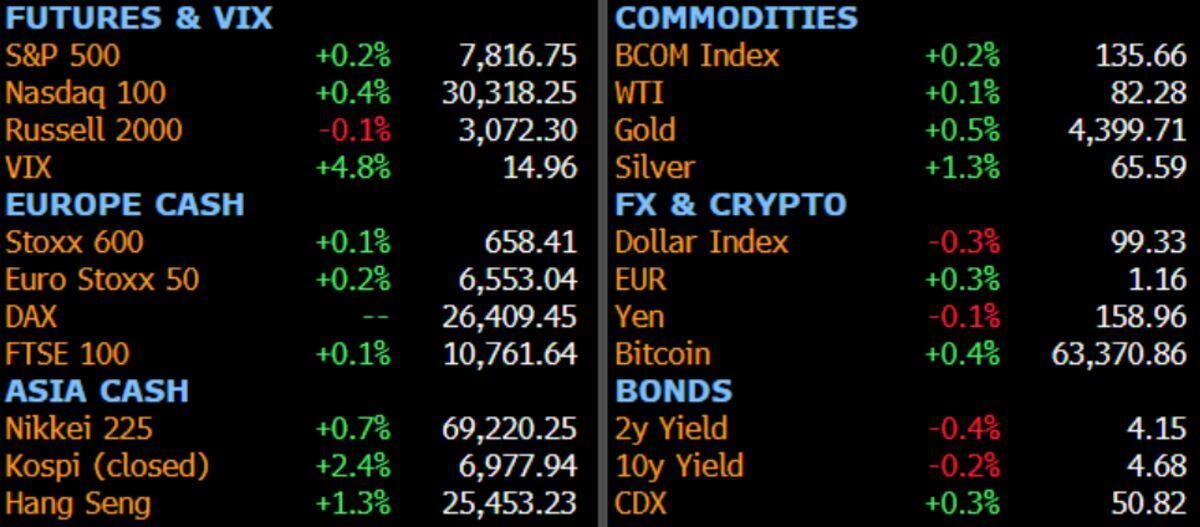
Futures are higher again, just a few basis points away from a new all time high, led by Tech as the week starts with Semis / Memory / AI themes bid globally, as small-caps are fractionally in the red. As of 8:00am ET, S&P futures are 0.1% higher, while Nasdaq futures climb 0.5% after strong revenue growth at Anthropic helped boost optimism around artificial intelligence and bolstered the view that massive spending on artificial intelligence will be sustained. Semis, Memory, and Mag7 are all higher with Software down. Cyclicals are mixed with Indu / Mats leading Fins / Discretionary, but the cohort is lead Defensives, which are dragged by HC and Staples. It is a light macro week so the positive Tech inertia may continue into NVDA earnings next week. Bond yields are flat to down 2bp as the yield curve bull steepens; higher yields remain a risk with Fed Minutes this week and Jackson Hole next week. USD continues to its decline touching a three-month low as rate hike odds faded, while commodities are bid up with strength across the 3 complexes. Crude prices appear to be holding in a range on increased cover flows in the MidEast and weaker Chinese demand. In metals, copper, silver, and palladium are the standouts. US economic data calendar includes August Empire manufacturing (8:30am), NAHB housing market index (10am) and June TIC flows (4pm). No Fed speakers scheduled for the session.

In premarket trading, Mag 7 stocks are mostly higher (Amazon +1.2%, Alphabet +0.5%, Nvidia +0.6%, Apple +0.3%, Tesla +0.1%, Meta Platforms -0.2%, Microsoft -0.7%)
- AI-linked stocks are rising after Anthropic PBC told prospective investors that its preliminary second quarter revenue was $11.5 billion, an at least 14-fold increase versus the same period a year ago. Marvell Technology (MRVL) +2%, Applied Optoelectronics (AAOI) +2%, Sandisk (SNDK) +4%
- Diana Shipping (DSX) is up 9% after the company pulled its offer for all the outstanding shares in Genco Shipping & Trading it doesn’t already own. The company said that Genco’s board had unrealistic price expectations.
- EyePoint (EYPT) said its experimental treatment for an eye disease failed to meet its primary goal in a late-stage trial. After being halted shares resumed lower by 66%
- L3Harris Technologies (LHX) slips 3% after the defense contractor replaced Chief Executive Officer Christopher Kubasik over conduct that “was not consistent with the values of the company.”
- Macy’s (M) is up 2% after Berkshire Hathaway disclosed a stake in the company in a filing.
- Target Hospitality (TH) gains 3% after Morgan Stanley started coverage on the provider of modular housing with an overweight rating, saying the company is poised to benefit from an AI buildout that is increasingly rural.
AI-linked stocks are reasserting their leadership after a volatile July that saw investors rotate into economically sensitive sectors. Fresh evidence of surging demand for the technology came from Claude chatbot maker Anthropic whose Q2 revenue jumped at least 14-fold from a year earlier, Bloomberg News reported late Friday, largely on the back of the new faded tokenmaxxing craze. The Claude chatbot maker posted preliminary revenue of more than $11.5 billion, plus positive adjusted operating income. In other AI news, Alibaba’s open-weight models have accumulated more than 3 billion global downloads in the past six months, eclipsing Meta, Alphabet and domestic peers to become the world’s No. 1 AI model.
AI infrastructure stocks, rather than adopters, have so far driven market performance because of limited visibility about which companies will be able to turn investments into tangible gains in productivity and earnings, according to Goldman strategists. On the subject of earnings, Big Tech is powering profits for corporate America, with S&P 500 Index EPS rising 31% in the second quarter from a year earlier, the strongest gain outside of recoveries from major recessions in Bloomberg Intelligence data going back to 1992.
“We continue to see strong risk appetite among institutional investors, particularly in areas where earnings are strongest, such as US equities and technology,” said Marija Veitmane, head of equity research at State Street Global Markets.
More broadly, reasons to be wary about stocks are quickly disappearing and a Goldilocks scenario looks increasingly likely — which is why it’s a perfect time to hedge against a market priced for perfection, notes today’s Taking Stock. Equity dispersion continues to drop, closing last week at the lowest level since early April, while financial conditions continue to track the most accommodative levels in 30 years.

Behind the bullish metrics lies the potential for instability, with the market having recently seen a sharp reversal from a broad bid for index volatility and skew to a FOMO-fueled demand for upside calls.

In other assets, spot Bitcoin ETFs recorded their largest outflows since the end of June, with a net $389.7 million drained in the week of Aug. 10. Covert oil flows out of the Persian Gulf are helping keep global prices in check, while copper is heading toward a record high on the LME as supply tensions build.
The health of US consumers will be in focus this week when retailing giants such as Walmart Inc. and Home Depot Inc. report earnings. Recent data showed spending cooled in July after a strong first half, while households are also getting concerned about worsening business conditions and rising inflation.
“Any signs of stress in the outlook, against a backdrop of slower hiring and higher borrowing costs, could challenge the resilient growth narrative,” said Laura Cooper, global investment strategist and head of macro credit at Nuveen.
Minutes of the Federal Reserve’s July monetary policy meeting could also attract interest. Traders have pushed back expectations for the next quarter-point Fed hike to January, though bond investors are also growing worried about heavy government borrowing and persistent fiscal concerns.
“The recent run of softer economic data has reduced the urgency for near-term tightening, so the minutes may carry less weight,” Cooper said. Still, “in a regime of the Fed keeping their cards close to the chest, any signals could be of outsized importance.”
The latest 13F filings show how one-sided AI long positioning was into July’s rout. As markets recover, the next 13F season will be a fascinating conviction test, notes Bloomberg’s Anthony Stephens. Other filings reveal Berkshire Hathaway increased its holdings in Delta Air Lines and Alphabet during the second quarter, mining tycoon Gina Rinehart bought eight million shares of SpaceX and Third Point exited Meta and Nvidia.
It’s a light macro and corporate tape to start the week, but further out traders will eye more clues on the state of the consumer with earnings from Walmart, Home Depot and Target in the coming days. Fed meeting minutes are also on the way this week, along with PMI readings in the US and across Europe.
In Europe, the Stoxx 600 rises 0.1%, with miners and tech outperforming as rising copper prices lifted miners while chip stocks gained after Anthropic reported a strong revenue surge for the second quarter. Here are the biggest movers Monday:
- Chip stocks were among the top gainers in Europe on Monday after Anthropic reported a strong revenue surge for the second quarter, while software stocks slipped across the board
- Argenx jumped as much as 10%, the most in more than a year, after the company announced positive late-stage trial results for its experimental myositis treatment
- Thungela Resources shares jumped as much as 12%, the most since March, after the coal mining company reported interim results showing significant earnings growth from a year earlier
- Accelleron gained as much as 10%, the most in more than five months, after Berenberg said the turbocharger manufacturer’s current growth cycle is stronger and more durable than previously modeled, and upgraded to buy
- Sandoz shares climbed as much as 3.5% to a record high after the Swiss maker of generics and biosimilar drugs announced a collaboration agreement with Shanghai Henlius Biotech. ZKB says the deal underlines the company’s “strong position in the global distribution of biosimilars”
- SIG shares fell as much as 27%, the most since the company’s 2018 IPO, after it said in a statement it had appointed Ann-Kristin Erkens as its new CEO, replacing Mikko Keto
Asian stocks advanced at the start of the week as semiconductor stocks gained for a sixth straight session. The MSCI Asia Pacific Index rose 0.4%, led by Kioxia, Tencent and Alibaba, after dropping as much as 0.2% earlier in the session. The benchmarks in China, Taiwan and Hong Kong climbed, while an Asian semiconductor gauge advanced 1.4% to extend its longest win streak since June 22. With AI-bellwether South Korea shut for a holiday, regional tech stocks showed renewed strength following a robust US earnings season, Anthropic’s second-quarter report, and the unwinding of leveraged bets. The China Star 50 Index rose more than 4% and Hang Seng Tech Index gained the most this month. Japan’s benchmark Topix snapped an eight-day win streak, after data showed economic growth unexpectedly slowed in the three months through June. Thai stocks climbed after its second-quarter GDP rose 1.9% from a year earlier, faster than the 1.8% median estimate in a Bloomberg survey but slower than 2.8% growth in the first quarter. Alibaba gained 1.9% in Hong Kong after disclosing a deal to sell its gaming arm and touting claims of more than 3 billion downloads for its open AI model. Meanwhile, margin balances in China and Korea have returned to 2025 levels and are rising again as sidelined funds re‑enter the market, Marvin Chen of Bloomberg Intelligence wrote in a note.
“Technology stocks strengthened, while the decline in their day-to-day volatility is encouraging investors who had stepped back from the sector to selectively re-enter,” said. Rajeev De Mello, a global macro portfolio manager at Gama Asset Management.
In FX, the selloff in the greenback extends with the Bloomberg Dollar Spot Index down 0.3% after earlier falling to its lowest level since mid-May. USD/JPY fell as much as 0.6% to 158.60, it recovered to trade at 159.37 in the New York afternoon, holding close to the closely watched level of 160. There’s a less than 30% chance that the Fed will raise its policy rate in September, down from about 70% odds at the end of last month, according to overnight-indexed swaps. The Aussie and Swiss franc are outperforming against the greenback, each rising 0.5%.
In rates, treasuries price action is steady over Asia, early London with front end outperforming slightly, steepening curves. WTI futures and stocks trade slightly higher on the day, follows fresh fighting in Lebanon while Washington prepares new economic measures against Iran. US 2-year yields outperform, trading richer by 1bp on the day while rest of the curve is little change vs. Friday closing levels. Steepening of curve sees 2s10s and 5s30s trade wider by 1bp and 1.2bp on the day. US 10-year yields trade unchanged around 4.69% with gilts outperforming by 1.2bp in the sector. IG dollar issuance slate includes a couple of deals. Dealers estimate around $20 billion in new deals this week, with the bulk of issuance expected to be front-loaded. Gilts lead modest gains in European government bonds. Treasury auctions this week include $16 billion 20-year bonds (Wednesday) and $8 billion 30-year TIPS (Thursday).
In commodities, Brent crude futures rise 0.8% to around $89 a barrel. Precious metals climb, with spot silver up over 1%. WTI futures trade up around 0.4%, just off session highs with S&P futures up around 0.15% vs. Friday close.
US economic data calendar includes August Empire manufacturing (8:30am), NAHB housing market index (10am) and June TIC flows (4pm). No Fed speakers scheduled for the session
Market Snapshot

Top Overnight News
- Trump Threatens to Bomb Oman If It Gets in Way of US: Fox
- Fighting between Israel and Iran-backed Hezbollah in Lebanon over the weekend marked the latest setback in efforts to end parallel conflicts in the Middle East: BBG
- Trump orders Pentagon to scale back joint exercises with South Korea: RTRS
- North Korea denounces upcoming US-South Korea drills, vows stronger nuclear deterrence: RTRS
- Top US commander visits aircraft carrier, Gaza talks in Egypt and other Mideast news: AP
- US pulls last aircraft carrier in Asia as Trump focuses on Iran and the Western Hemisphere: AP
- Trump’s Venezuela Fixer Is Promoting ‘America First’ Oil Deals: BBG
- Iran says two French embassy employees barred from returning: RTRS
- China’s economy got off to a sluggish start in the second half of the year, reviving pressure on policymakers: BBG
- Alphabet is looking to raise about A$5 billion ($3.6 billion) in what would be its debut bond offering in Australia: BBG
- Trump crypto firm backs venture offering AI from restricted Chinese companies: RTRS
- Jane Street Lost $15 Billion in Its First Down Month in a Decade: BBG
- US to tell partners they must pick sides in AI race with China: RTRS
- Goldman Sachs said market bets on Federal Reserve interest-rate hikes are still too aggressive: BBG
- Binance gave Moscow client details used to charge Russian over Ukraine donations: RTRS
- Copper Squeeze Builds With Spreads Surging and Price Near Record: BBG
A more detailed look at global markets courtesy of Newsquawk
APAC stocks began the week mixed, albeit with a mostly positive bias, following a quiet weekend of macro newsflow and amid geopolitical uncertainty as the 60-day US-Iran ceasefire is set to expire. Participants also digested a deluge of earnings and the latest data releases, while markets in South Korea are closed in observance of Liberation Day. ASX 200 was subdued as weakness in consumer discretionary, financials and real estate offset the gains in miners, resources and materials, while there is a slew of earnings releases, including ‘big 4’ bank NAB, which posted higher profits but noted cooling home loan demand. Nikkei 225 price action was choppy following disappointing GDP data, which could support the argument for the BoJ to refrain from hiking rates next month, although money markets are still leaning towards the central bank resuming rate increases at the September conclave. Hang Seng and Shanghai Comp were positive amid a slew of earnings and with the advances in Hong Kong led by chipmaker SMIC, while platform companies such as JD.com and Alibaba were also underpinned, with the latter helped by the sale of its gaming arm and news its AI models hit 3bln downloads.
Top Asian News
- China’s NBS said the external environment remains complex but they are going to continue expanding domestic demand, however some firms face operating difficulties. Additionally, NBS said the country has solid conditions to achieve its annual growth targets.
European bourses start the week mixed but in light volumes, given the Summer lull. Not much in terms of drivers to give a clear direction, with weekend geopolitical newsflow light. The 60-day US-Iran MoU deadline expires today, although the expiry does not automatically trigger a resumption of hostilities. Iran’s Foreign Ministry held its weekly press conference, in which they said no talks have begun due to Washington’s violation of the MoU, while stating that talks with Oman continue. Sectors highlight the mixed picture. Basic Resources outperform, given the lift in 3M LME copper prices to new ATHs, while Tech is supported following reports from Bloomberg that Anthropic reported Q2 revenue of over USD 11.5bln (prev. 0.79bln Y/Y). To the downside is Optimised Personal Care, Food Beverages & Tobacco and Retail
Top European News
- JPMorgan (JPM) CEO Dimon reportedly warned UK Chancellor Healey against creating a more hostile tax environment for banks, the FT reported. Dimon said that higher taxes drive jobs away, using the decline in financial roles in New York as an example, the report added.
- Fitch affirmed the UK at ‘AA-’; outlook Stable.
FX
- Continued USD weakness throughout the morning saw DXY fall to a 99.30 trough, its lowest since 5th June, while EUR/USD eclipsed the 1.16 mark, not seen since 17th June. The move was gradual and over the course of roughly an hour, the initial downticks without a driver, but later weakness seen around remarks from the Iranian Foreign Ministry which signalled commitment to the diplomatic process; remarks which also modestly weighed on Brent at the time. Analysts expect the USD weakness to continue, ING suggesting the USD can “probably trade to the soft side all week”, while others highlight the soft July data series; for now, DXY -0.2%, the level to watch below is the 200 DMA just below 99.20.
- Action elsewhere is very quiet, G10s mostly move in tandem with USD weakness.
- GBP/USD +0.2%, off the back of the weaker USD with UK catalysts light, Cable trading just above 1.3560, above all significant DMAs. Over the weekend, FT reported that Jamie Dimon warned the Treasury against raising bank taxes, a report which highlights the proximity of the Autumn budget. GBP is primed for a busy week of data, Tuesday sees Jobs data, Wednesday is inflation, Friday is Retail Sales.
- Low yielders are among the best performers as some likely carry USD positions unwind. USD/CHF -0.4%, testing the 50 DMA, USD/SEK -0.4% ahead of the Riksbank this week. High-beta currencies are also doing well on the back of easing Fed expectations which has helped the risk environment; markets now assign a 30% probability of tightening in September, last week was c. 50%.
Fixed Income
- Fixed benchmarks are trading mixed this morning, with USTs (+2+ ticks) around recent lows, whilst Bunds (-8 ticks) move a touch lower. As it stands, USTs hold towards the upper end of a 108-16+ to 108-24+ range. Macro newsflow was lacklustre over the weekend, with focus ultimately on the expiration of the US-Iran MoU, which is set to occur today. Whether there is a fresh round of hostilities remains to be seen, but the risk remains (a full piece and scenario analysis can be found on the board at 07:05 BST).
- As it stands, US yields are lower across the curve, with mild underperformance in the front-end/belly of the curve; a continuation of the action seen last week following the soft US data. ING opines that the 10yr yield could be subject to upward pressure for some time, citing fiscal deterioration and continued focus on the JPY intervention story. The Dutch bank concludes by writing that “we see yields still gravitating more toward the upper end of the recent range”. For reference, the 10yr hit a high of 4.73% on 11 August vs current 4.67%.
- Key US data is lacking for the remainder of the day, and in fact for the remainder of the week. The FOMC Minutes of the July meeting will provide a better understanding of how policymakers are thinking about the policy rate ahead of the September meeting; as it stands, money markets assign a 26% chance of a hike next month.
- Bunds are trading with very mild losses this morning, whilst Gilts are flat. The lack of macro newsflow and pertinent European/UK data has led to tentative action so far, but a slew of UK data is dotted throughout the week, which will be key in determining BoE pricing. As it stands, money markets assign a 24% chance of a hike in Sept, and fully price in a 25bps hike by year-end. On the fiscal side of things, JPMorgan’s Dimon warned the UK Chancellor against raising bank taxes and creating a more hostile tax environment for banks.
Commodities
- Energy futures are mostly subdued within recent ranges with a lack of notable geopolitics from over the weekend, and with the US-Iran MoU effectively lapsing today (full analysis on the Newsquawk board). Briefly, the 60-day US-Iran Islamabad MoU expiry does not automatically trigger a resumption of hostilities. Iran argues there is no ceasefire left to extend because the US already violated the agreement, while there is currently no confirmed deal to extend or replace the MoU. The key market focus is on whether the expiry results in renewed negotiations, additional US sanctions, further military escalation or progress towards reopening the Strait of Hormuz. The morning saw commentary from the Iranian Foreign Ministry which reiterated recent comments but prompted modest losses in the complex as Tehran said talks with Oman are ongoing.
- WTI and Brent trade higher by 0.40-0.80/bbl intraday, with the former within a USD 80.80-82.16/bbl range, and the latter in a USD 88.01-89.40/bbl range. WTI sees slightly deeper losses than Brent, with the Baker Hughes rig count on Friday pointing to expanding US drilling activity. Elsewhere, Dutch TTF bucks the trend with some gains as demand props up prices as Europe refills winter storage. Dutch TTF is firmer by some 1.5% intraday and resides just above EUR 62/MWh after finding resistance around EUR 63/MWh earlier.
- Precious metals are supported by subdued energy prices, in turn weighing on inflation expectations and thus the Dollar. Spot gold topped its 100 DMA once again (USD 4,386/oz) and resides in a current USD 4,367-4,416/oz range after topping Friday’s USD 4,397/oz peak, and vs last week’s USD 4,449/oz high. Spot silver trades towards the upper end of a USD 65.60-66.22/oz range, vs last week’s USD 66.80/oz peak.
- Base metals are similarly propped up, with 3M LME copper hitting record highs of USD 14,387.60/t (vs intraday USD 14,164.33/t). Another supporting factor for base metals could be the downbeat, delayed Chinese Activity data, which printed worse-than-expected across the board and further raises the argument for more stimulus from Beijing.
- At least 2 Asian refiners have asked Saudi Aramco if they can take their oil cargoes from Egypt’s Sidi Kerir port, instead of through Yanbu, Bloomberg reported.
Geopolitics: Middle East
- US President Trump’s son-in-law Jared Kushner met with Hamas leaders in Egypt to discuss a Gaza peace deal, while it was reported by Axios that the meeting was said to be very productive and Hamas leaders reaffirmed their commitment to disarmament and demilitarisation of the Gaza Strip.
- Iranian Foreign Ministry said that the MoU signed with the US does not stipulate a 60-day deadline and that no talks have begun with the US due to violations. The Ministry added that there are ongoing contacts with Qatar, which is playing an influential role in de-escalation efforts. On talks with Oman, they said talks are ongoing but that they are long due to the complexity of the subject, multiple actors involved and countries seeking to undermine the process.
- Iranian Foreign Minister Araghchi said Iran had not decided to resume talks with the US, and that Washington must meet conditions on the strait in order for shipping to resume in the waterway, according to an interview with Shahrara News.
- Iranian Deputy Foreign Minister Gharibabadi said the Strait of Hormuz will be opened and closed only under Iran’s command, while he warned that as long as the US does not accept the reality of defeat and stop indulging in fantasies, Iran will continue to enforce the blockade.
- IRGC senior commander said though Iran’s military actions have remained strictly defensive since the outbreak of hostilities, the armed forces are fully prepared to adopt an offensive posture if necessary, while he cautioned adversaries to expect strategic surprises.
- A high-ranking source said that Bab al-Mandab is closed to Saudi ships in both directions, adding that the “blockade-for-blockade” policy remains in place and will continue, Arabic TV reported.
- Kurdistan Regional Government (KRG) security said two drones attacked the KRG PM’s office and the residence of the head of the Protection Agency, adding that the attacks were launched from Iranian territory and no casualties were reported.
- Iran and Oman seem to be moving closer to reaching an agreement regarding management of the key waterway, despite increasing ship attacks, while a finalisation of the shipping map is said to form part of a wider accord to govern shipping through the strait.
- Only five commodity vessels transited through the Strait of Hormuz on Saturday and none on Sunday, according to shiptracking data from Kpler.
- Qatar’s PM spoke with Jordan’s Foreign Minister and discussed diplomatic efforts aimed at easing regional tensions.
- Israel conducted artillery attacks on the city of Mansouri in southern Lebanon.
- Yemen conducted strikes on Saudi-linked mercenary targets in Mokha and Marib, destroying weapon depots and command facilities, according to Tehran Times citing a statement on Saturday.
- Yemeni government forces said Houthi militias launched a new attack with two missiles in Bab al-Mandab.
Geopolitics: Russia-Ukraine
- EU foreign policy chief Kallas announced plans to introduce the most extensive sanctions package against Russia since the beginning of the war in the coming months.
- Ukraine’s Naftogaz said production has been lost following Russian attacks.
Geopolitics: Other
- US President Trump posted “Based on my very good relationship with Kim Jong Un, of North Korea, I am not happy with the fact that the United States has, long ago, agreed to participate in Joint Military Exercises with South Korea…. Therefore, and based on the fact that it is too late to cancel, I have instructed Secretary of War, Pete Hegseth, to substantially reduce the Joint Military Exercises!”
- South Korean President Lee called for a sit-down with North Korea to pursue peaceful coexistence and wants to transform the Korean peninsula’s unstable armistice into a peace regime.
US Event Calendar
DB’s Jim Reid concludes the overnight wrap
As we enter the second half of August, you’ll have Henry and I for company over the next couple of weeks as Jim makes his regular summer trip to the Alps. Many market participants, including Jim, will have been happy to see some signs of a summer lull emerging last week, as the VIX volatility index fell to a 2026 low on Friday.
However, while global equity indices are at or close to all-time highs, we’re seeing more challenging August crosswinds playing out in bond markets. Expectations for an imminent Fed rate hike have been pulled back, but this has been accompanied by a significant US curve steepening, with the backdrop of higher oil prices, elevated fiscal deficits, and demand for capital from the AI investment boom putting upward pressure on yields. The resulting long-end sell-off has also been a global affair, with 10yr OAT yields ending last week at their highest level since 2009 and the 30yr bund yields reaching a post-2011 high of 3.73% (see the full weekly recap at the end).
Bond markets could face further tests this week, with events including the flash August PMIs (Friday), minutes of the July FOMC meeting (Wednesday), as well as China’s monthly activity data a little later this morning. Meanwhile, this week’s 20yr Treasury auction (Wednesday) may become the most expensive Treasury bond issuance in the past 25 years – the current post-2001 high is a 5.245% yield at a 20yr auction in October 2023 and 20yr yields were 5.26% as of Friday.
The higher yield story is also playing out in Asia this morning, with 10yr JGB yields trading +3.3bps higher to a post-1996 high of 2.93%. That increase comes even as this morning’s GDP data showed Japan’s economy expanded by a slower-than-expected +1.1% annualised in Q2 (vs +2.0% expected, +1.9% previous). The slowing came amid disappointing domestic activity, as business investment fell by -1.2% QoQ, while private consumption saw zero growth (vs. +0.4% exp.). Next in focus will be the national CPI release on Friday, but for now markets are still pricing a 79% chance of a BoJ hike in September.
Following Japan’s GDP data, the Nikkei (+0.30%) is slightly higher but underperforming gains in China’s markets including the CSI 300 (+0.76%) and Shanghai Composite (+0.84% ) as well as the Hang Seng (+1.61%) in Hong Kong. Equity futures are also advancing, with NASDAQ futures (+0.35%) leading those on the S&P 500 (+0.10%) and Europe’s Stoxx 50 (+0.30%) this morning. In other markets, Brent crude (+0.09%) is little changed at $88.60/bbl this morning in the absence of material weekend news around Iran, after a +5.95% rise last week, including +1.67% on Friday as Trump suggested he’d put more pressure on Iran’s economy. Meanwhile, 10yr Treasury yields (-1.2bps) are slightly lower this morning after last week’s sell-off. Fed fund futures are pricing just a 30% chance of a September rate cut as I type, continuing the pullback that started following the softer July jobs report on August 7 and persisted with the fairly sanguine CPI and PPI prints last week.
That Fed pricing will be in focus with the minutes of the July FOMC meeting due on Wednesday. Given Chair Warsh has stepped back from offering policy guidance, the minutes may shed extra light on how the Fed is weighing inflation risks as well as their urgency to act should those risks remain elevated. Chair Warsh described the July discussion as a “good family fight” following the meeting, which saw three dissents in favour of a 25bps hike. While the minutes will be slightly stale after last week’s relatively tame CPI and PPI data, the +0.18% MoM reading our economists now foresee for July core PCE inflation still translates to a +3.2% YoY pace. So while the inter-meeting inflation data has likely reduced the urgency for imminent action by the Fed, they are far from providing sufficient confidence that inflation is trending back to the Fed’s objective.
Investors will also be watching the details of the FOMC discussion in the context of the sharp curve steepening we’ve seen since the July Fed meeting. The 2s10s slope has steepened by +20bps since July 28, its sharpest 13-session rise since the post-Liberation Day Treasury sell off last April.
Turning to this week’s data in more detail, the highlight will come with the flash August PMIs on Friday, including those for the US, Eurozone, Germany, France, UK and Japan. The resilience in economic activity data, including the PMIs, in the face of the Iran energy shock has been an important factor in supporting continued pricing of rate hikes across the major economies. Indeed, in July the composite PMI reached its highest levels since the start of the year in both the US and the Euro area.
In other events, we’ll have the latest Riksbank decision on Thursday, which is expected to keep rates on hold for an eighth consecutive meeting. Elsewhere in Europe, we’ll have the ZEW survey in Germany on Tuesday and the ECB’s July consumer expectations survey due Friday. For the latter, our own dbDataInsights survey suggests an uptick in short-term expectations but more stable medium-term ones. Otherwise, the UK will dominate the European data calendar, with the July inflation print on Wednesday, labour market data on Tuesday and retail sales on Friday. For the CPI print, our UK economists expect headline at 2.92% YoY and core CPI at 2.54%.
Before all that, the focus will be on China July activity data, including retail sales and industrial production, which will be out an hour or so after this hits your inboxes. The release comes as China’s domestic demand growth has been lacklustre in recent months, putting the reflation that has emerged since late 2025 at risk. Underwhelming domestic growth has also contributed to the underperformance in China’s equity market, with the main indices essentially flat YTD, in contrast to a +13.7% rise for the S&P 500, +11.1% for the Stoxx 600 and +36.5% for the Nikkei.
As the earnings season begins to wind down, the spotlight will be on the US retailers Home Depot (Tuesday), Target, TJX (Wednesday) and Walmart (Thursday) to gauge the health of the US consumer. Other names to watch include Analog Devices and Deere in the US and Alibaba and Baidu in China.
Recapping last week now, bond markets were caught between reacting to the ongoing deadlock between Iran and the US and a string of mixed US inflation and activity data. The US economic data story ultimately dominated the narrative at the front-end, with 2yr Treasury yields falling -2.5bps over the week (+2.8bps on Friday) as markets dialled back the likelihood of a September Fed hike. That followed the July CPI and PPI prints, which saw core CPI slow to 2.5% y/y, its slowest pace since early 2021. Friday’s data was also on the softer side, including July retail sales (-0.6% m/m vs +0.1% m/m est) and the preliminary August University of Michigan consumer sentiment (51.0 vs 55.0 est).
By contrast, longer-dated yields moved higher following a sizeable sell-off on Friday, with 10yr yield up +4.7bps to 4.69% (+4.9bps Friday), whilst the 30yr yield (+5.8bps, +4.7bps on Friday) ended the week at 5.26%, less than 2bps from their post-2007 high reached in late July.
The bond sell-off was more pronounced in Europe, where 10yr bund yields rose +7.2bps to 3.20% (+7.3bps on Friday), whilst 10yr OAT yields (+12.9bps, +10.2bps on Friday) reached their highest level since 2009 at 4.04%. And in the UK, 10yr gilts (+11.6bps, +8.4bps on Friday) saw their largest weekly sell-off since May. In addition to being more sensitive to the rise in oil, European bonds weren’t helped by a +10.59% rise in front-month TTF natural gas prices (+1.67% on Friday). Meanwhile, wheat prices moved +5.47% higher (+3.37% higher on Friday) following damage to Russian export infrastructure. These moves reignited inflation concerns, with the 1yr Euro inflation swap rising +19.9bps (+4.8bps on Friday), its largest weekly gain since mid-July.
While bonds struggled, US equities put in a more positive performance. The S&P 500 rose +0.36% despite a -0.17% pullback on Friday from Thursday’s record high, with the small cap Russell 2000 (+1.12%, +0.51% Friday) also reaching a record high. Tech stocks stabilised after their recent rebound, with the Nasdaq (+0.14%, -0.28% Friday) and the Philly Semiconductor Index (+0.49%, -0.31% Friday) seeing small weekly gains, though the Mag-7 lost ground (-0.97%, -0.22% Friday). And amid the uneventful US data and a quieter August period, the VIX volatility index (-0.65pts) ended the week at a 2026 low of 14.25.
European equities were more subdued, with the STOXX 600 (-0.36%, -0.21% Friday), the CAC (-0.90%, -0.16% Friday) and the FTSE 100 (-1.38%, -0.21% Friday) falling back, though the DAX (+0.46%, +0.53% Friday) reached a new record. And in Asia, we saw strong gains for the KOSPI (+11.49%) and Nikkei (+4.74%), which saw their best weeks since May and June respectively.