62.3 F
Chicago
Sunday, September 20, 2026
Home Blog Page 1509

Who Won The Latest Indo-Pak Conflict?

Who Won The Latest Indo-Pak Conflict?

Authored by Andrew Korybko via substack,

Opinions are mixed about who came out on top in the latest Indo-Pak conflict, but one thing is for certain, and it’s that India’s new doctrine is the lasting takeaway. 

According to reports, India will regard all future acts of terrorism as acts of war by Pakistan, which will result in cross-border strikes. 

That might not deter Pakistan, whose military leadership relies on the unresolved Kashmir Conflict to legitimize its outsized influence, but it could still make them think twice about orchestrating future attacks.

Moreover, the Indus Waters Treaty remains suspended despite the fragile ceasefire/”understanding” between them, which collectively contributes to the new reality in South Asia. Reports also suggest that it was Pakistan, not India, which asked the US to diplomatically intervene in the latest conflict. About that, India denied that any mediation took place despite the US’ claims, but the US probably passed along messages from Pakistan to India on Islamabad’s behalf during talks between their officials.

CNN claimed that Vance called Modi after receiving “alarming intelligence”, which hints that Pakistan told the US that it might use of nuclear weapons in desperation, likely due to India bombing multiple bases across the country. If that’s indeed what happened, then it would imply that Pakistan believed that was losing, thus lending credence to perceptions that India got the best of it. After all, the aforesaid strikes weren’t intercepted, which shows that India achieved escalatory dominance over Pakistan.

Although some Pakistani drones and missiles hit targets inside of India, Russia’s S-400s were praised by national media for neutralizing many of the incoming attacks. Likewise, the jointly produced BrahMos supersonic cruise missiles were used in India’s successful attacks against Pakistani bases, thus proving that Russian military equipment is truly some of the best in the world. By contrast, Pakistan’s mostly Chinese equipment fell short of some observers’ lofty expectations, which reflects negatively on both.

Nevertheless, many in the Alt-Media Community – including some top “Non-Russian Pro-Russians” – insist that Pakistan defeated India, though there are reasons to suspect that they don’t actually believe this but are driven by ulterior motives in claiming otherwise. Most of these same figures are known for their support of Palestine and/or China, and given that India is close to Israel and at odds with China, supporting Pakistan is “ideologically consistent” with their views and precludes accusations of hypocrisy.

No matter how reliable their takes on Ukraine, Palestine, and whatever else might be, their views on the latest Indo-Pak conflict should therefore be taken with lots of salt. This is important to keep in mind since Putin and Modi “emphasised the need to uncompromisingly fight terrorism in all its forms” during their call last week, which isn’t reflected by these top “Non-Russian Pro-Russians” who present themselves as interpreters of Russian foreign policy. 

Their support of Pakistan over India contradicts Russian interests.

All told, while opinions are mixed about who came out on top in the latest Indo-Pak conflict, India arguably won seeing as how it punished Pakistan for the Pahalgam terrorist attack by bombing multiple bases, the Indus Waters Treaty remains suspended, and a new military doctrine has entered into effect. Pakistan achieved no comparable outcomes despite its supporters’ claims. Even though it lost, Pakistan might not have learned its lesson, so a re-eruption of hostilities at some future time can’t be ruled out.

Tyler Durden
Sun, 05/11/2025 – 23:35

Google To Pay $1.375 Billion In Texas Data Privacy Settlement

Google To Pay $1.375 Billion In Texas Data Privacy Settlement

Google has agreed to pay $1.375 billion to settle two lawsuits brought by Texas over alleged violations of residents’ data privacy rights, marking one of the largest such settlements in U.S. history and escalating state-level scrutiny of Big Tech.

The settlement, announced Friday by Texas Attorney General Ken Paxton, resolves claims that the tech giant unlawfully tracked users’ locations, searches, and biometric data—despite user settings designed to protect such information.

This $1.375 billion settlement is a major win for Texans’ privacy and tells companies that they will pay for abusing our trust,” said Paxton in a statement. “For years, Google secretly tracked people’s movements, private searches, and even their voiceprints and facial geometry through their products and services. I fought back and won.”

The deal, which Paxton said dwarfs any prior state settlement with Google over data privacy, stems from two lawsuits filed in 2022. The allegations focused on the Chrome browser’s Incognito Mode, location tracking practices in Google Maps, and facial recognition data captured through Google Photos.

Friday’s agreement follows a similarly sized $1.4 billion settlement Paxton reached with Meta last year over claims involving unauthorized use of biometric data from Facebook and Instagram users.

While Texas hailed the outcome as a landmark victory, Google emphasized that the agreement does not include any admission of wrongdoing or changes to its current business practices.

“This settles a raft of old claims, many of which have already been resolved elsewhere, concerning product policies we have long since changed,” said Google spokesman José Castañeda. “We are pleased to put them behind us, and we will continue to build robust privacy controls into our services.”

Castañeda noted that Google had already announced or implemented policy updates in response to privacy concerns, independent of the Texas litigation.

The case is the latest in a string of state-level actions challenging how tech companies collect and monetize user data, particularly in the absence of sweeping federal privacy legislation. Paxton and other attorneys general have increasingly positioned themselves as watchdogs of digital privacy amid bipartisan calls for stronger oversight of the technology sector.

For Google, which is already facing federal antitrust trials and regulatory investigations across multiple jurisdictions, the Texas settlement adds another chapter to a growing legal ledger. But for state officials, it sends a broader signal: Tech platforms may operate globally, but they are not immune from local laws – or local penalties.

With the ink now dry on two multibillion-dollar privacy deals in under a year, Texas is asserting a new kind of digital jurisdiction – one that could shape the future of how personal data is protected in the U.S.

Tyler Durden
Sun, 05/11/2025 – 23:00

The Changing Face Of Organized Crime In The United States

The Changing Face Of Organized Crime In The United States

Authored by Allen Stein via The Epoch Times,

As the snow and icy rain began to fall on that early winter morning in New York, New Jersey, and Rhode Island, something big was going down.

They didn’t know it, but Jan. 20, 2011, was the beginning of the end for the Mafia.

On that day, the largest law enforcement operation against America’s most infamous crime organization commenced. Hundreds of FBI agents, equipped with criminal warrants, began arresting mob suspects across three states.

This operation was different from the many others that had been launched in the past. Authorities were going for not just the heart of the Mafia—the crime family bosses—but also individuals further down the hierarchy.

By the end of the day, ‘made men’ like Luigi Manocchio, the former boss of the New England Mafia; Andrew Russo, the street boss of New York’s Colombo family; and his acting underboss, Benjamin Castellazzo were in custody.

More than 125 individuals were arrested and charged with felonies including murder, extortion, and loan sharking.

The FBI’s dragnet even captured several labor union officials suspected of collaborating with the Mafia.

U.S. attorney general at the time, Eric Holder, said the FBI’s largest single-day operation, sent a “strong message” in the fight against traditional organized crime. And that wasn’t the end of it.

Still reeling from the 2001 operation, the Mafia was hit again on March 12, 2015, when FBI agents arrested 10 members of the New Jersey-based DeCavalcante crime family on charges of murder and prostitution.

In 2025, the seven traditional crime families known as La Cosa Nostra—meaning “This thing of ours”—are a shadow of their former selves.

While the Mafia was mostly a homegrown threat, there is now a much larger danger facing the United States.

Kristen Setera, spokesperson for the FBI’s Boston field office, said that the organized crime landscape has changed significantly since the late 20th century.

Back then, crime was often organized around hierarchical “families” that operated within neighborhoods, cities, and states.

Now, the United States is dealing with the rise of international criminal enterprises that possess multi-billion-dollar war chests and have a global reach.

Outside of the Mexican drug cartels are the Venezuelan gang Tren de Aragua and the Salvadoran MS-13 gang.

The most insidious of their crimes is the proliferation of illicit fentanyl and other opioids into American society, a flood that was responsible for almost 70 percent of the overdose deaths in the United States in 2024, according to the Drug Enforcement Administration (DEA).

In 2020, the FBI requested more than $137 million in program enhancements to combat transnational organizations and cartels. By 2024, that request increased to $196 million.

In the first quarter of 2025, the DEA seized more than 13.5 million fentanyl pills.

On Feb. 20, the State Department designated several Mexican cartels, as well as Tren de Aragua and MS-13, as foreign terrorist organizations and specially designated global terrorists.

The Department of Justice said the order marks a significant escalation in the United States government’s fight to eradicate drug cartels and foreign crime groups operating on domestic soil.

“We must do more than try to mitigate the enormous harms these groups cause in America,” the DOJ said in a statement.

“It is not enough to stem the tide of deadly poisons, such as fentanyl, that these groups distribute in our homeland.”

In fiscal year 2024, the Department of Homeland Security (DHS) arrested more than 3,600 individuals linked to fentanyl seizures and seized 2,200 pill presses and more than 27,000 pounds of illicit fentanyl at the nation’s borders. The fentanyl alone was equivalent to more than 738 million doses.

Salvatore Sammy “The Bull” Gravano meets with an Epoch Times reporter in Arizona on April 10, 2025. Allan Stein/The Epoch Times

A Bull in the FBI’s Shop

Salvatore Sammy “The Bull” Gravano has been deeply entrenched in the inner circles of the Mafia machine and has survived.

The former underboss of New York’s Gambino family sounds almost sentimental as he says, “The Mafia is nothing like it used to be—that’s for sure. They’ve boiled down to nothing. It’s not the same.”

If his nostalgia is honest then it’s also ironic, considering he assisted the FBI in bringing down Gambino family leader, John Gotti.

In 1991, Gravano—nicknamed “The Bull” after someone remarked that he fought like a bull in street fights—agreed to testify against Gotti, who was known as “Dapper Don” for his stylish appearance and “Teflon Don” for his remarkable ability to avoid criminal charges.

For his cooperation, Gravano, now 80 years old, served one year of a five-year sentence in federal prison after admitting to his involvement in 19 murders that implicated Gotti, who died in prison on June 10, 2002, from laryngeal cancer.

Gravano also confessed to participating in the 1985 unsanctioned killing of Paul Castellano, the former head of the Gambino family, before Gotti came to power.

Gravano entered the federal Witness Protection Program in Colorado but left in 1995 and relocated to Arizona.

How It All Came Apart

Gravano believes that advancements in surveillance technology, a concerted decades-long effort by the FBI, DEA, and other law enforcement agencies, and use of the Racketeer Influenced and Corrupt Organizations (RICO) Act ultimately brought down the organization.

“I think all of them combined—in my era, in my time, [the FBI] combined everybody, all over the place—in New York, they were everywhere,” Gravano told The Epoch Times.

“When you start sticking your finger in the FBI’s face and the government’s face, they’re gonna keep coming at you. So they joined forces—the FBI and the New York Organized Crime Task Force, the DEA,” Gravano said.

“It was the enormous power of the government that came down on them in a big way, and they destroyed quite a bit of it. With the RICO law and the witness protection program, guys were flipping like pancakes. So, you add all of those things together and the Mafia—its era—has passed away.

“They had teams on every family. All five [New York] families had a special team—14 to 16 agents working on each family. And … they busted everybody,” said Gravano.

The federal RICO Act of 1970 was aimed at combating organized crime by enabling its victims to seek recovery through civil lawsuits.

RICO imposes a criminal penalty of 20 years in prison for convictions showing a pattern of racketeering by the accused.

“It allowed for prosecution of organized crime in a way that had never been done before,” said Mafia expert Geoff Schumacher, vice president of exhibits and programs at The Mob Museum in Las Vegas.

“You did not have to prove that the boss of the family had actually pulled the trigger in a murder. He was involved in it because of his association. The burden of proof is reduced significantly.”

James “Whitey” Bulger (R) is escorted from a U.S. Coast Guard helicopter to a waiting vehicle at an airport in Plymouth, Mass., on June 30, 2011. Stuart Cahill/The Boston Herald via AP

Bigger Fish to Fry

Setera would not confirm if the FBI Boston field office had gone so far as to disband its organized crime squad and reassign its agents.

She told The Epoch Times via email that the FBI Boston continues to allocate resources to combat transnational and regional organized criminal enterprises.

“As a matter of general practice, and in keeping with longstanding policy, the FBI doesn’t discuss how it allocates personnel and resources to address today’s dynamic threat environment,” Setera said.

She said disclosing such information could give criminals and foreign adversaries an advantage.

“That said, every year, every field office across the FBI takes a hard look at the threats in their respective area of responsibility and adjusts resources assigned to mitigate those threats to ensure each one is adequately being worked. FBI Boston is no exception,” Setera said.

The FBI’s Boston field office, responsible for large parts of New England, has played a central role in combating organized crime over the past 50 years.

This includes significant efforts against the Patriarca crime family and the infamous Irish mobster James “Whitey” Bulger from South Boston.

Bulger became an informant for the FBI but fled Boston in 1994 after receiving a tip that he was facing murder charges.

After 16 years on the run, authorities caught up with Bulger, then 81, who was living in Santa Monica in 2011. He was tried and convicted and died in prison at the hands of a fellow inmate in 2018.

FBI agents flank Vincent Asaro as they escort the reputed mobster from FBI offices in New York on Jan. 23, 2014. Charles Eckert/Newsday via AP

Today’s Gangs

Gravano stresses that there are intrinsic differences between the Mafia and gangs such as MS-13 and Tren de Aragua–most notably, in the use of violence.

“My captain always told me, ‘We can use violence, but as a last resort. In other words, you get into an argument, you gotta chill. Otherwise, you’re an animal,’” Gravano said.

“These gangs are so [expletive] dangerous. They’ll rob a kid’s bike, kill the kid for the bike. You don’t see Mafia guys doing that,” he said.

“These people are completely different.”

Unlike modern crime syndicates, traditional organized crime families adhered to a specific code of conduct, Gravano said.

Gravano said the sanctioned killing of a Mafia member is a serious and complicated matter; it requires planning and the approval of the family boss. Breaking the code often meant a death sentence.

He sees a big difference between the Mafia and the Mexican cartels.

Drug trafficker Waldemar Lorenzana Lima, related to the Mexican Sinaloa drug cartel, was arrested on April 28, 2011, in Guatemala City. Johan  Ordonez/AFP via Getty Images

“They don’t have a code of honor. The Mafia did have a code of honor,” he said. “There’s a lot of us who broke the code of honor a number of times—I mean, I broke it myself. I took it out on a boss—killed a boss—Paul Castellano.

Gravano said of the cartel and gang members: “These are people, like, if a guy cooperates [with law enforcement], they want to kill the wife, the kids—the rest” of their family.

“We don’t kill kids. We don’t kill women. I mean, it happens once in a blue moon, but for practical purposes, we don’t do anything like that.”

MS-13 has more than 10,000 members operating in at least 10 states and the District of Columbia, according to the Department of Justice. The department said thousands more are involved in gang activities, including theft, intimidation, and murder in Central America and Mexico.

“MS-13 is organized by subsets known as ‘cliques,’ and each clique typically has one or more leaders, commonly referred to as ’shot callers,’” the Justice Department stated.

Between 2005 and 2014, Immigration and Customs Enforcement (ICE) arrested approximately 4,000 members of MS-13, which represents about 13 percent of the 31,000 gang members arrested nationwide, according to a report by the Center for Immigration Studies, a nonpartisan research organization.

Of those arrested with MS-13 affiliations, at least 92 percent were illegal immigrants and 16 percent of the individuals had illegally entered the United States at least twice.

While MS-13 affiliates made up 13 percent of all gang-related arrests during that time period, they accounted for 35 percent of murderers arrested by ICE, the report noted.

Down but Not Out

While La Cosa Nostra may no longer have the cunning clout it once did, the FBI reports that it continues to pose a “significant threat” in the New York metropolitan area, New England, Philadelphia, Chicago, and Detroit.

Through its investigations, the FBI has created an organizational chart of La Cosa Nostra that resembles a corporate board or commission.

At the top of the hierarchy is the crime family’s “boss” or don, along with his “consigliere,” who acts as an adviser.

The “underboss” is second in command, followed by the “capo,” a ranking member in charge of a crew of “soldiers.”

All these “soldiers” are “made men” who have taken an oath of silence.

At the lowest level of the hierarchy are the “associates,” uninitiated crew members who participate in various crimes under the family’s protection and are entitled to a share of the profits.

In 1988, John Gotti promoted Gravano to the position of consigliere after the latter had served as a captain for several years.

Gravano believes that traditional organized crime is far less glamorous than it was in the last century.

“Sooner or later, you got [law enforcement] people looking at you all the time. Sooner or later, you’re going to jail. And you’re going to do heavy time,” Gravano said.

“I don’t know why a young guy would want to get into it any more—because it’s stylish, maybe. But it’s going to bring you nothing but headaches.”

Gravano has seen other internal changes in “the life” of the Mafia that have undermined its once dominant role.

The traditional code of conduct, once a matter of life and death during Prohibition, is fast losing its influence, he said.

The Mafia code of silence, known as “omerta,” was a pillar of loyalty, Gravano said.

Old-school mobsters facing jail time were less likely to “rat” on other members, Schumacher said.

“Back in the day, these guys were willing to serve their time. They would not flip. That did change during the ‘70s and ’80s,” he said.

“You started seeing pretty high-profile mobsters—including Sammy “The Bull”—becoming government witnesses. That’s devastating evidence.

“He really was a big factor in taking down John Gotti.”

That code died when mobsters testified against other mobsters during the 1990s and 2000s.

The goal was to secure the best possible deal with the prosecution to obtain lighter jail sentences and avoid getting killed for cooperating with authorities, he said.

“I see [the Mafia] disappearing more and more,” Gravano said. “And I think there’s a lot of money to be made legitimately. Why would I want to be in the Mafia today?”

Times have changed, Gravano said.

Once, the Mafia had control over the labor unions through which it gained access to lucrative construction projects in the cities.

“You can’t get control of those unions now [with] 50 million phone cameras,” Gravano said. “Everybody’s taking pictures. You can’t get near the unions anymore.”

The Sheriff and the Mobster

After Gravano spent 18 months in the government’s witness protection program in Colorado, he moved to Arizona and became involved in the illegal trafficking of recreational narcotics in the late 1990s.

In June 2001, he pleaded guilty in Maricopa County, Arizona, to state charges for the distribution of the street drug ecstasy. His sentence included 19 years in prison and a $100,000 fine. He was released in 2017 and remains on supervised parole for the rest of his life.

Joe Arpaio, 92, served as a federal narcotics agent for 32 years before becoming the head of the DEA’s Arizona field office.

In 1993, he was elected as the sheriff of Maricopa County and became known for his tough stance on crime and unconventional punishment methods.

He reinstituted chain gangs, required inmates to wear pink underwear, and had them live in a tent city and eat bologna sandwiches. These moves earned Arpaio the moniker, “America’s Toughest Sheriff.”

Gravano and Arpaio’s paths eventually crossed at a Trump support rally during the 2024 election.

They also met twice after the election to discuss the realities of organized crime and the prison conditions that Gravano experienced in Maricopa County while Arpaio was the sheriff.

Maricopa County Sheriff Joe Arpaio speaks at a news conference at the Sheriff’s headquarters in Phoenix on Dec. 18, 2013. Ross D. Franklin/AP Photo

As a former narcotics agent, Arpaio believes that the Mafia’s involvement in illicit drug trafficking—cocaine, heroin, and marijuana—was their “worst mistake,” one that brought the full weight of the DEA and FBI upon them.

“That brought everybody down on them,” he said.

Over the years, Arpaio has developed a perspective about the mob compared to their violent foreign counterparts.

“The mob had their regulations, which were you didn’t kill kids. And you didn’t kill cops,” Arpaio told The Epoch Times. “The so-called Mafia [foreign gangs and cartels] today kill kids; they’re vicious, and they kill cops. So there’s a big difference.”

Mafia expert Geoff Schumacher, vice president of exhibits and programs at The Mob Museum in Las Vegas, said it’s a misconception that crime families shunned narcotics trafficking before the emergence of Mexican drug cartels.

“You go back to the Prohibition era, and the Mafia was involved in drug trafficking,” he said.

“There’s this myth that the Mafia wouldn’t touch drugs—that the bosses didn’t want anyone involved in selling drugs. While sometimes they would say that publicly, they were actively engaged in drug trafficking,” Schumacher said.

“Today, I suspect the Mexican cartels have kind of a stranglehold on that.”

A soldier stands guard inside a clandestine chemical drug processing laboratory discovered in Mexico on Feb. 9, 2012. Hector Guerrero/AFP/Getty Images

Will the Mafia Ever Return?

Arpaio said that the term “Mafia” will endure even after the crime families have disappeared.

“The name of the Mafia isn’t disappearing,” Arpaio said. “You’ve got crime stories and all this having to do with the mob, the old mob. There’s only one Mafia.”

Schumacher said that the five New York families—Bonanno, Columbo, Gambino, Genovese, and Luchese—are still active.

They continue their involvement in illegal bookmaking, loan sharking, tax fraud, and stock market fraud, with a greater emphasis on white-collar crime.

“There’s not much killing anymore—not much of that kind of stuff,” Schumacher said. “It’s more in finding illegal ways to make money.”

“There are still remnants of the Mafia in New York, New Jersey, Philadelphia, Chicago, and Detroit. But it is fading fast.”

ICE agents apprehend fugitive criminal aliens for alleged involvement in the illegal narcotics trade in Boston on Nov. 4, 2019. ICE

‘Misplaced Fascination’

Even as traditional organized crime is waning, the public’s fascination persists, Schumacher said.

“We should never look at it as glamorous,” he cautioned. “There was almost nothing positive about it. It sold a lot of newspapers. I can say that.”

“One of the reasons for nostalgia is that some of the mob bosses had charisma, personality, fueled by tabloid journalism and Hollywood.

“We created this monster, if you will. There’s nothing wrong with studying history, learning it, being interested in it, as long as we maintain our perspective.”

Gravano now focuses on his podcast ‘Our Thing with Sammy The Bull’ and his YouTube channel called ‘Salvatore Sammy The Bull Gravano’.

He has chosen to live his life openly and share his story, and recognizes the risks that come with this decision.

“I like the road, dealing with people—legitimate people.”

In September 2024, he formally became a born-again Christian. He wears a solid gold and diamond pinky ring to signify his past life in the mob.

“I changed when I left the life,” Gravano said.

“I don’t miss the life. But when I think about it, everything I’ve done—the good, the bad, the ugly—has made me what I am today.”


Tyler Durden
Sun, 05/11/2025 – 22:25

Trump Announces Order To Reduce Prescription Drug Prices By Up To 80%

Trump Announces Order To Reduce Prescription Drug Prices By Up To 80%

President Donald Trump announced late on May 11 that he would sign an executive order which would reduce prescription drug prices in the US by 30% to 80% “almost immediately” while also raising drug prices “rise throughout the World in order to equalize and, for the first time in many years, bring FAIRNESS TO AMERICA!”

To achieve that, Trump would institute what he called a most-favored nation policy “whereby the United States will pay the same price as the Nation that pays the lowest price anywhere in the World.” Healthcare costs in the US “will be reduced by numbers never even thought of before,” he said.

Trump’s Truth Social post, which was preceded by an earlier one that promised as one of “most important and impactful” statements he has ever issued, didn’t detail how the order would work. 

He also didn’t specify potential limits on the policy, such as whether it would apply only to government programs such as Medicare or Medicaid, if it would be limited to certain drugs or categories of drugs or if the White House sees a way to apply this more broadly.

Asian pharmaceutical companies fell in early Monday trading. Japanese drugmaker Chugai Pharmaceutical Co. dropped as much as 7.2%, the most in a month, with peers Daiichi Sankyo and Takeda Pharmaceuticals losing around 5%. In South Korea, SK Biopharmaceuticals Co., Celltrion Inc. and Samsung Biologics Co. all fell over 3%.

Americans pay the most in the world for medicines, fueling innovation and driving the growth of the pharmaceutical industry. Drugmakers have said revamping the system will slash revenue and stifle the development of breakthrough therapies that have the potential to lengthen and improve lives.

Trump cited the industry’s argument, but said it meant that “the ‘suckers’ of America” ended up bearing those costs “for no reason whatsoever.”

As Bloomberg notes, the US government already negotiates prices for some of the highest-cost medicines used in Medicare health insurance under the Inflation Reduction Act, which passed in 2022 under former President Joe Biden, with more slated to be added every year. The first two rounds of drug price negotiations haven’t included physician-administered drugs, but the next round might.

Billionaire hedge fund manager Bill Ackman suggested Trump might have been inspired by an idea he floated on X in March, when he said the best way to reduce US drug prices “is to make it illegal for drug companies to sell the same drugs abroad for lower prices than they sell them for here.”

In his first term, Trump proposed a Medicare pilot program for drugs with no low-cost generic competition that are given in doctor’s offices, saying he wanted to bring prices in line with countries like France and Japan where they cost dramatically less. 

That plan, which would have phased in over three years, aimed to ensure Medicare paid the lowest price offered to a group of 22 nations.

The effort was struck down in federal court after drug companies challenged it, claiming the administration hadn’t properly carried out the rulemaking process. The Biden administration didn’t appeal that finding, and instead pursued legislation that led to the Inflation Reduction Act.

Tyler Durden
Sun, 05/11/2025 – 21:15

Futures Soar After US, China Agree “Substantial Progress” On Trade Deal After “Very Constructive” Negotiations

Futures Soar After US, China Agree “Substantial Progress” On Trade Deal After “Very Constructive” Negotiations

Update: Two hours after the US delegation delivered its constructive remarks on the trade talks, China has done the same and it is generally a carbon copy of with what Bessent/Greer said earlier (hardly by accident):

  • CHINA’S VICE PREMIER HE LIFENG: ON CHINA-U.S. TRADE TALKS, BOTH SIDES HAD IN-DEPTH EXCHANGE 

  • HE LIFENG: TRADE TALKS WERE CONSTRUCTIVE, MADE SUBSTANTIVE PROGRESS

  • HE LIFENG: BOTH SIDES REACHED IMPORTANT CONSENSUS 

  • HE LIFENG: BOTH SIDES AGREED TO ESTABLISH CHINA-U.S. TRADE CONSULTATION MECHANISM

Not surprisingly weekend futures are surging on what appears to be a favorable outcome from the weekend talks with Nasdaq up over 2%, breaking pre-Liberation Day highs:

* * *

Just hours after Trump praised China tariff talks, saying that “great progress” had been made and that a “total reset” of relations was on the table, the second day of trade negotiations between the US and China concluded moments ago, and there was more good news: Treasury Secretary Scott Bessent and US Trade Representative Jamieson Greer said that the US and China made “substantial progress” adding that they will share more details on Monday.

*  *  *

Steak Lover’s Bundle

Wagyu Grill-Out Bundle

80/20 Ground Beef

The announcement followed hours of meetings between Bessent, Greer and Chinese Vice Premier He Lifeng. The talks were hosted by the Swiss ambassador to the United Nations, whose residence was used as the venue for the two countries’ teams.

Here are the Bloomberg and Reuters headlines after day 2:

  • BESSENT: US, CHINA MADE ‘SUBSTANTIAL PROGRESS’ ON DEAL
  • GREER: IMPORTANT TO UNDERSTAND HOW QUICK WE CAME TO AGREEMENT
  • THIS WAS A VERY CONSTRUCTIVE 2 DAYS
  • DIFFERENCES NOT AS GREAT AS PREVIOUSLY THOUGHT
  • BESSENT: COMPLETE BRIEFING COMING TOMORROW MORNING

Bessent said that “talks were productive” and involved China’s Vice Premier, two Vice Ministers who were integrally involved, Ambassador Jamieson and myself.” Bessent said that he “will be giving details tomorrow.”

“I spoke  to President Trump, as did Ambassador Jamieson last night, and he is fully informed of what is going on. There will be a complete briefing tomorrow morning.”

Separately, USTR Jamieson Greer said that “it’s important to understand how quickly we were able to come to agreement which were that perhaps the differences were not so large as maybe thought.”

“That being said, there was a lot of groundwork that went into these two days… we’re confident that the deal we struck with our Chinese partners will help us to resolve, work toward resolving that national emergency.”

Tensions between the world’s two biggest economies reached a new high point after President Donald Trump steadily increased tariffs on Beijing to 145%. The duties are supposed to address China’s role in the fentanyl trade, its massive trade surplus with the US, and respond to Beijing’s retaliatory measures imposed after Trump’s opening salvo. China in response increased its tariffs on US goods to 125%. Looking forward, however, Goldman expects a substantial drop in tariffs, expecting them to be cut by at least a half.

The tariff tit-for-tat led to a standoff between the world’s two largest economies, with neither side wanting to budge and no off-ramp in sight; however amid the economic slowdown, both sides acknowledged a reduction in tensions and tariffs is necessary and public talks were announced.

Tyler Durden
Sun, 05/11/2025 – 20:40

Zelensky ‘Ready To Meet’ Putin After Russia’s Call For Istanbul Peace Talks Thursday

Zelensky ‘Ready To Meet’ Putin After Russia’s Call For Istanbul Peace Talks Thursday

Is this the massive and key breakthrough the world has been waiting for? It started with President Putin’s Sunday proposal to hold talks with Ukraine in Istanbul on Thursday, May 15. Trump has called it “a potentially great day for Russia and Ukraine” and stressed he would “work with both sides to make sure it happens”. The White House has been busy unleashing frustration on both sides over lack of progress toward a negotiated settlement to the war which has likely taken hundreds of thousands of lives.

“We propose to start [negotiations] without delay on Thursday, May 15 in Istanbul,” Putin said Sunday, saying he would soon speak to Turkish President Recep Tayyip Erdoğan to ask for his help in facilitating the talks. The direct engagement is being framed as a return to short-lived talks which began within the opening months of the Russian invasion. “We propose to the Kyiv authorities to resume the talks that they broke off in 2022, and, I emphasize, without any preconditions,” Putin said.

And then within hours after, on Sunday Ukraine’s President Volodymyr Zelensky tried to raise the stakes higher, announcing that he will fly to Turkey where he’s ready to meet with Putin personally on Thursday. “I will be in Türkiye this Thursday, May 15, and I expect Putin to come to Türkiye as well,” he wrote on X, emphasizing he will be there “Personally”… “And I hope that this time, Putin won’t be looking for excuses as to why he ‘can’t’ make it. We are ready to talk, to end this war.” He then said again, “Thursday. Türkiye. President Trump has expressed support. All the leaders support this.”

“We await a full and lasting ceasefire, starting from tomorrow, to provide the necessary basis for diplomacy. There is no point in prolonging the killings. And I will be waiting for Putin in Türkiye…,” Zelensky also said, throwing down the gauntlet.

Just prior to the surprisingly bold overtures from both sides, President Trump had ratcheted up the pressure, expressing frustration aimed at both Moscow and Kiev, but especially putting the onus on Moscow – which happens to be winning the war, by most accounts.

“President Putin of Russia doesn’t want to have a Cease Fire Agreement with Ukraine, but rather wants to meet on Thursday in Turkey to negotiate a possible end to the BLOODBATH,” Trump wrote earlier on his Truth Social platform.

He insisted that the leaders should meet regardless, even if both have no stomach for compromise. “At least they will be able to determine whether or not a deal is possible, and if it is not, European leaders, and the U.S., will know where everything stands, and can proceed accordingly!”

Essentially Trump to is throwing down the gauntlet – saying that the two should have the meeting now, or expose which side really wants to continue the war and the killing.

I’m starting to doubt that Ukraine will make a deal with Putin, who’s too busy celebrating the Victory of World War ll, which could not have been won (not even close!) without the United States of America,” Trump wrote Sunday. “HAVE THE MEETING, NOW!!!” This has apparently nudged both sides, but it remains anything but clear whether Putin is himself ready to fly to Istanbul, especially given there are no clear, practical signs Kiev is ready to offer any significant compromise, or anything new will come of it.

Even though Zelensky now says he’s willing and ready to sit across the table from Putin – a first in over three years of war – is he ready to make territorial concessions?

It’s unlikely, given Moscow de facto already sees the four eastern oblasts of Donetsk, Luhansk, Zaporizhzhia and Kherson as “forever” part of the Russian federation. Of course, Crimea might be the opening test case, as the Kremlin is also certainly not going to budge on control of the vital Black Sea peninsula either. And yet so far Zelensky hasn’t publicly budged from his position on Crimea.

But it would be interesting to at least see what comes of the proposed direct talks. Likely this will indeed be enough to at least see the two warring sides’ negotiating teams meet, if not the heads of state themselves.

Zelensky is meanwhile chalking it up as possibly a ‘win’ for his side, while Trump is also celebrating: “It is a positive sign that the Russians have finally begun to consider ending the war,” Zelensky has asserted. “The entire world has been waiting for this for a very long time. And the very first step in truly ending any war is a ceasefire.”

Indeed, yet the entire world has also been waiting on him to make the compromises that would allow this to happen, which would include Moscow’s demand that his government stop persecuting Russian-speaking Ukrainians, as well as the Moscow-aligned Ukrainian Orthodox Church. Should Putin not personally go to Istanbul, Zelensky will simply use it as ‘told ya so’ leverage with Washington and his Western allies. Likely this is what this spectacle is really about.

Tyler Durden
Sun, 05/11/2025 – 20:40

Ultra-Wealthy Make It Rain On Luxury Brands As Main Street Tightens Belt

Ultra-Wealthy Make It Rain On Luxury Brands As Main Street Tightens Belt

While middle-market retailers brace for a slowdown, luxury’s upper echelon continues to soar – underscoring a growing economic divide that may prove as precarious as it is profitable.

Photo: Hollie Adams/Bloomberg News

Signs of strain are increasingly visible among mass-market players. Retail giants like Target and Macy’s are reporting that their customers are pulling back, trading down to less expensive alternatives as tariffs and inflation weigh on household budgets. But across the gilded corridors of high-end commerce, the story is markedly different.

Italian automaker Ferrari is sticking to its 2025 guidance even as peers trim forecasts. Hermes, the Parisian icon of leather and silk, has responded to U.S. import duties not with cost-cutting but by raising prices on its signature scarves. Brunello Cucinelli, the Perugian prince of cashmere, expects double-digit sales growth through next year. And Life Time, the luxury fitness chain with $200 monthly memberships, has seen its shares rise 85% since its 2021 IPO – well ahead of discount rival Planet Fitness, according to Reuters.

The chart shows the price return for the Stoxx Europe Luxury 10, the S&P 500 and the FTSE All-World Consumer Discretionary indices since 2016.

The persistence of the ultra-wealthy’s spending power is providing a rare pillar of strength in an otherwise uncertain macroeconomic environment. An index tracking Europe’s largest luxury companies has outpaced the S&P 500 by roughly 80 percentage points over the past decade. Luxury travel is seeing a similar divergence: upscale hotels have reported 6% higher revenue per room this year, while mid-tier lodging has struggled.

The logic behind the divergence is simple: scarcity and craftsmanship. Ferrari limits production. Hermes clients wait years for a Birkin bag. Cucinelli’s hand-stitched coats command prices north of $8,000. These brands are built not just on goods, but on exclusivity, and their customers are less sensitive to price shocks or economic headlines.

That insulation is quantifiable. According to Moody’s Analytics, spending by the top 10% of U.S. earners rose 58% from 2020 to 2024, compared to meager real gains for everyone else once inflation is accounted for. The Federal Reserve reports that the top decile of Americans gained over $30 trillion in net worth since 2019—a 40% jump. Globally, UBS estimates the richest 1.5% hold $214 trillion, while the bottom 40% share just $2.4 trillion.

This consumption chasm is lifting profits for the luxury sector even as it exposes the fragility of broader economic growth. For now, high-end brands may act as ballast against a slowdown. But they are also a mirror: reflecting a bifurcated economy in which prosperity is increasingly concentrated, and resilience ever more reliant on a narrow tier of consumers.

The risk, economists warn, is that such reliance is ultimately unsustainable. If the ultra-rich pull back—or if political pressures begin to target wealth disparities more aggressively—the entire structure could wobble.

In the meantime, the champagne keeps flowing—even as the beer taps slow to a trickle.

Tyler Durden
Sun, 05/11/2025 – 19:30

Trump Doesn’t Want Netanyahu To Spoil His Gulf Visit As Frustrations Boil

Trump Doesn’t Want Netanyahu To Spoil His Gulf Visit As Frustrations Boil

Via Middle East Eye

US President Donald Trump seems to think Israel could ruin his big trip to the Middle East, and it’s causing trouble. Trump appears to want the Middle East to have a respite from war and mass starvation during his trip to the oil-rich Gulf starting on Tuesday. He is signaling that he can leave Israel in the dust if it doesn’t go along for the ride.

“Rift is too strong of a word, but frustration is bubbling,” a senior western official in the region told Middle East Eye.

Trump’s May 2017 visit to the kingdom during his first term. AFP

Several sensitive dossiers are jostling together ahead of Trump’s visit that are irking Israeli Prime Minister Benjamin Netanyahu, analysts and diplomats say.

The most consequential file for Trump is the ongoing nuclear talks with Iran, which US Vice President JD Vance said this week have been “so far, so good”.

For months, Trump has scorned Netanyahu on the talks as his closest media allies attack “Mossad agents” trying to hamstring the US leader. By his own admission, Trump even resisted Israeli pressure to launch a preemptive attack on the Islamic Republic.

At the same time, Trump gave Netanyahu his full backing to wage war on Gaza and choke it of supplies. He also won plaudits in Israel for unleashing a bombing campaign on the Houthis in Yemen.

Now, Trump is moving to silence the guns in Yemen and come to an accommodation with Israel on Gaza that is upsetting Netanyahu’s base.

“At this stage, it’s clear Trump will take some big decisions unilaterally without significant consideration of Israeli interests when he wants to, like on Iran or Yemen,” Michael Wahid Hanna, director of the US programme at International Crisis Group, told MEE. “But we haven’t seen that so much on the Palestinian file,” he added.

On Friday, Israeli media reported that US Secretary of Defence Pete Hegseth had cancelled an upcoming visit to Israel. The visit was scheduled to begin a day before Trump’s visit to the Gulf on 13 May. Hegseth was set to meet Netanyahu and Defence Minister Israel Katz.

An ‘Aramco moment’ for Israel?

On Tuesday, Trump made a surprise announcement to enter a “ceasefire” with the Houthis. The decision is likely to remove an irritant in the nuclear talks with Iran because the Houthis receive weapons and training from Tehran. The US and Iran are scheduled to meet in Oman for their fourth round of talks on Sunday, just before Trump arrives in the Gulf.

Trump’s announcement also delighted US Arab allies and Saudi Arabia. The former had been lobbying Trump for an end to the attacks before his arrival in the kingdom, MEE reported. It also appeased Trump’s war-wary “America First” base.

But the decision shook Israel because Trump conditioned the truce on the Houthis not attacking global shipping, leaving Israel out in the cold. The ceasefire came just days after a Houthi missile struck near the main terminal of Israel’s Ben Gurion Airport. 

One US defense official told MEE that the ceasefire had the whiff of an “Aramco moment,” referring to Trump’s decision in 2019 not to respond to a massive drone attack claimed by Yemen’s Houthis on Saudi Arabia’s oil installations.

Indeed, the US’s commitment to the ceasefire was reaffirmed by Trump’s own ambassador and staunch Israel supporter, Mike Huckabee, on Friday. The same day a Houthi missile was shot down over Israel, setting off sirens, Huckabee told Israeli reporters that the US would only intervene if one of the casualties had a US passport.

There are 700,000 dual US-Israeli citizens, Huckabee added, warning the Houthis about their odds. With the nuclear talks scheduled for Sunday and a fragile truce in Yemen, Trump is turning his attention to the Gaza Strip, which aid workers warn could descend into mass starvation just as Trump arrives in the region.

“Trump is still shackled with Gaza ahead of his visit. He cannot wish it away,” Aaron David Miller, a former US Middle East negotiator who is a senior fellow at the Carnegie Endowment for International Peace, told MEE.

“He needs an aid plan in his talking points because he is going to be hammered by the Saudis for what is not happening there [in Gaza]. In sum, Trump is going to face Arab leaders delighted about his talks with Iran and truce with the Houthis, but very unhappy about Gaza,” Miller said.

Trump appears to be scrambling to address those concerns, while accommodating Israel’s chokehold over the enclave, experts say. 

Trump returns to Gaza plans

Trump’s Middle East envoy turned global troubleshooter, Steve Witkoff, briefed the UN Security Council on Wednesday about Gaza. Israeli media reports have said that Trump could unveil a new Gaza ceasefire plan this weekend. According to the reports, Trump could float a role for Hamas in Gaza’s future governance. 

MEE reported that the US is trying to insert a previously unknown nonprofit, The Gaza Humanitarian Foundation, into the enclave, citing a 14-page document circulating with aid groups and diplomats.

The foundation will take control of humanitarian aid distribution in the besieged enclave while a private US security contractor vetted by Netanayhu’s government secures the hubs where some Palestinians will receive 1,750 kcal meals costing donors a little more than a dollar each, according to diplomats and aid workers.

One UN official told MEE that the Trump administration was “putting the pressure on” to get the UN and aid groups to acquiesce to the plan, but they have raised concerns that the project runs against international humanitarian law.

The plan goes a long way to addressing Israeli objectives to diminish the UN’s role in Gaza. The plan would effectively militarise and privatize the trickle of aid into the enclave, two Arab diplomats briefed on the matter told MEE.

Although the foundation will be run by an American citizen and the US hopes to bring Qatari, Saudi and Emirati money onboard, Israel will have wide oversight, the officials told MEE, adding that Israel is loath to give the Palestinian Authority a role.

But even this plan elicited criticism from Netanyahu’s far-right coalition partners, who have ramped up calls for a full Israeli occupation of the strip and forced displacement of Palestinians. “It is foolishness and a moral and strategic mistake for Gazans to get supplies while our hostages are starved,” National Security Minister Itamar Ben Gvir said on Friday.

It’s unclear how the aid plan with a US footprint would sit with Trump’s America First base, which rallied against Trump’s call earlier this year for a US takeover of the Gaza Strip.

Conservative podcasters like Tucker Carlson and Congresswoman Marjorie Taylor Greene have been highly critical of deepening US engagement in the Middle East. “I think these people will ask, ‘Why on earth should the US be involved in administering aid to Gaza as a result of Israel’s war?’” Chas Freeman, a former US ambassador to Saudi Arabia, told MEE.

Freeman added that when Trump arrives in the Gulf, he will also face new concerns that he didn’t during his 2017 trip to the region. “The Gulf countries traditionally relied on the US to restrain Israel. Trump’s going to the region with that balance of power gone,” Freeman said. “Trump has acquiesced to the Israeli tactics and strategy in Gaza and the occupied West Bank.”

Saudi nuclear energy deal on the table

Trump’s coveted normalization deal between Israel and Saudi Arabia appears more distant than ever, experts say.  Riyadh has effectively pre-negotiated Trump’s visit to block talk of normalization without a ceasefire in Gaza or movement towards a Palestinian state, Arab officials told MEE.

But Trump doesn’t appear to want to wait for Netanyahu. His energy secretary, Chris Wright, said last month that the US had made progress with Saudi Arabia toward an agreement on helping Riyadh develop a commercial nuclear power industry.

Meanwhile, Trump’s National Security Council spread the word with business figures ahead of his visit that the administration was not tied to linking a nuclear energy deal – worth billions of dollars – to normalisation with Israel, a former senior US official told MEE.

That represents a pivotal change that removes one of three key pillars that the Biden administration was using to entice Riyadh into signing a normalization deal with Israel.

Although analysts say the talks are far from complete, just the possibility that Trump could sell Saudi Arabia nuclear technology without normalization alarmed Republican Senator Lindsey Graham, who was helping the Biden administration negotiate a normalization deal.

“I would like to make it crystal clear that I will never support a defense agreement with Saudi Arabia or other elements of a proposed deal that does not include normalizing the relationship with Israel as a part of the package,” Graham wrote on X on Thursday.

But the Trump administration is already set to expedite billions of dollars in arms sales to Riyadh, including potentially F-35 warplanes. This was another pillar in the grand bargain.

Experts say that leaves just the promise of a US defence treaty, a tall order that requires Senate backing, to offer Saudi Arabia in exchange for normalization. So, from Yemen to nuclear energy, Trump is telling Netanyahu he won’t let him spoil his second Arabian Gulf debut.

Tyler Durden
Sun, 05/11/2025 – 18:55

How Gold Gets To $10,000

How Gold Gets To $10,000

Submitted by QTR’s Fringe Finance

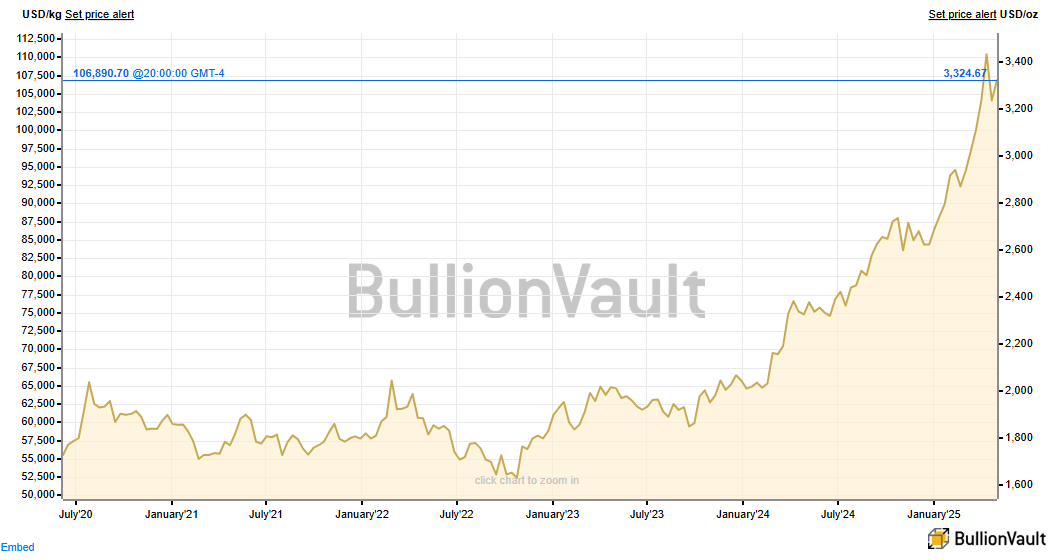
In April 2025, the gold market continued its unprecedented surge in physical deliveries from futures exchanges, signaling a significant shift in global financial dynamics. The COMEX reported the delivery of 64,514 gold contracts, equivalent to approximately 6.45 million ounces or $21.3 billion in value, marking the second-highest delivery volume on record.

The CME Comex is a key marketplace for trading futures in gold, silver, and other commodities, where contracts can also be converted into physical metal through delivery.

Typically, open contracts decline sharply before delivery starts, but this time, positions unexpectedly surged and were then largely cash-settled instead of delivered, raising speculation about potential behind-the-scenes shortages and high incentives for cash settlement. Despite this, demand for immediate delivery remained strong, with over 10,000 new contracts opened, the second-highest on record.

Concurrently, gold inventories have fallen since early April, possibly linked to these unusual settlements and subsequent physical withdrawals. Even with predictions that tariff changes would reduce arbitrage and slow gold flows from London to the U.S., demand for futures and physical deliveries remains robust as the market heads into May.

This extraordinary movement has prompted speculation about the underlying causes. Geopolitical tensions, such as the ongoing conflicts involving Russia and Ukraine, Iran and Israel, and the complex dynamics between India and Pakistan, have undoubtedly contributed to a heightened demand for safe-haven assets like gold. Additionally, the intensifying trade disputes between major economies have further fueled uncertainty, making gold an attractive option for preserving wealth.

However, beyond these immediate factors lies a more profound transformation in the global financial system. Since 2008ish, countries like Russia and China have been actively reducing their reliance on the U.S. dollar, a process known as de-dollarization. This trend has been accelerated by recent developments, including Saudi Arabia’s decision to settle oil transactions in currencies other than the dollar. Such moves indicate a collective shift towards a more diversified and resilient monetary framework.

In this excellent new interview, Luke Gromen argues that the current dollar-centric system is unsustainable due to escalating deficits and debt levels in the United States and suggests that transitioning to gold as a neutral reserve asset could facilitate a more balanced global economic structure. This approach would allow commodities to be priced in multiple currencies, reducing dependency on any single nation’s economic policies. This hour with Luke is a must listen.


🔥 70% OFF FOR LIFE: Using the below coupon gives you 70% off an annual subscription to Fringe Finance for as long as you wish to remain a subscriber. Your discount under this plan will never expire, but this offer is good only for today! Get 70% off forever


Gromen also notes that the conflict in Ukraine has exposed the limitations of conventional military strategies, emphasizing the need for economic tools to assert influence. By adopting gold as a reserve asset, nations can navigate geopolitical challenges without resorting to direct military confrontation, which is increasingly untenable in a world with nuclear capabilities and deeply interconnected economies.

The implications of such a shift are profound. The market revaluing gold to levels of $7,500 and even $10,000 per ounce could enable the U.S. Treasury to significantly bolster its financial position, should a shift take place. By adjusting the official price of its gold holdings, the Treasury could effectively generate $2 to $3 trillion in value, providing a substantial infusion into the Treasury General Account without increasing debt.

In this context, the massive gold deliveries observed in April may not be coincidental, Gromen notes. They could represent strategic moves by state actors, possibly including the U.S. itself, to prepare for a redefined monetary landscape.

The scale of these transactions suggests involvement at the highest levels, as such significant movements would typically attract regulatory scrutiny unless conducted by entities with sovereign authority.

It is starting to seem clear that as the global economy stands at the cusp of a potential monetary reset, the role of gold is being reevaluated. I can’t help but feel like I should continue to closely monitor these developments, as they may herald a new era in the architecture of global finance.

Something big could be in the works…


Now read:

QTR’s Disclaimer: Please read my full legal disclaimer on my About page hereThis post represents my opinions only. In addition, please understand I am an idiot and often get things wrong and lose money. I may own or transact in any names mentioned in this piece at any time without warning. Contributor posts and aggregated posts have been hand selected by me, have not been fact checked and are the opinions of their authors. They are either submitted to QTR by their author, reprinted under a Creative Commons license with my best effort to uphold what the license asks, or with the permission of the author.

This is not a recommendation to buy or sell any stocks or securities, just my opinions. I often lose money on positions I trade/invest in. I may add any name mentioned in this article and sell any name mentioned in this piece at any time, without further warning. None of this is a solicitation to buy or sell securities. I may or may not own names I write about and are watching. Sometimes I’m bullish without owning things, sometimes I’m bearish and do own things. Just assume my positions could be exactly the opposite of what you think they are just in case. If I’m long I could quickly be short and vice versa. I won’t update my positions. All positions can change immediately as soon as I publish this, with or without notice and at any point I can be long, short or neutral on any position. You are on your own. Do not make decisions based on my blog. I exist on the fringe. The publisher does not guarantee the accuracy or completeness of the information provided in this page. These are not the opinions of any of my employers, partners, or associates. I did my best to be honest about my disclosures but can’t guarantee I am right; I write these posts after a couple beers sometimes. I edit after my posts are published because I’m impatient and lazy, so if you see a typo, check back in a half hour. Also, I just straight up get shit wrong a lot. I mention it twice because it’s that important.

Tyler Durden
Sun, 05/11/2025 – 17:45

Hamas To Release American-Israeli Hostage As Goodwill Gesture To Trump

Hamas To Release American-Israeli Hostage As Goodwill Gesture To Trump

Israeli media is reporting Sunday that Israeli-American hostage Edan Alexander could be released by Hamas as early as Monday, after direct engagement between Hamas and Washington.

“After Hamas confirms that it will release Israeli hostage Edan Alexander, which it is reportedly doing as a gesture of goodwill to US President Donald Trump during his visit to the region this week, Israeli journalist Barak Ravid says US special envoy Steve Witkoff will arrive in Israel tomorrow to facilitate the process,” The Times of Israel reports.

Witkoff will “finalize the details ahead of the release of Edan Alexander, according to a source familiar with the matter,” Ravid wrote on X.

Donald Trump had previously been urged to use his influence to free Edan Alexander and the other hostages while meeting with victims’ families, via The Telegraph

Trump will travel to the region, stopping in the Gulf countries of Saudi Arabia, Qatar, and United Arab Emirates. Surprisingly, and apparently without official Israeli knowledge or input in behind-the-scenes US-Hamas diplomatic engagement on the issue, Hamas has formally confirmed the release is coming, but without saying exactly when.

Hamas announced Sunday that the decision to release Alexander comes after recent talks with US officials and “intensified efforts to achieve a ceasefire, open border crossings, and allow humanitarian aid into the Gaza Strip.”

Importantly, the Palestinian group which has warred against Israeli going back to the terror attack of Oct.7, 2023, has also said it is ready to resume intensified negotiations.

Hamas says it is ready to establish a mutually “agreed prisoner exchange, and enable Gaza to be administered by an independent professional authority.”

President Trump could be readying a big announcement on the prospect of Gaza peace as he gets ready to depart for the region in Air Force One.

All of this, interestingly enough, comes amid unverified reports of a new rift between Israeli Prime Minister Benjamin Netanyahu and Trump. While US Ambassador to Israel Mike Huckabee has denied the accuracy of the claims, the below widely circulated last week

President Trump has “cut contact” with Netanyahu, slamming the Israeli PM and his allies for acting “arrogant” and trying to push him around. Trump reportedly feels disrespected and manipulated by Netanyahu.

This new breakthrough where Hamas is willing to release the Israeli-American suggests that Israel may have been cut out of US-Palestinian talks.

If true, this would be a huge blow to Netanyahu. He’s facing growing domestic pushback, and accusations that he is intentionally prolonging the war, at the expense of the safety of the remaining living hostages.

*  *  *

Just a few hours before cutoff!

Steak Lover’s Bundle

Wagyu Grill-Out Bundle

80/20 Ground Beef

Tyler Durden
Sun, 05/11/2025 – 17:10