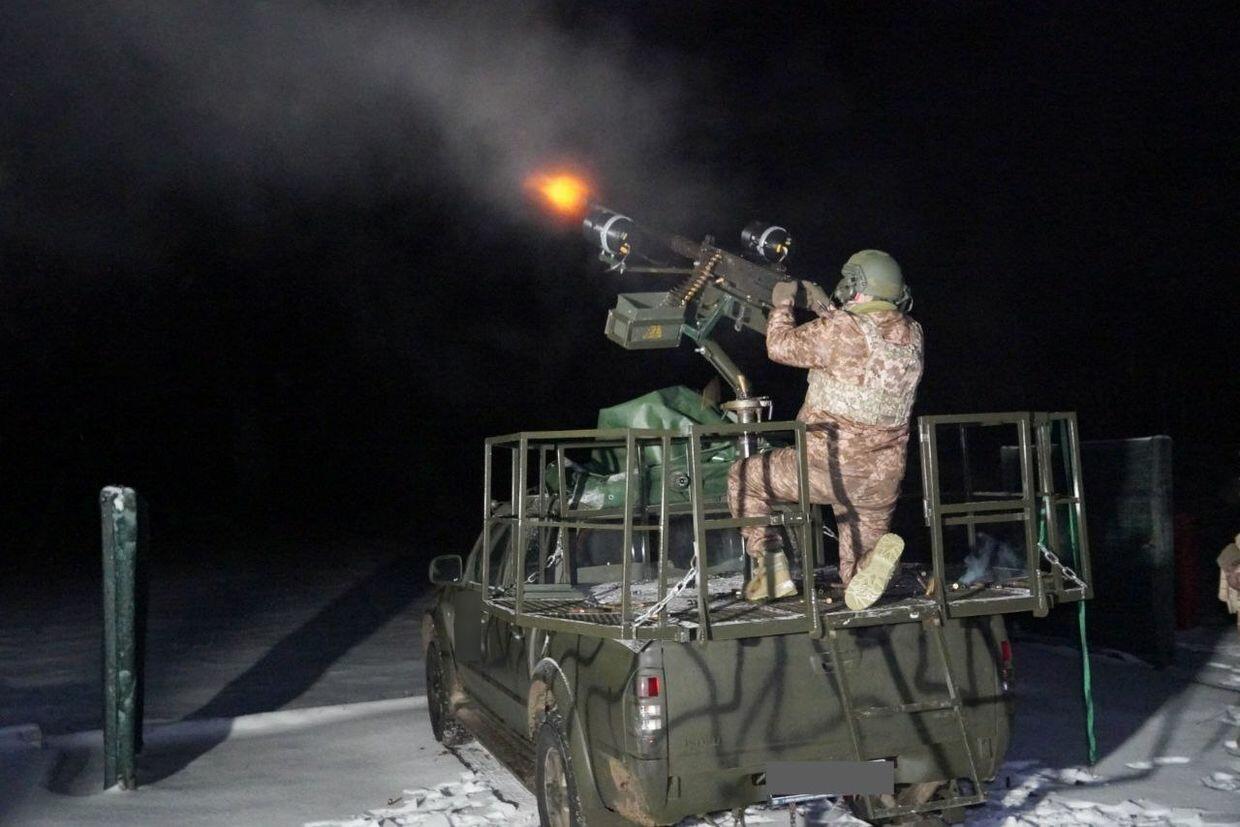
Russia, Ukraine Exchange Large-Scale Drone Fire Despite Plan For Istanbul Peace Talks
“Our top priority remains bringing an end to the fighting and an immediate ceasefire,” the State Department said Sunday concerning the war in Ukraine.
And yet the overnight exchanges of fire, especially drone attacks on a large scale, doesn’t suggest the warring sides are actually any closer to ceasefire, despite that over the weekend President Putin proposed negotiations in Istanbul on May 15, and Zelensky responded by saying he’s willing to fly to Turkey to meet with Putin “personally”.
“I hope that this time, Putin won’t be looking for excuses as to why he ‘can’t’ make it. We are ready to talk, to end this war,” Zelensky stated on X Sunday. “Thursday. Türkiye. President Trump has expressed support. All the leaders support this.”
Ukraine’s Air Force said early Monday that Russia launched dozens of drones across Ukraine overnight. A statement detailed that at least 108 UAVs were sent, which included mostly Iranian-made Shahed drones. “An additional 30 enemy decoy drones were lost due to location failure, with no negative consequences,” it sated.
The military said it intercepted 60 of the Iranian suicide drones across the eastern, northern, southern, and central regions of the country – which suggests many still hit their targets.
Emergency authorities indicated that at least 22 people were injured the attacks, along with damage in Odesa, Mykolaiv, Donetsk and Zhytomyr regions.
Things had been relatively quiet since Friday, given Moscow’s unilaterally declared 72-hour ceasefire in observance of WW2 Victory Day events, which went off without incident. Ukraine had seemed to hold to the ceasefire at least by not sending large numbers of drones on Russia, as was the case last week in the days leading up to Friday.
Also, the leaders of Britain, France, Germany and Poland were in Kiev Sunday for solidarity and talks with Ukrainian President Volodymyr Zelensky. European leaders urged a show of support to Zelensky at a moment some 29 world leaders were in Moscow for the Red Square V-Day parade, including China’s Xi and Brazil’s Lula.
Ukraine and its backers, the United States among them, want an immediate 30-day ceasefire. President Trump is turning up the pressure and expressing frustration with the slowness of dialogue.
“President Putin of Russia doesn’t want to have a Cease Fire Agreement with Ukraine, but rather wants to meet on Thursday in Turkey to negotiate a possible end to the BLOODBATH,” Trump wrote Sunday on his Truth Social platform.
He insisted that Putin and Zelensky should meet directly, even they prove not yet ready to reach any level of compromise. “At least they will be able to determine whether or not a deal is possible, and if it is not, European leaders, and the U.S., will know where everything stands, and can proceed accordingly!” -Trump wrote.
Meanwhile, drones didn’t just go one way overnight, but Russian officials in southern border regions say Ukrainian forces launched multiple drone and missile attacks on Belgorod and Kursk oblasts, resulting in injuries to civilians and damaged property and infrstructure.
A missile hit the town of Rylsk in Kursk Region on Sunday, the region’s governor reported. “Two men suffered serious shrapnel wounds to the head and arms, as well as bone fractures – they are in critical condition. A woman received shrapnel wounds to the forearm and thigh, but her life is not in danger,” regional head Aleksandr Khinshtein has been quoted as describing.
Additionally Belgorod Governor Vyacheslav Gladkov said of a Ukrainian drone assault, “One woman was injured when a first-person view (FPV) drone struck her moving car on the Krasny Oktyabr-Bessonovka road.”
As for Putin’s declared V-Day ceasefire, Moscow is still alleging that Ukraine broke it. “During Russian President Vladimir Putin’s unilaterally declared Victory Day truce from May 8 to May 11, Ukrainian forces attempted five cross-border incursions into Belgorod and Kursk regions, all of which failed, according to Russian officials,” Russian media writes.
It would be interesting to at least see what comes of the proposed direct Istanbul talks. President Putin is unlikely to go in person, despite the ‘challenge’ to do so from Zelensky, who is seeking to demonstrate to the White House that Kiev is ready and willing for peace. But we could at least see the two warring sides’ negotiating teams meet in Turkey, which would in and of itself be some level of progress.
U.S., China Reach Agreement To Lower Tariffs In 90-Day Cool-Off Period
China and the U.S. moved to ease trade tensions early Monday, agreeing to a temporary 90-day reduction in reciprocal tariffs on each other’s goods, according to a joint statement released by both governments on X. The accord, viewed as a breakthrough in a multi-month trade war between the world’s two largest economies, helped spark a rally in global markets: S&P 500 futures rose 3%, while Nasdaq futures gained 4%. European markets also advanced, and the U.S. dollar strengthened. U.S. government bonds sold as investors rotated back into equities and other risk-sensitive assets.
— Rapid Response 47 (@RapidResponse47) May 12, 2025
The joint statement said that the U.S. will reduce levies on most Chinese imports from 145% to 30% by Wednesday.
Here’s a summary of the U.S. actions:
The United States will remove the additional tariffs it imposed on China on April 8 and April 9, 2025, but will retain all duties imposed on China prior to April 2, 2025, including Section 301 tariffs, Section 232 tariffs, tariffs imposed in response to the fentanyl national emergency invoked pursuant to the International Emergency Economic Powers Act, and Most Favored Nation tariffs.
The United States will suspend its 34% reciprocal tariff imposed on April 2, 2025 for 90 days, but retain a 10% tariff during the period of the pause.
The 10% tariff continues to set a fair baseline that encourages domestic production, strengthens our supply chains and ensures that American trade policy supports American workers first, instead of undercutting them.
By imposing reciprocal tariffs, President Trump is ensuring our trade policy works for the American economy, addresses our national emergency brought on by our growing and persistent trade deficit, and levels the playing field for American workers and producers.
Unlike previous administrations, President Trump took a tough, uncompromising stance on China to protect American interests and stop unfair trade practices.
The breakthrough in the talks also led to China reducing its 125% tariff on U.S. goods to 10%.
Here’s a summary of the Chinese actions:
China will remove the retaliatory tariffs it announced since April 4, 2025, and will also suspend or remove the non-tariff countermeasures taken against the United States since April 2, 2025.
China will also suspend its initial 34% tariff on the United States it announced on April 4, 2025 for 90 days, but will retain a 10% tariff during the period of the pause.
The joint statement indicated that Monday’s agreement would pave the way for further negotiations between senior officials. On the U.S. side, talks are being led by Treasury Secretary Scott Bessent and Trade Representative Jamieson Greer, while Vice Premier He Lifeng will represent China…
After taking the aforementioned actions, the Parties will establish a mechanism to continue discussions about economic and trade relations. The representative from the Chinese side for these discussions will be He Lifeng, Vice Premier of the State Council, and the representatives from the U.S. side will be Scott Bessent, Secretary of the Treasury, and Jamieson Greer, United States Trade Representative. These discussions may be conducted alternately in China and the United States, or a third country upon agreement of the Parties. As required, the two sides may conduct working-level consultations on relevant economic and trade issues.
The White House wrote on X that these trade talks will address America’s trade imbalances:
The U.S. goods trade deficit with China was $295.4 billion in 2024—the largest with any trading partner.
Today’s agreement works toward addressing these imbalances to deliver real, lasting benefits to American workers, famers, and businesses.
The talks also addressed the ongoing fentanyl crisis.
The United States and China will take aggressive actions to stem the flow of fentanyl and other precursors from China to illicit drug producers in North America.
— Rapid Response 47 (@RapidResponse47) May 12, 2025
Shortly after the joint statement was released, Bessent, who led the American delegation at the talks, told reporters in Geneva that both sides have “substantially moved down the tariff levels” and “neither side wants a decoupling.”
“We had a very robust and productive discussion on steps forward on fentanyl,” Bessent added, pointing out that those talks might lead to “purchasing agreements” by China.
.@SecScottBessent: “We have reached an agreement on a 90-day pause and substantially moved down the tariff levels — both sides, on the reciprocal tariffs, will move their tariffs down 115%.” pic.twitter.com/Jxdd11U83s
— Rapid Response 47 (@RapidResponse47) May 12, 2025
Commenting on markets, Benedicte Lowe, an equity and derivatives strategist at BNP Paribas Markets 360, told Bloomberg TV that “deescalation was much better than expected by the market” and “for the next couple of days I would expect a bullish environment in the global equity market.”
Last week, President Trump floated the “80% Tariff on China seems right!” trial balloon on Truth Social, noting that the final decision rests with Bessent.
“In our view, equity markets are returning to where they would have moved to if Liberation Day had not happened and Trump had just applied the 10% universal tariff,” said Roberto Scholtes, head of strategy at Singular Bank.
Scholtes noted, “Corporate fundamentals are healthy, first quarter results have substantially surprised on the upside, and there’s plenty of cash to be invested.”
“This deescalation is much more positive than anticipated (GSe: 54% U.S. on China tariffs and 34% China on U.S. tariffs) and the market is reacting as such. We are seeing a clear reversal in short USD positions as U.S. recession risks reduce (GSe was 45%!) and risk-on sentiment rises. DXY rallied over 1%, S&P futures surged 3%, 10y UST rose to 4.43%, gold tumbled ~3%,” Goldman analyst Yichin Tsai told clients.
S&P 500 futures are up 3%, and Nasdaq futures are up 4%. European stocks are in the green.
The move toward lower tariffs and easing trade tensions between the world’s two largest economies follows Sunday’s negotiations, during which both sides reported making “substantial progress.”
The Border Patrol posted footage of a massive processing facility on the southern border that has been dismantled, but just a few months ago was heaving with thousands of illegal aliens, proving conclusively that the flow could have been stopped at any time.
The videos show the huge area in Texas previously manned by the Del Rio sector teeming with activity in December 2023, then sitting virtually unused in February 2025, before being taken down and removed earlier this month, leaving just an empty field.
Since Trump took office encounters of illegals at the U.S.-Mexico border have significantly decreased. Data indicates that in February 2025, Border Patrol arrested 8,300 migrants, the lowest monthly level since 2000. In March 2025, encounters dropped further to 7,000, the fewest since monthly records began in 2000.
In contrast, the peak of migrant encounters under President Joe Biden occurred in December 2023, with approximately 370,000 encounters, or about 12,000 per day.
This reflects a roughly 95% reduction in daily encounters under Trump’s initial months compared to Biden’s peak.
Additionally, “gotaways” (migrants not apprehended) have reportedly decreased significantly under Trump, with a daily average of 77 over a 21-day period in early 2025, compared to 1,837 daily under Biden in fiscal year 2023.
* * *
Your support is crucial in helping us defeat mass censorship. Please consider donating via Locals or check out our unique merch. Follow us on X @ModernityNews.
They ranked and scored states on three main benchmarks: financial education, financial planning (or consumer habits), and how Wallethub’s own users performed on their financial literacy survey.
ℹ️ These benchmarks are further subdivided into 17 metrics (credit score, savings, personal finance courses, etc.) and are weighted differently. Please read the source’s methodology section for a full breakdown.
The Most Financially Savvy U.S. State
Minnesota is the most financially literate U.S. state with 73 points, according to WalletHub’s latest analysis.
Here’s some sub indicators where Minnesota outperformed the rest of the country.
High-schoolers must take at least one personal finance program.
Only 15% of the surveyed Minnesotans spent more than they made—the lowest across all states.
Highest median credit score in the country (751).
And here’s how each state scores out of 100. Figures are rounded.
Rank
State
State Code
Total Score
(Out of 100)
1
Minnesota
MN
73
2
Colorado
CO
69
3
Nebraska
NE
69
4
Virginia
VA
69
5
Wisconsin
WI
68
6
New Hampshire
NH
68
7
Iowa
IA
67
8
Washington
WA
67
9
Vermont
VT
67
10
New Jersey
NJ
67
11
Maryland
MD
67
12
Florida
FL
66
13
Utah
UT
66
14
Pennsylvania
PA
65
15
Maine
ME
65
16
Michigan
MI
65
17
Oregon
OR
65
18
North Carolina
NC
65
19
Ohio
OH
65
20
Indiana
IN
65
21
Missouri
MO
65
22
Arizona
AZ
64
23
Massachusetts
MA
64
24
Kansas
KS
64
25
Connecticut
CT
64
26
Delaware
DE
64
27
North Dakota
ND
64
28
West Virginia
WV
63
29
Texas
TX
63
30
Idaho
ID
63
31
Rhode Island
RI
63
32
Illinois
IL
62
33
Georgia
GA
62
34
Wyoming
WY
62
35
New York
NY
61
36
Nevada
NV
61
37
South Carolina
SC
61
38
Montana
MT
60
39
New Mexico
NM
60
40
Alabama
AL
60
41
Hawaii
HI
60
42
District of Columbia
DC
58
43
California
CA
58
44
Alaska
AK
58
45
Louisiana
LA
58
46
Mississippi
MS
58
47
Tennessee
TN
58
48
Kentucky
KY
57
49
South Dakota
SD
56
50
Oklahoma
OK
54
51
Arkansas
AR
53
Meanwhile, Arkansas tested the worst, with 53 points. Its score is impacted by having the second-worst performance on WalletHub’s financial literacy survey.
And here’s each state’s rank within the three main benchmarks.
Rank
State
WalletLiteracy Rank
(50% Weight)
Financial Planning
Rank (25% Weight)
Financial Knowledge
Rank (25% Weight)
1
Minnesota
7
2
3
2
Colorado
8
1
20
3
Nebraska
9
25
6
4
Virginia
31
9
1
5
Wisconsin
14
6
14
6
New Hampshire
4
8
23
7
Iowa
10
27
15
8
Washington
12
3
30
9
Vermont
5
20
26
10
New Jersey
15
29
12
11
Maryland
13
11
22
12
Florida
37
16
9
13
Utah
47
10
2
14
Pennsylvania
26
23
17
15
Maine
1
28
40
16
Michigan
22
22
19
17
Oregon
46
21
4
18
North Carolina
35
37
8
19
Ohio
29
43
7
20
Indiana
33
40
10
21
Missouri
40
39
5
22
Arizona
18
33
25
23
Massachusetts
20
7
39
24
Kansas
11
35
35
25
Connecticut
50
5
11
26
Delaware
28
15
29
27
North Dakota
23
13
37
28
West Virginia
25
47
13
29
Texas
41
38
16
30
Idaho
39
19
28
31
Rhode Island
32
18
34
32
Illinois
27
32
33
33
Georgia
34
44
21
34
Wyoming
3
30
43
35
New York
24
17
42
36
Nevada
45
31
24
37
South Carolina
30
34
41
38
Montana
2
36
47
39
New Mexico
21
48
36
40
Alabama
44
42
27
41
Hawaii
19
12
48
42
District of Columbia
17
24
49
43
California
42
4
46
44
Alaska
6
14
51
45
Louisiana
43
49
32
46
Mississippi
36
51
31
47
Tennessee
49
41
38
48
Kentucky
51
45
18
49
South Dakota
16
26
50
50
Oklahoma
38
50
45
51
Arkansas
48
46
44
There’s some further insights to explain some noticeable geographic trends.
Colorado and Nebraska also require personal finance education in high school.
Kentucky, Oklahoma, and Arkansas have the lowest share of adults with emergency cash.
A higher share of Southern state residents borrow from non-bank lenders, affecting their financial planning score.
The Overlooked Part of Financial Literacy: Managing Debt
While investing in the markets is all the rage—particularly with the rise of no-fee platforms—WalletHub’s benchmarks prioritize an often overlooked part of money management: debt.
America’s credit card debt collectively crossed $1 trillion in 2023, and it’s only been growing since.
On average, American households have about $5,000 in outstanding credit card balances, which can take anywhere between one to two years to pay off depending on monthly incomes.
Of course, managing expenditures to avoid or reduce debt has been particularly difficult in the multiple years of post-pandemic inflation.
Renowned attorney Larry Klayman predicted on USAWatchdog.com that there would be full-blown, legal civil war happening in the court system. He also predicted that violence from the “rabid left” would not only increase but explode.
Klayman, founder of Judicial Watch and now Freedom Watch USA, says there are now more than 233 federal court cases trying to stop or delay President Trump and his Administration.
Klayman is here to update us on what is going on with the struggle America is having with the Deep State trying desperately to hold on to power. Let’s start with Joe Biden’s appearance last week on ABC’s “The View,” where he looked confused and incompetent. Can all of Biden’s last-minute pardons of criminals and J6 members who destroyed evidence be enforced or are they null and void as President Trump has declared? Klayman says,
“They are null and void and so is every other thing that was allegedly signed by him (Biden). He couldn’t even remember what he signed. . . . This is more than a scandal. It’s the worst scandal ever. Let me tell you something, Biden has not been abused as an elderly person. He abused the American people, and it’s much more than abuse. Biden committed treason.”
What about suspending “habeas corpus” as President Trump is thinking about doing to more quickly deport millions of illegal aliens?
Klayman says,
“He can do that in dire times, times of war. We are, in effect, in a war. We had drug traffickers, human traffickers, sex traffickers and terrorists running across our border in mass, over 10 million in the Biden Administration alone and many before that. So, yes, it’s a war-time situation, and he (President Trump) can suspend it. . . .Just get them the heck out of here. They are here illegally. They have no right to be here. The President should just ignore these edicts by these San Francisco judges and other judges . . . and do what he needs to do, and they can’t do anything.
You know the judiciary has no ability to enforce any ruling. It’s only the Executive Branch, President Trump’s branch that he sit’s over, can enforce the rule of law.
This President has been sued thus far . . . in places like San Francisco, Chicago, Boston, Seattle, Portland and other places where they know they are going to get a Leftist judge. Federal judges are supposed to be assigned randomly.
It’s like Wheel of Fortune, but that really does not happen. . . . They actually steer these cases. . . . We need to prosecute these judges and set up the Department of Judicial and Legal Accountability and work with President Trump.
I hope he will appoint me to head that with others that will come on board because we need some strong leadership right now because he’s sinking. He (Trump) has been enjoined 70% to 80% of the time in every Executive Order that he has issued.
This last one said Trump has no control over his departments anymore. There was a temporary restraining order that says you can’t cut workforce; you can’t do anything.”
Why all the attacks on President Trump? Klayman says
“They are attacking him because they hate him. . . . they are attacking him, and it’s all orchestrated. Washington is one giant, excuse the French, circle jerk. It’s a club.”
They are being sued by Loomer for falsely claiming she slept with President Trump. Klayman just deposed Maher and wants to release the video deposition. Maher’s lawyers have so far blocked that. Klayman says, “They are fighting tooth and nail to keep the video of Bill Maher secret so it can never be seen...”
“Look at the hypocrisy. Laura Loomer gets defamed by Bill Maher, and the court has already denied a motion to dismiss . . . She gets smeared all over the world, defamed that she had sex with the President behind the back of Melania. . . . Loomer’s reputation gets harmed, and this harms her financially . . . You can smear a woman and . . . . If President Clinton can have his deposition released, who is Bill Maher that he should be protected? Maher gave money to Kamela Harris as a political candidate. That’s why Maher went after Loomer, because she was a way to get to Trump.”
In closing, Klayman has a warning:
“Pro Hamas demonstrators are busting up campuses threatening Jews and Christians, we see that. We see Hakeem Jefferies the Minority Leader in the House, and Ilhan Omar, Rashita Tlaib, AOC and Bernie Sanders whipping up violence along with Jasmine Crockett, and they are calling for violence.”
Are we headed for a civil war?
Klaman says, “I believe we are.”
There is more in the 56-minute interview.
Join Greg Hunter of USAWatchdog.com as he goes One-on-One with renowned lawyer and government corruption fighter, Larry Klayman, founder of FreedomWatchUSA.org, as he rolls out a new organization to help Trump and the DOJ with his newly created Department of Judicial and Legal Accountability (DOLA) for 5.10.25.
Pentagon Orders Purge of DEI-Themed Books In Latest Blow To Wokes
In the Trump administration’s latest blow to the wokes, the Pentagon on Friday instructed military leaders to conduct a sweeping review of all library materials across bases and academies, with orders to remove any books promoting what the Department of Defense deemed “divisive concepts and gender ideology.”
According to internal memos reviewed by the Associated Press, commanders were told to “promptly identify” and withdraw any material that conflicts with the military’s core mission, with a deadline of May 21 to complete the review. The directive comes amid a broader reorientation of the military’s cultural and educational standards under Defense Secretary Pete Hegseth, a prominent critic of DEI programming.
In a separate memo issued the same day, the Pentagon informed the nation’s military academies – including West Point and the U.S. Naval Academy – that race, ethnicity, and sex should no longer factor into admissions decisions. Instead, selections must be based solely on merit, though the department left room for “unique athletic talent” to be considered.
The moves follow a January pledge by Secretary Hegseth to “purge DEI from the Pentagon,” arguing that the emphasis on diversity undermines military readiness. “Our diversity is our strength,” he said at the time, “is the single dumbest phrase in military history.”
As part of the book review, libraries are instructed to flag materials using search terms such as “affirmative action,” “anti-racism,” “critical race theory,” and “white privilege.” Already, the Naval Academy has removed nearly 400 titles, including Maya Angelou’s I Know Why the Caged Bird Sings, novels by Palestinian American author Etaf Rum, and various academic texts on race and gender.
To coordinate the ongoing review, the Pentagon is establishing a temporary “academic libraries committee” to assist other military colleges and institutions in identifying and removing similar materials.
The book bans extend beyond college libraries to K–12 schools on U.S. military bases worldwide. The Department of Defense Education Activity (DoDEA), which oversees these schools, has issued a list of prohibited children’s books, many of which include LGBTQ+ themes or explore racial identity.
Since the beginning of 2025, the federal government has seen what experts describe as a wholesale dismantling of DEI-related roles and programs. While no formal count has been released, estimates suggest that hundreds – if not thousands – of DEI personnel across federal agencies have been dismissed or reassigned.
The Pentagon’s directives are the latest in a series of actions that signal the Trump administration’s broader goal of reshaping federal institutions around “mission-first” principles, removing considerations of identity from official policy and practice.
JOHANNESBURG—Diplomats and officials from several leading African economies say the United States and China are pressuring them to make an “impossible choice,” as the superpowers fight a trade war that threatens to erode weak economies further.
Senior members of African governments, including those of South Africa, Egypt, Kenya and Nigeria, said Beijing has warned them it will retaliate against countries that sign trade agreements with the United States “at China’s expense.”
U.S. trade partners, including many from Africa, are currently negotiating with President Donald Trump’s administration following his global tariff announcement on April 2.
They’re trying to work out deals that could see the tariffs scrapped or lowered, depending on what they’re able to offer the White House.
Trump imposed some of the highest duties on African imports, ranging in some cases between 30 and 50 percent, arguing these are necessary to correct trade imbalances that take advantage of the United States.
He said the reciprocal tariffs will increase America’s competitive edge, protect its sovereignty, and strengthen its national and economic security.
But high taxes on their exports to the United States will cut billions of dollars from budgets already strained by high debt, inflation, the cost of industrializing, and the aftermath of the COVID-19 pandemic, said African nations.
Countries like Lesotho, hit with a tariff of 50 percent on its exports to the United States, which it said could destroy its textile industry, and South Africa (31 percent), have welcomed the chance to talk with the United States.
“But we know that if we do anything that is seen as appeasing Trump, it won’t go down well back east,” a government official in Pretoria told The Epoch Times, speaking anonymously because he didn’t have permission to speak with the media.
“We’re playing a delicate game here,” he said. “Because of Trump’s tariffs and the economic hardship they’re going to cause us, we’re trying to form new trade partnerships, but we know China is not going to be happy with some of those partnerships, especially if we move economically closer to their biggest enemy. Part of our strategy is to do even more trade with China, but then Trump is going to see that as a betrayal. We cannot win. It’s an impossible choice.”
Kenyan and Nigerian diplomats, who requested anonymity for the same reason, said Chinese officials had warned their governments not to give in to what Beijing has described as “bullying” by the Trump administration.
The Nigerian envoy told The Epoch Times that “the Chinese made it clear they expect Africans to be on their side” in this trade war.
“They said their government will strike back against anyone that signs anything with the United States that hurts [Beijing],” the Nigerian official said.
China’s Ministry of Commerce recently issued a statement in a vein similar to the comments made by the African officials.
“China firmly opposes any party reaching a deal at the expense of China’s interests,” the ministry said. “If this happens, China will never accept it and will resolutely take countermeasures in a reciprocal manner.”
Ina Gouws, political scientist at the University of Free State in South Africa, told The Epoch Times that China’s threat to retaliate has brought African countries to a “crossroads.”
“We now have the world’s two biggest economic powers involving the rest of the world, and particularly Africa, where China has held sway for decades, in their spectacular trade war,” she said. “What does Africa now do? It can’t please two masters. African countries cannot afford to lose trade with either America or China. They have always been adamant that they need trade with both. But Trump and [Chinese leader] Xi [Jinping] have forced them into a corner, and there seems to be no good way out of this for Africa.”
Russia Considered The Biggest Threat To Peace In Europe
After decades of relative peace in Europe following the end of World War II, with a few notable exceptions, Russia’s invasion of Ukraine served as a stark reminder that the specter of war is still alive. Within a few days in February 2022, millions of lives were turned upside down and Europe’s sense of safety was deeply rattled.
As Statista’s Felix Richter notes,the longer the war dragged on, the more aware Europeans became of the looming threat that Putin’s Russia poses to European peace, especially after Donald Trump was re-elected and immediately threatened to withdraw support for Ukraine and questioned the U.S. commitment to NATO, which had effectively shielded Western Europe from Russian aggression for decades.
According to a new YouGov survey, many Europeans even consider World War III a possibility, with at least 30 percent of respondents in France, Spain, Italy, Germany and the UK saying that it’s very or fairly likely that there will be another world war in the next 5-10 years.
With respect to Europe, tensions with Russia are seen as the biggest threat by far.
Around 50 percent of respondents from Germany, France and the UK said that Russia poses a major threat to peace in Europe, while tensions between Europe and the U.S. and between European nations are not perceived as an imminent threat.
It is this feeling of insecurity that has given Europe’s politicians the mandate to ramp up defense spending in an unprecedented fashion.
Aside from national defense budgets rising steeply, the European Commission is also working on ways to improve European security and limiting the continent’s historical reliance on the United States.
Victor Davis Hanson opened with a warning… and it wasn’t subtle…
This week, Germany’s only major right-wing opposition party, Alternative for Germany (AfD), was officially labeled an “extremist” group by the country’s domestic intelligence agency, the BfV.
The designation sent shockwaves through the political landscape.
AfD immediately challenged it in court, prompting the agency to suspend enforcement while litigation proceeds.
But the damage, Hanson said, has already been done.
This move, he argued, wasn’t about public safety—it was about political control.
“Recently, the German government announced that it is going to label or maybe relabel the Alternative for Deutschland,” Hanson explained.
“The conservative party that has an antithetical agenda both to the German government of both liberal and conservative factions, but also to the EU in general.”
He said the classification ensures AfD will remain on the outside of political power, regardless of how many people support them.
“It will cement this aura that no government under their parliamentary democracy system will ask them to join to form a majority government,” Hanson said.
“So the process of ostracism and demonization of this party continues.”
And for what? The real issue, he said, is that AfD simply offers a different vision.
“The party is advocating an alternative for the way that Germany is going.”
Victor Davis Hanson opened with a warning—and it wasn’t subtle.
This week, Germany’s only major right-wing opposition party, Alternative for Germany (AfD), was officially labeled an “extremist” group by the country’s domestic intelligence agency, the BfV.
Hanson painted a bleak picture—of economic decline, energy failure, and political denial.
“If you look at what has become of Germany,” he said, “it has had two years of essentially no growth or negative growth.”
He noted the country finally reached its long-delayed NATO defense spending goal, pledging 2% of GDP—something it was supposed to do back in 2014.
But the milestone felt more like a bare-minimum box-check than a serious turning point.
“It just barely did it,” Hanson said.
Meanwhile, Germany has doubled down on green energy while dismantling its nuclear infrastructure, despite the country’s climate not being suited for solar reliance.
The results have been catastrophic.
German electricity costs are now roughly four times higher than those in the United States.
And that’s not just hitting households—it’s pushing away manufacturers and investors who can no longer justify doing business in the country.
“You can see what that’s going to do to German investment,” Hanson warned.
So where is Germany going?
Hanson painted a bleak picture—of economic decline, energy failure, and political denial.
“If you look at what has become of Germany,” he said, “it has had two years of essentially no growth or negative growth.”
The problems aren’t limited to energy and economics.
Hanson pointed to a deeper crisis—one that strikes at the heart of Germany’s identity.
Open borders and mass migration, largely from the Middle East, has dramatically reshaped the population.
And according to Hanson, the consequences are both cultural and existential.
He estimated that 16 to 18 percent of Germany’s population wasn’t born in the country and has not assimilated.
“These are refugees—or I don’t think they’re refugees,” he said.
“They’re illegal immigrants from the volatile Middle East. Most of them are Muslim. Most of them do not have an intention of assimilating, intermarrying, and integrating fully in German society.”
The government’s refusal to address this, he said, has allowed a demographic transformation to unfold without public debate or accountability.
And that’s a far cry from the Germany that once held Europe together.
“For years, Germany was the powerhouse, the cohesive economic power that kept the EU together,” Hanson recalled. “It’s very tragic.”
Even the German military—a former pillar of NATO—is now little more than a shell.
“During the Cold War, it fielded one of the best NATO armies… well over 400,000 troops,” he said.
“It’s almost literally disarmed.”
The problems aren’t limited to energy and economics.
Hanson pointed to a deeper crisis—one that strikes at the heart of Germany’s identity.
Open borders and mass migration, largely from the Middle East, has dramatically reshaped the population.
In a functioning democracy, Hanson argued, this kind of failure would trigger a national reckoning.
There would be debate. Conflict. Reform. Politicians and citizens would argue over energy, borders, military policy, and economic growth. They’d hash it out—then find consensus.
Germany would close its borders. Demand full assimilation. Return to reliable energy. And reassert itself on the global stage.
That’s what you’d expect in a healthy system.
But instead of debating those solutions, the one party calling for them is silenced.
“They would do all of that,” Hanson said. “But instead, when one party is advocating much of what I just talked about, they demonize it because it’s out of the norm.”
Then came the most chilling line of all:
“And the norm, unfortunately in Germany today, is national suicide.”
For Hanson, this isn’t just a German issue.
The collapse of a once-great Western democracy—economically, militarily, and culturally—will have ripple effects far beyond Europe.
“Unfortunately, this is not going to end well for Germany,” he concluded.
“And it’s not going to end well for us. We need a powerful, friendly Germany and we wish it well.”
“But the reaction to needed reform—economic, political, social, cultural, military, diplomatic—is not to essentially ban a political party’s freedom of expression. That shows weakness and fear rather than confidence in the future.”
In a functioning democracy, Hanson argued, this kind of failure would trigger a national reckoning.
There would be debate. Conflict. Reform. Politicians and citizens would argue over energy, borders, military policy, and economic growth. They’d hash it out—then find consensus.… pic.twitter.com/uBQDfbMmzd
It was about one month ago, when as stocks tumbled, economists rushed to catch down to the sliding market by doing what they do best: chasing prices (in this case lower) by slashing their economic forecasts (most notably Goldman Sachs) a move which we mocked at the time, and correctly predicted it would be about a month before these same economists made an “unrecession” their base case once stocks rebounded.
Will be so slightly awkward when all the banks who made a recession their base case this week, make an unrecession their base case in 1 month.
It took less than a month for this forecast to come true, and now that stocks have erased all of their post Liberation Day losses, one of the most closely followed people on Wall Street, Goldman’s chief economist Jan Hatzius, said on CNBC on May 2 – just weeks after declaring that a recession was his base case for 90 minutes – that “The most recent information is certainly consistent with the economy not going through a recession right now”.
Of course, the concurrent surge in the Atlanta Fed real-time GDP tracker from -3% (which was dead wrong to where Q1 GDP actually printed) to +2.4% in Q2, only cemented a non-recession base case…
… because the technical definition of a recession – two consecutive negative quarters – meant that with Q2 GDP set to print well in the green, the earliest the US could be declared to be in an official recession was some time in early 2026 when the Q4 2025 GDP number would come out.
This was devastating to the liberal wing of the economic profession, not to mention the mainstream media, all of whom had decided that a Trump recession was imminent, and so they had to pivot to something else that would trigger a daily doom and gloom narrative.
That something was the hypothesis that with trade war between the US and China raging, it was only a matter of time before west coast ports were empty, as no Chinese containerships would come to the US, and the result would be a covid-like panic scramble for products (remember the legendary toilet paper runs) amid a historic inventory destocking.
It was as if the media turned on a dime, and with the “looming recession” narrative suddenly left in the dust, it was instead replaced with story after story about the looming port crisis that would, gasp, result in covid-like empty shelves everywhere across America!
But that was just the beginning, because the liberal media was only just starting its fearmongering campaign to get Americans to panic and to rush out and start stockpiling toilet paper once again. In other words, the “independent press” was hoping to cause the very catastrophic outcome it was “warning” about.
Nowhere was this more evident than on MSNBC where anchor and former Deutsche Bank bond salesman, Stephanie Ruhle, no longer an expert intimately familiar with Under Armor (and especially its CEO), but now a full-blown trade guru, declared that “Donald Trump has been told look at the cargo ships coming in to Seattle, the port of Los Angeles, pick the port. Those ports are getting fewer and fewer ships with less and less cargo. And unless he turns this around, three weeks from now, you walk into a store and we’re going to have a covid-like supply chain crisis, and Trump is looking for an exit.”
“Unless he turns this around, three weeks from now, you walk into a store and we’re going to have a covid-like supply chain crisis, and Trump is looking for an exit” — here’s the @SRuhle commentary that triggered a Trump Truth Social meltdown pic.twitter.com/hzmP9uGTqu
… an article written by CNN’s Business and Politics correspondent, Vanessa Yurkevich, who like MSNBC’s Ruhle above, is now a full-blown expert on naval commerce and logistics as a quick scan of her latest articles reveals.
So up until this point we had stayed away from this idiotic discussion, which merely demonstrated how little understanding so-called experts actually have of a nuanced and complicated topic as trade and global commerce.
However, CNN’s idiocy was the last straw.
But before we go there, a quick look at what has been really taking place.
First, regarding the claim that west coast ports have seen a sharp drop in inbound traffic, there certainly has been a modest decline in February and March inbound traffic, but a decline from a near-record print in January, which in turn was the result of inventory restocking ahead of what most retailers knew would be a trade war. After all, Trump had made it clear about a year ago that he had every intention of restarting trade war with the world, and especially China, and only someone watching CNN would be surprised by the recent sharp spike in tariffs, a move which incidentally was never meant to be permanent but was a strategy meant to inflict max pain and get trading partners to the negotiating table. In any case, the total inbound traffic to California ports shown below is hardly the apocalypse the liberal media has been making it out to be (and even Reuters discusses this in “Near-record US container import streak expected to snap in May due to tariffs“).
Then, addressing the topic of imminent product shortages, this was another fake news narrative meant to spark panic and chaos, and resulting in just the outcome the media was “warning” about. Because if it hurts Trump, it’s great for MSNBC and CNN… and of course China, which begs the question: just how much “ad dollars” and/or sponsorship have these media outlets received from Beijing and Chinese companies in recent months. As the following charts from Deutsche Bank demonstrate clearly, what has been taking place in recent months – and why we are now seeing the reverse – is record prebuying and excess imports…
… which according to Deutsche Bank has led to precisely the opposite outcome than the one MSNBC and CNN have been blasting: there is excess inventory in the supply channel, enough in fact to last weeks if not months, assuming a full-blown collapse in global trade, which of course would never happen absent a covid-like shock.
Additionally, if and when retailers end up liquidating these billions in excess inventories they have accumulated just for this contingency, the outcome would be wildly deflationary, and hardly the inflationary shock so many “experts” predict (that’s the topic of another post, and we’ll get to it eventually).
Going back to the media’s favorite topic of dropping cargoes from China, it wasn’t just us that countered the popular narrative: so did Standard Chartered’s Steve Englander who wrote last week that “the lurid headlines on the drop in cargoes from China may be misleading.” That’s because as we noted above, the volume of laden cargo now being shipped from China to the US is down almost 50% versus mid-April 2025, but the mid-April level was very high, and while you will never hear this on CNN, the current level is about on a par with much of 2023. In fact, Englander said that “the current pace as the low end of normal over the last couple of years.” Again, hardly the apocalypse Kevin Plank’s favorite media body (we use the term loosely) portrays it to be.
There’s more: another thing you would never hear on MSNBC or CNN is that if the early-May pace of shipping to the US is maintained though end-June, the cumulative amount shipped in H1-2025 would be 18% higher than in H1-2023 and only 5% lower than in H1-2024. So far this year, the tonnage shipped to the US is 40% higher than in 2023 and 9% higher than in 2024. Indeed, as noted above, and as Englander observes, “US importers may have an inventory buffer until tariffs are negotiated downwards.”
Taking a step back, if only for the benefit of our CNN and MSNBC readers, the big picture is one that even if the US were to lose all Chinese imports – an outcome which nobody anticipates as it would destroy China’s economy as Reuters admitted last week – the outcome to the US would hardly be devastating. Yes, prices would rise, but overall the US would be able to handle it. Here, again, is Englander explaining why:
US imports from China are about 1.6% of US GDP in value terms. If inbound cargo stays at early-May levels, then H2-2025 imports will be 85% of 2023 levels (in volume terms) and 67% of 2024 levels. So the import volume shock would be 0.25% of GDP relative to 2023 and 0.5% relative to 2024. And keep in mind that there may be substitution from elsewhere. There may be temporary delays as US importers figure out the practicalities of dealing with the new tariffs, and shipping may be down temporarily because importers stocked up ahead of tariff implementation.
There is little precedent for this kind of tariff shock, but our judgement is that the US economy can handle it. We agree that disruption is likely from tariffs and that any benefits are uncertain, but we don’t think that the US economy will fall off a precipice because of a shock of this magnitude.
Remarkably, none of the so-called experts predicting doom and gloom in recent days spent even a minute to consider this eventuality. Which is also why the left’s attempt to spark widespread panic by focusing on Chinese imports had largely been a dud… and why it forced the media to escalate its claims to ever more ludicrous proportions, until we got the CNN story that there were “zero ships from China are bound for California’s top ports.”
And this is where we drew the line because it takes about a 10 second google search on any of the marine tracking websites such as Marine Traffic to find out this is total bullshit. And the fact that CNN didn’t even consider that not all of its readers are absolute idiots who would accept its lies with zero pushback, is what was most remarkable.
Below is a chart from Bloomberg showing all the Dry Cargo/Container ships that have recently left China, and are currently in the water, headed for Wast Coast ports.
According to Bloomberg, there are no less than 52 cargo ships currently sailing from China to California and the West Coast, with the full list shown below.
It goes without saying that 52 is quite different from the zero ships headed to the US, as CNN claims, and to put that number in context, here is what the average number of ships heading across from China to the US has been in 2025:
January 59 ships
February 56
March 55
April 55
And now May is 52. So that drop – from 55 to 52 – is supposed to be the looming covid-like apocalypse that the mainstream propaganda media is urging Americans to run to their local Walmart and stock up on several years worth of toilet paper?
But it gets worse for CNN, because while we can understand if they don’t have access to Bloomberg, or even google as a result of recent cuts in USAID funding, they could have just gone to the Port of Los Angeles website to look at the public Port Optimizer data which shows that contrary to fake narratives of collapsing global trade, the import volumes for the week of May 18-24 are up 19% from the previous week and up a whopping 56% from a year ago.
And another way of showing it: here is the total number of container ships sailing from China to the US (in TEUs). The number on May 11 is higher than where it was in 2024 and the same as May 2023. But you won’t hear any of that on CNN.
Instead, this is what you will hear on CNN:
“On Friday morning, West Coast port officials told CNN about a startling sight: Not a single cargo vessel had left China with goods for the two major West Coast ports in the past 12 hours. That hasn’t happened since the pandemic.”
Only this attempt to spark panic (while evoking the covid pandemic for obvious reasons) is also dead wrong: first, consider that there are currently 52 ships transiting the Pacific from China to SoCal, in line with historic numbers: the trip takes 20 days which means 2.6 ships sailing each day or one ship every 9 to 10 hours. So a 12 hour period is not unusual. And, as Sal Mercogliano points out, while no ships may have set sail for California on Friday, a quick look at Marine Traffic shows that three ships – Cosco Africa, Ever Safety and Ever Mild – are all leaving China for SoCal this weekend. So much for that “startling sight.”
6/The story said 41 ships were scheduled to sail, but on Friday it was zero. This does not mean the 41 are not sailing. A quick look @MarineTraffic finds COSCO AFRICA, EVER SAFETY and EVER MILD all leaving for SoCal this weekend. pic.twitter.com/t35J2I8XgL
— Sal Mercogliano (WGOW Shipping) 🚢⚓🐪🚒🏴☠️ (@mercoglianos) May 10, 2025
We could continue but you – unlike CNN – get the picture: transpacific trade may have slowed down, but it is nowhere near the full ground stop observed for a few weeks during covid, not even remotely close.
Meanwhile, the entire discussion about empty ports and empty shelves is completely moot because as Reuters reported even before the news of this weekend’s US-China trade talks breakthrough hit, “China-based shipping agents have resumed buying container space for goods headed for the United States after a series of U.S. tariff-induced cancellations, as Beijing and Washington head for trade talks in Switzerland.”
And here is Reuters confirming what we said several days ago: “Since late April, however, traders have stepped up buying of shipping capacity, locking in space from mid-May, according to two China-based executives with freight forwarding firms.”
Or precisely what we said a week ago.
Ships sailing from China to US hits 2 week high. But Long Beach was supposed to be a ghost port pic.twitter.com/T2Jdi8eJx1
And remarkably, and contrary to anything you may hear on CNN or MSNBC, shipping from China to the US is actually set for another surge! According to Dominic Desmarais, chief solutions officer at Liya Solutions which connects small and medium-sized companies with suppliers in China making everything from furniture to titanium products, prices could go up by $500 per container after May 15 as shipping activity recovers.
So much for CNN’s fake news.
We’ll leave readers with another far more critical discussion topic, namely whether tariffs lead to inflation, something about which we will have more to say in the coming days since this has become a focal point of much economic debate in recent months, not just in the political arena but also inside the Fed.
And while Fed Chair Powell appears to be very “confused” once again, claiming that tariffs are inflationary with the same erroneous conviction he previously argued “inflation was transitory” – we will instead point you to the recent work of Javier Bianchi, senior research economist at the Federal Reserve Bank of Minneapolis, who thinks tariffs are not just a negative supply shock, but also a negative demand shock, and argues that the optimal monetary policy response to tariffs – which lead not to inflation but threaten recession – is to cut rates. For much more on this critical issue read “Under a stiff tariff, boosting the economy takes priority over inflation for a central bank“, something we are 100% certain neither CNN or MSNBC will ever do.