59.9 F
Chicago
Tuesday, September 22, 2026
Home Blog Page 1622

Deutsche Bank: Tariff Burden In Auto Industry Will Be Shared, Just As It Was During COVID

Deutsche Bank: Tariff Burden In Auto Industry Will Be Shared, Just As It Was During COVID

Deutsche Bank said in a note late last week that the directional takeaways they had for the auto industry going forward were “relatively unchanged” and the firm shared detail on where it believes tariff impact will land.

In an analysis covering virtually every model sold in the U.S., the bank did warn however that the fallout from protectionist policy won’t be limited to foreign automakers—it will ripple through the entire automotive ecosystem, from suppliers to consumers.

According to Deutsche, the cost of new tariffs will be shared across multiple layers: original equipment manufacturers (OEMs), end consumers, dealers, and Tier-1 suppliers. While the bank initially assumed certain components might be spared, updated federal documents now suggest otherwise.

“All parts of the vehicle (including tires) are subject to tariffs,” the report states, walking back earlier assumptions that components like seats and airbags might be excluded.

This expanded scope increases cost exposure, especially as non-U.S. content appears more embedded in vehicle production than previously assumed. Even automakers like Ford, which are relatively well-positioned, source a significant portion of engine parts from Mexico (25%) and Canada (15%).

In the short term, automakers are expected to make tactical adjustments—reallocating production within U.S. plants, running extra shifts, and avoiding large capital expenditures. There’s also an expectation that OEMs may have to absorb some supplier costs, much like during the COVID-era supply chain crunch.

Deutsche Bank notes, “OEMs will need to step in and absorb the tariffs for some suppliers… similar to the dynamics during COVID.”

Longer term, the bank sees a potential wave of announcements around onshoring, especially as companies seek political goodwill with the current administration. However, such structural changes—relocating supply chains, building new factories, and hiring en masse—could take years to materialize, especially in a politically uncertain environment.

The real kicker may be on the consumer side. The average transaction price (ATP) of vehicles is expected to rise, with buyers absorbing part of the tariff cost directly. Deutsche Bank has already lowered its 2025 U.S. sales forecast (SAAR) to 15.4 million units, and warns demand could slide further in the second half of the year if price pressures intensify.

In terms of automaker exposure, Tesla and Ford are seen as better positioned, thanks to their North American sourcing and assembly footprint. GM and Stellantis face moderate impacts, though Stellantis benefits from U.S.-sourced parts despite more assembly in Mexico. Hyundai is expected to be among the hardest hit due to its supply chain configuration.

Deutsche Bank’s analysis suggests tariff execution has a chance to backfire—raising costs, squeezing margins, and hitting consumers already grappling with elevated car prices.

As the bank puts it, “The burden of tariffs will be shared”—just not evenly, and certainly not painlessly.

“Our conclusions have not directionally changed but we do think the scope of impact is larger both at a macro (consumer now needs to absorb potentially a barrage of tariffs beyond autos) and micro level (non-US content appears higher than initially expected).”

Tyler Durden
Mon, 04/07/2025 – 02:45

The EU’s Military-Industrial Plans Could Accelerate The US’ Disengagement From NATO

The EU’s Military-Industrial Plans Could Accelerate The US’ Disengagement From NATO

Authored by Andrew Korybko via substack,

Interoperability issues could make the US think twice about intervening in the EU’s support against Russia…

Trump Is Unlikely To Pull All US Troops Out Of Central Europe Or Abandon NATO’s Article 5”, but he’s definitely “Pivoting (back) to Asia” in order to more muscularly contain China, which will have consequences for European security. Although Russia has no intent to attack NATO countries, many of these same countries sincerely fear that it does, which leads to them formulating policy appropriately. This (false) threat perception heightens their concerns about the US’ gradual disengagement from NATO.

To make matters worse, Reuters cited five unnamed sources to report that the US chided the EU for its military-industrial plans, particularly those which relate to production and procurement within the bloc. They’re presumably connected to European Commission President Ursula Von der Leyen’s “ReArm Europe Plan” that calls for members to boost defense spending by 1.5% on average for a collective €650 billion more in the next four years and provide €150 billion worth of loans for defense investments.

This bold program will strengthen the EU’s strategic autonomy but will likely come at the cost of accelerating the US’ disengagement from NATO. EU-produced equipment might not be interoperable with American equipment, which could complicate contingency planning. The bloc wants the US to intervene in the event of a military crisis with Russia, yet the US might think twice if its commanders can’t easily take control of European forces in that event.

The US might also be less likely to do so if the EU reduces its reliance on American equipment like the F-35s that are rumored to have “kill-switches”. These could hypothetically be activated if the EU tried provoking a conflict with Russia that the US didn’t approve of for whatever reason. If the EU becomes emboldened to do precisely that and thus becomes a major strategic liability for the US, then the odds of the US intervening in its support would dwindle, thus leading to a self-fulfilling prophecy.

At the same time, some countries like the Baltic States, Poland, and Romania – which occupy NATO’s strategic eastern flank with Russia, Belarus, and Ukraine and are much more pro-American than their Western European counterparts – will likely remain within the US’ military-industrial ecosystem. This could therefore serve to retain American influence along the EU’s periphery, keep those countries out of the bloc’s military-industrial ecosystem, and thus hamstring plans for a “European Army”.

Nevertheless, the US would also do well to share some defense technology with Poland and agree to at least partial domestic production of its large-scale purchases, which could transplant a portion of the American military-industrial ecosystem to Europe for easier export to other countries. That could in turn keep Poland from pivoting to France or at least relying more on it to balance the US like the ruling liberal-globalist coalition might do if its candidate wins the presidency during the next elections in May.

The US could therefore leverage its military-industrial cooperation with Poland by offering preferential terms (i.e. technology-sharing and at least partial domestic production) as a means for retaining American influence along the EU’s periphery amidst the bloc’s own military-industrial plans. That could greatly impede the EU’s strategic autonomy, make any “European Army” more difficult to form due to interoperability issues, and thus pressure Western Europe to relent by purchasing more US equipment.

Tyler Durden
Mon, 04/07/2025 – 02:00

Got Immigration Problems? Fix Foreign Policy First

Got Immigration Problems? Fix Foreign Policy First

Authored by Lora Karch via The Libertarian Institute,

As Syria begins to collapse into another civil war, western nations brace for the inevitable surge of Syrian refugees to their borders. Amid a national immigration crisis, America should consider how its own foreign policy perpetuates this problem. Over 1,500 people have been killed since the clashes earlier in March, including 1,000 civilians. Many call it the worst violence we’ve seen since Bashar al-Assad’s fall in December, yet it’s nothing new for those monitoring the situation since the Arab Spring.

In America, immigration discussions among both political camps overlook how U.S. foreign policy contributes to the growing problem. Syria’s fourteen-year conflict demonstrates how American hard power intervention worsens conditions on the ground for civilians, prompts mass migration, and enables extremists to assume control.

Since the beginning of the conflict in 2011, more than fourteen million Syrians have fled the country, with many now residing in neighboring Lebanon and European countries. Politicians refuse to acknowledge the policies that created this crisis, including military intervention, economic sanctions, and aid to extremist groups—all of which drove civilians to seek refuge.

Refugees from Syria near the Greek islands. via Shutterstock

The Syrian migrant crisis is only one example of how hawkish American foreign policy directly affects global migration. Regardless of intention, American intervention in Syria played a large role in producing economic collapse, civilian casualties, and unlivable conditions forcing Syrians to seek refuge abroad. To address the refugee crisis effectively, the United States should recognize the destabilizing impact of its foreign policy in other countries and reform of its hostile approach in the Middle East.

The Arab Spring spread to Syria in 2011, followed by Operation Timber Sycamore in 2013, an Obama-era CIA program launched to covertly arm and train extremist rebels against the Assad regime (fortified by British, Qatari, Saudi, and Jordanian intelligence). American troops arrived in late 2015 under the guise of countering ISIS alongside the trained Syrian Kurds and Arabs, who were later rebranded as the Syrian Democratic Forces (SDF). The United States dropped 12,192 bombs the following year, devastating critical infrastructure and erasing civilian livelihoods. The Syrian Network for Human Rights (SNHR) declared over 230,000 civilian casualties as a direct result of this conflict between March 2011 and March 2024. American-led explosions in Syria continue today, mainly as precision airstrikes eliminating leaders of various terror groups left in the region.

Timber Sycamore featured a lack of regulation and accountability, resulting in American weapons ending up in the hands of FBI watchlist foreign terrorist organizations (FTOs), which prolonged the war and fueled more violence. At this point, there were essentially four sides on the Syrian battleground, each with its own foreign backing: the Syrian Army, Kurds, Syrian rebels, and ISIS.

NATO members Turkey and the United States found themselves in their own proxy war due to the American-backed YPG, the Syrian wing of the Kurdistan Workers Party (PKK) terrorist group that originated in Turkey in the 1980s. Russia’s involvement as a Syrian ally created further destruction and death, with direct attacks on American-backed rebels.

To make matters worse, rebels fought alongside members of Al Nusra Front (now Hay’at Tahrir al-Sham), then known as a Salafi-Jihadist organization and Al Qaeda affiliate. Al Nusra Front successfully recruited rebels, a critical miscalculated failure by the U.S. that caused a program shutdown in 2017. However, the cancerous spread of extremist factions continued, and Syrians are left facing the consequences of irresponsible intervention today. Though ISIS was territorially defeated in 2019 by the SDF, American presence remains questionably steady in northeast Syria, with the official reason being to prevent the return of ISIS.

If a wild west of extremists and complete demolition of neighborhoods wasn’t enough to make locals flee, American sanctions via the Caesar Act and its devastating consequences certainly were. Restricting foreign business operations in Syria quickly crippled its key industries of agriculture and manufacturing. This quickly depreciated the Syrian pound and increased prices of food and basic necessities, rendering life unaffordable.

My cousin summarized a recent visit to Damascus in 2024 with haunting images. “The once vibrant, pluralistic Syria we knew is a ghost town with no one in sight.” When asked about the state of the infrastructure, she added, “We sat in a dark living room while visiting family friends in the area, and they served us their most expensive meal, bread and tea.” Reduced oil imports as a result of the sanctions also directly affected electricity and transportation, likely the cause of most dark living rooms and food shortages across the entire country. 90% of Syrians are currently living below the poverty line and have no way out of these conditions.

Though originally intended for Assad, the impact of sanctions instead produced food insecurity, joblessness, and economic collapse that forced millions to seek refuge in Europe and the United States. After contributing to the decline of Syria by economic and militaristic means, the American government outright banned Syrian refugees in 2017, an infamous move that reinforced the following contradiction: The West-imposes policies abroad that ultimately create displacement, then resent the refugee’s cry for asylum.

What happens after American economic and hard power intervention destroys all infrastructure and economic sectors that keep an already struggling society running? A power vacuum created by these same actions allows an FTO like Hay’at Tahrir al Sham (HTS) to expand its control across the country. It’s no secret that American aid for so-called moderate rebels in Syria empowered jihadism, and essentially primed it to expand. Though proclaimed as a more “pragmatic” group by The New York Times, the history of HTS in Idlib tells a different story. The Sunni Islamist insurgent group rooted from Al Nusra Front and backed by Turkey is now seeking international recognition of its interim government in Syria from neighboring countries and the West alike. So far, it seems to be working.

Economic sanctions from the United States didn’t only disable and depreciate daily lives in Syria, but also inadvertently propped up terrorist groups. HTS exploited the ongoing conflict by first seizing control of Idlib, its aid distribution, and trade routes. The group’s legacy in northern Syria is ridden with public executions, forced taxes, and Sharia law—all causes for concern regarding the country’s future. Many civilians in Idlib also faced religious extremism and forced conscription, forcing them to flee the area and continue to seek refuge abroad. In an interview with Al Jazeera in 2015, leader Abu Mohammad al-Jolani declared he’d “impose Sharia law” over Syria once he assumed control, now unfolding before our eyes.

HTS’s change in branding was partly manufactured by CNN in an interview al-Jolani in December 2024. The discussion advertised al-Jolani’s baseless claims of forming a government “based on institutions and a ‘council chosen by the people.’” Amidst the gradual global legitimization of its power, we’ve observed everything but that, despite calls for “regional peace.” This prompted sanctions relief from the U.S. Treasury, stating it would continue supporting “responsible governance in Syria.” However, recent fighting in Latakia invalidates HTS’s “responsible” rule and instead reminds us of its FTO classification. In just the last days, Syrian security forces executed at least148 Alawite civilians with helicopter gunships and drones; attempting justification by dubbing the dead “Assad loyalists.”

Over seven hundred additional civilians were killed in the crossfire of the clash between said loyalists and al-Jolani’s Islamist fighters, according to the Syrian Observatory for Human Rights (SOHR). Last week, after criticism surrounding the recent killings and a lack of diversity in his original cabinet, Jolani revealed his transitional government. The new government includes Druze and Alawite representatives, and a female Minister of Social Affairs and Labour, though the lack of a prime minister implies Jolani as self-appointed president.

Additional tensions stem from the unofficial division of Syria into three major factions since 2011. Central Syria was governed by Turkish-backed HTS, in their capture of major cities of Aleppo and Damascus. Northeast Syria, also known as Autonomous Administration of North and East Syria (AANES), is led by American-backed SDF and its counterparts, which include Kurdish fighters who Turkish President Recep Erdogan hoped to dissolve. After demands for SDF dissolution and expulsion of Turkish leaders from the PKK back to Turkey for sentencing, HTS managed to strike a deal to dissolve AANES into the new Syrian state democratic forces.

However, Druze have resisted HTS consolidation of power in southern provinces and are generally considered “infidels” by extremists for not accepting the five pillars of Islam, elevating risk of further persecution considering al-Jolani and HTS ties to Al-Qaeda. Israel has since declared the area a demilitarized zone and promised protection for the group that has not yet been deployed.

American intervention in Syria demonstrates how an aggressive foreign policy marked by military intervention, harsh economic sanctions, and aid to proxy groups fuels unlivable conditions, needless casualties, and forced displacement. Unfortunately, a post-Assad Syria demonstrates the lingering consequences of these questionable policies. Acknowledging the link between an intrusive foreign policy and migration is the first step to crafting better solutions. It’s time to replace hard power responses with diplomacy in the Middle East, by reducing military intervention and rethinking the need for economic sanctions that disproportionately worsen conditions for civilians rather than their intended targets. A pragmatic approach in future conflicts could prevent similar destruction, humanitarian crises, and extremism we’ve seen in Syria.

If the United States wants to address immigration at its source, it must consider its own policies abroad that create and contribute to mass displacement.

Tyler Durden
Sun, 04/06/2025 – 23:20

Gold Price Hike Sparks Surge In Electronic Metal Detecting

Gold Price Hike Sparks Surge In Electronic Metal Detecting

Authored by Allen Stein via The Epoch Times,

Joe Marihugh caught the gold bug years ago while running buckets of sand through a washer to extract flakes of the precious yellow metal.

He and his wife once ran 50 buckets to retrieve two grams of gold, which was worth nearly $200 at the time.

Since then, he has been using his dependable Minelab Gold Monster 1000 metal detector, with high expectations and his eyes fixed on the ground.

“I love searching for gold. It’s what we do,” Marihugh said as he swept the metal detector’s search coil across the hard, dry soil south of Tucson, Arizona, hoping to discover something valuable beneath the surface.

On March 22, Marihugh and more than 20 members of the Desert Gold Diggers set out to make profitable discoveries during the club’s annual spring outing for metal detecting.

Like forensic investigators searching for evidence, the metal detectorists worked with focused determination in a close formation under the bright morning desert sun.

“There are people out here that do find gold nuggets,” said club president Ralph Montano. “I tell everybody: you’re not going to get rich” metal detecting, but, “you might get lucky.”

It’s not just the thrill of the hunt that draws metal detector enthusiasts, like the Desert Gold Diggers, to remote locations in search of hidden treasure.

It’s the attraction of discovering precious metals following gold’s recent surge to more than $3,000 an ounce—marking the first time in U.S. history.

At the same time, silver continues rising and is more than $34 an ounce.

Montano told The Epoch Times that it’s not merely by chance that the club has been receiving more inquiries from individuals interested in metal detecting.

Desert Gold Diggers President Ralph Montano coordinates the metal club’s annual spring outing near Tucson, Ariz., on March 22, 2025. Allan Stein/The Epoch Times

There seems to be a direct connection between gold prices and interest in the hobby.

“We’ve gotten a lot of interest lately. In the last couple of months, we’ve gotten a lot of new members,” Montano said.

“They’re coming out and learning from us about what equipment they will need and what to look for—how to look for the spots that might produce.”

Not since gold reached an all-time high of $1,896 and silver hit $49.52 per ounce in 2011 have precious metals—often considered “barbarous relics” in the financial world—commanded such prices.

A Global Run On Gold

According to investment consultant T. Rowe Price, there are several factors causing the price of gold and silver to breach the $3,000 high-water mark.

Since late 2022, the company observed that the long-standing inverse relationship between gold prices and real interest rates had become disconnected from the U.S. dollar and stock market.

“This reflects the growing influence of global fiscal policies and currency debasement, a sharp rise in central bank buying, as well as an environment of heightened geopolitical risks,” T. Rowe Price noted.

“Geopolitical risks only seem to be growing. Wars rage in the Middle East and Ukraine. Conflicts between China and its neighbors are a looming threat.

“The coalition of countries hostile to the West will continue to look for ways to decrease dependency on the [U.S. Dollar] as a reserve currency and medium for international exchange.”

Gold.org reported that gold reached more than 40 new highs in 2024, with an additional 14 highs so far this year.

This significant upward movement is considered “no coincidence,” according to the analyst, who indicated that a potential “perfect storm” is forming for the yellow metal.

“The focus isn’t just the number itself but the pace at which gold has reached it. The jump from U.S. $2,500 [per ounce] to $3,000 took just 210 days—a notably faster move that underscores the momentum gold has built over the past two years.”

Joe Marihugh, from Tucson, Arizona, displays a vial containing roughly 1 gram of gold flakes he extracted from buckets of sand through a washer, on March 22, 2025. Allan Stein/The Epoch Times

While the demand for retail gold and silver remains high, more adventurous individuals are discovering the potential riches of metal detecting.

“All detectorists have dreamt of making that one great find at some point,” noted the Massachusetts-based metal detector seller MetalDetector.com.

“The most common items found are usually older coins, gold or silver coins, gold nuggets, Roman coin treasures, medieval coins, ferrous metals, Civil War buttons, and other buried treasure or gold objects.”

Another Gold Rush?

Ron Shore, the owner of Windy City Metal Detecting in Chicago, has noticed a definite increase in metal detector sales since the price of gold surpassed $3,000 per ounce on March 14.

However, this recent “bump” in purchases is not nearly as substantial as the high volume of metal detectors he sold during the “gold rush” of the 1980s. The company was established in 1985.

In January 1980, gold first reached a price of $850 per ounce, marking a historic milestone.

Shore said that his customers are now seeking an economical way that will “help them find gold” as the price of precious metals trends higher.

“There’s a few people that know the cost of gold is up. They want to get into the hobby because of that,” he said.

“But it’s not even close to what it was in the 80s. I mean, there was literally a gold rush on. I had cars pulling up [outside the store.] I couldn’t get gold detectors in the cars [fast enough]—that’s literally how many were being sold.”

Shore said he hadn’t seen anything like it since he began metal detecting in the 1970s.

However, this could change if the value of gold continues to rise, and indications suggest that it will, he added.

In addition to metal detecting, panning for gold remains a popular activity for those interested in traditional prospecting methods, according to precious metals advisor GMR Gold.

Members of the Desert Gold Diggers metal detecting club fan out as they search for buried treasure south of Tucson, Ariz., on March 22, 2025. Allan Stein/The Epoch Times

There are several methods for gold prospecting. The traditional technique of gold panning can be enhanced by using a Rocker Box, also known as a cradle.

This tool is more efficient than simple panning, as it consists of a wooden box with a sieve and a rocking mechanism.

Another method is the sluice box, which features a long trough designed to capture gold particles while directing water and sediment through it.

In areas with scarce water, dry panning is an efficient method that relies on air instead of water to separate gold from the sediment.

“Many enthusiasts enjoy the thrill of panning for gold in rivers and streams, reliving the experiences of the early prospectors,” GMR Gold said on its blog.

“The history of gold panning is a testament to human ingenuity, perseverance, and the enduring allure of gold.”

Steve Moore, the marketing director of Texas-based electronic metal detector manufacturer Garrett, concurred that the rising price of gold has increased interest in electronic gold prospecting.

Moore said that Garrett, a privately held business, could not speculate on the actual increase in sales volume. Nonetheless, “we expect to see nice increases this year in our prospecting detector sales,” he said.

“Garrett will certainly expect additional sales in 2025 of our best prospecting detectors”—the Goldmaster 24k, specifically made for gold nugget hunting, and the Axiom, Moore told The Epoch Times.

Moore said that there is still subsurface gold to be found in many regions, including Australia, the Yukon, Arizona, California, and Nevada.

“One of the keys to finding gold is having a gold-producing region, which requires some research,” he said. “Then they must gain access to a claim where they can properly search.”

A member of the Desert Gold Diggers metal detecting club searches for buried objects during the club’s yearly outing near Tucson, Ariz., on March 22, 2025. Allan Stein/The Epoch Times

Marihugh credited his uncle with sparking his interest in gold prospecting during his youth. In 2010, the Gold Rush series premiered on the Discovery Channel, and from that moment, Marihugh said he was hooked.

“We’ve just been finding gold ever since. I’ve got ounces that I’ve found over the years.”

To illustrate, he presented a vial containing approximately a gram of gold flakes he recently discovered.

Other detectorists search parks where they may find lost rings and valuable objects, he said.

Gold Side-Hustle

“It’s out there—it’s still out there,” Marihugh said. “People lose rings. The kids lose necklaces.”

As gold prices continue to rise, he said: “It’s going to draw more and more people” to metal detecting as a money-making hobby or pastime.

“Ever since gold hit over $2,200, people have been getting out there more and more. I hope it keeps going up,” he said.

Montano said that Desert Gold Diggers formed about 35 years ago, and currently maintains 19 claims for members to search for buried treasure.

“I’m still learning since I started like six years ago” using an entry-level Garrett 250, he said.

Jose Lizarraga, a club member from Tucson, has been metal detecting for the past two years and used a Monster 1000 at the outing.

He believes it was his “beginner’s luck” to discover a gold nugget during another metal-detecting adventure.

“And so what I did is last year for our anniversary, I made it into a necklace,” Lizarraga told The Epoch Times. “That was my anniversary present for my wife. She loves it.”

Jose Lizarraga, a member of the Desert Gold Diggers metal detecting club, stands with his Minelab Gold Monster 1000 near Tucson, Ariz., on March 22, 2025. Allan Stein/The Epoch Times

Bob Burgette, 62, who hails from Wisconsin, began gold prospecting and metal detecting in his youth.

He currently has six Minelab metal detectors to search for various types of metal objects.

“I had a couple sisters that lived out here, so I came out and visited and I got hooked on looking for gold,” Burgette told The Epoch Times.

“They were more into arrowheads, but I used the same amount of time to go out and prospect in washes.”

One of his best discoveries was an 1886 Seated Liberty silver dime, which he found about a foot deep in the ground.

Bob Burgette, 62, holds up the 1937 Indian Head nickel he found with his Minelab metal detector during the annual Desert Gold Diggers spring club outing, near Tucson, Ariz., on March 22, 2025. Allan Stein/The Epoch Times

During the club outing, he uncovered a 1937 Indian Head nickel in good condition.

NGC Coin, an independent coin grading service, estimates that these nickels can sell for between 50 cents and $20, depending on their condition. Nickels with mint defects may fetch much higher prices.

Over time, such finds can offset the cost of a metal detector, said Burgette, who paid $399 for the Minelab machine he used on March 22.

“I’ve been all the way over to California and Oregon looking for gold. I found a nice big hefty 3-gram nugget [panning] over there,” he said.

“And when you see something like that, it just shines in your pan, you know—when the sun hits it. So it just gives you that gold fever.”


Tyler Durden
Sun, 04/06/2025 – 22:10

Mapping Happiness Levels Across The Americas

Mapping Happiness Levels Across The Americas

Happiness rankings in the Americas have seen notable shifts, with some smaller nations climbing while major economies have experienced steady declines.

Despite these changes, the region maintains a relatively high overall happiness level. Across North, Central, and South America, average scores generally range from 5.7 to 7.3.

This map, via Visual Capitalist’s Kayla Zhu, showcases the findings for countries in North, Central, and South America from the 2025 World Happiness Report, an annual publication that measures global contentment based on life evaluations, social support, freedom of choice, GDP per capita, and additional indicators of well-being. The data is drawn from the Gallup World Poll and various supplementary sources.

Each nation’s score in the World Happiness Report reflects an average of life evaluations over a three-year span (2022–2024 for this edition), ranking countries from highest to lowest.

Where does this data come from?

SourceThe World Happiness Report which leverages data from the Gallup World Poll.

Methodology: The World Happiness Report derives its rankings from Gallup World Poll data, surveying approximately 1,000 people per country per year across 140+ countries. The total sample size typically exceeds 140,000 respondents annually. The rankings are based on three-year averages, from 2022 to 2024. Respondents evaluate their lives using the Cantril Ladder, a 0-to-10 scale. The rankings are based on six key factors: GDP per capita, healthy life expectancy, social support, freedom to make life choices, generosity (measured by charitable acts), and perceptions of corruption. In addition to life evaluations, the report examines emotional well-being through positive and negative affect indicators, such as laughter, worry, and sadness. The 2025 edition also emphasizes social trust and benevolence, analyzing behaviors like sharing meals, helping strangers, and returning lost wallets to assess how caring and community engagement contribute to happiness.

Criticisms: Critics of the World Happiness Report point out that survey questions measure satisfaction with socioeconomic conditions as opposed to individual emotional happiness. As well, there are myriad cultural differences around the world that influence how people think about happiness and life satisfaction. Finally, there can be big differences in life satisfaction between groups within a country, which are averaged out even in a nationally representative group. The report does acknowledge inequality as a factor by measuring the “gap” between the most and least happy halves of each country.

The Most and Least Happy Countries in the Americas

Below, we show the happiness scores of countries in North, Central, and South America from the World Happiness Report 2025.

Global Rank Country Average Happiness Score (2022-2024)
6 🇨🇷 Costa Rica 7.3
10 🇲🇽 Mexico 7.0
18 🇨🇦 Canada 6.8
24 🇺🇸 United States 6.7
25 🇧🇿 Belize 6.7
28 🇺🇾 Uruguay 6.7
36 🇧🇷 Brazil 6.5
37 🇸🇻 El Salvador 6.5
41 🇵🇦 Panama 6.4
42 🇦🇷 Argentina 6.4
44 🇬🇹 Guatemala 6.4
45 🇨🇱 Chile 6.4
47 🇳🇮 Nicaragua 6.3
54 🇵🇾 Paraguay 6.2
61 🇨🇴 Colombia 6.0
62 🇪🇨 Ecuador 6.0
63 🇭🇳 Honduras 6.0
65 🇵🇪 Peru 5.9
70 🇹🇹 Trinidad and Tobago 5.9
73 🇯🇲 Jamaica 5.9
74 🇧🇴 Bolivia 5.9
76 🇩🇴 Dominican Republic 5.8
82 🇻🇪 Venezuela 5.7

Costa Rica saw one of the most significant jumps in rankings this year, rising from #12 to #6–the highest ranking ever for a Latin American country and highest ranking non-European country in this year’s report.

The country’s “Pura Vida” lifestyle–meaning “pure life,” a philosophy centered on gratitude and enjoying the simple things in life–contributes to its relaxed pace of life and overall higher happiness levels.

In South America, Uruguay retained its title as the happiest country in the region. Known for its strong social welfare programs, political stability, and high quality of life, the small coastal nation has consistently ranked as the happiest in South America since 2020.

Both Uruguay and Costa Rica are also among the Latin America with the highest GDP per capita.

Venezuela, ranked #82 this year, remains the least happy country in South America amid ongoing economic crisis, political turmoil, and large-scale emigration.

The economic crisis in Venezuela has significantly contributed to a rise of organized crime, including human smuggling and trafficking, particularly along the Colombian-Venezuelan border.

Also of note is the U.S., which has seen a steady decline in its happiness ranking over the years, dropping from 11th in 2011 to 24th in 2025, its lowest-ever spot. In 2024, the U.S. dropped out of the world’s 20 happiest countries for the first time since the report began 12 years ago.

To compare country happiness rankings from a different region, check out this graphic that visualizes the happiness levels across East Asia and Oceania.

Tyler Durden
Sun, 04/06/2025 – 21:35

USDA Cites Wildfire Risk, Invasive Insects In Orders To Expand Logging In National Forests

USDA Cites Wildfire Risk, Invasive Insects In Orders To Expand Logging In National Forests

Authored by Aldgra Fredly via The Epoch Times (emphasis ours),

The Department of Agriculture (USDA) issued a memo on Friday allowing the use of more than 112 million acres of national forests for logging to increase timber production and reduce wildfire risk.

A crew member uses a tree processor to strip bark and branches from logs before being transported to a mill near Camptonville, Calif., Tuesday, June 6, 2023. Godofredo A. Vásquez /AP Photo

In the memo dated April 3, USDA Secretary Brooke Rollins declared these forests—making up 59 percent of national forests—to be in an emergency situation due to their high risk of wildfires and hazardous tree conditions. The memo was released on April 4.

Rollins stated that the national forests are in crisis due to “uncharacteristically severe wildfires, insect and disease outbreaks, invasive species, and other stressors.”

Those threats—combined with overgrown forests, the growing number of homes in the wildland-urban interface, and decades of rigorous fire suppression—have contributed to a “full-blown wildfire” and “forest health crisis,” according to the memo.

Healthy forests require work, and right now, we’re facing a national forest emergency,” Rollins said in a statement. “We have an abundance of timber at high risk of wildfires in our National Forests.”

The emergency designation would allow the Forest Service to expedite approval for logging activity in the designated forests, bypassing the usual processes required under national environmental laws.

The memo directs Forest Service personnel to increase timber production by 25 percent over the next four to five years, while also meeting the minimum requirements of the National Environmental Policy Act and other environmental laws.

In a letter to Forest Service regional foresters, acting associate chief Christopher French said he will direct regulatory authorities to streamline approval processes for timber production in the designated forests.

French called on regional foresters “to the maximum extent practicable, use existing and new categorical exclusions for timber stand improvement, salvage, and other site preparation activities for reforestation, consistent with applicable law.”

Environmental group Earthjustice has rejected the USDA’s emergency designation.

“This absurdly vast, and poorly justified, emergency determination aims to boost logging and reduce environmental safeguards across most national forestlands in a handout to the logging industry,” Earthjustice legislative representative Blaine Miller-McFeeley said in a statement.

Miller-McFeeley said that cutting down trees that currently serve as “important buffers against climate change” will not help to reduce the threat of wildfires, and that it could cause “significant harm” to forest ecosystems and negatively impact the outdoor recreation economy.

The memo follows President Donald Trump’s executive orders aimed at increasing domestic timber and lumber production. The first executive order directed “all affected agencies” to suspend regulations “that impose an undue burden on timber production.” The second directed the commerce secretary to investigate the national security implications of timber imports.

Trump stated that the country’s abundance of timber resources is “more than adequate” to meet domestic needs, but that “heavy-handed Federal policies have prevented full utilization of these resources” and caused it to rely on imported lumber.

“It is vital that we reverse these policies and increase domestic timber production to protect our national and economic security,” Trump stated in his order issued on March 1.

His second order states that the United States’ softwood lumber industry has the practical production capacity to meet 95 percent of its softwood consumption last year. Despite this capacity, the country has been a net importer of lumber since 2016, it stated.

The Forest Service has sold about 3 billion board feet of timber annually for the past decade. Timber sales peaked several decades ago at about 12 billion board feet amid widespread clear-cutting of forests.

Volumes dropped sharply in the 1980s and 1990s as environmental protections were tightened and more areas were put off limits to logging. Most timber is harvested from private lands.

Steven Kovac and The Associated Press contributed to this report.

Tyler Durden
Sun, 04/06/2025 – 21:00

Dems “Openly Defending” Hiring Illegal Immigrants After Wash. ICE Raid

Dems “Openly Defending” Hiring Illegal Immigrants After Wash. ICE Raid

ICE raided Mount Baker Roofing in Bellingham, Washington this week as part of an “ongoing criminal investigation into the unlawful employment of aliens without legal work authorization”, according to Jason Rantz at 770KTTH

The agency reported arresting 37 illegal immigrants “who had fraudulently represented their immigration status and submitted fraudulent documents and/or information to seek employment.”

Rantz this week writes to point out that Democrats are simply “openly defending businesses hiring illegal immigrants”. 

ICE described its investigation as targeting “worksite violations and/or the exploitation of workers”—a goal Democrats usually support, unless it involves illegal immigrants.

The Washington State Senate Members of Color Caucus (MOCC) condemned the raid, claiming it harms business. “Businesses also face significant challenges, including labor shortages, operational disruptions, and uncertainty in their ability to provide goods and services,” they stated.

Rantz writes that Washington Democrats appear more concerned about businesses allegedly hiring illegal workers than about the violations themselves. They’ve even funneled millions into helping illegal immigrants avoid deportation and continue working unlawfully.

Illegal workers are often exploited, but Washington Democrats seem fine with that—as long as they can use them to posture as champions of the marginalized. Even if the arrests had involved violent criminals, their outrage would still be directed at ICE, not the lawbreakers.

Roofing isn’t one of those jobs Democrats claim Americans refuse to do, so why defend illegal employment? Is it just about securing cheap labor while locals face a 4.9% unemployment rate in Bellingham?

If you’re questioning their priorities, the MOCC’s statement says it all—and not in a flattering way, Rantz concludes.

Tyler Durden
Sun, 04/06/2025 – 20:30

Trump 2.0: Back To Basics

Trump 2.0: Back To Basics

By Peter Tchir of Academy Securities

Trump 2.0 – Back to Basics

After a tumultuous week in stocks (Nasdaq 100 down 10%, the S&P 500 down 9%, and the Russell 2000 down somewhere in between), it seems like a good time to get back to basics.

Though it hasn’t just been a bad week – the Nasdaq 100 is down almost 15% in the past month and 17% year-to-date.

Credit spreads were also starting to show signs of wear and tear – the Bloomberg Corporate bond OAS went from 93 to 109 and CDX IG went from 61 to 72. Not alarming, but worth watching. The high yield market, which has been so resilient, also experienced some weakness, with CDX HY rising 100 bps, to 439 since March 25th.

Treasuries performed very well, with the 10-year dropping 25 bps to close out the week at under 4%! Though Treasuries did fade off of the best levels of the day when Powell made it clear that he is watching inflationary impacts from tariffs, as well as watching the jobs data (which was surprisingly solid).

Bitcoin was the standout, as it defied recent correlations on Friday and acted as a “safe haven.” My best guess on this, or at least what I’m thinking, is that the tariff policy demonstrated that this administration will stick to their guns, and one of their guns has been to buy crypto to pay off the debt.

But let’s move on to the basics – the Mission Statement and Tariff Basics.

The Mission Statement

We have been discussing what we see as this administration’s “mission” for months. Whether you want to call it a mission statement, desired legacy, or what they were elected to do, I think this sums it up quite well:

  • Rebuild the American Middle Class. Create a larger, more successful middle class than we have seen in a long time, if not ever. Great goal!
    • Bring back jobs to America. This is front and center for the strategy. Jobs of all types should be created by various mechanisms. Drill Baby Drill is just one example. We have expected that to expand more broadly into What is Good For National Security Must Be Produced Domestically. I did think that for many of the things, “domestically” would include close allies, but I think it is now purely domestic. From chips to natural resources of all types, not just the extraction of those natural resources, but also the processing.
    • Reduce the deficit. Deficit reduction is one of the key elements of building a greater than ever middle class. Reduced spending, increased revenue from foreign sources, lower interest rates, etc., all play into reducing the deficit. Which in turn will lower the tax burden on individuals.

I think that accurately reflects the main mission of this administration and two major elements of what they will work towards to achieve it.

Fully on board with this mission but let’s for a moment assume the global economy is a zero-sum game.

In game theory, it is usually safe to assume that a “zero-sum game” should be “win-win” (not impossible to achieve) and “lose-lose” should largely be avoided.

So, in a zero-sum game, if the American Middle Class is to grow and get richer, it benefits the existing middle class and should reach down and help lower income families the most. I don’t think anyone can argue with that. 

Well, where will the income/wealth distribution come from?

  • People in other countries. Clearly the strategy of this administration revolves around the concept that much of the world has been taking advantage of the U.S. for decades. The policies are meant to shift resources/money/jobs from those countries to the U.S. So, one source of transfer will be from outside the U.S. Foreign companies, when importing something to the U.S. to sell, will have to pay the tariffs, yet another way to transfer money from overseas to the U.S., in a way that should hurt the stock prices of those companies. Presumably, other countries will do what they can to mitigate such wealth transfer.
  • Redistribution within the U.S. The other potential is to transfer wealth within the country. That leaves the wealthy and corporations as pockets of wealth to be redistributed. It would seem at odds with the overall objective of the government to directly take the money (via taxes) from the wealthy (though chatter about taxes for those making above $1 million has emerged). That leaves corporations as the main domestic source. It is unlikely to be through “income taxes,” but it is likely to come down to lower profit margins initially. Whether paying more for workers, more for goods, or paying tariffs, one wealth source will be the transfer of wealth from corporations to the burgeoning middle class. That will likely hit stock prices (it already has, and there are a lot of reasons to think that it will continue), which indirectly transfers wealth from the wealthy. As Chamath Palihapitiya (@chamath on X) points out in a tweet this weekend – the top 10% of households own 88% of the total equities owned by U.S. households. The bottom 50% have virtually no interest in U.S. stocks. Given his success on the investing side, with his All-In podcast, and involvement with this administration, I would take the tweet quite seriously. It would argue, quite strongly, that there is no Trump Put. Which makes perfect sense as the administration if fully on board with the policies. Clearly there is the belief that the brunt of the wealth transfer will come from foreigners, but as investors, we should be aware that some can come from corporations. If the government plans work, that will change over time, as presumably the improving middle class in the U.S. is great for U.S. stock valuations. Also, U.S. domiciled corporations, doing a lot of business in the U.S., have less ability to avoid government actions than (potentially) foreigners have.

I think it is perfectly rational to believe in the mission, and to believe that the policies will be successful, and at the same time still be nervous about corporate earnings and valuations.

We won’t delve into all the policies enacted (and likely to be enacted) to achieve this mission, as it would be too long, and be total guesswork, relative to what we know now about tariffs.

Tariff Basics

We went into a lot of detail on what we considered The New Trump Tariffs in early February. In our Bottom Line in that report, we published “At the moment, I’m not that worried” and went on to discuss our lack of concern about tariffs, as we understood them back then.

Our view changed on that back in the middle of February as we evaluated the policies as implemented. Leading up to this week, we were already nervous about the combination of geopolitical policies alongside tariffs but were still, quite frankly, shocked by the tariff policy launched in the Rose Garden this week.

As of Friday afternoon, we backed off being negative on U.S. stocks for a trade (see NFP, Powell and Tariffs).

What does the administration expect tariffs to deliver?

  • Revenue. The administration clearly states that tariff revenue will be a primary source of reducing the deficit and tax burdens (in line with their mission).
  • Reviving Manufacturing in America. It is also expected that more will be produced in this country. That U.S. companies will produce more domestically to sell into the U.S., thus avoiding tariffs. Presumably, there is an expectation that facing lower tariffs from other countries (once we reach that stage) will create more sales of things already made in America in other countries.

Since it will take time to build up manufacturing capacity in the U.S. (there is some excess capacity, but nothing on the scale that is envisioned by the administration), presumably the initial benefit will be the income from tariffs, and over time that income will dissipate as manufacturing shifts here (the two goals are somewhat mutually exclusive – either import and get the tariff revenue but not the jobs, or build here and get the jobs, but not the tariff revenue). But in an ideal world, the tariffs pay for a lot up front as the U.S. builds the manufacturing base, creating jobs during the buildout and even more jobs down the road, which will replenish any revenue gap from no longer receiving the tariffs.

QED.

But only if it was that simple. It seems, logically, if it was that simple, someone would have tried it already, successfully. That terms like “comparative advantage” would have dropped out of our language due to lack of use. So, let’s examine some of the risks.

Country A produces a widget that they sell for the equivalent of $100 to a U.S. importer. The U.S. now imposes a 30% tariff on that country/product combination.

That is about as basic as it gets.

As described in more detail in the February report on tariffs, 4 things can happen and in all likelihood, some combination of the 4 occurs.

  • Currency moves offset some of the tariffs. That was always somewhat tenuous and applied best to inventories already created. But back in February DXY (a dollar-based index) was at almost 110, up from 100 in early September. Now, it has fallen back to 102, so the tariff cannot be offset by currency moves (at least not yet).
  • The exporter can reduce their price. If the exporter reduces their price by 23%, then a 30% tariff on $77 gets us back to a price of $100. In this case the exporter loses, the importer is indifferent (its total cost is the same), and the U.S. government makes $23. The ideal outcome for the U.S. Prices don’t rise, and all of the pain is extracted from the foreign entity.
    • How likely is this? If this was the most likely outcome, we’d be off to the races and I’d be pounding the table to buy stocks, but there are many factors that make this outcome unlikely (some of the cost will be taken on by the exporter, but probably not all).
    • Specialty products. Many things are very specialized and have relatively few sources. The more specialized a product is, the more likely the exporter will not “eat” the tariffs. The longer it would take to find an alternative supplier (which could be measured in years), the less likely they are to bear the brunt of the tariffs.
    • Comparative advantage. Presumably, there is a reason the importer was buying this product for $100 from this exporter. The combination of quality, reliability, and price likely made this the best source. If there is a similar company making this for $110, then the supplier probably has to reduce their price, to keep the net cost to the importer around $110 (could be a bit higher than that – does the importer really want to open up with a new supplier?). If the next equivalent supplier is $131, why would the exporter cut their price at all? If it is something that can be manufactured elsewhere at below $130, they have to be concerned (maybe no one bothered making it at $115 because it was uneconomic, but now it wouldn’t be uneconomic, so new supply comes on to the market over time).
      • Many companies took the “anti-China” signal seriously. Many companies have already shifted manufacturing outside of China reading the tea leaves of Trump 1.0, even Biden to some extent, and Trump 2.0. But it wasn’t just China that was tariffed. The likelihood that the $110 producer will also get tariffed, as of the time of this report, is high. Therefore, the $110 item might have a net cost of $130 or higher (depending on the tariff rate listed in the Rose Garden), making substitution more difficult. If you planned for a tariff war, with China as the main enemy, you have been disappointed.
      • The more countries that get tariffed, the less negotiating they are likely to do. Picking on one or two countries would likely lead to more negotiations, but that doesn’t bring industry back to the U.S., it just shifts which country gets the U.S. business.
      • GDP matters. For all the tariffs put on, GDP matters for two reasons. One, “good” deals, with small GDP nations, do very little to move the needle. How much can they import from the U.S.? How many high margin, high value things can they afford? How much can they ramp up production to keep costs down (which is irrelevant if the desire is to end manufacturing elsewhere and have it all be domestic)? By the time you are at the 21st country in the world (according to Wikipedia) you are below $1 trillion in GDP. GDP per capita is also quite relevant as it likely correlates to how much stuff they can buy. Vietnam, according to the IMF, is about $17k per person, while Cambodia is $8k (mentioning them as they were quick to reach out and offer a deal). Vietnam, also has an effective tariff rate of just over 5% and an average tariff rate of under 10% (according to Grok), so seems like it should be easy for them to set it to zero as it seems unlikely that tariff rates were the main reason they don’t import much (lack of wealth seems more likely) to avoid the 35% tariffs scheduled for them. China is already pushing back, and what the EU does next will be critical. The more the EU acts as a block, the more likely they are to play it slow.

The importer can reduce margin or pass on higher costs. Whatever the net cost rises by it either hits earnings (the importer eats it) or it is inflationary, as prices increase. Yes, in theory it is a “one-time price increase” but at already high price levels for many things, that might hit hard.

This is already complex enough, but there is one more big question that we are getting mixed signals on – how long will the tariffs stay in place?

If tariffs are viewed primarily as a negotiating ploy two things are likely to happen:

  • Potential shortages over time as importers are hesitant to order new stock subject to high tariffs that they expect to be reduced if they wait.
  • The primary benefit from the U.S. won’t be from tariff income, it would have to come from increased sales of U.S. goods, once the tariffs are reduced. How much are U.S. sales into other countries affected by tariffs, vs. other factors? (design, price, regulations, etc.). U.S. jobs will only increase if we have the capacity to meet higher foreign demand (if such demand increases as tariffs are reduced).

If tariffs are going to bring back jobs, they need to be long-lasting.

  • To meet the administration’s goals (tariff income to replace other forms of tax and to bring jobs back to the U.S.), there needs to be a strong belief that the tariffs will last long enough to cover the cost of building out manufacturing in the U.S. and turning a profit. There is some sparce capacity that can be used right away. There are some things that can (maybe) be retrofitted or developed in months, that could come online. But in the end, many things will take years to build. While the buildout itself will create jobs, will companies believe that the tariff policy will last long enough to turn a profit on building out facilities in the U.S.? Again, some of this occurs naturally and is already in the works, but based on the mission, it is a dramatic shift and will take time. If the commitment to build is there, then the U.S. can get the tariff revenue, and then the jobs, but that is a lot of assumptions.

Basically, if this is just negotiating, the stated goals don’t really work (unless you believe that tariffs really are hitting sales of U.S. made goods globally really hard). In which case, the markets need to start pricing in long-lasting tariffs. The end game could work, but it will not be an easy path, and the world is likely trying to figure out alternatives (so far China isn’t coming to the table, so much as upping the ante).

Everyone is free to see how these scenarios play out, but for now I’m stuck in the camp:

  • No major deals that make it clear that the administration is making big strides on jobs, so tariffs likely stay to provide the tariff revenue to the government.
  • Profit margin erosion across the globe, but the U.S. is harder hit than China.
  • No big boost in jobs on sales of U.S. brands in the near-term (let’s call near-term a year).
  • Inflation and some shortages in the U.S. causing some angst in the next year.
  • New trade alliances formed, partly due to tariffs, but also due to concerns surrounding geopolitical posturing in and around the globe.

I cannot get bullish stocks, beyond just for a trade, while I see tariffs playing out this way (as my base/maybe even good case).

Bottom Line

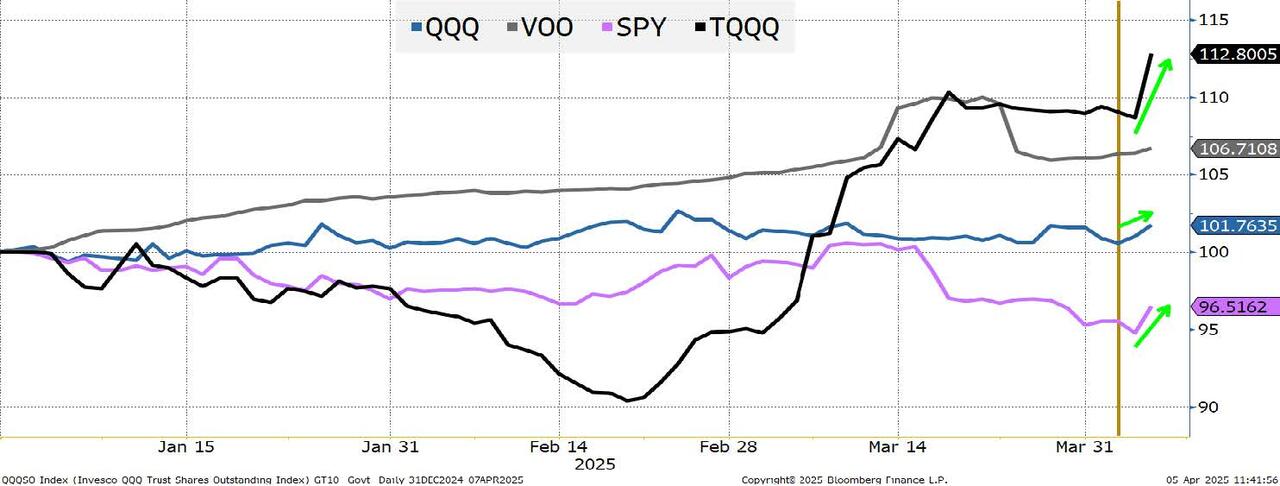
Since we focused on mission/legacy goals and some thoughts on how tariffs might work (I think I laid out a more optimistic case than I expect, and I don’t think it is great for risk assets globally), I wanted to include one chart in this section.

The “soft” data all points to extreme fear. CNN Fear and Greed Index. AAII Investor Sentiment. You name it, but I look at these 4 incredibly important ETFs and some had almost record inflows into the selling after April 2nd. It is great to be a contrarian, but is the contrarian trade really that it is oversold? That everyone is bearish?

The “hard” data/fund flows don’t seem to support that. If you get bored and have a Bloomberg terminal, find any ETF you want (the more speculative, the better) and append SO (shares outstanding) at the end of the ticker and hit . Massive inflows into risky funds and big outflows out of inverse funds.

Whatever we might think, there is still a lot of belief that stocks are cheap and that the plans will all work out. Down 20% from the highs, it is difficult to argue with that, and I’m long for a trade, but I think we have another 10% downside and when I look at the massive dip buying still occurring, I’m sadly more comfortable with that outlook in the next week or two.

Credit has “joined” the fray as we thought last weekend. That could turn, but as so many other factors (not discussed today, but that we’ve touched on repeatedly) point us towards recession, maybe even stagflation, I don’t think we’ve seen the wides yet.

At some point I will be bullish again on risk. Either I find the scenarios (as I probability weight them) point to better conditions for stocks, or we finally get so oversold that it is truly the contrarian trade to buy.

In the meantime, I expect more downside.

Rates are tricky, as they should be lower, but inflation pressures could be real if the tariffs go ahead as planned (and are semi-permanent). But my bigger concern, which applies both to stocks and bonds, is that the wave of capital repatriation has only just started.

It will be curious to see if (or when) retirees (or those getting close) decide that maybe it is prudent to reduce stock exposure for safety? I don’t think that has happened yet (though, it probably has occurred with Democrats already as the gap between the parties on so many fronts has never been wider at any time that I can think of).

Good luck, I hope I’m right about the bounce to start the week, and I hope I’m wrong that we won’t see enough of a policy shift, or signs of “winning,” to make me bullish beyond a trade.

Tyler Durden
Sun, 04/06/2025 – 20:00

Bessent Rejects Recession Talk, Calls Market Turmoil “A MAG7 Problem, Not MAGA Problem.” 

Bessent Rejects Recession Talk, Calls Market Turmoil “A MAG7 Problem, Not MAGA Problem.” 

President Trump’s “Liberation Day” tariff blitz and the resulting escalation in the trade war with China and other top trading partners fueled a downgrade in growth expectations that dominated the rates market last week. Goldman analysts now expect three interest rate cuts from the Federal Reserve this year—in July, September, and October—and have raised their 12-month U.S. recession probability to 35%, up from 20%. While a pivot toward tariff de-escalation remains plausible in the near term, market turmoil and potential trade disruptions amid the grand global economic reordering won’t push the U.S. into a recession, Treasury Secretary Scott Bessent said Sunday.

NBC’s Meet the Press with Kristen Welker told Bessent the stock market just experienced the biggest two-day crash since early Covid, asking: “How long will Americans hang tough” with current market gyrations? 

“I see no reason that we have to price in a recession,” Bessent responded to Welker. 

We should also note that in a recent interview with Tucker Carlson, Bessent pointed out: “The distribution of equities across households—the top 10% of Americans own 88% of equities, 88% of the stock market.”

So when Welker asked Bessent about Americans weathering the stock market turmoil, the question really applies only to a small segment of the population—those who have seen massive gains over the past couple of decades—while much of the Heartland, as some have noted, has been stuck in a recession and never fully recovered since the early 2000s. 

Bessent told Welker, “What we’re looking at is building the long economic fundamentals for prosperity, and I think the previous administration put us on a course for financial calamity.” 

“Again, this is an adjustment process – we saw with President Regan when he brought down the great inflation and brought down President Carter’s malaise. There was some choppiness at that time, but he held the course,” Bessent noted.

Bessent then described Trump’s economic re-ordering of the global economy that will fulfill the ‘America First’ agenda and urgently resolve the “National Security problem” of critical supply chains in overseas economies run by foreign adversaries. He said there was one good outcome of Covid: “It was a beta test for what would happen if our supply chains were broken,” adding that the president would fix and re-shore supply chains back to the Homeland for a “more stable future.” 

Welker, suffering from extreme “Trump derangement syndrome,” tried to trap Bessent with a question about how last week’s market turmoil resulted in Americans’ “lifetime savings drop significantly.” 

Before we provide readers with Bessent’s response, here’s a chart of the WILSHIRE 5000 over 15 years versus Welker’s claim that Americans were somehow financially paralyzed last week by the stock drop.

Bessent called Welker’s comments a “false narrative” and said, “Most Americans have 60/40 accounts and have a long-term view.” 

He continued: “Oil prices went down almost 15% in two days, which impacts working Americans much more than the stock market does. Interest rates hit their low for the year, so I’m expecting mortgage applications to pick up.” 

So much for Welker’s ‘gotcha moment’… 

*  *  *

ENDING SOON! Weekend Sale at ZH STORE!

Neuro Ignite $50.01 $39.95 (add to cart to see price)

ZeroHedge Multitool $34.95 $29.95

Rosewood Big Bowie Knife $400.00 $374.95

14-Day Emergency Food Bucket $149.99 $124.95

IQ Biologix Brain Rescue $74.95 $44.95 (add to cart to see price)

Bessent downplayed the risk of tariff-driven inflation, describing the tariffs as one-time adjustments. He added that Trump is “raising wages for working Americans and reducing regulations,” and noted that the upcoming tax cut bill, along with falling energy prices and interest rates, will benefit the working class

Pressed by Welker on tariff negotiations with trading partners, Bessent said, “I think we’re going to have to see what the countries offer and whether it’s believable,” adding, “We are going to have to see the path forward. After 20, 30, 40 years of bad behavior, you can’t just wipe the slate clean.”

In a separate interview with Tucker Carlson, Bessent discussed similar topics to those he covered with Welker, suggesting that a reordering of the global economy is underway—one that will ultimately benefit American workers.

He pointed out that the stock market downturn didn’t start with tariffs—in fact, it began with China’s “DeepSeek” moment earlier this year, calling it “A MAG7 problem, not a MAGA problem.”

Bessent pointed out that economic reordering is all about preventing a crash that would’ve happened given the explosion in government-fueled spending. 

Correct course now, or continue down the path of destruction. Most Americans would agree that acting now to secure the nation and prevent a Marxist takeover is a winning strategy, especially when it comes to maintaining power and preparing for the China challenges of the 2030s.

Tyler Durden
Sun, 04/06/2025 – 16:55

State Department Revokes, Halts Visas For South Sudan Over Refusal Of Deportees

State Department Revokes, Halts Visas For South Sudan Over Refusal Of Deportees

Authored by Melanie Sun via The Epoch Times,

The State Department has announced it is freezing all existing and new visas for South Sudanese seeking to enter the United States, citing the transitional government’s refusal to accept its own nationals being deported from the United States.

Secretary of State Marco Rubio announced the new visa and travel restrictions on Saturday, while accusing the East African nation’s leadership of “taking advantage of the United States.”

“Enforcing our nation’s immigration laws is critically important to the national security and public safety of the United States,” Rubio said. “Every country must accept the return of its citizens in a timely manner when another country, including the United States, seeks to remove them.

“Effective immediately, the United States Department of State is taking actions to revoke all visas held by South Sudanese passport holders and prevent further issuance to prevent entry into the United States by South Sudanese passport holders.”

The secretary said the freeze will remain in force until “South Sudan is in full cooperation.”

The U.S. Embassy in Khartoum, Sudan, had suspended its services on April 22, 2023, over regional instability.

South Sudan stands on the brink of falling back into civil war after the first vice president was put under house arrest, accused by the president of the transitional government of inciting a rebellion in Nasir in the Upper Nile State in March.

The arrest threatens a 2018 peace deal that ended a five-year civil war between forces loyal to President Salva Kiir and First Vice President Riek Machar. The deal saw the formation of the Revitalized Transitional Government of National Unity (RTGoNU) in February 2020. The deadly conflict, rooted in communal tensions between Kirr’s Dinka community and Machar’s Nuer community, cost approximately an estimated 400,000 lives.

The transition government is also facing security challenges in the Upper Nile state, where government forces have clashed with opposition groups.

Tyler Durden
Sun, 04/06/2025 – 16:20