77.6 F
Chicago
Thursday, June 25, 2026
Home Blog Page 172

Trump Issues Letter Rejecting Congressional Oversight For War, Citing Ceasefire Has ‘Terminated’ Hostilities

Trump Issues Letter Rejecting Congressional Oversight For War, Citing Ceasefire Has ‘Terminated’ Hostilities

Summary

  • Trump submits letter to Congress at 60-day mark: ceasefire ‘terminated’ hostilities & so doesn’t need authorization, he argues.

  • US Treasury goes after Hormuz payment fees, sanctioning  three Iranian foreign currency exchange houses. Bessent issues pressure points against Iranian ‘rats’.

  • Trump on Friday rejects Iran’s latest revised proposal to Pakistan mediatorsNuclear issue not included: a non-starter, and focus is on ending the war. Israeli officials balk.

  • Iran economically squeezed, signs of divided response among leadership, but surviving: “Weeks of conflict have aggravated Iran’s dire economic problems, risking calamity after the war, but the Islamic Republic looks able to survive a standoff in the Gulf for now.” (Rtrs)

  • Alternative routes emerge: “Iran cannot be besieged; We have different ways to export and import,” Iranian official says.

US x Iran permanent peace deal by June 30, 2026?
Yes 37% · No 64%
View full market & trade on Polymarket

*  *  *

Trump Letter: Doesn’t Need Congressional Approval As Ceasefire Has ‘Terminated’ Conflict

In an acknowledgement that his anti-Iran Operation Epic Fury has indeed hit 60 days, President Trump has issued a formal letter to Congress which argues he does not need their authorization for war. He is arguing the current ceasefire has in effect ‘terminated’ the conflict. Below are his main points via NBC [emphasis by ZH]:

  • “On April 7, 2026, I ordered a two-week ceasefire. The ceasefire has since been extended. There has been no exchange of fire between the United States Forces and Iran since April 7, 2026. The hostilities that began on February 28, 2026, have terminated,” Trump wrote in the letters, one of which went to the House and one of which went to the Senate.
  • “Despite the success of United States operations against the Iranian regime and continued efforts to secure a lasting peace, the threat posed by Iran to the United States and our Armed Forces remains significant,” the president added in the letter, promising to keep congressional leaders updated on further developments in Iran.
  • I have and will continue to direct United States Armed Forces consistent with my responsibilities and pursuant to my constitutional authority to conduct United States foreign relations and as Commander in Chief and Chief Executive,” the president wrote in his letter.

Trump Rejects Latest Iran Proposal

In fresh Friday words to reporters, President Trump says he is not satisfied with the latest proposal from Iran. He further stated that these negotiations “are not getting there right now.His main points via Newsquawk:

  • Iran wants a deal, but i am not satisfied.
  • Iran has no military left.
  • Talks with Iran are by phone.
  • Made strides in talks with Iran.
  • Not sure we are going to get to a deal.
  • Not happy with Italy or Spain on Iran.
  • Iran leaders do not get along with each other.

Bessent Lists 5 Pressures Iranian ‘Rats’ Facing

US Treasury Secretary Bessent takes to X on Friday to again call Iranian leaders “rats” – which won’t bode well for restarting stalled negotiations. He’s busy boasting on the economic damage unleashed by the ongoing US naval blockade, writing: “It is very difficult for rats in a sewer pipe to know what’s going on in the outside world. Some color for the Iranian Leadership as they literally sit in the dark.” He then lists out the following:

1. The United States has complete control of the Strait of Hormuz.

2. There is a hard currency, i.e. U.S. dollar, shortage.

3. Food and gasoline rationing are in place.

4. The entire international community has turned against you.

5. The BLOCKADE will continue, until there is pre-February 27 Freedom of Navigation.

He also shared a WSJ article proclaiming that the Iranians have ‘failed’ to roll back the US military blockade, and that supposedly the clock is ticking on the government’s ability to rule…

Israel To Renew Bombing if Nuclear Issue Not Dealt With

The Netanyahu government is signaling that it will restart the bombing campaign if the nuclear issue is not resolved. It should also not be forgotten that ‘denuclearizing’ Iran by force has been a multi-decade priority of Prime Minister Netanyahu and the hardliners of Israel. These are the latest warnings out of the Israeli military establishment on Friday:

An Israeli military official says that if Iran’s stockpile of more than 400 kilograms of uranium enriched to 60% is not removed from the Islamic Republic, the entire latest war will be considered “one big failure.”

Israeli officials have said that this stockpile is sufficient for 11 nuclear bombs.

And the Times of Israel underscores further, “The senior officer says that if, as part of negotiations between the United States and Iran, no agreement is reached to remove the uranium stockpile and halt enrichment in the country, the achievements in the 40 days of fighting will have been for nothing.” So this means that “If the nuclear objective is not achieved, then everything we did in Iran will be one big failure. The evil Iranian regime can pounce on the nuclear program,” the official emphasized. And then the threat

The officer adds that “if the uranium is removed from Iran through diplomatic means, we have done our part.” However, if that does not happen, Israel would need to launch another operation in Iran to achieve the objective, they say.

Already Israel has demonstrated its immense influence over the decision to go to war in the first place.

US Treasury Hits Back Against Hormuz Tolls

The OFAC notice on ­Hormuz payment sanctions: Today, the U.S. Department of the Treasury’s Office of Foreign Assets Control (OFAC) is designating three Iranian foreign currency exchange houses and their associated front companies as part of Economic Fury and Treasury’s ongoing efforts to disrupt the Iranian regime’s financial lifelines that sustain its war effort.  Collectively, Iranian exchange houses facilitate billions of dollars in foreign currency transactions each year.  Because Iran primarily settles its oil sales in Chinese yuan, these exchange houses play a critical role in converting oil revenues into currencies that are more readily useable by the Iranian military and its partners and proxies. 

“Iran is the head of the snake for global terrorism, and under President Trump’s leadership, Treasury is moving aggressively, through Economic Fury, to sever the Iranian military’s financial lifelines,” said Secretary of the Treasury Scott Bessent. “We will relentlessly target the regime’s ability to generate, move, and repatriate funds, and pursue anyone enabling Tehran’s attempts to evade sanctions.”

War Powers: 60 Days

There’s common agreement that today: Friday, May 1st, constitutes the 60-day mark on Operation Epic Fury. But President Trump and his administration are trying to sidestep the 1973 law which requires a president to withdraw troops within 60 days of notifying Congress of their deployment unless lawmakers formally authorize the military action as a declaration of war. Of course, thus far there’s been no Congressional authorization, amid some six failed attempts to push through War Powers resolutions.

The administration is now arguing that the extended ceasefire itself, reached three weeks ago and then recently unilaterally extended by Trump, buys more time and allows the White House to avoid Congressional approval. Admin officials argue the absence in exchanges of fire between Iranian and US forces means the 60-day timeline doesn’t apply.

“For War Powers Resolution purposes, the hostilities that began on Saturday, February ​28, have terminated,” a Trump official has been cited broadly in US media as saying. The same perspective had first been put forward by Pentagon chief Pete Hegseth during his hearing before the House Armed Services Committee on Thursday:

Answering questions from senators on Thursday, Hegseth said: “We are in a ceasefire right now, which our understanding means the 60-day clock pauses or stops in a ceasefire.”

The questioner, Democratic Senator Tim Kaine, responded: “I do not believe the statute would support that. I think the 60 days runs maybe tomorrow, and it’s going to pose a really important legal question for the administration there.”

The debate over mainstream airwaves is also about to grow fiercer as the war slides with no clear articulated grand US strategy…

Talks Back at Square One

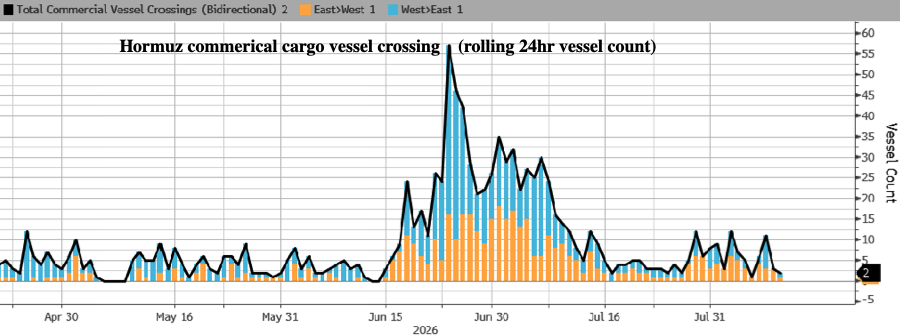
Iran has reportedly submitted its latest revised proposal to Pakistan mediators as of Thursday night. It is a response to the latest US amendments to end the war, per Axios. So the conflict is two-months deep, talks are completely stalled, global energy transit through the Hormuz Strait is at a bare trickle to non-existent as the US naval blockade is enforced and while international vessels are still under looming threat of attack by Iran, and there’s still no sign of an offramp coming anytime soon.

To review, and as we wrote previously, next fall’s midterms staring Congressional Republicans in the face, there this increasingly uncomfortable trend: “The average price of one gallon (3.8 litres) of gasoline in the United States has reached $4.30, according to the American Automobile Association (AAA), up from less than $3 before the February 28 start of the US-Israel war on Iran.” President Trump’s response to this in fielding questions in the Oval Office on Thursday was to tell reporters that ​gas ​prices would “drop like ⁠a rock” ​as soon ​as the Iran war ended. He said: “The [price of] gasoline and the oil will go down rapidly once the war’s over,” and at one point emphasized prices would go down “like a rock.”

Important development via Al Jazeera confirming that nuclear issue is a non-starter for Iran:

Proposals resurface: Tehran presented a new proposal to the Pakistani mediator yesterday, a diplomatic source told me. He added that nuclear negotiations will not succeed under these circumstances and that the focus will likely shift to ending the war.

Fresh activity on X:

Iran Squeezed But Surviving

We’ve been reporting on the collapsing Iranian rial and US officials’ hopes that the engineered crisis and economic warfare would force Iranians into the streets to overthrow their own government – which is a plan that already failed to produce enough momentum previously, and even under heavy US-Israeli bombs.

Reuters on Friday describes, “Weeks of conflict have aggravated Iran’s dire economic problems, risking calamity after the war, but the Islamic Republic looks able to survive a standoff in the Gulf for now, despite a U.S. blockade that has cut off energy exports.” It’s an enduring stalemate, with the Iran war and Hormuz closure now being a game of geopolitical chicken, where each side believes it can inflict more pain on the other while being the one to outlast.

There’s been talk of Pakistan having opened up its border, as well as increased use of Caspian trade routes – especially for vital goods like food, medicines, and factory or other parts. But WSJ freshly explains that “Alternative trade routes won’t be sufficient. Iran has been working to send some of its oil by rail to China and to import foodstuff by road from the Caucasus and Pakistan. Only 40% of Iran’s trade can be redirected away from blockaded ports, the Iranian Shipping Association said Thursday via the Fars news agency, which is affiliated with Iran’s security services.”

The report then speculates on what’s going on internally in Iran’s government and leadership, and calculations on how much economic pain Iranian society can take as renewed fighting looms, also as Israel is said to be preparing for more rounds of attack:

The risk of a spiraling crisis has split Iran’s political system between moderates such as President Masoud Pezeshkian and hard-liners including Saeed Jalili, a former presidential candidate who leads Iran’s most conservative faction.

The moderates believe in holding fire and negotiating a favorable deal with President Trump, whom they view as eager to get out of the messy war as soon as possible. They worry Iranians are growing tired of the conflict after an initial nationalist uptick.

“The regime has to do something to break this deadlock,” Saeid Golkar, who studies Iran at the University of Tennessee at Chattanooga. “Moderates want a deal because they think more destruction is political suicide,” he said.

While some Iranian officials have touted the country has more of its air force left than what the Pentagon asserts, it remains that Tehran doesn’t appear capable of inflicting serious damage on the significant US naval blockade, other than through asymmetric or drone warfare.

Caspian Sea alternative

More Latest Developments

via Newsquawk

  • US President Trump is expected to make a decision on the path forward [on Iran] in the coming days, NBC reported citing a US official.
  • US President Trump said would not have approved enriched Uranium for Iran; needs guarantees Iran will not have a nuclear weapon ever. Hormuz blockade is 100% effective.
  • A senior Trump administration official said that for War Power Resolution purposes, hostilities that began on February 28th have been terminated.
  • Iranian Judiciary head said Iran does not accept negotiation based on imposition; adds Iran has never left the negotiating table, Iranian press reported.
  • Iranian National Security Commission member Rezei said “we are currently in the second phase of the war with the enemy..the naval blockade is a continuation of the war.. we are not in a ceasefire situation now”, Mehr reported.
  • Full post: “Iran cannot be besieged; We have different ways to export and import. In a conversation with Mehr, Ebrahim Rezaei said: “The enemy has turned to our naval blockade after failing in the military war and direct confrontation, and we are currently in the second phase of the war with the enemy.” In other words, the naval blockade is a continuation of the war that the Americans have started against us. So, we are not in a ceasefire situation now. A member of the National Security Commission of the Majlis, stating that the Americans do not have the operational capacity to blockade Iran by sea, said: “Our only access route for transit is not through the Persian Gulf and the Strait of Hormuz.”.
  • US CENTCOM Commander Cooper briefed President Trump for 45 minutes on new operational plans for potential strikes against Iran, Axios’ Ravid reported citing sources.
  • Iranian Foreign Ministry Spokesperson said that it is not responsible to expect a quick conclusion of the negotiations and that the other party has not used the opportunity provided by Iran’s proposal, must be ready for any eventuality. The US and Israeli regime are famous for breaking their promises and the biggest guarantee for not repeating the war is the power of Iran.
  • Drone attack hits Iranian Kurdish opposition camp east of Iraq’s Erbil, according to Reuters, citing security sources. via vv.
  • The defense sound heard over Tehran is related to countering micro-birds and reconnaissance drones, via Tasnim.
  • Air defence sounds are being heard in some areas of Tehran but reasons are unclear, Mehr News reported.

Tyler Durden
Fri, 05/01/2026 – 14:55

OPEC Just Signaled A Historic Gold Tailwind

OPEC Just Signaled A Historic Gold Tailwind

Authored by Matthew Piepenburg via VonGreyerz.gold,

The United Arab Emirates’ headline departure from OPEC this week has now made the case for precious metals almost too obvious. In fact, the critical USD-Petrodollar-Gold triangle just sent us one of the most important gold signals in over 50 years.

And for anyone paying attention, this should come as no surprise.

Warnings from 2022

From day one of the 2022 U.S. sanctions against Russia, we argued in “How the West was Lost that this event marked the greatest macro-economic watershed to hit the world since Nixon decoupled the dollar from gold in 1971.

As of this week, the ripple effects of that warning just grew to wave height.

Back in 2022, we warned that trust in a now weaponized world reserve currency would fall, creating a scenario in which the BRICs+ nations would slowly de-dollarize, thereby weakening the hegemony of the USD in general and the USA in particular.

In the years that immediately followed, de-dollarization became an undeniable current, the momentum of which we have written and spoken with both consistency and conviction ever since. 

Petrodollar Significance

We further warned that there would be gradual, then inevitable, threats to the Petrodollar, an essential pillar of the USD’s hegemony. 

After all, forcing the world to buy oil in USDs (and oil producers to use their oil revenues to buy USTs) is indeed an “exorbitant privilege.” 

The 1974 Petrodollar effectively created a global sponge for otherwise over-produced/printed Greenbacks, which explains why the U.S. could so easily export its inflation to the rest of the world with impunity for decades.

But if that “sponge” ever weakened, so too would dollar supremacy. 

One simply cannot overstate enough how essential the Petrodollar is/was to the USD as a currency and to the USA as a financial hegemon. 

This is why we have been tracking the Petrodollar’s post-2022 cracks hereherehereherehere and, well… here.

In short: The Petrodollar matters; it really matters.

Petrodollar Cracks

Once the USA weaponized its already over-indebted and increasingly debased Greenback in 2022, we argued that even its oil “allies” at OPEC would eventually rethink their 1974 agreement to sell oil only in dollars. 

As China openly sought a non-dollar oil solution, it was only a matter of time and circumstance before the OPEC nations would move away from the dollar and look east toward the yuan.

And as of this week, it is now apparent that each of these warnings is slowly coming to fruition. 

Petrodollar Uh-Oh Moment: What Happened?

The UAE, one of America’s biggest allies, just ended its OPEC membership while simultaneously announcing to the U.S. Treasury Department that it may begin to sell its oil in other currencies.

Why?

There are many answers, but they all boil down to an increasing distrust of the USD and a decreasing respect for U.S. global hegemony/policy.

When Kissinger made the 1974 Petrodollar deal with the Saudis, for example, it was effectively a handshake deal made at knifepoint—i.e., a coerced arrangement in which the U.S. promised military protection to the OPEC members in exchange for their forced sale of oil in Greenbacks.

Fast forward some 50 years later, however, and that overly-indebted USD and increasingly impotent UST are not nearly as attractive/strong as they were in the early 1970’s.

Furthermore, the “threat of the Soviet” in 1974 is not the same in 2026 as it was in 1974. 

Nations like the UAE and Saudi Arabia are no longer worried about a red star over Riyadh or Abu Dhabi, but they are certainly aware of the U.S. missiles crisscrossing their current skies in what, at least to many and for now, feels like an absolute military fiasco led by an increasingly desperate U.S.

The OPEC nations see a rich oil market in China and debt-soaked bully in an America who already has its own oil. 

The UAE (already tilting into the BRICs coalition since 2024 and selling oil to India in rupees rather than dollars) is now the first nation to openly reveal that it is tired of being the dog wagged by a Petrodollar tail. 

Meanwhile, even Saudi Arabia has been flirting with China for years, considering oil sales in yuan rather than dollars.

The Petrodollar: What Its Cracks Mean for the Greenback

All of this is a direct threat to an America which always assumed the world would follow its orders to buy oil in dollars and hoard USTs like dutiful serfs. 

But China is no longer a serf, and has sold 48% of its USTs while looking for non-dollar oil.

As I argued earlier this year from Vancouver, John Connally’s infamous (and arrogant) declaration to the world in the 1970’s that it was “our dollar but your problem” would turn out to be an historically embarrassing and short-sighted homage to hubris before the fall.

Today, Uncle Sam’s dollar is his dollar and his problem” for the simple reason that after 50+ years of deficit spending, inflation, exporting, and oil-driven wars of “freedom and democracy,” the world no longer trusts or wants that dollar.

The Petrodollar: What Its Cracks Mean for Gold

In fact, ever since 2014, when U.S. money printing became addictive rather than “temporary,” nations slowly lost faith in Uncle Sam’s “exorbitant privilege.” They began net-buying gold (blue line) and net dumping USTs (red line) that very same year:

By 2022, of course, the net-stacking of gold by global central banks went from incremental to exponential. 

Between then and now, central bank gold stacking has increased by 5X, acting as an open middle finger to the USD and UST.

Furthermore, ever since the USA weaponized the dollar in 2022, the BIS has made gold a tier-one asset, a nd even the TBTF commercial banks like UBS, Goldman Sachs, and JP Morgan (once intentionally complicit in downplaying gold) are now structurally bullish on the “pet rock.”

In short, the combined forces of 1) a debased and weaponized dollar, 2) a negative real-yielding UST, 3) undeniable de-dollarization trends, 4) unsustainable U.S. public debt levels, 5) a disastrous war in Iran, and 6) a now openly failing Petrodollar make it obvious (rather than debatable) that demand for, and trust in, the USD is tanking.

This slow, but oh-so predictable devolution from U.S. superpower and super-currency to a debt-desperate, debased fall is as old and familiar as history itself, a cycle I explained years ago.

Without a powerful Petrodollar to absorb its inflated and over-expanded Greenback, America’s economic and currency fall will only accelerate going forward.

As the world (and that includes a crumbling OPEC) increasingly turns its back on USDs and USTs, American bond yields and U.S. debt levels will rise as USD purchasing power falls, creating the perfect setup for more mouse-clicked trillions and a stagflation backdrop of historic proportions.

The inevitable monetary and fiscal “accommodation” (i.e., money printing) to “support” a tanking Main Street economy and entirely Fed-centralized S&P will only accelerate the debasement of an already openly debased USD.

This dollar expansion/debasement will act as a massive tailwind to gold in the years to come.

As we’ve argued for years, the inevitable decline in paper currencies fully explains the rise in physical gold, which, not so coincidentally, saw more than 50 all-time highs in 2025, for the simple reason that paper currencies were falling with equal panache.

Toward this end, the bull market in gold has only just begun. 

Gold’s staying power and secular direction North (despite recent forced sell-offs) is effectively guaranteed for the simple reason that the fate of a paper currency system, debased in a backdrop of a decaying credit cycle, is now equally (and historically) unavoidable. 

What we are seeing in the crumbling OPEC membership is a slow shift from dollar-backed oil to nations who will be net-settling more of their regional currency oil trades in gold, whose market cap is only a tiny fraction of the global oil market.

Slowly, gold will not only store value better than a distrusted and debased USD, but t will rise in prominence (and price) in the global oil trade.

After all, oil net-settled in gold is far less volatile than dollar-settled oil. 

If we can see this, so can the oil nations of the OPEC cartel. Their move away from the dollar will be slow but brutal to a USD whose supremacy has been slowly declining for years.

After decades of hegemony, the USD is losing trust not only among American Main Streets, central banks, commercial banks, and oil nations, but also among all of us who understand the history of currency debasement, the math of gold, the theft of inflation, and the dishonesty of policymakers

In short: What we saw this week with the UAE’s infamous OPEC exit is just further confirmation of the dollar’s gradual end-game and the first innings of gold (and silver’s) winning game.

Tyler Durden
Fri, 05/01/2026 – 14:45

As Anthropic Entertains Offers At $900 Billion Valuation, OpenAI CFO Swears There’s A ‘Vertical Wall Of Demand’

As Anthropic Entertains Offers At $900 Billion Valuation, OpenAI CFO Swears There’s A ‘Vertical Wall Of Demand’

Anyone that’s ever spent serious time with Anthropic’s Claude – particularly after being a GPT user – can understand why the Trump administration just did a major about-face after a Pentagon spat led to the company’s blacklisting as a “supply chain risk.” 

Two months after the Pentagon moved to several all ties with the AI wunderkind, the National Security Agency (NSA), which falls under DoW, had to have access to Anthropic’s ‘Mythos’ model – the company’s most powerful model to date – which according to internal warnings could “hack every major system.” And of course, Treasury has to have it too. 

So they’ve got a public-facing Claude that kicks GPT ass at workflow tasks and provides valuable insights (try spinning up multiple Claudes at once, assigning them jobs, and having them talk…), and a scary private ZeroCool level hacker Claude (Mythos) that the government is scrambling to get their hands on – while the Pentagon is standing around holding their dick after that “supply chain” tantrum. No wonder Anthropic was willing to call their bluff. 

Don’t sleep on them though…

Anyhow – roughly a week after Bloomberg reported that Google committed to invest $10 billion – and Amazon $5 billion – at a $350 billion valuation, the outlet now reports that Anthropic is entertaining offers from investors at more than $900 billion

Anthropic had previously resisted several inbound proposals from investors for a new round at a valuation of $800 billion or more, Bloomberg News has reported.

The new discussions, which have not been reported, coincide with a push by Anthropic to ramp up fundraising amid the breakout success of its AI software. Anthropic, which Bloomberg has reported is considering an initial public offering as soon as October, has been on the hunt for more infrastructure to meet growing demand for its products. –Bloomberg

So things are going well for CEO Dario Amodei and crew. 

Meanwhile

Live look a Sam Altman

On the other side of the AI race, OpenAI is pushing back on concerns about missing internal targets

In a Thursday interview with Bloomberg, CFO Sarah Friar insisted that was a nothingburger, and that there’s a “vertical wall of demand” for their products.

“We feel like we’re beating our plan at the highest level,” she said. “How we get there often moves around period to period, because this is still a young business that is not perfectly forecastable across every single metric.”

Friar acknowledged that the company has ambitious internal “stretch goals” that can be different than the ones it shares publicly. But the popularity of OpenAI’s products continues to grow, she said. This month, OpenAI said its coding agent Codex hit 4 million weekly users — up from 3 million two weeks earlier.

“Every company I’ve ever been inside of in my entire CFO life, and as an analyst, always has stretch goals — always,” she said. “And if you don’t have those stretch goals, I feel like, actually, you’re not doing your job as a CFO.”

Friar has held various positions at companies including Goldman Sachs Group Inc., Salesforce Inc., Nextdoor Holdings Inc. and Square Inc., now known as Block Inc. –Bloomberg

On Tuesday, the WSJ reported that OpenAI missed its own targets for both new users and revenue, – after which Sarah Friar reportedly told other company leaders that she is worried the company might not be able to pay for future computing contracts if revenue doesn’t grow fast enough. In other words, that $1.5 trillion OpenAI had pledged to spend on various data centers, GPUs and memory chips… you can kiss all that goodbye.

So, Thursday was damage control for Tuesday, and Anthropic is the homecoming queen.

Tyler Durden
Fri, 05/01/2026 – 14:20

Top US General Signals Russia Is Helping Iran In War

Top US General Signals Russia Is Helping Iran In War

Authored by Jack Phillips via The Epoch Times,

The highest-ranking U.S. general on Thursday signaled that the Russian government is assisting the Iranian regime in its war with the United States.

In comments before Senate Armed Services Committee, Gen. Dan Caine, the head of the Joint Chiefs of Staff, responded in an affirmative manner to a question from the panel’s chairman, Sen. Roger Wicker (R-Ala.), about whether there is Russian involvement.

“General Caine, there’s no question that Vladimir Putin’s Russia is taking serious action to undermine our efforts for success in Iran. Is there any question about that?” Wicker asked the general.

Without going into detail, Caine said, “I think there’s actions and activities. [I’m] mindful of the hearing room we’re in, but there’s, there’s, there’s definitely some action there.”

Meanwhile, Iran’s regime said on Thursday it would respond with attacks on U.S. military positions if Washington renewed attacks on the country in the midst of a ceasefire and a U.S. naval blockade on Iranian ports. The country’s leader, Mojtaba Khamenei, said in a statement through state-run media that it would assert control over the Strait of Hormuz, which could complicate plans to reopen the key waterway.

Any U.S. attack on Iran, even if limited, will usher in “long and painful strikes” on America’s regional positions, a senior Revolutionary Guards ​official said. “We’ve seen what happened to your regional bases, we will see the same thing happen to your warships,” Islamic Revolutionary Guard Corps Aerospace Force Commander Majid Mousavi was quoted by Iranian media as saying.

Earlier this week, Iran’s foreign minister traveled to Russia to meet with Putin. “As you can see, we have always had close consultations with Russia and have had continuous and bilateral consultations on a wide range of issues, especially regional issues,” Iranian Foreign Minister Abbas Araghchi said in a Telegram post on April 27.

As for Beijing’s support of Tehran, U.S. President Donald Trump said that he believes the Chinese Communist Party’s (CCP) influence is limited. The CCP has long done business with the clerical regime that has ruled Iran since the 1979 revolution.

“I think maybe helping, but I don’t think much,” Trump said in an interview with Fox News on April 26 when he was asked about any Chinese aid to Iran. “I think China could have been much worse than they’ve been, so I don’t consider them having been very bad.”

Oil prices have sharply increased since the war began on Feb. 28, driving inflation and sending pump prices to painful levels ​worldwide. Meanwhile, U.N. Secretary-General Antonio Guterres warned that if the disruption caused by the closure dragged on through mid-year, global growth would fall, inflation would rise, and tens of millions more people would be pushed into ​poverty and extreme hunger.

“The longer this vital artery is choked, the harder it will be to reverse the damage,” he told reporters in New York on Thursday.

Inside the United States, the price for a gallon of regular gasoline nationwide reached $4.30, according to the American Automotive Association (AAA). Data from the organization show that a gallon of diesel reached $5.49.

Tyler Durden
Fri, 05/01/2026 – 14:00

Tune In To Tonight’s Fertilizer Debate: How Bad Will It Get?

Tune In To Tonight’s Fertilizer Debate: How Bad Will It Get?

As we covered earlier this week, Goldman Sachs analysts now say the fertilizer disruption is larger than expected, with nitrogen markets taking the brunt. Urea prices have risen 50% to 70% since the conflict began. Goldman’s Duffy Fischer wrote that “nitrogen fertilizer is the most impacted chemical chain,” adding that the scale of disruption is “greater than we originally expected.”

And signs of improvement have yet to reveal themselves…

As the U.S.–Iran conflict enters its seventh week, ZeroHedge, in partnership with the Macro Dirt Podcast, will host a debate tonight focused on the implications for agriculture, inflation, and global supply chains.

The discussion features former Bridgewater head of commodities Alex Campbell, Brent Johnson of Santiago Capital, and is hosted by Tony Greer and Jared Dillian.

Johnson appeared with Marc Faber and Adam Taggart on an Iran-focused ZeroHedge debate earlier this month and announced that his fund was loading up on fertilizer producers, arguing that even if Hormuz were to open today, he believes the supply shock has yet to be felt and will be severe.

And, of course… Hormuz remains closed.

The hike in prices is already flowing through to earnings. U.S. producers CF Industries and Nutrien are positioned to benefit, supported by relatively stable domestic natural gas costs. Goldman estimates that every $50-per-ton increase in urea prices adds roughly $800 million in annualized EBITDA for CF. Since late February, U.S. Gulf urea prices have climbed about $234 per ton.

Pressure is also building in phosphate markets. U.S. prices, which initially lagged, are now up roughly 23% since the start of the conflict. At the same time, sulfur prices have reached record highs, forcing production curtailments and tightening supply further as input costs rise.

Potash remains less affected for now. Supply routes through the Red Sea have stayed open, and North American supply remains ample, limiting near-term upside.

Join us tonight to see how you should be positioning your portfolio to be better prepared for the coming inflationary shock.

7pm ET here on the ZeroHedge homepage, X feed, and YouTube channel.

Tyler Durden
Fri, 05/01/2026 – 13:00

Google DeepMind Veteran Raises $1.1 Billion For AI That Doesn’t Train On Human Data

Google DeepMind Veteran Raises $1.1 Billion For AI That Doesn’t Train On Human Data

Authored by Jason Nelson via decrypt.io,

In brief

  • DeepMind veteran David Silver raised $1.1 billion for his new startup Ineffable Intelligence at a $5.1 billion valuation.
  • Silver says reinforcement learning, not large language models, is the best path to superintelligence.
  • The startup aims to build AI “superlearners” that learn through simulations and self-play.

David Silver, the DeepMind scientist behind AlphaGo’s historic 2016 win over world Go champion Lee Sedol, has raised $1.1 billion to launch a startup betting that the next era of AI won’t come from today’s dominant technology.

Image: Shutterstock/Decrypt

Silver’s company, Ineffable Intelligence, launched in January at a $5.1 billion valuation and is betting on reinforcement learning, a method where AI systems improve through trial and error. Silver argues that approach, rather than the large language models now dominating the field, offers a more credible route to superintelligence.

I think of our mission as making first contact with superintelligence,” Silver told Wired. “By superintelligence, I really mean something incredible. It should discover new forms of science or technology or government or economics for itself.

Popularized by philosopher Nick Bostrom in his 2014 book “Superintelligence,” the term refers to AI that surpasses human intelligence across nearly all domains, while artificial general intelligence, or AGI, describes systems capable of matching human-level reasoning across a wide range of tasks.

Silver argues that large language models are fundamentally limited because they learn from human-generated data, instead of building their own understanding through experience.

Human data is like a kind of fossil fuel that has provided an amazing shortcut,” he said. “You can think of systems that learn for themselves as a renewable fuel—something that can just learn and learn and learn forever, without limit.”

Silver has spent much of his career advancing that argument. AlphaGo, which combined human training data with reinforcement learning and self-play, developed strategies that surprised even top human players and demonstrated how AI can exceed human precedent in narrow domains.

I feel it’s really important that there is an elite AI lab that actually focuses a hundred percent on this approach,” he told Wired. “That it’s not just a corner of another place dedicated to LLMs.

Ineffable Intelligence plans to build what Silver calls “superlearners”—AI agents placed inside simulations where they can pursue goals, fail, adapt, and improve without the limits of a static human dataset. Silver declined to describe what those simulations would look like, but said the approach would allow agents to collaborate and develop capabilities autonomously.

Silver argued that large language models are limited by the data they are trained on, adding that a model trained in a world where everyone believed the Earth was flat would likely keep that belief unless it could test reality for itself. A system that learns through experience, he said, could discover otherwise.

Ineffable Intelligence did not immediately respond to a request for comment by Decrypt.

Tyler Durden
Fri, 05/01/2026 – 12:40

Trump Says Spirit Airlines Rescue Still In Review, Final Proposal Coming

Trump Says Spirit Airlines Rescue Still In Review, Final Proposal Coming

Summary: 

  • Trump says Spirit received the final proposal for the lifeline deal 

  • WSJ reported that bankrupt Spirit Airlines was preparing to shutter operations 

President Trump comments on Spirit Airlines:

  • TRUMP: GAVE SPIRIT FINAL PROPOSAL

  • TRUMP SAYS US STILL LOOKING AT SPIRIT, WILL GIVE FINAL PROPOSAL

  • TRUMP SAYS TRYING TO HELP SPIRIT, CITING JOBS 

  • TRUMP SAYS WILL HAVE SOMETHING ON SPIRIT TODAY OR TOMORROW 

WSJ Reports Spirit Airlines Prepares To Shutter Operations 

The Wall Street Journal reports that bankrupt Spirit Airlines is preparing to wind down operations after failing to secure a $500 million lifeline from the Trump administration.

WSJ reports:

The ailing budget airline had been hoping to finalize a $500 million lifeline from the government before running out of cash. The discount carrier hasn’t been able to get sufficient support between certain bondholders and the government to secure the funding to keep it in business, people familiar with the matter said.

News last week raised hopes that Spirit would secure a rescue deal of up to $500 million from the Trump administration, which could have left the federal government with 90% control.

A reporter asked Trump last week: “Is the government going to buy a stake in Spirit Airlines?”

The president responded: “So we are looking at Spirit. It’s in bankruptcy court. And we’re looking, if we could get it for the right price…”

Polymarket odds:

US takes a stake in Spirit Airlines by May 31?

US takes a stake in Spirit Airlines by May 31?
Yes 19% · No 81%
View full market & trade on Polymarket

Spirit Airlines shutdown/liquidation by May 31?

Spirit Airlines shutdown/liquidation by May 31?
Yes 79% · No 22%
View full market & trade on Polymarket


Tyler Durden
Fri, 05/01/2026 – 12:39

Trump Argues War ‘Terminated’ Before 60-Day Congressional Approval Deadline, As Iran Submits Latest Proposal To Pakistan Mediators

Trump Argues War ‘Terminated’ Before 60-Day Congressional Approval Deadline, As Iran Submits Latest Proposal To Pakistan Mediators

Summary

  • White House officials argue the current absence of fighting between Iranian & US forces means the 60-day timeline for Congressional approval (or US forces must leave) doesn’t apply due to the ceasefire.

  • Iran submitted its latest revised proposal to Pakistan mediators as of Thursday night. It is a response to the latest US amendments to end the war, per Axios. Nuclear issue not included: a non-starter, and focus is on ending the war.

  • Iran economically squeezed, signs of divided response among leadership, but surviving: “Weeks of conflict have aggravated Iran’s dire economic problems, risking calamity after the war, but the Islamic Republic looks able to survive a standoff in the Gulf for now.” (Rtrs)

  • Alternative routes emerge: “Iran cannot be besieged; We have different ways to export and import,” Iranian official says.

US x Iran permanent peace deal by June 30, 2026?
Yes 37% · No 64%
View full market & trade on Polymarket

*  *  *

War Powers: 60 Days

There’s common agreement that today: Friday, May 1st, constitutes the 60-day mark on Operation Epic Fury. But President Trump and his administration are trying to sidestep the 1973 law which requires a president to withdraw troops within 60 days of notifying Congress of their deployment unless lawmakers formally authorize the military action as a declaration of war. Of course, thus far there’s been no Congressional authorization, amid some six failed attempts to push through War Powers resolutions.

The administration is now arguing that the extended ceasefire itself, reached three weeks ago and then recently unilaterally extended by Trump, buys more time and allows the White House to avoid Congressional approval. Admin officials argue the absence in exchanges of fire between Iranian and US forces means the 60-day timeline doesn’t apply.

“For War Powers Resolution purposes, the hostilities that began on Saturday, February ​28, have terminated,” a Trump official has been cited broadly in US media as saying. The same perspective had first been put forward by Pentagon chief Pete Hegseth during his hearing before the House Armed Services Committee on Thursday:

Answering questions from senators on Thursday, Hegseth said: “We are in a ceasefire right now, which our understanding means the 60-day clock pauses or stops in a ceasefire.”

The questioner, Democratic Senator Tim Kaine, responded: “I do not believe the statute would support that. I think the 60 days runs maybe tomorrow, and it’s going to pose a really important legal question for the administration there.”

The debate over mainstream airwaves is also about to grow fiercer as the war slides with no clear articulated grand US strategy…

Talks Back at Square One

Iran has reportedly submitted its latest revised proposal to Pakistan mediators as of Thursday night. It is a response to the latest US amendments to end the war, per Axios. So the conflict is two-months deep, talks are completely stalled, global energy transit through the Hormuz Strait is at a bare trickle to non-existent as the US naval blockade is enforced and while international vessels are still under looming threat of attack by Iran, and there’s still no sign of an offramp coming anytime soon.

To review, and as we wrote previously, next fall’s midterms staring Congressional Republicans in the face, there this increasingly uncomfortable trend: “The average price of one gallon (3.8 litres) of gasoline in the United States has reached $4.30, according to the American Automobile Association (AAA), up from less than $3 before the February 28 start of the US-Israel war on Iran.” President Trump’s response to this in fielding questions in the Oval Office on Thursday was to tell reporters that ​gas ​prices would “drop like ⁠a rock” ​as soon ​as the Iran war ended. He said: “The [price of] gasoline and the oil will go down rapidly once the war’s over,” and at one point emphasized prices would go down “like a rock.”

Important development via Al Jazeera confirming that nuclear issue is a non-starter for Iran:

Proposals resurface: Tehran presented a new proposal to the Pakistani mediator yesterday, a diplomatic source told me. He added that nuclear negotiations will not succeed under these circumstances and that the focus will likely shift to ending the war.

Iran Squeezed But Surviving

We’ve been reporting on the collapsing Iranian rial and US officials’ hopes that the engineered crisis and economic warfare would force Iranians into the streets to overthrow their own government – which is a plan that already failed to produce enough momentum previously, and even under heavy US-Israeli bombs.

Reuters on Friday describes, “Weeks of conflict have aggravated Iran’s dire economic problems, risking calamity after the war, but the Islamic Republic looks able to survive a standoff in the Gulf for now, despite a U.S. blockade that has cut off energy exports.” It’s an enduring stalemate, with the Iran war and Hormuz closure now being a game of geopolitical chicken, where each side believes it can inflict more pain on the other while being the one to outlast.

There’s been talk of Pakistan having opened up its border, as well as increased use of Caspian trade routes – especially for vital goods like food, medicines, and factory or other parts. But WSJ freshly explains that “Alternative trade routes won’t be sufficient. Iran has been working to send some of its oil by rail to China and to import foodstuff by road from the Caucasus and Pakistan. Only 40% of Iran’s trade can be redirected away from blockaded ports, the Iranian Shipping Association said Thursday via the Fars news agency, which is affiliated with Iran’s security services.”

The report then speculates on what’s going on internally in Iran’s government and leadership, and calculations on how much economic pain Iranian society can take as renewed fighting looms, also as Israel is said to be preparing for more rounds of attack:

The risk of a spiraling crisis has split Iran’s political system between moderates such as President Masoud Pezeshkian and hard-liners including Saeed Jalili, a former presidential candidate who leads Iran’s most conservative faction.

The moderates believe in holding fire and negotiating a favorable deal with President Trump, whom they view as eager to get out of the messy war as soon as possible. They worry Iranians are growing tired of the conflict after an initial nationalist uptick.

“The regime has to do something to break this deadlock,” Saeid Golkar, who studies Iran at the University of Tennessee at Chattanooga. “Moderates want a deal because they think more destruction is political suicide,” he said.

While some Iranian officials have touted the country has more of its air force left than what the Pentagon asserts, it remains that Tehran doesn’t appear capable of inflicting serious damage on the significant US naval blockade, other than through asymmetric or drone warfare.

Caspian Sea alternative

More Latest Developments

via Newsquawk

  • US President Trump is expected to make a decision on the path forward [on Iran] in the coming days, NBC reported citing a US official.
  • US President Trump said would not have approved enriched Uranium for Iran; needs guarantees Iran will not have a nuclear weapon ever. Hormuz blockade is 100% effective.
  • A senior Trump administration official said that for War Power Resolution purposes, hostilities that began on February 28th have been terminated.
  • Iranian Judiciary head said Iran does not accept negotiation based on imposition; adds Iran has never left the negotiating table, Iranian press reported.
  • Iranian National Security Commission member Rezei said “we are currently in the second phase of the war with the enemy..the naval blockade is a continuation of the war.. we are not in a ceasefire situation now”, Mehr reported.
  • Full post: “Iran cannot be besieged; We have different ways to export and import. In a conversation with Mehr, Ebrahim Rezaei said: “The enemy has turned to our naval blockade after failing in the military war and direct confrontation, and we are currently in the second phase of the war with the enemy.” In other words, the naval blockade is a continuation of the war that the Americans have started against us. So, we are not in a ceasefire situation now. A member of the National Security Commission of the Majlis, stating that the Americans do not have the operational capacity to blockade Iran by sea, said: “Our only access route for transit is not through the Persian Gulf and the Strait of Hormuz.”.
  • US CENTCOM Commander Cooper briefed President Trump for 45 minutes on new operational plans for potential strikes against Iran, Axios’ Ravid reported citing sources.
  • Iranian Foreign Ministry Spokesperson said that it is not responsible to expect a quick conclusion of the negotiations and that the other party has not used the opportunity provided by Iran’s proposal, must be ready for any eventuality. The US and Israeli regime are famous for breaking their promises and the biggest guarantee for not repeating the war is the power of Iran.
  • Drone attack hits Iranian Kurdish opposition camp east of Iraq’s Erbil, according to Reuters, citing security sources. via vv.
  • The defense sound heard over Tehran is related to countering micro-birds and reconnaissance drones, via Tasnim.
  • Air defence sounds are being heard in some areas of Tehran but reasons are unclear, Mehr News reported.

Tyler Durden
Fri, 05/01/2026 – 08:58

Futures Rise, Oil Slides On Iran Ceasefire Optimism After Best Month For Stocks Since 2020

Futures Rise, Oil Slides On Iran Ceasefire Optimism After Best Month For Stocks Since 2020

US equity futures are higher, set for a new all time high, as the rally that’s pushed Wall Street to record highs on strong megacap tech earnings continues, after the S&P posted its best monthly increase since November 2020. As of 8:00am ET, S&P futures are up 0.3% (spiking moments ago on a report that Iran submitted its latest response to US amendments on the ceasefire agreement), while Nasdaq futures are modestly in the red and the Russell underperforms. Pre-market, AAPL is up 3% on healthy guidance and earnings beat even as it warned that memory-chip costs will increase and that shortages of Mac computers will persist for “several months.” NVDA and MSFT are 40bp higher, while AMZN is down 60bp. Headlines since yesterday’s close have been largely quiet, especially given the market holidays across most European and Asian markets. Bond yields dropped 1-2bp, and oil slipped after news that Iran had delivered its response to the latest US ceasefire amendment via Pakistani sources; the news pushed Brent down by about $1 to $110 and WTI dropped to session lows around $103; precious metals and aluminum are lower. The dollar was little changed having wrapped up its worst month since June, after a second intervention to by the BOJ/MOF in Japan pushed the yen sharply higher (although it has again given up most of its gains). Gold traded around $4,600 an ounce. Today’s economic data calendar slate includes April manufacturing PMI (9:45am) and ISM manufacturing (10am). Fed speaker slate includes Miran at 8am

In premarket trading, Mag 7 stocks are mixed: Apple is up 3.8% after giving a surprisingly strong revenue forecast for the third quarter, even as it warned that memory-chip costs will increase and that shortages of Mac computers will persist for “several months” (Nvidia +0.4%, Microsoft +0.4%, Meta +0.3%, Tesla -0.2%, Alphabet -0.2%, Amazon -0.7%). 

  • Amgen (AMGN) is down 1.6% after the drugmaker reported underwhelming sales of some of its newer products for the first quarter, with Baird calling the results a “mixed bag.”
  • Cohu (COHU) falls 1.1% after the semiconductor manufacturing company reported adjusted earnings per share that missed the average analyst estimate. However, analysts remain positive on its long-term growth prospects.
  • Moderna Inc. (MRNA) jumps 6.7% after first-quarter sales beat expectations, as the struggling vaccine maker that’s faced resistance from the Trump administration has found new growth outside the US.
  • Roblox (RBLX) tumbles 24% after the video-game company reported daily active users for the first quarter that missed the average analyst estimate. The company also lowered its forecast for full-year bookings, a key measure of sales, after implementing safety features restricting how kids, who make up a majority of its audience, can use the platform.
  • Sandisk (SNDK) is down 6.2% after the computer hardware and storage company reported third-quarter results that were much stronger than expected and gave an outlook that was well above the consensus. Despite the upside in the report and forecast, analysts said the report may not have been strong enough to meet high investor expectations.
  • Summit Therapeutics (SMMT) is down 21% after the biotech firm said it plans to continue the study of its experimental cancer drug, following a review by an independent committee. Barclays analysts say the optics of the new guidance pressured shares.
  • Sunbelt Rentals (SUNB) is down 2.6% after JPMorgan cut the recommendation on the equipment rental company to underweight from neutral, citing an “increase in industry-wide freight rates and fuel costs and the expected outperformance of Specialty (which is lower margin vs. General Tool).”
  • Twilio Inc. (TWLO) jumps 18% after the software company reported revenue for the first quarter that beat the average analyst estimate. The company also raised its revenue growth forecast for the year.
  • Veeva Systems (VEEV) rises 9.7% as the cloud-based software company is set to replace Coterra Energy in the S&P 500.
  • Zeta Global (ZETA) is up 6.5% after the software company reported first-quarter results that beat expectations and raised its full-year forecast. Analysts are especially positive on the company’s Athena AI operating system.

In other corporate news, Tesla generated more than half a billion dollars in revenue last year from selling products to two of Elon Musk’s other companies, the carmaker disclosed in an amended annual filing. Western Digital shares fell in extended trading despite reporting better than expected results across key metrics. Expectations were high, with shares up more than 60% in April. Novo Nordisk’s obesity shot Wegovy helped people with alcoholism reduce their drinking in a controlled study of patients who sought help with their addiction. 

Stocks are set to start the month of May in the green after closing a volatile April at record highs, with the S&P 500 logging its strongest monthly gain since 2020. Apple, the fifth Mag 7 megacap to report in two days, delivered a surprisingly strong revenue forecast for its third quarter, even as it warned that memory-chip costs will increase and that shortages of Mac computers will persist for “several months.”

Apple aside, it’s all about AI: according to Bloomberg, S&P 500 margin expansion is being entirely driven by AI stocks, and without those companies, margins would have contracted.  And AI stocks are cheap relative to history alongside much stronger fundamentals, with AI stocks expected to deliver 33.7% EPS growth from 2Q to 4Q 2026 — roughly 2.5x that of non-AI peers, writes Bloomberg analyst Nathaniel T Welnhofer. 

Alphabet’s 10% gain on Thursday added $421 billion to its market value, the second-biggest one-day jump in market cap add for any stock ever. OpenAI CFO Sarah Friar, rebutting concerns about missing internal targets, said the company is meeting objectives and sees “a vertical wall of demand” for its products. Elsewhere in AI, debt investors are showing signs of fatigue after $300 billion of deals that have spanned every corner of the credit market, with bankers having to work harder to sell deals by offering more incentives and higher compensation. 

“The latest US earnings season has been robust, which has helped prevent global markets from suffering big losses despite the impact of the Iran conflict,” said Russ Mould, investment director at AJ Bell.

Meanwhile, Goldman traders note that May is likely to see moderate tailwinds from corporate buybacks, while systematic strategies are more likely to become sellers of global stocks after a heavy re-leveraging.  S&P Dow Jones Indices has launched a consultation that could eventually speed up the entry of mega cap companies seeking to IPO into its indexes, including the S&P 500.

Fitch Ratings warned the US’s credit grade faces challenges due to a widening deficit that leaves its debt burden “far above” other nations that share its AA score. 

Oil held its second weekly gain as US President Donald Trump said he was sticking with a naval blockade of Iranian ports, elevating concerns the vital Strait of Hormuz would not reopen anytime soon. Brent for July rose above $111 a barrel, while West Texas Intermediate was above $105 — up 12% this week.

“Oil prices remaining above $110 per barrel though are a reminder of the stakes for the global economy and the fact that there looks no path to the Strait of Hormuz reopening in the near term,” AJ Bell’s Mould said.

Most European markets are closed for a public holiday; UK stocks dropped in thin holiday trading, led lower by NatWest on disappointing earnings and AstraZeneca on a regulatory setback. Meanwhile, water utilities fell after Citi downgraded United Utilities and Severn Trent on “limited absolute valuation upside.” Diageo rose on tariff relief hopes.  The FTSE 100 fell 0.5%, while Denmark’s OMX Copenhagen 25 Index was little changed, amid holidays for many other European markets. Here are the key stock movements this morning

  • Diageo gained 1.6% after US President Donald Trump said he would be removing some Scotch tariffs following a visit from King Charles III.
  • NatWest dropped as much as 4.2%, hitting a one-month low, as analysts looked past forecast-beating results to note that the UK lender’s adjusted profit had undershot expectations, while the improved income target had already been anticipated. Net interest income came in slightly below expectations.
  • AstraZeneca slipped as much as 2.2% after the US Food and Drug Administration’s Oncology Drugs Advisory Committee voted against the drugmaker’s breast cancer medicine, known as camizestrant. Morgan Stanley noted the vote creates a “regulatory overhang and a dent to investor sentiment,” though the commercial impact is “relatively modest.”
  • UK water utility stocks slide following a steep rally on Thursday as Citi downgrades United Utilities and Severn Trent due to “limited absolute valuation upside” on a 12-month view.

Asian stocks rose, poised to cap a fourth-straight weekly gain, buoyed by tech earnings as traders awaited more catalysts. The MSCI Asia Pacific Index was up about 0.3% Friday, with key gauges in Japan, Australia and New Zealand closing in the green. All of the region’s other key markets were closed for holidays. The regional benchmark was on track for a weekly advance of 0.7%. Japan’s tech-heavy Nikkei 225 tracked gains in US peers after results from major tech firms. Chip-equipment Tokyo Electron was among the biggest boosts to the regional gauge after a better-than-expected forecast. Next week’s highlights include rate decisions in Australia and Malaysia. Companies including HSBC, Toyota, Nintendo and Westpac will report results.

In FX, USD/JPY is little changed near 156.50 although that underplays another volatile session. The pair rose in Asia but fell abruptly during European morning hours, shedding ~150 pips in just a few minutes before recovering after a 2nd Japanese FX intervention. The swings are not as large as those observed on Thursday where Japan likely spent around $34.5 billion Thursday to prop up the yen, according to a Bloomberg analysis of central bank accounts.

In rates, treasuries are steady over Asia, early London session with yields trading marginally cheaper on the day, as oil is set to hold a second weekly gain after President Trump said he was sticking with Iran naval blockade. US yields dropped by 1-2bps across the curve following news that Iran delivered its latest response to US amendments on the agreement to end the war through Pakistani mediators. US 10-year yields trade around 4.36%. IG dollar issuance slate empty so far. Gilts fall, with declines more pronounced at the short-end. UK two-year yields rise 3 bps to 4.48%.  Twelve names priced $38.3 billion Thursday, paying about 4.5 basis points in new issue concessions on deals that were 3.7 times oversubscribed. Weekly volumes past $62 billion so far exceed dealer forecasts of near $50 billion. Friday is expected to be quiet.

In commodities, oil remains key driver for Treasuries price action. July Brent traded near $112 a barrel, heading for a weekly gain of more than 6%, while West Texas Intermediate was near $106 — up more than 12% for the period. Precious metals fall. Bitcoin rises 1%.

US economic data calendar slate includes April manufacturing PMI (9:45am) and ISM manufacturing (10am). Fed speaker slate includes Miran at 8am.

Market Snapshot

  • S&P 500 mini +0.2%
  • Nasdaq 100 mini -0.1%
  • Russell 2000 mini -0.1%
  • Stoxx Europe 600 -0.2%
  • FTSE 100 -0.7%
  • 10-year Treasury yield +1 basis point at 4.38%
  • VIX +0.2 points at 17.1
  • Bloomberg Dollar Index little changed at 1192.06
  • euro little changed at $1.1738
  • WTI crude +0.6% at $105.75/barrel

Top Overnight News

  • Iran delivered its latest response to US amendments on the agreement to end the war through Pakistani mediators: Al Jazeera
  • Weeks of conflict have aggravated Iran’s dire economic problems, risking calamity after the war, but the Islamic Republic looks able to survive a standoff in the Gulf for now, despite a U.S. blockade that has cut off energy exports. With major fighting paused by an April 8 truce, Iran is locked in a stalemate with the U.S. and Israel, with talks for a lasting ceasefire stalled while Tehran keeps the Strait of Hormuz shut and Washington blockades Iranian Gulf ports. RTRS
  • A U.S.-Iran ceasefire that began in early April has “terminated” hostilities between the two sides for the purposes of an approaching congressional war powers deadline, a senior official of President Donald Trump’s ‌administration said on Thursday. RTRS
  • The US credit rating is under pressure from a widening deficit, with debt “far above” other AA peers, Fitch warned. It expects further fiscal deterioration, driven by tax cuts. BBG
  • Huawei is set to capture the largest share of China’s AI chip market this year, with sales jumping by at least 60 per cent amid strong demand from Chinese companies seeking domestic alternatives to Nvidia. FT
  • OpenAI CFO Sarah Friar said the company sees a “vertical wall of demand,” after a WSJ report about missed internal goals weighed on AI-linked stocks earlier this week. She said growth may be constrained by limited computing capacity. BBG
  • A growing camp of hard-liners believe Iran has to take the military initiative and start a shooting war again to send oil prices soaring higher and increase the pressure on Trump. They argue that the blockade goes beyond the sanctions Iran has faced down in the past and amounts to an act of war that must have a military response. WSJ
  • S&P Dow Jones Indices LLC has launched a consultation that could speed up the entry of mega cap companies into its indexes, including the S&P 500. The proposed rule change would shorten the time a company needs to be public before being eligible to six months versus the current minimum of 12 months. If approved, the changes would apply to indexes including the S&P 500, S&P MidCap 400 and S&P SmallCap 600, with any changes to be adopted prior to the market open on June 8.  BBG
  • Chevron and Exxon beat estimates, offsetting supply and production losses from the Iran war. Shares of both firms rose premarket (CVX+1%, XOM +60 bps). BBG
  • Anthropic is racing to close another fundraising round, asking investors to submit applications within the next 48 hours as the company looks to take in ~$50B at a valuation of ~$900B+ (Anthropic closed its last round in Feb at a ~$380B valuation). Tech Crunch
  • US President Trump has signed the DHS funding bill.

Iran News

  • US President Trump is expected to make a decision on the path forward [on Iran] in the coming days, NBC reported citing a US official.
  • US President Trump said would not have approved enriched Uranium for Iran; needs guarantees Iran will not have a nuclear weapon ever. Hormuz blockade is 100% effective.
  • A senior Trump administration official said that for War Power Resolution purposes, hostilities that began on February 28th have been terminated.
  • Iranian Judiciary head said Iran does not accept negotiation based on imposition; adds Iran has never left the negotiating table, Iranian press reported.
  • Iranian National Security Commission member Rezei said “we are currently in the second phase of the war with the enemy..the naval blockade is a continuation of the war.. we are not in a ceasefire situation now”, Mehr reported. Full post:”Iran cannot be besieged; We have different ways to export and import In a conversation with Mehr, Ebrahim Rezaei said: “The enemy has turned to our naval blockade after failing in the military war and direct confrontation, and we are currently in the second phase of the war with the enemy.” In other words, the naval blockade is a continuation of the war that the Americans have started against us. So, we are not in a ceasefire situation now. A member of the National Security Commission of the Majlis, stating that the Americans do not have the operational capacity to blockade Iran by sea, said: “Our only access route for transit is not through the Persian Gulf and the Strait of Hormuz.”.
  • US CENTCOM Commander Cooper briefed President Trump for 45 minutes on new operational plans for potential strikes against Iran, Axios’ Ravid reported citing sources.
  • Iranian Foreign Ministry Spokesperson said that it is not responsible to expect a quick conclusion of the negotiations and that the other party has not used the opportunity provided by Iran’s proposal, must be ready for any eventuality. The US and Israeli regime are famous for breaking their promises and the biggest guarantee for not repeating the war is the power of Iran.
  • Drone attack hits Iranian Kurdish opposition camp east of Iraq’s Erbil, according to Reuters, citing security sources. via vv.
  • The defense sound heard over Tehran is related to countering micro-birds and reconnaissance drones, via Tasnim.
  • Air defence sounds are being heard in some areas of Tehran but reasons are unclear, Mehr News reported.

A more detailed look at global markets courtesy of Newqsuawk

Asia-Pac stocks traded with decent gains, helped by the positivity seen stateside. The majority of markets are closed today for Labour Day. ASX 200 rebounded after 8 straight days of losses. Miners led gains while Energy underperformed following Thursday’s drop in oil prices. ANZ reported cash profit that beat estimates; however shares have slipped lower after it raised its coverage ratio by 4bps due to the heightened geopolitical risk. Nikkei 225 posted decent gains, despite the sudden JPY strength amid intervention talk. Tokyo Electron benefited following its positive Q4 results, in which net profit beat estimates.

Top Asian News

  • Japan’s Top Diplomat Mimura said will not comment on FX.

Eurozone cash and derivatives are closed today in observance of Labour Day. FTSE 100 (-0.6%) is lower this morning, dragged lower by the likes of NatWest (-4.2%), AstraZeneca (-2%) and pressure across the mining names. Delving into the UK bank in a bit more detail, the Co. reported strong headline metrics and lifted its income guidance for the year, whilst reaffirming other components. Despite the upbeat Q1, shares find themselves in the red; some will point towards the 1.4% decline in interest income. As for AstraZeneca, shares have dropped after the US FDA voted against the co’s breast cancer drug.

Top European News

  • UK M4 Money Supply MoM (Mar) M/M 0.8% vs. Exp. 0.5% (Prev. 0.6%).
  • UK Net Lending to Individuals MoM (Mar) M/M 8B vs. Exp. 5.9B (Prev. 6.8B).
  • UK BoE Consumer Credit (Mar) 1.895B (Prev. 1.935B).
  • UK Mortgage Approvals (Mar) 63.53K vs. Exp. 60K (Prev. 62.58K).
  • UK Mortgage Lending (Mar) 6.15B (Prev. 4.84B).
  • UK S&P Global Manufacturing PMI Final (Apr) 53.7 vs. Exp. 53.6 (Prev. 51.0).
  • UK Nationwide Housing Prices YoY (Apr) Y/Y 3.0% (Prev. 2.2%).
  • UK Nationwide Housing Prices MoM (Apr) M/M 0.4% vs. Exp. -0.3% (Prev. 0.9%).

Trade/Tariffs

  • Japanese PM Takaichi said she will be visiting Vietnam and Australia. “Moreover, through these visits to both countries, taking into account the current situation in the Middle East, I will confirm cooperation on strengthening supply chain resilience, including stable energy supply and critical minerals within the Asian region. I believe such initiatives are also important for procuring critical supplies such as crude oil and petroleum products in Japan.”.
  • USTR Greer said he suggested a US-China Board of Trade in his meeting with Chinese VP He Lifeng.
  • USTR Greer said the US will extend preferential treatment to other UK goods.

FX

  • USD/JPY took another leg lower this morning, surpassing Thursday’s low of 155.55 to mark a session trough of 155.48.
  • Thursday saw strong verbal intervention from Japanese Finance Minister Katayama, then later comments from top FX official Mimura, which pushed the pair lower in excess of 2%. Later in the session on Thursday, Nikkei sources said a Japanese government official confirmed the intervention to Nikkei, but we are still awaiting official confirmation, with Mimura declining to comment on intervention speculation, and figures showing potential FX intervention due late May. Some desks noted the remarks/potential intervention on Thursday may have had a follow-through to the downside in Brent prices as Mimura’s “looking at markets on all fronts” could have been viewed as having cross-asset implications. However, there was no move in the Brent Jul’26 contract this morning.
  • Though it is impossible to say whether intervention occurred in this morning’s 150pip+ move, 7:45 am BST (3:45 pm JST) marks the low-liquidity period and the final hour of the Tokyo trading session, a European holiday, and also month-end. Factors which provide a relatively low liquidity environment, which boost the effectiveness of intervention.
  • In terms of the move this morning, USD/JPY fell 156 pips from 157.05 to a low of 155.48, half of the move has now been pared as participants continue to price the still low real rates in Japan, and the potential for energy prices to remain high, which MUFG says will see USD/JPY rebound quickly.
  • DXY was resilient to JPY moves, with the index falling briefly below the 98.00 mark, then paring most of the move. DXY will likely attempt to return to 100 and 200 DMAs either side of 98.50, which it has mostly respected throughout the week.
  • BoJ data for April 30th shows FX intervention of some JPY 5.4tln.

Fixed Income

  • Fixed benchmarks are flat amid mass market closures with liquidity thin and the docket sparse.
  • USTs in a narrow 110-17+ to 110-22+ range, awaiting Final Manufacturing PMI and then the ISM Manufacturing figure thereafter. Today’s docket also has Fed’s Miran; reminder, as Powell has indicated he will remain at the Fed once he is no longer Chair, Miran will likely vacate his spot for Warsh.
  • Gilts gapped lower by 15 ticks and then slipped to an 86.36 low, though comfortably above Thursday’s 85.90 contract base. No move to the Final Manufacturing PMI, which unsurprisingly points to marked price pressures and frontloading of purchase activity.
  • Ahead, BoE Chief Economist Pill is due; Pill was the sole hawkish dissenter in April, and sees the risk of second round effects as being to the upside vs the three scenarios, calling for a “prompt but modest hike” to “help mitigate upside risks to price stability”.
  • Japan sold JPY 250bln 10-year I/L JGBs: b/c 3.40x, Yield at the Lowest Accepted Price 0.578%.
  • Australia sold AUD 1.0bln 4.50% 2033 bond: b/c 3.56x, average yield 4.8608%.

Commodities

  • In geopolitics, the Trump administration is framing hostilities with Iran as “terminated” under the War Powers Resolution due to a ceasefire, allowing it to bypass the 60-day congressional approval requirement despite ongoing tensions and historically weak enforcement of the law. Trump’s stance remains inconsistent—he alternates between suggesting a deal with Iran may or may not be necessary while firmly maintaining that Iran must never acquire nuclear weapons—and he has indicated that Iran’s military capabilities are significantly degraded, though the ceasefire’s durability is uncertain. Meanwhile, CENTCOM has already presented detailed strike options, with a decision on next steps expected within days. Diplomatically, talks are stalled: Iran signals slow progress, internal disagreements are emerging within its leadership over negotiation strategy, and external actors like Israel anticipate a collapse in talks, potentially triggering escalation, including possible strikes on Iranian energy infrastructure. Iran, for its part, is preparing for “any eventuality,” adopting a defiant posture, reinforcing defences, and continuing limited military responses.
  • Crude prices remain elevated with WTI Jun between USD 104.13-106.65/bbl and Brent July towards the middle of a USD 110.33-112.45/bbl range at the time of writing. Price action this morning has been fairly muted amid broad market closures in APAC and Europe, due to the Labour Day holiday. Unlike Thursday, oil was unreactive this morning to JPY strength. (See FX for details)
  • Spot gold and silver are softer as higher crude prices keep the precious metals space pressured, with little action seen from a slide in the DXY amid a sudden surge in the JPY around 0745BST. Spot gold resides within yesterday’s USD 4,539-4,647.05/oz.
  • Base metals are mixed with 3M LME copper flat within a narrow USD 13,008.53-13,121.88/t range amid little impetus as Chinese markets were closed overnight and a large part of Europe is away.
  • US President Trump’s mineral reserve reportedly plans to purchase rare earths from China.
  • White House said presidential permit authorizes bridger pipeline expansion to construct, connect, operate, and maintain pipeline facilities at boundary at Phillips County, Montana, between US and Canada. Permitee granted permission to transport between the United States and Canada crude oil and petroleum products.

US Event Calendar

  • 9:45 am: United States Apr F S&P Global US Manufacturing PMI, est. 54, prior 54
  • 10:00 am: United States Apr ISM Manufacturing, est. 53.2, prior 52.7
  • 10:00 am: United States Apr ISM Prices Paid, est. 80.3, prior 78.3

DB’s Jim Reid concludes the overnight wrap

It should be quiet today, with many countries around the world on holiday, particularly in Europe. The UK is off on Monday so it should be a couple of days of low volume even as the war uncertainty drags on.

As it’s the start of the month, Henry will shortly release our regular performance review for April. It was another eventful month, as mounting fears about stagflation pushed many government bond yields to multi-year highs. However, equities had a much stronger time after their March slump, with the S&P 500 (+10.5% in total return terms) posting its best monthly performance since November 2020 when the vaccine news was released, ending the month at a new record high. And most notably, the Philly Semiconductor index (+38.4% total return) had its best month since February 2000, the month before the dot com bubble began to burst. For all the negativity around Europe of late, the Stoxx 600 (+5.6%) managed its best month since January 2025 while the MSCI EM index (+14.7%) had its best month since November 2022. Oil had a U-shaped performance, ending not far from where it started, but with Brent crude up over 25% from the mid-month lows. So a fascinating month. See the full review in your inboxes shortly.

Oil prices have continued to creep higher overnight, with no sign that the US and Iran are moving closer to a deal. Given the month-end, there’s been a contract roll, but if we stick with the July 2026 contract for consistency, Brent crude is up +1.07% this morning to $111.58/bbl. Moreover, Trump showed no sign of backing down, saying “Their economy is crashing, the blockade is incredible”, and “we’ll see how long they hold out.” Meanwhile, there’s been no sign of comprise from the Iranian side, with new Supreme Leader Mojtaba Khamenei issuing a statement that Iran would maintain its missile and nuclear capabilities and suggesting that Iran would implement “new legal frameworks” over the Strait of Hormuz.

This morning in Asia, the yen has weakened -0.36%, after surging +2.44% against the US Dollar yesterday. There was no official word on whether an intervention had taken place, but Nikkei reported later in the day that the Japanese government and the Bank of Japan conducted a yen-buying operation. And Bloomberg also reported overnight that an intervention had taken place. Those moves accelerated after Japan’s currency chief Atsushi Mimura said he was giving a “final warning” before taking action on FX. So if there was intervention, that final warning didn’t last very long. In turn, that pushed the yen to 156.59 per dollar by the close, strengthening from its level of 160.41 on Wednesday, when it hit its weakest closing level since July 2024.

Otherwise overnight, the risk-on tone has generally continued as May begins, although many indices are closed for a holiday. However, those that are open have generally risen, with the Nikkei (+0.60%) and Australia’s S&P/ASX 200 (+0.98%) both higher this morning, whilst futures on the S&P 500 (+0.23%) are pointing to further gains as well.

Markets also ended April on a stronger note yesterday, as a sharp intraday pullback for oil helped to ease fears about stagflation. In fact, Brent crude fell from an intraday high for this conflict of $126.41/bbl, all the way down to $114.01/bbl by the close. These moves may have been distorted by the impending end-of-month benchmark shift, but even for WTI we saw prices rise to a post-ceasefire high of $110.93/bbl intra-day before easing to $105.07/bbl by the close (-1.69% on the day). So relative to 24 hours ago, concerns about inflation have eased considerably, with markets pricing in a slightly more dovish path for central banks as well.

Those oil moves came as central banks sounded less hawkish in their decisions than many feared yesterday, which led to a decent sovereign bond rally on both sides of the Atlantic. For instance, the ECB held rates as expected, keeping their deposit rate at 2%. President Lagarde did give several hints towards a June hike, saying “directionally, I know where we are heading” and acknowledging that rate hikes had been discussed yesterday. But she also offered some dovish counterarguments and didn’t paint a June hike as a fully done deal. This led markets to dial back their expectations for imminent tightening, with the number of hikes priced by year-end falling -10.6bps to 73bps. Our European economists’ main takeaway is that the data and events now need to disprove the case for a hike in June, but they see this leading to a “measured” tightening cycle rather than a “forceful or persistent” one. 

That backdrop meant that European bond yields fell back from their recent highs. So 10yr bund yields (-7.3bps) fell to 3.03%, down from their post-2011 high on Wednesday, and yields on 10yr OATs (-8.4bps) and BTPs (-9.8bps) also fell back. Moreover, that was particularly clear at the front end, with 2yr yields seeing even sharper declines in Germany (-10.0bps), France (-9.3bps) and Italy (-11.7bps). Otherwise, European equities made a decent recovery too, with the STOXX 600 (+1.38%) recovering after four consecutive declines.

For the Bank of England, it was a similar story yesterday, as they also held rates at 3.75% as expected, but didn’t sound in a rush to hike rates. The decision was an 8-1 vote, with chief economist Huw Pill dissenting for a 25bp rate hike. But otherwise, Governor Bailey said that they weren’t “giving some slightly clandestine message that interest rates are going to go up”. So yields fell back after the decision, with the 2yr gilt yield (-10.5bps) coming down to 4.45%, whilst the 10yr gilt yield (-5.9bps) fell back to 5.01%. And as with the ECB, given markets had already priced material tightening for the rest of year, the reaction went in a more dovish direction, with the probability of a hike at the next meeting in June falling from 85% to 61%. So there was some contrast with the Fed’s announcement on Wednesday, which had been more hawkish than expected as three regional presidents dissented against the easing bias. Obviously the unfolding oil narrative of the day helped cement the moves as well.

This backdrop also meant equities put in a decent performance on both sides of the Atlantic. So the S&P 500 (+1.02%) rebounded after the last two days of losses, albeit with some weakness among tech stocks, with the Mag-7 (-0.41%) slipping as losses for Meta (-8.55%) and Microsoft (-3.93%) outweighed Alphabet’s (+9.96%) rally after their results the previous evening. After the close, we also had Apple’s results, whose shares rose around +2% after-hours after projecting stronger-than-expected sales growth for the current quarter (+14-17% vs +9% expected).

That equity recovery was supported by the latest batch of US data, which added to the theme of economic resiliency. For example, the weekly initial jobless claims fell to their lowest level since 1969, coming in at just 189k in the week ending April 25 (vs. 212k expected). Separately, we also had the Q1 GDP print, which came in at an annualised rate of +2.0% (vs. +2.3% expected). But the so-called “core GDP” measure of real final sales to private domestic purchasers was slightly stronger at +2.5%.

Otherwise, we also had the PCE inflation data for March, which showed headline PCE at a monthly pace of +0.7%, with the year-on-year print moving up to +3.5%. The print was as expected, but significantly, it means that PCE inflation has now been above the Fed’s 2% target for five full years, which is something I looked at in my chart of the day yesterday (link here). Many thought we were in a permanent period of lower inflation back in the 2010s, but the last five years have seen US inflation consistently above target. As I show in the note, regimes have tended to last for long periods of time. Are we in the early stages of an above-target regime now? Or will we ultimately trend back to target in a reasonable period? My bias is for the former.

However yesterday was a day of relief and Treasury yields also fell back, with the 2yr yield (-7.8bps) falling to 3.87%, whilst the 10yr yield (-5.9bps) fell to 4.37%. In large part that was helped by easing concerns around inflation as oil prices fell back. But we also saw Fed pricing shift in a slightly dovish direction as well, with futures for the December meeting going from 3bps of hikes on Wednesday to 3bps of cuts by yesterday’s close.

Looking at the day ahead, data releases include the ISM manufacturing for April, along with UK mortgage approvals for March. Otherwise, central bank speakers include the BoE’s Pill. Finally, earnings releases include Exxon Mobil and Chevron.

Tyler Durden
Fri, 05/01/2026 – 08:41

US Pledges $100 Million To Repair Chornobyl Nuclear Plant

US Pledges $100 Million To Repair Chornobyl Nuclear Plant

Authored by Naveen Athrappully via The Epoch Times (emphasis ours),

The U.S. Department of State intends to offer up to $100 million in foreign assistance toward a G7 initiative to repair the Chornobyl nuclear plant’s protective structure that was damaged in Russian strikes.

A visitor touring the former Chernobyl nuclear power plant takes a photo through a window looking toward facilities that house reactors 1 and 2 near Chernobyl, Ukraine, on Sept. 29, 2015. Sean Gallup/Getty Images

The plant, located in Ukraine, was the site of a major disaster in 1986 when Reactor No. 4 exploded, releasing radioactive material across Europe. This prompted one of the biggest emergency responses in history, including building protective structures around the plant. While the final reactor at Chornobyl was shut down in 2000, the site continues to remain highly sensitive.

“For three decades, the United States and G7 partners have led efforts to secure nuclear material at the Chornobyl plant, with the United States providing more than $365 million in total funding towards the New Safe Confinement (NSC) arch that secures the main reactor areas,” the State Department said in an April 29 statement.

Initially built with a 100-year lifespan, the NSC was damaged last year in a drone strike during the senseless ongoing war between Russia and Ukraine. Without repairs, the NSC can no longer provide adequate protection, creating the specter of a dangerous leak of highly radioactive material in Europe.”

According to a report from campaign network Greenpeace, Soviet authorities constructed what was called the Shelter Object over the destroyed Reactor 4 in the aftermath of the 1986 accident.

The Shelter Object aimed to reduce radiation levels at the site, minimize the release of radionuclides into the atmosphere, and prevent water contamination. It was never intended to be permanent and had a design life of around 20 years.

Between 1998 and 2016, the NSC structure was designed and constructed, covering the Shelter Object. NSC was formally commissioned in 2019.

“The NSC was designed to provide a 100-year safe and secure environment for the dismantlement of the Shelter Object and the control of highly radioactive materials inside the building – nuclear fuel, lava-like melted fuel, radioactive dust, and all structural debris,” the report said.

The design and functioning of the NSC was intended to prevent the release of radioactive materials during the many decades required to conduct this work.”

In February 2025, the NSC was struck by what Ukraine identified as a Russian long-range drone. Moscow denied the claim, saying it does not target nuclear infrastructure and accused Ukraine of staging the incident.

The strike on NSC’s north-west side created an opening of roughly 15 square meters, according to the Greenpeace report. While emergency repairs were initiated on the exterior of the NSC, they could not fully restore the confinement function of the structure.

“This increases the risk of radioactivity release in the environment especially in the case of a collapse of the Shelter Object. The dismantlement of the vulnerable Shelter Object is not possible without repairs to the NSC,” the report said.

“A collapse of the Shelter Object would have significant consequences, including for radiation issues inside the NSC, additional financial costs and in terms of the total collective radiation dose to workers.”

The European Bank for Reconstruction and Development has initiated a funding program to restore NSC’s functionality, setting 2030 as the deadline to complete the repairs.

The bank warned that without repairs, the structure faces irreversible corrosion within four years.

In its statement, the State Department said it was “proactively committing 20 percent, or $100 million, of the G7’s estimated $500 million cost to rehabilitate the NSC arch and ensure continued safety and security of the Chornobyl reactors and nuclear material.”

“We call upon our G7 and European partners to follow suit and make substantial financial commitments to share the burden of these essential repairs.”

Greenpeace said in an April 14 statement that the ongoing war conditions in the Chornobyl region, including the threat of Russian missiles and drones, make it “near impossible” to kick off major engineering work at the site to repair the NSC.

Eric Schmieman, an engineer who wrote the report and was involved in the design and construction of NSC, said that it’s almost impossible for people to understand the magnitude of lethal conditions inside the Shelter Object.

Tons of highly radioactive nuclear fuel, dust and debris. My colleagues and I spent years investigating inside the ruins of Chornobyl reactor 4. We designed and built the New Safe Confinement to protect the environment and people of Ukraine and Europe,” Schmieman said.

“It is urgent that all measures are taken to find a way to restore as much of the critical functions of the facility as possible.”

Tyler Durden
Fri, 05/01/2026 – 08:10