69.4 F
Chicago
Wednesday, September 30, 2026
Home Blog Page 1827

Elizabeth Warren Destroyed By X Community Notes Over Pharma Corruption

0
Elizabeth Warren Destroyed By X Community Notes Over Pharma Corruption

Authored by Ben Bartee via PJMedia.com,

If ever you needed proof that X Community Notes is vastly superior to corporate “fact checks” as a way for real journalists to do real work countering “misinformation” rather than as a bludgeon to suppress dissident narratives, this is it.

Lying about being a Native American for DEI leg-ups, it turns out, isn’t the only dishonesty Elizabeth Warren peddles.

This lie, however, is much more consequential in terms of policy impact: 

 “I don’t take contributions from Big Pharma executives. I don’t take any corporate PAC money,” Elizabeth Warren says in the Senate hallway when confronted over her smears of RFK Jr.

But the contradictory proof is all right there in the X Community Notes window, just under the lying pharma tool, with links and links and links, rendering my job as a journalist exposing her blatant lies far easier:

“Elizabeth Warren has in fact received donations from both Pharmaceutical companies and PAC organizations in the combined tune of millions of dollars.”

Warren, in fact, is the second-biggest beneficiary of cash from pharma employees and/or PACs in the entire Congress, next to Bernie Sanders.

Via TIME, 2020 (emphasis added):

In an ironic twist, that now makes Warren, who along with Vermont Sen. Bernie Sanders has been the strongest opponent of super PACs in the 2020 campaign, the biggest beneficiary of such a group heading into Super Tuesday — the most prominent reversal yet among the candidates on the issue of high-dollar donations. At one point, nearly every candidate decried the practice, before realizing it may be a necessity for survival.

Under campaign finance laws, donors can give unlimited amounts to a super PAC as long as the groups do not directly coordinate with the candidates they are supporting. Since launching her campaign, Warren has prided herself on her refusal to accept money from political action committees or federal lobbyists, and she has promised to disavow any super PAC that formed on her behalf.

That pledge is still publicly available on her campaign website, but Warren has not distanced herself from Persist PAC. Instead, her rhetoric on the issue started to shift in the past month, as her once-promising campaign underperformed its expectations in the first three states to vote. “If all the candidates want to get rid of super PACs, count me in, I’ll lead the charge,” she told reporters on Feb. 20 in Nevada when asked if she would disavow Persist PAC. “But that’s how it has to be. It can’t be the case that a bunch of people keep them and only one or two don’t.”

Tyler Durden
Fri, 02/07/2025 – 10:25

Democrats Send UMich Inflation Expectations Exploding Higher In Feb

0
Democrats Send UMich Inflation Expectations Exploding Higher In Feb

With Democrats driving inflation expectations (dramatically) higher in January, all eyes will be on this morning’s UMich preliminary data for February… and right they were as 1-year inflation expectations ramped up to 4.3% (from 3.3% vs 3.3% expected). Additionally, the medium-term inflation expectation jumped up to 3.3% – its highest since June 2008…

Source: Bloomberg

Most notably, the surge in inflation expectations was due entirely to Democrats (we guess they’ve been reading Politico’s ‘tariff tax’ fearmongering too much?)…

Source: Bloomberg

Overall, sentiment slumped in February, from 71.1 to 67.8, greatly disappointing the expectation of a rise to 71.8 with both current conditions and expectations sliding…

Source: Bloomberg

Finally, the slump in broad sentiment seems driven by partisan politics of course with Democrats’ now at their least confident since Aug 2020…

Source: Bloomberg

All five index components deteriorated this month, led by a 12% slide in buying conditions for durables, in part, according to Survey Director Joanne Hsu, due to a perception that it may be too late to avoid the negative impact of tariff policy. 

Expectations for personal finances sank about 6% from last month, again seen across all political affiliations, reaching its lowest value since October 2023. 

Many consumers appear worried that high inflation will return within the next year.

Perhaps some Democrats should read what Goldman Sachs has said on the matter of FULL tariffs…

Goldman’s rule of thumb is that every 1% increase in the effective tariff rate raises the core PCE price level by 0.1%, the bank now estimates that tariffs will provide a one-time boost to year-on-year core PCE inflation of 0.5% (vs. 0.3% previously), leaving it at 2.6% in December.

Interviews for this release concluded on February 4… so before Mexico and Canada had folded and Trump delayed tariffs.

Tyler Durden
Fri, 02/07/2025 – 10:11

Forecasting Error Puts Fed On Wrong Side Again

0
Forecasting Error Puts Fed On Wrong Side Again

Authored by Lance Roberts via RealInvestmentAdvice.com,

The Federal Reserve’s record of forecasting has frequently led it to respond too late to changes in economic and financial conditions. In the most recent FOMC meeting, the Federal Reserve changed its statement to support a pause in the current interest rate-cutting cycle. As noted by Forbes:

“The policy-setting Federal Open Market Committee agreed unanimously to hold the target federal funds rate at 4.25% to 4.5%, the U.S. central bank announced Wednesday afternoon following the conclusion of the FOMC’s two-day meeting. The pause breaks a three-meeting streak of cuts dating back to September, when the Fed rolled out its first rate cut since March 2020.

The FOMC announcement noted unemployment “has stabilized at a low level” and “inflation remains somewhat elevated,” notably removing a reference from its prior rates decision of inflation making “progress” toward the 2% target.”

As a reminder, the Federal Reserve has two official mandates: full employment and price stability. The Fed specifically addressed those two mandates in its announcement to pause rate cuts at the last meeting. Furthermore, those two mandates are crucial to economic stability and, ultimately, the financial system. Full employment and stable inflation should support stronger levels of economic activity, providing stability to the financial system through increased credit use with lower default rates.

However, the Fed’s record of forecasting future economic growth rates is abysmal. The table below tracks the average of the Fed’s economic forecast range from 2011 vs actual GDP. The obvious problem is that the risk of policy response errors increases when future growth estimates range far from reality (typically during crisis events).

Unexpected Factors

The obvious problem for the Federal Reserve is that forecasting is always problematic due to unexpected events that can disrupt consumer activity. This is particularly the case today, more than in the past, given that consumption is nearly 70% of the U.S. economy. However, it is notable that since 2000, while household debt continues to increase dramatically, it is no longer fueling increases in economic activity. In other words, households are consuming more debt to sustain their standard of living rather than increasing it, as seen from 1980 to 2000.

This is a crucial point. The Fed depends on consumer confidence to drive economic activity, which it hopes to achieve through higher asset prices. However, despite higher asset prices, the bottom 90% of the economy struggles to increase consumption as their share of “economic wealth” has not materially increased. Such was a point we made in “Bullish Exuberance Returns:”

This is why nominal economic growth continues to return toward its long-term 2% growth trend, which will likely fall below that level over the next few years. Given that debt diverts productive dollars into debt service, such deters stronger economic outcomes across income classes.

Given that economic growth is a function of economic production and consumption, the inability to expand economic prosperity suggests the Fed’s current forecasts are likely once again overstated. Such is particularly the case with their views on the strength of employment.

Forecasting Errors Lead To Policy Errors

The critical component to expanding economic growth is employment. As we explained in “Labor Market Impact On The Stock Market:”

“While [recent] headline figures seemed decent, the underlying data reveals clear warning signs that worker demand is slowing. Investors should pay attention because the link between employment and its impact on the economy and the market is undeniable. While often overlooked, as we will discuss, there is an undeniable link between economic activity and corporate earnings. Employment is the driver of a consumption-based economy. Consumers must produce first before consuming, so employment is critical to corporate earnings and market valuations.“

The production cycle is crucial to both economic and inflation expectations. Without a strong employment market, increasing organic economic activity is challenged. While increases in Government spending can temporarily offset weakness in consumption, the sustainability of that support is challenged as it requires increasing levels of debt to generate the same level of economic activity in the future, as shown above.

Given that employment is the lynchpin of economic growth, the Fed’s current assessment of the labor market’s strength is a significant risk in its forecasting accuracy. Following the most recent FOMC meeting analysts were quick to jump on “employment strength” as the reason to delay further rate cuts.

“This is a new phase of the Fed’s easing cycle, given the strong growth and resilient labor market data providing scope for a more patient approach amid elevated data and policy uncertainty. The Fed’s easing cycle has not yet run its course, but the FOMC will want to see further progress in the inflation data to deliver the next rate cut highlighted by the fact they removed the reference on inflation making progress.” – Lindsay Rosner, Goldman Sachs

However, as the history of Fed rate-cutting cycles shows, the Fed often “reacts“ to economic events that undermined their previous assessments of lagging economic data. In other words, the Fed is almost always “too late” in enacting policy changes.

The Real “Employment” Situation

This will likely happen again, as the Fed’s assessment of the labor market’s strength is likely overly optimistic.

“We think the Fed is going to end up being on the wrong side of the forecast. Job gains are far less ‘strong’ than has been characterized in this statement. All these job gains are in part-time employment and hiring rates have absolutely plummeted. The backlog of continuing claims has been on a discernible upward path and the consumer surveys have revealed a substantial loss in labor market confidence.” – David Rosenberg, Rosenberg Research

He is correct. The chart below shows the cumulative change to full-time and part-time labor over the last few years.

As noted above, employment is required to create consumption and increase economic activity. Crucially, “full-time” employment is required to create stronger economic growth rates, providing higher incomes, benefits, and household stability. Notably, peaks in full-time employment relative to the total number of employed civilians have correlated with weaker future economic outcomes and disinflationary impacts. (The only exception was 2020, as mass employment terminations created a temporary bump in full-time employment.)

The data supports that last statement. Weaker full-time employment as a percentage of the current employment level correlates to weaker personal consumption expenditures. If the “demand” for goods and services declines, so does inflation.

The current “lagging” economic data may support the Fed’s recent pause in rate cuts. However, its forecast of stable employment and inflation may be in error when future data revisions reveal a far weaker situation.

A Familiar Mistep By The Fed

The tendency to rely on past data increases the risk of policy errors. Such can have significant consequences for financial markets, economic growth, and consumer confidence. While current economic data may appear healthy, consumers do not necessarily agree. Such is shown by consumer expectations of incomes over the next year. As Michael Lebowitz commented recently:

” While labor market data is generally good, there are signs the labor market is at a standstill. Continuing jobless claims are steadily rising at their highest level in over three years. The JOLTS hires rate is at ten-year lows. While the number of layoffs remains low, employers aren’t hiring either. Accordingly, the broad labor market data may seem good, but the chart below and other data should give the Fed pause so that consumers may start to spend less and save more. As if the chart below wasn’t concerning. It shows employment expectations are also plummeting. Similar changes in expectations have led to a higher unemployment rate previously.”

The rise in part-time employment, slowing hiring rates, and increased continuing jobless claims indicate a weaker labor market. Historically, overestimating employment strength has led the Fed to delay necessary rate cuts. Once economic conditions deteriorate further, the Fed is forced to reverse course.

Another key issue for the Fed remains higher borrowing costs. As debt burdens rise and wage growth stagnates, consumers increasingly rely on credit to maintain their standard of living. The longer rates remain elevated, the more pressure is applied to disposable incomes. For the Fed, if consumer spending weakens, inflation will decline more sharply than the Fed anticipates. Such will pose risks to future financial and economic stability.

The implications of the Fed’s forecasting errors extend beyond employment and consumption. A delayed policy response can heighten market volatility, disrupt business investment decisions, and exacerbate economic downturns. As history has shown, the Fed often acts too late, reacting to economic deterioration rather than proactively preventing it. Given these risks, investors should remain cautious and prepared for potential shifts in monetary policy that could impact market trends.

Based on current data, the Fed’s decision to pause rate cuts may appear justified. However, future revisions may reveal a far weaker economic backdrop than anticipated. If past patterns persist, the central bank could adjust policies too late.

However, such remains the Fed’s ongoing challenge of accurately forecasting the future.

*  *  *

For more in-depth analysis and actionable investment strategies, visit RealInvestmentAdvice.com. Stay ahead of the markets with expert insights tailored to help you achieve your financial goals.

Tyler Durden
Fri, 02/07/2025 – 09:45

NATO Troops To Defend Greenland? Report Says Europe Mulls Options To Deter Trump

0
NATO Troops To Defend Greenland? Report Says Europe Mulls Options To Deter Trump

New reports say that European countries are actually discussing sending troops to Greenland in order to deter President Donald Trump after he said taking control of it is an “absolute necessity” while warning of the potential for China or other US global rivals to obtain the island’s mineral wealth.

Trump has never yet ruled out the use of military force to take it, and earlier this week NATO chief Mark Rutte offered a compromise of letting NATO secure the vast Arctic territory instead. This as Denmark’s prime minister insisted has remained firm in insisting that Greenland is not for sale.

NATO file image

“I will never support the idea of fighting allies. But of course, if the U.S. puts tough terms on Europe, we need a collective and robust response,” PM  Minister Mette Frederiksen told reporters in Brussels when EU leaders gathered for defense talks Monday.

On Friday The Telegraph reports on the most extreme (and we must admit, a highly dubious) scenario as follows:

Nato countries discussed deploying troops to Greenland in response to Donald Trump threatening to use the US military to seize the Danish island.

Germany was among dozens of European allies understood to have held informal talks over “what Nato troops would do” if the US president followed through on his threats, diplomatic sources told The Telegraph.

Questions were even raised over whether Article 5, the Western military alliance’s mutual defense clause, could be invoked in the event of an American invasion of a fellow Nato member state.

Certainly Putin would sit back and grab the popcorn, and without doubt the Kremlin is enjoying this unusual and entertaining example of inter-NATO angst and disunity.

“Berlin doesn’t want to send troops to Ukraine because the situation is ‘too ambiguous’ but is openly flying kites about sending Nato troops to Greenland,” a Nato diplomat told The Telegraph, commenting on the irony of the situation. “It’s a moral compass without a needle.”

One EU official identified as Robert Briegeran – an Austrian general in charge of the EU’s military committee – has said that sending deploying NATO troops to Greenland would send a “strong signal” to Washington. Of course, there are some NATO and American troops already stationed there, it should be noted.

But rather than deter Trump it would probably provoke him to more drastic action and pressure on Europe. While no one believes that some kind of NATO on NATO shooting war would actually erupt over Greenland, Trump likely has plenty of cards to play to pressure the Europeans to back down.

Last month when the controversy first emerged, Danish defense minister Troels Lund Poulson admitted that Denmark had “neglected for many years to make the necessary investments in ships and in aircraft that will help monitor our kingdom, and that is what we are now trying to do something about.”

But it’s looking too little, too late at this point as Washington continues to eye a purchase or takeover deal. As detailed before, Greenland’s geopolitical significance has surged alongside the melting of its vast ice sheet, transforming the island into a key player in global security and resource extraction. 

Beyond its role as host to an American military base critical to missile detection and space surveillance, Greenland’s untapped reserves of gold, diamonds, uranium, and rare earth minerals have made it a coveted prize in the competition for dominance over strategic minerals.

Tyler Durden
Fri, 02/07/2025 – 09:25

Pelosi Claims Democrats “Did Not Lose”

0
Pelosi Claims Democrats “Did Not Lose”

Authored by Steve Watson via Modernity.news,

Nancy Pelosi is sticking to her guns, asserting that while Democrats didn’t lose (who’s going to tell her?) they would have lost a lot more if Joe Biden hadn’t been coup’d.

In an MSNBC interview, Pelosi didn’t so much throw Biden under a bus, as launch him under a Mack truck.

“Well all I know is that we won a seat in the House. We did not lose any seats. People were like ‘oh the Democrats lost,’ no, we did not,” Pelosi blathered.

Talk about being in denial.

“I think it would’ve been quite different with President Biden at the top of the ticket,” Pelosi brutally added.

Oof.

Pelosi confirmed to anchor Andrea Mitchell that she has not spoken to Biden since the coup that she initiated.

“Jill Biden has spoken out saying she was disappointed in you. Is there any way to patch that up, have you spoken to [Biden]?” Mitchell asked.

“No, I haven’t,” Pelosi responded, adding before bizarrely pivoting to blather about how she’s “on a mission for the children.”

“So what is it that we’re doing for the children?” Pelosi stated, adding “I think it would’ve been important for the children to not have Donald Trump be President of the United States, and I would take every step necessary to make sure that didn’t happen. But it did, and now we have to deal with it.”

What?

*  *  *

Your support is crucial in helping us defeat mass censorship. Please consider donating via Locals or check out our unique merch. Follow us on X @ModernityNews.

Tyler Durden
Fri, 02/07/2025 – 09:05

January Jobs Growth Below Estimates Amid Massive Revisions Which Trim Unemployment, Reduce Historic Payrolls

0
January Jobs Growth Below Estimates Amid Massive Revisions Which Trim Unemployment, Reduce Historic Payrolls

There were no strong convictions ahead of today’s jobs report – perhaps because everyone by now knows the numbers are all bogus and made up on the spot – and perhaps this time it was a good thing because while on one hand the payrolls print came in weaker than expected, driven by a sharp drop in private payrolls, the unemployment rate actually dropped below estimates, painting yet another mixed picture of what to expect.

Here’s what the BLS reported in Trump’s first official jobs report since he returned to the White House: total payrolls printed at 143K…

… down sharply from an upward revised 307K (256K originally) and missing estimates of 175K.

Looking further back, the change in total nonfarm payroll employment for November was revised up by 49,000, from +212,000 to +261,000, and when adding the +51,000 revision to December employment in November and December combined is 100,000 higher than previously reported

But while the sequential change in the Establishment survey was notable, what was far more remarkable was the Household survey where we saw massive population related revisions (discussed last night), which pushed the civilian labor force higher by 2.2 million to 170.744 million, while the number of employed workers also increased by over 2.2 million to 163.895 million. As a result, the Household survey has finally caught up to Establishment survey…

… and since the number of Unemployed people actually declined (to 6.849 million from 6.886 million) while the number of employed workers rose by 2.2 million to 163.9 million, the unemployment rate declined to 4.0% from 4.1%, and the lowest since May of 2024!

According to the BLS, the unemployment rates for adult men (3.7 percent), adult women (3.7 percent), teenagers (11.8 percent), Whites (3.5 percent), Blacks (6.2 percent), Asians (3.7 percent), and Hispanics (4.8 percent) “showed little or no change in January”, although as can be seen on the chart above, white unemployment is dropping notably while black unemployment rate is rising.

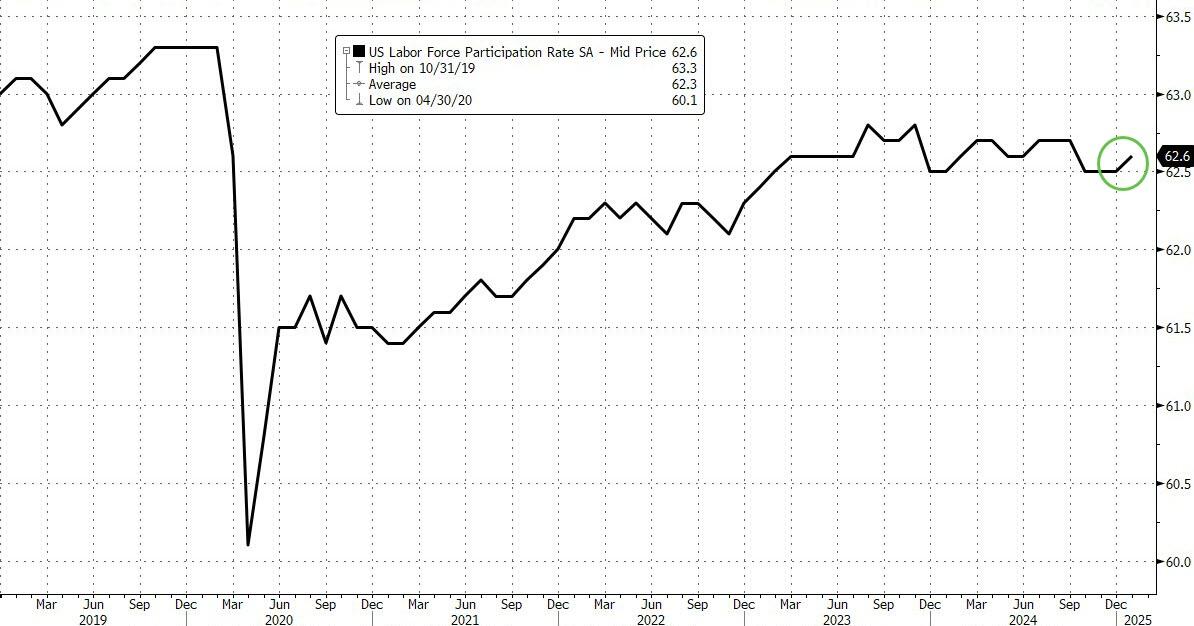
Despite the drop in the unemployment rate, the participation rate actually rose modestly from 62.5% to 62.6%.

Some more qualitative details from the report:

  • The number of long-term unemployed (those jobless for 27 weeks or more), at 1.4 million, changed little in January. The long-term unemployed accounted for 21.1 percent of all unemployed people.
  • In January, both the labor force participation rate (62.6 percent) and the employment-population ratio (60.1 percent) were unchanged, after accounting for the annual adjustments to the population controls.
  • The number of people employed part time for economic reasons, at 4.5 million, changed little in January. These individuals would have preferred full-time employment but were working part time because their hours had been reduced or they were unable to find full-time jobs.
  • The number of people not in the labor force who currently want a job, at 5.5 million, was little changed in January. These individuals were not counted as unemployed because they were not actively looking for work during the 4 weeks preceding the survey or were unavailable to take a job.
  • Among those not in the labor force who wanted a job, the number of people marginally attached to the labor force, at 1.6 million, was essentially unchanged in January. These individuals wanted and were available for work and had looked for a job sometime in the prior 12 months but had not looked for work in the 4 weeks preceding the survey. The number of discouraged workers, a subset of the marginally attached who believed that no jobs were available for them, changed little at 592,000 in January.

All of this, of course, is in the context of the massive downward revisions to 2024 payrolls which we discussed last night, and which look as follows: roughly 600K jobs lost every month last year.

Taking a closer look at the annual revisions which we discussed last night, and which affected both the Establishment Survey data and the Household Survey, this is what the BLS said, starting with the Establishment Survey:

In accordance with annual practice, the establishment survey data released today have been benchmarked to reflect comprehensive counts of payroll jobs for March 2024. These counts are derived principally from the Quarterly Census of Employment and Wages (QCEW), which counts jobs covered by the Unemployment Insurance (UI) tax system. The benchmark process results in revisions to not seasonally adjusted data from April 2023 forward. Seasonally adjusted data from January 2020 forward are subject to revision. In addition, data for some series prior to 2020, both seasonally adjusted and unadjusted, incorporate other revisions.

The seasonally adjusted total nonfarm employment level for March 2024 was revised downward by 589,000. On a not seasonally adjusted basis, the total nonfarm employment level for March 2024 was revised downward by 598,000, or -0.4 percent. Not seasonally adjusted, the absolute average benchmark revision over the past 10 years is 0.1 percent.

The over-the-year change in total nonfarm employment for March 2024 was revised from +2,900,000 to +2,346,000 (seasonally adjusted). Table A presents revised total nonfarm employment data on a seasonally adjusted basis from January to December 2024.

And here is the Household:

Effective with data for January 2025, updated population estimates were incorporated into the household survey. Population estimates for the household survey are developed by the U.S. Census Bureau. Each year, the Census Bureau updates their population estimates to incorporate new information and assumptions about the growth of the population since the most recent population base year, typically the last decennial census. The change in population reflected in the new estimates results from adjustments for net international migration, updated vital statistics on births and deaths, and improvements in estimation methodology.

This year’s adjustment was large relative to adjustments in past years. It reflects both updated methodology and new information about net international migration in recent years.

In accordance with usual practice, BLS did not revise the official household survey estimates for December 2024 and earlier months. However, to show the impact of the population adjustments, table B displays differences in selected December 2024 labor force series based on the old and new population estimates.

Table B shows the adjustment increased the estimated size of the civilian noninstitutional population age 16 and over in December by 2.9 million. The increases in population were relatively large for Asians and Hispanics. The adjustment increased the total civilian labor force by 2.1 million, including increases of 2.0 million in employment and 105,000 in unemployment. The number of people not in the labor force increased by 765,000. Although the effect on levels was relatively large, the effect on rates and ratios was small. The adjustment increased the total unemployment rate, employment-population ratio, and labor force participation rate by 0.1 percentage point each. The effects of the adjustment on these ratesfor the major worker groups were also relatively small.

While we will do a thorough breakdown of these numbers, perhaps the biggest surprise was in the wage department, because according to the BLS, average hourly earnings printed at 4.1% YoY, beating soundly the 3.8% estimates and unchanged from an upward revised December print (which was 3.9% before).

While some had worried that the recent California fires could impact today’s survey, the BLS denied that with the following comment: 

Wildfires in Southern California began in early January and continued through the reference periods for both the  household and establishment surveys. Severe winter weather occurred in much of the country during the January reference periods for both surveys. These events had no discernible effect on national payroll employment, hours, and earnings from the establishment survey, nor on the national unemployment rate from the household survey. Response rates for the two surveys were within normal ranges.

Finally, taking a closer look at the Establishment Survey we find the following breakdown of jobs by industry:

  • Health care added 44,000 jobs in January, with gains in hospitals (+14,000), nursing and residential care facilities (+13,000), and home health care services (+11,000). Job growth in health care averaged 57,000 per month in 2024.
  • Employment in retail trade increased by 34,000 in January. Job gains occurred in general merchandise retailers (+31,000) and furniture and home furnishings retailers (+5,000). Electronics and appliance retailers lost 7,000 jobs. Retail trade employment had shown little net change in 2024.
  • Social assistance added 22,000 jobs in January, led by individual and family services (+20,000). Employment also rose in the community food and housing, emergency, and other relief services industry (+4,000). Employment in social assistance grew by an average of 20,000 per month in 2024.
  • Government employment continued to trend up in January (+32,000), similar to the average monthly gain in 2024 (+38,000).
  • Employment in the mining, quarrying, and oil and gas extraction industry declined by 8,000 over the month, following little net change in 2024. In January, the job loss was concentrated in support activities for mining (-8,000).
  • Employment showed little change over the month in other major industries, including construction, manufacturing, wholesale trade, transportation and warehousing, information, financial activities, professional and business services, leisure and hospitality, and other services.

And visually

We will discuss today’s jobs revisions more in a subsequent post.

Tyler Durden
Fri, 02/07/2025 – 08:56

Futures Flat Ahead Of Payrolls

0
Futures Flat Ahead Of Payrolls

US equity futures are unchanged, with tech lagging and small caps leading as traders hunker down ahead of a payrolls report that is expected to show 175,000 new workers but will also be dramatically revised. As of 8:00am ET, S&P futures are flat with the index on track for a 0.7% weekly advance; Nasdaq futures are down 0.1%, with Mag 7 mostly lower after AMZN’s earnings disappointment last night (AMZN -2.6%; TSLA -1.5%; NVDA -0.9%); the e-commerce and cloud-computing company gave an outlook that was weaker than expected. Meanwhile, there seems to be no stopping Meta as the social networking giant is on track to extend gains for a record 15th consecutive session. Bond yields are largely flat; USD unchanged. Commodities are mostly higher led by oil (+0.8%). Today, the key macro focus will be NFP (a full scenario analysis from JPM and Goldman can be found here): the Street’s estimate is 175k; a step down from last month’s 256k print. For the unemployment rate the Street expects 4.1%. 

In premarket trading, Amazon was down 3% and is leading losses for the Mag7 after warning investors that it could face capacity constraints in its cloud computing division despite plans to invest some $100 billion this year, with most of the money going toward data centers, homegrown chips and other equipment to provide artificial intelligence services. Affirm Holdings rose 15% after the financial technology company reported quarterly results that beat expectations and gave an outlook that is seen as strong. Expedia shares jumped almost 10% in premarket trading after the online travel agency reported fourth-quarter results that beat expectations.  Here are some other notable premarket movers: 

  • Bill Holdings Inc. (BILL) sinks 29% after the company forecast total revenue for the third quarter below the average analyst estimate
  • Canopy Growth (CGC) falls 17% after posting a wider-than-expected quarterly loss.
  • Cloudflare (NET) climbs 10% after the software company reported fourth-quarter results that beat expectations
  • Denny’s (DENN) rises 4% after Wedbush raised the restaurant operator to outperform from neutral, calling its Keke’s breakfast chain “meaningfully undervalued and underappreciated”
  • Doximity (DOCS) rises 24% after the healthcare-software company raised its full-year forecast
  • Elf Beauty (ELF) plunges 27% after the cosmetics company lowered fiscal-year projections for sales and profits, citing softer-than-anticipated January trends
  • Fortinet (FTNT) rises 5% after the network security software provider’s forecast for 2025 revenue topped the average analyst estimate
  • Microchip Technology (MCHP) declines 6% after the semiconductor device company gave an outlook that was weaker than expected
  • Monolithic Power Systems (MPWR) rises 6% after the semiconductor device company gave an outlook for revenue that is much stronger than expected
  • Nikola Corp. (NKLA) falls 35% after the Wall Street Journal reported that the company is exploring filing for bankruptcy
  • Open Text ADRs (OTEX) are up 4% after the software company reported second-quarter results that beat expectations. However, analysts noted concerns about its outlook
  • Pinterest (PINS) jumps 20% after the company posted strong holiday-quarter revenue and gave an upbeat forecast for sales in the current period
  • Skechers (SKX) falls 12% after the footwear company issued annual forecasts for sales and profit that trailed Wall Street expectations
  • Take-Two (TTWO) jumps 10% after the video-game company reiterated its plan to launch the highly-anticipated Grand Theft Auto VI in fall 2025
  • Webtoon (WBTN) plummets 20% after the online comics company posted quarterly preliminary revenue that fell short of the average analyst estimate

All eyes now turn to the US jobs report which is expected to show 175,000 new roles added last month after advances in excess of 200,000 in the prior two months,  which partly reflected recovery from two severe hurricanes.  Wall Street will be closely watching a revision to job growth for the 12 months through the previous March. Economists expect the markdown to show a labor market that’s gradually cooling (our full preview is here).

“The stock market, needing a boost after a decent but lukewarm earnings season, could potentially rise if the job market shows signs of cooling,” said Florian Ielpo, head of macro research at Lombard Odier Investment Managers. An uptick in hiring might reignite concerns about inflation, he added.  

In other markets news, US Treasury Secretary Scott Bessent said that he favors a strong dollar and has no plans to alter the government’s debt-issuance plans. During the election campaign, President Donald Trump expressed concern about the strength of the dollar, given that it makes US products more expensive overseas.

“The strong-dollar policy is completely intact with President Trump,” Bessent said in an interview with Bloomberg. “We want the dollar to be strong. What we don’t want is other countries to weaken their currencies, to manipulate their trade.”

European equities traded lower on Friday after some key earnings reports disappointed and before investor focus switches to US employment data. Construction and material shares outperform in Europe after a flurry of well-received earnings updates. Consumer and health care stocks provide a drag however with the Stoxx 600 down 0.1%. Here are the biggest movers Friday:

  • Vinci gains as much as 4.4%, the most since July, after the French construction group’s full-year report shows another quarter of strong cash flows, analysts note
  • Danske Bank shares advanced as much as 7.5% to the highest level since March 2018 after it launched a new buyback program and pledged higher-than-expected dividends. Denmark’s largest lender also gave a profit outlook for this year
  • Thule shares rise as much as 5.6% and hit their highest level since April 2022 after fourth-quarter results from the Swedish maker of car roof racks and bike trailers beat estimates
  • Legal & General shares jump as much as 11%, the most since 2020, after the firm said it plans to sell its US protection business and return around £1 billion of the proceeds to its shareholders after striking a deal with its longstanding partner Meiji Yasuda
  • Iveco soar as much as 18%, the most on record, as the Italian truckmaker says it’s considering separating its defense business in 2025 through a spinoff
  • Telecom Italia shares rise as much as 5% to the highest in over a year, after newspaper Corriere della Sera reported that Iliad representatives met with Italy Finance Ministry officials in the past few days to pitch the benefits of combinations in the Italian telecom sector
  • L’Oreal shares in Paris drop as much as 4.5%, following the drop suffered by its ADRs in the US overnight, after the beauty company’s like-for-like sales for the fourth quarter missed consensus estimates
  • Porsche shares fall as much as 8% to an intraday record low valuation after the German carmaker slashed its 2025 guidance in a move Bernstein called a “major concern” after the company had described 2024 as its transition year. Citi sees shares testing new low
  • Saab shares fall as much as 6.5%, the most since October, as Citi spots the Swedish defense firm reduced its cumulative cash conversion guidance, and says investors may not like this. Shares rose 54% in 2024
  • Kongsberg shares fall as much as 3.4% after the Norwegian defense firm reported full-year results that failed to enthuse investors, as analysts note some margin weakness. The pullback follows a 175% surge in the shares last year

Asian stocks advanced, with gains in Chinese shares offsetting losses in Japan, as traders awaited US jobs data that will help provide clues for the Federal Reserve’s rate path. The MSCI Asia Pacific Index rose 0.1%, erasing an earlier 0.2% loss. Technology shares including TSMC and Tencent were among the biggest boosts. Toyota Motor dragged on the gauge as Japanese stocks fell on a stronger yen. Despite recent volatility in the market amid a brewing US-China trade war, some calm has returned as traders focus on earnings reports and economic data. The Asian stock benchmark is headed for a fourth-straight week of gains, the longest such win streak in 11 months.

In FX, the Bloomberg Dollar Spot Index is also little changed. The yen is the weakest of the G-10 currencies, falling 0.4% against the greenback and pushing USD/JPY above 152.

In rates, treasuries are steady with US 10-year yields trading around 4.435%, little changed on the day, with bunds and gilts outperforming by 1.5bp and 2.5bp in the sector; front-end Treasuries lagging has 2s10s spread flatter by 1.2bp, extending a three-day move that has seen the curve drop from around 30bp Wednesday to current 21bp. Bunds and gilts outperform over early London session, but price action broadly quiet ahead of the January nonfarm payrolls print expected at 8:30am New York time; German and UK 10-year yields down 1 bp each.

In commodities, oil prices advance, with WTI rising 0.8% to $71.20 a barrel. Spot gold climbs $8 to around $2,864/oz. Bitcoin rises 0.5% and above $97,000.

Looking to the day ahead, US economic data calendar includes January jobs report (8:30am), February University of Michigan sentiment, December wholesale inventories (10am) and December consumer credit (3pm). Fed speaker slate includes Bowman (9:25am) and Kugler (12pm).

Market Snapshot

  • S&P 500 futures little changed at 6,102.25
  • STOXX Europe 600 down 0.1% to 544.29
  • MXAP up 0.2% to 185.64
  • MXAPJ up 0.6% to 583.58
  • Nikkei down 0.7% to 38,787.02
  • Topix down 0.5% to 2,737.23
  • Hang Seng Index up 1.2% to 21,133.54
  • Shanghai Composite up 1.0% to 3,303.67
  • Sensex down 0.4% to 77,741.03
  • Australia S&P/ASX 200 down 0.1% to 8,511.43
  • Kospi down 0.6% to 2,521.92
  • German 10Y yield little changed at 2.36%
  • Euro little changed at $1.0393
  • Brent Futures up 0.6% to $74.70/bbl
  • Gold spot up 0.4% to $2,868.64
  • US Dollar Index little changed at 107.64

Top Overnight News

  • US President Trump signed an executive memo ordering a review of funding to all NGOs that rely on federal dollars, while it was also reported that the Trump administration is to keep just 294 USAID staff out of over 10,000 globally, according to sources cited by Reuters. In relevant news, the Trump administration is being sued by government workers over slashing of international aid agency USAID.
  • US House Speaker Johnson said they were working to finish the final details of the reconciliation bill and could wrap up the deal by Thursday night.
  • In just two weeks as Treasury chief, Scott Bessent has seen plenty of turbulence. The department became a target of Elon Musk’s crackdown on federal spending — triggering protests outside Bessent’s office — and investors are on edge over President Donald Trump’s unpredictable trade policies: BBG
  • House republicans are torn over the level of spending cuts, House GOP initially proposed USD 500bln to USD 1tln, conservative hardliners are pushing for at least USD 2.5tln: Punchbowl
  • US President Trump has reportedly placed VP Vance and NSA Waltz in charge of overseeing a potential sale of TikTok: Punchbowl
  • Fed’s Logan (2026 voter) said choices in 2025 boil down to resuming rate cuts soon or holding rates steady for quite some time, while she added that near-2% inflation with the labour market holding steady would not necessarily allow the Fed to cut rates soon. Logan also stated that a rise in inflation would signal monetary policy has more to do and cooling labour market or demand could be evidence it’s time to cut rates. Furthermore, she said estimates of the real neutral rate in the US vary widely, but most have moved up substantially since the pandemic and it will always be important to take broad financial conditions into account when setting monetary policy.
  • Porsche AG is falling further off track from lofty targets set during its splashy stock listing, with costs mounting from executives having misjudged how eager sports-car buyers were to go electric: BBG
  • Private equity’s favorite tax break is back in President Donald Trump’s crosshairs. Trump on Thursday told Republican lawmakers he wants to end the carried interest exemption used by legions of private equity fund managers and venture capitalists around the country, arguing it could be used to offset the multitrillion-dollar tax cut Republicans plan to pass before the end of the year: BBG
  • New York-based hedge fund Fir Tree Partners — known for instigating activist campaigns against distressed companies — is returning outside capital to investors: BBG

A more detailed look at global markets courtesy of Newsquawk

APAC stocks traded mixed following the similar performance stateside where price action was choppy amid soft data and as participants looked ahead to the latest key US jobs report. ASX 200 struggled for direction as strength in tech and consumer staples offset the losses in energy and healthcare. Nikkei 225 was pressured by recent currency strength and mild upside in yields but with losses cushioned by stronger-than-expected Household Spending data which showed a surprise M/M growth and the fastest Y/Y pace of increase since August 2022. Hang Seng and Shanghai Comp were on the front foot despite the absence of any major fresh catalysts with participants potentially taking solace from the lack of trade war escalation, while the gains in Hong Kong were led by advances in tech and auto names.

Top Asian News

  • Chinese Foreign Minister, in response to a media inquiry regarding reports that China is exploring a potential antitrust probe into Apple (AAPL) policies related to its app store policies and fees, says “he was not aware of the situation”, via Global Times
  • UMC (2303 TT) revenue +4.2% Y/Y to TWD 19.8bln.
  • RBI cut the Repurchase Rate by 25bps to 6.25%, as expected, via a unanimous vote and unanimously decided to maintain a neutral policy stance, while the Standing Deposit Facility rate was adjusted to 6.0% and the Marginal Standing Facility Rate was set at 6.5%. RBI Governor Malhotra stated that CPI has mostly stayed aligned with the target, barring a few occasions, as well as noted that growth is expected to recover and growth-inflation dynamics will open up space to support growth. He also commented that food inflation pressures should see significant softening, barring supply shocks, and core inflation is expected to rise but remain moderate. The central bank lowered its FY25 real GDP growth forecast to 6.4% from 6.6% and sees FY26 real GDP growth at 6.7%, while it maintained FY25 CPI inflation view at 4.8% and sees FY26 CPI inflation at 4.2%. Furthermore, Malhotra said exchange rate policy has remained consistent, with intervention focused on smoothing excess volatility and the RBI does not target any exchange rate level or band.
  • China mutual funds have reportedly been buying convertible bonds amid less supply with end-Q4 2024 fund holdings of convertible bonds reaching CNY 287.7bln, according to China Securities Journal.

European bourses (Stoxx 600 +0.1%) are mixed, with trade tentative ahead of the all-important US NFP report. European traders will also be cognizant of the ECB Staff Revision of the Natural Interest Rate. European sectors are mixed, and aside from the top/bottom performers, the breadth of the market is fairly narrow. Construction and Materials tops the pile, lifted by post-earning strength in Vinci; Consumer Products is weighed on by losses in L’Oreal (-4%) after posting weak LFL Sales in Q4 and highlighting poor Chinese demand.

Top European News

  • ECB’s Lane says services inflation in January was softer-than-expected; 2% inflation target should be achieved “fairly soon”.
  • ECB’s de Guindos says inflation is beginning to converge to 2% in spring, services inflation remains top price concern, need prudent approach to monetary policy.

FX

  • DXY is a touch softer with the USD mixed vs peers (firmer vs. havens, weaker vs. cyclicals). Today is of course NFP day with headline payrolls expected to slow to 170k from 256k and the unemployment rate hold steady at 4.1%. Note, today will also see the BLS publish its annual benchmark revisions.
  • EUR/USD is steady vs. the USD in the run-up to today’s publication of the ECB’s neutral rate. Ahead of which, ECB Chief Economist Lane has suggested that it is best not to focus too much on the neutral rate. EUR/USD is currently capped by the 1.04 mark and within yesterday’s 1.0352-1.0405 range.
  • JPY is a touch softer vs. the USD as havens lag cyclicals. Overnight, USD/JPY saw two-way price action in which it initially extended on recent declines after stronger-than-expected Household Spending data from Japan but then rebounded off support around the 151.00 level. Since then, the pair has made its way up to a 151.89 peak.
  • GBP is attempting to recoup some of Thursday’s BoE-induced losses, which were triggered by a “dovish cut” from the MPC as uber-hawk surprised markets with a vote for a 50bps cut. Cable is currently tucked within yesterday’s 1.2359-1.2509 range.
  • Antipodeans are both incrementally firmer vs. the USD in what has been a strong showing this week for both currencies after a shaky performance on Monday.
  • PBoC set USD/CNY mid-point at 7.1699 vs exp. 7.2780 (prev. 7.1691).
  • BoC Governor Macklem said they are facing new uncertainty with a shift in policy direction in the US and President Trump’s threats of new tariffs are already affecting business and household confidence, particularly in Canada and Mexico. Furthermore, Macklem said the world looks increasingly shock-prone and the longer the uncertainty persists, the more it will weigh on economic activity in their countries.

Fixed Income

  • USTs are flat and are awaiting today’s US NFP report, as well as the benchmark payroll revisions. Firstly, the pace of payroll additions is expected to ease towards recent averages with consensus looking for 170k; though, hurricane, wildfire, cold weather and industrial factors could all impact and weigh on the headline. Into the release, USTs hold in a particularly narrow 109-13+ to 109-20 band with yields mixed and the curve itself a touch flatter.
  • Bunds are contained; German export data was better than expected but sparked little move at the time. Bunds find themselves at the top-end of 133.29-49 band which is entirely within Thursday’s 133.13-61 parameters. No reaction to commentary from ECB’s Lane or de Guindos this morning, who both spoke on inflation. Traders are awaiting the ECB Natural Interest Rate release, due at 12:00GMT / 07:00 ET. Ahead of the release it is worth revisiting remarks from recent officials on where they think the Neutral Rate is, to surmise: Lagarde 1.75-2.25%; Schnabel 2.0-3.0%; Rehn 2.2-2.8%, Villeroy & Stournaras around 2.0% and Centeno >2.0%.
  • Gilts are contained with specifics light post-BoE and as the fixed complex is focussed on upcoming events from the ECB and US BLS. As such, Gilts are pivoting the unchanged mark in a 93.06-93.49 band.

Commodities

  • Crude futures overnight attempted to pick themselves up from the prior day’s trough. Newsflow was light this morning but Iran delivered some punchy rhetoric in which Leader Khamenei said talks with the US are neither smart, wise, nor honourable, according to IRNA. Brent Apr resides in a USD 74.26-75.12/bbl parameter.
  • Spot gold remains afloat but within Thursday’s ranges as the yellow metal bides times ahead of the US Jobs reports. China’s Financial Regulator will allow insurance funds to purchase gold as part of a pilot project – modest upticks in prices were seen around this time. Spot gold resides in a current USD 2,855.98-2,870.73/oz parameter.
  • Copper futures overnight edged mild gains amid the positive risk sentiment seen in its largest buyer, with traders now looking ahead to the US jobs report. 3M LME copper resides in a USD 9,295.97-9,433.00/t range.
  • China gold reserves end-Jan USD 206.53bln (vs end-Dec USD 191.34bln); Gold reserves 73.65mln toz (prev. 73.29mln toz).
  • China’s Financial Regulator will allow insurance funds to purchase gold as part of pilot project

Geopolitics

  • Russian Kremlin’s Peskov says Russia is open to negotiations on Ukraine.
  • IAEA Head Grossi says the number of attacks on Zaporizhia nuclear power plant in Ukraine has increased; adds the situation is tough, via Tass
  • “Al-Arabiya sources: Hamas informed mediators that Israel did not abide by the agreed humanitarian protocol” and as such Hamas is “Delaying the names of hostages scheduled to be released tomorrow”.
  • Russia’s Kremlin says Russia and the US have not yet begun to discuss a possible Trump-Putin meeting and there have been no initial contacts about whether such a meeting is needed or where and how it might take place if it is, according to IFAX.
  • Israel’s army conducted a strike in Lebanese territory on two military sites that contained Hezbollah weapons.
  • Taiwan announced that it detected six Chinese balloons near the island, while it also detected nine Chinese military aircraft, six warships and two official ships in the prior 24 hours.

US Event Calendar

  • 08:30: Jan. Change in Nonfarm Payrolls, est. 175,000, prior 256,000
    • Jan. Change in Private Payrolls, est. 158,000, prior 223,000
    • Jan. Unemployment Rate, est. 4.1%, prior 4.1%
    • Jan. Underemployment Rate, prior 7.5%
    • Jan. Labor Force Participation Rate, est. 62.5%, prior 62.5%
    • Jan. Average Weekly Hours All Emplo, est. 34.3, prior 34.3
    • Jan. Average Hourly Earnings YoY, est. 3.8%, prior 3.9%
    • Jan. Average Hourly Earnings MoM, est. 0.3%, prior 0.3%
  • 10:00: Dec. Wholesale Trade Sales MoM, est. 0.5%, prior 0.6%
    • Dec. Wholesale Inventories MoM, est. -0.5%, prior -0.5%
  • 10:00: Feb. U. of Mich. Sentiment, est. 71.8, prior 71.1
    • Feb. U. of Mich. Current Conditions, est. 73.7, prior 74.0
    • Feb. U. of Mich. Expectations, est. 70.1, prior 69.3
    • Feb. U. of Mich. 1 Yr Inflation, est. 3.3%, prior 3.3%
    • Feb. U. of Mich. 5-10 Yr Inflation, est. 3.2%, prior 3.2%
  • 15:00: Dec. Consumer Credit, est. $14.6b, prior -$7.49b

DB’s Jim Reid concludes the overnight wrap

As we reach the end of another exhausting week where the themes at the end of it are a long way from where they were on the Monday, I have a film recommendation for you for the weekend if you’re looking to switch off, especially if you like music! It’s over 10 years old but I finally watched a film called “Searching for Sugarman” last weekend. It was a remarkable documentary that if paraded as fiction you would say was too unrealistic. It is about a musician who was relatively unknown in the US (circa 1970) and soon went back to labouring after releasing two unsuccessful albums. 

Unbeknown to him he became bigger than Elvis in South Africa (selling half a million copies) but in an age of apartheid and without the internet, they knew nothing about him and the stories were that he was dead. It took 25 years for him to realise his fame abroad and for them to realise he wasn’t dead. You can then see the movie for what happened next. It inspired me to believe that my former band Vapour Trail might be bigger than the Beatles in say North Korea. I live in hope.

After Monday’s trade-related slump, film scriptwriters would have been thrown out for a plot that had markets hitting or approaching their highs by the end of the week. But that’s what’s happened, and last night the S&P 500 (+0.36%) closed less than 1% away from its all-time high, whilst Europe’s STOXX 600 (+1.17%) hit a new record. In fact, the German DAX (+1.47%) even took its YTD gains above the 10% mark, making it the only major global index to do so this year, which is pretty striking when you consider the sensitivity of German automakers to the tariff threats. Nevertheless, markets have continued to take the trade news in their stride, and investors remain sceptical that President Trump will follow through on his more aggressive threats, which has helped to support a broader recovery in risk assets since the weekend.

Having said that, the positive mood has lost a bit of ground on Amazon’s results after the close. The company delivered a solid earnings beat but this was overshadowed by slower cloud growth and weaker guidance for Q1, with projected operating income in the $14bn to $18bn range (vs $18.2bn average estimate). Amazon’s CEO noted capacity constraints in cloud computing, with plans to invest $100bn in 2025, and its shares fell by about -4% in after-market trading. If confirmed in today’s regular session, it would make it 4 out of 6 of the Magnificent 7 reporting so far that’s seen a negative market reaction. See my CoTD yesterday here that speculates whether the hyperscalers within the Mag-7 are in a “winner’s curse” at the moment, where to stay in the game they have to spend mind boggling sums on Capex. Like the telcos in 1999/00 with 3G licences but obviously without the debt. This capex spend encourages share price appreciation when no-one has any doubts about eventual AI monetisation, but begins to become an issue when doubts emerge. You have certainly seen that a bit more this results season.

Of the Mag-7 there is now just Nvidia left to report on February 26th so the group have some space now. And prior to Amazon’s results, tech stocks had a pretty solid day, with the Mag-7 (+0.68%) and NASDAQ (+0.51%) slightly outperforming the S&P 500 (+0.36%). That said, the equity gains were far from uniform with equal-weighted S&P 500 (-0.12%) and the small cap Russell 2000 (-0.39%) both retreating.

Overnight in Asia, we’ve seen a mixed performance for equity markets. In Hong Kong, the Hang Seng (+1.28%) is on track for its highest closing level since October, and both the CSI 300 (+1.59%) and the Shanghai Comp (+1.32%) have also seen solid gains. But elsewhere the performance has been more negative, with the Nikkei (-0.55%) and the KOSPI (-0.41%) both losing ground, whilst US equity futures are also pointing a bit lower, with those on the S&P 500 down -0.09%.

Meanwhile in Japan, there was further strong economic data overnight, with real household spending up +2.7% year-on-year in December (vs. +0.5% expected). That’s the fastest pace since August 2022, which is helping to cement expectations that the BoJ will keep hiking over the months ahead. Indeed, the 2yr Japanese government bond yield (+3.3bps) is up to 0.79%, which is the highest it’s been since 2007. And the 10yr yield is up +2.7bps to 1.29%, the highest since 2011.

Looking forward now, today’s main highlight will be the US jobs report for January, which is coming out at 13:30 London time. In terms of what to expect, our US economists are looking for nonfarm payrolls at +175k, dipping down from the 9-month high of +256k in December. Part of that downtick is because of the Los Angeles wildfires, which occurred during the survey week, but they think the unemployment rate should remain at 4.1%. The other important feature of today’s report is the annual benchmark revisions, meaning that the previous 5 years of payrolls are subject to revisions this month. For more details, see our economists’ preview here and how to sign up for their subsequent webinar.

Ahead of the jobs report, the weekly initial jobless claims were a bit worse than expected, rising to 219k in the week ending February 1 (vs. 213k expected). That also pushed the 4-week moving average up to 216.75k, its highest so far this year. But even so, US Treasury yields ticked up across the curve, with the 2yr yield up +2.6bps to 4.215%, whilst the 10yr yield was up +1.8bps to 4.44%. That came as investors dialled back the likelihood of rate cuts this year, with the amount priced in by December down -2.7bps on the day to 44bps. That’s continued to dial back overnight, following comments from Dallas Fed President Logan that even if inflation moved close to 2% in the months ahead, “it wouldn’t necessarily allow the FOMC to cut rates soon, in my view”.

Other notable comments came in an interview by Treasury Secretary Bessent, who reiterated a preference for lower 10yr yields, which he said would naturally come down under Trump’s policies. He also said he did not “foresee any changes in the issuance (of Treasuries) for the foreseeable future” and noted that the US would continue to have a “strong dollar” policy.

Over in Europe, the main story came from the UK, as the Bank of England delivered another 25bp rate cut, taking their policy rate down to 4.5%. Significantly, the vote was a 7-2 split, with the two dissenters wanting a larger 50bp rate cut, and their latest forecasts halved the growth projection for 2025 to 0.75%, down from 1.5% three months ago. On top of that, they’re now forecasting CPI inflation rising to 3.7% in Q3, so in general the forecasts moved in a stagflationary direction.

With investors anticipating more rate cuts this year in response, sterling was the worst-performing G10 currency on the day, weakening -0.56% against the US Dollar. However, even though front-end gilt yields fell initially, they ended the day higher after Governor Bailey said he wouldn’t “put too much weight on the voting”. So by the close, the 2yr gilt yield was up +2.2bps, and the 10yr gilt yield was up +4.9bps. In addition, the rhetoric from the BoE themselves was still fairly cautious, with the summary saying that “a gradual and careful approach to the further withdrawal of monetary policy restraint is appropriate.”

Elsewhere in Europe, the risk-on tone was clear from several angles, as the STOXX 600 (+1.17%) pushed up to a new record. Those moves were also evident in the bond market, where yields on 10yr bunds (+1.2bps) moved a bit higher, and there was a fresh tightening in sovereign bond spreads as well. In fact, the Franco-German 10yr spread tightened to just 71.3bps yesterday, which is the tightest it’s been since mid-September.

Finally on central banks, today is also set to bring the ECB’s review on where they see r*, or what’s called the neutral/natural/equilibrium interest rate. In simple language, it’s the rate at which monetary policy is neither stimulating nor restricting the economy, hence “neutral”. But it’s a theoretical concept that can’t be directly observed, so economists have a range of estimates for where that is for different countries. For markets, the significance is it’ll offer an indication of how far the ECB think their current deposit rate of 2.75% is above neutral, and hence how much further they might cut rates.

To the day ahead, and the main highlight will be the US jobs report for January. Other data releases include the University of Michigan’s preliminary consumer sentiment index for February (watch inflation expectations), along with German industrial production for December. From central banks, we’ll hear from ECB Vice President de Guindos, the Fed’s Bowman and Kugler, along with the BoE’s Pill.


Tyler Durden
Fri, 02/07/2025 – 08:24

Cocoa Prices Go Bitter After Hershey CEO Spots “Demand Destruction”

0
Cocoa Prices Go Bitter After Hershey CEO Spots “Demand Destruction”

Cocoa futures declined in New York following comments from Hershey CEO Michele Buck, who indicated on an earnings call with investors that signs of potential demand weakness are emerging. 

Earlier, Piper Sandler analyst Michael Lavery asked CEO Buck:

“You mentioned in – you mentioned in your prepared remarks, you’re seeing cocoa end-users adapting through reformulation. Could you maybe touch on what exactly you’re seeing there and if you are reformulating yourselves as well?”

Buck responded:

“We have been seeing some increased global demand across the market for cocoa alternatives. So we are seeing some folks who are pressured and who perhaps have the opportunity to switch to cocoa butter alternatives. Obviously, we’re — we do that where possible, but we’re pretty precious about the brands and what they stand for with consumers.”

And she continued (this is what caught the attention of the cocoa traders…): 

“Yeah, it does create some demand destruction in the market as we see others do that.” 

Bloomberg noted that Buck’s concerns about souring demand aligned with those of Mondelez CFO Luca Zaramella, who stated earlier this week that cocoa consumption is sliding in parts of the world, including North America. 

The most active cocoa futures in New York nearly doubled in the latter parts of 2024 on a bleak production outlook for cocoa farms across West Africa. Contracts fell about 5% on Thursday, hovering around the $10,000 per ton level by lunch.  

Last month, a Bloomberg report specified that Hershey was trying to gain approval from the Commodity Futures Trading Commission to purchase a massive amount of cocoa through the New York exchange. 

“The headlines on Hershey today suggest the outlook for confectionary (cocoa) cost inflation is getting even more extreme,” Goldman’s Natasha de la Grense told clients following the Bloomberg report. 

In mid-December, Goldman’s commodity derivatives analyst Hugo Fuentes told clients to “go long cocoa” as “prices are positioned for significant upside driven by structural supply deficits, under-hedged consumers, and historically low warehouse stocks.” 

Signs of demand destruction may spook the cocoa rally, and potentially, some of the first signs are materializing this week with Hershey and Mondelez. 

Tyler Durden
Fri, 02/07/2025 – 07:45

Microplastics Found In Brain Weighs As Much As A Plastic Spoon: Study

0
Microplastics Found In Brain Weighs As Much As A Plastic Spoon: Study

Authored by Cara Michelle Miller via The Epoch Times (emphasis ours),

Microplastics are making their way into human brains at higher levels than in other vital organs, according to new findings.

SIVStockStudio/Shutterstock

The study, published in Nature Medicine on Feb. 3, confirms that tiny plastic fragments are passing through the brain’s protective blood-brain barrier, potentially impacting health and cognitive function.

Researchers from the University of New Mexico (UNM) tested autopsy samples from 2016 and 2024. They found that over just 8 years, the amount of microplastic fragments in the brain has increased by about 50 percent. Brain samples from 2024 contained microplastics equal in weight to a plastic spoon.

Brains affected by dementia showed significantly higher concentrations of these plastic particles.

Finding such high concentrations in the brain was unexpected and alarming, Matthew Campen, lead researcher and toxicologist, told The Epoch Times during a press conference.

“People are simply being exposed to ever-increasing levels of micro- and nanoplastics,” said Campen. The particles are so small, they’re roughly the width of two COVID viruses standing side by side, he noted.

The rate of accumulation “is simply mirroring the environmental buildup and exposure.” As plastic breaks down over time, it degrades and becomes small enough to enter the human body and brain.

Plastic Pollution in Organs

Brain tissue contained 7 to 30 times more microplastics than other vital organs like the livers or kidneys, making it one of the most plastic-polluted tissues yet examined.

Researchers tested 52 human brain samples from both 2016 and 2024, all taken from the frontal cortex—the part of the brain responsible for judgment, decision-making, and muscle movement.

In the brain, the microplastic concentration reached around 5,000 micrograms per gram—far higher than the liver and kidneys, which carried around 400 micrograms of plastics per gram.

The study also compared earlier brain samples from the eastern U.S. (1997–2013), which had lower microplastic levels, around 1,250 micrograms per gram. Their findings support a trend of gradual increases in plastic accumulation in the organs over time, with 2024 showing the highest levels.

To visualize the amount of microplastics in the brain, Campen held up a plastic spoon. Since the brain weighs around 1,400 grams (or three pounds), having 5,000 micrograms of plastic per gram would amount to over 5 grams of plastic in total—roughly the weight of a plastic spoon.

In deceased people with dementia, levels reached much higher levels of over 26,000 micrograms per gram. In the dementia samples, some particles were clumped together in areas with inflammation, raising concerns about a possible link between microplastics and brain tissue damage, according to the researchers.

However, while the study correlates microplastics to dementia, the study does not prove that higher plastic levels in the brain directly cause dementia symptoms.

It is also possible that the disease process itself may hinder the brain’s ability to clear out the accumulated plastics, Campen added.

Common Plastic Found in the Brain

Researchers found 12 types of plastic in the brain, with polyethylene (PE), commonly used in bottles, bags, and containers, making up 75 percent of the total. Other plastics included types commonly found in packaging, car parts, pipes, flooring, bottles, containers, fabrics, and other industrial products.

“It was notable that these are largely mirroring proportions of polymers that we do see in our environment,” Marcus Garcia, study co-author and postdoctoral researcher at UNM, explained to The Epoch Times during the press briefing.

The particles in the brain were mostly sharp nanoscale shards and flakes. These tiny particles are small enough to cross the blood-brain barrier, although Campen says it’s still unclear how exactly the particles enter the brain.

Researchers believe that micro- and nanoplastics may enter the body through eating, drinking, and breathing. These particles have been found in various parts of the body, including arteries, hearts, lungs, blood, and placentas. A study published on Jan. 30 found plastic pollution to be significantly higher in placentas from premature births.

One possible reason for the buildup, according to Garcia, is that organs like the liver and kidneys are designed to filter toxins, while the brain has more limited clearance systems.

Another theory is that brain tissue, which is about 60 percent fat, may better “trap” plastic particles.

“If you’ve ever cleaned a Tupperware bowl that had bacon grease or butter in it, you know, it takes a lot of soap and hot water. It’s really hard to get the plastics and fats apart,” Campen said. He suggests that microplastics might be “hijacking” their way into the brain along with dietary fats being metabolized.

The finding also lends concerns to plastics being used in some medical applications, like heart stents or artificial joints.

According to Campen, the physical properties of the plastic particles could be the main issue, rather than any chemical toxicity.

These plastics might obstruct blood flow in capillaries, he speculated. There is also the potential that they could interfere with the connections between brain cells. But “we just don’t know for sure.”

Bigger Picture

Despite the concerning rise in microplastics, Campen believes the data provide some optimism: The observation that plastic levels are similar in both older and younger people suggests that there may be natural processes at play to help manage or rid the body of them over time.

The researchers believe that many of these particles come from older “decades old, degraded plastics” that have been discarded and left to break down in the environment over the years, Campen said. This insight can help guide environmental policies that include older sources, rather than focusing solely on newer products.

Effective environmental policies aimed at reducing plastic pollution could help limit future exposure, Campen said. Microplastic pollution is increasing rapidly, with levels in the environment doubling every 10 to 15 years, he said, and adding that addressing the source of this pollution could help slow down this build up in our bodies.

Currently, no treatment exists to remove microplastics from the body. To help reduce exposure, Campen and his colleagues are investigating the sources of microplastics in the environment, including in soil, plants, and even meat.

“I don’t feel comfortable with this much plastic in my brain,” Campen said. “I don’t want to wait 30 more years to see what happens if the concentrations keep rising.”

Tyler Durden
Fri, 02/07/2025 – 05:00

Iran Inaugurates First-Ever Drone Carrier Warship In Persian Gulf

0
Iran Inaugurates First-Ever Drone Carrier Warship In Persian Gulf

Iran on Thursday unveiled and inaugurated its first ever drone-carrier warship, which features a 180-meter long runway for UAVS, and which is capable of carry several helicopters.

Manned by the elite paramilitary Revolutionary Guard’s navy (IRGC), the vessel is dubbed Shahid Bagheri, and is further capable of launching cruise missiles.

Iran’s Shahid Bagheri drone carrier, via Press TV

Iran’s military and media is touting that the ship is able to travel “independently” across the globe’s oceans for up to one year, and it can go up to 22,000 nautical miles without needing to refuel in ports.

The vessel began its life as a commercial ship, and was overhauled and completely re-outfitted for as a drone carrier.

“The Revolutionary Guards took action to transform a commercial ship… into a mobile naval platform capable of carrying out drone and helicopter missions in the oceans,” said Navy Commander of the Revolutionary Guards Alireza Tangsiri.

“The addition of this ship to our fleet is an important step in increasing the defense and deterrence capability of Iran in distant waters and in maintaining our national security interests,” Tangsiri added.

State IRNA has touted that the carrier has a capacity of carrying 60 drones. A state TV broadcast unveiling the Shahid Bagheri showed at least four helicopters and three UAVs on the warship’s runway at the time of the footage.

Tehran officials are further hailing it as the “largest naval military project” in the history of the Islamic Republic.

State media footage featuring the drone carrier in action…

Chief of the Guard’s navy Adm. Ali Reza Tangsiri described that the project to transform a commercial vessel into a drone warship took over two years, and that it even features a hospital and gym for the crew.

Some military analysts in the West have criticized that Iran’s drone arsenal mainly consists of much bigger drones, and that the released footage seems to feature smaller RC jet planes.

In that sense, it would indeed be a lot of fun to launch RC planes off this thing…

It is joining the IRGC fleet in the Persian Gulf, and is now sailing after last year’s major Iranian attack on Israel using ballistic missiles and drones. Small drone warfare is becoming increasingly prominent in hotspots around the world.

For example, Russia heavily relies on Iranian suicide drones during attacks on Ukrainian cities – something which the West has fiercely condemned. 

Tyler Durden
Fri, 02/07/2025 – 04:15