Trump Says “Perimeters Of A Deal Reached” With Iran To Reopen Hormuz After Call With Saudi Crown Prince
The past few days have been tense. Although no US strikes were launched from Friday night into Saturday morning and the Gulf region remained quiet early Sunday, anticipation surrounding President Trump’s next move is keeping energy traders and Gulf governments on edge. The big concern is that another round of strikes could trigger a wider regional conflict, particularly as the Iranian-backed Houthis have reactivated offensive operations in the southern Red Sea in recent weeks.
The Trump administration and Department of War may pursue de-escalation from here after Trump wrote on Truth Social late Saturday night: “We have just been asked by Iran, and other Middle Eastern Countries, to hold off any attack in that the perimeters of a deal has been agreed to.”
“Tonight from 9:36 PM to 9:37 PM the S&P 500 price on Hyperliquid spiked bigly, and I couldn’t figure out why… …then Trump posted his TACO @ 10:05 PM. THEN I understood why,” X user Stanphyl Capital wrote.
That de-esclation pathway was followed by a new signal early Sudnay from Saudi Press Agency, Saudi Arabia’s official state news agency, stating that Saudi Crown Prince Mohammed bin Salman held a call with President Trump, discussing the “necessity of prioritizing dialogue to de-escalate tensions and the importance of exerting all possible efforts to achieve a truce that paves the way for diplomatic solutions that yield positive results for preserving the security and stability of the region and prevent it from being drawn into a wider conflict whose repercussions would affect regional and international security and stability.”
The MbS-Trump call was first reported by Axios, which got the scoop on Saturday evening:
Saudi Crown Prince Mohammed bin Salman spoke to President Trump on Saturday and expressed concern over his plans for massive new strikes against Iran, according to two U.S. officials and a third source with knowledge of the call.
. . .
Such an attack could lead to an unprecedented escalation in the five-month war, which has repeatedly paused as Trump opened the door to negotiations — only to resume when those diplomatic efforts failed.
Iran has threatened to retaliate by launching attacks against energy and infrastructure facilities in Israel and the Gulf countries
The Saudis expressed concern and asked for clarity about the plan of action,” one U.S. official told Axios.
A second source with knowledge of the call said MBS urged Trump to de-escalate and refrain from launching the strikes.
Why the MBS-Trump conversation matters is that Saudi Arabia remains one of Washington’s top Gulf region allies. Riyadh has heavily influenced Trump’s Iran policy at previous inflection points and appears to have exerted similar influence in delaying or narrowing the next phase of US military action.
Female Bomber Kills At Least 3, Injures 21, At Upscale Moscow Restaurant
A bomb ripped through a central Moscow upscale restaurant mid-evening on Saturday in what authorities are calling a “brutal terrorist act” – which left three people dead and wounded at least 21.
“Yesterday, a brutal terrorist act was committed in Moscow that claimed human lives. The victims are currently in the city’s hospitals, where they are receiving all necessary care,” Moscow mayor Sergei Sobyanin stated Sunday.
The location was at Kudrinkskaya Square outside an Italian restaurant, in one of Moscow’s seven Stalin-era skyscrapers, police described.
Russia’s anti-terrorism committee stated the culprit was an unidentified woman carrying an improvised explosive device who tried get into the restaurant before being stopped by a security guard, who was killed in the subsequent blast, along with a customer.
The Guardian notes that the death toll could climb as many victims are being treated at area hospitals:
REN TV cited a source on Sunday as saying that two people who had been taken to hospital had later died of their wounds, bringing the death toll to five, but there was no official confirmation. The channel said six people were in a serious condition.
There’s been widespread speculation as to what entity carried out the attack, and who was the intended target.
“Unverified social media reports suggested that a top Russian military commander had been the intended target but had been unharmed,” The Moscow Times writes. “Russian war bloggers, without citing any evidence, were quick to blame Ukraine for the attack. Kyiv did not immediately comment.”
The same report adds, “The Kommersant daily suggested that the woman carrying the bomb may not have known about it, and that it had been set off remotely by someone else,” and it notes that “The restaurant’s website said the venue had been closed on Saturday for a private event.”
This terror attack possibly adds, pending the details, to a growing list of high profile assassinations related to the Ukraine war. To review:
—Darya Dugina was killed in a car bombing in 2022 which was likely meant for her father, prominent political thinker and often dubbed “Putin ally” Aleksandr Dugin.
—Gen Igor Kirillov died in December 2024 outside of his residence when a bomb planted in a nearby scooter detonated.
—Gen Yaroslav Moskalik, who served asdeputy head of the Main Operations Directorate of the General Staff of the Russian Armed Forces, was killed in a car bomb attack last April. A “homemade” explosive device detonated under his Volkswagen Golf in a residential neighborhood.
And in circumstances somewhat similar to this latest restaurant bombing, in April 2023 a cafe bombing killed prominent pro-Kremlin blogger and war correspondent Vladlen Tatarsky. The blast at a St. Petersburg cafe during a close-quarters speaking event wounded some two dozen bystanders, six of them critically.
Russian media have reported details of the attack near Moscow’s Balzi Rossi restaurant, where an improvised explosive device detonated yesterday:
America’s CIA or Britain’s MI6 has long been suspected by some pundits of being involved in these targeted killings, or at least assisting in such brazen Ukrainian-linked operations, but ultimately little has been uncovered or proven in terms of a potential Western hidden hand in this ongoing ‘dirty war’.
Marxist Terror Group Responsible For Colombian Truck Bomb Attack
Summary:
VBIED Attack Comes Days Before President-Elect Abelardo de la Espriella’s Inauguration
Marxist-Leninist Terror Group Responsible For Truck Bomb Attack
Twin Car Bombs Rock Colombian City Days Before Trump-Backed “El Tigre” Takes Power
Marxist-Leninist Terror Group Responsible For Truck Bomb Attack
The Colombian government blamed the far-left, Marxist-Leninist ELN for the truck bombing outside a police headquarters in the border city of Cúcuta, which injured 11 officers and killed a police dog.
The early Saturday morning VBIED attack damaged the building’s roof and shattered its windows, according to police chief Gen. William Rincón.
“This was a vile terrorist attack,” Rincón told AP News. “We will not rest until we find those who are responsible and have them prosecuted.”
COLOMBIA: UN CAMIÓN CON EXPLOSIVOS ESTALLÓ EN CÚCUTA A DÍAS DE LA ASUNCIÓN DE DE LA ESPRIELLA
Un camión cargado con explosivos estalló junto a una estación de Policía en Cúcuta, cerca de la frontera con Venezuela, y dejó al menos 11 heridos y daños en viviendas. El ataque… pic.twitter.com/wcU9bsNoRr
The attack comes just days before President-elect Abelardo de la Espriella – a Trump-backed conservative who has pledged to restore law and order and wage war on rebel groups – takes office.
The ELN is believed to have about 6,000 fighters operating across Colombia and neighboring Venezuela.
Its ideology combines:
Revolutionary socialism and communism
Cuban-style Guevarism
Anti-capitalism and anti-American “imperialism”
Land and resource redistribution
Its activities include:
Attacks against Colombian security forces and oil infrastructure
Twin Car Bombs Rock Colombian City Days Before Trump-Backed “El Tigre” Takes Power
Details remain limited, but initial reports and footage on X suggest that one or more vehicle-borne improvised explosive devices (VBIEDs), commonly known as car or truck bombs, detonated near a police station in Cúcuta, Colombia, close to the Venezuelan border.
The apparent VBIED attack occurred just six days before President-elect Abelardo de la Espriella’s inauguration, which will transfer power from Gustavo Petro’s socialist regime to a right-wing administration expected to align closely with the Trump administration.
Footage:
Desde otros puntos de Cúcuta también fueron captadas las explosiones en contra del comando de la Policía de Norte de Santander.
El atentado estaría dirigido contra la Unidad de Operaciones Especiales Jungla.
Un camión con explosivos estalló el sábado junto a una estación de policía en la ciudad colombiana de Cúcuta, cerca de la frontera con Venezuela, seis días antes de la investidura del presidente electo Abelardo de la Espriella, constataron periodistas de la @AFP.
#EnDesarrollo | Al menos una decena de personas heridas, entre uniformados y civiles, deja un violento ataque con exposivos contra el comando de la Policía Norte de Santander, en Cúcuta.
Los hechos ocurrieron en la madrugada de este sábado cuando fueron activadas varias cargas… pic.twitter.com/CjpANSGbVc
— Metropolitano Noticias (@metropolitano_X) August 1, 2026
🔴Un atentado con explosivos se registró en la madrugada de este sábado 1 de agosto en inmediaciones del comando del Departamento de Policía de Norte de Santander, en Cúcuta.
De la Espriella, a conservative lawyer known as “El Tigre,” has pledged to intensify operations against guerrillas and drug-trafficking organizations, abandon the socialists’ peace negotiations, and pursue deeper military cooperation with the US.
Around 11,000 soldiers and police officers are expected to secure the inauguration through coordinated land, air, and maritime operations. De la Espriella has repeatedly warned of an alleged plot to assassinate him by left-wing groups.
El Tigre’s rise to power comes amid a once-in-a-generation shift from nation-killing left-wing regimes across the Americas to right-wing governments closely aligned with the Trump administration. The State Department has pursued this strategy to secure the West, ensure countries align with the US, not China or Russia, and promote open and free markets over broken Marxist ones.
Americas Political Map: Presidential Shift From Left To Right
Country-by-country presidential shift tracker
“For the first time in 15–20 years, the overwhelming majority of the countries in the Western Hemisphere are now led by pro-American leaders and governments since @POTUS was elected president,” Secretary of State Marco Rubio announced on Friday with President Trump and Secretary of War Pete Hegseth.
Hunter Biden is no Van Gogh. In addition to having both ears, Hunter’s work has generally been panned beyond an enabling media following. However, he claims he is also a starving artist. The problem appears to be that, as predicted years ago, his sales dried up in the influence-peddling market once his father left office.
Now, his lawyers want him to cough up $17 million that he owes them. Hunter says that not only is he broke, but so is his family.
In a deposition in ongoing litigation with the law firm Winston Taylor, Hunter claimed an inability to pay the $17 million he owes his lawyers for representing him in criminal prosecutions, congressional investigations, and civil lawsuits.
Hunter claimed under oath that “I don’t own anything of any value other than — and I don’t know the value of it — my paintings which I painted myself. So that’s it. And I don’t even have any other assets at all, stocks, bonds, anything like that, savings accounts.”
He also added, “My family doesn’t have any money, and it’s not their debt anyway.”
The statement about his family is curious, since Joe and Jill Biden recently received numerous book contracts and were thought to be worth millions. However, the Wall Street Journal recently reported that Joe Biden is struggling with $800,000 in debt and, ironically, increased property taxes in his blue state of Delaware on his $2.7 million home. (Moving to Florida like many fleeing blue state taxes is not a viable option for the Bidens).
Worse yet, no one wants Biden to do speeches and appearances, cutting off a lucrative post-presidency income. Not only is Biden obviously diminished in his ability to give a speech, but many Democrats blame him for the reelection of Trump by clinging to power despite his obvious deteriorating mental and physical condition.
Of course, the former president still rakes in more than $400,000 a year in government pensions.
Yet, in the end, Hunter is correct. It is not their debt unless they signed as guarantors on any debt.
Hunter continues to be the darling of the media with podcasts and interviews, including some who have called for him to run for president. He has lived in mansions and luxurious hotels for much of his life. However, that lifestyle was subsidized by wealthy Democratic donors and friends.
What is impressive is how Hunter could burn through millions accrued from alleged influence peddling and shady deals.
Notably, Fox News reports that the law firm, which is known for representing Democratic figures, has tried to connect Biden with donors to help him cover his legal bills, without success. With his father out of power, no one is willing to bankroll his lifestyle or buy his art.
Gone are the former swaggering threats that Hunter could make to shake down foreign figures. There was a time when he only needed to pick up a phone and send a text message like the one to a Chinese businessman, openly threatening Joe Biden’s displeasure if money is not sent to them immediately. In the WhatsApp message, Hunter stated:
“I am sitting here with my father, and we would like to understand why the commitment made has not been fulfilled. Tell the director that I would like to resolve this now before it gets out of hand, and now means tonight. And, Z, if I get a call or text from anyone involved in this other than you, Zhang, or the Chairman, I will make certain that between the man sitting next to me and every person he knows and my ability to forever hold a grudge that you will regret not following my direction. I am sitting here waiting for the call with my father.”
No one is answering now.
Hunter insisted that he is now virtually destitute: “I don’t have any assets. I don’t own a car. I don’t own a phone.”
Even his recent dubious award of $1.7 million in a defamation case was immediately claimed by the law firm, though that award can and should be appealed.
Hunter has written extensively on his struggle with drugs and alcohol. It is a great achievement to have overcome those addictions. Yet, the accounts would be more compelling if he did not unleash a scorched-earth campaign against critics when he was sober. He sued or threatened to sue a wide array of people to try to muscle them into silence. I was one of those threatened with a defamation lawsuit by his friend and sponsor Kevin Morris for writing about their curious relationship.
Hunter gamed the system on his crimes and was ultimately rescued from prison only by his father breaking his repeated public promise not to pardon his son.
Yet, Hunter is likely to live well as a ward of the privileged class. He remains the toast of the town for the left, a type of foul-mouthed prophet who claims to have been liberated by his own excesses. For those of us who have long been critics of his antics, it remains a bit too familiar.
The highest-ranking US general in Europe informed the Pentagon this week that he does not have enough naval units to protect Israel against potential Iranian missile strikes, according to a report by the Washington Post on Saturday.
General Alexus Grynkewich, the head of US European Command (EUCOM), notified senior Pentagon officials in writing that without another navy destroyer, he will be forced to choose between defending the US “homeland” and defending Israel. Grynkewich’s warning comes as US President Donald Trump continues to escalate the war on Iran.
The US Navy has shouldered a significant burden in waging the war, including responsibility for blockading Iranian ports in response to the Islamic Republic’s closure of the Strait of Hormuz.
US naval destroyers in the eastern Mediterranean have long been part of Israel’s defense strategy. They are equipped with radar systems and missile interceptors capable of countering Iranian ballistic missiles and drones.
EUCOM is responsible for protecting Israel from the Mediterranean and deterring any Russian ground incursion into NATO member states.
The US Navy has five destroyers deploying from Rota, Spain, with a sixth expected later this year. They face maintenance issues due to lengthy missions. The US is also reportedly experiencing a shortage of missile interceptors, which are costly to manufacture and hard to restock.
Pentagon assessments conducted earlier in the war showed that US forces have “shouldered the brunt of defending Israel from Iranian ballistic missiles.“
Washington has used more of its defensive weapons, including the Terminal High Altitude Area Defense (THAAD) and naval interceptors, to defend Israel from Iranian missile and drone attacks than Israel has used of its own interceptor stocks.
US inventories of Patriot missiles have now fallen below 1,000 and THAAD inventories to about 250, according to the Center for Strategic and International Studies (CSIS).
Israel has not participated in the war on Iran since Washington and Tehran signed a memorandum of understanding (MoU) and ceasefire in mid-June. Trump resumed attacks on Iran three weeks ago.
WaPo: “A shortage of Navy destroyers, used to defend against Iranian ballistic missile attacks, will force the head of U.S. European Command to prioritize the U.S. homeland instead officials said.”
First the Arab Dome is falling, now US EUCOM says its destroyers wont be able to defend Israel anymore (shortage of SM-3 & SM-6 anti-ballistic missile interceptors) https://t.co/dxN0G5Jasapic.twitter.com/owfT2hhzty
Last week, Israeli Finance Minister Bezalel Smotrich saidIsrael was content to remain out of the fighting and allow the US and its Gulf allies to fight the war on Tel Aviv’s behalf.
“Israel has no interest in joining the campaign – the current situation is the best for us,” Smotrich said on Tuesday.
Meanwhile, Israeli Prime Minister Benjamin Netanyahu visited the White House last week and lobbied Trump to escalate the war by imposing a land blockade on Iran. According to a CBS News report on Friday, Washington and Tel Aviv are planning to significantly escalate the war of aggression by targeting Iran’s vital energy infrastructure.
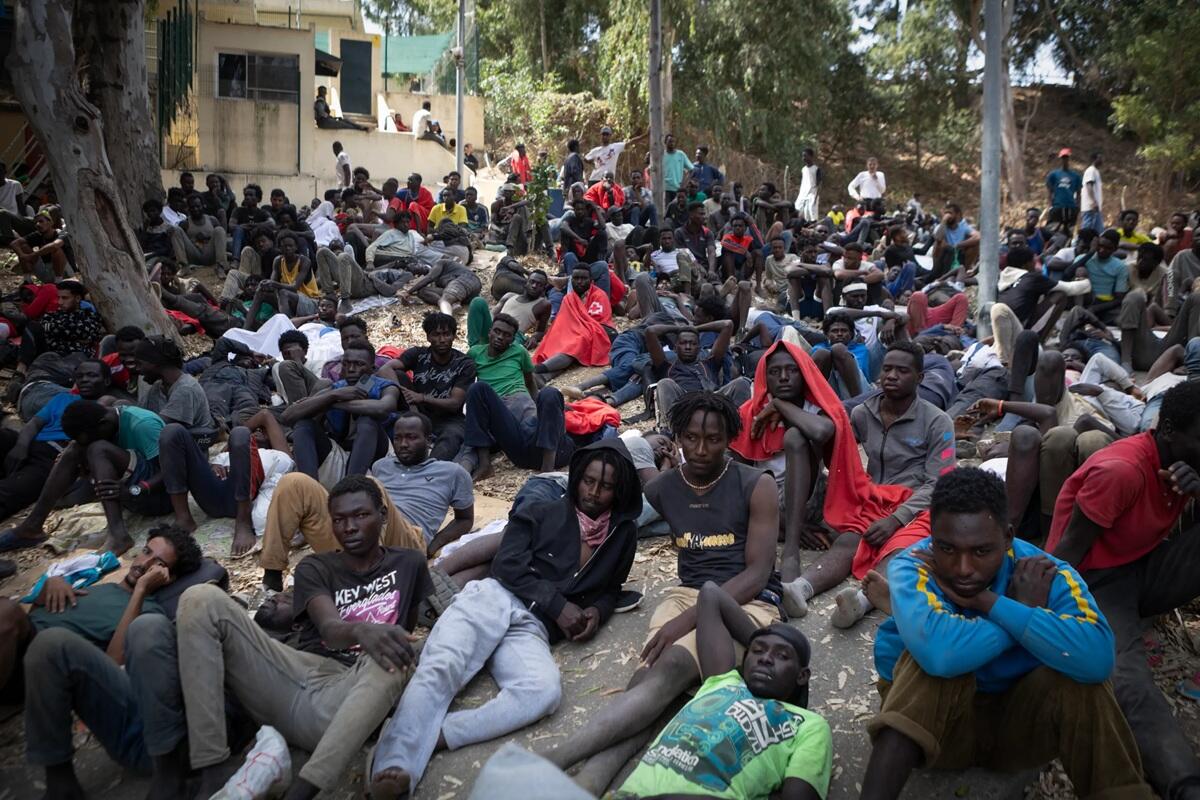
Entitled Migrants Complain About Hospitality And Prices After Invading Spanish Territory
One of the most egregious fantasies promoted by liberals over the past several decades is the worshipful image of the desperate and grateful third world asylum seeker. We see it constantly in movies television and popular media; the narrative of the “huddled masses, yearning to breathe free…” This narrative has become so ingrained in western culture that it is absolutely world shattering when people find out how entitled and arrogant most migrants really are.
The flood of over 60,000 Muslim migrants from Morocco to the Spanish enclave of Ceuta has dashed a lot of progressive delusions in the past week, with migrants fresh from the beaches already looting businesses, raiding homes, attacking locals and setting fires. European officials are reluctantly admitting that the invasion is a problem that must be corrected.
The video evidence on social media is a crushing blow to the multicultural agenda, so much so that Ursula von der Leyen, head of the European Commission, complained about the optics of the images coming out of Ceuta on social media.
The images coming from Ceuta are unacceptable.
We cannot allow anyone to come to our Union without abiding by our rules.
Dangerous crossings must stop immediately. Smuggling networks must be dismantled. And returns must be swift, as our rules allow.
Spanish officials have attacked the negative response of some European leaders as “selfish” and “prejudiced”, stating that the European Union would be harmed by the “polarizing” rhetoric.
But isn’t this migrant horde exactly what European elites have been enabling for the past decade? Yes, it is, but the Cueta incident is happening too quickly and gaining far too much public attention. They usually prefer a “frog in a boiling pot” strategy over blatant barbarian pillaging plastered all over international news.
But it gets much worse for the multicultural cabal, because interviews with these migrants are hitting the mainstream. What these people have to say about their stay in Ceuta so far is mind blowing. The entitlement is unprecedented. Third worlders thought they were marching into a free buffet with easy access to amenities, jobs and westerners bowing at their feet.
Instead, the illegals were met with closed businesses (for safety), prices they could not afford, no jobs and hostility from other migrants who came to Ceuta legally.
People being beaten or killed (if the claims are true) is unfortunate, but then again, it seems to have worked. Large numbers of migrants are reportedly leaving Ceuta on their own because they fear backlash from the locals. There’s an important lesson that could be learned her by populations across the western world:
If governments are not going to do their duty and secure national borders from invaders, then the public still has the power to make those invaders leave simply by making the lives of illegal migrants miserable. If their experiences in the west are worse than their experiences in their home country, they will go back.
Of course, the entitlement of migrants is amplified by progressive leaders in the west. Foreigners have been regaled with stories from western media about a land of plenty and a life of ease. All they have to do is make the crossing and the streets will be paved with riches for the taking. It is clear that the majority of migrants entering Ceuta were under the impression that they would be welcomed with open arms and lavished with subsidies.
Instead, the Spanish military is escorting thousands of them out of the enclave. Or, at the very least, the military is making a good show of trying to remove the migrants from the area. Meanwhile, the locals are doing the job that the government should have been doing from the beginning, which is making Ceuta so inhospitable to migrants that they will never want to go back.
Water-System Hacks Hit 7 States This Week, FBI Warns, As Trump Shoots Down Iran Theory
Cyberattacks on municipal water systems were reported in at least seven states this week, according to a joint public service announcement from the FBI and the Environmental Protection Agency – and in some cases, the agencies say, the malicious activity actually degraded water operations. The feds declined to name the states.
The warning lands just days after we reported that a “coordinated cyberattack” struck more than 30 community water systems in Minnesota over July 26-27 – knocking the water plant in tiny Braham offline for a stretch, pushing Plymouth and South St. Paul onto manual operations, and prompting Maple Plain to declare a local state of emergency, according to Just The News.
The playbook, per federal officials, was crude but effective: attackers remotely accessed internet-facing operational technology, changed device IP addresses and passwords, and locked utility operators out of their own monitoring and control systems, NBC News reported. The PSA is now pleading with utilities to do the bare minimum – pull programmable logic controllers off the open internet and put them behind gateways and firewalls, use actual passwords, and restrict which devices are allowed to talk to one another.
(Yes – in the year 2026, a nontrivial share of the machines controlling America’s drinking water are still sitting on the public internet, some with absurdly simple passwords.)
CISA followed Thursday with an advisory warning that Iranian-affiliated actors are going after U.S. critical infrastructure, water and wastewater systems included – an update to guidance the agency first pushed out in April, which we flagged in our earlier coverage. Some of the larger water-sector intrusions, the advisory notes, have produced boil-water notices and left plants grinding along in manual mode for extended stretches. CISA’s top-line fix is the same one it has been repeating for years: cut direct internet access to control systems.
Except – Washington can’t agree on who did it.
Multiple U.S. officials have told ABC News the Minnesota attacks may be linked to Iran, and investigators’ preliminary assessment reportedly leans the same way – with the caveat that it could change. Meanwhile President Trump denied it. Speaking to reporters at Camp David on Friday, Trump dismissed the Iran theory – “Iran should be so lucky,“ he said – and instead pinned the blame on what he called Minnesota’s grossly incompetent and corrupt leadership under Gov. Tim Walz, arguing Tehran has bigger problems than the Gopher State’s pump stations.
Trump:
They like to say, “Ohh, it’s Iran. Iran should be so lucky.”
Cybersecurity veteran Morgan Wright, founder of the National Center for Open and Unsolved Cases, told The Hill that Iran is the likely culprit, pointing to the CISA advisory as one tell. The U.S. may dominate on land and at sea, Wright argued, but cyberspace is the one domain where Tehran gets to punch above its weight class. Federal officials, for their part, caution that attribution requires careful technical analysis alongside broader threat intelligence – because otherwise it looks like the same nakedly transparent propaganda we’ve been fed for decades (duh).
That said – there is precedent as we detailed in our Minnesota coverage, if we’re to believe the official stories. In November 2023, the IRGC-linked CyberAv3ngers seized control of a device at the Municipal Water Authority of Aliquippa, Pennsylvania. In early 2024, the Cyber Army of Russia Reborn claimed attacks on water facilities in the U.S. and Poland, including a breach in Muleshoe, Texas that dumped tens of thousands of gallons of water. In October 2024, American Water – the largest regulated water utility in the country, serving more than 14 million people across 14 states and 18 military installations – shut down computer systems after a cyberattack. Beijing’s Volt Typhoon has spent years quietly pre-positioning inside U.S. critical-infrastructure networks, per CISA. And just weeks ago, the Iranian MOIS-linked Handala persona claimed to have compromised California Water Service – which serves roughly 2 million customers – leaking 5 gigabytes of data, then vowed via Tehran’s Press TV to keep hitting U.S. industrial control systems.
A Liberal Democrat council has secured a High Court injunction that effectively bans the unauthorised display of the St George’s Cross and Union Flag on lampposts and public highways across an entire English county.
What began as a grassroots campaign to raise the colours of the nation has been declared a threat to community safety, with the full force of the courts now deployed against it.
Oxfordshire County Council, run by the Liberal Democrats, won its landmark case after months of legal action against the Raise the Colours campaign.
High Court approves injunction to BAN Britons hanging Union and St George’s flags on lampposts. https://t.co/jWvRfTdcjK
Justice Dexter Dias granted the order prohibiting unidentified persons from attaching England or Union flags to highway infrastructure or painting flag imagery on roads. Breach carries the risk of imprisonment, unlimited fines, or asset seizure.
Council leader Tim Bearder celebrated the outcome, stating “This is a welcome judgement. We’re very pleased with the result,” adding “This sets a legal precedent and will hopefully deter people in not just Oxfordshire but around the country from partaking in this criminal activity.”
He described those involved as “very challenging people, not patriots.”
The council claims the flags created highway safety risks, trespass, and obstruction. It spent roughly £80,000 removing them and a further £40,000 on legal fees, costs it now intends to recover.
Staff tasked with taking the flags down reportedly faced hostility, to the point that some were instructed to wear face coverings and check their vehicles for tracking devices after one worker’s home address was published.
The judge noted that maintenance teams had been “working in fear” and that people directed by the council had been obstructed “to the extent that at times they have simply given up on the removal.” He concluded there was “little prospect absent an injunction that it will stop.”
The new order does not prevent flags on private property, and the council insists it flies both the Union Flag and St George’s Cross at County Hall.
This is the same Oxfordshire authority that earlier issued formal stop notices branding the widespread installation of national flags an “act of intimidation and division.”
The pattern is now familiar. English councils have repeatedly treated the national flag as a problem to be managed rather than a symbol to be celebrated. FOI requests previously revealed at least £70,000 spent removing Union Jacks and St George’s Crosses from lampposts, with some local politicians openly calling the expenditure “money well spent” to combat supposed far-right agitation.
In Essex, staff were offered emotional support if they felt “discomforted” by the mere sight of the national flag in their communities.
A leaked government social cohesion strategy went further still, describing how the “extreme right has tried to turn symbols of pride into tools of hate,” framing the Union Flag itself as a potential instrument of exclusion and intimidation.
The phenomenon has a name: vexillophobia – the irrational fear of the flag. Britain has reached the point where flying the St George’s Cross is treated as a form of aggression while other political symbols face no such institutional hostility.
During the recent World Cup, English people were warned not to fly flags, the reasoning being that it could intimidate migrants and non-English people.
The selective nature of the discomfort is hard to miss. When rows of Pride flags lined streets in such density that even a prominent television presenter described them as “oppressive,” the institutional response was silence or defence. National colours, by contrast, trigger injunctions, safety briefings, and high court orders.
Raise the Colours began as a simple act of public expression – covering Britain in its own flags. In Oxfordshire it has now been met with the full machinery of the state.
The High Court has drawn a line: the English flag may be flown on private property, but the public highway is a neutral zone where the nation’s colours are treated as a potential hazard.
The precedent is set. Other councils are watching. The message to ordinary people who simply want to see their country’s flag in public spaces is clear. In 2026 Britain, that desire is something the authorities feel compelled to police.
Your support is crucial in helping us defeat mass censorship. Please consider donating via Locals or check out our unique merch. Follow us on X @ModernityNews.
A Brain That Can Swap Bodies: Google DeepMind Aims To Be The ‘Android’ Of Robotics
Google DeepMind unveiled Gemini Robotics 2 on Wednesday, a suite of three AI models that gives humanoid and other robots whole-body control, sharper manipulation, and the ability to work together. The system can run locally on the robot itself and adapt to an entirely new machine body with a few hours of training data. DeepMind is pitching it as the “intelligence layer” for robots – the foundational operating system that every hardware maker builds on.
Rather than a single monolithic system, the company released three models across three access tiers:
Gemini Robotics 2: A vision-language-action model that turns what a robot sees and is told into motor commands. It can drive a full humanoid from feet to fingertips, as well as standard two-armed systems.
Gemini Robotics ER 2: An embodied-reasoning model that plans multi-step jobs over several minutes, recovers from failures, and lets multiple robots split a workflow between them.
Gemini Robotics On-Device 2: A lightweight version that runs directly on the hardware, for industrial settings where cloud connectivity is unreliable or unavailable.
DeepMind demonstrated a single model checkpoint controlling three physically distinct robots: an Apptronik Apollo 2 fitted with two different sets of hands, and a separate two-armed rig with a gripper. One model ran hardware it was never designed for.
Unlike its 2025 system, which handled only a robot’s upper body, this version controls movement from the torso down through the legs, letting a humanoid walk, crouch, bend, and reach at once. In one demonstration, an Apollo 2 walked to a watering can and placed it on a lower shelf.
Success has been hit-or-miss, wit robots hitting roughly 68% accuracy picking objects from a table and 76% from a shelf, but only 46% from the floor. Multi-finger dexterity is still an unsolved problem, and simple grippers continue to outperform elaborate robotic hands. Movement needs to be faster and more reliable. This is a research release with a waitlist; nobody is putting it to work on a warehouse floor next quarter.
DeepMind says Gemini ER 2 its safest robotics model yet, based on benchmarks for adhering to safety constraints and avoiding humans, and it included an evaluation of whether a robot will refuse an unsafe instruction and defer to a human for help. The vision-language-action and on-device models are gated to more than 100 trusted testers and a handful of early partners; the reasoning model is in a more open preview.
The Bigger Bet
Alphabet, Nvidia, and a wave of Chinese tech firms are all racing to own the “physical AI” stack rather than any single robot – the same bet that made mobile operating systems so valuable. If humanoid machines ever become as common as laptops, whoever supplies the universal brain that transfers cleanly from one body to the next will own a toll booth on the entire industry.
As for DeepMind – so far it hasn’t kicked any Chinese kids in the head, so that’s a start.
A Unitree G1 humanoid robot just roundhouse kicked a child in China’s Xinjiang region, sparking urgent conversations about public safety.
The robot, which was executing a pre-programmed, 360-degree spinning roundhouse kick, delivered enough force to double the child over.
Spanish authorities and their leftist allies are pushing the line that the tens of thousands of migrants who stormed Ceuta have mostly “gone home.” The claim is pure fantasy. Fresh video from the streets shows the city still under siege, with invaders assaulting facilities, smashing graves, clashing with locals, and turning a Spanish enclave into a no-go zone.
This is the same dangerous mass migration reality that open-borders ideologues keep denying, even as the evidence piles up in real time.
The official narrative landed hard on Friday. Spain’s Foreign Minister José Manuel Albares declared that “the practical totality of those who entered Ceuta have already returned to Morocco.” The Spanish Embassy in the UK amplified the message, insisting almost everyone was gone, that no one could reach the mainland without ID checks, and that Schengen integrity remained fully guaranteed.
Almost everyone who entered Ceuta yesterday has now returned to Morocco.
It is not possible to travel from Ceuta or Melilla to mainland Spain without presenting identification at a police checkpoint. The integrity of the Schengen area is fully guaranteed. https://t.co/F2s3JWN4bF
The Guardia Civil’s own association posted that Ceuta was “breathing again,” with returns advancing little by little and normality returning thanks to security forces.
Ceuta vuelve a respirar.
? El retorno a Marruecos avanza poco a poco y la ciudad recupera su pulso. La normalidad también es una victoria.
?? Gracias a los guardias civiles, policías y militares que han sostenido la frontera sur de Europa con entereza, sin descanso y sin un… pic.twitter.com/8uSyLQodw2
Locals on the ground immediately called it a lie. One Ceuta resident posted that around 50,000 invaders remained, the city was collapsed, and the official numbers were pure spin. Video filmed that same afternoon showed streets still packed, nothing like the “most have left” story.
Por favor, necesito que difundáis esto:
Soy de Ceuta, y esto ES MENTIRA.
Quedan alrededor de 50mil inmigrantes en Ceuta, que no os engañen, fiaros de testimonios de persona de Ceuta.
Just days earlier, we documented the initial invasion and the subsequent rampage through homes and streets.
The claim that the crisis simply evaporated overnight collapses under the weight of the footage still circulating.
While Madrid spun the returns, Moroccan migrants were filmed storming a public asylum centre in Ceuta. The CETI facility came under direct assault as the government continued insisting order had been restored.
?? | AHORA — Inmigrantes marroquíes están asaltando en estos momentos un asilo público en Ceuta, el CETI.
Elsewhere, invaders smashed Christian graves and hurled the broken pieces at Spanish citizens. Locals fought back with whatever they could grab while police and military presence remained inadequate.
?MY GOD!!!!!
The Muslim invaders from Morocco are now SMASHING THE GRAVES of the people of Cueta and THROWING THE PIECES AT THE CITIZENS OF SPAIN.
Citizens are now FIGHTING BACK against the invaders with anything they can find.
Knives came out in the open. Migrants stabbed one another in the streets while Spanish residents stayed locked indoors, prisoners in their own city of roughly 80,000 people now overrun.
Questa e Ceuta oggi :” due immigrati marocchini si prendono a coltellete nella cittadina”. Questi,per i buonisti, sono quelli che fanno i lavori che non facciamo piu e ci pagano le https://t.co/Xrryn1MRg3 andate a cagare. pic.twitter.com/rqo5IFFeT6
Cars belonging to locals were attacked simply for driving past and showing dissatisfaction. Grocery stores had to be fenced off and guarded by police to stop looting by the hungry crowds.
?? In Ceuta, Moroccan migrants are attacking cars of local residents driving past who express dissatisfaction that tens of thousands of outsiders have invaded their city. pic.twitter.com/uVywHRtmwQ
?? In Ceuta, grocery stores are being fenced off and guarded by police because hundreds of hungry migrants are waiting for a chance to loot them. pic.twitter.com/7fARl4FOz5
Vehicles burned at the border as the surge continued. Groups of military-age men, far from the “families and refugees” talking point, were filmed taking escalators and moving through the city with the swagger of occupation rather than desperation.
Several cars were set on fire on the border between Ceuta and Morocco as thousands of migrants have been storming the border fence pic.twitter.com/OEymoPVPww
One clip captured the pure contempt: an invader brutally attacking a Spaniard. Another showed the broader pattern of violence and disorder that leftist outlets prefer to ignore.
A simple question cut through the spin: if these were genuine asylum seekers looking for safety and a better life, why the rampage, the attacks on civilians, the destruction of graves, and the open hostility?
Let me ask you this simple but direct question:
If you were a genuine asylum seeker seeking help and rescue for a better life, would you do this??????????????????????????????????????????????????? ? pic.twitter.com/ynKWpftWjB
A hospital worker described axes and sticks in the streets, people entering homes, shops boarded up, and police turning on protesting Spaniards while the border remained porous.
Un conocido que trabaja en un hospital de Ceuta me escribe: hachas y palos en la calle, personas entrando en viviendas, comercios cerrados como el de su familia, y la policía cargando contra ceutíes que protestaban contra Sánchez mientras la frontera seguía abierta. Los datos le… pic.twitter.com/BPCnrYassv
Estimates put the influx at 50,000 according to Interior, up to 60,000 according to Ceuta’s own president, in a city of 84,000. Twenty-four bodies had already been recovered from the coast by that point. Sánchez visited for three hours, spoke alone without the local president, and left to shouts of resignation.
Spanish intelligence reportedly warned the government in advance, including details of rehearsals and coaches massing in the nearby Moroccan town of Castillejos. The warnings were ignored.
?? Spanish intel agencies reportedly warned the government of the Moroccan invasion of Ceuta well in advance, including rehearsals that were taking place before the event.
They also told them about a large number of coaches that had arrived in the Moroccan town of Castillejos,…
The fury was not confined to Ceuta. Thousands of Spaniards gathered outside PSOE headquarters in Madrid, chanting against Pedro Sánchez and rejecting the government’s handling of the invasion.
????? | ESPAÑA DESPIERTA: Miles de patriotas se congregaron frente a la sede del PSOE en Madrid para repudiar al Gobierno de España al grito de “Pedro Sánchez, ¡hijo de puta!”, tras la invasión de miles de magrebíes en Ceuta. pic.twitter.com/bJ9bjTBr85
— La Derecha Diario (@laderechadiario) July 31, 2026
Instead of securing the border, Sánchez went on the offensive against other European leaders. In a letter to EU heads of government he denounced those who had tightened controls as “selfish.”
Spain’s socialist prime minister has denounced “selfish” European leaders who ramped up their border controls in response to the sudden migrant surge in Ceuta.
Pedro Sánchez wrote a letter to the heads of EU nations calling for an emergency meeting after Italy suspended free… pic.twitter.com/zWMfJIBTmD
Italy suspended free movement under the Schengen agreement with Spain for a month. Meloni made clear that uncontrolled illegal migration threatens Europe’s security and that Italy would not stand by. France ramped up checks on its Spanish border, planning a fivefold increase in officers.
Sánchez wrote: “In the current international context, the European Union cannot afford this kind of selfish, polarising and unlawful reaction.” He demanded an emergency meeting of interior ministers. Spain’s interior minister echoed the line, asking for “greater solidarity, more responsibility and less selfishness” while reminding critics of Lampedusa.
The European Commission confirmed no migrants had reached the mainland or the wider Schengen zone, yet the political fallout continued. At least 67 people died in the crossings according to Spanish figures released on Saturday. A 500-metre floating barrier was being installed at the Tarajal breakwater. Soldiers broadcast messages in Arabic telling the young men to go home.
The numbers and the images do not match the soothing government script. Ceuta’s president estimated 60,000 entries. Returns were real, but thousands remained and the disorder persisted.
Footage kept arriving of assaults, desecration, violenace, and a city that had not simply returned to normal overnight. Leftist voices seized on the official talking points to deny the obvious: this was a coordinated mass breach that exposed the fragility of open-border policies and the willingness of socialist governments to prioritise ideology over their own citizens’ safety.
Will you be posting about their return to Morocco and the raft that none have reached the European mainland? Or does that not fit your narrative. Vote Binface https://t.co/Wo74tefxsM
When a government treats a sudden invasion of tens of thousands of military-age men as a temporary inconvenience that can be papered over with press releases, the people on the ground pay the price.
What is happening in Ceuta is the direct result of years of failed deterrence, amnesty incentives, and the refusal to treat borders as non-negotiable. Europe’s more serious leaders are already acting. Sánchez prefers to lecture them for defending their own populations.
The footage keeps proving who is living in reality and who is not.
Your support is crucial in helping us defeat mass censorship. Please consider donating via Locals or check out our unique merch. Follow us on X @ModernityNews.