62.3 F
Chicago
Sunday, September 20, 2026
Home Blog Page 2715

Huge Blast Rocks Iraq Base Used By Iran-Linked Militias

Huge Blast Rocks Iraq Base Used By Iran-Linked Militias

Reuters is reporting a “massive” blast at an Iraqi base used by Iran-linked militias south of Baghdad in the overnight hours (local). 

“A huge blast rocked a military base used by Iraq’s Popular Mobilization Forces (PMF) to the south of Baghdad late on Friday,” army sources said to Reuters.

Few other details have been given, but images are widely circulating online showing what indeed appears to be a very large-scale strike.

A number of regional correspondents have been quick to identify it as an American military airstrike; however, given the events of the night prior (the ‘limited’ attack on Iran), others are speculating it was the Israelis behind it.

Both the Israelis and Americans have struck Iran-linked PMF bases before, mostly in Eastern Syria – but a strike on such a scale inside Iraq by Israel remains very rare or even unprecedented.

Of course, since this again takes place when he market is closed the only way to trade it is via bitcoin, where the algos have decided to price in the end of the world for the third time in 5 days.

Tyler Durden
Fri, 04/19/2024 – 18:50

Is There More To This Current Bird Flu Panic Than Meets The Eye?

Is There More To This Current Bird Flu Panic Than Meets The Eye?

Authored by Michael Snyder via TheMostImportantNews.com,

Why are global health officials issuing such ominous warnings about the bird flu?  Do they know something that the rest of us do not? 

H5N1 has been circulating all over the planet for several years now, and it has been the worst outbreak that the world has ever seen.  Hundreds of millions of birds are already dead, and now H5N1 has been infecting mammals with alarming regularity.  The good news is that so far it has not been a serious threat to humans, but could that soon change? 

According to the World Health Organization, the possibility that H5N1 could start spreading among humans is an “enormous concern”

The increasing spread of bird flu to humans is an ‘enormous concern’, the World Health Organization has warned.

The virus, an extremely deadly H5N1 subtype, has caused devastating declines in bird populations following its emergence in Europe in 2020.

It has since jumped to mammals such as cows, cats, seals and now people, raising the risk of the virus mutating to become more transmissible.

The fact that so many different types of mammals are now being infected is definitely alarming.

But perhaps cows would not be getting infected if we were not literally feeding them chicken crap

As epidemiologists scramble to figure out how dairy cows throughout the Midwest became infected with a strain of highly pathogenic avian flu — a disease that has decimated hundreds of millions of wild and farmed birds, as well as tens of thousands of mammals across the planet — they’re looking at a standard “recycling” practice employed by thousands of farmers across the country: The feeding of animal waste and parts to livestock raised for human consumption.

“It seems ghoulish, but it is a perfectly legal and common practice for chicken litter — the material that accumulates on the floor of chicken growing facilities — to be fed to cattle,” said Michael Hansen, a senior scientist with Consumers Union.

It is not known if eating chicken crap is why so many cows in so many different states are being infected with H5N1.

But at a time when the bird flu is running rampant among chickens and turkeys, it seems very foolish to take chicken crap and feed it to our cows.

In any event, now there is a lot of panic about the potential for an H5N1 outbreak among humans.

Authorities at the WHO are warning that the death rate would be “extraordinarily high” if such an outbreak were to occur…

Experts at the WHO said humans face an ‘extraordinarily high’ mortality rate if the strain were to take hold, currently killing more than half of those infected.

I agree.

The bird flu is very dangerous, and if it starts spreading among humans on a widespread basis a lot of people will die.

So why are U.S. taxpayer dollars being used to fund experiments in China that are specifically designed to make bird flu viruses even more deadly?  The following comes from an extremely shocking Daily Mail article

Lawmakers are demanding answers after it was revealed the US is sending taxpayer dollars to a Chinese army lab to make bird flu viruses more dangerous to people.

Eighteen members of Congress are demanding answers from the Department of Agriculture (USDA) about the project, which was first revealed by DailyMail.com.

It is part of a $1million collaboration between the USDA and the CCP-run Chinese Academy of Sciences – the institution that oversees the Wuhan lab at the center of the Covid lab-leak theory.

In a scathing letter to USDA Secretary Tom Vilsack last week, the bipartisan group said: ‘This research, funded by American taxpayers, could potentially generate dangerous new lab-created virus strains that threaten our national security and public health.’

As I warn in my latest book, mad scientists all over the globe are taking some of the most deadly bugs even known to humanity and are purposely trying to make them even more deadly.

And way too often, your tax dollars are paying for it.

Of course experiments on H5N1 are not new.

Over a decade ago, gain of function experiments that were funded by Dr. Francis S. Collins and Dr. Anthony Fauci actually created a mutant version of H5N1 that “had gained the ability to spread through the air between ferrets”

And yet in late 2011 the world learned that two scientific teams – one in Wisconsin, led by virologist Yoshihiro Kawaoka, and another in the Netherlands, led by virologist Ron Fouchier – had potentially pushed the virus in that direction. Each of these labs had created H5N1 viruses that had gained the ability to spread through the air between ferrets, the animal model used to study how flu viruses might behave in humans.

The ultimate goal of this work was to help protect the world from future pandemics, and the research was supported with words and funding by two of the most prominent scientists in the United States: Dr. Francis S. Collins, director of the National Institutes of Health, and Dr. Anthony Fauci, director of the NIH’s National Institute of Allergy and Infectious Diseases.

Why would they purposely create such a thing?

Ferrets were specifically chosen for that research because they have respiratory systems that are very similar to humans.

Our ability to create deadly diseases far exceeds our ability to control them, and once something gets out it can spread around the globe in the blink of an eye.

Right now, there is a lot of concern about a “mystery respiratory illness” that has suddenly appeared in Argentina…

A mystery respiratory illness has hospitalised dozens of people in Argentina in an outbreak that shares eerie similarities with Covid’s arrival.

Sixty patients have been sickened with ‘severe atypical pneumonia’ in the capital, Buenos Aires.

An alert about the cluster of cases was last night circulated via an international public health surveillance system.

Covid was brought to the attention of the world in late 2019 as a result of the same database, called ProMed.

Hopefully this will turn out to be nothing.

But it is just a matter of time before more great pestilences ravage our planet.

Will H5N1 be one of them?

I don’t know, but this is a story that I will definitely be watching closely.

*  *  *

Michael’s new book entitled “Chaos” is available in paperback and for the Kindle on Amazon.com, and you can check out his new Substack newsletter right here.

Tyler Durden
Fri, 04/19/2024 – 18:40

The World’s Economic Myths Are Hitting Their Limits

The World’s Economic Myths Are Hitting Their Limits

Authored by Gail Tverberg via Our Finite World blog,

There are many myths about energy and the economy. In this post I explore the situation surrounding some of these myths.

My analysis strongly suggests that the transition to a new Green Economy is not progressing as well as hoped.

Green energy planners have missed the point that our physics-based economy favors low-cost producers.

In fact, the US and EU may not be far from an economic downturn because subsidized green approaches are not truly low-cost.

[1] The Chinese people have long believed that the safest place to store savings is in empty condominium apartments, but this approach is no longer working.

The focus on ownership of condominium homes is beginning to unwind, with huge repercussions for the Chinese economy. In March, new home prices in China declined by 2.2%, compared to a year earlier. Property sales fell by 20.5% in the first quarter of 2024 compared to the same period a year ago, and new construction starts measured by floor area fell by 27.8%. Overall property investment in China fell by 9.5% in the first quarter of 2024. No one is expecting a fast rebound. The Chinese seem to be shifting their workforce from construction to manufacturing, but this creates different issues for the world economy, which I describe in Section [6].

[2] We have been told that Electric Vehicles (EVs) are the way of the future, but the rate of growth is slowing.

In the US, the rate of growth was only 3.3% in the first quarter of 2024, compared to 47% one year ago. Tesla has made headlines, saying that it is laying off 10% of its staff. It also recently reported that it is delaying deliveries of its cybertruck. A big issue is the high prices of EVs; another is the lack of charging infrastructure. If EV sales are to truly expand, they will need both lower prices and much better charging infrastructure.

[3] Many people have assumed that home solar panel sales would rise forever, but now US home solar panel sales are shrinking.

A forecast made by the trade group Solar Energy Industries Association and consulting firm Wood Mackenzie indicates that US solar panel installations by homeowners are expected to fall by 13% in 2024. There are many issues involved: higher interest rates, less generous subsidies to homeowners, not enough grid capacity for new generation, and too much overproduction of electricity by solar panels in the spring and fall, when heating and air conditioning demand is low. The overproduction issue is particularly acute in California.

For each individual 24-hour day, the timing of solar energy production does not match up well with when it is needed. With sufficient batteries, solar electricity produced in the morning can help run air conditioners in the evening. But storage from summer to winter is still not feasible, and batteries for short-term storage are expensive.

[4] It is a myth that wind and solar truly add to electricity supplies for the US and the countries in the EU. Instead, their pricing seems to lead to tighter electricity supplies.

Strangely enough, in the US and the EU, when wind and solar are added to the electric grid, electricity supplies seem to get tighter. For example, one article saysMost of US electric grid faces risk of resource shortfall through 2027, NERC [regulatory group] says.

Charts of electricity supply per capita show an unusual trend when wind and solar are added. Figure 1 shows that, in the US, once wind and solar are added, total electricity generation per capita falls, rather than rises!

Figure 1. US per capita electricity generation based on data of the US Energy Information Administration. (Data is through 2023, even though this is not easy to see from the labels.)

The EU, using a somewhat shorter history period, shows a similar pattern of declining total electricity generation per capita, even when wind and solar are added (Figure 2).

Figure 2. Electricity generation per capita for the European Union based on data of the 2023 Statistical Review of World Energy, prepared by the Energy Institute. Amounts are through 2022.

I believe that the strange pricing systems used for wind and solar in the US and EU are driving out other electricity suppliers, especially nuclear. With this system, intermittent electricity enjoys the subsidy of going first at the regular wholesale market rate. Other providers find themselves with very low or negative wholesale rates in the spring and fall of the year and on weekends and holidays. As a result, their overall return falls too low. Nuclear is particularly affected because it requires a huge, fixed investment, and it cannot be ramped up and down easily.

Besides the foregoing issues affecting the supply of electricity generated, there are also factors affecting the demand for electricity. Electricity generation using wind and solar tends to be high priced when all costs are included. The US and EU are already high-cost areas for businesses to operate. High electricity rates further add to the impetus to move manufacturing and other industry to lower-cost countries if businesses desire to be competitive in the world market.

    On a world basis, in 2022, wind and solar added about 13% to total world electricity generation (Figure 3).

    Figure 3. Electricity generation per capita for the World based on data of the 2023 Statistical Review of World Energy, prepared by the Energy Institute. Amounts are through 2022.

    Based on Figure 3, with the addition of wind and solar, the upward slope of the world per capita electricity generation has been able to remain pretty much constant from 1985 to 2022, at about 1.6% per year. But the US and the EU, as high-cost producers of goods and services, haven’t been able to participate in this per capita growth of electricity.

    Instead, China has been a major beneficiary of the shift of manufacturing overseas from the US and EU. It has been able to rapidly increase its electricity supply per capita, even with wind and solar. It has also been adding both nuclear and coal-fired electricity generation capacity.

    Figure 4. Electricity generation per capita for China based on data of the 2023 Statistical Review of World Energy, prepared by the Energy Institute. Amounts are through 2022.

    Thus, this analysis produces the result a person would expect if the physics of the world economy favors efficient (low-cost) producers.

    [5] It is a myth that the US and EU can greatly ramp up the use of EVs or greatly increase the use of Artificial Intelligence (AI) without relying on fossil fuels.

    Both EV production and AI are heavy users of electricity supply. We have seen that the US and the EU no longer have growing per-capita electricity supplies. Ramping up electricity generation would require a long lead time (10 years or more), a major increase in fossil fuel consumption, and an increase in electricity transmission lines.

    The State of Georgia, in the United States, is already running into this issue, with planned data centers (related to AI) and EV manufacturing plants. The state plans to add new gas-fired electricity generation. It will also import more electricity from Mississippi Power, where the retirement of a coal-fired plant is being delayed to provide the necessary additional electricity. Eventually, more solar panels are planned, as well.

    [6] It is a myth that the world economy can continue as usual, whatever happens to energy supply and growing debt. China’s homebuilding problems could, in theory, lead to debt bubbles crashing around the world.

    The world economy depends upon a growing bubble of debt. It also depends on an ever-increasing supply of goods and services. In fact, the two are closely interrelated. As long as a growing supply of low-priced energy of the types used by built infrastructure is available, the economy tends to sail along.

    China, with problems in its property business, is an example of what can go wrong when energy supplies (coal in China) become expensive, as supply becomes increasingly constrained. Figure 5 shows that China’s per-capita coal supply became constrained in about 2013. China’s per capita coal extraction had been rising, but then it dipped. This made it more difficult for builders to construct the homes planned for would-be homeowners. This is part of what got home builders in China into financial difficulty.

    Figure 5. Per capita coal supply in China based on data of the 2023 Statistical Review of World Energy, prepared by the Energy Institute. Amounts are through 2022.

    Finally, in 2022, China was able to get coal production up. But the way this was done was through very high coal prices (Figure 6). (The prices shown are for Australian coal, but Chinese coal prices seem to be similar.)

    Figure 6. Newcastle Coal (Australia) prices in chart prepared by Trading Economics.

    Building concrete homes at such high coal prices would have resulted in new homes that were far too expensive for most Chinese citizens to afford. If builders were not already in difficulty from low supply, adding high coal prices, as well, would be a second blow. Furthermore, all the workers formerly engaged in home building needed new places to earn a living; the current approach seems to be to move many of these workers to manufacturing, so that the popping of the home building bubble will have less of an impact on the overall economy of China.

    There is now concern that China is ramping up its manufacturing, particularly for exports, at a time when China’s jobs in the property sector are disappearing. The problem, however, is that ramping up exports of manufactured goods creates a new bubble. This huge added supply of manufactured goods can only be sold at low prices. This new low-priced competition seems likely to lead to manufacturers, around the world, obtaining too-low prices for their manufactured products.

    If other economies around the world are forced to compete with even lower-cost goods from China, it could have an adverse impact on manufacturing around the world. With low prices, manufacturers are likely to lay off workers, or give them excessively low wages. If wages and prices are inadequate, debt bubbles in other parts of the world are likely to collapse. This will happen because many borrowers will become unable to repay their debt. This is the reason that we have been hearing a great deal recently about raising tariffs on Chinese exports.

    [7] The world’s biggest myth is that the world economy can continue to grow forever.

    I have pointed out previously that based on physics considerations, economies cannot be expected to be permanent structures. Economies and humans are both self-organizing systems that grow. Humans get their energy from food. Economies are powered by the types of energy products that our built infrastructure uses. Neither can grow forever. Neither can get along without energy products of the right types, in the right quantities.

    We become so accustomed to the narratives we hear that we tend to assume that what we are told must be right. These narratives could be based on wishful thinking, or on inadequate models, or on a sour grapes view that says, “We don’t want fossil fuels anyhow.” We know that humans need food, and that economies will continue to require fossil fuels. We can’t make wind turbines or solar panels without fossil fuels. What do we plan to do for energy without fossil fuels?

    In a finite world, economies cannot continue forever. We don’t know precisely what will go wrong or when it will go wrong, but we can get a hint from the recent failures of myths that our economy may change dramatically in the not-too-distant future.

    Tyler Durden
    Fri, 04/19/2024 – 18:00

    US Domestic Bank Deposits Drop For Second Straight Week

    US Domestic Bank Deposits Drop For Second Straight Week

    On the heels of a major deposit outflow the week before, and a huge (record) money-market fund outflow last week, all eyes are back on the banks again on Friday evening to see if this ‘flight’ continues as Tax-Day drags cash away from its comfy-5%-earnings-spots.

    On a seasonally-adjusted basis, total US bank deposits declined for the second straight week (though only $2.4BN) after reaching back to pre-SVB levels…

    Source: Bloomberg

    And once again – like last week, and rather oddly giving the tax-day’ timing – non-seasonally-adjusted bank deposits rose $16BN, now well above pre-SVB levels…

    Source: Bloomberg

    Is some of the money-market cash being moved (temporarily) into bank deposits before heading out to tax man?

    Source: Bloomberg

    Historically, it appears NEXT week is when we see the Tax-Day decline in the NSA data…

    Source: Bloomberg

    Excluding foreign deposits, domestic bank deposits did fall on both an SA (-$2.9BN – large banks -$14.8BN, small banks +11.9BN) and NSA (-$12bn – large banks -$24BN, small banks +12BN) basis.

    Source: Bloomberg

    But, unlike last week when deposits dropped, we saw bank loan volumes rise (not fall) in the week ending 4/10 with large bank voilumes rising 0.65BN and small bank volumes rising $7.3BN…

    Source: Bloomberg

    Finally, as we detailed earlier, it appears the reality of bank reserves at The Fed is slowly (but surely) catching up with US equity market cap…

    Source: Bloomberg

    That’s going to get awkward in an election year…

    Tyler Durden
    Fri, 04/19/2024 – 16:44

    Down With Big Brother: Warrantless Surveillance Makes A Mockery Of The Constitution

    Down With Big Brother: Warrantless Surveillance Makes A Mockery Of The Constitution

    Authored by John and Nisha Whitehead via The Rutherford Institute,

    “Whether he wrote DOWN WITH BIG BROTHER, or whether he refrained from writing it, made no difference … The Thought Police would get him just the same … the arrests invariably happened at night … In the vast majority of cases there was no trial, no report of the arrest. People simply disappeared, always during the night. Your name was removed from the registers, every record of everything you had ever done was wiped out, your one-time existence was denied and then forgotten. You were abolished, annihilated: vaporized was the usual word.”

    – George Orwell, 1984

    The government long ago sold us out to the highest bidder.

    The highest bidder, by the way, has always been the Deep State.

    What’s playing out now with the highly politicized tug-of-war over whether Section 702 of the Foreign Intelligence Surveillance Act gets reauthorized by Congress doesn’t just sell us out, it makes us slaves of the Deep State.

    Read the fine print: it’s a doozy.

    Just as the USA Patriot was perverted from its stated intent to fight terrorism abroad and was instead used to covertly crack down on the American people (allowing government agencies to secretly track Americans’ financial activities, monitor their communications, and carry out wide-ranging surveillance on them), Section 702 has been used as an end-run around the Constitution to allow the government to collect the actual content of your conversations (phone calls, text messages, video chats, emails and other electronic communication) without a warrant.

    Now intelligence officials are pushing to dramatically expand the government’s spying powers, effectively giving the government unbridled authority to force millions of Americans to spy on its behalf.

    Basically, the Deep State wants to turn the American people into extensions of Big Brother.

    As Sen. Ron Wyden (D-Ore.) explains:

    If you have access to any communications, the government can force you to help it spy. That means anyone with access to a server, a wire, a cable box, a Wi-Fi router, a phone, or a computer. So think for a moment about the millions of Americans who work in buildings and offices in which communications are stored or pass through.

    After all, every office building in America has data cables running through it. The people are not just the engineers who install, maintain, and repair our communications infrastructure; there are countless others who could be forced to help the government spy, including those who clean offices and guard buildings. If this provision is enacted, the government can deputize any of these people against their will, and force them in effect to become what amounts to an agent for Big Brother—for example, by forcing an employee to insert a USB thumb drive into a server at an office they clean or guard at night.

    This could all happen without any oversight whatsoever: The FISA Court won’t know about it, Congress won’t know about it. Americans who are handed these directives will be forbidden from talking about it. Unless they can afford high-priced lawyers with security clearances who know their way around the FISA Court, they will have no recourse at all.”

    This is how an effort to reform Section 702 has quickly steamrollered into an expansion of the government’s surveillance powers.

    We should have seen this coming.

    After all, the Police State doesn’t relinquish power easily, the Surveillance State doesn’t look favorably on anything that might weaken its control, and Big Brother doesn’t like to be restricted.

    What most Americans don’t get is that even without Section 702 in play, the government will still target the populace for warrantless, suspicionless mass surveillance, because that’s how the police state maintains its stranglehold on power.

    These maneuvers are just the tip of the iceberg.

    For all intents and purposes, we now have a fourth branch of government.

    This fourth branch came into being without any electoral mandate or constitutional referendum, and yet it possesses superpowers, above and beyond those of any other government agency save the military.

    It is all-knowing, all-seeing and all-powerful.

    It operates beyond the reach of the president, Congress and the courts, and it marches in lockstep with the corporate elite who really call the shots in Washington, DC.

    The government’s “technotyranny” surveillance apparatus has become so entrenched and entangled with its police state apparatus that it’s hard to know anymore where law enforcement ends and surveillance begins. They have become one and the same entity.

    The police state has passed the baton to the surveillance state.

    On any given day, the average American is now monitored, surveilled, spied on and tracked in more than 20 different ways by both government and corporate eyes and ears.

    Every second of every day, the American people are being spied on by the U.S. government’s vast network of digital Peeping Toms, electronic eavesdroppers and robotic snoops.

    Beware of what you say, what you read, what you write, where you go, and with whom you communicate, because it will all be recorded, stored and used against you eventually, at a time and place of the government’s choosing.

    Privacy, as we have known it, is dead.

    Whether you’re walking through a store, driving your car, checking email, or talking to friends and family on the phone, you can be sure that some government agency is listening in and tracking you. This doesn’t even begin to touch on the complicity of the corporate sector, which buys and sells us from cradle to grave, until we have no more data left to mine. These corporate trackers monitor your purchases, web browsing, Facebook posts and other activities taking place in the cyber sphere and share the data with the government.

    Just about every branch of the government—from the Postal Service to the Treasury Department and every agency in between—now has its own surveillance sector, authorized to collect data and spy on the American people. Then there are the fusion and counterterrorism centers that gather all of the data from the smaller government spies—the police, public health officials, transportation, etc.—and make it accessible for all those in power.

    These government snoops are constantly combing through and harvesting vast quantities of our communications, then storing it in massive databases for years. Once this information—collected illegally and without any probable cause—is ingested into NSA servers, other government agencies can often search through the databases to make criminal cases against Americans that have nothing to do with terrorism or anything national security-related.

    Empowered by advances in surveillance technology and emboldened by rapidly expanding public-private partnerships between law enforcement, the Intelligence Community, and the private sector, police have become particularly adept at sidestepping the Fourth Amendment.

    Talk about a system rife for abuse.

    Now, the government wants us to believe that we have nothing to fear from its mass spying program because they’re only looking to get the “bad” guys who are overseas.

    Don’t believe it.

    The government’s definition of a “bad” guy is extraordinarily broad, and it results in the warrantless surveillance of innocent, law-abiding Americans on a staggering scale.

    Indeed, the government has become the biggest lawbreaker of all.

    It’s telling that even after it was revealed that the FBI, one of the most power-hungry and corrupt agencies within the police state’s vast complex of power-hungry and corrupt agencies, misused a massive government surveillance database more than 300,000 times in order to target American citizens, we’re still debating whether they should be allowed to continue to sidestep the Fourth Amendment.

    This is how the government operates, after all: our objections are routinely overruled and our rights trampled underfoot.

    It works the same every time.

    First, the government seeks out extraordinary powers acquired in the wake of some national crisis—in this case, warrantless surveillance powers intended to help the government spy on foreign targets suspected of engaging in terrorism—and then they use those powers against the American people.

    According to the Foreign Intelligence Surveillance Court, the FBI repeatedly misused Section 702 in order to spy on the communications of two vastly disparate groups of Americans: those involved in the George Floyd protests and those who may have taken part in the Jan. 6, 2021, protests at the Capitol.

    This abuse of its so-called national security powers is par for the course for the government.

    According to the Brennan Center for Justice, intelligence agencies conduct roughly 200,000 of these warrantless “backdoor” searches for Americans’ private communications each year.

    No one is spared.

    Many of the targets of these searches have done nothing wrong.

    Government agents have spied on the communications of protesters, members of Congress, crime victims, journalists, and political donors, among many others.

    The government has claimed that its spying on Americans is simply “incidental,” as though it were an accident, but it fully intends to collect this information.

    As journalist Jake Johnson warns, under an expanded Section 702, U.S. intelligence agencies “could, without a warrant, compel gyms, grocery stores, barber shops, and other businesses to hand over communications data.”

    According to the Wall Street Journal, “The Securities and Exchange Commission is deploying a massive government database—the Consolidated Audit Trail, or CAT—that monitors in real time the identity, transactions and investment portfolio of everyone who invests in the stock market.”

    Journalist Leo Hohmann reports that the government is also handing out $20 million in grants to police, mental health networks, universities, churches and school districts to enlist their help in identifying Americans who might be political dissidents or potential “extremists.”

    Ask the government why it’s carrying out this far-reaching surveillance on American citizens, and you’ll get the same Orwellian answer the government has been trotting in response to every so-called crisis to justify its assaults on our civil liberties: to keep America safe.

    What this is really all about, however, is control.

    What we are dealing with is a government so power-hungry, paranoid and afraid of losing its stranglehold on power that it is conspiring to wage war on anyone who dares to challenge its authority.

    When the FBI is asking banks and other financial institutions to carry out dragnet searches of customer transactions—warrantlessly and without probable cause—for “extremism” indicators broadly based on where you shop, what you read, and how you travel, we’re all in trouble.

    You don’t have to do anything illegal.

    For that matter, you don’t even have to challenge the government’s authority.

    Frankly, you don’t even have to care about politics or know anything about your rights.

    All you really need to do in order to be tagged as a suspicious character, flagged for surveillance, and eventually placed on a government watch list is live in the United States.

    As long as the government is allowed to weaponize its 360 degree surveillance technologies to flag you as a threat to national security, whether or not you’ve done anything wrong, it’s just a matter of time before you find yourself wrongly accused, investigated and confronted by police based on a data-driven algorithm or risk assessment culled together by a computer program run by artificial intelligence.

    As I make clear in my book Battlefield America: The War on the American People and in its fictional counterpart The Erik Blair Diaries, it won’t be long before Big Brother’s Thought Police are locking us up to “protect us” from ourselves.

    At that point, we will disappear.

    Tyler Durden
    Fri, 04/19/2024 – 16:20

    Tech Wrecks As FedSpeak F**ks FOMO-Followers; Gold Hits New Record High

    Tech Wrecks As FedSpeak F**ks FOMO-Followers; Gold Hits New Record High

    Well, that escalated quickly…

    In a week characterized by data supporting ‘no landing’ from a growth perspective and disappointment from a disinflation perspective

    Source: Bloomberg

    This was reinforced by FedSpeak that was without exception – hawkish!

    As they suddenly realized that all that ‘pivot’ optimism did nothing but dramatically ease financial conditions and fuck their ‘best laid plans’ for a rate-cut and soft landing…

    Source: Bloomberg

    Even the dove-est of the doves – Austan Goolsbee – bent the knee today:

    “So far in 2024, that progress on inflation has stalled,” Goolsbee said Friday in remarks prepared for an event in Chicago.

    “You never want to make too much of any one month’s data, especially inflation, which is a noisy series, but after three months of this, it can’t be dismissed.”

    “Right now, it makes sense to wait and get more clarity before moving,” Goolsbee said.

    And sure enough, rate-cut expectations for 2024 and 2025 have both plunged this week…

    Source: Bloomberg

    …and that has finally started to weigh on investors’ risk appetites (that’s a long way to catch down to reality)…

    Source: Bloomberg

    Most traders thought the worst was over last night as the panic-puke in futures was BTFD’d back to unchanged ahead of the cash open, but then the selling started (on Nasdaq) and never really stopped. On the day, Nasdaq was down over 2% while The Dow managed to gain 0.5%. Small Caps were almost unchanged by the end of the day with the S&P lagging…

    But, all the majors ended the week red (with The Dow desperately trying to get back to even). Nasdaq was down over 5.5% on the week! S&P and Small Caps down around 3%…

    Nasdaq is down for six straight days for its biggest weekly drop since Nov 2022, breaking below its 100DMA as CTA ‘sell threshold’s were crosed. Goldman’s trading desk noted:

    The NDX now pacing for its worst week in over a year (down 6 of 7 weeks) as a complicated technical backdrop (CTAs, lower retail participation, NDX now testing 100-dma, seasonality), sideways earnings revisions thus far (ASML, TSM and even Sheridan’s NFLX EPS revisions were only 1-2% last night), a tense geopolitical backdrop (overnight headlines) and elevated positioning are testing conviction into a busy week of earnings … some debate if this all ‘helps’ the set-up into FAAMG prints or if the market is just read to ‘take a breather’ and sell any good news…”

    The MAG7 basket broke below its 50DMA this week – the first time since October, when The Fed ‘pivoted’ and save the world. The market cap of the MAG7 is now down over $1 Trillion from its highs a week ago…

    Source: Bloomberg

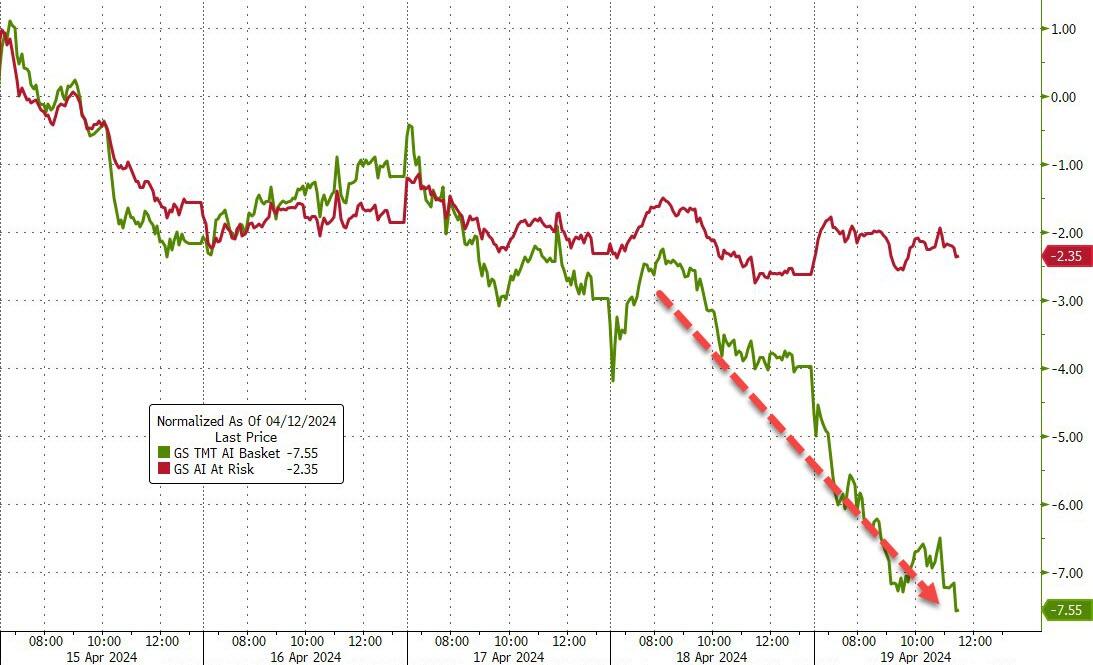
    AI Leaders crashed relative to firms ‘at risk from AI’, plunging to their lowest in two months…

    Source: Bloomberg

    Of note is that the AI Leaders are perfectly back to their prior peak in 2021 (which was driven by chip demand for crypto mining and COVID disruptions), breaking down to the 100DMA and through the medium-term uptrend…

    Source: Bloomberg

    Semis were slaughtered this week…

    Source: Bloomberg

    NVDA plunged 10% today back to two month lows, closing below its 50DMA for the first time since Nov 2023…

    … now in bear market (down over 22% from its highs) and the CSCO analog doesn’t look so crazy anymore…

    Source: Bloomberg

    Interestingly, amid all this carnage, banks had a decent week with WFC and MS outperforming (JPM still lagging from its drop on last Friday’s earnings)…

    Source: Bloomberg

    The Russell 2000, Nasdaq, and Dow are all back below their 100DMA, and the S&P 500 is pushing down towards its 100DMA (having blow thru the CTA ‘sell’ thresholds)…

    Goldman’s trading desk warns, it could get worse: CTA supply is building – our team’s work shows this group sold $25B globally this week ($9B in SPX) with next week expected to bring another $27B globally (and $10B SPX) in a flat tape scenario.  Reminder the medium term threshold (aka most important) level is 4886 – less than 100 handles away from spot.”

    Next week brings 43% of SPX set to report earnings highlighted by META/MSFT/GOOGL (aka $6.1T of mkt cap) reporting on Thurs night…on the macro front, key reports include 1Q GDP on Thurs & March PCE on Fri.

    VIX soared this week to six-month highs, and credit markets also – finally – started to crack…

    Source: Bloomberg

    Treasury yields ended the week higher, but not before plunging overnight on  a flight-to-quality bid as Israeli missiles hit Iran, taking yields lower on the week. By the close of the week, the belly slightly underperformed but yields were all up by around 8-10bps….

    Source: Bloomberg

    The dollar rallied for the second straight week, hitting its highest since early Nov 2023 last night on the mid-east attacks before sliding back…

    Source: Bloomberg

    Heading into today’s ‘halving’ – likely to occur within the next few hours – Bitcoin was down, puking once again overnight on geopolitical chaos like it did last weekend, only to see buying come right back (after testing below $60,000 for the first time since early March)…

    Source: Bloomberg

    5.00% remains a key level for the 2Y Yield…

    Source: Bloomberg

    Despite two major attacks in the Middle East, oil prices ended lower for the second week in a row (well WW3 hasn’t started yet). Some knock-on effects from an evaporation of hope for demand-sponsoring rate-cuts also weighed on sentiment as WTI

    Source: Bloomberg

    Spot Gold prices spiked overnight on the Israel attack, pulled back, then rallied up to $2400 once again to close at the highs…

    Source: Bloomberg

    Gold closed the week at a new record high…

    Source: Bloomberg

    Silver soared 3% on the week to new cycle highs (its highest since Feb 2021)…

    Source: Bloomberg

    Silver has been broadly speaking outperforming gold in recent weeks after peaking at a gold-to-silver ratio of around 92x in January, it is ow down to 83 (still well above the 65x average since 1980… implying silver remains ‘cheap’ to gold)…

    Source: Bloomberg

    …and then there’s Cocoa…

    Source: Bloomberg

    And finally, are bank reserves at The Fed still the driving force for reality?

    Source: Bloomberg

    We saw the reality check from Aug-Oct last year; are we about to get another?

    Tyler Durden
    Fri, 04/19/2024 – 16:00

    Climate Worries Are Non-Credible, Luxury Beliefs That Harm Civilization Itself

    Climate Worries Are Non-Credible, Luxury Beliefs That Harm Civilization Itself

    Authored by Joakim Book via The Mises Institute,

    I live in a small village at the edge of lands surrounded by very harsh nature. Those who occupied these valleys in ages past lived ruthlessly dangerous lives, where starvation was a constant worry, the sea just as often nurtured as it took away, and the winters were long and perilous. Nowadays, while I’m walking the desolate mountains or admiring the fierce storms from inside my nice, sheltered existence, echoing in my head is Thomas Hobbes’s descriptions of man’s precivilizational life: “Solitary, poor, nasty, brutish, and short.”

    In the 2020s, we live fairly comfortable lives here, my fellow villagers and I. Our hearths are warm, our command over economic goods excellent. We live long, safe lives, where nobody starves and where almost nobody perishes in outbursts of nature’s wrath. We use machines—constructed far, far away using materials we don’t have, that run on fossil fuels that these lands don’t contain—to move away the snow that frequently and predictably lands on our doorsteps and otherwise would have made our roads impassable and our houses prisons. We use different machines—constructed far, far away using materials we don’t have, that run on fossil fuels that these lands don’t contain—to get ourselves out of our valley and transport goods and services back, including exotic fruits and vegetables that never grow here (certainly not in winter!).

    It truly is fascinating to behold the astonishing things that globalized trade and capitalism can accomplish. Stepping back and thinking about the miracles of modern trade, innovation, and division of labor is so humbling.

    Yet we well-off moderns worry about our collective existence to the point that kids have nightmares, and survey respondents overwhelmingly say climate change will end the human race.

    Something like one-third of young people say they don’t want kids for fear of worsening the climate condition or how they’d fare in that brave, new world. “Climate anxiety is widespread among youth,” reports National Geographic. “How can we help kids cope with ‘eco-anxiety’?” asks the British Broadcasting Corporation. The vast majority of respondents in a global ten thousand–person study published in the Lancet in 2021 admitted to be very or extremely worried. Vox writers worry about the ethics of raising children. A new study, reported on by Phys.org, pointed to how many young people won’t have kids because of climate change: it’d be unfair to “bring a child into the world,” who’d have to live with the constant “feeling of impending doom, every day, for their whole life,” says one interviewed would-be parent.

    Many of my fellow villagers entertain all these global ideas—melting glaciers and parts per million–numbers, floods and ethical dilemmas about us vulgar humans making earth inhospitable or uninhabitable.

    It’s a strange thing to worry about obsessively, while the vicious storm raging outside the double-glazed windows affect nothing about our food supply, electricity use, heating, or ability to participate in the global division of labor—whether in our offices or remotely via high-speed internet. It somehow seems contradictory to passionately rally against capitalism from the comforts of very capitalistically built and maintained houses, hotels, and pubs; to inveigh against the burning of fossil fuels that literally keeps one alive.

    It has me thinking about the action axiom, the starting point of Ludwig von Mises’s praxeology and the pillar-stone upon which Austrian economics rests. The colloquial version of this foundational Austrian maxim is “put your money where your mouth is” or “actions speak louder than words.” We demonstrate by our actions where our preferences and values lie; we reveal them to the world (act them into existence, really) when we do one thing instead of another, when we purchase one good instead of another, when we work instead of relax. All of this is wrapped in uncertainty and hopes and subjective human desires trading off against other such desires; in hindsight we can regret the choices we made. Still, says Murray Rothbard, a man’s “preferences are deducible from what he has chosen in action.”

    Perhaps all this climate complaining is simply virtue signaling, in a world where feelings matter more than facts. The detachment from the physical processes of basic living—energy, materials, transportation, and in complicated monetary economies, money—has made many people ignorant, taking for granted the lifestyles we live and the standards of living we have. It has allowed us to start thinking foundational and civilization-carrying systems like money, fossil fuels, or commercial institutions are optional—a mere matter of ideological choice between good and evil people. They’re not.

    I’m reminded too of luxury beliefs, a somewhat hyped concept coined by Rob Henderson, a psychologist at the University of Cambridge and author of the recent book Troubled. Henderson transfers Thorstein Veblen’s “conspicuous consumption”—the purchasing of expensive, often seemingly useless goods with the purpose of flaunting one’s wealth—to the moral and political domain. luxury belief, like a conspicuous good, is acquired in order to impress others, and is designed to “confer status on the upper class at very little cost, while inflicting costs upon the lower classes.”

    Luxury beliefs don’t make much sense and don’t have staying power in the real world of atoms and temperature, of nature and starvation. But we’re so far detached from the world that physically supports us—so rich, so deluded, so well off—that we’re willing to believe (and by extension willing to experiment with) the very systems that uphold our existence.

    Cue environmental concerns and anticapitalism.

    Taken literally, enacting policies based on such follies into place, we’re on a path to horror and poverty, with brutish and short lives to follow.

    The good news is that those systems are remarkably resilient and these voices might still be all “tawk,” as Nassim Taleb would say.

    The popular energy-finance Substack Doomberg made a similar observation in February, listing two paragraphs’ worth of major events that happened from 1971: oil crisis, Iran-Iraq, Kuwait wars, Middle Eastern conflicts, the Asian and peso and ruble financial collapses, the terrorist attacks, Libya-Syria-Ukraine, the global financial crisis, and covid.

    Through all of them, as tumultuous as they seemed at the time and as relevant as they remain in the political consciousness, the world’s total energy consumption is a straight line through all of it.

    Here’s their graph:

    BP Statistical Review global total energy consumption

    Source: Doomberg

    Socioeconomic events as radical as women’s rights or racial equality; left-wing or right-wing leaders; crises and recessions, inflations and boom years; generations of scholars and scientists and political movements . . . and there’s no impact on the basic thing that powers our civilization.

    Eighty-five percent of the globe’s primary energy consumption comes directly from fossil fuels—the same it was over thirty years ago when I was born. You can speak beliefs about climate change, about noncredible, net-zero policy goals (always with years suspiciously ending in zero or five), about reducing reliance on fossil fuels, or about how “clean” renewable energy is. You can throw government money at it, pass laws, or pontificate in the high courts, legislative auditoriums, or the public square, but you’re just not changing that. You can’t change that.

    Cypherpunks write code. Clever people ignore politicsYou should get out of the house, stop worrying too much about the lunatics running the asylum, and instead admire nature.

    That’s what I’m doing.

    Tyler Durden
    Fri, 04/19/2024 – 15:43

    Nike “Permanently” Laying Off 740 Employees At World Headquarters

    Nike “Permanently” Laying Off 740 Employees At World Headquarters

    US athletic footwear and apparel company Nike announced late in the cash session on Friday that it is undergoing a restructuring effort to trim costs at its World Headquarters (WHQ) located in Beaverton, Oregon. 

    Michele Adams, VP of People Solutions at Nike, might be the most hated person at the company this afternoon. In a letter to staff, she wrote that “approximately 740 employees at WHQ” will be “permanently” laid off by late June. 

    “As a result of a second phase of impacts, which will take effect by June 28, 2024, approximately 740 employees at WHQ will have been impacted by this and the recent prior permanent reduction of the workforce,” Adams said. 

    In December, Chief Executive Officer John Donahoe said the company would reduce its global headcount by 2% as management moves forward with a cost-savings program of as much as $2 billion over the next three years. 

    Data from Bloomberg shows that Nike’s total headcount stood at around 83,700 as of the end of 2023. The company has been dramatically hiring over the last decade and a half – those efforts appear to have just stalled. 

    Nike shares have stumbled into a correction as of late March. 

    Yet another sign consumers are pulling back on clothing apparel and other sporting goods merchandise?

    Tyler Durden
    Fri, 04/19/2024 – 15:20

    Freedom Caucus Posts Rotating Guard To Block Sneaky Leadership Moves

    Freedom Caucus Posts Rotating Guard To Block Sneaky Leadership Moves

    In a sign of growing discord among House Republicans, members of the Freedom Caucus are taking turns monitoring the House floor to prevent the GOP leadership from using sneaky procedural tactics to sap the power of increasingly rebellious conservatives.  

    Specifically, they’re wary that party leaders and their allies will, without prior announcement, bring measures to the floor and seek their passage via “unanimous consent.” With that approach, the presiding officer simply states, “If there is no objection, the motion will be adopted.” After a pause to allow for objections, the officer declares, “Since there is no objection, the motion is adopted.”  

    That’s where the Freedom Caucus’s Floor Action Response Team (yes, “FART”) comes in. With their round-the-legislative-clock presence, they always have a member positioned to object to unanimous consent motions, forcing proposals to go through a more arduous procedure. 

    House conservatives both inside and outside the Freedom Caucus are increasingly irate over Speaker Mike Johnson’s actions, from pushing foreign aid for Ukraine, allowing omnibus spending bills that kick the fiscal can down the road, and personally casting the tie-breaking vote against adding a warrant requirement to the extension Foreign Intelligence Surveillance Act. All the while, he’s pushed border security to the back burner. 

    The Freedom Caucus and its allies are on particular alert for moves that would reverse concessions made by Johnson’s predecessor, Kevin McCarthy, as part of his negotiations with conservatives pursuant to ascending to the speakership. For example, establishment Republicans could try to

    • Remove three conservatives from the powerful Rules Committee, which exerts a variety of controls over the flow of legislation through the House, and is therefore in position to expedite or thwart the progress of a bill. The targeted conservatives are Thomas Massie (KY), Chip Roy (TX) and Ralph Norman (SC), Politico reports.   
    • Raise the required number of members who must back a motion to oust the speaker before it can be put to a vote. Today, it only requires one. Last month, Georgia Rep. Marjorie Taylor Greene filed such a “motion to vacate the chair.”  On Tuesday, Massie announced he would co-sponsor the motion, telling Johnson to his face, “You’re not going to be speaker much longer.”  

    After a tense meeting with Johnson, Florida Rep. Matt Gaetz, who introduced the successful motion to oust McCarthy, issued a public warning against changing the rules. “Talking about changing the threshold to the motion to vacate is likely to induce the motion to vacate,” he told reporters. 

    Greene issued her own admonition: “Mike Johnson owes our entire conference a meeting. And if he wants to change the motion to vacate he needs to come before the Republican Conference that elected him and tell us of his intentions and tell us what this rule change … is going to be.”

    Johnson has been deflecting questions about whether he was contemplating such a move, both with media and with Gaetz and others. When Gaetz was asked on Thursday if he would back a motion to vacate, he hinted that he was moving in that direction, coyly saying, “You know I woke up today and I didn’t.” At the same time, he said Johnson’s ouster would be “sub-optimal,” and that he’d prefer to see Johnson come around and “govern in accordance with the commitments we made.”  

    Gaetz marveled at Johnson’s rapid conversion to establishment puppet once the gavel was in his hand:

    “When we voted for Mike Johnson for speaker, he was fresh off of a vote against Ukraine aid, he was publicly advocating for a warrant requirement on FISA, and the central thesis of his campaign for speaker was single-subject spending bills…[Now] look where we are.”  

    Tyler Durden
    Fri, 04/19/2024 – 13:45

    Watch: Migrants Complain That New Yorkers Don’t Learn African Languages

    Watch: Migrants Complain That New Yorkers Don’t Learn African Languages

    Authored by Steve Watson via Modernity.news,

    A hearing held earlier this week in New York by the Council’s immigration and hospital committees saw black migrants who have arrived in the city airing their grievances about public services they have been provided, including food and accommodation, with one woman even complaining that New Yorkers won’t learn Congolese languages.

    The hearing drew over a thousand immigrants, mostly from countries in Africa, and many illegally in the country, with some claiming that they had been promised money, green cards or work visas if they attended.

    While only 250 of them were allowed inside, the rest congregated outside in a park protesting.

    The hearing was touted in a press release as aimed at African migrants in shelters to “understand how the [Adams] Administration is addressing language access barriers, cultural competency challenges, health needs, and other roadblocks.”

    At one point during the hearing, which lasted for over SIX HOURS, the conversation turned to language services offered by the state, with some migrants complaining that Spanish and English speakers are given priority, and African immigrants are unfairly excluded.

    It was then pointed out that many immigrants are illiterate and can only speak their native language and further suggested that New Yorkers “refuse to accommodate” by not learning those languages.

    There are 3,000 languages spoken across Africa, with many having hundreds of different dialects.

    At another point in the hearing migrants began complaining about the free food and housing they have been provided, saying it isn’t good enough.

    They described the situation as “unacceptable,” and “shameful,” and even calling New York City “Anti-African, racist and Xeonophobic,” charging that the council is “responsible for this pain and suffering” that will affect migrants “for generations to come.”

    At another point in the hearing, City Councilwoman Vickie Paladino challenged the complaints, noting “I’ve been listening to everybody speak and making demands on New York City to do MORE MORE MORE.

    “How much more are we supposed to do?” she urged, adding “this system is so overworked and overburdened. We don’t have the resources.”

    “I have to ask you all, what motivated you to come here thinking the streets are paved in gold? They are not,” Paladino continued adding “people have come across the border illegally,” before other council members interrupted her and demanded she ask a pertinent question.

    Here is the full exchange, with Paladino’s comments:

    Mayor Eric Adams responded to the protests and complaints, stating that it is the Federal government’s responsibility to “finish the job they started.”

    “As we have said repeatedly, the federal government needs to finish the job they started by providing an immediate pathway to work for the tens of thousands of migrants they let into this country,” Adam’s office stated.

    It added that “We are exceptionally proud of the dignity and respect we’ve been able to provide these migrants, as well as everyone else in our care, but, make no mistake, New York City should have never been left largely on its own to manage this national humanitarian crisis.”

    *  *  *

    Your support is crucial in helping us defeat mass censorship. Please consider donating via Locals or check out our unique merch. Follow us on X @ModernityNews.

    Tyler Durden
    Fri, 04/19/2024 – 13:25