64.6 F
Chicago
Sunday, September 20, 2026
Home Blog Page 2716

5 Things You Didn’t Know About Bitcoin Halvings & BTC Price

5 Things You Didn’t Know About Bitcoin Halvings & BTC Price

Every four years, the Bitcoin community celebrates the Bitcoin halving.

Many BTC market analysts view this as a quadrennial milestone event due to its historically bullish impact on the cryptocurrency market as a whole.

A key component of Bitcoin’s design is its periodic halving, which ensures the cryptocurrency’s scarcity and acts as a buffer against inflationary pressures. 

Bitcoin halvings, which are programmed into Bitcoin’s code, occur about every four years. The block reward is halved with each halving event, and the supply of new Bitcoin (BTC) is directly impacted.

Additionally, halvings add to the intrinsic scarcity of Bitcoin by steadily lowering the rate at which new BTC enters the market. Its predictable and limited supply, which is capped at 21 million coins, supports Bitcoin’s long-term value proposition. 

Halvings also reduce inflation by gradually decreasing the supply of new Bitcoin. This predictable inflation control mechanism makes Bitcoin a desirable alternative to conventional fiat currencies, which are vulnerable to unpredictable inflation.

As the market edges closer to Bitcoin’s fourth halving within hours, CoinTelegraph’s Yashu Gola dives into five fascinating facts about this phenomenon that even seasoned crypto-enthusiasts might not know.

Bitcoin price’s up over 650,000% since the first halving

Historically, Bitcoin’s price has increased following a halving, though this largely hinges on the balance of supply and demand.

Historical data provides some insights: After Nov. 28, 2012, the day of Bitcoin’s first halving, its price climbed from $11 to the then-record high of $1,240 a year later. Similarly, after the second halving in July 2016, Bitcoin’s price surged from around $650 to a new record high of $20,000 in December 2017.

In May 2020, after the third halving, Bitcoin’s price boomed from around $8,8000 toward $69,000 in November 2021. So, Bitcoin’s returns since the first halving stand at an astounding 650,000%.

Multiple catalysts have spurred demand for Bitcoin following its halving events. For instance, during 2020-2021, a generally dovish stance by global central banks significantly contributed to Bitcoin’s price rally.

Halvings test miners’ economic resilience

Each halving reduces the income that miners receive for verifying transactions, making profitability more challenging, especially for those with higher operational costs. This situation pressures miners to either upgrade to more efficient technology or cease operations.

For instance, after the third Bitcoin halving in May 2020, the average cost to mine one BTC rose, as the blue wave in the chart below illustrates. 

The rise in operations costs squeezed smaller players out of the market, potentially increasing network centralization. 

Pre-halving price rallies can be speculative

The anticipation of a Bitcoin halving often leads to speculative price increases.

For example, in the six months before the 2020 halving, Bitcoin’s price increased by over 40%, from around $7,000 in November 2019 to approximately $10,000 by May 2020.

BTC/USD weekly price chart. Source: TradingView

These gains are often driven by speculative investors hoping to capitalize on the post-halving price increase, reflecting historical patterns and leading to volatility.

The theory behind a post-halving price increase is based on a supply shock. With each of the first three halvings, the daily production of Bitcoin decreased from 50 to 25 to 12.5, and most recently in 2020, to 6.25 BTC per block. This reduction can lead to significant price movements if demand remains strong.

For instance, the year following the 2016 halving saw a nearly 300% rise in Bitcoin’s price, partly attributed to this supply shock.

Macroeconomic impact on Bitcoin halving cycles

The broader economic environment plays a crucial role in shaping the impact of Bitcoin halvings on its price.

For example, the 2020 halving coincided with the period of loose monetary policies, including near-zero interest rates in the U.S. This unique situation contributed to Bitcoin’s appeal as a “digital gold,” helping its price to soar from around $8,000 at the time of the halving in May 2020 to an all-time high of nearly $69,000 by November 2021.

BTC/USD vs. U.S. M2 supply weekly performance chart. Source: TradingView 

Last Bitcoin halving will occur next century

Thanks to the halving process, the final Bitcoin is projected to be mined around the year 2140. After the last halving, miners will no longer receive block rewards in new BTC but will rely solely on transaction fees for revenue.

This shift could fundamentally change Bitcoin’s security and economic model, influencing everything from miner participation to transaction costs.

In summary, anticipation around halving events can increase demand for Bitcoin, potentially attracting new investors and boosting its visibility. 

The cryptocurrency community may feel a sense of urgency and anticipation as a result of the halving. Around halving events, this increased attention frequently results in higher demand for Bitcoin and possible price swings. 

Such market activity may pique people’s interest in Bitcoin and cryptocurrencies and raise public awareness of them, which could lead to increased adoption. Although the halving’s direct effect on price is speculative, BTC’s overall value proposition is strengthened within the evolving landscape of digital assets due to its role in highlighting its unique economic design. 

Moreover, the emphasis on limited supply, controlled inflation and scarcity strengthens Bitcoin’s appeal as a competitive alternative to fiat currencies and other cryptocurrencies, potentially attracting a wider range of individual and institutional investors.

Tyler Durden
Fri, 04/19/2024 – 12:45

Tesla Voluntarily Recalls Cybertruck To Fix “Trapped Pedal” 

Tesla Voluntarily Recalls Cybertruck To Fix “Trapped Pedal” 

Tesla announced a voluntary recall of nearly all 4,000 Cybertrucks produced between November 15 and April 4 due to faulty accelerator pedals that can dislodge, stick, and unintentionally accelerate, increasing the risk of a crash. 

“On affected vehicles, when high force is applied to the pad on the accelerator pedal, the pad may dislodge, which may cause the pedal to become trapped in the interior trim above the pedal,” Tesla wrote in the recall report submitted to the US National Highway Traffic Safety Administration.

Tesla explained that the accelerator pedal defect was caused by “an unapproved change introduced lubricant (soap) to aid in the component assembly of the pad onto the accelerator pedal. Residual lubricant reduced the retention of the pad to the pedal.”

Here’s more from the safety recall report: 

The report also revealed that Tesla assembled 3,878 Cybetrucks in the five-month span—this is also the same number of stainless steel-clad trucks delivered to customers since the November 30 launch. 

On TikTok, user el.chepito1985, a Cybertruck owner, described a situation where his pedal cover detached, forcing him to use the brakes, which cut power to the accelerator and allowed him to stop fully. 

@el.chepito1985 serious problem with my Cybertruck and potential all Cybertrucks #tesla #cyberbeast #cybertruck #stopsale #recall ♬ original sound – el.chepito

As of Wednesday, Business Insider reported that Cybertruck vehicles in production were being equipped with “proper accelerator pedal parts.

Elon Musk recently noted Cybertruck’s low production rates and said a 12 to 18-month ramp-up period will be needed. He also indicated that an annualized production rate of 250,000 could be realized sometime in 2025. 

Earlier this month, Tesla also reported disappointing first-quarter vehicle deliveries, totaling around 386,810, missing the average analyst estimates calculated by Bloomberg of 449,000. 

Shares of Tesla have been sliding downward year-to-date, down 40%, as the EV bubble unwinds. 

The New York Post quoted one Cybertruck owner as saying, “Tesla really rushed these trucks out, what a nightmare.” 

Tyler Durden
Fri, 04/19/2024 – 12:25

Watch: Paul, Hawley Torch Mayorkas To His Face On Laken Riley’s Killer

Watch: Paul, Hawley Torch Mayorkas To His Face On Laken Riley’s Killer

Authored by Steve Watson via Modernity.news,

During a hearing Thursday, Senators Rand Paul and Josh Hawley grilled Homeland Security Secretary Alejandro Mayorkas concerning the open border and the murder of Laken Riley.

Mayorkas appeared very uncomfortable as Paul took him to task over the full scale invasion he has overseen at the border.

“You refuse to look at the facts and it’s still, I guess, insulting to all of us and insulting to the memory of Lake and Riley and to the memory of others who have been killed by people who came into this country,” Senator Paul urged.

Paul reeled off a short list of examples of crimes committed by illegal immigrants recently, that represents a tiny fraction of the true scale of the problem.

He stated, “On March 2nd, an illegal alien who got into the country as a gotaway killed Washington State Trooper Christopher Gadd. A Haitian man who entered the US via the CHNV parole program was arrested for sexual assault of a 15-year-old girl. On March 21st. Illegal aliens in El Paso rushed the fence. You saw that on national television. An illegal alien on March 23rd murdered 25-year-old Michigan resident, Ruby Garcia.”

Paul continued, “A Chinese National, came across the border an illegally breached a military base in California. I mean, the stories go on and on and I think a lot of people in America are going to be appalled that you refuse to answer the questions.”

The Senator then turned to Jose Ibarra, charged with the murder of 22-year-old Augusta University nursing student  Laken Riley. It has emerged that Ibarra was released into the US at the border via parole due to lack of detention space.

Paul asked Mayorkas “was it lawful to parole him? Was it lawful to let him in the country because you say the camp’s full?”

Mayorkas responded, “Ranking member Paul, as a former federal prosecutor for 12 years. I can say with tremendous conviction that individuals who commit criminal acts need to be held accountable for their crimes.”

“Well, that’s not much consolation if you wait until after he is murdered somebody,” Paul fired back.

“See, part of the problem is, and I think people would be aghast to know this, that when you come in, you just give people your name. It’s the honor system,” Paul continued, adding “There may be some databases you check, but certainly most of the domestic crimes in Venezuela probably are not in any kind of international database.”

“So if you waltz into the country through your generous parole programs and say, ‘I’m John Smith from Venezuela,’ you have no way of ascertaining that and you still let ’em go. So you say, ‘well, we’re going to make sure that they’re not a violent criminal.’ You have no way. You look in some databases, maybe they’re not in the database, but you have no way of even knowing that that’s their name,” the Senator further urged.

Paul continued, “Then you give biometric, you give them fingerprints. Now they have a new name and fingerprints. They essentially have been given a new identity by your agency.”

“I am just so sickened and sad by the families who have lost loved ones from this. I don’t see real remorse. I don’t see you’re willing to answer the questions,” he further charged.

“I mean, if it were me, I would be so upset by this. I would be doing everything possible to make sure that another Jose Ibarro doesn’t get in, but apparently you let his brother in too, and his brother’s got a rap sheet 10 times longer than Jose does,” Paul further asserted.

Mayorkas is the first cabinet official in American history to be impeached over high crimes and misdemeanors, including ‘aiding and abetting’ a foreign invasion and committing perjury before Congress, but he has so far managed twice to dodge an impeachment trial.

“All I can express is disappointment and bewilderment that the Democrats let you get away with it,” an exasperated Paul declared.

In a further grilling, Senator Josh Hawley ripped into Mayorkas regarding the release of Ibarra into the country, reading the parole report detailing his criminal history and exposing the amount of times the illegal committed offences and was let go before Laken Riley’s murder.

Mayorkas then had the gall to claim Hawley had “misstated some facts.”

“I have read from the parole file, which you have said you don’t recall,” Hawley shot back, adding “I have just read it into the record. And the reason is you have lied repeatedly to Congress and to the American people about this. They deserve to know. And the only way they’re going to know is if I tell them.”

“I’ve just told them it’s in the record. Now I’ve read it verbatim from the parole file, verbatim. I just want to know, why did you change your story so often? Why didn’t you just answer honestly to Congressman Bishop and Senator Brett?” Hawley further enquired.

Mayorkas glibly responded “Senator, I am I am confident that justice will be vindicated in the criminal prosecution of the case.”

“Well, hopefully he’ll get more of a trial than you got. Otherwise there’ll be no justice for anyone at all,” Hawley blasted back at Mayorkas.

Here is the full exchange:

Can anyone justify why Democrats keep saving this guy’s ass?

*  *  *

Your support is crucial in helping us defeat mass censorship. Please consider donating via Locals or check out our unique merch. Follow us on X @ModernityNews.

Tyler Durden
Fri, 04/19/2024 – 12:05

US Vetoes Palestinian Bid For Full UN Membership

US Vetoes Palestinian Bid For Full UN Membership

Authored by Dave DeCamp via AntiWar.com,

The US has vetoed a UN Security Council resolution that would have granted Palestine status as a full UN member state, a move that goes against President Biden’s claim that he favors a two-state solution.

The US was the only member of the 15-member council to vote against the resolution, while the UK and Switzerland abstained. There were 12 votes in favor from Russia, China, France, Japan, South Korea, Ecuador, Algeria, Malta, Slovenia, Sierra Leone, Mozambique, and Guyana.

Palestine currently has non-member observer status at the UN, via Reuters.

A resolution needs nine votes to pass, but the US and the other four permanent members of the council — China, Russia, France, and the UK — have veto power.

Before the Thursday vote, The Intercept reported that the US was lobbying other countries to vote against the resolution so the US wouldn’t have to veto it.

The Biden administration has come under criticism for claiming to favor a peace deal that involves a two-state solution while continuing to provide unconditional military aid and diplomatic support to Israel, while Prime Minister Benjamin Netanyahu has repeatedly stated his opposition to a Palestinian state.

Netanyahu has explicitly stated that he will not allow the creation of a Palestinian state in any future scenario. “In any future arrangement … Israel needs security control all territory west of the Jordan,” he said in January. “This collides with the idea of sovereignty. What can you do?”

The Israeli leader has also credited himself for why there is no Palestinian state. “Everyone knows that I am the one who for decades blocked the establishment of a Palestinian state that would endanger our existence,” he said in February.

The opposition to a Palestinian state is not unique to Netanyahu or his coalition government. Ninety-nine out of the 120 members of the Knesset recently voted against a resolution rejecting the “unilateral” creation of a Palestinian state.

Tyler Durden
Fri, 04/19/2024 – 10:05

Trump Media Stock Spikes After CEO Pens “Naked” Short Letter

Trump Media Stock Spikes After CEO Pens “Naked” Short Letter

Shares of Trump Media spiked on Friday after the company alerted the Nasdaq to ‘potential market manipulation’ from ‘naked’ short selling of its stock.

The warning came as the company, which trades under the symbol $DJT, offered shareholders detailed instructions on how to prevent someone from loaning out their shares to short sellers.

In a Friday morning letter to Nasdaq CEO Adrena Friedman, CEO Devin Nunes noted that as of Wednesday, “DJT appears on Nasdaq’s ‘Reg SHO threshold list,’ which is indicative of unlawful trading activity.”

“his is particularly troubling given that ‘naked’ short selling often entails sophisticated market participants profiting at the expense of retail investors,” Nunes continued.

In his letter, Nunes pointed to circumstantial evidence – including DJT being the most expensive stock to short in the US, which he said would give brokers “significant financial incentive to lend non-existent shares,” CNBC reports. The letter also links to a CNBC article which delves into the high premiums brokers were charging short sellers for loans of DJT to sell.

“I write to bring your attention to potential market manipulation of the stock of Trump Media & Technology Group Corp,” wrote Nunes. “As you know, ‘naked’ short selling — selling shares of a stock without first borrowing the shares of stock deemed difficult to locate — is generally illegal pursuant to Securities and Exchange Commission (‘SEC’) Regulation SHO,” the letter continues.

“Data made available to us indicate that just four market participants have been responsible for over 60% of the extraordinary volume of DJT shares traded: Citadel Securities, VIRTU Americas, G1 Execution Services, and Jane Street Capital,” Nunes said, adding: “In light of the foregoing, and Nasdaq’s obligation and commitment to protect the interests of retail investors, please advise what steps you can take to foster transparency and compliance by ensuring market makers are adhering to Reg SHO, requiring brokers to disclose their ’Net Short” positions, and preventing the lending of shares that do not exist.”

Shares of DJT began spiking premarket, and were up as much as 11%.

Tyler Durden
Fri, 04/19/2024 – 09:46

Thought Police: Home Visit For UK Man Who Expressed Anger Online About Sydney Bishop Being Stabbed by Islamist

Thought Police: Home Visit For UK Man Who Expressed Anger Online About Sydney Bishop Being Stabbed by Islamist

Authored by Paul Joseph Watson via Modernity.news,

A video out of the UK shows a man being visited at home by two police officers and an NHS psychologist after he expressed anger online about the stabbing of a Bishop in Sydney by an Islamist.

Bishop Mar Mari Emmanuel was stabbed by a 16-year-old boy at the Assyrian Christ the Good Shepherd church on Monday night, an attack that was caught on camera.

The teenager walked right up to the bishop as he was giving a sermon and furiously jabbed at him with a knife while shouting “Allahu Akbar” as onlookers desperately tried to wrestle him to the ground.

After the teen was pinned down, he could be seen smirking.

Now a new video has emerged showing how an Orthodox Christian man in the UK received a home visit from police and a psychologist for reportedly posting online, “Christians must stand up.”

The clip shows a female officer explaining how authorities had “a few concerns” about what the man had posted on social media.

“So why are you here today?” asks the man.

The woman says the police have been told the man “might have a few concerns, a few things that are bothering you at the moment.”

“This is religious discrimination,” responds the man, asserting that the police wouldn’t be knocking on the door of a Muslim if they had made similar statements.

“People raised concerns about your views…about what’s going on in Australia,” the police officer continues.

“Yeah, so I’m an Orthodox Christian, now you’ve turned up at my house because I went and seen my priest,” the man responds.

The NHS psychologist reiterated that there was a report about “some beliefs being expressed” and that he was there to ‘help’ the man.

“So because I’ve questioned about the church not acting on behalf of Christians, you’re now turning up here with mental health nurses assuming I’m some right-wing nutter,” the thought criminal responds.

The video ends at this point.

Presumably, despite rising violent crime and police increasingly incapable of responding to actual crimes like theft and burglaries, they have plenty of resources to visit people’s homes over Facebook posts.

The teenager who stabbed the bishop has been charged with committing a terrorist act and could face lifetime imprisonment.

The attack was followed by a riot outside the church, which prompted more media demonization of the ‘fiery, but mostly peaceful demonstrators’ than the stabbing of the bishop itself.

*  *  *

Your support is crucial in helping us defeat mass censorship. Please consider donating via Locals or check out our unique merch. Follow us on X @ModernityNews.

Tyler Durden
Fri, 04/19/2024 – 09:40

“Eye For An Eye, A Tooth For A Tooth”: Only Hamas Wants Bigger War As Iran, Israel Signal Strikes ‘Done’

“Eye For An Eye, A Tooth For A Tooth”: Only Hamas Wants Bigger War As Iran, Israel Signal Strikes ‘Done’

There has been no Iranian response against Israel for the overnight Israeli retaliation attack on the Islamic Republic. US officials have since confirmed that it was in fact an Israeli attack, yet all the while Iran’s leaders are trying desperately to downplay it, saying it inflicted no damage, and that several reported explosions were actually the result of Iran’s air defenses intercepting a few drones, particularly over the city of Isfahan, site of a key nuclear facility. 

Importantly, as we predicted, Tehran is saying it has no plans for further retaliation following the oddly toothless, performative response from Israel. Officially, Iran and its state media are even referring to the attack incident as having been done by “infiltrators” while not readily naming Israel, also declaring that the aggression ‘failed’. So far, it is looking like none of Iran’s nuclear facilities were actually hit.

Atomic energy production site in Bushehr, Iranian Presidency/ZUMA

Reuters has called Iran’s stance “a response that appeared gauged towards averting region-wide war.” US Secretary of State Antony Blinken in a fresh statement sought to emphasize that the United States was not involved in any offensive operations against Iran, nor did he confirm Israel was behind it during the remarks, and the West continues to urge restraint by both sides.

The Washington Post is also acknowledging Iranian media’s muted response in wake of overnight events:

Iranian state media was muted in its response to the attack, saying its air defense systems had intercepted “three small drones” in Isfahan province. There was no damage to Iran’s nuclear sites, including those in Isfahan, the International Atomic Energy Agency said Friday morning. Isfahan is the site of Iran’s largest nuclear research complex; the area is home to a military base.

Israeli national security officials were cited in the The Jerusalem Post on Friday as saying, “An eye for an eye, a tooth for a tooth. Israel retaliated where they were attacked.”

However, JPost additionally noted some strange qualifiers, suggesting both sides are taking a ‘nothing to see here folks’ approach:

That said, officially, Israel will not accept responsibility for this attack for strategic reasons. Sources explain that the Iranians claim it was an “explosion at a factory” because they wish to avoid escalation. Israeli sources told the Post that it’s unclear why the Pentagon disclosed to the American media that Israel was involved; they could have remained silent, they say. They could have preserved Iran’s dignity and avoided escalating the situation on their own.

An earlier Bloomberg report disclosed that Israel had informed the White House on Thursday that a military strike on Iran was being planned in “the next 24-48 hours.”

Bloomberg is now reporting Friday morning that “an Iranian military official signaled Tehran doesn’t feel compelled to react to the blasts which US officials say were caused by Israeli strikes, with semi-official Mehr agency quoting Army Commander-in-Chief Abdolrahim Mousavi saying Tehran has already reacted to Israeli threats.”

Iran’s President Ebrahim Rais made a planned speech on Friday and did not mention the overnight attack on Iranian soil, only the last Saturday offensive operations against Israel: “Operation True Promise led to authority, unity and cohesion in the country,” Raisi said.

No Iranian nuclear sites were reported damaged…

Via Washington Post

“Today, all political groups and factions believe that this response was necessary and a big honour for the country,” the Iranian president added, saying nothing further about the Israeli attack just hours prior.

There’s only one group at this point that appears to be disappointed that it’s over: 

  • HAMAS OFFICIAL SAYS ISRAELI AGGRESSION ON IRAN IS AN ESCALATION AGAINST THE REGION
  • HAMAS OFFICIAL CALLS FOR EXPANDING ENGAGEMENT AGAINST ISRAEL OVER WAR OF GENOCIDE IN GAZA AND ESCALATION IN THE REGION.

Hamas leadership likely thought this is the start of the ‘big war’ in Gaza’s defense – which still possibly may come – but at this point of “cooler heads” prevailing is no longer looking likely.

As a further sign of this rapid climb-down, Iran’s Civil Aviation Organization has lifted all prior airspace restrictions imposed the night before. However, German airline group Lufthansa has suspended all of its flights to Israel and Iraq amid the reports of Israel’s overnight retaliation. The airline says this will hold till early Saturday.

Tyler Durden
Fri, 04/19/2024 – 09:20

With ‘Halving’ Imminent, Peter Schiff Says ‘Bitcoin Has No Value’

With ‘Halving’ Imminent, Peter Schiff Says ‘Bitcoin Has No Value’

Via SchiffGold.com,

Peter recently appeared on Market Overtime with Oliver Renick for an interview. In their wide-ranging discussion, Peter speaks on monetary policy, the reliability of inflation data, and reasons to avoid Bitcoin.

Contrary to the popular narrative, gold’s recent rise is not because of world conflicts. Inflation is the driving force behind the metal’s price action:

“This is just the beginning of a massive re-pricing of gold, and people aren’t even buying it yet. You have central banks buying, but investors aren’t even buying gold. Retail investors, the institutions— they’re not in the market at all. They don’t even understand why gold is rising. They’re attributing it to geopolitical risks, but it’s all about inflation. The key is that the markets have the inflation story wrong. The Fed rate hikes up to five and a quarter, five and a half, have not been nearly enough to put the inflation genie back in the bottle.”

As the media and policymakers begin to question the feasibility of a 2% inflation target, their preferred measures of inflation are probably not as accurate as they should be:

I’d say [inflation’s] at least double what the CPI is. So if the government claims inflation is two, it’s four. And when they claimed it was nine, it was probably 18. People are struggling. It’s a lousy economy. People’s real incomes have been eviscerated by inflation. They’re forced to work multiple jobs. They’re drowning in a mountain of debt, and we’re headed for a major disaster.

Lurking under the economy’s surface are decades of residual damage from artificially low-interest rates, especially in the housing and banking sectors:

The entire banking system is insolvent. That’s the big problem— when interest rates were kept at zero, and all these homeowners were refinancing their mortgages at 3%. The banks own all that paper. They’re insolvent now! They own all these treasuries. Thanks to the government— the Fed— the entire US banking system is insolvent. And if the Fed actually raised interest rates to an appropriate level, all the banks would fail, including all the too-big-to-fail banks.”

The omens of economic disaster remind Peter of warnings he made in the early 2000s:

I kept warning about the mistakes the Fed was making, and the housing bubble, and the financial crisis that was going to hit when the bubble popped. People would say, ‘When, when, when?’ Well, I don’t have a date. I just know that it’s going to happen. I can’t tell you exactly when. It’s the same thing now. But a lot of things have happened now, just like they did in 2007, that indicated that the day of reckoning was getting closer.”

Pivoting to the crypto vs. gold debate, Peter argues gold’s value stems from non-monetary uses that Bitcoin lacks:

“They say, ‘Bitcoin is a store of value,’ but it doesn’t have any value. You can’t store what you don’t have. The reason gold is a store of value is I can take the gold that I have and in a hundred years, I can make a watch with it. I can conduct electricity with it. I can use it in medicine, in dentistry. Gold has a real purpose in the world. It is a commodity that is used throughout industry.”

He thinks Bitcoin’s recent highs are driven by ETF hype, perhaps a prime example of the “greater fool” theory:

The public was dumping their gold stocks to put their money into these ETFs. But the problem is, when the people who bought these ETFs want to get out, it will be impossible. … There won’t be enough demand for the people who bought to get out. The price is going to crash. We’re going to see the biggest Bitcoin crash we’ve ever seen. … These are paper hands. They’re not diamond hands.”

Bitcoin and gold are categorically different assets, and investing in Bitcoin is a risky bet:

“Look, if you want to go in Bitcoin, take the money that you would have used to buy lottery tickets or if you’re planning a trip to Vegas, instead of playing craps or roulette, you can gamble with Bitcoin. But don’t confuse it with an investment. It’s not even a legitimate speculation. It’s just pure gambling.”

Be sure to check out Peter’s other recent interview on Fox Business, and stay tuned for Peter’s response later this week to Jerome Powell’s remarks made on Tuesday, April 16th.

Tyler Durden
Fri, 04/19/2024 – 09:00

The Great Firewall: China Orders Apple To Remove WhatsApp, Threads From App Store

The Great Firewall: China Orders Apple To Remove WhatsApp, Threads From App Store

The Cyberspace Administration of China asked Apple on Friday to remove Meta Platforms’ WhatsApp and Threads from its App Store in China due to national security concerns. Signal and Telegram—two foreign messaging apps—were also removed from the Chinese App Store. The removal of the four apps comes as elites in Washington, DC, attempt to ban Chinese app TikTok from US phones. 

“We are obligated to follow the laws in the countries where we operate, even when we disagree. The Cyberspace Administration of China ordered the removal of these apps from the China storefront based on their national security concerns,” Apple said in a statement, as quoted by Bloomberg

Apple continued, “These apps remain available for download on all other storefronts where they appear.”

These four messaging apps allow users to bypass China’s Great Firewall through virtual private networks. Beijing finds this troubling as citizens could be subjected to disinformation and misinformation content (created by foreign adversaries) that sparks social unrest or discontent with the communist regime. 

Bloomberg said the orders to nuke the four apps follow a prior “cleanup program Chinese regulators initiated in 2023 that was expected to remove many defunct or unregistered apps from domestic iOS and Android stores, including local ones. In August, China asked all mobile app developers to register with the government by the end of March, or cease operating.” 

Rich Bishop, co-founder and chief executive officer of AppInChina, expressed concern that Chinese consumers will now be limited to domestic apps, with only a handful of international ones. He warned that this move by Beijing could further isolate Chinese citizens from the rest of the world.

The removals come at a time when Apple is navigating a delicate balance between complying with China’s censorship-industrial complex and maintaining iPhone market share in the world’s largest handset market. 

Last year, Apple was China’s top smartphone maker, commanding over 17% of the market. However, Huawei is now challenging the US brand with new phone lineups, potentially shifting the dynamics. 

Meanwhile, on Capitol Hill, US lawmakers are actively pursuing a bill that would force Beijing-based ByteDance to divest TikTok or face a nationwide ban from app stores. This move underscores the ongoing tech war between the US and China. 

Speaker Mike Johnson plans to include the TikTok divestiture legislation in an aid package for Ukraine and Israel that can be voted on as early as Saturday. 


Tyler Durden
Fri, 04/19/2024 – 07:45

Hard Money Heat Check

Hard Money Heat Check

Submitted by QTR’s Fringe Finance

There are few things I like more about NBA basketball than when a player gets so hot that it seems as though they can’t miss a shot, no matter where they are shooting from. The legendary video game NBA Jam captured this beautifully, for those that remember.

A “heat check” is when a hot player takes what would normally be a shot that’s borderline absurd because they are feeling so good and confident in their ability that they feel like they can “push it” a little. The difficult shot is supposed to be the determining factor as to whether or not the player is still “hot”.

The point is that I’m having the same kind of “heat check” feeling about precious metals and hard money this week — let me explain why.

First off, the movement in gold has been absolutely outstanding — even Goldman Sachs raised their forecast to $2700/oz. this week. But still, the action in the precious metal has really only gotten limited coverage in the news media so far.

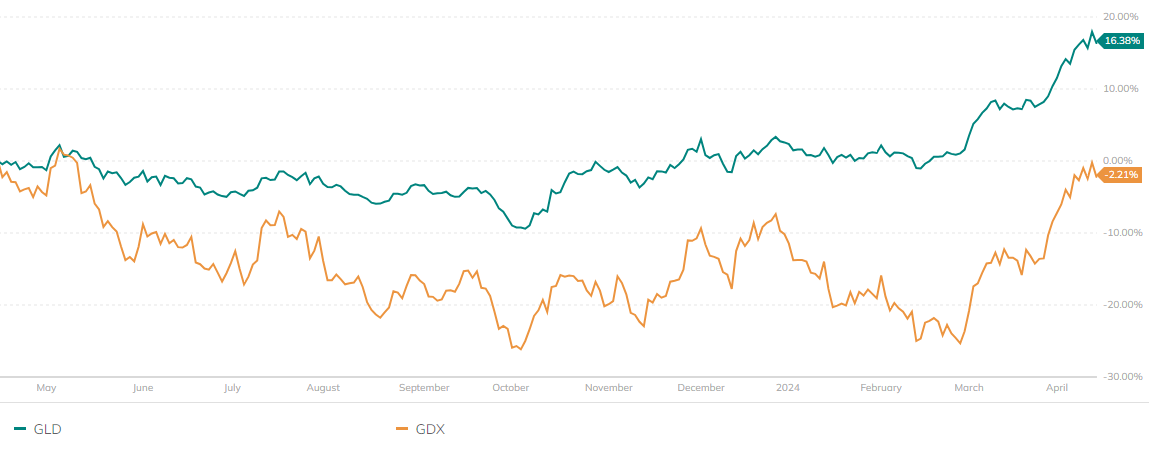
And if it isn’t obvious by now, gold miner stocks are still extremely unloved. As I mentioned in my portfolio review of my 24 stocks I like for this year days ago, sentiment around miners remains horrific. Gold and the GLD is continually piercing through all-time highs, and miners and GDX are nowhere near all-time highs, let alone 52-week highs.

As the divergence between the gold spot price and miners continues to widen, it feels as though it is getting more and more blindingly obvious that miners remain one of the best places for value in the entire market.

Miners continue to be my top conviction pick, and I still think there is tons of runway. While gold spot prices have gotten a few mentions in financial media, the precious metal miners have gotten very few, if any. The sell signal I’ll be looking for will be the days when the GDX performance has been so good that CNBC can do nothing but talk about miners. This is obviously a very, very, very long way off.

The purpose of this article—the reason why it is a “heat check” for gold and sound money assets—is because even though I’ve never been more bullish on gold, it’s important to understand that if the broader market crashes, gold will sell off with everything else. If the broader market starts to sell off for any reason—political conflict, overvaluation, election results—everything that isn’t bolted down is going to be sold as people scramble for liquidity in a 5.5% interest rate environment. Gold, silver, bitcoin, and all commodities will likely be part and parcel with such a sell-off.

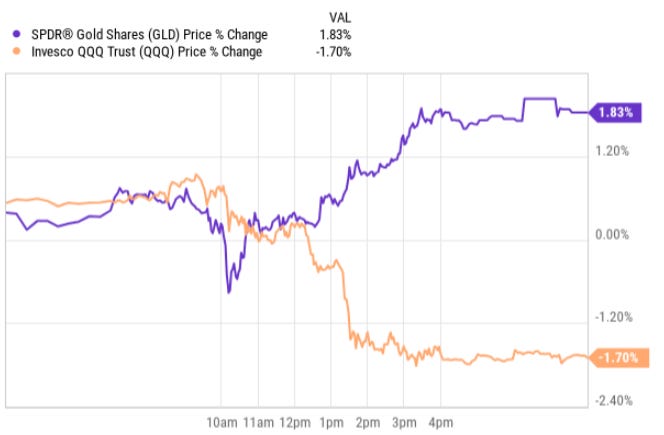
For example, on Monday when the market puked midday, it took gold with it. This is the same type of selling that would occur during a crash. The encouraging thing is that it didn’t take but an hour or two for investors to realize that the sell-off was nonsensical, as the reason for the crash—escalating tensions in the Middle East—was actually bullish for gold. So, you can see the GLD diverge from the Nasdaq (QQQ) and finish the day positive despite falling with the indices midday.

This move is a microcosm of what I expect to happen when the broader market crashes at some point in the relatively near future as a result of high interest rates and a stretched consumer during an economic contraction: a crash with markets, followed by a recovery as the market remains decimated.

It’s not even that the crash that will occur in metals will matter, seeing as how $2000 is likely now going to act as significant support for gold, and that’s a price that is still 10 or 20% higher than most miners have modeled for the next couple of years. It’s more about just keeping our heads screwed on straight right now, as there appears to be a lot of developments worthy of mixed feelings.


🔥 50% OFF ALL SUBSCRIPTIONS: Subscribe and get 50% off and no price hikes for as long as you wish to be a subscriber.


As a gold investor, I said at the beginning of the year that I liked it not only because it was a commodity but also because it was a fiscal dominance/inflation hedge and a geopolitical hedge. All of the situations I raised at the beginning of the year now seem to be playing out at the same time, which frankly makes me feel a little conflicted. I don’t want the US to be in an inflation crisis, nor do I want World War III to break out. However, as I said at the beginning of the year, it just seemed that these would be the most likely situations investors would be responding to this year, unfortunately. That said, it really doesn’t make crowing about how right we have been about gold for the last decade enjoyable.

I’m cautiously optimistic about the way things are going, but just remember that it’s called volatility because it can shock the market with unexpected outcomes. I personally plan to have cash on the sidelines and plenty of breathing room to be able to navigate whatever choppy waters may be ahead, even as gold rips.

Also on Monday, I sacrificed a couple of brain cells to let Charles Payne onto my TV since he was hosting Natalie Brunell and Peter Schiff debate bitcoin versus gold.

I’ve been pretty clear that my bitcoin allocation is far less than that of my gold position. I still think the precious metals are top dog when it comes to money. And even I get sick of listening to Peter Schiff crow about gold every time bitcoin is up and gold is down, but he did make some very good points during his appearance.

He noted that relative to one another—if you want to compare them both as types of assets—that bitcoin priced in gold has still not hit new all-time highs:

“Well, you know, gold’s probably going to close at a new record high today. It’s only a few dollars off now, above $2370. Gold is rising because the dollar, the Euro, and the Yen—fiat currencies—are losing value. Inflation is real, it’s here to stay, it’s not going anywhere near the Fed’s 2% target. We’re headed in the wrong direction. We’ll probably be in double digits by next year, and eventually, the first digit isn’t going to be a one.

Central banks are out in front of this; they’re the main buyers. You know, a lot of Americans have been foolishly selling their gold to buy these Bitcoin ETFs. There’s nothing elegant about losing your money in Bitcoin. Bitcoin is not going up; in fact, Bitcoin peaked two and a half years ago at about 37 oz. of gold. As we speak now, it’s worth less than 27 oz. That’s a 27% decline in 2 and a half years. This is a bear market.”

On the other hand, Peter was using price to make his case:

“There’s nothing sound about Bitcoin. It’s losing the race right now. Take a look at your screen. Gold is up $25, $26, and Bitcoin is getting clobbered.”

Using price to make your case is something that when bitcoiners do it, Schiff is quick to remind them that “price is what you pay and value is what you get”. Personally, the price action for me is not an indicator of the fundamentals. On the contrary, the fundamentals are a driver of the price action. Companies don’t perform better because their price goes up, for the most part. Usually, companies performed better and then their price goes up.

Natalie also made some points that I didn’t particularly agree with, specifically when she claimed that bitcoiners don’t feel the need to attack gold:

“Oh, I know Peter, and you know what? Bitcoiners don’t feel the need to constantly attack gold because we’re not threatened by gold.”

This (bitcoiners attacking gold) is so prominent it was going to be the topic of an entire article for me this week, but I’m writing this article instead.

Natalie is dead wrong. Bitcoiners absolutely cannot stop infringing on otherwise happy gold and silver investors by constantly telling them they don’t own enough bitcoin or that their allocation is too small. I see it every day that I tweet about gold — people respond to me and ask me why I waste my time with it, people are constantly telling me that I need more bitcoin or and bitcoiners are generally not staying out of the business of people who choose to own gold, either by itself or alongside bitcoin.

This is extremely toxic behavior. In my decade of working with short sellers and dealing with scams, a pump like this — where people go out of their way to unprovokedly tell you that you need to own something — always seems to be a common denominator. It just isn’t a good look for bitcoin and it’s why I wrote the article “Let Bitcoin Cook”. In it, I made the argument that the community would be better served by simply shutting the f*** up and letting the asset do the talking.

For example, I’m a gold investor, but I don’t tell people that are bitcoin-only that they need to own gold. Instead, I just mind my own business. Bitcoiners seem incapable of this. Natalie also gets it wrong when she says that gold “didn’t work” — yet it is the main reserve asset of many Central Banks, which is a dream scenario for bitcoiners (becoming a Central Bank reserve asset). During the interview, Natalie claims:

“I think the American dream has really been hijacked. We tried gold; it didn’t work. It was papered over. That system has failed the American people, and Bitcoin does provide hope for us, the working class. We want to be able to work for something that has to be measured by a free market so that we can see real value emerge, as opposed to being captured by politics and bureaucracy, which ultimately is a system that benefits the few at the expense of everyone else…”

All this did was remind me of Celsius’s Alex Minsky—now with his company bankrupt and dealing with criminal liability for running a crypto scheme—who said nearly the same nonsensical argument about gold, claiming in a debate with Peter Schiff that gold had “zero value”.

Bitcoin and gold have different properties—each with their own positives and negatives—but anybody telling you that gold has zero value or has failed is either catastrophically misinformed or simply not arguing in good faith, in my opinion.

And so, we forge forward another day, where owning whatever sound money assets we want to own—gold, silver, commodities, housing, etc.—still remains the obvious choice. Tensions in the Middle East are still simmering, and the United States still has the urgency of fiscal dominance. By virtue of those two things alone, pretty much anything that has a fixed supply is going to wind up going up in price, in my opinion. If I had to deliver general advice in one saying it would be “take it easy…but take it”.

What I mean by that is embrace the fact that from an investment perspective, things appear to be moving as we planned, but don’t get cocky or arrogant, and to remember that in a broader market sell-off, nearly everything can drop in value. However, as the only tool in the Fed’s toolbox remains printing money—which I believe they will do no matter how bad inflation is if the market crashes—any such crash in sound money would likely be short.

For today, the world hasn’t ended and the US is not experiencing hyperinflation. Treasury auctions haven’t failed and the market is still living to fight for one more day. So, onward and upward — take it easy, but take it.

QTR’s Disclaimer: I am an idiot and often get things wrong and lose money. I may own or transact in any names mentioned in this piece at any time without warning. I didn’t double check any numbers or figures in this piece and am generally lazy with my research. Contributor posts and aggregated posts have not been fact checked and are the opinions of their authors. Contributor posts and curated content are posted either with the author’s permission or under a Creative Commons license. This is not a recommendation or solicitation to buy or sell any stocks or securities, just my opinions. I often lose money on positions I trade/invest in. Sometimes I just lose money by misplacing it. I’m generally irresponsible. I may add any name mentioned in this article and sell any name mentioned in this piece at any time, without further warning. These positions can change immediately as soon as I publish this, with or without notice. You are on your own. Do not make decisions based on my blog. Do your research elsewhere. I exist on the fringe. The publisher does not guarantee the accuracy or completeness of the information provided in this page. These are not the opinions of any of my employers, partners, or associates. I did my best to be honest about my disclosures but can’t guarantee I am right; I write these posts after a couple beers sometimes. Also, I just straight up get shit wrong a lot. I mention it numerous times because it’s that important that you know.


Tyler Durden
Fri, 04/19/2024 – 07:20