Moar Power: White House Considers Invoking “Unprecedented” Climate Emergency
How best to grab power when there’s no convenient emergency to use as excuse? Invent one!
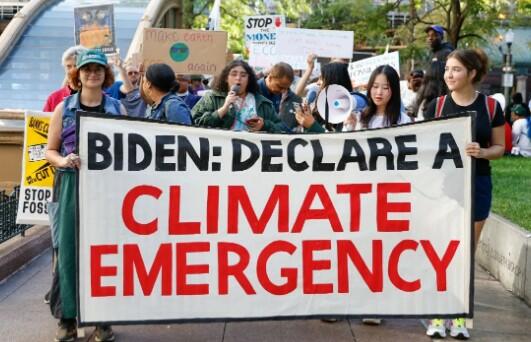
That’s right: if you had ‘climate emergency’ on your ‘list of disasters to prompt mail-in balloting’ bingo card, you may soon be able to cross that square off. That’s because the Biden administration is reportedly renewing discussions “about potentially declaring a national climate emergency,” according to Bloomberg.
Such an “unprecedented” declaration could “unlock federal powers to stifle oil development”, among other things, the report says.
Bloomberg reports, according to sources who requested anonymity as a final decision has not been reached, top advisers to President Joe Biden are reconsidering the possibility of declaring the emergency.
This action could lead to restrictions on crude exports, a suspension of offshore drilling, and a reduction in greenhouse gas emissions, sources say.
Within the White House, opinions are split on this issue. Some advisers believe that declaring a climate emergency wouldn’t grant Biden sufficient new powers to enact significant changes. Others, however, contend that it could energize voters who prioritize climate issues.
“President Biden has treated the climate crisis as an emergency since day one and will continue to build a clean energy future that lowers utility bills, creates good-paying union jobs, makes our economy the envy of the world and prioritizes communities that for too long have been left behind,” said White House spokesperson Angelo Fernandez Hernandez.
Historically, U.S. presidents, including former President Donald Trump, have declared national emergencies for various reasons. A climate emergency declaration would be unprecedented and likely face legal challenges.
The Biden administration considered this in 2022 amidst a deadlock on clean-energy legislation, but shelved the idea after the Inflation Reduction Act passed. Last year, President Biden said he had effectively used his authority for climate action by imposing conservation and clean-energy measures, and this year he halted new natural gas export licenses.
Environmental groups, however, are pushing for more aggressive actions. Emergency declarations could allow the president to halt crude exports, suspend offshore drilling, and restrict oil and gas transportation.
Youth environmental organizations like the Sunrise Movement, Fridays For Future USA, and the Campus Climate Network are planning Earth Day protests to demand that Biden declare a national climate emergency.
Aru Shiney-Ajay, the Sunrise Movement’s executive director, said Biden must “use every tool at his disposal to tackle the climate crisis and prepare our communities to weather the storm” of “another summer of floods, fires, hurricanes and extreme heat”.
Conservative activists have been calling for the House GOP to hold congressional hearings regarding the threat of Google Gemini, Google’s artificial intelligence (AI) program, and its left-wing biases ahead of the 2024 election.
As reported by Just The News, a letter signed by multiple conservative groups was sent to Congressman Jim Jordan (R-Ohio), Chairman of the House Judiciary Committee, this week demanding that Congress take action to investigate possible collusion between Big Tech platforms such as Google and the Biden White House.
“With President Trump the decisive favorite to win in November, it’s clear that Big Tech giants will try to pull the same tricks as last time to throw the election to the Democrats,” the letter reads in part.
“Unfortunately, as tech giants ramp up their crusade against Trump ahead of the 2024 election, 15 new technologies like generative AI will give them even more powerful tools to boost Democrats’ electoral prospects than four years prior,” the letter continues.
“[I]t’s more important than ever for Republicans in Congress to scrutinize Google’s monopolistic AI efforts, particularly given the threat it could pose to election integrity in 2024 and beyond.”
The letter was signed by the leaders of six conservative groups: The New York Young Republican Club, the Bull Moose Project, the American Principles Project, Citizens for Renewing America, American Accountability Foundation Action, and the National Constitutional Law Union.
Jordan has previously ordered Big Tech companies to hand over documents regarding their communication with the Biden Administration, as well as any influence the White House may have had over Google’s development of Gemini.
In addition, the Biden Administration has been hit with multiple lawsuits over its efforts to coerce social media companies into censoring conservative viewpoints, particularly regarding the Chinese Coronavirus and widespread voter fraud in the 2020 election.
Futures Tumble, Oil And Gold Soar On Reports Of “Huge Explosions” In Central Iran, Israeli Airstrikes In Iraq And Syria
And just like that, Israel – having once again ignored Biden’s pleadings not to escalate the already tense situation – is retaliating against Iran’s weekend strike, which was itself a retaliation against Israel bombing Iran’s embassy in Syria on April 1.
Moments ago futures dumped, oil prices spiked, and treasury yields slumped amid social media reports and Reuters headlines that there have been three “huge explosions” near the central Iran cities of Natanz (location of an Iranian nuclear power plant) and Isfahan (location of the Iranian Nuclear Technology Center which is suspected of being the center of Iran’s nuclear weapons program), as well as simultaneous explosions in Iraq and Syria, where the Israel air force appears to be targeting pro-Iranian militias.
IRANIAN MEDIA: 3 HUGE EXPLOSIONS WERE HEARD IN ISFAHAN, SOUTH OF TEHRAN
JERUSALEM POST: SIMULTANEOUS EXPLOSIONS REPORTED IN IRAN, SYRIA, AND IRAQ ACCORDING TO INITIAL REPORTS
IRAN’S FARS NEWS AGENCY SAYS EXPLOSIONS HEARD IN CENTRAL ISFAHAN AIRPORT, REASON UNKNOWN
ISRAELI MISSILES HIT IRAN SITE, US OFFICIAL SAYS: ABC
Some more reports:
Iraqi Sources are reporting that the Airstrikes on the Capital of Baghdad have Targeted a Building in which a High-Ranking Meeting was taking place involving several Iranian-Backed Groups and Members of the Islamic Revolutionary Guard Corps (IRGC).
Explosions so far have been reported in the last few minutes near the Cities of Isfahan and Natanz in Central Iran, which both contain Significant Facilities for the Iranian Nuclear Program.
🚨#BREAKING : 🇮🇷💥🔔Explosions so far have been reported in the last few minutes near the Cities of Isfahan and Natanz in ⛳️ Central Iran, which both contain Significant Facilities for the Iranian Nuclear Program. pic.twitter.com/xBPteeYA64
Unconfirmed reports suggest that the Israeli airstrikes are targeting a building where a high level meeting was being held among groups supported by Iran and the IRGC:
UNCONFIRMED: Iraqi sources report that airstrikes in the capital city of Baghdad have targeted a building where a high-level meeting was being held with the presence of several groups supported by Iran and members of the Islamic Revolutionary Guard Corps.
The Florida Supreme Court issued a long-awaited ruling on April 1, upholding a 15-week abortion ban that was signed into law in 2022. The ruling paved the way for a six-week abortion ban to take effect on May 1.
A second ruling on the same day allowed an initiative to amend the state constitution to guarantee abortion access to be placed before voters. An abortion advocacy group had already secured the required signatures, so a constitutional question on abortion will be on the Florida ballot in November.
Barely a week later, the Arizona Supreme Court upheld an 1864 law banning nearly all abortions in the state. Three days later, the Biden campaign initiated a seven-figure ad buy in the Grand Canyon State, including a billboard that reads, “Abortion is banned in Arizona thanks to Donald Trump. He won’t stop until it’s banned nationwide. #TrumpsAbortionBan.”
Democrats are leveraging abortion as a central issue in the 2024 election, and they are waging that campaign through ballot initiatives in key battleground states.
The theory is simple, according to political analyst Keith Nahigian. “Ballot questions help to get more independent expenditures for ‘get out the vote’ campaigns,” he told The Epoch Times.
In Arizona, a campaign is underway for a ballot measure amending the state constitution to provide the “fundamental right” to abortion up to the point a baby could survive outside the womb, typically around 24 weeks. It also would allow later abortions to save the mother’s life or to protect her physical or mental health.
In Nevada, a petition drive is in the works to include an amendment on abortion access. In Colorado and Maryland, voters will decide on abortion-related amendments in November.
“The Democrats’ strategy heading into this election cycle was to put these measures on the ballot in every big swing state,” Phoenix-based Republican strategist Marcus Dell’Artino told The Epoch Times.
Republicans are using the same tactic with election integrity—placing related measures on the ballot in nine states, including in Arizona, Florida, and Wisconsin.
Both sides appear to believe their efforts will aid them in the fall and ballot measures themselves are a successful way to further a cause.
In the 2022 election, voters in 38 states decided on 140 statewide ballot measures, according to Ballotpedia. Voters approved 69 percent of the measures and rejected 31 percent.
The movement to amend state constitutions to guarantee abortion access is a calculated strategy by the Democratic Party to rally voters to the November election.
The Democratic Congressional Campaign Committee laid out the strategy in an April 5 memo.
The committee attributed a ballot measure to add abortion to the state constitution in Ohio for the “historic” turnout during an off-year election in November 2023. Voters in the state passed the measure 57 percent to 43 percent—a margin of 14 percent. President Trump won Ohio by 8 percentage points in both 2016 and 2020.
“When abortion is on the ballot, voters turn out to defend their rights,” the memo states. “Seven battleground states are on track to have abortion measures on the ballot in 2024 … this further guarantees that reproductive freedom will remain a driving issue for voters this November.”
Capitalizing on Momentum
Momentum around the issue of access to abortion has been building since the U.S. Supreme Court’s 2022 Dobbs decision overturned Roe v. Wade, the seminal decision that, for decades, limited restrictions states can impose on the procedure.
Within 18 months of the Dobbs decision, seven states put abortion-related ballot questions before the public. In red and blue states alike, voters came down on the side of access to abortion.
Voters in Kansas voted to stick with the status quo, which provides the right to abortion in the state constitution, while Kentucky voted to reject an amendment that said there was no constitutional right to an abortion.
Montana voters rejected a measure that would have declared a child born alive at any stage of pregnancy to be a legal person and required medical care for that child. The measure also included criminal penalties for health care providers who violated the “born alive” portion of the law, by establishing a maximum of a $50,000 fine and/or 20 years in prison.
Meanwhile, voters in California, Michigan, Vermont, and Ohio amended their state constitutions to include a right to “reproductive freedom,” defined to include abortion and contraception.
Democrats have hammered the issue for over two years while Republicans have been slow to admit that many of their own voters don’t favor a near-complete abortion ban.
In Virginia, Democrats took advantage of Gov. Glenn Youngkin’s interest in a 15-week abortion ban to campaign on abortion access in 2023. They retook control of the state’s General Assembly, prompting prominent Democrats to make abortion a centerpiece of the 2024 campaign.
“The prospect of a national abortion ban is real,” Michigan Gov. Gretchen Whitmer said in December 2023.
Ms. Whitmer launched the Fight Like Hell PAC in June 2023 to raise campaign funds for Democratic candidates who are “unapologetic in their fight for working people and their basic freedoms.”
The Biden campaign released an emotionally charged ad on April 8 featuring a Texas woman who was denied an abortion after being told her baby would not survive birth. Over the woman’s tearful sobs, text appears on the screen:“Donald Trump did this.”
‘China Is Xenophobic & Cheating’: Biden Ramps Up Anti-Beijing Rhetoric On Campaign Trail
President Biden has ramped up his anti-China rhetoric on the campaign trail ahead of November, looking to grab headlines away from Trump while touring northern industrial states, and he has just called for major increases to some tariffs on Chinese steel and aluminum products.
“These are strategic and targeted actions that are going to protect American workers and ensure fair competition,” Biden told a small crowd of members at the United Steelworkers. “Meanwhile, my predecessor and the MAGA Republicans want across-the-board tariffs on all imports, from all countries, that could badly hurt American consumers.”
According to more from Biden’s speech via the NY Times, he said he would tell US trade representative Katherine Tai to increase tariffs “to what White House officials said would be 25 percent on certain Chinese products that now face tariffs of 7.5 percent, or none at all, pending the outcome of an administration review of the China tariffs initially imposed under Mr. Trump.”
But as fully expected, Biden’s words once again inflamed tensions with Beijing, given that in the remarks he slammed China as “xenophobic” while commenting on the Asian powerhouse’s current economic struggles.
“They’ve got a population that is more people in retirement than working. They’re not importing anything. They’re xenophobic—nobody else coming in. They’ve got real problems” Biden said further on Wednesday.
He had also accused China of cheating and policies that do harm against fair competition. The president said according to the White House readout:
Because Chinese steel companies produce a lot more steel than China needs, it ends up dumping the extra steel into the global markets at unfairly low prices. And the prices are unfairly low because Chinese steel companies don’t need to worry about making a profit, because the Chinese government is subsidizing them so heavily.
They’re not competing. They’re cheating. They’re cheating. And we’ve seen the damage here in America.
You know, back in the early 2000s, the Chinese steel began floating the mar- — flooding the market wi- — in steel towns all across Pennsylvania and Ohio, who were hit very hard.
The accusation of xenophobia and cheating marks the most aggressive rebuke of China thus far on the campaign.
China’s foreign ministry was quick to respond Thursday by once again highlighting US ‘hypocrisy’ – with spokesman Lin Jian lashing out sarcastically, “China wants to ask the U.S. whether it is referring to China, or the U.S. itself.”
Biden on his Pennsylvania tour also pledged to continue seeking to deny China advanced technology like computer chips. “They can’t be sent to China because it would undermine our national security,” Biden said. “When I spoke with Xi Jinping he said ‘Why?’ And I said, ‘Because you’d use it for all the wrong reasons, so you’re not gonna get those advanced computer chips.’“
US-China relations have someone stabilized of late, also amid the Biden-Xi phone call of two weeks ago. Also, this week Defense Secretary Lloyd Austin spoke to his Chinese counterpart for the first time in two years, as the two sides work to restore regular military-to-military communications.
The secretary of the Army on Jan. 6, 2021, lied about multiple details regarding what unfolded as the U.S. Capitol was breached, National Guard whistleblowers said during a congressional hearing on April 17.
Then-Army Secretary Ryan McCarthy made multiple false claims, including that he spoke to the commanding general of the District of Columbia National Guard on two separate occasions after officials requested that the Guard be deployed to the Capitol, the whistleblowers said.
After Maj. Gen. William Walker conveyed a request from the U.S. Capitol Police for Guard personnel, Mr. McCarthy called Maj. Gen. Walker at 2:14 p.m. and instructed the Guard to stand by, according to a Guard timeline of Jan. 6, 2021. But that call and others that Mr. McCarthy or one of his top advisers were said to have made later authorizing the Guard for mobilization and deployment did not happen, according to the Guard officials.
“At no time did Gen. Walker take any calls, nor did we ever hear from the secretary on any of the ongoing conference calls or the secure video teleconferencing throughout the day,” Capt. Timothy Nick, who served as Maj. Gen. Walker’s personal assistant on Jan. 6, 2021, said during the hearing. “This I know because I was with the command general the entire time recording the events.”
National Guard Captain Blows Up J6 Narrative, Accuses U.S. Govt of Lying to the American People
“I’m here today to aid the subcommittee in resolving factual errors in the official record of what happened on January 6th, 2021, specifically regarding the alleged District of… pic.twitter.com/1hJAarFgdx
Capt. Nick has not previously discussed publicly what transpired on Jan. 6, 2021, and neither has Brig. Gen. Aaron Dean, who was the National Guard’s adjutant general on the day that the Capitol was breached.
The Department of Defense (DOD) inspector general report on Jan. 6, 2021, which relied heavily on Mr. McCarthy and other military officials, was rife with “inaccuracies,” Brig. Gen. Dean said. “I believe it is my duty and moral obligation to stand before you today and illuminate the truth,” he told the hearing, which was held by the House Administration Committee’s Subcommittee on Oversight.
Despite Mr. Walker conveying the request for assistance at about 1:50 p.m., the Guard was not deployed to the Capitol until about 5:10 p.m.
“This was a dereliction of duty by the secretary of the Army,” Rep. Greg Murphy (R-N.C.), one of the members of the committee, said.
Mr. McCarthy refused to appear before the panel, Dr. Murphy said.
Christopher Miller, the acting secretary of defense at the time, authorized Guard deployment at 3:11 p.m., but Mr. McCarthy took the order and decided to draw up a plan before ordering the deployment, according to military timelines and testimony from Mr. McCarthy and others.
“You never would employ our personnel, whether it’s on an American street or a foreign street, without putting together a [plan],” Mr. McCarthy told the now-disbanded House Jan. 6 committee.
Mr. McCarthy could not be reached for comment. The Army declined to comment.
“We stand by our January 6th Report and have no further comment at this time,” a DOD inspector general spokesperson told The Epoch Times via email.
The whistleblowers also testified that Army officials Lt. Gen. Walter Piatt and Gen. Charles Flynn, during a 2:30 p.m. conference call on Jan. 6, 2021, expressed concern about the optics of having the Guard at the Capitol.
“I did hear the word optics. And they did use it. Specifically, Gen. Piatt said ‘optics.’ And his concern was that he did not want soldiers or airmen on Capitol grounds, with the Capitol in the background,” Brig. Gen. Dean said. “They were giving every other reason why we should be around the Capitol, away from the Capitol, and not responding to the Capitol.”
The officials lacked familiarity with the Guard and the Guard’s capabilities, Brig. Gen. Dean said.
Lt. Gen. Piatt has been quoted by Maj. Gen. Walker and others as saying during the call: “I don’t like the visual of the National Guard standing a line with the Capitol in the background. I would much rather relieve USCP [U.S. Capitol Police] officers from other posts so they can handle the protestors.”
Lt. Gen. Piatt has told lawmakers that he did not recall using the words optics, visuals, or image during the call or in any other conversations on Jan. 6, 2021. But he later said, “I may have said that,” citing people who took notes during the call.
Gen. Flynn told the House Oversight Committee in 2021 that he “never expressed a concern about the visuals, image, or public perception of sending the D.C. National Guard to the U.S. Capitol.”
Col. Earl Matthews, a lawyer who was with Maj. Gen. Walker on Jan. 6, 2021, and who has challenged the Pentagon Jan. 6 narrative, and District of Columbia National Guard Command Sgt. Michael Brooks, a senior officer with the Guard until he retired in 2022, also testified during the hearing in Washington.
None of the Guard officials who testified were formally interviewed by the House Jan. 6 committee, which was primarily run by Democrats and disbanded at the end of the previous Congress.
The officials said the Guard was ready to act and could have made a difference if not for the delay.
“I know if we were able to deploy immediately when Gen. Walker made the request, the National Guard could have helped end civil disturbance and restore order quickly,” Capt. Nick said.
Biden Pushing Pipe-Dream Of Israel-Saudi Mega Deal Based On Palestinian State Recognition
The Biden administration is keeping its dream of seeing Saudi-Israeli diplomatic normalization achieved (or rather, what is in fact originally Trump’sdream set in motionvia the Abraham Accords).
But Biden is dangling something before Netanyahu that the Israeli leader is unlikely to be very attracted by. “The Biden administration is pushing for a long-shot diplomatic deal in coming months that presses Israeli Prime Minister Benjamin Netanyahu to accept a new commitment to Palestinian statehood in exchange for diplomatic recognition by Riyadh, U.S. and Saudi officials said,” writes The Wall Street Journal Thursday.
This is not the first time the plan has been floated or was leaked to the media. Last year, for example, Saudi Arabia asked the US for help with developing a “civilian nuclear program” and for fewer restrictions on arms purchases in exchange for normalizing ties with Israel, as the New York Times previously reported.
The only thing that has changed is there are even bigger hurdles at this moment of a post-Oct.7 Middle East, including a still impending Israeli ground offensive on Rafah, and the specter of a major Iran-Israel war in the wake of the Saturday Iranian drone and ballistic missile attack on Israel.
“As inducements to recognize Israel, the White House is offering Riyadh a more formal defense relationship with Washington, assistance in acquiring civil nuclear power and a renewed push for a Palestinian state—a package that U.S. officials say they are in the final stages of negotiating,” continues the WSJ.
Admin officials speaking to the Journal also claimed that the major weekend attack out of Iran could hasten broader Arab Gulf and Israeli rapprochement:
U.S. officials say the successful multicountry effort to shoot down Iranian missiles and drones on Saturday should make it clear to Israel that its security against threats from Tehran can be enhanced through closer integration with Saudi Arabia.
However, as we underscored in featuring this Wednesday analysis: US Push For A ‘Middle East NATO’ Failed To Emerge During Iran Strikes, the reality is that in the end, the oil-rich Gulf states downplayed any involvement and left the heavy lifting of fighting off Iran’s attack to the US and its western allies and Jordan, the resource-poor Hashemite Kingdom dependent on US financial assistance.
On Friday the UN Security Council is expected to vote on an Algerian-proposed draft resolution to recognize a Palestinian state, which would give the Palestinian representatives full membership status at the United Nations.
The US position has long been that a Palestinian state must be born out direct negotiations between the Israelis and Palestinians, and not accomplished superficially within an external forum like the UN. The US has already said, via a State Department statement, that it will vote down the measure.
Israel for its part has clearly rejected that it will allow for a Palestinian state so long as Hamas still exists, and PM Netanyahu has even linked the more secular-leaning Palestinian Authority in the West Bank to ‘terrorism’. He has also rejected a prior US call to allow the PA to take over and administer the Gaza Strip. The reality is that the current Gaza war makes the prospect of achieving a Palestinian state more distant than ever.
And the prospect of Palestinian statehood resulting from some kind of Israel-Saudi normalization agreement – which US media reports previously dubbed the ‘deal of the century’ – also seems a pipe dream at this point.
Recently the World Bank released a handbook for asset managers on why to invest in gold. At Gainesville Coins I have written numerous articles on gold revaluation accounts and how these can be deployed by central banks to absorb losses in case of emergency. The World Bank has taken notice of my research as they allude to this practice in a chapter on reserve accounting and reference to my work.
The World Bank publication underlines the fact that gold is the only financial asset without counterparty risk, and due to its scarcity relative to fiat currencies its price in the long run always increases. Central banks that own gold for an extended period can reap the benefits of their gold revaluation account without having to sell any gold.
Introduction
The Gold Investing Handbook for Asset Managers document published earlier this year by the World Bank Treasury is an interesting read for investors. It covers the gold market structure, optimal portfolio assessments, geopolitical aspects, a trading and liquidity guide, and a discussion on gold accounting, among other subjects.
The World Bank Treasury is tasked to manage the World Bank’s finances and contribute to the Bank’s twin goals of “ending extreme poverty and promoting shared prosperity.” As such it acts as a trusted advisor to its member countries to support financial stability and provide “thought leadership in the broader treasury and financial management arena.” With this mission in mind the Bank’s Treasury writes that:
Throughout history, gold has played a vital role as a financial asset in the global financial system. … In the modern era, gold continues to play a critical role in the global financial system, serving as a hedge against inflation, a safe haven asset, and a reserve asset for central banks. … The role of gold in the global financial system has evolved over time, with changes in monetary policy, economic conditions, and technological advancements influencing demand and supply dynamics. Despite these changes, gold remains a crucial component of the global financial system and is likely to continue to play an essential role in the future. … The market disruptions brought about by the 2008 Global Financial Crisis (GFC), the US and China trade war, Brexit, and the COVID-19 pandemic, as well as a prolonged period of negative real interest rates and geopolitical uncertainties caused by financial sanctions imposed on Russia to freeze its foreign reserves, reinforced the strategic importance of gold as a buffer against financial instability.
Central Bank Gold Revaluation Accounts
After the central banks of advanced economies such as the Netherlands and Germany stated their gold revaluation accounts (GRAs) guarantee their solvency in 2013, the World Bank now joins the discussion on GRAs. On page 57 of its report there is a summary of my article on how the central bank of Curaçao and Saint Martin utilized its GRA to cover losses in 2021.
Simplified, a GRA is an accounting entry on the liability side of a central bank’s balance sheet that records unrealized gains in gold. Because central banks are the root of the modern money tree, they can use these entries to pay for expenses. A GRA, if sufficient, can prevent a central bank from going into negative capital in times of financial stress without having to sell gold (for more details read my article here).
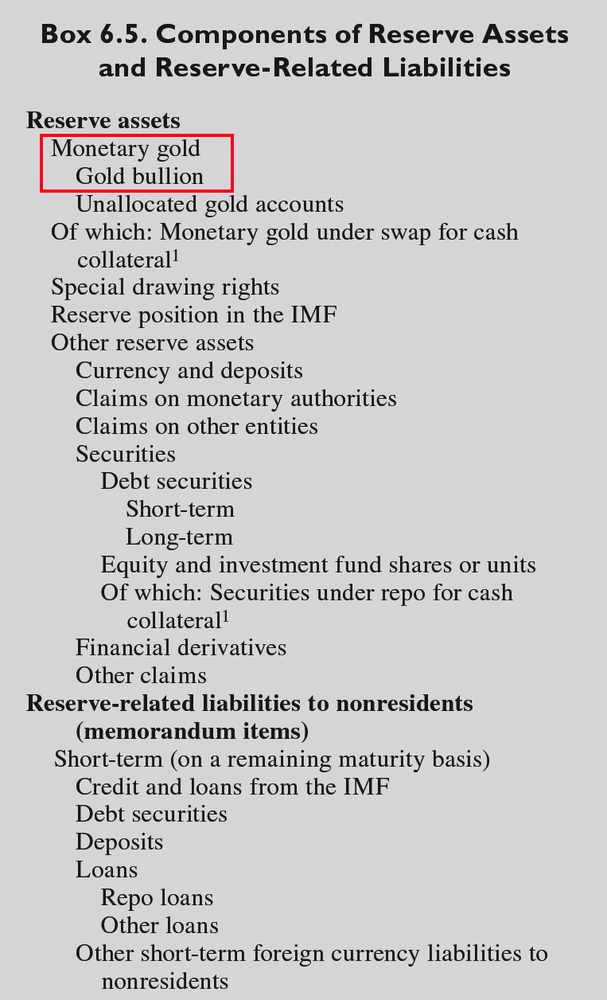
All in all, the World Bank’s reporting of GRAs is bullish for gold as it once again confirms gold’s position front and center in the monetary system. Gold—as per International Monetary Fund (IMF), the World Bank’s sister institute—is the only universally accepted financial asset that is not someone else’s liability. From the IMF (BPM6):
Financial assets are economic assets that are financial instruments. Financial assets include financial claims and, by convention, monetary gold held in the form of gold bullion … A financial claim is a financial instrument that has a counterpart liability. Gold bullion is not a claim and does not have a corresponding liability. It is treated as a financial asset, however, because of its special role as a means of financial exchange in international payments by monetary authorities and as a reserve asset held by monetary authorities.
Gold has no counterparty risk and can’t be arbitrarily devalued. Hence, the IMF lists gold at the very top of reserve assets, which makes gold the hardest asset for central banks to own and creates significant unrealized gains over time through the debasement of the currency they issue. And as I have explained previously these unrealized gains can be turned into realized gains to pay for expenses.
In the past years more and more central banks from both the global South and North—and international financial institutions like the World Bank—are pitching gold as an imperative asset with multiple functions. Gold is a safe haven asset, inflation hedge, backup currency, its revaluation accounts can be used, etcetera.
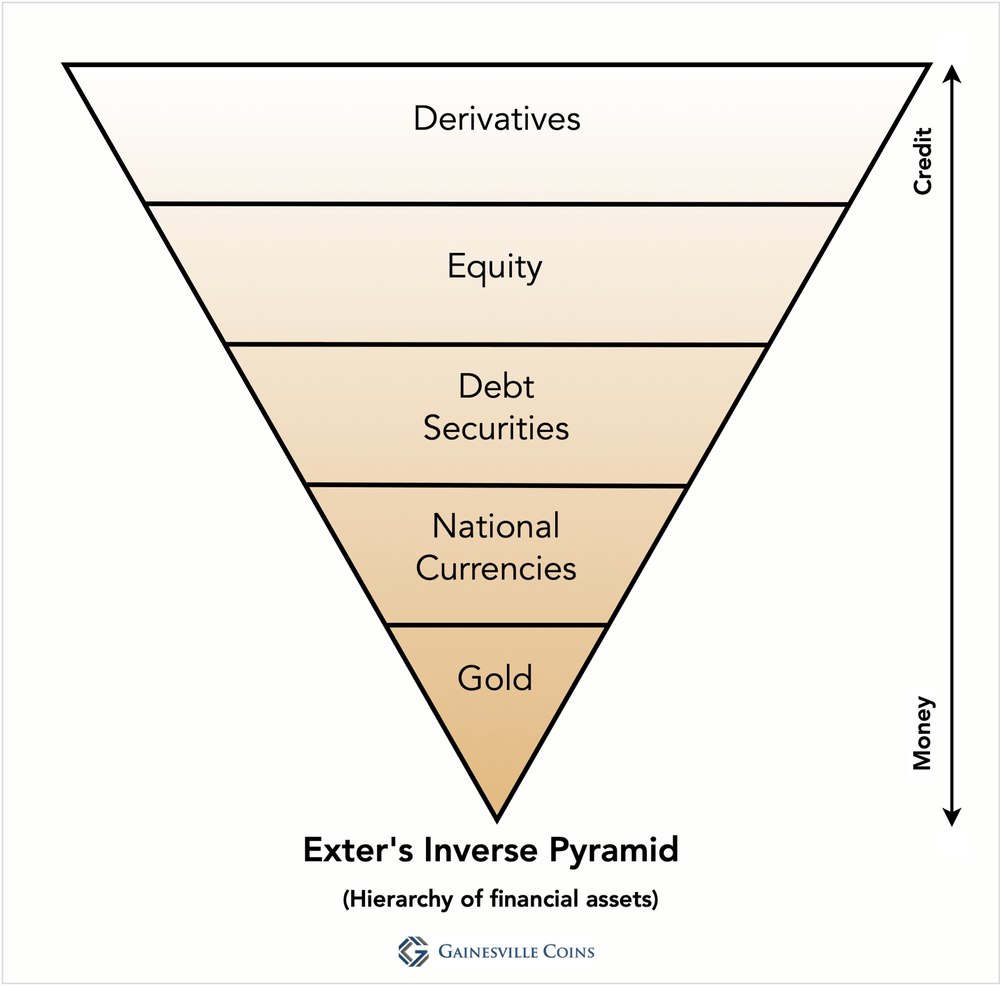
If one looks at the order of the IMF’s list of reserve assets the similarities with Exter’s inverse pyramid is easily seen. Gold truly underpins the global financial system. In my view, though, the value of all financial assets resting on gold has grown too large in the past decades. For stabilizing the pyramid (financial system), the value of the gold needs to increase accordingly.
But we will explore these imbalances more in depth in my next article.
Russia, Russia, Russia!: Watch As Democrats Go Full Russia-Tard During Hearing Over China’s “Political Warfare”
While China has spent decades conducting deep espionage throughout US institutions – mostly in the form of plucky PhD candidates handling sensitive projects at American universities, and places like Los Alamos National Laboratory, Congressional Democrats simply can’t shake their fixation with Russia.
Point in case, during a Wednesday House Oversight hearing on defending America from China’s political warfare, Democrats – who take tons of money from China (and bang their spies on occasion), couldn’t seem to remain on topic.
Watch:
Yesterday, we held a critical hearing on defending America from China’s political warfare.
“Our team re-reviewed the domain, the rating will not change as it continues to have anti-LGBTQI+ narratives…
The site authors have been called out for being anti-trans. Kathleen Stock is acknowledged as a ‘prominent gender-critical’ feminist.”
This was part of an email sent to UnHerd at the start of January from an organisation called the Global Disinformation Index. It was their justification, handed down after a series of requests, for placing UnHerd on a so-called “dynamic exclusion list” of publications that supposedly promote “disinformation” and should therefore be boycotted by all advertisers.
They provided examples of the offending content: Kathleen Stock, whose columns are up for a National Press Award this week, Julie Bindel, a lifelong campaigner against violence against women, and Debbie Hayton, who is transgender. Apparently the GDI equates “gender-critical” beliefs, or maintaining that biological sex differences exist, with “disinformation” — despite the fact that those beliefs are specifically protected in British law and held by the majority of the population.
The verdicts of “ratings agencies” such as the GDI, within the complex machinery that serves online ads, are a little-understood mechanism for controlling the media conversation. In UnHerd’s case, the GDI verdict means that we only received between 2% and 6% of the ad revenue normally expected for an audience of our size. Meanwhile, neatly demonstrating the arbitrariness and subjectivity of these judgements, Newsguard, a rival ratings agency, gives UnHerd a 92.5% trust rating, just ahead of the New York Times at 87.5%.
So, what are these “ratings agencies” that could be the difference between life and death for a media company? How does their influence work? And who funds them? The answers are concerning and raise serious questions about the freedom of the press and the viability of a functioning democracy in the internet age.
Disinformation only really became a discussion point in response to the Trump victory in 2016, and was then supercharged during the Covid era: Google Trends data shows that worldwide searches for the term quadrupled between June and December 2016, and had increased by more than 30 times by 2022. In response to the supposed crisis, corporations, technology companies and governments all had to show they were taking some form of action. This created a marketplace for enterprising start-ups and not-for-profits to claim a specialism in detecting disinformation. Today, there are hundreds of organisations who make this claim, providing all sorts of “fact-checking” services, including powerful ratings agencies such as GDI and Newsguard. These companies act as invisible gatekeepers within the vast machinery of online advertising.
How this works is relatively straightforward: in UnHerd’s case, we contract with an advertising agency, which relies on a popular tech platform called “Grapeshot”, founded in the UK and since acquired by Larry Ellison’s Oracle, to automatically select appropriate websites for particular campaigns. Grapeshot in turn automatically uses the “Global Disinformation Index” to provide a feed of data about “brand safety” — and if GDI gives a website a poor score, very few ads will be served.
The Global Disinformation Index was founded in the UK in 2018, with the stated objective of disrupting the business model of online disinformation by starving offending publications of funding. Alongside George Soros’s Open Society Foundation, the GDI receives money from the UK government (via the FCDO), the European Union, the German Foreign Office and a body called Disinfo Cloud, which was created and funded by the US State Department.
Perhaps unsurprisingly, its two founders emerged from the upper echelons of “respectable” society. First, there is Clare Melford, whose biography published by the World Economic Forum states that she had previously “led the transition of the European Council on Foreign Relations from being part of George Soros’s Open Society Foundation to independent status”. She set up the GDI with Daniel Rogers, who worked “in the US intelligence community”, before founding a company called “Terbium Labs” that used AI and machine learning to scour the internet for illicit use of sensitive data and then sold it handsomely to Deloitte.
Together, they have spearheaded a carefully intellectualised definitional creep as to what counts as “disinformation”. Back when it was first set up in 2018, they defined the term on their website as “deliberately false content, designed to deceive”. Within these strict parameters, you can see how it might have appeared useful to have dedicated fact-checkers identifying the most egregious offenders and calling them out. But they have since broadened the definition to encompass anything that deploys an “adversarial narrative” — stories that may be factually true, but pit people against each other by attacking an individual, an institution or “the science”.
GDI founder Clare Melford explained in an interview at the LSE in 2021 how this expanded definition was more “useful”, as it allowed them to go beyond fact-checking to targeting anything on the internet that they deem “harmful” or “divisive”:
“A lot of disinformation is not just whether something is true or false — it escapes from the limits of fact-checking. Something can be factually accurate but still extremely harmful… [GDI] leads you to a more useful definition of disinformation… It’s not saying something is or is not disinformation, but it is saying that content on this site or this particular article is content that is anti-immigrant, content that is anti-women, content that is antisemitic…”
Larger traffic websites are rated using humans, she explains, but most are rated using automated AI. “We actually instantiate our definition of disinformation — the adversarial narrative topics — within the technology,” explains Melford. “Each adversarial narrative is given its own machine-learning classifier, which then allows us to search for content that matches that narrative at scale… misogyny, Islamophobia, anti-Semitism, anti-black content, climate change denial, etc.”
Melford’s team and algorithm are essentially trained to identify and defund any content she finds offensive, not disinformation. Her personal bugbears are somewhat predictable: content supporting the January 6 “insurrections”, the pernicious influence of “white men in Silicon Valley”, and anything that might undermine the global response to the “existential challenge of climate change”.
The difficulty, however, is that most of these issues are highly contentious and require robust, uncensored discussion to find solutions. Challenges to scientific orthodoxy are particularly important, as the multiple failures of the official response to Covid-19 amply demonstrated. Indeed, one of the examples of GDI’s good work that Melford highlighted in her LSE talk was an article on a Spanish website in June 2021 about the Delta variant of Covid-19. “Official data: a third of deaths from the Delta variant in the United Kingdom were among the vaccinated,” reads the headline, next to an advertisement for Chipotle Mexican Grill. “This is clearly untrue,” she said breezily, “and Chipotle has been caught next to this ad unwittingly, and unfortunately for them have funded this highly dangerous disinformation about vaccines”.
This was, however, far from an accurate description. The statistic being reported comes from a June 2021 Public Health England report into Covid variants that sets out the 42 known deaths from the Delta variant from January to June: 23 were unvaccinated, 7 vaccinated with one shot and 12 fully vaccinated. In other words, 29% were fully vaccinated — around a third — and 17% partially vaccinated, making a total of 45% vaccinated. The headline claiming a third were vaccinated, it turns out, was not spreading “dangerous disinformation” at all — if anything, it underplayed the story.
Examples like this are far from rare. The GDI still hosts an uncorrected 2020 blog about the “evolution of the Wuhan lab conspiracy theory” surrounding Covid-19’s origins, which concludes that “cutting off ads to these fringe sites and their outer networks is the first action needed”.
This is despite the fact that Facebook and other tech companies long ago corrected similar policies and conceded that it was a legitimate hypothesis that should never have been censored.
In the US, a number of media organisations have started to take action against GDI’s partisan activism, prompted by a GDI report in 2022 that listed the 10 most dangerous sites in America. To many, it looked simply like a list of the country’s most-read conservative websites. It even included RealClearPolitics, a well-respected news aggregator whose polling numbers are among the most quoted in the country. The “least risk of disinformation” list was, predictably enough, populated by sites with a liberal inclination.
In recent months, a number of American websites have launched legal challenges against GDI’s labelling system, which they claim infringes upon their First Amendment rights. In December, The Daily Wire and The Federalistteamed up with the attorney general of Texas to sue the state department for funding GDI and Newsguard. A separate initiative to prevent the Defense Department from using any advertiser that uses Newsguard, GDI or similar entities has been successful, and is now part of federal law.
But GDI is a British company and, on this side of the Atlantic, the Conservative Government continues to fund it. A written question from MP Philip Davies last year revealed that £2.6 million was given in the period up to last year, and that there is still “frequent contact” between the GDI and the FCDO “Counter Disinformation and Media Development” unit.
Yesterday, I was invited to give evidence to the House of Lords Communication and Digital Committee during which I outlined the extent of the threat to the free media of self-appointed ratings agencies such as the Global Disinformation Index. The reality, as I told Parliament, is that GDI is merely the tip of the iceberg. At a time when the news media is so distrusted and faces a near-broken business model, the role of government should be to prevent, not encourage, and most certainly not fund, consolidations of monopoly power around certain ideological viewpoints.
But this isn’t simply a matter for the media. Both companies and those in the advertising sector also need to act: it cannot be good marketing for brands to target only half the population. Last year, Oracle announced it was cutting ties with GDI on free speech grounds, but as we discovered, it seems they are still collaborating via the Grapeshot plaform: is Larry Ellison aware of this?
At its heart, the disinformation panic is becoming a textbook example of how a “solution” can do more harm than the problem it is designed to address. Educated campaigners such as Clare Melford may think they are doing the world a service, but in fact they are acting as intensifying agents, lending legitimacy to a conspiratorial world view in which governments and corporations are in cahoots to censor political expression. Unless something is done to stop them, they will continue to sow paranoia and distrust — and hasten us towards an increasingly radicalised and divided society.