Musk Funds National Signature Campaign In Support Of First Amendment
Since acquiring the X platform, formerly known as Twitter, Elon Musk has been on a ‘free speech’ crusade against leftist corporate media, dark money propping up progressive fact-checkers, taxpayer-funded non-governmental organizations working under the guise of defending free speech, woke corporations, the censorship-complex blob, and rogue elites and progressive lawmakers who push dystopic agendas to undermine the First Amendment.
We’ve been living through a civil war over the existence of freedom of speech. If you haven’t been paying attention, here’s a brief summary: US intelligence agencies and the FBI pressured social media platforms, including X, to censor and suppress protected free speech, opponents of the Democratic party, and non-approved government narratives, such as the Covid lab leak, which by the way is not a theory.
When Musk purchased X, he exposed the government’s censorship blob and the big tech companies’ collaboration to censor the opposition. This effectively kicked off the 1A movement.
The movement could go into hyperdrive, as Musk posted on X, “Given the relentless attacks on free speech, I am going to fund a national signature campaign in support of the First Amendment.”
Given the relentless attacks on free speech, I am going to fund a national signature campaign in support of the First Amendment
Democrats and Republicans on the X platform responded to Musk’s posts, eagerly waiting to sign the signature campaign. The goal is to collect enough signatures in support of 1A. These signatures will likely be presented to government officials, organizations, or other decision-makers as a form of advocacy or as a way to initiate change and ensure that the censorship blob, woke corporations, progressive lawmakers, and radical leftist think tanks stop undermining 1A.
However, what could signatures do in an election year while 1A has been under routine assault by far-left billionaire George Soros’ dark money funding leftist groups? Maybe Musk should form or fund nonprofits that promote 1A to combat far-left causes that undermine the Constitution.
A second juror who was seated on the jury for former President Donald Trump in the Manhattan ‘Hush-Money’ Trial earlier this week was excused on Thursday, after prosecutors said that someone with the same name was arrested in the 90s for “tearing down political advertisements.”
The Associated Press also reported that this juror, an IT consultant who previously described President Trump as “fascinating and mysterious,” failed to disclose his wife was allegedly a previous participant in a corruption inquiry by the Manhattan district attorney’s office.
Earlier in the day, a juror was dismissed after saying she had concerns about her ability to be fair and impartial and had concerns about her identity being made public.
The two were sworn in earlier in the week with five others, including one alternate, on the second day of the trial.
The two dismissals by New York Supreme Court Justice Juan Merchan reduce the number of seated jurors to five. A total of 18 jurors need to be seated before the trial begins, six of which will be alternates.
AP described the scene in the Manhattan courtroom on Thursday morning as “frenetic,” as prosecutors also asked the judge to hold President Trump in contempt of court over social media posts they claim violated a gag order by Judge Merchan.
Second Dismissal
The second dismissal Thursday came when prosecutors raised concerns the juror may have not been forthcoming during jury selection when a question was asked whether he had ever been accused of or convicted of a crime, AP reported.
The juror was summoned to the court to answer questions after an article was found regarding a person with the same name being arrested in the 1990s for tearing down political campaign signs supporting conservative candidates in Westchester County, a suburban county of New York.
The prosecution also disclosed the man’s wife may have been involved in a deferred prosecution agreement with their office, also in the 1990s.
AP reported that the questions by Judge Merchan were “off-microphone” and thus his responses to the judge’s questions were not fully known, along with whether or not he confirmed or denied the allegations were indeed connected to him.
Thursday’s events bring a roadblock to an already difficult task of finding enough jurors to seat in the largely liberal Manhattan jury pool who are found to be able to decide President Trump’s fate fairly and impartially.
Inside the court, there’s broad acknowledgment of the futility in trying to find jurors without knowledge of Trump. A prosecutor this week said that lawyers were not looking for people who had been “living under a rock for the past eight years.”
But Thursday’s events laid bare the inherent challenges of selecting a jury for such a landmark, high-publicity case. More than half the members of a group of 96 prospective jurors brought into the courtroom were dismissed Thursday, most after saying they doubted their ability to be fair and impartial.
Earlier Dismissal
Early in the morning, Judge Merchan reported that the woman also known as “Juror 2” had slept on the decision to sit on the jury overnight and informed the court she wished to be dismissed.
She was brought into the room and said after thinking about it, she has friends, colleagues, and family that “push things” and outside influences that would likely affect her impartiality. She added that she had been identified as a juror from news reports.
The juror, an oncology nurse, said her family and friends had questioned her about whether or not she was a juror based on media reports. The judge in turn ordered journalists to refrain from publishing information about the juror’s current and prior jobs.
Justice Merchan said, “As evidenced by what’s happened already, it’s become a problem,” according to AP. The answers also will be redacted from court transcripts.
Prosecutors additionally asked for the employer question to be removed from the questionnaire for jurors, while the judge disagreed with the argument and said it was necessary information.
Other Developments
Also in court on Thursday, prosecutors asked for the 45th president to be held in contempt for what they said were social media posts that violated a gag order that bars him from attacking witnesses.
Those posts, prosecutors argued, included an article referring to witness and former Trump attorney Michael Cohen as a serial perjurer and another by a Fox News personality that liberals were disguising their true motives to be seated on the jury.
Mr. Trump’s attorney said that Mr. Cohen had attacked his former boss in public and the president was replying to those attacks.
On Monday, when Justice Merchan asked 96 prospective jurors if they couldn’t be fair and impartial in the trial, more than half of them raised their hands. They were then dismissed.
The Case
The legal case against President Trump involves an alleged $130,000 payment made by his former lawyer, Michael Cohen, to adult performer Stephanie Clifford, also known as Stormy Daniels, to keep her claims of having an affair with the president from becoming public.
President Trump has pleaded not guilty to the charges, asserting that it’s part of a longstanding and widespread effort to prevent him from being reelected. Earlier this week, President Trump wrote on Truth Social and told reporters that being in court every day will hamper his campaign, noting that he won’t be able to visit potential battleground states with just months to go before the November election.
The trial is expected to last upwards of eight weeks. Of that, the jury selection process could last as long as two weeks, analysts speculate.
The New York case is one of four criminal prosecutions the former president faces. The other cases stem from his alleged mishandling of classified information and activity in challenging the results of the 2020 election.
He has pleaded not guilty to those charges, too, although it’s not clear whether the three cases will make it to trial before November.
The federal election case was placed on hold by a Washington-based judge as the appeals process plays out. In the documents case in Florida, the federal judge has yet to reschedule a new trial date.
In Georgia, the former president has appealed state election-related charges in Fulton County, putting that case on hold. It came amid allegations that the Fulton County district attorney, Fani Willis, engaged in inappropriate behavior that the defendants say should have led to her dismissal.
Jack Phillips and The Associated Press contributed to this article.
Stocks had limped higher all night after four straight days lower but into the cash open, Fed’s Williams ruined the party by admitting that while rate-hikes are not ‘his baseline’ they are possible if the data warrants. But that dip was bought aggressively after the open.
Stocks were spooked a little by the ‘no landing’ narrative screaming from Philly Fed’s data (showing HL improvement but soaring prices-paid, and despite the weakest workweek since COVID lockdowns, expectations for prices are at multi-year highs…), boringly (and mysteriously) solid jobless claims, and benign home sales…
Source: Bloomberg
But then more hawkish FedSpeak wrecked the ramp-fest as Bostic warned The Fed “won’t be in a position to cut rates until the end of the year.”
That leg pushed Nasdaq down to break its MT CTA ‘sell’ threshold (17,569) and things got interesting. A late-day bid put some lipstick on an otherwise pig of a day, but it couldn’t hold. The Dow closed green, Nasdaq was the biggest loser, with S&P and Small Caps red…
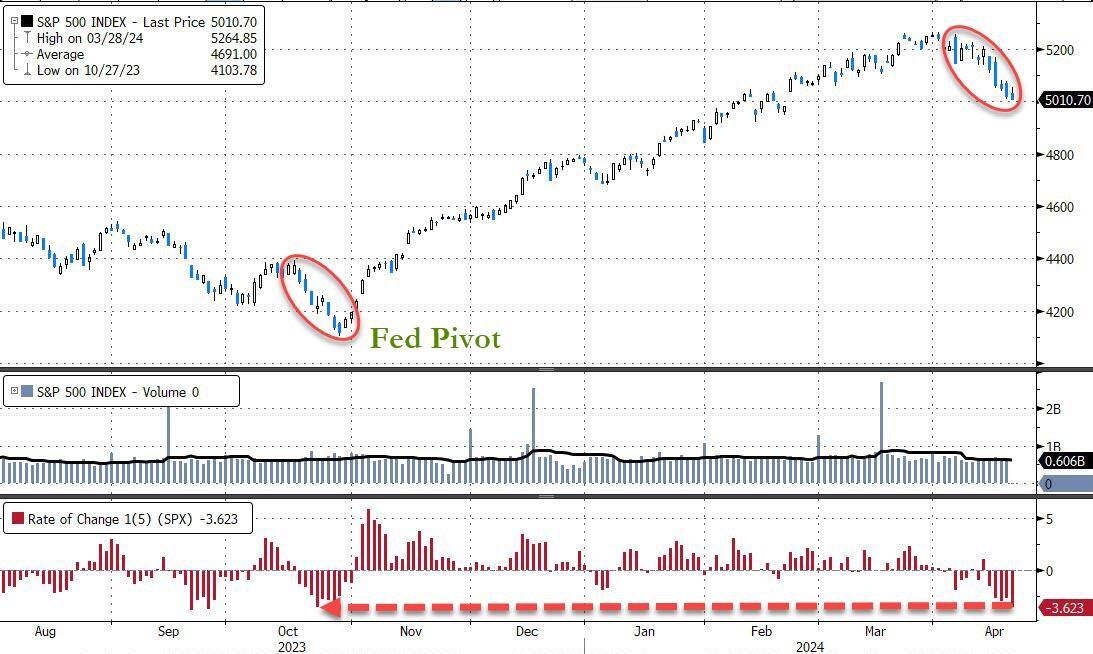
S&P down for five straight days hasn’t happened since October 2023 (just ahead of The Fed ‘Pivot’)…
Source: Bloomberg
Albeit much smaller, we once again saw a pump-n-dump around 1400ET…
Since 1990, I found 20 other times the S&P 500 opened green, but eventually closed red three consecutive days. It just happened today.
Negative returns on avg a month later and up only 55% of the time.
Could this be a subtle clue the bulls are losing control?
Having broken down through the ST CTA ‘sell’ threshold earlier in the week, today saw Nasdaq lose the MT CTA ‘sell’ threshold (17,569) and chop (support at 17462 (100DMA))…
As Goldman’s trading desk confirmed ” a combo of continued hawkish fed and strong macro data….testing some key levels too, with 2y notes right around 5%, and would think as we approach the weekend, there’s likely gonna be a push/pull between geopolitical weekend risk premium vs supply next week.”
“As a strategist, it is an uncomfortable place to be to have a target below the market, but our work continues to lead us in the same direction,” Evercore ISI’s Julian Emanuel said in an interview.
“Valuations are very, very taxing and the forward returns at these valuations tend to be subpar.”
The average pullback in a non-recession year is 13%, Emanuel added, pointing to stickier cost pressures and monetary policy that is “more of a question mark” as catalysts for further declines.
“Part of the story that got us — particularly in the momentum stocks — as overextended as we were at peaks in March, was that the public was an incredibly enthusiastic player in equity markets who saw some record flows,” Emanuel said.
“We now think this is an environment where people are going to temper their optimism and do a little bit of reset.”
Indeed, the US majors are suffering their biggest drawdowns since Sept 2023 (right before the Fed Pivot)…
Source: Bloomberg
VIX is now near its 6m high as markets continue to grapple with geopolitical tensions in the Middle East, and credit markets have started to crack…
Source: Bloomberg
But, while equities were not pretty, bonds were just as ugly with yields up 6bps across the short-end and belly with the long-end modestly outperforming (30Y +4bps)…
Source: Bloomberg
…with 2Y yields pushing back up to 5.00%…
Source: Bloomberg
For some brief moments today, May rate HIKES were more likely than CUTS…
Source: Bloomberg
…and 2024 rate-cut expectations closed at a new low with just 38bps priced-in…
Source: Bloomberg
After a couple of hard days, Bitcoin extended yesterday’s bounce off $60,000 ahead of what is expected to be the ‘halving’ tomorrow…
Source: Bloomberg
Gold also gained on the day, back above $2390 intraday…
Source: Bloomberg
…even as the dollar rallied…
Source: Bloomberg
Oil prices ended unchanged on the day, recovering from an early puke to an $81 handle (WTI)…
Source: Bloomberg
Finally, the “no landing” narrative is winning…
Source: Bloomberg
…and as Nomura’s Charlie McElligott pointed out “‘no landings’ lead to ‘hard landings'”.
Columbia University Gives NYPD Cops Greenlight To Arrest Anti-Israel Protesters Occupying Campus
Americans should wake up to fiery anti-Israel protests erupting across the nation this week, from attempting to close critical infrastructure such as bridges and airports; we must ask who exactly is funding this social unrest. And whoever is funding this chaos appears to have taken a page out of the communist movement by Black Lives Matter several years ago.
On Thursday, New York City Police Department officers in riot gear swarmed the woke Ivy League school of Columbia University. New York’s finest arrested dozens of radical leftist anti-Israel protesters after the school’s president had no other choice but to remove them or face an uproar from X, school donors, and Republicans on Capitol Hill.
Here’s what happened this afternoon.
UPDATE: NYPD have entered the Columbia Palestine solidarity encampment and are threatening to arrest the protesters. pic.twitter.com/4JQXly0cfO
Pro-Hamas domestic terrorists @Columbia having a meltdown screaming “WHY ARE YOU DOING THIS TO ME???” as #NYPD carts them off . Always the victims. pic.twitter.com/UE1VFQrOUH
— Michal/Michele -מיכל✡️ 🟦 (@MichalSabra) April 18, 2024
With Harvard’s Gay firing still fresh in the mind of Columbia University President Minouche Shafik, she acted quickly to push the anti-Israel protests off campus.
“Out of an abundance of concern for the safety of Columbia’s campus, I authorized the New York Police Department to begin clearing the encampment from the South Lawn of Morningside campus that had been set up by students in the early hours of Wednesday morning,” Shafik said.
Shafik’s move comes one day after she told the House Committee on Education and the Workforce at a hearing about antisemitism on university campuses in Washington that she fired a professor who allegedly expressed support for Hamas on social media following the October 7 terror attack on Israel and has taken other measures to prevent antisemitism on campus.
Meanwhile, the communist daughter of Rep. Ilhan Omar (D-MN) has been suspended by Columbia University for organizing the occupation on campus grounds. She describes herself as an “angry black girl” with a communist hammer and sickle symbol on X.
Ilhan Omar’s psycho daughter just got suspended from Barnard over her Hamas activism, and she has a Soviet hammer & sickle emoji in her bio + pronouns. Perfection. pic.twitter.com/xhgMestxAs
One ex-senior Trump official told us about the possibility this unrest is coming from a little-known international organization called Samidoun. The Israeli government declared Samidoun a terrorist organization in 2021.
“They support terrorism, and they want to gain public opinion — support — for terrorism,” Yossi Kuperwasser, the former chief of the research division in the Israel Defense Forces’ military intelligence unit, recently said.
Maybe lawmakers should get serious about who is funding these anti-Israel protests erupting across the US, or face BLM-style riots this summer.
This Is The Uniparty ‘Reveal’: Speaker Johnson To Pass $95.3 Billion Foreign Aid Package Using Democrats
House Speaker Mike Johnson (R-LA) is scrambling – both to keep his job, and to pass several bills to devote billions in US taxpayer funds to foreign entanglements that Johnson’s conservative base has little-to-no appetite for. The bills would provide around $60.8 billion for Ukraine, $26.4 billion for Israel, and $8.1 billion for Ukraine. Meanwhile, following Republican outcry – Johnson included a fifth bill which would revive the Secure Border Act – so US border security is essentially an afterthought.
In order to appease said base, Johnson – who faces a growing threat of removal by House conservatives – has added a US border security measure to the package, which he told lawmakers the House would vote on Saturday night. The $95.3 billion package includes three aid bills to send funds to Ukraine, Israel and Taiwan, after claiming that the situation in Ukraine was at a tipping point, and the “axis of evil” of Russia, China and Iran are coordinating to help Russia to push further into Europe, like Hitler.
Speaker Mike Johnson: “We’re going to stand for freedom and make sure that Putin doesn’t march through Europe… we’re the greatest Nation on the planet, and we have to act like it”
He confirms Trump supports him and the record-breaking Ukraine funding plan he just introduced pic.twitter.com/uTUjs7rRz2
“To put it bluntly, I would rather send bullets to Ukraine than American boys,” said Johnson, the Washington Times reports.
He’s a stupid, gullible, dishonest person whose incompetence is eclipsed only by his cowardice. Imagine being alive and sentient and witnessing the last 10 years of Deep State skullduggery and then allowing yourself to be manipulated by the most corrupt intelligence apparatus on… https://t.co/h0DIvuNstb
The Ukraine aid would be provided as a loan, but with provisions allowing for the loan to be canceled.
A fourth bill would allow the use of seized Russian assets for aid, and sanctions for Russia, China and Iran. It also includes the language of a House-passed bill requiring TikTok to divest from China, a proposal that stalled in the Senate.
A fifth, separate bill includes core components of the House GOP’s Secure the Border Act. -Washington Times.
Far-right conservatives in the House balked at the new plan, calling the border language “watered down” and demanding it to be attached to Ukraine aid.
Conservatives slam
Rep. Bob Good (R-VA) called it a “joke,” arguing that Johnson is more worried about Ukraine than the US-Mexico border – which the speaker had previously promised to pair together.
“He certainly doesn’t want to try to use border security because I guess he’s afraid it might mess up Ukraine,” Good added.
Rep. Thomas Massie said on X that Johnson “plans to pass the rule for the $100 billion foreign aid package using Democrats on the Rules Committee,” adding “This is the Uniparty “reveal.””
GOP Gives up on Johnson: @RepThomasMassie says Mike Johnson has betrayed the Republican conference on 2 big occasions and he is about to do it a third time. Massie has called on Johnson to resign as John Boehner did and allow the GOP to elect a new speaker. #TheGreatAmericaShowpic.twitter.com/Xz2RY2kJAG
The Secure Border Act – passed by the House but shut down in the Democrat-led, open-border Senate, would restart the construction of Donald Trump’s southern border wall, and would include other measures to stem the flow of migrants.
Momentum Builds for Ouster
According to The Hill, momentum is “growing quickly” to oust (‘vacate’) Johnson if he moves to alter the ‘motion to vacate’ rule as part of the above package. The move would raise the threshold for forcing a vote on a motion to vacate – which can currently be called by a single lawmaker. This would reverse an agreement struck between former GOP Speaker Kevin McCarthy (CA) and conservatives in January of last year as a condition of their support for his leadership.
Johnson denied that he’s considering such a modification, however he told CNN on Wednesday that the ouster mechanism “has been abused in recent times,” adding that “maybe, at some point, we change that.”
The denial has done little to mollify the conservatives, who huddled with Johnson for a long and tense discussion on the chamber floor Thursday — a meeting that featured plenty of yelling. Afterward, some of the conservatives said they’re ready to support a motion to vacate if Johnson endorses the rule change making it harder to launch that very process.
“It’s a red line for me, for sure,” Rep. Lauren Boebert (R-Colo.) told reporters after the gathering broke up.
Rep. Matt Gaetz (R-Fla.), who led the effort to oust McCarthy from the Speakership in October, would not commit to supporting Johnson’s removal over the rule change but suggested that it could be the last straw for him.
“I think a motion to vacate is something that could put the conference in peril, and Ms. Boebert and I were working to avoid that,” Gaetz said. “Our goal is to avoid a motion to vacate. But we are not going to surrender that accountability tool, particularly in a time when we are seeing America’s interests subjugated to foreign interests abroad.” –The Hill
The controversy comes as Rep. Marjorie Taylor Greene (R-GA) has repeatedly threatened to drop a motion to vacate on Johnson over his willingness to negotiate deals with Democrats on key issues such as federal spending, government surveillance, and most recently – Ukraine aid.
“He’s serving Ukraine first and America last, and that would be the worst thing to do,” said Greene. “I can’t think of a worse betrayal ever to happen in United States history. And here’s what’s really ironic: the constitutional attorney, Mike Johnson, is literally betraying the American people in order to keep his grip of power on the Speakership.”
Bloomberg’s Ye Xie reports that a small group of funds has accumulated such large short wagers in the Treasury market that they could destabilize the broader financial system during times of stress, according to the International Monetary Fund.
“A concentration of vulnerability has built up, as a handful of highly leveraged funds account for most of the short positions in Treasury futures,” the IMF said in its Global Financial Stability Report released this week.
“Some of these funds may have become systemically important to the Treasury and repo markets, and stresses they face could affect the broader financial system.”
The IMF’s comments came in a section discussing the so-called basis trade, which contributed to turmoil in the world’s biggest bond market at the time of the pandemic outbreak in 2020.
In this trade, hedge funds exploit tiny differences between the prices of cash Treasuries and futures, using large sums of money borrowed from the repurchase-agreement market to amplify returns. Because of this leverage and reliance on short-term funding, the bet has drawn increasing scrutiny from regulators. And now the IMF is highlighting another risk: concentrated positions.
As of December, about half the two-year Treasury short positions in the futures market were in the hands of eight traders or less, according to the IMF. It was at a similar level at the end of 2019, just before a surge in funding costs in the early days of the pandemic spurred traders to unwind the positions, which helped boost volatility in bonds at a time of upheaval across financial markets.
Source: IMF’s Global Financial Stability Report
The use of basis trades swelled along with the Federal Reserve’s interest-rate hikes, which potentially make the strategy more profitable by widening the price gap between the cash and futures markets.
A Fed study last month estimated that hedge funds have amassed at least $317 billion in Treasury holdings related to basis trades since the first quarter of 2022, although the size is “significantly” less than it previously estimated.
In December, the SEC required the funds and brokerages to centrally clear far more of their US Treasuries transactions, a move to bolster oversight of basis trades.
Source: IMF’s Global Financial Stability Report
Since then, there are signs that use of the trade may be waning: Commodity Futures Trading Commission data shows a decline in leveraged funds’ short positions in bond futures.
The concentration in these bets has also diminished.
In two-year futures, net short positions controlled by eight traders or less have dropped to about 38% of total open interest, from 50% in early January, according to CFTC data compiled by Bloomberg.
Source: CFTC’s Commitments of Traders data
Note: Data show percentage of two-year Treasury short futures contracts held on a net basis
Despite that unwinding, the IMF noted the short positions of leveraged funds remain large, which means they may still loom as a risk.
As the Fed shrinks its holdings of Treasuries, a process known as quantitative tightening, it also may reduce the liquidity in the financial system, potentially triggering a jump in funding costs and leading the basis trade to unravel, the IMF said.
“Basis trade investors rely on low repo haircuts and low repo rates to leverage their positions and increase basis trade profitability,” the report said.
“A spike in repo rates — triggered, for example, by surprises in quantitative tightening — can render the trade unprofitable and could trigger the forced selling of Treasury securities and a brisk unwinding of futures positions as funds seek to quickly delever.”
Which explains, as we noted previously, why the SEC is now scrambling to figure out just how much capital is truly allocated to basis trades within multi-manager/multi-strat hedge funds, but based on our quick look at regulatory leverage, the actual amount allocated to basis is orders of magnitude greater than $550BN, more likely in the $2+ trillion ballpark across the entire global hedge fund industry.
And there you have it: all the basis trade is, is the latest manifestation of the “collecting pennies in front of a steamroller” trade, because when it works it generates 10% returns every year like clockwork, with the only gating factor being how much leverage a hedge fund has access to.
However, during a crisis, such as the Sept 2019 repo fiasco or the March 2020 crash, it all goes to hell… and the Fed rushes to bail out not just bank but hedge funds which are now so tightly interwoven in the financial fabric (via ultra loose and generous Prime Brokerage linkages) that central banks have no choice but to bail out everyone, including the billionaires who run the hedge funds that have put on trillions of basis trades on!
Crude oil exports from Iran hit the highest level in six years during the first quarter of the year, data from Vortexa cited by the Financial Times has shown.
The daily average over the period stood at 1.56 million barrels, almost all of which was sent to China, earning Tehran some $35 billion.
“The Iranians have mastered the art of sanctions circumvention,” Fernando Ferreira, head of geopolitical risk service at Rapidan Energy Group, told the FT. “If the Biden administration is really going to have an impact, it has to shift the focus to China.”
The news comes as the EU and the United States prepare new sanctions against Iran in a bid to convince Israel to not retaliate against Tehran after the latter’s drone and missile attack on Israeli military targets last weekend.
Iran’s oil industry would be the no-brainer target for new sanctions as suggested by U.S. Treasury Secretary Janet Yellen.
“Clearly, Iran is continuing to export some oil. There may be more that we could do. I don’t want to preview our actual sanctions activities, but certainly, that remains in focus as a possible area that we could address,” Yellen said earlier this week as quoted by Reuters.
Analysts, however, have told the FT that the Biden administration is reluctant to tighten the sanction noose too much as this would inevitably lead to an increase in oil prices that a president running for re-election cannot really afford in an election year.
Iran is producing record amounts of oil, enabling it to pay for missiles, drones and whatnot, as Biden refuses to enforce Trump’s sanctions against Iran oil exports afraid an oil price spike would further crush his approval rating pic.twitter.com/eeX0OnwYBA
That’s especially relevant in light of the fact that the federal government would hardly be able to repeat the SPR release from 2022 to tame prices at the pump as the reserve sits at the lowest level in 40 years after that 2022 release.
Also, any heavy-handed action against Iran’s oil exports would affect relations with China, which is virtually the only outlet for Iranian crude. That crude, according to the FT, covers a tenth of China’s total oil imports.
Workers Who Had Their Middle-Class Status Offshored By 40-Years Of Neoliberalism Are Finally Vindicated
By Benjamin Picton of Rabobank
An Eye For An Eye
Treasury yields fell yesterday for the first time this week. The 2-year was down 5.5bps to 4.93%, while Brent crude gave up 3% to be sitting well below the $90/bbl again. Crude is sending some interesting signals. It rose every day in the week of Israel’s suspected attack on an Iranian compound in Syria that killed a senior Quds Force commander. Last week crude vacillated between gains and losses as markets awaited the Iranian response and this week, having ‘bought the rumour’ a fortnight ago, markets appear content to ‘sell the fact’.
That’s not to say that there isn’t another geopolitical shoe yet to drop. It seems very likely that there is. Axios reports that the Israeli war cabinet considered giving the IDF the green light to retaliate on Monday, despite urgings from the White House and the G7 for Israel to do nothing. According to Axios, the decision to strike back is already made, only the timing and the scale remains in question. Israel must now run the calculus on how to extract a price from Iran without overplaying its hand and sparking a multi-front war. Iran has threatened that any attack by Israel could be met with a response that is 10x the scale of the weekend attacks and involving more sophisticated weaponry. Clearly, the stakes are high.
Nevertheless, the price action seems to suggest that markets are untroubled by these reports. Commentary in recent days has variously swung between imminent WWIII (unlikely) and “it’s all just for show” (naïve). The entreaties from G7 leaders for Israel to ‘turn the other cheek’ reveal the extent to which Israel’s position is mis-read in the broader West. The post-protestant instinct of European and American leaders to ‘take the win’ on shooting down the vast majority of Iran’s deadly projectiles is at odds with the Israeli viewpoint.
Israel is THE Jewish state. Bibi – and several members of his war cabinet – are old-covenant kinds of guys. “An eye for an eye and a tooth for a tooth” is more than just a millennia-old theological disposition, it is a security imperative for a country attempting to maintain strategic deterrence while surrounded by foes.
So where does that leave markets? Highly irrational in some respects. Risk premia is being rapidly priced out of the energy complex, despite G7 sanctions on Iran, the threat of interruption in the Strait of Hormuz, and news overnight of new US sanctions on Venezuelan oil. Bear-steepening of the Treasuries curve suggests that markets are much more attuned to the ‘game of basis points’ being played in inflation and policy rate projections, rather than the ‘game of pointing missiles at bases’ being played in the Middle East.
To wit, Fed speakers Bowman and Mester have followed up on Powell’s delayed rate cuts admission of a day ago. Mester – usually a hawk – rolled out the back catalogue by saying that the Fed “need[s] to see more data to be sure of [the] inflation path”. Bowman – a definite hawk – said that “progress on inflation may have stalled” and that “time will tell if policy is sufficiently restrictive.”
That last line makes it sounds as if Bowman doesn’t believe policy is sufficiently restrictive. Is she resigned to the idea of the FOMC erring by keeping the Fed Funds rate unchanged while they cross their fingers and toes that three months of rising inflation is just a bump in the road? Perhaps she’s wise to be wary of assurances that “it’s transitory!”
The Fed isn’t the only central bank with difficult decisions ahead. CPI inflation reports for the UK and New Zealand both threw up concerns yesterday, particularly on the trajectory for services inflation.
New Zealand CPI for Q1 came in at 0.6% q-o-q and 4% y-o-y, which is above the RBNZ’s 3.8% forecast. The services component rose from 4.7% y-o-y to 5.3%, while non-tradable inflation (i.e. inflation generated within the country) rose on a quarterly basis from 1.3% to 1.6%. That means that all of the heavy lifting on the headline rate was done by a larger-than-expected fall in tradeable inflation (-0.7% vs expectations of -0.2% q-o-q) that might actually be transitory, given lag effects for energy and freight prices.
Over in the UK the headline inflation rate fell from 3.4% y-o-y to 3.2% in March. The consensus of the Bloomberg survey was for 3.1%, so this was definitely a miss. The median estimate of surveyed economists on the services component was 5.8%, but the actual result came in at 6%, just one-tick lower than the previous month. Our resident BOE watcher, Stefan Koopman, says that this result – taken in conjunction with the prior day’s labour market data – pretty much rules out a rate cut in May. Stefan expects the BOE to cut in August, with two follow-up cuts later in 2024.
Aussie labor market data released earlier today saw some mean-reversion in the headline employment figures. According to the ABS, Australia shed 6,600 jobs in March after gaining 117,600 in February. Rabobank had been expecting 10,000 jobs to be lost – which puts us equal closest to the pin amongst forecasters – but despite a 1-tick rise, the unemployment rate of 3.8% remained below our forecast (and below the market consensus) because of a fall in participation. All-in-all, it was another strong result for the Aussie labour market that does nothing for the view that Australia will be cutting rates imminently.
Herein lies a developing theme. Stronger-than-expected domestic inflation pressures driven by stronger-than-expected labor market outcomes. Is this likely to change? Not if politicians have anything to do with it. Labor demand in the West is being stoked by fiscal expansion as governments scramble to catch up with China on industrial policy.
Overnight Joe Biden announced a tripling of the 7.5% tariff on Chinese steel and aluminium imports and Mario Draghi gave a speech arguing that “radical change is what is needed”; making the case for Europe to respond to Sino-US protectionism with coordinated industrial policy of its own. According to Draghi, failure to do so will inevitably lead to (further) loss of industry to offshore competitors who provide cheaper energy, lower regulatory burdens and state-subsidies.
Even in small, open economies like Australia the fortress mentality is developing. Prime Minister Anthony Albanese’s ‘A Future Made in Australia’ strategy will be a centrepiece of the upcoming May budget, with new government support for green energy, minerals processing and defence. Treasurer Chalmers says that the budget will contain “significant new public investments”, but that there will also be a heavy emphasis on attracting private investment. That sounds similar to Draghi’s contention that government will call the tune, but the private capital will need to be mobilized to cover the investment gap (see Erik-Jan van Harn’s recent report on France’s over-stretched public finances here).
So, real production is back in vogue, and the workers of developed countries who had their middle-class status offshored by 40-years of neoliberalism are vindicated. But talking is much easier than doing, especially when you lack the infrastructure, the expertise or the labor supply to re-industrialize. If the West is serious about responding to security threats and hostile trade practices with ‘an eye for an eye’ in an environment of real constraints, hard decisions will need to be made on how to allocate scarce labour and capital. THAT will be a huge departure from the pre-Covid paradigm.
SAAB CEO Says Rising War Risk Drives Defense Spending; Missile Stocks In Bull Market
Let’s start with these five most recent headlines that show why defense spending needs to increase in a world evolving into a multi-polar state marked by conflict and uncertainty:
Saab CEO Micael Johansson, who spoke with Bloomberg TV on the sidelines of the European Defence & Security summit in Brussels on Wednesday, expanded more on the risks of escalating conflict in Eastern Europe and the Middle East and how uncertainty will drive defense spending higher.
Bloomberg’s Oliver Crook asked Saab CEO Johansson: “I just want to start with the sort of latest developments that we saw from Iran and Israel and the attacks. Do you think that that is going to encourage even more spending, or do you think it changes things in the defense industry, or is this more of the kind of story that we’ve been seeing unfold?”
Johansson responded, “Well I think it’s um the political focus on what sort of where the threat environments is in the world will of course change a bit. I’m more worried that the the focus on the war in Ukraine will sort of disappear and that uh that wouldn’t be good.”
“I think all tensions, all threat environments, and the political tensions that happen now will definitely drive defense spending. It’s hard to say whether this sort of what’s happening in the Middle East now will ultimately result in even more defense spending. But I think right now, the focus on Ukraine versus the Middle East is worrying me,” he continued.
Crook then asked: “It’s hard to get exact figures on this, but I saw some reporting saying that you know – much has been made as Israel’s very successfully shooting down these 300 drones and missiles – though the cost approximate associated with that was sort of $600 million. And I saw that’s 2 million per drone – and the economics of that if you have a prolonged conflict doesn’t really work. So, as a defense company, how do you think about this? How do you solve that problem?”
Before Johansson responds, let’s introduce readers to Saab, a Swedish aerospace and defense company that supplies NATO countries and allies with missiles and bombs. Some of those weapons include anti-ship missiles, anti-drone missiles, and anti-tank missiles.
Back to Johansson’s response: “You have to take them out with the systems you have, but over time this will change. I think it’ll become more efficient, and we’re all putting research into this.”
He also reiterates that Europe must boost its military-industrial complex manufacturing capacity to reduce its reliance on weapon imports from outside the EU.
Here’s the interview.
Early this year, military think tank International Institute of Strategic Studies said global defense spending jumped 9% to a record $2.2 trillion in 2023, driven mostly by heightened geopolitical tensions caused by the Russia-Ukraine conflict.
In March, former Allied Commander at NATO, Adm. James Stavridis, told Goldman Sachs’ Allison Nathan, “In my career, I’ve never seen a higher level of maritime risk than I do today. That owes first and foremost to the return of great power competition, which we thought was basically over when the Soviet Union collapsed.”
And now, risks of further escalation between Israel and Iran have driven global defense stocks to fresh record highs.
Johansson is correct. The defense industry is in a bull market. War = moar money for the military-industrial complex.
Some, such as Elon Musk, argue that DEI—which, definitionally speaking, means addressing structural inequalities in society—constitutes blatant racism. Others contend that DEI is simply about creating more equitable and harmonious workplaces and offers clear financial benefits to companies as well.
“Study after study has proved that diverse companies perform better than their more homogeneous counterparts,” Inc. reported in 2023. “Companies that don’t foster an inclusive environment or prioritize diversity initiatives do so at their own peril.”
“Proved” is a heavy (and inaccurate) word here, but Inc. isn’t wrong about the abundance of evidence showing that DEI initiatives make companies more profitable. Between 2015 and 2023, McKinsey & Co., a multinational strategy and management consulting firm, released four separate studies showing that DEI initiatives boost corporate earnings. Unfortunately for DEI advocates, the research appears to be bunk.
A new study published in Econ Journal Watch, a semiannual peer-reviewed academic journal, shows that researchers were unable to replicate the results of all four McKinsey studies.
“Our results indicate that despite the imprimatur often given to McKinsey’s 2015, 2018, 2020, and 2023 studies, McKinsey’s studies neither conceptually … nor empirically … support the argument that large US public firms can expect on average to deliver improved financial performance if they increase the racial/ethnic diversity of their executives,” professors John R.M. Hand and Jeremiah Green found.
This is not the only research that shows that DEI initiatives are not the panacea for corporate earnings that supporters claim them to be. Writing in the Harvard Business Review, Robin J. Ely, a professor of business administration at Harvard, and David A. Thomas, president of Morehouse College, pointed out that “the rallying cries for more diversity in companies” are not supported “by robust research findings.”
Ms. Ely and Mr. Thomas said, “We say this as scholars who were among the first to demonstrate the potential benefits of more race and gender heterogeneity in organizations.”
The idea that all these studies showing clear financial benefits to DEI are rubbish might be shocking to some readers, but it’s a familiar academic pattern. For more than a decade, scholars and media have publicly worried about the “replication crisis” in science. It turns out that an astonishing number of findings in various fields—from psychology and economics to sociology, medicine, and beyond—fail to hold up when other researchers attempt to replicate the findings, as Vox has explained.
None of this is to say that diversity and inclusion are inherently bad, of course.
I value diversity and am an inclusive person, and I encourage others to be the same. It’s the means that we choose to achieve diversity and inclusion that is the problem, as well as that word wedged in between them: equity. To many, advancing social equity is a paramount value. Because of this, many support illiberal means (in the classical sense) to achieve this end—including supporting policies that actively discriminate on the basis of race.
Coleman Hughes, a fellow at the Manhattan Institute and author of “The End of Race Politics,” recently appeared on “The View” and offered a better approach.
“My argument is that we should try our very best to treat people without regard to race, both in our personal lives and our public policy,” Mr. Hughes told the hosts (who accused him of being “co-opted” by the right).
He is right to say that this is the North Star that we should be aiming for: the equal treatment of all people regardless of race or class.
The great orator and abolitionist Frederick Douglass saw that such a view is the true path to progress.
“In a composite nation like ours, as before the law, there should be no rich, no poor, no high, no low, no white, no black, but common country, common citizenship, equal rights, and a common destiny,” Mr. Douglass noted in a speech in 1867.
The ethos of DEI runs counter to this, which is precisely why both the concept and the industry should be scrapped. A good place to start would be to dispense with the fiction that DEI programs are a rainbow leading to a pot of gold in corporate profits.