64.6 F
Chicago
Sunday, September 20, 2026
Home Blog Page 2720

Biden’s ‘Punishing’ Iran Sanctions For Israel Attack End Up Being Meek Political Smokescreen

Biden’s ‘Punishing’ Iran Sanctions For Israel Attack End Up Being Meek Political Smokescreen

President Biden has unveiled the administration’s promised new sanctions on Iran targeting the country’s drone, steel and automotive industries, which is ‘punishment’ in response to the unprecedented Saturday overnight Iranian ballistic missile and drone attack against Israel.

Biden’s Thursday statement presented the sanctions as part of his vow to help defend Israel and all about “holding Iran accountable”. Biden touted that during the weekend attack, “Together with our allies and partners, the United States defended Israel.”

“The sanctions target leaders and entities connected to the Islamic Revolutionary Guard Corps, Iran’s Defense Ministry, and the Iranian government’s missile and drone program that enabled this brazen assault,” he said, also emphasizing that G7 partners are committed to “acting collectively to increase economic pressure on Iran.” 

Washington Post/Getty Images

This is toward restricting “Iran’s destabilizing military programs” and to utilize sanctions “that further degrade Iran’s military industries.” But at the same time US have officials have reportedly been warning Israel behind the scenes that it should not pursue a military strike against Iran

Other Western allies, including Germany and the UK, have taken the US stance of wanting to cool any potential escalation which could spiral to major regional war. Prime Minister Netanyahu on Wednesday said he was receiving “all kinds of suggestions and advice,” but Israel will nevertheless “make our own decisions, and the State of Israel will do everything necessary to defend itself.”

A fresh Thursday statement from US Treasury said the new Iran sanctions are being coordinated with Britain, particularly measures which target the Islamic Republic’s drone program.

“We’re using Treasury’s economic tools to degrade and disrupt key aspects of Iran’s malign activity, including its UAV program and the revenue the regime generates to support its terrorism,” said Treasury Secretary Janet Yellen. According to details revealed thus far the sanctions target 16 individuals and two entities overseeing Iran’s drone production, per Axios:

  • Five companies that provide materials for “Iran’s Khuzestan Steel Company (KSC),” will also be listed, according to the release.
  • In addition, three subsidiaries of the Bahman Group, an Iranian automaker, will also be sanctioned.

But so far it doesn’t look like new sanctions on Iranian oil are on the table, which will no doubt result in further Republican anger that Biden has been more worried about gasoline prices (and his own re-election chances) than Israel’s security.

In the background is also the last September decision of the White House to release some $6 billion in Iranian oil revenue in exchange for the release of some hostages that were held in Iranian prisons. Critics point out that Biden could hit Tehran’s military funding where it really hurts, but is intentionally turning a blind eye – specifically regarding China’s massive and ongoing purchases of Iranian oil.

The Wall Street Journal also took a swipe at the administration this week:

Treasury Secretary Janet Yellen said Tuesday that “all options” are on the table to disrupt Iran’s terror financing. Great, and we hope this means the Administration will welcome the 383-11 vote in the House Monday to expand sanctions against Chinese financial institutions that buy Iranian oil.

It’s no secret the White House has been reluctant to stiffen sanctions against Iranian oil lest prices rise before the November election. The Administration has looked the other way as Chinese “teapot” refineries have imported an increasing amount of Iranian crude at a discount.

Meanwhile Iran’s oil exports are at a six-year high, as FT points out: “Iran is exporting more oil than at any time for the past six years, giving its economy a $35bn-a-year boost even as western countries discuss stepping up sanctions in response to its attack on Israel.”

The awkward political dance by the administration is basically summed up in this:

Yellen alluded to “all options” on Tuesday, and yet Thursday’s formal announcements on anti-Iran sanctions curiously leave out anything regarding oil. “Clearly, Iran is continuing to export some oil. There may be more that we could do. I don’t want to preview our actual sanctions activities, but certainly, that remains in focus as a possible area that we could address,” Yellen had said.

But Republicans are expected to do something about this, in the form of stuffing Iran oil sanctions into the House foreign aid package that House Speaker Mike Johnson is looking to bring to a vote. Senator James Risch of Idaho was cited in Bloomberg as saying “The pot’s boiling right now” as there are “discussions in the two houses to include some of those kinds of things in this package that will hopefully pass out of the House.”

Tyler Durden
Thu, 04/18/2024 – 12:05

Watch: Biden Falsely Claims That WWII Uncle Eaten By Cannibals, Twice

Watch: Biden Falsely Claims That WWII Uncle Eaten By Cannibals, Twice

Joe Biden has always been a prolific liar and plagiarist, but on Wednesday he took things to another level.

While attempting to disparage former President Donald Trump for ‘skipping out’ on a 2018 visit to a military cemetery outside Paris (when in fact the Navy made a ‘bad-weather‘ call), Biden claimed that his uncle, 2nd Lt. Ambrose J. “Bozey” Finnegan Jr., was shot down in World War II and eaten by cannibals.

“He was a hell of an athlete, they tell me, when he was a kid. He flew those single-engine planes as reconnaissance over war zones, and he got shot down in New Guinea. They never found the body because there used to be, there were a lot of cannibals, for real, in that part of New Guinea,” Biden said during a Wednesday stop in Pittsburgh – an account which appears in the official transcript of his remarks.

“They never recovered his body, but the government went back when I went down there and they checked and found some parts of the plane,” Biden continued.

Except that’s total bullshit of course

As Jonathan Turley points out, there was a survivor who gave a detailed account of how Finnegan and another man remained in the plane as it sank. What’s more, Bozey’s plane was not shot downit was a Douglas A-20 Havoc with two Pratt & Whitney R-985 Wasp Junior 9-cylinder radial engines. The plane had mechanical problems when it crashed near New Guinea and simply sank into the ocean.

“On May 14, 1944, an A-20 havoc (serial number 42-86768), with a crew of three and one passenger, departed Momote Airfield, Los Negros Island, for a courier flight to Nadzab Airfield, New Guinea. For unknown reasons, this plane was forced to ditch in the ocean off the north coast of New Guinea. Both engines failed at low altitude, and the aircraft’s nose hit the water hard. Three men failed to emerge from the sinking wreck and were lost in the crash. One crew member survived and was rescued by a passing barge. An aerial search the next day found no trace of the missing aircraft or the lost crew members.”

What’s more, Biden repeated it more than once! Watch:

So for those keeping track:

– Not shot down

– Not a single engine plane

– Not eaten by cannibals

All of which was has been in the public domain for decades. And not one reporter following him around pushed back on what could have been googled within seconds.

And according to AP – Biden was simply “off on details.”

Meanwhile, Biden has falsely claimed at least 13 times that his uncle Frank won the Purple Heart, and said that he (Biden) was picked twice to attend the Naval Academy, when no supporting evidence exists.

In 2021, Biden told Jewish leaders that he remembered “spending time at” and “going to” Pittsburgh’s Tree of Life synagogue in 2018 after 11 people were murdered in a mass shooting – which also never happened. The White House covered by later claiming he was thinking about a 2019 phone call with the synagogue’s rabbi.

Tyler Durden
Thu, 04/18/2024 – 10:25

Existing Home Sales Plunged (Again) In March… But Prices Continue To Rise

Existing Home Sales Plunged (Again) In March… But Prices Continue To Rise

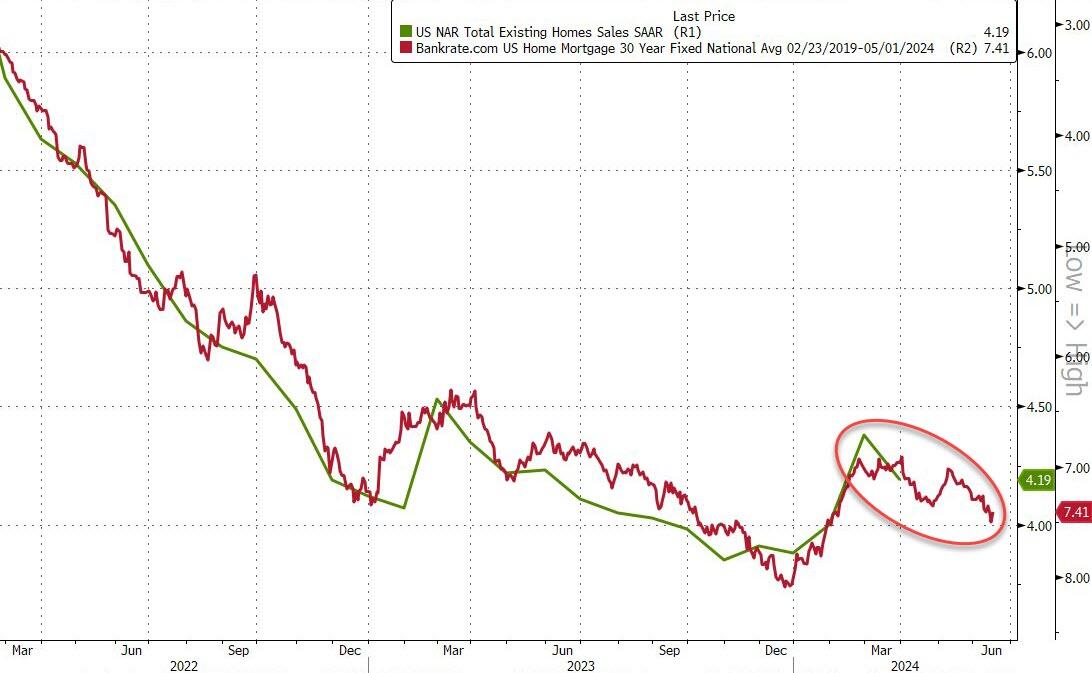
After the collapse in housing starts and permits in March, it is no surprise that existing home sales disappointed in the same month, dropping 4.3% MoM (-4.1% exp) after surging 9.5% in February. That is the biggest drop since Nov 2022.

Sales were down almost 10% from a year earlier on an unadjusted basis, as sales of both single-family homes and condominiums and co-ops dropped.

Source: Bloomberg

This dragged total existing home sales SAAR back down to 4.19mm…

Source: Bloomberg

“Though rebounding from cyclical lows, home sales are stuck because interest rates have not made any major moves,” said NAR Chief Economist Lawrence Yun.

“There are nearly six million more jobs now compared to pre-COVID highs, which suggests more aspiring home buyers exist in the market.”

…and it’s about to get worse…

Source: Bloomberg

Total housing inventory registered at the end of March was 1.11 million units, up 4.7% from February and 14.4% from one year ago (970,000). Unsold inventory sits at a 3.2-month supply at the current sales pace, up from 2.9 months in February and 2.7 months in March 2023.

“More inventory is always welcomed in the current environment,” Yun said.

“It’s a great time to list with ongoing multiple offers on mid-priced properties and, overall, home prices continuing to rise.”

All price levels saw sales decline except $1mm+…

The median selling price increased 4.8% from a year ago to $393,500, the highest for any March on record.

Source: Bloomberg

…and existing home prices are about to top new home prices…

Source: Bloomberg

First-time buyers made up 32% of purchases in March, up from 26% a month earlier.

Tyler Durden
Thu, 04/18/2024 – 10:12

“Yikes”: Impeachment ‘Whistleblower’ Was In The Loop Of Biden-Ukraine Affairs That Trump Wanted Probed

“Yikes”: Impeachment ‘Whistleblower’ Was In The Loop Of Biden-Ukraine Affairs That Trump Wanted Probed

Authored by Paul Sperry via RealClear Wire,

The ‘whistleblower’ who sparked Donald Trump’s first impeachment was deeply involved in the political maneuverings behind Biden-family business schemes in Ukraine that Trump wanted probed, newly obtained emails from former Vice President Joe Biden’s office reveal.

In 2019, then-National Intelligence Council analyst Eric Ciaramella touched off a political firestorm when he anonymously accused Trump of linking military aid for Ukraine to a demand for an investigation into alleged Biden corruption in that country.

But four years earlier, while working as a national security analyst attached to then-Vice President Joe Biden’s office, Ciaramella was a close adviser when Biden threatened to cut off U.S. aid to Ukraine unless it fired its top prosecutor, Viktor Shokin, who was investigating Ukraine-based Burisma Holdings. At the time, the corruption-riddled energy giant was paying Biden’s son Hunter millions of dollars.

Those payments – along with other evidence tying Joe Biden to his family’s business dealings – received little attention in 2019 as Ciaramella accused Trump of a corrupt quid pro quo. Neither did subsequent evidence indicating that Hunter Biden’s associates had identified Shokin as a “key target.” These matters are now part of the House impeachment inquiry into President Biden.

“It now seems there was material evidence that would have been used at the impeachment trial [to exonerate Trump],” said George Washington University law professor Jonathan Turley, who has testified as an expert witness in the ongoing Biden impeachment inquiry. “Trump was alleging there was a conflict of interest with the Bidens, and the evidence could have challenged Biden’s account and established his son’s interest in the Shokin firing.”

Ciaramella’s role – including high-level discussions with top Biden aides and Ukrainian prosecutors – is only now coming to light thanks to the recent release of White House emails and photos from the National Archives.

The emails show Ciaramella expressed shock – “Yikes” is what he wrote – at Biden’s move to withhold the $1 billion in aid from Kyiv, which represented a sudden shift in U.S. policy. They also show he was drawn into White House communications over how to control adverse publicity from Hunter taking a lucrative seat on Burisma’s board.

Yet there is no evidence Ciaramella raised alarms about the questionable Biden business activities he witnessed firsthand, which is in sharp contrast to 2019. In that instance, he was galvanized into action after being told by White House colleague Alexander Vindman of an “improper” phone call between President Trump and Ukrainian President Volodymyr Zelensky. During the call, Trump solicited Zelensky’s help in investigating Burisma and Hunter Biden’s role in the company.

Some former congressional investigators say Ciaramella effectively helped cover up a scandal far worse than what Trump was impeached over. What’s more, he failed to disclose that he had a potential conflict of interest stemming from his connection to the matter Trump asked Zelensky to probe when he lodged his complaint against Trump. RealClearInvestigations was the first to identify the then-33-year-old Ciaramella as the anonymous impeachment “whistleblower,” something major media continue to keep under tight wraps.

Ciaramella worked under CIA Director John Brennan when President Obama made Biden his point man on Ukraine in 2014, the same year Burisma hired Hunter. The next year, the CIA detailed Ciaramella, a longtime advocate for aid to Ukraine, to the White House, where he worked closely with Biden and his staff as a top adviser on key Ukrainian policies. After Biden left office, he stayed on at the GOP White House until mid-2017 even though he’s a Democrat, working as a Ukrainian and Russian analyst on Trump’s National Security Council. Co-workers there accused him of trying to sabotage Trump, including allegedly leaking sensitive information to the press.

RealClearInvestigations has reviewed more than 2,000 pages of newly disclosed archived emails from the former vice president’s office related to Ukraine, of which more than 160 contained references to Ciaramella. They reveal that his role advising Biden’s office potentially intersects with the current impeachment inquiry in several areas. Chiefly, Ciaramella focused on aid to Ukraine and anti-corruption reforms in the country. In that capacity, he:

  • Hosted, cleared into the White House, and met face-to-face there with senior Ukrainian prosecutors.
  • Gave a “readout” of the meeting to his superiors, who in turn pushed for Shokin’s firing.
  • Traveled with Biden to Kyiv during the 2015 trip during which Biden demanded Shokin’s firing.
  • Wrote media “talking points” for Ukrainian officials.
  • Huddled with the top Biden officials involved in discussions concerning the $1 billion aid package and Shokin, including: Amos Hochstein; Victoria Nuland; Geoffrey Pyatt; Bridget Brink; and Michael Carpenter.
  • Corresponded with Biden officials coordinating responses to negative media reports about Hunter’s cushy and controversial Burisma job.

Former Obama-Biden administration officials have confirmed in recent closed-door congressional testimony that Ciaramella was a key part of Biden’s process for making policy in Ukraine. In 2016, for instance, a White House photo shows him taking notes at a White House meeting Biden held with then-Ukrainian Prime Minister Arseniy Yatsenyuk to discuss Ukraine’s anti-corruption reforms and other issues.

Ciaramella also worked directly with top Obama and Biden administration diplomats on Ukraine, including senior State Department official Victoria Nuland. “Eric was regularly the clearing authority to get me into the White House for interagency meetings on Ukraine,” Nuland revealed in a 2020 Senate deposition. Asked if she ever discussed Ukraine policy and Shokin with Ciaramella, Nuland testified: “Of course, I did. He was part of the interagency process. He was also on my negotiating team for the six, seven rounds of negotiations I did with the Russians on [the disputed Ukraine region] Donbas.”

Ciaramella was directly involved in talks concerning the massive U.S. aid package to Ukraine that Biden conditioned on the removal of Shokin, who at the time had seized the assets of the corrupt Burisma oligarch employing Hunter Biden. He also arranged and participated in White House talks with Ukrainian prosecutors visiting from Shokin’s office.

White House visitor logs confirm Ciaramella escorted Shokin’s deputy prosecutor, David Sakvarelidze, into the White House for a January 2016 meeting. A White House agenda for the meeting lists Ciaramella as “point of contact” for the Ukrainian delegation. He also checked in Andriy Telizhenko, the Ukrainian Embassy official who says they discussed Burisma and Hunter Biden during the meeting and struggled to understand why his U.S. counterparts were suddenly hostile to Shokin after praising him in earlier talks.

Emails from the time show Ciaramella appeared surprised to hear about the linkage between the $1 billion loan to Ukraine and the dismissal of Shokin. Though Biden maintains he insisted Kyiv oust Shokin because he was too soft on weeding out fraud in entities that included Burisma, Ciaramella suggested he didn’t share the view that Shokin was corrupt. “We were super impressed with the group,” Ciaramella added, “and we had a two-hour discussion of their priorities and the obstacles they face.”

On Jan. 21, U.S. Ambassador to Ukraine Geoffrey Pyatt emailed Ciaramella and other White House aides an article from the Ukrainian press – “U.S. loan guarantee conditional on Shokin’s dismissal.”

“Yikes. I don’t recall this coming up in our meeting with them,” Ciaramella replied, referring to the White House meeting he hosted with top Ukrainian prosecutors.

But in a closed-door 2020 deposition before the Senate, Pyatt sounded skeptical that Ciaramella was in the dark about the decision. “I think you have to ask Eric what he meant by ‘Yikes,’” Pyatt told Senate investigators. He said that he believed conditioning the loan guarantee on Shokin’s removal “obviously came up in those meetings” hosted by Ciaramella, suggesting that Biden’s aide knew of the quid pro quo before Pyatt circulated the article about it from the Ukrainian press.

The day before he hosted the Ukraine prosecutors, Ciaramella received an agenda from a State Department official that asked him to “note the importance of appointing a new PG [Prosecutor General], reiterating that Shokin is an obstacle to reform,” according to emails. The agenda also called on Ciaramella to “ask the del [Ukrainian delegation] what high-level cases are on the docket for prosecution,” which raises suspicions in some quarters that Biden’s advisers were fishing for information about Shokin’s plans for prosecuting Burisma oligarchs, something Hunter Biden had been asked to find out.

In a Jan. 21 email, Pyatt told Ciaramella to “buckle in” because, as he later explained to Senate investigators, the deal was a “difficult issue” and “there was going to be political controversy around this [news].”

The former ambassador demurred when asked if conditioning the $1 billion on Shokin’s firing was Biden’s idea or came from his office. “It was the – our interagency policy,” he testified, adding, “I don’t remember when the vice president would have weighed in on this.”

However, Pyatt allowed that it was a sudden change in policy. “At the beginning,” he said, “it was not our expectation that Shokin’s removal would be necessary.” Indeed, an Oct. 1, 2015, memo summarizing the recommendation of the Interagency Policy Committee on Ukraine stated, “Ukraine has made sufficient progress on its [anti-corruption] reform agenda to justify a third [loan] guarantee.” Ciaramella was a member of the IPC task force, which monitored Shokin’s office. The next month, moreover, the task force drafted a loan guarantee agreement that did not call for Shokin’s removal. Then, in December, Joe Biden flew to Kyiv to demand his ouster.

If what Ciaramella expressed in his email (which he knew would be part of archived White House records) was a genuine reaction, it appears that Vice President Biden went against the recommendation of one of his top NSC advisers on Ukraine. If Ciaramella were genuinely alarmed, he might have blown the whistle on his boss like he did on Trump, but he stayed mum. If, on the other hand, Ciaramella were a party to the quid-pro-quo discussions, as Pyatt suggests, then he had “a direct conflict,” noted Derek Harvey, the former congressional investigator involved in the first impeachment. Either way, Ciaramella clearly found himself in the middle of a major controversy.

Just weeks prior, White House photos indicate that Ciaramella traveled with Biden on the same December 2015 Air Force Two flight the vice president took to Kyiv to threaten Ukrainian President Petro Poroshenko to ax Shokin. Republicans have accused Biden of pushing Shokin’s ouster to block scrutiny of his son’s actions.

“Biden called an audible and changed U.S. policy toward Ukraine to benefit his son on the plane ride to Ukraine,” House Oversight Committee Chair James Comer said, and “later bragged about withholding a U.S. loan guarantee if Ukraine did not fire the prosecutor [Shokin].”

Biden and his supporters have repeatedly claimed Shokin had to go because he wasn’t cracking down on corruption and that everyone else in the administration, as well as Europe, agreed Shokin should be fired. This remains the prevailing narrative in major U.S. media. But around that time, Shokin had conducted a raid of Burisma oligarch Mykola Zlochevsky’s home, seizing his house, cars, and other assets.

IRS Special Agent Joseph Ziegler, who examined Hunter’s emails as part of his investigation of Hunter for tax evasion, said Shokin was identified as a “key target” in emails exchanged between Hunter and Burisma officials in November 2015 – the month before Biden traveled to Ukraine to demand Shokin’s removal. Just days before Biden arrived in Kyiv in early December 2015 to demand Shokin’s ouster, Hunter allegedly called his father from Dubai following a meeting there with Burisma official Vadym Pozharskyi, who asked him to pressure his father to shut down Shokin’s investigation. Vice President Biden was familiar with Pozharskyi, having met with him in April 2015 during a dinner at the Cafe Milano in D.C. arranged by Hunter.

The unstated goal was to have the Ukrainian prosecutor removed in an effort to close the criminal case against [Burisma founder] Zlochevsky,” Ziegler said in recent testimony before the House impeachment inquiry. After Shokin was pushed out of office, the Burisma investigation dried up.

Ciaramella tried to marshal a defense for Biden in the whistleblower complaint he sent to Rep. Adam Schiff in August 2019. He listed among Trump’s concerns at the time of the fateful July phone call “that former Vice President Biden had pressured Poroshenko in 2016 to fire Shokin in order to quash a purported criminal probe into Burisma Holdings.” But Ciaramella attempted to pour cold water on the notion by referencing a Bloomberg News article that quoted a “former senior Ukrainian prosecutor” who falsely claimed “that Mr. Shokin in fact was not investigating Burisma at the time of his removal in 2016.”

White House emails reveal that Ciaramella was looped into messages sent by Biden’s communications team, who were concerned that Hunter Biden taking a position on corrupt Burisma’s board created unseemly optics and undercut their boss’ mission to clean up corruption in Ukraine.

In a Dec. 8, 2015, email, for example, Biden’s communications director Kate Bedingfield copied Ciaramella on a link to a New York Times article headlined, “The Knotty Ties Between Joe Biden, His Son and Ukraine.” Bedingfield is quoted in the story, authored by James Risen, denying Hunter had traveled with his father to Ukraine in an attempt to downplay his influence. She also said Ukrainian officials never raised his position on the Burisma board with Biden as an issue of concern. Risen got spun, however, on the issue of compensation for Hunter, reporting that it was “not out of the ordinary.”

At the time, Burisma was paying Hunter, who had no energy sector experience, $1 million a year just for lending his name to its board. It turns out that Hunter never traveled to Ukraine for a single meeting in the five years he sat on Burisma’s board. Republicans suspect Biden got the prosecutor ousted to keep the money flowing from Burisma to the Biden family.

Career State Department officials led by George Kent, who was stationed in Ukraine at the time, tried to get Biden’s aides to raise the issue of potential family conflicts with the vice president. Despite their concerns, Biden never asked his son to step down from the Burisma board, which would have made all questions go away. And despite Kent and other officials identifying Burisma founder Zlochevsky by name as a corrupt actor in Ukraine, Biden himself never publicly called Zlochevsky out as corrupt while Hunter served on his board and pocketed millions in payments from him. For all his talk of fighting corruption in Ukraine, Biden failed to distance himself from one of the most corrupt oligarchs in the country.

Harvey, who served as the staff investigator for the Republican side of the House Intelligence Committee during the 2019 Trump impeachment hearings, said: “The [Biden] impeachment inquiry should compel Ciaramella to testify since we now know he was involved in communications about Biden using the $1 billion in aid to extort Ukraine into firing Shokin.”

Harvey said Ciaramella would make a valuable material witness against Biden in the probe, which centers on whether Biden used his White House clout or political influence on behalf of his son’s foreign paymasters. White House photos indicate Ciaramella took notes during his meetings with Biden, his staff, and Ukrainian officials – materials that lawmakers could subpoena along with his testimony.

Another former staff investigator noted that Ciaramella is no longer protected by federal whistleblower laws. He has left the government and now works as a senior fellow focusing on Ukraine and Russia for the Carnegie Endowment for International Peace in Washington, where he is consulting with White House officials and pushing for billions more in U.S. aid for Ukraine – including “a Marshall Plan for the Ukrainian military.” Through a spokesperson, Ciaramella declined to comment.

None of the whistleblower protections apply to this particular situation,” said Jason Foster, former chief investigative counsel for the Senate Judiciary Committee and a whistleblower expert. He also noted that the Whistleblower Protection Act doesn’t shield whistleblowers from any other conduct they might have been involved in, including their own conduct. Nor does it give them a legal right to anonymity.

A spokeswoman for the House Oversight Committee, which is leading the Biden impeachment inquiry, declined to say whether Ciaramella is on the witness list. “I don’t have anything for you on this at this time,” said House Oversight Communications Director Jessica Collins. However, Comer has publicly described the “whistleblower” impeachment of Trump as a “cover-up” operation for the alleged Biden blackmail scheme in Ukraine involving U.S. aid and the Burisma corruption probe.

What Ciaramella witnessed and what he documented in notes he took during high-level Biden-Ukraine meetings could now be relevant to the active impeachment inquiry of President Biden. The House may have little choice but to hold the kind of hearings the Democrats blocked during the earlier impeachment by keeping Ciaramella’s identity – and his own potential conflict – secret.

As the catalyst for Trump’s impeachment, Ciaramella could now be a reluctant witness for Biden’s.


Tyler Durden
Thu, 04/18/2024 – 09:25

Apple’s Dominance On Watch: Huawei Unveils New Smartphone Lineup With Advanced Chip 

Apple’s Dominance On Watch: Huawei Unveils New Smartphone Lineup With Advanced Chip 

China’s smartphone market has stumbled into a downturn as economic woes turn consumers cautious. At the same time, consumers are ditching Apple’s new iPhone 15 and have embraced domestic brands.

Huawei Technologies Co. is one of those domestic brands that gained popularity with Chinese consumers last fall when it released its ‘Made-in-China’ Mate 60, which helped erode Apple’s market dominance in high-end handsets. 

Now, Huawei has announced, first published on its corporate WeChat account, that the company plans to release a new smartphone called the “Pura 70” to compete with iPhone 15 models. 

On April 18, 2012, Huawei’s first P series mobile phone was launched. Over the past twelve years, hundreds of millions of consumers have captured countless wonderful moments with P series mobile phones. With everyone’s company and support, HUAWEI P series has been fully upgraded to HUAWEI Pura, starting again with a new attitude! Today, we launched the “HUAWEI Pura 70 Series Pioneer Plan”. Pura 70 Ultra and Pura 70 Pro will go on sale at 10:08 Pioneer. Everyone is welcome to try it!

Here are the starting prices for the Pura lineup: 

  • Pura 70: 5,499 yuan
  • Pura 70 Pro: 6,499 yuan
  • Pura 70 Pro Plus: 7,999 yuan
  • Pura 70 Ultra: 9,999 yuan

The iPhone 15 in China starts at around 5,999 yuan, while the iPhone 15 Pro Max starts at 9,999 yuan – yet a sign Huawei is directly challenging Apple. 

According to Bloomberg, the Pura lineup has a domestic Kirin 9010 chipset. This comes after Chinese state media lauded the made-in-China Kirin 9000s inside the Mate 60 Pro in the fall that circumvented Biden’s chip bans. 

Huawei’s resurgence in the world’s largest smartphone market is a troubling sign as Apple’s dominance wanes

Tyler Durden
Thu, 04/18/2024 – 09:05

It’s Time To Pay Attention To Funding Risks Again

It’s Time To Pay Attention To Funding Risks Again

Authored by Simon White, Bloomberg macro strategist,

The risk of a squeeze in US funding markets is increasing as the yield curve bear steepens, i.e. longer-term yields rise more than short-term ones. More attractive bill yields and climbing interest-payment costs on government debt are depleting reserves and reducing their velocity, increasing the chance of a disorderly upswing in funding rates, as well as posing a risk to the stock market.

The bond market intimidates everybody, in the oft-cited words of Bill Clinton’s chief strategist James Carville. That description is apt today as rising yields reverberate across the financial system. Funding risks are intensifying again, increasing the chance of a rate-volatility driven correction in stocks.

Concerns about funding issues have been in abeyance for most of this year, but it is time to sit up and take notice again as the backdrop becomes more pernicious. The bear steepening of the yield curve is a double whammy, accelerating the rate of reserve depletion through a declining reverse repo facility (RRP) and rising government interest payments.

The curve has been bear steepening in the 3-12 month versus 10-year sectors as inflation fears drive term premium higher, with the measure now close to levels last seen in 2008 (using tradeable forward OIS rates rather than “academic” term premium).

A bear steepening is particularly problematic in the current set-up.

First note that the RRP has been hugely important in keeping risk assets supported despite the fastest rate-hiking cycle for decades and ongoing QT.

The Treasury’s decision to pivot issuance toward short-term bills allowed money market funds (MMFs) to tap the more than $2.5 trillion liquidity idling in the RRP to fund the government. That prevented enormous public issuance crowding out other assets, and allowed the rally in stocks and bonds to continue.

But the RRP falling and eventually going to zero is a harbinger total reserves overall are potentially nearing their so-called lowest comfortable level — with estimates for the LCLoR ranging from about $2.5 to $3 trillion — where abrupt and acute funding problems become more likely. This week the domestic RRP fell as low as $327 billion, and is now at $440 billion, the lowest levels it has reached since June 2021, taking the sum of reserves and the RRP to just over $4 trillion.

The RRP has been declining as six-month and 12-month bill yields have been rising in response to the market reducing the number of rate cuts expected from the Fed, making bills more attractive to MMFs relative to the RRP facility.

Some of the RRP’s recent fall has also likely been driven by seasonal tax payments. But that should not mask the clear downwards trend in the facility and its rising volatility. It would not be the first time that a telegraphed non-risk becomes a real risk precisely because peoples’ guards are down.

That’s potentially the case today. As I noted in a column earlier this year, a portent of previous funding episodes was a sharp drop in funding volumes immediately preceding a rapid rise in them, similar to a tsunami wave. As the chart below shows, when the total amount of reserves + RRP declines, volumes in fed funds (i.e. reserves) tend to also decline.

Further falls in fed funds volumes would be a sign that funding problems are potentially fomenting.

Rising longer-term yields are the other side of the coin in the bear steepening. The US government’s interest-rate bill is climbing rapidly, and is now over $1 trillion on an annual basis. This is set to grow much higher.

The 10-year yield gives us a near real-time barometer for the US’s annual interest expense. The recent rise in yields projects the expense will soon double to almost 5% of total debt outstanding, or over $1.7 trillion – i.e. about the GDP of Australia each year in interest.

Here lies the rub: to pay that interest, the government needs to tax and borrow. But that is an ever-greater drain on reserves and their velocity, accentuating the effects of the Fed’s ongoing QT program.

You might ask why that is the case given the interest is paid to bond holders and is therefore re-injected into the economy?

But that’s unlikely to be so for two reasons.

  • The first is that the corporate and household sectors, the two most likely to spend interest back in the domestic economy, together only account for about 10% of UST holdings. The much larger financial and foreign sectors are more likely to save the proceeds, or spend them abroad.

  • Second, reserves that end up as savings are of lower velocity, especially if they were originally higher-velocity bank deposits used to pay taxes. The more that interest payments percolate through the system, the more they end up with holders who have an increasingly lower propensity to spend them.

Thus a bear steepening squeezes the RRP and outstanding reserves — as well as their velocity — in a pincer movement, increasing the risk of a funding episode.

The last such major squeeze was in September 2019. It’s notable that in the days running up to that, the yield curve was bear steepening (in fact, it was in the top 1% of eight-day rises for the 2s10s curve going back 2000).

The bear steepening therefore means we should once again be vigilant to funding risks, and keep a close eye on the Funding Stress Trigger shown below.

The signal is inactive at the moment and the SOFR rate is currently well-behaved, but that can change quickly. In the last two major funding flare ups in 2018 and 2019, there were very few signs of what was to come, with the signal triggering only a few days before rates started to spike higher.

Funding stress would also be likely to increase rate volatility, which in turn would lead to higher stock-index correlation. That means a higher VIX, increasing the likelihood of a market correction as the stock perpetual motion machine shudders to a halt.

The potential risks, of course, may not come to pass, and funding markets continue to operate smoothly. But there are enough ex ante reasons to justify heightening one’s senses. The bond market may be intimidating, but a bear-steepening yield curve in the current market set-up is especially menacing, and should be watched closely.

Tyler Durden
Thu, 04/18/2024 – 08:45

US Submits ‘Assurances’ To UK Govt Over Assange Extradition 

US Submits ‘Assurances’ To UK Govt Over Assange Extradition 

Via Consortium News

The United States Embassy on Tuesday filed two assurances with the British Foreign Office saying it would not seek the death penalty against imprisoned WikiLeaks publisher Julian Assange and would allow Assange “the ability to raise and seek to reply upon at trial … the rights and protections given under the First Amendment,” according to the U.S. diplomatic note.  

Assange’s wife Stella Assange said the note “makes no undertaking to withdraw the prosecution’s previous assertion that Julian has no First Amendment rights because he is not a U.S citizen. Instead,” she said, “the US has limited itself to blatant weasel words claiming that Julian can ‘seek to raise’ the First Amendment if extradited.”   

The note contains a hollow statement, namely, that Assange can try to raise the First Amendment at trial (and at sentencing), but the U.S. Department of Justice can’t guarantee he would get those rights, which is precisely what it must do under British extradition law based on the European Convention on Human Rights. 

Via AP

The U.S. Department of Justice is legally restricted to assure a free speech guarantee to Assange equivalent to Article 10 of the European Convention, which the British court is bound to follow. But without that assurance, Assange should be freed according to a British Crown Prosecution Service comment on extraditions.

In USAID v. Alliance for Open Society, the U.S. Supreme Court ruled in 2020 that non-U.S. citizens outside the U.S. don’t possess constitutional rights. Both former C.I.A. Director Mike Pompeo and Gordon Kromberg, Assange’s U.S. prosecutor, have said Assange does not have First Amendment protection.

Because of the separation of powers in the United States, the executive branch’s Justice Department can’t guarantee to the British courts what the U.S. judicial branch decides about the rights of a non-U.S. citizen in court, said Marjorie Cohn, law professor and former president of the National Lawyers’ Guild. 

“Let’s assume that … the Biden administration, does give assurances that he would be able to raise the First Amendment and that the [High] Court found that those were significant assurances,” Cohn told Consortium News’ webcast CN Live! last month.

“That really doesn’t mean anything, because one of the things that the British courts don’t understand is the U.S. doctrine of separation of powers,” she said.  “The prosecutors can give all the assurances they want, but the judiciary, another [one] .. of these three branches of government in the U.S., doesn’t have to abide by the executive branch claim or assurance,” Cohn said. 

In other words, whether Assange can rely on the First Amendment in his defense in a U.S. court is up to that court not Kromberg or the Department of Justice, which issued the assurance on Tuesday. “The United States has issued a non-assurance in relation to the First Amendment,” said Stella Assange.

Assange Can Challenge Assurances

Assange’s legal team now has the right to challenge the credibility and validity of the U.S. assurances filed on Tuesday. The U.S. would then have a right to reply to Assange’s legal submissions to the court, which will hold a hearing on May 20 to determine whether or not to accept the U.S. assurances.

If the court does, Assange can be put on a plane to the U.S. theoretically that day. If not Assange would be granted a full appeal against the Home Office’s 2022 order to extradite him.  Assange is wanted in the U.S. on 17 charges under the 1917 Espionage Act and one on conspiracy to commit computer intrusion. He faces up to 175 years in a U.S. dungeon.

“The diplomatic note does nothing to relieve our family’s extreme distress about his future — his grim expectation of spending the rest of his life in isolation in US prison for publishing award-winning journalism,” Stella Assange said. 

In its 66-page ruling on March 26, the two High Court judges wrote Kromberg wouldn’t have said Assange would be without First Amendment rights at trial “unless that was a tenable argument that the prosecution was entitled to deploy with a real prospect of success.”

“If such an argument were to succeed it would (at least arguably) cause the applicant [Assange] prejudice on the grounds of his non-US citizenship (and hence, on the grounds of his nationality),” the judges said. They added:

“The applicant wishes to argue, at any trial in the United States, that his actions were protected by the First Amendment. He contends that if he is given First Amendment rights, the prosecution will be stopped. The First Amendment is therefore of central importance to his defence to the extradition charge.”

This is the statement Stella Assange put out on X Tuesday at 11:36 am EDT…

“The United States has issued a non-assurance in relation to the First Amendment, and a standard assurance in relation to the death penalty. It makes no undertaking to withdraw the prosecution’s previous assertion that Julian has no First Amendment rights because he is not a U.S citizen. Instead, the US has limited itself to blatant weasel words claiming that Julian can ‘seek to raise’ the First Amendment if extradited. The diplomatic note does nothing to relieve our family’s extreme distress about his future — his grim expectation of spending the rest of his life in isolation in US prison for publishing award-winning journalism. The Biden Administration must drop this dangerous prosecution before it is too late.”

Tyler Durden
Thu, 04/18/2024 – 06:30

Gold Vs. S&P 500: Which Has Grown More Over Five Years?

Gold Vs. S&P 500: Which Has Grown More Over Five Years?

Gold is considered a unique asset due to its enduring value, historical significance, and application in various technologies like computers, spacecraft, and communications equipment.

Commonly regarded as a “safe haven asset”, gold is something investors typically buy to protect themselves during periods of global uncertainty and economic decline.

It is for this reason that gold has performed rather strongly in recent years, and especially in 2024. Persistent inflation combined with multiple wars has driven up demand for gold, helping it set a new all-time high of over $2,400 per ounce.

To put this into perspective, Visual Capitalist’s Marcus Lu visualized the performance of gold alongside the S&P 500.

See the table below for performance figures as of April 12, 2024.

Over the five-year period, gold has climbed an impressive 81.65%, outpacing even the S&P 500.

Get Your Gold at Costco

Perhaps a sign of how high the demand for gold is becoming, wholesale giant Costco is reportedly selling up to $200 million worth of gold bars every month in the United States. The year prior, sales only amounted to $100 million per quarter.

Consumers aren’t the only ones buying gold, either. Central banks around the world have been accumulating gold in very large quantities, likely as a hedge against inflation.

According to the World Gold Council, these institutions bought 1,136 metric tons in 2022, marking the highest level since 1950. Figures for 2023 came in at 1,037 metric tons.

If you’re fascinated by gold, be sure to check out more Visual Capitalist content including 200 Years of Global Gold Production, by Country or Ranked: The Largest Gold Reserves by Country.

Tyler Durden
Thu, 04/18/2024 – 05:45

The European Commission Is Preparing To Sue Germany Over Its Gas Tariffs

The European Commission Is Preparing To Sue Germany Over Its Gas Tariffs

Authored by Charles Kennedy via OilPrice.com,

Unnamed Reuters sources said on Wednesday that the European Commission is preparing to sue Germany over its fees for purchasing gas from German storage in contravention of the European Union’s single market rules. 

In a matter of days, the European Commission is expected to file its infringement procedure lawsuit against the German tariff, Reuters reports, citing two unnamed sources, though a spokesman for the Commission told Reuters that talks were ongoing. 

The tariff, according to an EU energy regulator who spoke with Reuters, is creating higher gas prices in some EU countries. 

Germany’s tariff on purchases of stored gas is a relatively new development that arose out of the aftermath of Russia’s invasion of Ukraine when the EU banned imports of piped Russian gas, and in the wake of the shut-down of the Nord Stream pipeline, connecting Russia and Germany. 

Germany is accused of using its neighbors to fill in a fiscal gap created by the need for Germany to fill its storage with more expensive, non-Russian gas.

That fee has tripled–at a minimum–since its implementation in October 2022, according to Reuters. 

According to some members of the EU, the bloc’s single market rules do not allow for trade tariffs among its members. 

“We remain in touch with the German authorities on this matter, including at political level…we do not speculate on the possible opening of infringement procedures,” a spokesperson for the Commission told Reuters, while an Economy Ministry spokesperson claimed the tariff was in the spirit of “European security” by enabling Germany to fill its storage. 

On Tuesday, the Austrian Vice President of the European Parliament, Othmar Karas, and Austrian Energy Minister Leonore Gewessler challenged Germany’s gas transit tariffs before the European Commission, alleging that the higher fees made it more difficult for some of the bloc’s eastern members to give up Russian gas. 

The end result, according to Austrian authorities, is that Austrians and other members of the bloc–mostly Eastern European–are footing the bill for the billions of cubic meters of gas Germany purchased when prices were high.

That gas must now be sold at a lower price, Euractiv reports.

Tyler Durden
Thu, 04/18/2024 – 05:00

Russia Restoring Oil Refining Capacity After Ukrainian Suicide Drone Strikes

Russia Restoring Oil Refining Capacity After Ukrainian Suicide Drone Strikes

With Western sanctions widely failing against Russia, as well as Ukraine’s depleted air force unable to patrol its skies, Western leaders have said General Dynamics F-16 Fighting Falcon fighter jets would be game-changing in the war (these are the same leaders that said the M1 Abrams tanks would be game-changing). But with M1 Abrams busted and F-16s unlikely to hit the highly contested airspace of the Eastern European country anytime soon, desperate Kyiv made a bold effort in recent months to target Moscow’s crude refineries (how the war is funded) with wave after wave of stealthy suicide drones. 

For months, Ukraine and the Western leaders (and the CIA) cheered (either publicly in NATO-friendly corporate press or behind the scenes) about bombing Russia’s refineries deep within the country with suicide drones, sending crude refining capacity-idled in the country to nearly 14%.

However, the short-lived celebrations are winding down. Reuters estimates that capacity idled at refineries in Russia fell from 14% to 10% at the end of March, primarily because the refineries are being repaired quickly. 

Reuters noted several damaged Russian refinery plants that were hit by Ukrainian drone attacks have been fixed in recent weeks. Also, other refineries with planned maintenance have come back online. 

That includes the Rosneft-owned Ryazan plant, which put back the CDU-4 and main CDU-6 primary oil refining units into operation, as well as Kuibyshev refinery repairing CDU-4 and Syzran’s CDU-5 and previously idled for maintenance CDU-6.-Reuters

According to Reuters estimates, Russian oil refining capacity idled by drones plunged to 90,500 metric tons per day (660,000 barrels per day) from around 123,800 tons per day (907,000 bpd) previously. 

The last major Ukrainian drone attack on a large Russian refinery facility occurred on April 2 at the Taneco refinery in Nizhnekamsk, Russia, the third-largest refinery in the country

Reuters pointed out that Russia’s total primary oil refining capacity was shut down due to outages, and maintenance was around 4.4 million tons in April, up from 4.1 million tons in March. 

Since April 2, there have been no new reports of successful drone attacks on large Russian refineries. 

We wonder why? Well, it’s pretty easy to figure this one out. 

Last week, US Defense Secretary Lloyd Austin warned Ukraine that drone and missile attacks should not be focused on energy infrastructure but instead on military targets because of the risk of sending Brent crude prices over $100 per barrel. 

And recall this note from last month, “”Terrified” Joe Biden Demands Ukraine Halt Strikes On Russian Refiners As It Is Sending Oil Prices Surging.”

The main goal of the refinery drone attacks by Ukraine is to crush Moscow’s funding of the war through crude product (such as diesel) exports. The quick repair work and resilience of the Russian economy from repeated Ukranian attacks and Western sanctions shows how elites in Washington and Brussels are failing in a world dangerously spiraling into a multi-polar state. 

If Biden’s foreign policy is basically to keep Brent prices sub $100/bbl before the presidential elections in November. Well, they’re going to have a whole lot of trouble if Israel uses Lockheed Martin F-35 stealth jets to bomb critical oil/gas infrastructure in Iran. 

Tyler Durden
Thu, 04/18/2024 – 04:15