64.6 F
Chicago
Sunday, September 20, 2026
Home Blog Page 2722

2020: The Year The System Showed Its Real Face

2020: The Year The System Showed Its Real Face

Authored by Paul Rosenberg via FreemansPerspective.com,

(Originally published September 28, 2020.)

As we grew up, nearly all of us were inundated with stories of our glorious national fathers, our beautiful democracies, and so on.

And being young, we for the most part believed them. The system gave us our prosperity, our comfort, our medicine, our sense of importance.

Soon enough we learned that the system was also stupid and perverse, but we found a way around that contradiction by blaming one segment of the system or another: The Blues or the Greens or the Reds were the problem; it could not, must not, be that the system itself is the problem.

Then came 2020, and the system revealed its true face.

I suppose I should be fair and add that the system wasn’t always as rotten as it is now, but regardless, it wasn’t able to prevent the rot that overtook it.

2020, In A Nasty Little Nutshell

The system would like everything except the daily outrages (one for the Blues, one for the Reds) to go down the Memory Hole. So I think it’s important to recap the revelations of 2020:

The system decreed who could work and who couldn’t. This was not done democratically; it was done by edict. “Democracy” did nothing to stop it.

People were arrested for going to church or synagogue. This was the real disgrace of the police forces. Are there any orders from their paymasters they won’t enforce upon us?

Political gangs roam the streets, beating, threatening and burning. Make no mistake, these are covertly authorized political gangs, serving political ends. This vile tactic goes back to ancient Rome at least, where gangs of thugs beat opponents in the streets.

Science” said one thing then the opposite, supporting whatever power wanted. Not every scientist, but more or less the entire grant-seeking, position-seeking complex showed themselves to be without integrity; they said and did whatever power wanted them to do.

Mass media was as a fear delivery system. They were devoted to capturing eyeballs with fear and monetizing outrage. Journalistic integrity was a joke at best.

Social media silenced thousands of dissenters, purely at the behest of political power. This was no less that the mass suppression of speech. (If you want to profit from becoming the public square, you have to act like a public square.) Free services have always been parasites, but these have shown themselves to be sycophantic to the point of fascism.

The mandatory school system, around which millions of families had arranged their lives, was ripped away in an instant.

Hate was legitimated. Political loud-mouths and televised faces have treated hate as the voice of justice, instead of the disease it is. Millions have joined in the barbarity, pretending that hate is actually duty, honor, and truth.

More could be added, but this is quite enough to make my point: The system is not what we were taught it was, and 2020 has revealed that quite well.

The System Doesn’t Deserve Us

By referring to “the system” and “us,” I’m dividing the world into two parts, and so I should be clear on what those parts are:

Us refers to producers: the people who grow food, transport it, process it, build machines, provide medical care, and so on. Everyone from the construction worker to the small business owner to the cleaning lady is a producer, and deserve great respect for what they do. We owe all the comforts of our lives, and frequently our lives altogether, to these people.

The system refers to the entire governmental complex that takes our money and couldn’t survive without it. It also includes everything that couldn’t be what they are without them: Central banks, government school systems, businesses that live on government connections, television networks, social media behemoths, and more or less everything high and mighty.

What I’d like is for the producers of the world to become clear on the fact that we don’t need them. Everything they “do for us” is done with our money, which they take from us by force and fraud.

So let’s be honest about this: The system is a violent, corrupt and control-obsessed entity. Millions of us would choose other arrangements if we could, but the system forbids them. Forcibly.

We should also understand that this has happened before. Here, to illustrate, is a passage from historian C. Delisle Burns on the real reason Rome collapsed:

Great numbers of men and women were unwilling to make make the effort required for the maintenance of the old order, not because they were not good enough to fulfill their civic duties, but because they were too good to be satisfied with a system from which so few derived benefit.

The system is not worthy of our labor and treasure. Whether or not it once was (and if so, when) no longer matters.

2020 has made this much clear. It’s time to drop our child-training and look at the world like the adults we’ve become.

Tyler Durden
Wed, 04/17/2024 – 19:40

“Central Bank Observers Take Note”: HSBC Warns “Weak Bull” Commodity Run Has Begun

“Central Bank Observers Take Note”: HSBC Warns “Weak Bull” Commodity Run Has Begun

Commodity prices provide a real-time snapshot of the global economy through spot prices, which are essentially high-frequency data about the current supply and demand environment. These prices are key components in measuring inflation, which has shown signs of easing over the past year. However, a recent surge in the Bloomberg Commodity Index and signs of a reacceleration in US inflation data are troubling for Fed chair Powell. 

HSBC’s Paul Bloxham and Jamie Culling asked clients in a note: “Have commodity prices past the trough?” 

Their answer, very simply, “It seems likely.”

“Global commodity prices have picked up in recent weeks and could be past the trough,” the analysts said, noting an emerging “weak” upward global industrial cycle has materialized. They continued: 

On the demand side, ‘green shoots’ in the global industrial cycle are becoming more apparent. On the supply-side, geopolitical factors are playing an increasingly disruptive role in the ongoing ‘super-squeeze.’ 

At a deeper level, real commodity prices have already fallen back to their long-run average – that is, the relative prices of commodities to other goods and services are now not unusually high. 

So, even if commodity prices only rise in line with other prices from here, they would be passed their trough. 

The analysts warned their new machine learning commodity cycle tool is forecasting a “Weak Bull” run, indicating, “If the trough has passed, the recent disinflationary force from falling commodity prices may be done. Central bank observers should take note.” 

The timing of HSBC’s “Weak Bull” commodity run comes as inflation is reaccelerating in the US. Last week’s March CPI data dump showed a stronger-than-expected 3.5% YoY print, an uptick from the 3.2% YoY rise in February. 

Summing up the latest inflation report… 

The hot inflation print has pushed rate traders to price in the first 25bps of cuts between September and November. Initially, rate traders were pricing in March cuts.  

Hotter-than-expected inflation puts upward pressure on rates and borrowing costs with higher risks of derailing Biden’s reelection odds as Bidenomics fails. 

The reacceleration of inflation has Larry MacDonald of The Bear Traps Report warning, “We’re only one event away from a 1970-style stagflation explosion.” 

Could the return of the mid-70s inflation storm result from an escalation of the Israel-Iran war where Brent crude soars past $100bbl? 

Tyler Durden
Wed, 04/17/2024 – 19:20

Los Angeles Mayor Urges ‘More Fortunate’ Residents To Help Fund Housing For Homeless

Los Angeles Mayor Urges ‘More Fortunate’ Residents To Help Fund Housing For Homeless

Authored by Katabella Roberts via The Epoch Times (emphasis ours),

Los Angeles Mayor Karen Bass has suggested that “more fortunate” residents help fund housing for the homeless as part of a new campaign to tackle the city’s ongoing homelessness crisis.

Los Angeles Mayor Karen Bass speaks during a press conference to announce new efforts to curb recent retail thefts at City Hall in Los Angeles, Calif., on Aug. 17, 2023. (Frederic J. Brown/AFP via Getty Images)

Ms. Bass, a Democrat, announced the “LA4LA campaign,” which she said would speed up the creation of affordable housing for homeless individuals, during her State of the City address on April 15.

The mayor called on “fortunate Angelenos”—including business leaders, philanthropic organizations, and others—to help the city “acquire more properties, lower the cost of capital, and speed up housing” for the homeless population under the new program.

However, Ms. Bass didn’t provide further details regarding the specifics of the campaign, such as how much money business leaders and organizations should donate or how exactly the campaign will work.

“We have brought the public sector together and now we must prevail on the humanity and generosity of the private sector,” the mayor said. “LA4LA can be a Sea Change for Los Angeles–an unprecedented partnership to confront this emergency … an example of disrupting the status quo to build a new system to save lives.

We will not hide people. Instead, we will house people,” she continued. “This means committing to the goal of preventing and ending homelessness—not hiding—not managing—but ending homelessness—with a new strategy and a new system that urgently lifts people from the street, and that surrounds them with the support and housing they need to never go back.”

Bass Touts ‘Inside Safe’ Program

During her address, the mayor touted her efforts to move homeless Angelenos out of short-term housing, including hotels and motel rooms, and into apartments under her “Inside Safe” program.

That program, which initially launched in December 2022 when Ms. Bass declared a state of emergency on homelessness, has seen roughly 2,500 homeless individuals taken off the street and placed into interim housing, according to the mayor’s office.

A total of 440 people have also been placed into permanent housing under the program, as per her office.

However, roughly 613 of those who took part in the program have returned to homelessness, according to the Los Angeles Homeless Services Authority. Another 42 have been incarcerated, and 38 have died, as per the agency.

Ms. Bass said Inside Safe is “our proactive rejection of a status quo that left unhoused Angelenos to wait–and die–outside, in encampments until permanent housing was built.”

Budget Deficit Woes

Still, the mayor acknowledged that more than 46,000 people in Los Angeles currently have no home and stressed that motel rooms rented out on a nightly basis are increasingly adding up at a time when the city is already struggling under a burgeoning budget deficit.

Los Angeles is currently facing a projected $467 million shortfall, driven by increased spending and lower-than-expected revenues.

Ms. Bass noted that the homelessness crisis—along with the continued opioid crisis that is fueling fentanyl overdose deaths—has affected residents of Los Angeles both mentally and financially, forcing them to “pay the cost of the thousands and thousands of fire, paramedic and police calls.”

The ongoing issues plaguing the city are also driving away business and tourism, she noted, highlighting the fact that many companies are fleeing the city out of safety concerns.

“I just will not accept this–and our city cannot afford to accept this. That is why we are disrupting, challenging, and rebuilding the system. Inside Safe and our overall approach is evolving and will continue to evolve,” the mayor said.

Tyler Durden
Wed, 04/17/2024 – 19:00

Doug Casey On The New American Dream: “You’ll Own Nothing and Be Happy”

Doug Casey On The New American Dream: “You’ll Own Nothing and Be Happy”

Via InternationalMan.com,

International Man: According to a recent study by Investopedia, the classic middle-class American Dream now costs over $3.4 million.

That’s the estimated lifetime cost of marriage, two children, cars, homes, healthcare, education, and retirement. It’s now entirely out of reach for many Americans.

What do you make of this? How did this happen?

Doug CaseyThe fact is, despite the fact that his standard of living has been slipping over the past 50 years, the average American today lives much better and longer than a king during pre-industrial times. There were never any guarantees that Americans would live in the lap of luxury for their entire lives.

We got to this high standard of living for two reasons. One, people tended to produce more than they consumed and saved the difference. And two, technology has been improving at almost the rate of Moore’s law for the last 200 years.

However, there’s no guarantee that either of these fonts of progress will continue, especially since savings are being wiped out by the destruction of the dollar. A lack of savings means there won’t be a capital pool to finance further advances in technology.

But there are other serious things at work, termites eating away at the foundations of civilization. It’s become customary for Americans to think that it’s okay for some people to live their entire lives without producing at all and to live at the expense of others. A lot of the country is on welfare. And many more are buried in consumer debt, which means they’re either living off the capital others have saved in the past, or they’re mortgaging their own futures.

On top of that, since about 1980, the main export of the US hasn’t been Boeings or soybeans; it’s been dollars. Foreigners have accepted those paper dollars in exchange for real wealth. They’re really just another form of debt. At some point—soon—they’ll repatriate them in exchange for titles to land and companies.

Capital is also being destroyed by the constant wars that the US fights against trivial countries on the other side of the world.

The fact is that our institutions, from corporations to academia to government, have become corrupt, ineffectual, and bloated. The Second Law of Thermodynamics tells us that, in the physical world, things inevitably degenerate over time. That’s also true in the world of human action. In general, as any institution gets old, it winds down. That’s true of the US, and it’s apparent to everyone—at least anyone outside of the Washington Beltway.

International Man: As the American middle class continues to shrink, it seems the “New American Dream” is to merely get by and make ends meet.

People will have to rent instead of own. They may not be able to afford kids, pets, ribeye steaks, or retirement. They’ll have to take on a lot more debt.

The “New American Dream” looks more like the WEF’s “you’ll own nothing and be happy.”

What’s your take?

Doug CaseyIt’s rather shocking that in a traditionally middle-class society like the US, that the “one percenters”—typically those wired to the State and major corporations—now own about one-third of the total wealth.

What’s even more shocking is that the bottom half of society only owns 2% of the country’s wealth. That kind of an imbalance makes for instability. No wonder it’s said that the average guy can’t lay his hands on even $500 cash if there’s an emergency. No wonder a criminal like Klaus Schwab can promote his “You’ll own nothing and be happy” meme and not be hung from a lamp pole— a lot of people now feel they’d be better off in that kind of world.

Increasingly, the wealth of the country is owned by corporations and their top management. It used to be said that “What’s good for General Motors is good for America.” I used to believe that because General Motors actually created cars, and that was good. But we’ve devolved. GM and other major corporations have become defacto arms of the State. Taxes, staggering regulations, subsidies, and bailouts have destroyed free-market capitalism.

The capitalist system in the US is long gone. We’ve devolved into classical Mussolini-style fascism, which is to say, State corporatism, where corporations and the State work hand-in-glove.

It’s euphemistically called a public-private “partnership.” The people in government and the people in top corporate levels scratch each other’s backs and reinforce each other’s positions. They feed each other power and money. This makes for a highly politicized society, where connections, not production, are what count.

For instance, in the last election, $14 billion was spent on campaign spending to get the hoi polloi to vote for one party or another. But only a fifth of that money came from small donors—the rest from the wealthy and corporations. Of course, the rich are getting richer, and the poor are getting poorer as our highly politicized society degenerates.

International Man: Many people look back on how they viewed the future and how it was portrayed in movies. Many thought we would have flying cars by now, among other futuristic luxuries.

Instead, we have a declining standard of living, and people look back on the good old days.

Where do you think this trend is headed?

Doug CaseyWe’re heading in the wrong direction at an accelerating rate because there’s been a breakdown of moral fiber in society. People, in general, no longer understand what’s right and what’s wrong—or what’s good and what’s evil. They’re taking less responsibility for their individual lives and what happens around them.

We’ve gone from a high-trust society, where you didn’t need to lock your car or your front door, to a low-trust society, where everybody is constantly observed, and security is of critical importance.

At the same time, the country has generally gone from having low time preferences and being future-oriented to high time preferences; “I want it all, and I want it now.” They’re not as future-oriented as they once were.

Going back to the question of moral fiber breakdown, the economic observer Thorstein Veblen coined the phrase “conspicuous consumption.” People wanted to show off expensive cars and clothes to advertise to other people that they were more successful. But now, because of all the debt in society, anyone can have a nice car. And nobody even cares about nice clothes anymore; everybody wears the equivalent of T-shirts and jeans.

The trend setters have moved from owning and displaying frivolous goods to displaying frivolous ideas—like Wokeism. Everybody is adopting those ideas, to show that they’re hip, in-the-know, and part of the cognoscenti. In the past, adopting the conspicuous consumption lifestyles of their betters would only make them poor. Adopting these degenerate ideas makes them stupid and immoral—which is much worse.

International Man: What advice do you have for struggling middle-class people who are about to be kicked down to the lower class?

Doug CaseyFirst and most important, don’t go to college unless you need a STEM degree—Science, Technology, Engineering, or Math.

Going to college today does nothing but misallocate four critically important years of your life, permanently indebt you, and corrupt your mind with the idiotic ideas that Marxist professors and administrations cram down students’ throats. Educate yourself. Read constantly.

Next, work to become self-employed, not to “get a job.” You don’t want to rely on a job that somebody else gives you. And save your money—but don’t save in fiat dollars. Save in gold. When you have sufficient savings, learn to speculate and invest.

International Man: As you’ve noted, The Greater Depression is a period in which there will be a significant decline in the general standard of living.

Is there any way to make lemonade out of these lemons?

Doug CaseyWe’re well into what I’ve long called The Greater Depression. But I’d point out that most of the real wealth in the world will still exist – it’s just going to be owned by different people.

The opportunity will exist for nimble entrepreneurs and speculators to do well, even as most people’s standard of living drops. But the big question is: For how long will the societal trend that we’re now on continue going down?

When Rome collapsed over a period of several hundred years, living well and peaceably got harder and harder as Europe entered the Dark Ages. Even if you had a lot of money, it really didn’t do you that much good. That’s why it’s important to preserve what’s left of the idea of America.

*  *  *

Unfortunately, there’s little any individual can practically do to change the trajectory of this trend in motion. The best you can do is to stay informed so that you can protect yourself in the best way possible, and even profit from the situation. Most people have no idea what really happens when a currency collapses, let alone how to prepare… How will you protect your savings in the event of a currency crisis? This just-released video will show you exactly how. Click here to watch it now.

Tyler Durden
Wed, 04/17/2024 – 18:20

The Purpose Of War According To George Orwell (1984)

The Purpose Of War According To George Orwell (1984)

Some food for thought from George Orwell’s ‘1984’…

Does anything really ever change? (emphasis ours)

The primary aim of modern warfare is to use up the products of the machine without raising the general standard of living.

Ever since the end of the nineteenth century, the problem of what to do with the surplus of consumption goods has been latent in industrial society. From the moment when the machine first made its appearance it was clear to all thinking people that the need for human drudgery, and therefore to a great extent for human inequality, had disappeared. If the machine were used deliberately for that end, hunger, overwork, dirt, illiteracy, and disease could be eliminated within a few generations. And in fact, without being used for any such purpose, but by a sort of automatic process — by producing wealth which it was sometimes impossible not to distribute — the machine did raise the living standards of the average human being very greatly over a period of about fifty years at the end of the nineteenth and the beginning of the twentieth centuries.

But it was also clear that an all-round increase in wealth threatened the destruction — indeed, in some sense was the destruction — of a hierarchical society. In a world in which everyone worked short hours, had enough to eat, lived in a house with a bathroom and a refrigerator, and possessed a motor-car or even an aeroplane, the most obvious and perhaps the most important form of inequality would already have disappeared. If it once became general, wealth would confer no distinction. It was possible, no doubt, to imagine a society in which wealth, in the sense of personal possessions and luxuries, should be evenly distributed, while power remained in the hands of a small privileged caste.

But in practice such a society could not long remain stable.

For if leisure and security were enjoyed by all alike, the great mass of human beings who are normally stupefied by poverty would become literate and would learn to think for themselves; and when once they had done this, they would sooner or later realize that the privileged minority had no function, and they would sweep it away.

In the long run, a hierarchical society was only possible on a basis of poverty and ignorance.

To return to the agricultural past, as some thinkers about the beginning of the twentieth century dreamed of doing, was not a practicable solution. It conflicted with the tendency towards mechanization which had become quasi-instinctive throughout almost the whole world, and moreover, any country which remained industrially backward was helpless in a military sense and was bound to be dominated, directly or indirectly, by its more advanced rivals.

Nor was it a satisfactory solution to keep the masses in poverty by restricting the output of goods. This happened to a great extent during the final phase of capitalism, roughly between 1920 and 1940.

The economy of many countries was allowed to stagnate, land went out of cultivation, capital equipment was not added to, great blocks of the population were prevented from working and kept half alive by State charity. But this, too, entailed military weakness, and since the privations it inflicted were obviously unnecessary, it made opposition inevitable.

The problem was how to keep the wheels of industry turning without increasing the real wealth of the world. Goods must be produced, but they must not be distributed. And in practice the only way of achieving this was by continuous warfare.

The essential act of war is destruction, not necessarily of human lives, but of the products of human labour.

War is a way of shattering to pieces, or pouring into the stratosphere, or sinking in the depths of the sea, materials which might otherwise be used to make the masses too comfortable, and hence, in the long run, too intelligent.

Even when weapons of war are not actually destroyed, their manufacture is still a convenient way of expending labour power without producing anything that can be consumed. A Floating Fortress, for example, has locked up in it the labour that would build several hundred cargo-ships. Ultimately it is scrapped as obsolete, never having brought any material benefit to anybody, and with further enormous labours another Floating Fortress is built.

In principle the war effort is always so planned as to eat up any surplus that might exist after meeting the bare needs of the population. In practice the needs of the population are always underestimated, with the result that there is a chronic shortage of half the necessities of life; but this is looked on as an advantage.

It is deliberate policy to keep even the favoured groups somewhere near the brink of hardship, because a general state of scarcity increases the importance of small privileges and thus magnifies the distinction between one group and another.

By the standards of the early twentieth century, even a member of the Inner Party lives an austere, laborious kind of life. Nevertheless, the few luxuries that he does enjoy his large, well-appointed flat, the better texture of his clothes, the better quality of his food and drink and tobacco, his two or three servants, his private motor-car or helicopter—set him in a different world from a member of the Outer Party, and the members of the Outer Party have a similar advantage in comparison with the submerged masses whom we call ’the proles’. The social atmosphere is that of a besieged city, where the possession of a lump of horseflesh makes the difference between wealth and poverty.

And at the same time the consciousness of being at war, and therefore in danger, makes the handing-over of all power to a small caste seem the natural, unavoidable condition of survival…

…war is waged by each ruling group against its own subjects, and the object of the war is not to make or prevent conquests of territory, but to keep the structure of society intact.

The very word ‘war’, therefore, has become misleading. It would probably be accurate to say that by becoming continuous war has ceased to exist.

War is Peace.

In short – the purpose of war is to keep the ruling class in power while the lower classes remain powerless.

Tyler Durden
Wed, 04/17/2024 – 18:00

IMF Warns Biden’s Fiscal Profligacy Poses “Significant Risks” To Global Economy ‘In Great Election Year’

IMF Warns Biden’s Fiscal Profligacy Poses “Significant Risks” To Global Economy ‘In Great Election Year’

The IMF said the the quiet part out loud today (admittedly wrapped in 100s of pages of PhD-ese) in their benchmark Fiscal Monitor this morning: pointing out that America’s recent economic performance is partially the result of the country’s unsustainable borrowing, and that the US’ massive fiscal deficits have stoked inflation and pose “significant risks” for the global economy.

The exceptional recent performance of the United States is certainly impressive and a major driver of global growth, but it reflects strong demand factors as well, including a fiscal stance that is out of line with long-term fiscal sustainability,” the IMF wrote in its latest World Economic Outlook. They added that: “Fiscal policy developments in major economies, notably in the United States, have implications for global financing conditions.”

The IMF said the US had exhibited “remarkably large fiscal slippages”, with the fiscal deficit hitting 8.8 per cent of GDP last year – more than double the 4.1 per cent deficit figure recorded for 2022, calculating that ‘Bidenomics’ (and its Inflation Reduction Act) had contributed 0.5 percentage points to core inflation (due to its fiscal profligacy).

Who could have seen that coming?

The fund further said in its Fiscal Monitor report that it expected the US to record a deficit of 7.1 per cent next year – more than three times the average for other advanced economies. It also raised concerns over Chinese government debt as Beijing copes with weak demand and a housing crisis.

The US and China were among four countries the fund named that “critically need to take policy action to address fundamental imbalances between spending and revenues.”

The others were the UK and Italy.

Rampant spending by the US and China in particular could “have profound effects for the global economy and pose significant risks for baseline fiscal projections in other economies,” the IMF said.

Furthermore, The IMF (rather too honestly) noted that things could get even worse as it’s a massive election year and politicans like to spend money they don’t have to buy votes (well, that’s our translation of their findings that deficits in election years tend to exceed forecasts by 0.4 percentage points of GDP, compared to non-election years).

The risks of fiscal slippages are particularly acute given that 2024 is what is being called the ‘Great Election Year’: 88 economies or economic areas representing more than half of the world’s population and GDP have already held or will hold elections during the year,” says The IMF.

Support for increased government spending has grown across the political spectrum over the past several decades, making this year especially challenging, as empirical evidence shows that fiscal policy tends to be looser, and slippages larger, during election years.”

Finally, we note that IMF chief economist Pierre-Olivier Gourinchas warned that the US’s fiscal position was “of particular concern”, suggesting it could complicate the Fed’s attempts to return inflation to its 2% goal.

“It raises short-term risks to the disinflation process, as well as longer-term fiscal and financial stability risks for the global economy,” he said.

“Something will have to give.”

“Something” indeed, Monsieur!

Tyler Durden
Wed, 04/17/2024 – 16:40

AI, Gold, & Nuclear War

AI, Gold, & Nuclear War

Authored by James Rickards via DailyReckoning.com,

So-called artificial intelligence (AI) is taking the world by storm. Meanwhile, gold has shot up like a rocket over the past couple of months.

In mid-February, gold was trading at $1,990. Two months later, gold is trading above $2,400 — a $410 gain in just two months.

So here’s a question:

Is there a connection between AI and gold?

It seems like an odd question.

But as it turns out, the answer is yes. And surprisingly, there has been for decades. It involves the Cold War between the U.S. and the Soviet Union.

In the early 1980s, the KGB was deeply concerned about the possibility of a nuclear first strike by the United States. At the time, Yuri Andropov was head of the KGB.

Andropov’s fear of a nuclear first strike by the U.S. was based in part on the 1980 election of Ronald Reagan and Reagan’s plan to install Pershing II intermediate-range missiles in Europe.

Those missiles could be armed with nuclear warheads and could strike the Soviet Union within minutes of being launched. This put Soviet nuclear forces on a hair-trigger alert. They adopted a “launch on warning” posture.

This means that as soon as credible evidence of a planned first strike was discovered, the Soviet Union would launch its own first strike to avoid destruction of its forces.

The irony was that the U.S. had no actual plans to launch a first strike, but the Soviet Union didn’t know that. Reagan’s speeches about the “evil empire” did nothing to calm Soviet concerns.

AI and Nuclear Readiness

In response, the Soviets developed a primitive (by today’s standards) AI system called VRYAN. That’s a Russian acronym for: sudden nuclear missile attack.

VRYAN took about 40,000 military, economic and political inputs and computed the relative strength of the Soviet Union compared with the United States expressed as a percentage output. The model used a value of 100% for equivalence of the USSR to the U.S.

The Soviet leadership was comfortable that the U.S. would not launch a nuclear first strike if the USSR could maintain a value of 60%, although they viewed 70% as providing a more comfortable margin.

A VRYAN output of 40% was considered the critical threshold at which the U.S. might feel it could launch a first strike with acceptable risk that the Soviets would not be able to mount a successful second strike.

VRYAN output values were in steady decline in the dangerous period from 1981–1984 (in 1984, the VRYAN output had declined to 45%).

The VRYAN AI system relied on by the KGB and the Soviet Politburo was an important factor in the Soviet decision in 1981 to vastly increase intelligence collections aimed at detecting U.S. preparations for a first strike.

Close Call

This intelligence collection effort was complicated to the point of extreme danger by the fact that the U.S. and NATO were conducting a war game in late 1983, code-named Able Archer 83. This war game was to practice a nuclear strike on the Soviet Union.

It turned out that the U.S. was rehearsing a nuclear first strike at the same exact time that the KGB was looking for evidence of a nuclear first strike. Able Archer 83 provided the KGB with more than enough reason to suspect the U.S. was indeed preparing for a first strike under cover of a war game.

VRYAN’s AI output on relative U.S. strength was compounded by massive U.S. intelligence failures regarding Soviet intentions. U.S. intelligence analysts assumed that the future would resemble the past, and that Soviet alerts were really propaganda designed to halt the U.S. deployment of Pershing II intermediate-range nuclear missiles in Europe.

U.S. intelligence analysts were also guilty of what’s called mirror imaging: the belief that because you know your own intentions, your opponents must share your view. In this case, the U.S. assumed that because they had no intention to launch a first strike, the Soviets must have understood that intention and would therefore have no cause for concern.

In fact, the Soviets had the opposite view based in part on VRYAN AI output.

The world came extremely close to World War III and a nuclear holocaust as a result of this sequence of events and misperception of intentions. It was only when one U.S. general decided not to escalate in the face of Soviet first strike preparations that both sides deescalated, and the crisis eventually receded.

The information above wasn’t fully understood by either side at the time of the escalation. On the U.S. side, it wasn’t until the 1990 publication of a study entitled The Soviet War Scare by the President’s Foreign Intelligence Advisory Board (PFIAB) that something like the full story was revealed.

Nuclear War Threats: Good For Gold

This study was originally classified above TOP SECRET. Most citizens assume that TOP SECRET is the highest level of classification. But there are secret access codes that limit circulation of certain documents even among those cleared with TOP SECRET access.

In the case of The Soviet War Scare, those restrictions had the code names UMBRA, GAMMA, ININTEL, NOFORN, NOCONTRACT, ORCON. I can’t discuss my own TOP SECRET clearances, but I can inform you that very few intelligence operatives would have been able to view the PFIAB report based on those restrictions.

So what does all this have to do with gold?

Buried inside The Soviet War Scare was this passage about the U.S. assessment of KGB collection requirements related to a potential nuclear war:

VRYAN Collection Requirements – Throughout the early 1980s, VRYAN requirements were the No. 1 (and urgent) collection priority for Soviet intelligence… They were tasked to collect:… monitoring of the flow of money and gold on Wall Street as well as the movement of high-grade jewelry, collections of rare paintings and similar items. (This was regarded as useful geostrategic information.) (Emphasis added)

And there it is! The U.S. assessed that the KGB tracked the movement of gold as a leading indicator of nuclear attack.

I didn’t find this completely surprising. From 2004–2010, I was co-director of a CIA effort called Project Prophesy that looked at capital markets activity as an early warning of an enemy attack.

Gold was one of the valuable assets that was on our list of items to track. The idea was that if a general or political leader had advance information about an attack, they’d convert their wealth to gold in safekeeping in order to financially survive the fallout.

The bottom line is that this intelligence reporting and AI system are not ancient history. Today, the world is closer to nuclear war than at any time since the Able Archer scare in 1983. Gold is once again on the move, having risen from $1,830 per ounce on Oct. 5, 2023, to over $2,400 today. That’s a 31% gain in six months.

Is this a coincidence? Hardly. A close correlation of huge gains in gold with serious threats of nuclear war is exactly what one should expect.

Unfortunately, those threats of nuclear war are not going away soon. One need only look at the Iranian attack on Israel this past weekend and the possibilities of further escalation.

There are also situations in Ukraine, Russia, NATO, Gaza, the Red Sea and the Suez Canal revealing that the world is a more dangerous place than it has been for decades.

That’s bad news for the world but good news for gold investors. The rally we’ve seen in the past six months is just getting started.

Tyler Durden
Wed, 04/17/2024 – 16:20

Crude-Crash Saves Stocks From CTA-Slaughter; Bonds Bid But Bitcoin Battered

Crude-Crash Saves Stocks From CTA-Slaughter; Bonds Bid But Bitcoin Battered

A volatile day for markets (relatively speaking) with crude and crypto the high- low-lights.

Goldman’s trading desk (Lee Coppersmith) noted that for the first time all year, it feels like the market is starting to question the strong growth narrative on the back of weaker earnings this AM: ASML -8% spilling into all Semis; JBHT a bellwether transport -7.5% and KNX -3.5% cut their forecast; Industrial REITs (GSSIREID) -3.2% on back of a neg print in the space. All of this weighing on the Momo trade (GSPRHIM) -2%.

Stocks were sliding early on after the cash open but at around 1055ET the following headline hit: STRIKING IRAN’S NUCLEAR FACILITIES ‘ON THE TABLE’, SAYS EX-MOSSAD INTELLIGENCE CHIEF – SKY NEWS which took stocks down aggressively.

But that was reversed higher as oil prices plunged

Source: Bloomberg

Oil was drifting lower early on amid a larger crude stockpile build but then Maduro and SPR headlines hit and the price plummeted to three-week lows

Who could have seen that coming?

Then around 1440ET stocks went vertical.. because, frankly, no idea at all… and then reversed it just as fast! An almost perfect redux of what we saw yesterday around the same time…

Notably, the driver for that spike was a sudden surge in 0-DTE call-buying…

Source: SpotGamma

That did not last long – just like yesterday, and by the close Equities were back near the lows of the day with Nasdaq and Small Caps the biggest laggards. The S&P was down around 0.5% on the day and The Dow was unable to hold unchanged…

The bounce in stocks – thanks to plunging crude prices – rescued stocks critical CTA thresholds that should remain on everyone’s radar: medium term threshold = 4880 (~2.7% below spot). Goldman warns this would trigger >$50bn in SPX supply over 1 month. As a reminder, the short-term CTA sell threshold was 5,135 yesterday.

One more thing before we leave equity-land, VIX ended the day unchanged, while stocks were down quite notably – are we finally seeing some call-unwinds?

Source: Bloomberg

Oddly, gold also started to tumble around the same time as oil plunged…

Source: Bloomberg

Treasuries were very well bid today with a strong 20Y auction further emboldening buyers this afternoon. The belly of the curve outperformed, with 5Y -9bps, 2Y and 30Y -5bps…

Source: Bloomberg

The 2Y Yield thoroughly rejected 5.00% for now…

Source: Bloomberg

While yields tumbled, rate-cut expectations were basically unchanged…

Source: Bloomberg

One thing of note is that 2025 rate-cut expectations increased modestly today (SOFRZ4Z5), but remain very much more hawkish than a month ago…

Source: Bloomberg

…and it merely reversed yesterday’s record volume capitulation move…

Source: Bloomberg

The dollar dropped for the first time in six days – its biggest drop since March 7th…

Source: Bloomberg

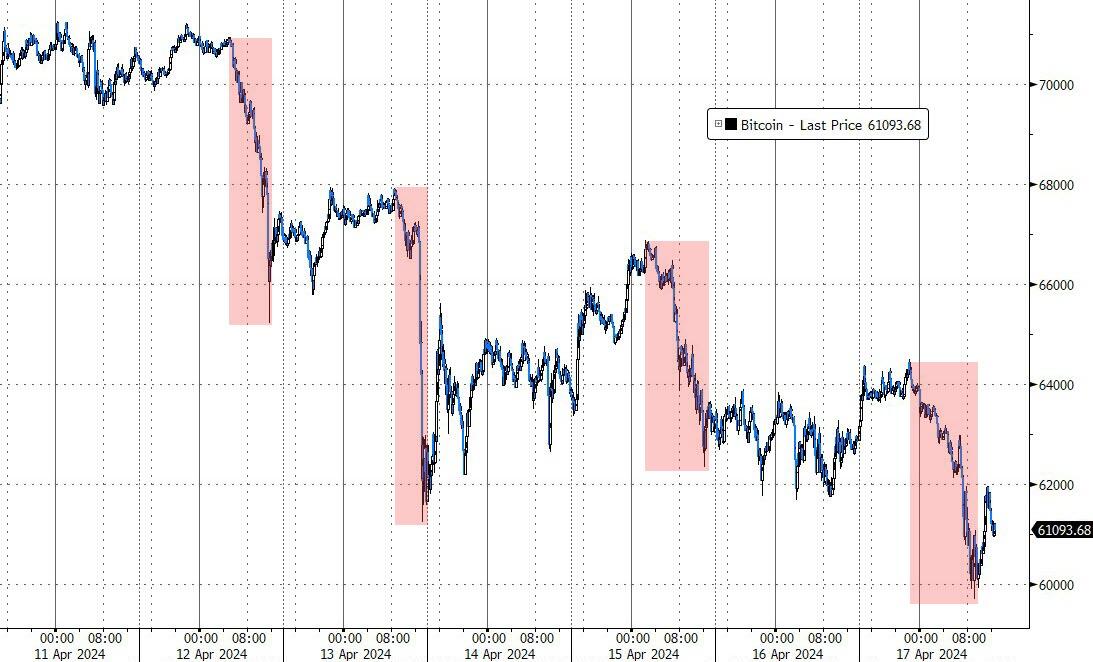
But the big move on the day… was in crypto which puked hard along with stocks, losing its $60k handle briefly before bouncing back a bit…

Source: Bloomberg

Ethereum outperformed bitcoin on the day, erasing most of its big relative puke last Friday/Saturday…

Source: Bloomberg

Finally, as we detailed earlier, the market has seen more Hindenburg Omens than in any year since the peak of the

Source: Bloomberg

‘Probably nothing!’

Tyler Durden
Wed, 04/17/2024 – 16:00

“Do Not Touch Me… I Am A Faculty Member”: Cornell Professor Disrupts Coulter Speech

“Do Not Touch Me… I Am A Faculty Member”: Cornell Professor Disrupts Coulter Speech

Authored by Jonathan Turley,

Monica Cornejo, an assistant professor of interpersonal communication, was forcibly removed from a Cornell University event this week after disrupting a speech by conservative commentator Ann Coulter. She is only the latest faculty member to seek to prevent others from hearing opposing views. The question now is what Cornell will do about her conduct.

To its credit, Cornell resolved to reinvite Coulter to speak after a prior event was disrupted by protesters.

On March 13, Cornell Provost Michael Kotlikoff  stated that:

 “Having been deeply troubled by an invited speaker at Cornell (any speaker) being shouted down and unable to present their views, I agreed that there could be few more powerful demonstrations of Cornell’s commitment to free expression than to have Ms. Coulter return to campus and present her views.”

Kotlikoff should be commended for taking a principled stance in favor of free speech.

The question, however, is how he will handle Cornejo. In a 36-second video posted by The College Fix officers indicate that she is under arrest for “disorderly conduct.”

According to the site,  she repeatedly responded “don’t touch me — do not touch me,” and tells them “I am a faculty member.”

(I could not make out the last reported statement on the tape itself).

Cornejo is described in media reports as “one of the first undocumented tenure-track faculty members at Cornell.”

She was interrupting a speech by Coulter titled “Immigration: The Conspiracy To End America.”

Her bio states that

“Dr. Monica Cornejo is an Assistant Professor in Interpersonal Communication in the Department of Communication at the College of Agriculture and Life Sciences. Dr. Cornejo’s research uses qualitative and quantitative methodologies to examine the structural barriers that lead to inequities among undocumented immigrants, how undocumented immigrants draw on communication identity management and advocacy strategies to challenge those barriers, and how those strategies relate to undocumented immigrants’ health and wellbeing.

…Dr. Cornejo focuses on teaching students about different ways in which interpersonal communication can reduce or create disparities and inequities in the United States (e.g., discrimination towards sexual orientation minorities and immigrant communities), as well as the strategies members of minoritized communities (and allies, co-conspirators, families) utilize to challenge the disparities and inequities that position minoritized group members in a second-class position.”

I have previously written that universities must draw a clear distinction between free speech and this type of disruptive conduct. Cornejo has every right to protest outside of the event. However, preventing others from speaking or hearing opposing views is not free speech. It is the antithesis of free speech. It will continue until universities show the courage to discipline faculty or students engaging in such conduct.

The removal of Cornejo showed a commitment to free speech by the school. Often schools remain passive or enforce a heckler’s veto in such cases.

Yet, removal alone is not sufficient.

Protesters will often plan a series of disruptions to effectively shutdown an event. Moreover, the university stated publicly that it wanted to show that such an event could occur on campus without disruption. This faculty member defied that policy and elected to heckle and disrupt the event.

She is not the first.

Years ago, many of us were shocked by the conduct of University of Missouri communications professor Melissa Click who directed a mob against a student journalist covering a Black Lives Matter event. Yet, Click was hired by Gonzaga University. Since that time, we have seen a steady stream of professors joining students in shouting down, committing property damageparticipating in riotsverbally attacking students, or even taking violent action in protests.

Blocking others from speaking is not the exercise of free speech. It is the very antithesis of free speech. Nevertheless, faculty have supported such claims. CUNY Law Dean Mary Lu Bilek showed how far this trend has gone. When conservative law professor Josh Blackman was stopped from speaking about “the importance of free speech,”  Bilek insisted that disrupting the speech on free speech was free speech. (Bilek later cancelled herself and resigned). Even student newspapers have declared opposing speech to be outside of the protections of free speech.

At Fresno State University public health professor Dr. Gregory Thatcher, recruited students to destroy pro-life messages.

At the University of California Santa Barbara, professors actually rallied around feminist studies associate professor Mireille Miller-Young, who physically assaulted pro-life advocates and tore down their display.  Despite pleading guilty to criminal assault, she was not fired and received overwhelming support from the students and faculty. She was later honored as a model for women advocates.

At Hunter College in New York, Professor Shellyne Rodríguez was shown trashing a pro-life display of students.

She was captured on a videotape telling the students that “you’re not educating s–t […] This is f–king propaganda. What are you going to do, like, anti-trans next? This is bulls–t. This is violent. You’re triggering my students.”

Unlike the professor, the students remained calm and respectful. One even said “sorry” to the accusation that being pro-life was triggering for her students.

Rodríguez continued to rave, stating, “No you’re not — because you can’t even have a f–king baby. So you don’t even know what that is. Get this s–t the f–k out of here.” In an Instagram post, she is then shown trashing the table.

Hunter College, however, did not consider this unhinged attack to be sufficient to terminate Rodríguez.

It was only after she later chased reporters with a machete that the college fired Rodríguez. She was then hired by another college.

Another recent example comes from the State University of New York at Albany, where sociology professor Renee Overdyke shut down a pro-life display and then resisted arrest. One student is heard screaming, “She’s a [expletive] professor.”

That of course is the point. She is a professor and was teaching these students that they do not have to allow others to speak if they oppose their viewpoints.

In watching their faculty engage in such conduct, one can understand why students believe that they have license to prevent others from speaking on campus. The only way to change that view is to suspend, fire, or expel those who seek to prevent others hearing opposing views by disrupting events. Again, the universities must show equal commitment in protecting their right to protest outside of events.

Yet, disrupting a class or event from within these spaces is a denial of the essential commitment of higher education to the free exchange of ideas.

Tyler Durden
Wed, 04/17/2024 – 15:40

Boeing Whistleblower Tells Lawmakers: “They Are Putting Out Defective Airplanes”

Boeing Whistleblower Tells Lawmakers: “They Are Putting Out Defective Airplanes”

Update (1530ET): 

“I have serious concerns about the safety of the 787 and 777 aircraft, and I’m willing to take on professional risk to talk about them,” Boeing whistleblower Sam Salehpour said in his opening statement on Capitol Hill today at the second Senate committee investigating the plane manufacturer’s safety problems. He said when he raised concerns about the 787 Dreamliner, he was “ignored” by the company and “told not to create delays. I was told, frankly, to shut up.”

Salehpour warned that the 787 Dreamliner fuselage was improperly put together and that the company “rushed to address the bottlenecks in production.” The result, he warned, is “premature fatigue failure” on these planes. He noted, “They are putting out defective airplanes.” 

“If something happens to me, I am at peace because I feel like coming forward, I will be saving a lot of lives,” he added.

Boeing did not have any witnesses at the hearing, but a spokesperson for the company told The Hill the company “understands the important oversight responsibilities of the Subcommittee and we are cooperating with this inquiry. We have offered to provide documents, testimony, and technical briefings, and are in discussions with the Subcommittee regarding next steps.”

Sen. Richard Blumenthal (D-Conn.), the committee chair, thanked the whistleblower for “speaking truth to power in the best sense of that word. Thank you for facing down one of the most powerful companies in the world.” 

Blumenthal added, “We intend to uncover what has enabled the culture of safety disregard to exist, so that we can change it for good.”

In early March, the last Boeing whistleblower was found dead in his car from a “self-inflicted wound.” 

*   *   *

Update (1113ET):

The second Senate hearing on Boeing is about to begin (1115 ET). Lawmakers will hear whistleblower allegations about significant safety lapses in Boeing’s manufacturing of the 787 Dreamliner. 

*   *   *

Update (0955ET):

Boeing faces two hearings on Capitol Hill today: 

First: Senate Commerce Committee

US Senator Maria Cantwell (D-Wash.), Chair of the Senate Committee on Commerce, Science and Transportation, will convene a full committee hearing titled “FAA Organization Designation Authorization (ODA) Expert Panel Report” on Wednesday, April 17, 2024, at 10:00 AM EDT. This hearing will review the findings and recommendations from the Organization Designation Authorization (ODA) Expert Review Panel’s final report. The landmark Aircraft Certification, Safety, and Accountability Act required the FAA to convene an independent expert panel to review the safety management processes and culture of ODA holders like Boeing and make recommendations to address any safety deficiencies.

Watch Live:

The whistleblower hearing begins at 1115 ET.  

*   *   *

The Senate Commerce Committee, which oversees the Federal Aviation Administration and Boeing, will kick off today’s first hearing at 1000 ET. This will feature a panel of aviation experts who recently released a report criticizing Boeing’s “inadequate” and “confusing” safety culture and has called for significant changes. 

The report states, “The procedures and training are complex and in a constant state of change, creating employee confusion, especially among different work sites and employee groups.” The experts noted “a lack of awareness of safety-related metrics” across all levels of the company. 

Sen. Tammy Duckworth (D-Ill.), chair of the Senate Commerce Aviation subcommittee, said Tuesday that the Federal Aviation Administration “needs to look at what Boeing does, not just what it says it’s doing.” 

Duckworth, who will attend the first of today’s two hearings, said there is a real possibility that the FAA “is willing to use its “civil enforcement authority when appropriate” against Boeing. 

The second hearing (beginning at 1115 ET) will feature a Boeing quality engineer turned whistleblower who will testify before the Senate Homeland Security Committee’s Permanent Subcommittee on Investigations about the alleged poor manufacturing quality of the 787 Dreamliner. 

The whistleblower is Sam Salehpour, a quality engineer at Boeing. In a report released last week, he told The New York Times about large sections of the 787’s fuselage that were improperly connected and could break down over time. 

“The entire fleet worldwide, as far as I’m concerned right now, needs attention,” Salehpour told NBC News, adding, “The attention is that you need to check your gaps and make sure that you don’t have the potential for premature failure.”

“The is going to surface some really shocking allegations about failures and safety practices and culture and light and retaliation that should shock the conscience of corporations as well as Americans,” subcommittee Chair Richard Blumenthal (D-Conn.) told The Hill.

Blumenthal added, “The whistleblower will have the guts to show up, and I’m hoping that Dave Calhoun will as well at some point.” 

Meanwhile, Boeing CEO David Calhoun plans to step down at the end of this year. He has repeatedly stated that he wants to improve manufacturing quality and safety culture. Calhoun has not publicly said if he will attend the hearings today. 

Tyler Durden
Wed, 04/17/2024 – 15:30