77.3 F
Chicago
Sunday, September 6, 2026
Home Blog Page 3234

Why Was It So Hard For Elite Universities To Condemn Hamas Terrorism?

0
Why Was It So Hard For Elite Universities To Condemn Hamas Terrorism?

Authored by Marc Zvi Brettler & Michael B. Poliakoff via RealClear Wire,

America’s leading universities have an antisemitism problem—and it starts at the top. This past week, university presidents and deans across the country wrote to their students and faculties to express concern in the aftermath of the terrorist attacks on Israel by Hamas. What they said, and what they did not say, provides a window into the culture of intellectual and moral rot and cowardice that reigns at these once-great institutions. 

Those who attack Jews or Israel are all too often exempt from their excoriation. Hamas terrorists massacred some 1,300 Israelis, took approximately 200 hostages, most of them civilians, and left an additional 3,200 injured, but you would not know it from some university leaders’ missives this week.

At Harvard University, President Claudine Gay has issued three muddled statements, under pressure, on the horrific events. Her first statement was a tepid confession of “heartbreak” that implied an equivalence between the Hamas attacks and Israel neutralizing the terrorists. This embarrassment was signed by all the university’s senior deans. Only after a barrage of online criticism—and threats by donors—did she muster the strength to condemn the child killers. Not content to leave it alone, she has issued another statement, but still without criticizing the 30-odd student groups who professed to “hold the Israeli regime entirely responsible” for the murder, rape, kidnapping, and torture of Jews, referring instead to the principle of freedom of speech. Let us be clear that these students have freedom of speech, but so does Claudine Gay. She has the right to condemn their words. In 2022, Harvard denounced in no uncertain terms “the capricious and senseless invasion of Ukraine.” Harvard knows how to speak clearly about Ukrainian victims but not, apparently, about Jewish victims.

Columbia University President Minouche Shafik offered a masterfully slippery statement: “I was devastated by the horrific attack on Israel this weekend and the ensuing violence that is affecting so many people.” While all lives matter, the mention of “ensuing violence” is a reference to Israeli targeting of terrorists—putting it on a par with raping and pillaging by Hamas. She implied moral equivalence. 

The moral lassitude and obscurantism of Shafik’s statement trickled down. Columbia College Dean Josef Sorett emitted the following: “The events in Israel and Gaza over the past several days have shocked the world and impacted many of our students.” Dean Sorett’s “events in Gaza” are, of course, Israeli military operations undertaken in self-defense and in an effort to kill murderers, which he places on par with the door-to-door murder of civilians in Israel. 

The dean of Columbia Law School did not outclass her colleague. Gillian Lester wrote to her students and faculty, “The violence that erupted in Israel and Gaza this past weekend is nothing short of tragic,” again implying a moral equivalence between the enemies of the Jewish people and their victims.

At Middlebury College, the senior leadership wrote to “acknowledge the untold pain, suffering, and loss of life unfolding from the violence happening now in Israel and Palestine.” President Laurie Patton seems unclear about who is making the violence “happen.” She goes on to warn against “hate, racism, ethnic discrimination, antisemitism, or Islamophobia.” The equivalence is complete, and we can move on to meet the real threat: Islamophobia. Compare this muddle to the perfect clarity of Middlebury’s official response to the Russian invasion of Ukraine: It “wreaked untold havoc in the lives of innocent civilians. Russia’s aggression against its democratic neighbor is a violation of international law, made only more egregious by its escalation in the face of international condemnation. I join that condemnation in solidarity with our Middlebury community.” How easy it would have been to revise that statement ever so slightly to say that Hamas “wreaked untold havoc in the lives of innocent civilians. Hamas’s aggression against its democratic neighbor is a violation of international law, made only more egregious by its escalation in the face of international condemnation. I join that condemnation in solidarity with our Middlebury community.”  

The University of California–Berkeley, which spends $36 million annually on its Division of Equity & Inclusion, may be the most openly antisemitic campus in the country. Its law school is under federal investigation for discriminating against Jews. Student organizations there expressed their “unwavering support” for the Hamas pogrom. The president refused to condemn this statement. Instead, he expressed his heartbreak at “the violence and suffering in Israel and Gaza,” pointedly comparing Israel’s self-defense to the terrorist attacks themselves, gesturing, like too many others, to the “complex history” of the situation. 

In reality though, no complexity is so great as to obscure the distinction between the intentional slaughter of innocents and targeted strikes against terrorists. Some schools eventually issued careful statements—but their initial reaction—or lack of reaction—is most telling, especially when contrasted with quick and decisive past declarations of outrage.

At Stanford University, the administration has covered itself in special disgrace by adding dishonesty to cowardice, despite finally acknowledging the horror. Criticized for its silence about the weekend’s slaughter, Stanford claimed in an unsigned statement that it “does not take positions on geopolitical issues and news events.” But when Russia invaded Ukraine, Stanford’s president released this statement: “The unprovoked, full-scale invasion of Ukraine by Russia, and the attack it represents on democracy, is beyond shocking.” He continued, “It has been remarkable to witness the courage and resilience of the Ukrainian people.” Stanford also commented when a child’s skipping rope was found in a tree in 2021, where it had been tangled for some years, officially denouncing it as a “a potent symbol of anti-Black racism and violence that is completely unacceptable under any circumstances.” Stanford discovered the principle of institutional neutrality, it seems, just in time for the Sabbath assault on Israeli civilians.

Under the principle of institutional neutrality, colleges and universities should indeed refrain from speaking corporately on contemporary social or political issues, unless they transcend the institution’s values as a whole (such as the wanton taking of innocent life by terrorists). Higher education’s mission is to encourage diversity of thought. But condemning brutality and savagery, whether the murder of George Floyd under the knee of a policeman, or the civilian carnage Hamas wrought, is not a political statement. No one has asked presidents to endorse Zionism or the two-state solution or anything vaguely geopolitical. They needed only to affirm human decency without which the university is a place of moral chaos.

However serpentine the ongoing contortions of these administrators, what is revealed in these official reactions by colleges is a cancerous moral rot and intellectual confusion. Bothsidesism is a symptom; the root cause is worse. They were perfectly able to rush to condemn the murder of George Floyd, the seedy depravities uncovered by the #MeToo movement, and the brutal invasion of Ukraine—as they should. They pronounce vocally and volubly on the events of January 6, 2021, and on horrible killings at houses of worship. They take flamboyant public positions on everything from affirmative action to climate policy to marriage equality. So why is it so hard to condemn the slaughter of Jewish babies? Why is it so hard to offer proper support and empathy to their grieving Jewish students?

The University of Pennsylvania’s president had no word of censure for Penn’s Palestine Writes festival, which ran between Rosh Hashanah and Yom Kippur and featured Pink Floyd’s Roger Waters, notorious for exhibitionist antisemitism. Then came the anemic initial response of Penn’s president to the Hamas atrocities. Jon Huntsman, a Penn graduate and donor and a former governor of Utah, pinpointed the cause of his alma mater’s failure: “Moral relativism has fueled the university’s race to the bottom.” If only Penn’s administration possessed such moral (and pedagogical) clarity.

To be fair, some universities have offered proper statements that unambiguously condemn the pogrom of Hamas. But these are few and far between. The United States used to lead in higher education, but now we need to look for leadership abroad, for example in the exemplary statement of the German Rectors’ Conference that noted quickly, clearly, and unambiguously: 

We are deeply shocked and appalled by the terrorist attack of Hamas on Israel, the terrible massacres, and the kidnappings. 

On behalf of all German universities, I would like to express our sincerest condolences and heartfelt sympathy. We are deeply saddened by the senseless loss of life. Our thoughts are with those killed and injured, those still in danger, and their families and friends. 

As the German Rectors’ Conference, the voice of German universities, we stand in solidarity with the Israeli universities and academic colleges and all their members. We would be grateful if you could share this message of sympathy and solidarity with your member institutions.

Educational institutions have a responsibility to educate and lead—not only in subject matters but in basic issues of morality. Those who fail to condemn the slaughter of children and fail to show empathy to their students who identify with this slaughter, are failing their mission at the most basic level. 

Tyler Durden
Sat, 10/21/2023 – 00:00

How Much Do EV Batteries Cost?

0
How Much Do EV Batteries Cost?

The cost of an electric vehicle (EV) battery pack can vary depending on composition and chemistry.

In this graphic, Visual Capitalist’s Bruno Venditti and Sabrina Lam use data from Benchmark Minerals Intelligence to showcase the different costs of battery cells on popular electric vehicles.

Size Matters

Some EV owners are taken by surprise when they discover the cost of replacing their batteries.

Depending on the brand and model of the vehicle, the cost of a new lithium-ion battery pack might be as high as $25,000:

The price of an EV battery pack can be shaped by various factors such as raw material costs, production expenses, packaging complexities, and supply chain stability. One of the main factors is chemical composition.

Graphite is the standard material used for the anodes in most lithium-ion batteries.

However, it is the mineral composition of the cathode that usually changes. It includes lithium and other minerals such as nickel, manganese, cobalt, or iron. This specific composition is pivotal in establishing the battery’s capacity, power, safety, lifespan, cost, and overall performance.

Lithium nickel cobalt aluminum oxide (NCA) battery cells have an average price of $120.3 per kilowatt-hour (kWh), while lithium nickel cobalt manganese oxide (NCM) has a slightly lower price point at $112.7 per kWh. Both contain significant nickel proportions, increasing the battery’s energy density and allowing for longer range.

At a lower cost are lithium iron phosphate (LFP) batteries, which are cheaper to make than cobalt and nickel-based variants. LFP battery cells have an average price of $98.5 per kWh. However, they offer less specific energy and are more suitable for standard- or short-range EVs.

Which Battery Dominates the EV Market?

In 2021, the battery market was dominated by NCM batteries, with 58% of the market share, followed by LFP and NCA, holding 21% each.

Looking ahead to 2026, the market share of LFP is predicted to nearly double, reaching 38%.

NCM is anticipated to constitute 45% of the market and NCA is expected to decline to 7%.

Tyler Durden
Fri, 10/20/2023 – 23:30

Turley: The Trump Gag Order Should Be Struck Down

0
Turley: The Trump Gag Order Should Be Struck Down

Authored by Jonathan Turley,

Below is my column in The Hill on the imposition of a gag order on former President Donald Trump by U.S. District Judge Tanya Chutkan. Despite my long-standing criticism of Trump’s personal attacks on judges and critics, this gag order should be curtailed or struck down on appeal. While the odds tend to favor the lower court in such orders, there is ample reason to object to the scope and language of the order. The ill-defined bar on criticizing the prosecution or witnesses (including one of Trump’s opponents in this election) raises serious free speech concerns. It is also unlikely to have any appreciable impact on the heated public debate over this and other prosecutions of the presidential candidate. Much of this campaign will focus on the alleged weaponization of the criminal justice system. While Trump is still allowed to criticize the case generally, the vague order cuts too deeply into his right to criticize the prosecutor, the judge, and witnesses in the case in this election.

Here is the column:

The imposition of a gag order on former President Donald Trump was overwhelmingly applauded by pundits and press alike. Journalists described the order from U.S. District Judge Tanya Chutkan as “narrow” and “limited.” Most of them lionized Chutkan as an “unflinching” and “no-nonsense”  judge who would not tolerate Trump’s penchant for personal attacks and reckless rhetoric.

However, this order should concern everyone who values freedom of speech. While the odds may favor Chutkan on appeal, this order should be overturned as overbroad and dangerous.

For years, many of us have been criticized Trump for his personal attacks on judges and opponents alike. Undeterred, Trump has continued such inflammatory attacks on “deranged” Special Counsel Jack Smith and the “biased, Trump-hating Judge” Chutkan. Smith has pushed aggressively for a gag order, even though one of the major issues in Trump’s campaign is whether the Biden Administration has weaponized the criminal justice system against him and other Republicans.

This week, Chutkan issued a partial gag order and stressed that she will not allow Trump to conduct a “smear campaign” in which he seeks to “vilify and implicitly encourage violence against public servants who are simply doing their jobs.” She stressed that “no other criminal defendant would be allowed to do so, and I’m not going to allow it in this case.” Chutkan reflects this trend in stating categorically that these are the limits that must be imposed regardless of the defendant.

These orders come at a great cost — limiting both parties and counsels in raising objections to alleged abuses of the government. The First Amendment was written in the aftermath of such abuses, including the infamous prosecution of publisher John Peter Zenger 290 years ago in 1733.

Some polls show that a majority now believe the Trump prosecutions are “politically motivated.” Tens of millions oppose the prosecutions, and this will be the single most-discussed issue of the campaign. Yet, one candidate would be both the subject of this national debate and a gag order barring full participation in it.

Chutkan steadfastly refused to recognize that either this case or this defendant are far from typical. Her order bars Trump from making statements against Smith, his staff, court personnel, and potential witnesses. That last category could include one of Trump’s opponents in the presidential election, former Vice President Mike Pence.

If Chutkan had simply barred statements targeting court staff or jurors, there would be no controversy. But she has imposed a vaguely worded court order that could turn campaign speeches into criminal contempt.

While appellate courts have largely ruled in favor of lower courts’ gag orders, there have long been constitutional concerns over these limits on not just the free speech rights of defendants but also their zealous representation by defense counsel.

It is not surprising that Smith dismisses such concerns. Smith has long adopted extreme legal positions that ignore constitutional values. This includes his prosecution of the former governor of Virginia, Robert McDonnell (R), which was reversed in a unanimous 8-0 decision by the Supreme Court in 2016.

The courts remain divided on the standards for curtailing the free speech rights of a defendant. A closely analogous case is the corruption trial of Rep. Harold E. Ford Sr. (D–Tenn.). The district court barred Ford from making any “extrajudicial statement that a reasonable person would expect to be disseminated by means of public communication” that included criticism of the motives of the government or basis, merits, or evidence of the prosecution.

The United States Court of Appeals for the Sixth Circuit rejected the gag order as overbroad and stressed that any such limits on free speech should be treated as “presumptively void and may be upheld only on the basis of a clear showing that an exercise of First Amendment rights will interfere with the rights of the parties to a fair trial.”

There remains a division on the courts of what showing is needed, but there is little evidence of any true balancing in Chutkan’s decision. This and the other trials will remain the focus of heated debate in this campaign. Her order will only silence the voice of the man who many feel is the victim of politically motivated prosecutions. This order will do little to reduce the criticism or the coverage.

Ironically, it is a level of restraint that Judge Chutkan herself has failed to show in the past. For example, in sentencing a rioter in 2022, Chutkan said that the rioters “were there in fealty, in loyalty, to one man — not to the Constitution.”

She added that “[i]t’s a blind loyalty to one person who, by the way, remains free to this day.”

That would seem to imply the guilt of an individual who was not even charged. Yet Chutkan has refused to recuse herself in now trying the very man she was referencing as responsible for the crimes of that day.

As has long been the case, many are turning a blind eye to the implications of this order. They cannot see beyond the name at the top of the caption page. But this order would allow any judge to effectively strip a political candidate of the ability to contest the merits and motivations involved in his own prosecution, including challenging the veracity of prosecutors or witnesses.

In some of these cases, there is ample reason for such criticism. While I have long said that the Mar-a-Lago prosecution by Smith is well-supported in both law and facts, other prosecutions currently ongoing are clearly politically motivated. The most obvious is the prosecution brought by Alvin Bragg in New York — a case that contorts existing law in an attempt to bag a political figure unpopular in his jurisdiction.

While the Chutkan gag order does not extend to the other cases, they constitute a daisy-chain of trials that will have Trump running between courts before the election. There is much to criticize in Smith’s second indictment, which will be tried before a judge who previously denounced Trump in a district where 95 percent of the voters opposed Trump.

After Chutkan ordered a trial just before Super Tuesday, she is now gagging only one candidate — the very candidate who is campaigning against the weaponization of the criminal justice system. You do not have to like or support Trump to recognize the serious problem inherent in such a gag order.

Tyler Durden
Fri, 10/20/2023 – 23:00

De-Dollarization? China Completes First Digital Yuan Purchase For Cross-Border Oil Transaction

0
De-Dollarization? China Completes First Digital Yuan Purchase For Cross-Border Oil Transaction

De-dollarization continues accelerating with news of the Shanghai Petroleum and Natural Gas Exchange (SHPGX), a Chinese-backed exchange for trading energy-related products, settling its first cross-border transaction in digital yuan.

Chinese-based financial news outlet “Yicai” first reported PetroChina International bought one million barrels of crude oil using digital yuan on Thursday. It was the exchange’s first overseas oil settlement in digital yuan. However, the name of the seller was not disclosed. 

SHPGX has made several transactions in yuan earlier this year: In March, PetroChina and TotalEnergies completed a yuan-denominated liquefied natural gas transaction on the exchange. According to the exchange, four such LNG transactions have occurred this year. 

China’s central bank began the digital yuan project in 2014 and has piloted the electronic currency in numerous regions across China. The world’s second-largest economy has been preparing to use the yuan and its digital version in international trade and finance as an alternative to the dollar. 

In August, Brazil’s President Luiz Inacio Lula da Silva called for BRICS nations to create a common currency as the world furiously searches for ways to circumvent the dollar-based financial system. 

Brazil’s president said a BRICS currency “increases our payment options and reduces our vulnerabilities.” 

The US shutting Russia out of the SWIFT messaging system that underpins most global payments in response to its invasion of Ukraine has supercharged the de-dollarization trend. 

It remains to be seen who exactly PetroChina paid digital yuan for the crude oil, but it might not be out of the question that it was Russia, considering it’s been shut out of the SWIFT system, plus oil exports to China have hit a record high. 


Tyler Durden
Fri, 10/20/2023 – 22:30

US Announces New Immigration Program For Ecuadorians

0
US Announces New Immigration Program For Ecuadorians

Authored by Stephen Katte via The Epoch Times (emphasis ours),

A new legal immigration pathway for immigrants from Ecuador has been implemented by the Biden Administration to help slow the influx of illegal immigrants trekking to enter the United States at its Mexico border.

Secretary of Homeland Security Alejandro Mayorkas speaks during the daily news briefing at the James S. Brady Press Briefing Room of the White House on May 11, 2023. (Anna Moneymaker/Getty Images)

According to the Department of Homeland Security (DHS), Family Reunification Parole (FRP) allows U.S-based Ecuadorians to sponsor immediate family members abroad to come into the country legally.

Secretary of Homeland Security Alejandro Mayorkas said the FRP process will open up new pathways for legal immigration, while also hopefully reducing the number of people making the dangerous journey from Ecuador using people smugglers.

Establishing this process for certain Ecuadorian nationals will ensure more families can access lawful pathways rather than placing themselves at the mercy of smugglers to make the dangerous journey,” he said.

“Those who do not avail themselves of family reunification parole or other lawful, safe, and orderly pathways, and attempt to enter the United States unlawfully will continue to face tough consequences,” he added.

Hundreds of illegal immigrants seeking asylum in line for Immigration Customs Enforcement appointments outside of the Jacob K. Javits Federal Building in New York City on June 6, 2023. (David Dee Delgado/Getty Images)

To qualify, Ecuadorians must have a family member who is already a citizen or permanent resident to sponsor them for an immigrant visa. If approved, officials will invite the applicant to enter the United States under the humanitarian parole authority without waiting for a visa.

Under the new FRP process, qualifying applicants must be outside the United States at the time of application and go through all the usual screening, vetting, and medical requirements. Anyone who has already received an immigrant visa is not eligible.

As part of the FRP, migrants can remain in the United States for up to three years, apply for work permits while they wait for an immigrant visa, and then apply to become a lawful permanent resident.

The process is being touted as much faster than the family-based visa system, which is nearly permanently backlogged and capped at a specific number. The FRP already includes eligible nationals from Cuba, Haiti, Colombia, El Salvador, Guatemala, and Honduras.

Unvetted immigrants prepare to be transported by bus to processing facilities in Yuma, Ariz., on May 18, 2023. (John Fredricks/The Epoch Times)

Illegal entry into America is classed as a federal crime and can attract penalties such as deportation, and bans on re-entry into the country.

Chaos in Ecuador Driving Up Emigrant Numbers

Ecuador has previously been in the midst of its own immigration crisis, as millions fled socialist Venezuela to escape hyperinflation and extreme poverty in the once wealthy nation. In recent years, Ecuadorians have also been fleeing their country in huge numbers due to a struggling economy and a massive uptick in violent crimes from drug cartels and street gangs.

In July, Ecuador’s President Guillermo Lasso was forced to declare a state of emergency and night curfews in three coastal provinces after a wave of violence swept through the country, leaving at least eight dead.

Ecuadorian President Guillermo Lasso walks on the day of his annual report to the nation, a week after dissolving the National Assembly and calling for early elections in Quito, Ecuador, on May 24, 2023. (Karen Toro/Reuters)

Ecuadorian presidential candidate Fernando Villavicencio was also gunned down Aug. 9 while leaving a political rally. The six men accused of the crime were killed in prison while awaiting the results of the investigation into the crime.

The State Department has advised Americans not to visit certain areas of the country due to heightened risks of kidnapping, assault, and murder.

The ongoing chaos has seen record numbers of Ecuadorians attempt to flee to safer countries. Federal data shows that Border Patrol reportedly apprehended nearly 99,000 Ecuadorians who entered the United States without authorization in the last 12 months.

Tyler Durden
Fri, 10/20/2023 – 22:00

RFK Jr’s Presidential Bid Hinges On Ballot Access

0
RFK Jr’s Presidential Bid Hinges On Ballot Access

Earlier this month, Robert F. Kennedy, Jr announced he was abandoning a Democratic Party that’s overtly hostile to his 2024 presidential campaign, choosing to run as an independent candidate instead.

He’s already drawing a hefty 16% in three-way contest with Biden and Trump, according to a recent NPR/PBS/Marist poll. However, all the public support in the world will mean nothing unless RFK Jr can overcome a major hurdle for any independent candidate: getting his name on the ballot in 50 states and the District of Columbia. 

There’s more to that feat than gathering signatures. “It takes significant expertise to navigate specific rules for every state and the requirements needed before signatures can even begin to be collected — and then to beat back the legal challenges that will almost certainly follow,” writes Politico‘s Brittany Gibson. 

Kennedy announced his independent run in Philadelphia on Oct 9 (Hannah Beier/Bloomberg)

Time is a big factor, and one that makes the ballot challenge all the more daunting for Kennedy’s campaign, given his relatively late start. Consider that the nascent No Labels party has been at it for two years says it will complete the process for 28 states by New Year’s, with a goal of hitting 50 for the election.

Utah’s deadline comes first, and in less than three months — on January 6. “I wondered if they had thought it all through before making the switch over,” ballot access expert Michael Arno tells Politico

Signature requirements vary wildly: Kennedy has to get 200,000 signatures in California but a mere 275 in Tennessee. To be on the safe side, campaigns need to exceed those targets so they still qualify after signatures are scrutinized. Many states add an extra level of complexity by requiring that the group of people signing a ballot petition represent various parts of the state to a stipulated extent.  

There’s also a need to hire signature collectors, with the cost typically coming in between $7 and $10 per autograph. Those collectors need thick skin, as they’re prone to being confronted by party loyalists angered over an independent’s potential “spoiler” role. 

To defend their duopoly, Democratic and Republican parties each routinely file legal challenges against independent candidates, and Kennedy’s campaign is surely bracing for legal battles over the coming months. 

However, it’s not yet obvious which party has the most to lose from Kennedy’s presence on the ballot. In the latest NPR/PBS/Marist polls, Kennedy lifted Biden’s lead over Trump from 3 points to 7.   

Kennedy’s impact on Trump and Biden will likely change over time, as he stakes out different policy positions. Even before the Hamas attack on Israel stirred that issue, Kennedy alienated progressives and non-interventionist libertarians with full-throated support of Israel that went well beyond the level of lip-service often deemed mandatory of politicians. Meanwhile, his flirtation with reparations for black people — which his campaign calls “direct redress payments” — is certain to rankle disaffected Republicans. 

Tyler Durden
Fri, 10/20/2023 – 21:30

Grenada, 1983: Catalyst To Upgrading Special Operations

0
Grenada, 1983: Catalyst To Upgrading Special Operations

Authored by Forrest Marion via RealClear Wire,

In mid-October 1983, a “sordid little Leninist dictatorship” on the Caribbean Island of Grenada crumbled, resulting in the British Commonwealth country’s takeover by a more-leftist military junta. The situation immediately raised concerns in Washington regarding the potential for a large-scale hostage crisis in addition to the threat of regional instability within the Cold War’s context.

From 1979 to 1983, the revolutionary Grenadian government, led by Maurice Bishop, established close ties with Cuba and the Soviet Union. Probably its most important project was the construction of an international airport with a 9,000-foot runway. The government stated the airport was for tourism, but, inexplicably, the hotels to support the anticipated increase in visitors were lacking. Tellingly, the Point Salines airport on Grenada’s southern coast was to be capable of handling Soviet military aircraft. President Ronald Reagan called Grenada “a Soviet-Cuban colony being readied as a major military bastion to export terror and undermine democracy.”

On October 19, 1983, Bishop – considered not leftist enough by some of his fellow Marxists – was murdered. Within days, Reagan approved the chairman of the joint chiefs’ recommendation to develop plans for possible hostilities on the island, should the Grenadians and/or the Cubans – 450 of the latter were building the airport – oppose a U.S. evacuation of its citizens. Of greatest concern to the Reagan administration was the presence of several hundred medical students on the island. It feared “another Tehran” – referring to the hostage crisis in 1979-80 that contributed to President Jimmy Carter’s failed reelection bid.

On October 25, 1983, an eight thousand-member U.S.-led coalition force invaded Grenada. Its objective was to “conduct military operations to protect and evacuate US and designated foreign nationals from Grenada, neutralize Grenadian forces, stabilize the internal situation, and maintain the peace.” To no one’s surprise, the operation was one-sided and short – most hostilities ended within 72 hours – but it was somewhat akin to an NFL team defeating a scrub club, 7-3. Regardless of media coverage that gave the impression of a flawless battlefield victory, “it was an ugly win, with many problems” surrounding the employment of special operations forces.

Instances of poor operational planning and deficiencies in areas such as the knowledge of conditions on the ground at Grenada, interservice cooperation, and communications abounded. Although Washington had closely followed developments in Grenada since 1979, military planners lacked current maps of the island. In numerous cases during the operation, various military elements did not share common radio frequencies or system compatibility, contributing to the widely publicized anecdote of one military member on the ground at Grenada resorting to a payphone to call back to the United States for artillery support. While the story became an urban legend (at least one similar incident featuring a regular phone did occur, however), the actual deficiencies in communications provided the ideal platform for the “payphone” anecdote to spread far and wide – including senior U.S. officials and Hollywood.

The unfinished but usable airfield at Port Salines was a major objective. Early on October 25th, as the lead C-130 aircraft carrying the airfield seizure package approached, it lost navigational and infrared systems. Coupled with unexpected rain showers and low ceilings, the aircraft commander passed the formation’s lead to another Hercules. Following the reshuffling of aircraft, and learning the Grenadians were awaiting the assault, the Army Ranger 1st Battalion commander, Wes Taylor, directed his men to jump from only 500 feet above the ground. Lieutenant Colonel Taylor’s impromptu decision probably saved numerous lives, as the Grenadians could not achieve a trajectory low enough for their antiaircraft guns to target the aircraft. In any case, the Americans’ reception was not the “pina coladas” that one senior Air Force briefer had led the aircrews to expect.

Air Force combat controllers were among the several types of special operations forces in Grenada, some of whom jumped in with the Rangers. While the Rangers established a perimeter around the Salines airfield, the combat controllers ensured the safe, timely, and coordinated flow and movement of aircraft during landings, takeoffs, and ground operations, and following the set-up of radios, navigational aids, and lighting, they handled those duties plus airspace coordination.

Gaining actual control of the field was extremely difficult, however. One combat control officer recalled, “Our real issue . . . was that the Army and the Navy and Marine Corps were all attempting to use the airfield as well [as the Air Force], and no one had deconflicted the control. . .. Everybody had their own plan. . .. [and] was trying to execute it on the same piece of real estate.” Each Service thought it was the primary airfield user and in charge. In one case, an Air Force combat control officer and an Army superior officer nearly came to blows when an Army artillery battery which had set up on one side of the airfield began firing across the runway! In the chaotic environment at Port Salines, near-misses occurred “all the time.”

Upgrading Special Operations

From the close of America’s Southeast Asia military operations, U.S. special operations forces experienced significant trials in the decade that followed, marked particularly by the failed Iranian hostage rescue attempt in 1980 and the Grenada operation’s mixed record three years later. In the aftermath of Iran-Grenada, several congressional leaders took the initiative to reorganize the Pentagon’s special operations forces, culminating in the creation of U.S. Special Operations Command in 1987.

Looking back from 1991, U.S. Army Col. William G. Boykin – later a 3-star general – wrote in his war college research paper of a key Senate hearing five years earlier in which retired Maj. Gen. Richard Scholtes provided “compelling testimony” concerning Grenada. Scholtes, the Joint Special Operations Command commander for the operation, explained to the senators how his forces were “misused” and “robbed of their unique capabilities by the conventional planners and chain of command,” leading to “relatively significant casualties in Grenada as a result of numerous fundamental misunderstandings of their tactics and capabilities.”

The effect was powerful. The next day, Senator William Cohen (R-Maine) introduced a revised version of his original special operations bill as an amendment to the 1987 defense authorization bill. Cohen told his fellow lawmakers:

I do not believe that this record is attributable to persistent bad luck or an inadequate caliber of men in the armed services. In my view, we have not been effectively organized to fight the most likely battles of the present or the future.

Both houses of Congress passed the special operations measures. Two months later, in October 1986, President Reagan signed the 1987 defense bill into law, which included the framework for U.S. Special Operations Command. In the coming years, Cohen’s bleak assessment was destined to change – a fact he undoubtedly appreciated while serving as the nation’s defense secretary a decade later.

From a broader perspective, the brief Grenada operation in 1983 began the post-Vietnam rebuilding of the positive image of America’s military in the eyes of many citizens. That rebuilding continued with another short, successful operation in the 1989 removal of Manuel Noriega from Panama. In 1991, during the vastly larger, successful operation against Saddam Hussein’s Iraqi regime – U.S. objectives remained limited – the American public’s favorable view of its armed forces reached a high not seen in decades. At the same time, the long overdue recognition of U.S. veterans of the Southeast Asia conflict was a welcome corollary.

But the 1990s also began a trend in the U.S. military that threatened cohesion and combat readiness. Like the well-known tragedy at Parris Island in 1956 in which six Marine recruits perished in a swamp, beginning with the Clinton administration in 1993 the Pentagon wandered into the swamp of social engineering for political ends. Clinton’s “Don’t Ask, Don’t Tell” policy permitting homosexuals in the armed forces began the process that, three decades later, helped bring us to where we are now: neo-Maoist (self-loathing) diversity trainings; Orwellian “memory hole” treatment of military heroes; and drag-queen-, abortion-, and transgender-related perversions – all of which are front-and-center in the U.S. armed forces.

None of this contributes to the current recruiting crisis, we are told, however. Put another way, if one wished to destroy the U.S. military from within, what might one do differently?

For the first time, the American military is rated “weak” by the respected Heritage Foundation. Meanwhile, China continues its engagement in low-level hostilities against the United States that it could ramp up at any moment; ideally, not until victory seems assured. As I remember from a 1980s’ radio sermon on the Book of Jeremiah: “Payday comes someday. . .. Payday comes some day.” Although the national context differs today, Jeremiah wrote of Judah: “Yet I shall not make a full end of you; But I shall correct you properly And by no means leave you unpunished.” . . . Perhaps it will be so with us.     


Forrest L. Marion, Ph.D., is a retired U.S. Air Force officer and military historian. He is the author of Flight Risk: The Coalition’s Air Advisory Mission in Afghanistan, 2005-2015 (Naval Institute Press, 2018), and (forthcoming), Standing Up Space Force: The Road to the Nation’s Sixth Armed Service (Naval Institute Press).

Tyler Durden
Fri, 10/20/2023 – 21:00

“Dangerous And Misguided”: California AG Flips Out After Judge Strikes Down Assault Weapons Ban

0
“Dangerous And Misguided”: California AG Flips Out After Judge Strikes Down Assault Weapons Ban

California Attorney General Bob Bonta is hoppin’ mad after a federal judge in San Diego declared the state’s law banning assault weapons to be unconstitutional, and that a 1989 prohibition on certain semi-automatic weapons could not stand in light of a US Supreme Court ruling last year that expanded gun rights.

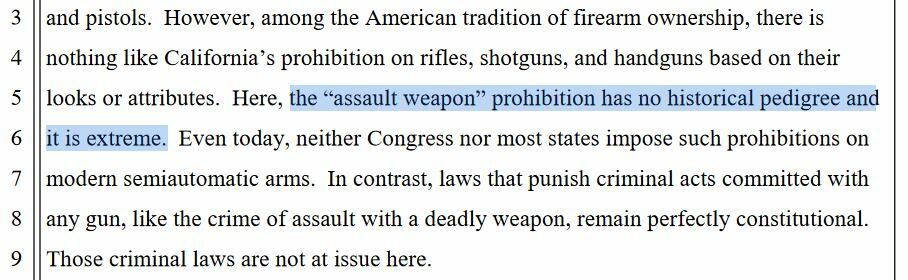
In a 79-page ruling on Thursday, US District Judge Roger Benitez said that the state’s ban deprived law-abiding people from owning semiautomatic firearms like the AR-15 (in certain configurations) is “extreme,” and violates the US Constitution’s Second Amendment right to “keep and bear arms.”

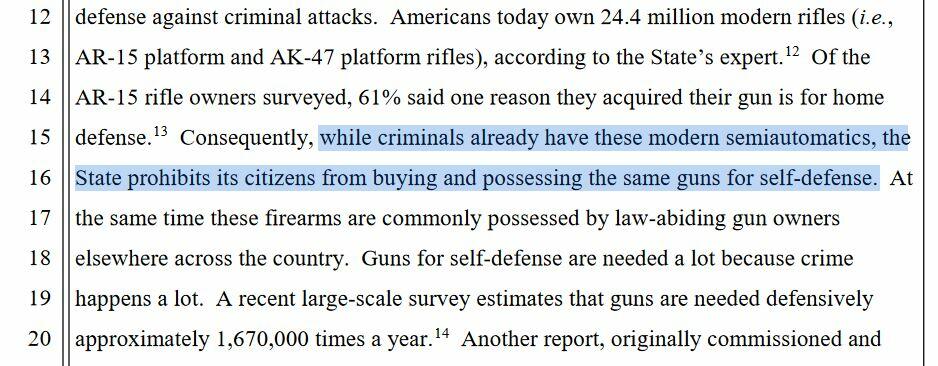
Benitez also (accurately) notes that criminals are already in possession of “assault weapons,” and that “Rather than being outgunned, many citizens want these same firearms as a defense against criminal attacks.”

Benitez then provided examples of self-defense that are rarely picked up in the media, starting with a pregnant woman in Florida, who was able to defend her home from violent attackers using an AR-15.

According to Benitez, in light of the US Supreme Court striking down New York state’s limits on carrying concealed handguns outside the home, that there were “no founding era dead ringers or historical twins” to California’s assault weapons ban, and that the state couldn’t point to any historical laws before it adopted its ban.

California in 1989 became the first U.S. state to ban assault weapons, acting in the wake of a school shooting that killed five children.

The legal challenge was brought by several California residents who wanted to own firearms like the AR-15 as well as by gun rights groups including the Firearms Policy Coalition, the California Gun Rights Foundation and the Second Amendment Foundation.

Benitez, an appointee of Republican former President George W. Bush, said California’s decision to ban assault weapons “creates the extreme policy that a handful of criminals can dictate the conduct and infringe on the freedom of law-abiding citizens.” -Reuters

In response to the ruling, AG Bonta fired off an angry letter and filed an appeal, calling Benitez’s decision “dangerous and misguided.” We expect the state’s liberal 9th Circuit Court of Appeals to agree, after which the US Supreme Court will need to weigh in (or not).

Meanwhile, California gun owners aren’t exactly overjoyed. As one anonymous user on Calguns.net posted in response:

After Duncan (not to mention Heller, Peruta, Bruen, etc., etc.) talk of this being a win is just delusional. NOTHING has changed for the better. In fact it’s far WORSE.

Can I buy handguns the rest of the nation can? NO.
Can I open carry? NO
Can I carry concealed? NOT AFTER JAN 1, 2024
STD mags? NO
Can I own AR-15s or the like that aren’t bastardized, unsafe, nonstop ugly a*s reminders of our impotence? NO
Can I buy ammo online like I used to? NOT WITHOUT JUMPING THROUGH FFL03+COE HOOPS).
For crying out loud people, we can’t even buy ammo without first asking permission and then having to paying for that permission (background check)!!

What a joke this all is. And there’s so much more I haven’t even thought of. You call this winning? Wake up. I’m done.

Tyler Durden
Fri, 10/20/2023 – 20:30

“The Whole George Floyd Story Was A Lie”: Tucker Carlson

0
“The Whole George Floyd Story Was A Lie”: Tucker Carlson

Tucker Carlson just challenged one of the left’s most sacred of cows – George Floyd, an ex-con who died with an elephant-dose of fentanyl in his system and a history of health issues, while in custody of Minneapolis police on May 25, 2020.

According to Carlson, we need to revisit certain popular narratives, including the circumstances surrounding Floyd’s death – and in particular, inconsistencies between public perception – that Floyd died under the knee of former officer Derek Chauvin, who’s currently serving more than 40 years in state and federal sentences.

“Did, for example, a racist white cop actually murder a man called George Floyd, a civil rights leader in Minneapolis on Memorial Day of 2020? Now we’ve been told that that happened, told it relentlessly for more than three years,” Carlson says, adding “But the question is, did he [Derek Chauvin] actually murder George Floyd? And the answer is, well, no, he didn’t murder George Floyd, and we’re not guessing about that; we know it conclusively thanks to a new court case now underway in Hennepin County, Minnesota.

The lawsuit, incidental to Floyd and Chauvin, unveiled sworn deposition excerpts from a conversation with County Medical Examiner Andrew Baker, indicating that Floyd’s passing was not due to asphyxiation or strangulation. Instead, factors including drug use and a fatal concentration of fentanyl were significant contributors, reframing his demise from the widely publicized ‘murder’ to an inadvertent overdose.

“In other words, George Floyd, according to the official autopsy, was not murdered. He died instead of what we used to call natural causes, which, in his case, would include decades of drug use, as well as the fatal concentration of fentanyl that was in his system on his final day,” Carlson continued – laying out how the initial George Floyd storyline was endorsed and amplified by mainstream media, and ignited nationwide protests, intensive racial discourse, and movements like Black Lives Matter. 

These changes encompassed police defunding efforts, corporate hiring practices, and the institutionalization of new cultural observances like Juneteenth.

Carlson interviewed Vince Everett Ellison, author of “Crime Inc.” – who discussed the possibility of orchestrated degradation and victimization within the Black community by political entities, particularly the Democratic party.

Ellison suggests that the glorification of figures like George Floyd represents an insidious strategy to perpetuate a certain stereotype of blacks who are reliant on the system, thereby solidifying a voting base and maintaining a form of socio-political control.

Drawing parallels between movements like BLM and historical or international groups used for political leverage, Ellison’s commentary insinuates that these organizations could be modern iterations of ‘domestic militias’ utilized by the Democrats for social manipulation and power consolidation. The unsettling comparison of BLM to groups like Hamas and Hezbollah, or the historical utilization of the Ku Klux Klan, paints a grim picture of political machinations where civil unrest is a tool rather than a byproduct.

“The Democratic party uses BLM and Antifa as theirs, throwing the rock and hiding the hand. Of course, they’re going to do it; they’ve always done it, even at the beginning, they used the Ku Klux Klan,” he said.

Watch:

Tyler Durden
Fri, 10/20/2023 – 18:50

Georgia Man Issued $1.4 Million Super Speeder Ticket For Doing 90 In A 55

0
Georgia Man Issued $1.4 Million Super Speeder Ticket For Doing 90 In A 55

Inflation really has gotten out of control.

We’re sure those were the thoughts of the Georgia man who received a $1.4 million speeding ticket last month. Connor Cato was on his way home on September 2 when he was pulled over for doing 90 in a 55 mile per hour zone. 

Georgia State Patrol then tore him off a ticket with a $1.4 million dollar fine, according to WASV

“‘$1.4 million,’ the lady told me on the phone. I said, ‘This might be a typo’ and she said, ‘No sir, you either pay the amount on the ticket or you come to court on Dec. 21 at 1:30 p.m,’” Cato told his local NBC affiliate. 

Criminal defense attorney Sneh Patel commented: “I mean I can’t imagine someone would have to pay $1.4 million for not showing up for a speeding ticket.”

He added: “At first when I was asked about this, I thought it was a clerical error. But then you told me you followed up and apparently it’s not a clerical error. But again, I have never seen something like this, ever.” 

Patel told the NBC affiliate that misdemeanor charges in Georgia can only go up to $1,000: “It’s a misdemeanor of high and aggravated nature, it will be $ 5,000. Now, the bond amount should be relevant to that so for misdemeanor, you wouldn’t see bond amounts over $5,000 maybe $10,000 just to ensure if it’s a crime that involves violence or if you’re anticipating they will commit more crimes, it would set a higher amount or if you think they won’t show for court, you set a higher amount.”

He added: “But not $1.4 million — that’s something that goes into cases that are drug trafficking, murders or aggravated assaults, something of that nature.”

The city of Savannah then explained to NBC that, like all good efficient government work, the “system” uses $999,999.99 as a “placeholder” on tickets until a judge has a chance to set the fine at a hearing, as is done with super speeder tickets. 

The balance reflected in the e-citation is a placeholder. Super speeders are required to go to court. The system automatically puts in $999,999.99 as the base amount plus other costs since the only way to resolve the ticket is to appear in court,” Savannah told NBC

Tyler Durden
Fri, 10/20/2023 – 18:50