71.2 F
Chicago
Sunday, September 6, 2026
Home Blog Page 3244

Have Central Banks Lost Control Of The Gold Price?

0
Have Central Banks Lost Control Of The Gold Price?

Via GoldMoney.com,

Over the past few months, gold prices have completely detached from our model-predicted prices.

While we have seen deviations between actual and predicted prices in the past, those deviations were always temporary.

What we are witnessing now is the paradigm shift we alluded to in our report from March 2023.

Some explanations for this deviation we presented in that report are still valid. However, it appears increasingly likely that the main reason for this development is the central banks’ having lost control over the gold price.

Exhibit 1: Gold prices have completely detached from model-predicted values

$/ozt

Source: Goldmoney Research

Earlier this year, we published a two-part report Gold prices reflect a shift in paradigm – Part I and Part II, (March 15 & 16, 2023) in which we explored the thesis that the gold market exhibits a permanent paradigm shift. Historically, gold prices followed three drivers: Real-interest rate expectations, longer-dated energy prices, and central bank policy (net gold sales and QE). In 2016 we presented a gold price model to our readers, which showed that most of the price changes in gold can be explained with these three drivers. Deviations of the observed price from the model were usually short lived and prices eventually converged with the underlying drivers. Readers unfamiliar with our model can catch up here (Gold Price Framework Vol. 2: The energy side of the equation, May 28, 2018, here (Part II, 10 July 2018) and here (Part III, 24 August 2018), as well as some follow up reports that built on the model (Gold Price Framework Update – the New Cycle Accelerates, 28 January 2021) and (Gold prices continue to weather the rate storm, 13 April, 2022.

When the Fed began to hike rates in late 2021 as a reaction to burgeoning inflation, gold prices did first what the model would predict: They began to decline. Rising interest rates usually lead to higher real interest rate expectations if long-term rates rise faster than long-term inflation expectations. Real-interest rate expectations (as measured by 10-year TIPS yields) are strongly inversely correlated with gold prices as shown in our model. In the past, gold prices often followed real interest rates almost tick-by-tick intraday without any other news.

The decline in gold prices in early 2022 on the back of rising real-interest rate expectations was somewhat cushioned by rising energy prices. Long-dated oil prices rallied from $63.90/bbl in December 2021 to $75.91/bbl by July 2022. In our model, the rise in 10-year tips lowered predicted gold prices by $400/ozt while the rise in deferred oil prices increased it by $100/ozt (see Exhibit 2). On net, by August 2022, gold stood at $1737/ozt, just $25/ozt over our model predicted price of $1712.

Exhibit 2: The effect on gold by the rise in 10-year TIPS yields was initially offset by rising longer-dated oil prices

$/bbl (LHS), % (RHS)

Source: FRED, Goldmoney Research

However, while model-predicted prices continued to decline on the back of relentlessly rising real-interest rate expectations – and later the retracement of long-dated oil prices – gold prices turned and started to go up again. By fall 2022, we began noticing that, once again, gold prices had meaningfully deviated from predicted values. By the time we wrote our March 2023 note, gold traded already $450/ozt over the model predicted price, an absolute record at the time. Now the delta is a staggering $668/ozt. At the time of writing, gold is trading at $1870/ozt. But based on our model, it should be closer to $1202/ozt (see Exhibit 1). The chart illustrates clearly how detached gold prices have become from our model, and thus, the underlying drivers.

In our March 2023 note, we explored several theories that attempted to explain this large discrepancy between actual and predicted prices and we discussed whether we thought this was just a temporary phenomenon or whether this was something more permanent. 

The first observation was that central banks of non-OECD countries have been on a massive buying spree from late summer 2022. In our March 2023 report, we highlighted that the IMFs estimate of net central bank purchases was way too low in our view. We highlighted that even the much more optimistic estimates by the World Gold Council might be too low. For our model, we are using the high end of estimates from the WGC, but if actual gold purchases were even higher, then our model-predicted price would be too low. In addition, we also explained why we think our model may underestimate the extent to which central bank purchases drive the price. Historically, changes in CB holding were relatively small, and often the reporting time did not match the actual purchase. Particularly non- OECD central banks have been very opaque when it comes to gold purchases. That means our econometric models cannot properly attribute changes in the gold price to changes in central bank gold holdings. We concluded that the true impact on the price of gold is likely larger than what our model predicts. Thus, in our March 2023 note we came to the conclusion that strong central bank gold purchases might partially explain why our model was underpredicting prices.

However, since then central banks became net sellers again. Data from the World Gold Council shows that central banks were large net gold sellers in March, April and May of this year, and only became net gold buyers again in June, July and August. 

Exhibit 3: After a few months of large increases, central banks turned to net sellers in summer 2023 again

Tonnes month-over-month

Source: WGC, Goldmoney Research

On net, central banks didn’t add more gold than normal so far in 2023. In fact, despite the strong rebound over the past few months, central banks added less gold in 2023 than on average since 2009. Hence, we can conclude that the large deviation of actual and model predicted gold prices was and is not due to abnormally high central bank gold purchases.

Exhibit 4: Central banks added less gold in 2023 than on average since 2009

Tonnes

Source: WGC, Goldmoney Research

The second observation we made is that something seemed to have changed in the relationship between real-interest rate expectations and gold prices. The US has a very useful financial instrument to observe real-interest rate expectations: Treasury Inflation Protected Securities (TIPS). TIPS are government issued bonds that pay a fixed interest, similar to Treasuries. However, TIPS also compensate the holders for inflation as measured by the CPI. Thus, TIPS tend to carry a lower yield than treasuries of equivalent maturity. The difference between the nominal yield of a treasury note and the equivalent TIPS is therefore the market’s expectations for future inflation. We call this the breakeven inflation. TIPS yields themselves reflect real-interest rate expectations, meaning what the market thinks holders will earn in (real) interest until maturity, after inflation has been taken into account. Until very recently, gold and 10-year TIPS yields showed a remarkable inverse correlation over decades. However, since fall 2022, that relationship has broken down (see Exhibit 5). 

Exhibit 5: The strong inverse correlation between TIPS yields and gold has broken down

% change gold price y-o-y (Log) (LHS), change in 10y TIPS yield % (RHS), inversed

Source: Goldmoney Research

10-year TIPS yields rallied sharply since the Fed started raising rates, from -1.08% to currently 2.43%. That shift alone should have pushed gold price $600/ozt lower (see Exhibit 6).

Exhibit 6: 10-year TIPS yields moved over 3.5% higher in just 18 months

%

Source: FRED, Goldmoney Research

Arguably, there still are periods during which gold and real-interest rate move in lockstep, but for the past months, we observed long periods during which the inverse correlation between the two has completely broken down. Why is this? One can argue that the gold market is simply pricing in different inflation expectations than the TIPS market. One possible interpretation of the resilience of gold amidst rising real-interest rate expectations is that it is actually the TIPS market that is broken and not our model. While realized inflation jumped to 9% last year, implied breakeven inflation in TIPS yields barely moved above 3% and are already back to just shy of 2%, a level similar to years prior to the jump in inflation (see Exhibit 7).

Exhibit 7: 10-year TIPS breakeven inflation expectations remained low throughout the recent inflation spike

%

Source: FRED, Goldmoney Research

The absence of rising long-term breakeven inflation in the TIPS amidst relentlessly rising long-term interest rates have pushed 10-year TIPS yields to the highest level since 2008 (see Exhibit 8).

Exhibit 8: 10-year TIPS have reached levels not seen since 2008 on the back of rising nominal yields

%

Source: FRED, Goldmoney research

Inflation expectations would not have to be much higher than what is currently priced into TIPS yields to close the gap between observed and predicted gold prices. Assuming that “true” inflation expectations are 1% higher than what is embedded in 10-year TIPS yields, our model predicted gold prices would be around $1410/ozt. 2.5% higher inflation expectations close the gap almost entirely. 

However, while we are sympathetic to the view that the gold market simply prices in higher (and in our view, more reasonable) longer-term inflation expectations than the TIPS market, this does still not explain why the correlation between changes in TIPS yields and gold prices seem to have completely broken-down multiple times since 2022. We, thus, present our readers with a third explanation. That is, we think western central banks have simply lost control over gold prices. What do we mean by that? 

Despite abandoning the gold standard decades ago, gold prices still largely reflected central bank actions since then. Arguably western central banks so far were not primarily concerned about the price of gold in their respective currency, but they do try to control some of the factors that also drive gold prices. To illustrate this with the three main drivers for gold prices we identified in our model (Central bank net gold purchases/sales, real-interest rate expectations and longer dated energy prices):

  1. Until recently, it was mainly western central banks that bought and sold large quantities of gold (mostly sold). 

  2. Central banks set interest rates, which impacted real-interest rates expectations. Central banks also control how much money is in circulation, which impacted inflation and inflation expectations. QE was just another form of manipulating interest rates (and we argue it is behind the surge in inflation).

  3. On a long enough timeline, longer dated energy prices reflect mostly inflation. 

In other words, markets understood that central banks and their policies were ultimately behind rising gold prices. But importantly, the market also believed that central banks had the power to reverse the impact of their policies and implicitly had the power to bring gold prices down. Our model shows that over the last 20+ years, sell-offs in gold prices were mainly due to falling longer-dated energy prices and / or rising real-interest rate expectations. The fact that the recent massive rally in real-interest rate expectations – which was entirely driven by central bank rate hikes – was just shrugged off by the gold market, suggests that the power of western central banks, and particularly the Fed, to implicitly control gold prices, has dramatically decreased, if not vanished. 

To go one step further, the above interpretation may look at things the wrong way around. One can argue golds reluctance to react to the Fed rate hikes is just a symptom of a much larger issue. Rather than having lost control over gold prices, the Fed may have lost control over the US dollar itself. Gold priced in US dollars simply reflects that. And the Fed is not alone, all central banks are facing the same issue. 

Gold has always been able to retain its purchasing power over the long run. But now it seems that gold is the only form of money left that retains value. All other monies are just wildly fluctuating against each other. It appears that gold is a better arbiter of value today than it has ever been since President Nixon suspended the gold standard in 1971. 

Can the fed regain control over gold prices? The sharp rise in US interest rates by the Fed may have temporarily slowed price inflation as reported in the CPI. We think there is a high chance that the sudden rise in interest rates will cause a global recession in the near term, which in turn could even lead to temporary deflation as commodity demand collapses. But all the monetary policy that preceded the recent rise in inflation has not been undone and as a result, neither have all the excesses in the financial markets. For example, while the Fed funds rate went from zero to 5.5%, the Fed only unwound a fraction of its assets, from $9 trillion to $8 trillion (see Exhibit 9). Since the start of QT, the Fed has reduced its balance sheet by roughly $13bn per week. At this pace, it would take until 2029 to bring back the Feds balance sheet to just pre-pandemic levels, and until 2034 to bring it back to pre-financial crisis levels. 

Exhibit 9: Amidst massively tighter financial conditions, the Feds balance sheet has barely moved lower

$ millions

Source: FRED, Goldmoney Research

It is extremely unlikely in our view that we will see significantly more QT until the next crisis forces the Fed to reverse course. More and more people are recognizing that gold is a neutral anchor in an increasingly fragile currency world.

They chose to move more of their wealth in gold simply because the uncertainty of currency value remains extremely high even as observed inflation has come off substantially.

In our past reports about this topic, we concluded that the reasons why gold prices deviate from their historical drivers may well be permanent, but there is also a risk that the impending recession will crush that gap as inflation turns to deflation, real-interest rate expectations jump and investors seek refuge in the $ rather than gold, as they have done before, most notably in the early days of the great financial crisis in 2008/2009. While we still think that a sharp recession can put downward pressure on gold prices, we no longer think that the gap between observed prices and model predicted prices will close. The drivers behind the deviation are permanent in our view. Foreign central banks will most likely continue increasing their gold holdings.

“True” inflation expectations will remain high, and probably rise sharply when the Fed and other western central banks will inevitably return to ZIRP and NIRP and aggressively pursue QE. This will further undermine the Feds and other central banks ability to control the exchange rate between gold and their respective currencies. 

Tyler Durden
Tue, 10/17/2023 – 15:40

Harvard Gets More Bad News As Another Billionaire Cuts Ties Over Pro-Hamas Remarks

0
Harvard Gets More Bad News As Another Billionaire Cuts Ties Over Pro-Hamas Remarks

Authored by Tom Ozimek via The Epoch Times,

The Wexner Foundation, a nonprofit founded by billionaire Leslie Wexner and his wife Abigail, has broken ties with Harvard University over the school’s response to the Hamas terror attacks against Israelis and to an anti-Israel statement issued by student groups.

“We are stunned and sickened at the dismal failure of Harvard’s leadership to take a clear and unequivocal stand against the barbaric murders of innocent Israeli civilians by terrorists last Saturday,” the Wexner Foundation’s leadership wrote to the Harvard board of overseers, in an Oct. 16 letter obtained by The Epoch Times.

Abigail and Leslie Wexner, whose fortune Forbes estimates at $6 billion, were among the signatories of the letter. The couple expressed their disappointment with Harvard’s failure to condemn a shocking statement issued by 34 student groups that says Israel is entirely responsible for the violent attack carried out on Oct. 7 by Hamas terrorists.

Over 1,400 Israelis were killed in the terror attacks, the vast majority civilians, while some 200 were taken hostage. A member of the Israeli nongovernmental rescue and recovery service ZAKA said that at one Israeli community targeted by the attackers, roughly 80 percent of the 280 murdered victims bore signs of torture, including children.

Following the attacks, 34 student groups co-signed an Oct. 8 letter authored by the Harvard Undergraduate Palestine Solidarity Committee that held “the Israeli regime entirely responsible for all unfolding violence.”

“Today’s events did not occur in a vacuum,” the letter said.

“The apartheid regime is the only one to blame. Israeli violence has structured every aspect of Palestinian existence for 75 years.”

After Harvard was criticized for its silence on Hamas’s deadly attacks and on the student letter, a chorus of alumni and professors rebuked the students’ statement, including former Harvard president Larry Summers, who said the letter “sickened” him.

“The silence from Harvard’s leadership, so far, coupled with a vocal and widely reported student groups’ statement blaming Israel solely, has allowed Harvard to appear at best neutral toward acts of terror against the Jewish state of Israel,” Mr. Summers wrote in a post on X.

Israeli billionaire Idan Ofer and his wife Batia quit a Harvard executive board in protest over how university leaders responded to the Hamas terror attacks.

“Unfortunately, our faith in the University’s leadership has been broken and we cannot in good faith continue to support Harvard and its committees,” the couple said in a statement to CNN.

Following the backlash, at least nine organizations that initially signed the letter withdrew their support.

‘Tiptoeing, Equivocating’

Harvard University President Claudine Gay would later issue a brief statement condemning “the terrorist atrocities perpetrated by Hamas” while also noting that students “have the right to speak for themselves” but insisting that they don’t speak on behalf of the university.

“We will all be well served in such a difficult moment by rhetoric that aims to illuminate and not inflame,” she wrote.

“And I appeal to all of us in this community of learning to keep this in mind as our conversations continue.”

But the Wexners said that Harvard’s overall response to the Hamas atrocities wasn’t good enough.

“Other university presidents have said precisely what we should have heard from President Gay: ‘What Hamas did is evil and there is no defense for terrorism. This shouldn’t be hard,'” the Wexners wrote, citing Ben Sasse, President of the University of Florida.

They accused Harvard leaders of “tiptoeing, equivocating, and we, like former Harvard President Larry Summers cannot ‘fathom the administration’s failure to disassociate the university and condemn the statement'” issued by the student groups.

The Wexners wrote that, in the absence of the kind of “clear moral stand” demonstrated by Mr. Summer’s swift condemnation of the students’ statement, the Wexner Foundation and Harvard “are no longer compatible partners.”

“Our core values and those of Harvard no longer align,” they wrote, adding that the Wexner Foundation was ending its financial and programmatic ties with Harvard and the Harvard Kennedy School.

CEOs Look to Blacklist Students Over Anti-Israel Letter

The negative reaction to the Harvard student groups’ anti-Israel statement also extended to America’s corporate boardrooms.

A number of CEOs of U.S. companies have expressed a willingness to blacklist Harvard students who blamed Israel for the violence perpetrated by Hamas.

Hedge fund manager Bill Ackman said in a post on X that he had been asked by several CEOs if the university would release a list of the members of each of the Harvard organizations that supported the letter “so as to [e]nsure that none of us inadvertently hire any of their members.”

“If, in fact, their members support the letter they have released, the names of the signatories should be made public so their views are publicly known,” Mr. Ackman said.

Mr. Ackman’s comments received support from a number of business leaders.

“I would like to know so I know never to hire these people,” Jonathan Neman, CEO of restaurant chain Sweetgreen, said in an X post.

“I second this,” Jake Wurzak, CEO of DoveHill Capital Management, said in a reply to Mr. Ackman’s post.

“We are in as well,” said Michael Broukhim, the CEO of lifestyle firm FabFitFun.

Some of the student organizations that signed the letter include the Harvard Jews for Liberation, the Harvard Prison Divest Coalition, and the Harvard Undergraduate Palestine Solidarity Committee.

Several groups later backtracked. According to the student newspaper of Harvard University, The Harvard Crimson, the Harvard Undergraduate Nepali Student Association, Harvard College Act on a Dream, Amnesty International at Harvard, and the Harvard Islamic Society have all backtracked on their support.

Another organization, the Harvard Undergraduate Ghungroo, released a statement on Instagram to “formally apologize,” for signing the letter and retract their signature.

“We would like to clarify that we stand in solidarity with both Israeli and Palestinian Victims and Families,” the statement said.

The students also “strongly” denounced and condemned the “massacre propagated by the terrorist organization Hamas.”

“We truly apologize for the insensitivity of the statement that was released recently.”

The PSC later amended the letter to hide the organizations who signed, citing safety concerns over ongoing harassment of students in those groups, even ones that graduated years ago and are no longer members.

Tyler Durden
Tue, 10/17/2023 – 13:40

Biden Health Department Forces All Employees To Use ‘Preferred Pronouns’

0
Biden Health Department Forces All Employees To Use ‘Preferred Pronouns’

Authored by Steve Watson via Summit News,

The Department of Health and Human Services, headed up by Joe Biden’s transgender ‘Admiral’ Rachel Levine, has enforced a mandate that all employees must use ‘preferred pronouns’ and acknowledge the gender identity of their colleagues.

An internal HHS email outlining the new “streamlined” policy was obtained and made public by the Heritage Foundation’s Roger Severino.

Titled “HHS Gender Non-Discrimination and Inclusion Policy,” the email begins “Happy National Coming Out Day!” (yet another LGBTQ+ ‘holiday’).

It then notes “When individuals bring their whole selves to work, all of us at HHS thrive. We want to ensure that HHS continues [to be a] welcoming, supportive environment where all employees feel safe and seen, including transgender and non-binary employees.”

It continues, “Today, we are proud to announce a new HHS Gender Identity Non-Discrimination and Inclusion Guidance that outlines employees rights and protections related to gender identity.”

“This policy outlines the protections in place [when] employees undergo workplace changes, such as legal name changes, and provides workplace procedures safeguard[ing] gender all employees’ gender expressions,” it further notes.

The email introduces the pronoun mandate, noting that “all employees should be addressed by the names and pronouns they use to describe themselves, clarifying that employees can wear clothing and [use] restrooms in accordance with their gender identity.”

The email was accompanied by a video from Levine, also featuring Andrea Palm, Deputy Secretary at HHS, in which both explain why the policy is to be enforced:

Levine states that “The Gender Identity Non-Discrimination and Inclusion Guidance is very important, and all supervisors and managers are responsible for helping to ensure it is fully implemented across all opdivs and staffdivs.”

In other words, higher ups must enforce it.

Watch:

Earlier this year, Biden’s State Department attempted a similar policy enforcement, and then backtracked saying it was a mistake:

*  *  *

Brand new merch now available! Get it at https://www.pjwshop.com/

In the age of mass Silicon Valley censorship It is crucial that we stay in touch. We need you to sign up for our free newsletter here. Support my sponsor – Summit Vitamins – super charge your health and well being.

Also, we urgently need your financial support here.

Tyler Durden
Tue, 10/17/2023 – 13:00

SBF Used Customer Funds To Donate To Democrats Through “Straw Donor” Scheme, Former FTX Engineer Testifies

0
SBF Used Customer Funds To Donate To Democrats Through “Straw Donor” Scheme, Former FTX Engineer Testifies

One of Sam Bankman-Fried’s colleagues and former FTX Engineering Chief, Nishad Singh, testified on Monday that the FTX head used money from his Alameda Research hedge fund to make political donations even after learning it owed $13 billion to customers of FTX.

Put simply, Bankman-Fried was using customer funds to make political donations to Democrats, according to the testimony. 

Singh said that when he found out about the shortfall, he confront SBF in an hour long conversation in September 2022, according to Yahoo Finance. In that conversation, SBF told him that he was going to raise more cash and cut expenses. 

However, Singh then said that in the interim, “he continued to receive transfers from Alameda and allow Bankman-Fried associates to use the money to donate to U.S. Democratic candidates”. 

According to the report, Singh called it a “straw donor” scheme. 

Singh said: “There was an enormous hole. Alameda sending me money to spend … necessarily deepened that hole.”

Singh’s testimony, following his guilty plea for wire fraud and conspiracy to violate campaign finance laws in February, provided the jury with a glimpse into the spending habits of Bankman-Fried, Yahoo noted

Prosecutors presented a March 2023 spreadsheet detailing $1.1 billion in FTX endorsement deals. These deals encompassed naming rights to the Miami Heat’s arena and partnerships with notable figures such as NFL quarterback Tom Brady, model Gisele Bundchen, basketball star Steph Curry, and comedian Larry David.

Singh thought the deals “reeked of excess and flashiness” at the time and told SBF: “This is crazy, we need to cut as much of them as we can.”

Singh shed even more light on Bankman-Fried’s political activities when he revealed that he frequently permitted Guarding Against Pandemics, a political action group led by Bankman-Fried’s brother Gabriel, to use his name for donations originating from Alameda, the report says. 

Singh detailed a Signal group chat where Sam Bankman-Fried, Gabriel Bankman-Fried, or their political advisors often directed donations in his name. Singh concluded: “I was a straw donor for campaign donations. I knew that the money for those donations was coming from customer funds.”


Tyler Durden
Tue, 10/17/2023 – 12:40

“We Are Building Up To Something Far More Substantial Than Any Previous Israel-Hamas Fight”

0
“We Are Building Up To Something Far More Substantial Than Any Previous Israel-Hamas Fight”

By Michael Every of Rabobank

“We won, at very little cost.”

The past ten days have provided little clarity on the economic and market outlook, as this now increasingly depends on the geopolitical front.

Not that this fact stopped Paul Krugman behaving like the Jewish uncle who keeps talking about the superiority of Marxism at a family gathering, this time claiming on X yet again that, “The war on inflation is over. We won, at very little cost.” That ignores not only current US inflation well above 2%, but that the world is actually at war again, with no way of knowing who gets dragged in, for how long, and with what inflationary consequences.

Frantic shuttle diplomacy by US Secretary of State Blinken is trying to avert Middle East escalation. However, the issue is not when Israel goes into Gaza to topple Hamas –which says it holds 200 hostages, with other groups another 50– but rather who they allow to run it the day after: the US stress Israel needs an exit plan, and the US belatedly knows a thing or two about that. Meanwhile, Iran claims the expansion of the war “is reaching the inevitable stage,” which is what we have been warning since last Monday, and warned of “pre-emptive action” by Iran and its allies in the coming hours. After all, Israel has evacuated 60,000 people from its south, while extending a ceasefire at the Rafah crossing into Egypt to allow Gazans to exit, and now additional thousands more from 28 villages up to 2km away from the Lebanese border, As such, it seems we are building up to something far more substantial than any previous Israel-Hamas fight.

It’s already spreading outside the region, first with angry street protests, now with the murder of two Swedes during a football match in Belgium last night by an Islamic extremist. Sadly, the risks are of much more of this to come.

As in Cold War 1.0, both Israel and the Palestinians are now openly backed by Great Powers, raising the stakes. The US is sending two Navy carrier strike groups, 24 fighter jets to Jordan, and maybe President Biden to Jerusalem tomorrow or Thursday: this simply doesn’t happen in minor regional crises. On the other side, Iran’s role is obvious; Russia is behind the Palestinians, without yet having burned all bridges to Israel; and a senior Palestinian Authority figure has publicly stated, ‘China will lead the world and is on our side,’ that Beijing will accept whatever the Palestinians demand, and they “want to make Israel swallow the poison one drop at a time.”

Is the US still in the position to be the arsenal of democracy for Ukraine, and Israel, and Taiwan? That’s the key question whatever asset class you are looking at. If you don’t realise that core fact, you shouldn’t be looking at any asset class at all. On that front, US Treasury Secretary Yellen argues that debt interest is not a problem for the US –having mismanaged this all so incredibly badly by funding via expensive short-term bills rather than locking in long-term cheap debt a few years ago, she would have to say that– and that the US can easily afford two wars (i.e., Ukraine and Israel).

She’s right in the classic Keynesian respect that he argued in 1942: “Anything We Can Do, We Can Afford” – if there is spare capacity in the economy, the government can absorb it via higher spending. Yet the problem for the US, which Yellen and Krugman can’t get their heads round, is that it is now limited in what it can *do* because, with their past encouragement, it shipped so many of its military industry supply-chains offshore, and left those at home as bloated monopolists. The US may be able to *afford* to fight two wars, or three, but it physically cannot produce the goods to do so on a larger scale over the longer term. Trying to, the US will get more inflation, as we saw in Covid, and while they attempt to rapidly onshore.

Meanwhile, Iran, the Taliban, over a hundred other delegations, and Putin and Xi will all meet at the Belt and Road Forum today and tomorrow, the latter to deepen their “no limits” partnership, and all to discuss ‘A Global Community of Shared Future: China’s Proposals and Actions’. Will there be a statement on Israel-Palestine counter to the West’s stance, showing another global split along with Ukraine?

That might play well with some of the Western public, it seems. Boston Globe columnist @Jeff_Jacoby notes that in the guts of a YouGov poll on the current crisis, despite the mountain of evidence of what just occurred, “just 32% of US adults between 18 and 24 believe that Hamas deliberately targets civilians. You have raised a generation of idiots, America.” One starts to understand not just how the Holocaust happened, but how Holocaust denial continues to.

On which, and regardless of the justice of calls for a Palestinian state, @RobertMSterling notes:

“It’s been amazing this week to watch the left invert every rhetorical device they’ve used since 2020, all to avoid having to criticize terrorists dedicated to Jewish genocide. It would be hilarious, if it weren’t so reprehensible.

2020: Silence is violence.

2023: It’s okay to just keep silent, especially while events are still unfolding.

————————

2020: If you’re nit-picking small details instead of focusing on the big picture, you’re doing so to avoid your complicity in atrocities.

2023: 40 babies may have been killed, and some of them may have been beheaded, but that’s not the same as 40 getting beheaded. Details matter.

————————

2020: Universities must proactively take a stand and speak out in opposition to racism. “Academic freedom” is a false concept used to enforce oppression

2023: Universities need to maintain neutrality and ensure that they do not make any statements that jeopardize the principle of academic freedom, which is a paramount virtue.

————————

2020: You must immediately and forcefully condemn an attack, even if investigations are ongoing.

2023: You can’t expect us to release statements opposing an attack within four days, when the facts are still being discovered.

————————

2020: People are responsible for their words, even if they are just working-class teenagers in small towns. Freedom of speech doesn’t mean freedom from consequences.

2023: Graduate students at the most prestigious university in the world are just kids and cannot be held accountable for statements they sign. This is cancel culture.

————————

2020: Believe all women.

2023: Where is the physical evidence of these “alleged rapes”?

————————

2020: It’s not enough to be non-racist. If you are not actively anti-racist, it means that you are, in fact, racist.

2023: How dare you question whether I support terrorists just because I haven’t actively spoken out against Hamas freedom fighters.

————————

2020: We don’t get to tell people in affected communities how to deal with their pain in the aftermath of violence.

2023: It is Israel’s responsibility to ensure that violence doesn’t escalate.

————————

2020: Anything that disproportionately affects one group of people is oppression and must be condemned.

2023: Settlers –a term that includes all Israeli Jews– are not civilians and are therefore all valid targets for attacks.”

This kind of political hypocrisy is not new. The Right embraced early Hitler and Cold War banana republic thugs, like Saddam Hussein and Pinochet; the Left’s G. B. Shaw and New York Times both covered up Stalin’s crimes, and Chomsky those of the genocidal Khmer Rouge. Do I need to stress that this doesn’t generally end well for the West? It won’t do today for three reasons in particular:

  • First, as we head deeper into a new global Cold War, some might ask who in the West is actually on whose side, and if so how the West is going to win at all, let alone at “very little cost” – and if it isn’t going to, which assets should you be holding to retire on?
  • Second, ruthlessly shedding intellectual and moral consistency like snakeskin when it’s tactically expedient to do so in order to win at all costs is not in line with core Western values that are the bedrock of the rule of law supporting Western markets – don’t dismiss that long-term threat.
  • Third, as writer and historian Paul Johnson noted, wherever anti-Semitism takes hold, social and political decline almost inevitably follows.

In short, for many reasons, inflation may be the winner soon. At very high cost.

Tyler Durden
Tue, 10/17/2023 – 12:05

Egypt’s Suez Canal Prepares To Raise Transit Fees, Potentially Intensifying Global Inflation

0
Egypt’s Suez Canal Prepares To Raise Transit Fees, Potentially Intensifying Global Inflation

Egypt announced on Monday that it will increase transit fees for all types of vessels passing through the Suez Canal, a move that might further amplify global inflation concerns. 

According to a statement released by the Suez Canal Authority, transit fees for crude oil tankers, LPG carriers, LNG carriers, Chemical tankers, and other liquid bulk tankers passing through the canal will rise by 15%, effective Jan. 15, 2024. The increase for dry bulk vessels, cargo ships, roll-on/roll-off vessels, and other vessels will be 5%. 

SCA said container ships coming from ports in “North-West Europe” and heading directly to ports in the “Far East” are exempt from price hikes in transit fees.  

Here’s the announcement from SCA: 

While this won’t have a massive impact on trade flows, increased transit fees for carriers sailing through the canal will most likely be passed on to consumers, fueling even more inflation. 

Despite the price hike, the canal is still the cheapest route for carriers. As of 2021, data from Statista shows 20,600 vessels transited the canal in 2021. 

Tyler Durden
Tue, 10/17/2023 – 11:45

Trump Is Surging

0
Trump Is Surging

Authored by Matthew Boose via American Greatness,

Few outside some bitter Republican circles are still arguing that Donald Trump can’t win the 2024 election. What was conventional wisdom a few months ago has fallen to pieces. Trump has already won the primary, not that Republicans have any reason to regret it: he is outperforming Joe Biden in the polls, despite being indicted four times, a remarkable feat that only Trump could pull off. Notably, Trump ran far behind Biden in 2020, when Trump barely “lost,” something that enraged many liberals at the time.

2024 is not destined to be a repeat: it is a new year with a different incumbent, and different concerns. The pandemic has faded, and rather than a virus, Americans are worried about gas prices, immigration, housing, terrorism, and even world war. This is a winning issue set for Trump. Democrats are only winning on one major issue: abortion. But even here, Trump has shown better instincts than many Republicans by moderating, blunting the impact of the left’s messaging about “extreme” restrictions.

Democrats have one other card to play: convict Trump in a kangaroo court and hope that the public recoils at a “criminal.” But what if voters just don’t care? The war in Israel has absorbed the world’s attention, and for a few days at least, everyone has forgotten about Trump and his legal battles.

The war has raised anew the specter of Islamic terrorism, giving Trump a fresh opportunity to flex his strong record on immigration and foreign policy. Under Trump, jihadism virtually disappeared as he crushed the ISIS caliphate, sealed the border, and stabilized the Middle East. The fool Biden has allowed dangerous people from every corner of the world into the United States, and his weakness has left the world teetering on the brink of Armageddon.

In Trump, America had a serious president disguised as a comedian. Biden is a clown pretending to be a statesman, and his weakness is catching up with him.

The historic debacle at the southern border is receiving sustained mainstream media attention for the first time, as the endless influx of immigrants floods blue urban centers. Biden’s late expedient pivot toward erecting a border barrier vindicates Trump and exposes the insanity of Biden’s open border policy. In any case, it’s too late for Biden to unring the bell: millions of illegal immigrants are already here, and foreigners are going to keep taking their chances at crossing now rather than wait for Trump to return.

Of course, immigration is also an economic issue: as people pour in, housing gets more expensive, the burden on public services increases, and cheap wages get even cheaper.

Nobody is falling for Biden’s fantastic boasts about “Bidenomics” as consumers pick up side gigs to keep pace with the skyrocketing cost of living. And despite the left’s spin, most voters are aware of Biden’s brazen corruption. This makes for a potent election narrative: as economic tides swallow up ordinary people, Biden and his privileged son are able to avoid accountability for their criminal grifting. The spectacle of slanted justice could defuse the impact of Trump’s overcooked prosecutions, which have already begun to bore the public.

There are other unwelcome distractions working against Trump: House Republicans are running around like chickens without heads, when they could be working together to investigate Biden.

But if there is a silver lining to the absurd lawfare campaign against Trump, it is that Democrats can smell defeat. They’re not getting rid of Biden – they’re too cautious for that – but they’re not confident either. If it were a fair fight, and the election were held today, Trump would likely win, and Democrats know it. Prosecuting a political opponent is a method of last resort.

This may be an optimistic assessment of the circumstances. But Biden is not getting any sharper, and there will be plenty of chaos to come in the months ahead.

[ZH: And then there’s the wildcard…]

Tyler Durden
Tue, 10/17/2023 – 10:00

US Manufacturing Production Lower YoY For 7th Straight Month

0
US Manufacturing Production Lower YoY For 7th Straight Month

Update (0950ET): Ok, you can’t make this up but both Industrial Production and Manufacturing Output bothtumbled on a non-seasonally-adjusted basis…

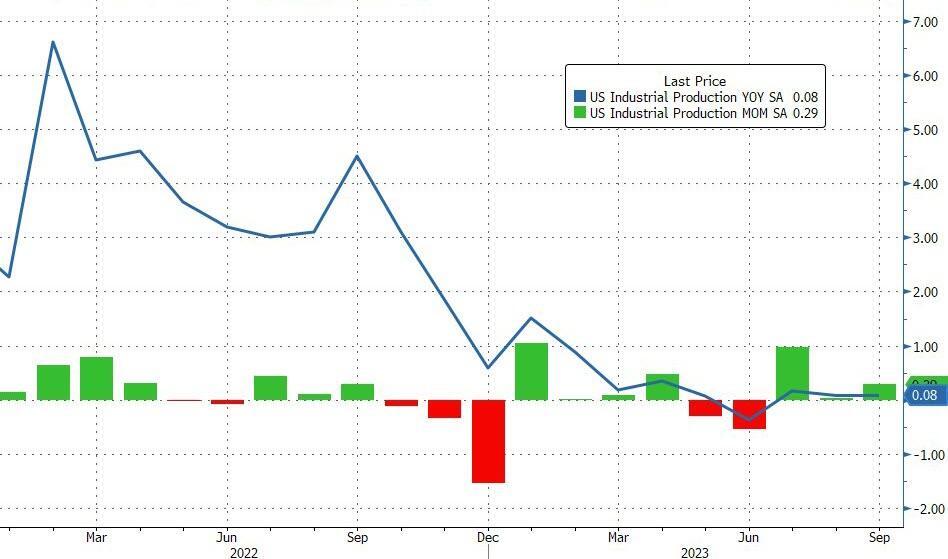
Industrial Production rose 0.3% MoM (SA)… but plunged 1.7% MoM (NSA)

Manufacturing Output rose 0.35% MoM (SA)… but tumbled 0.5% MoM (NSA)

Seasonals are indeed saving Bidenomics… for now.

*  *  *

US industrial production unexpectedly jumped by 0.3% MoM in September (0.0% exp) as capacity utilization picked up modestly (from 79.5% to 79.7%). This is the 3rd straight month of increased industrial production (and IP remains marginally higher on YoY basis)…

Source: Bloomberg

Utilities slid 0.3% MoM in Sept after rising 0.7% MoM in Aug.

On the manufacturing specific sector, production rose 0.4% MoM (better than the 0.0% exp).

Manufacturing production, however, remains lower on a YoY basis for the seventh straight month.

Once again, seasonal-adjustments saved the day as Manufacturing output fell 0.5% NSA (+0.4% SA)…

Source: Bloomberg

Seasonals saved Bidenomics…

One thing of note – ahead of the UAW strikes – is that Business Light Vehicles-Autos production plunged 6.2% MoM in September (after a big jump in August)…

Presumably this will be an utter shitshow next month as the factory closures hit.

Tyler Durden
Tue, 10/17/2023 – 09:39

VIX Is Primed To Surge Higher As Credit Cycle Turns

0
VIX Is Primed To Surge Higher As Credit Cycle Turns

Authored by Simon White, Bloomberg macro strategist,

The rising wall of corporate loans and debt to be refinanced will increasingly stress company balance sheets, leading to a secular rise in equity volatility.

Tensions in the Middle East are adding uncertainty to the outlook. What does that mean for volatility? So far it has led to at least a temporary rise in equity-market volatility, but in recent years any increase has been fairly short lived, despite the sort of catalysts that would be expected to keep it persistently elevated.

Greater uncertainty, therefore, does not necessarily lead to greater volatility. However, a much surer reason why it is destined to see a structural rise in the coming quarters is mounting evidence that the credit cycle is nearing its late stages.

Finance is about cycles. There are business cycles, inventory cycles, housing cycles and liquidity cycles. They all typically dance to their own beat, but they often lead and follow each other in fairly regular ways.

One of the most important of these relationships is between the credit cycle and the volatility cycle. Simply put, the credit cycle leads the volatility cycle, and the cracks in credit we are now seeing, along with the wave of upcoming bond and loan refinancings, mean that equity volatility will see a secular move higher.

As the chart below shows, rises in bank-loan growth have typically led rises in the VIX by an average of three years.

Corporate balance sheets explain the link between credit and volatility. As credit expands, loan growth rises, funding business investment and consumer spending. But when the loans come due, they often need to be refinanced. This stresses both sides of corporate balance sheets. As equity is just a thin wafer of capital on the balance sheet, it must bear the adjustment, meaning that equity volatility rises.

The lead time in the relationship is explained by the average maturity of loans. In the aftermath of the GFC, ultra-low rates meant rising loan maturities and less difficulty in re-financing debt, explaining the disconnect in the relationship from 2010 to 2020.

But as everyone now knows, that was an anomalous period, and the relationship is beginning to re-assert itself as rates rise, loan periods contract, and bankruptcies increase. The die is cast for increasing stress on firms’ equity.

We’ve only looked at bank loans so far, but we can get greater visibility on the credit cycle’s outlook by looking at corporate debt. Corporate debt outstanding accounts for ~80% of total corporate credit (debt + C&I loans), excluding private credit.

Average debt maturity for both investment-grade (IG) and high-yield (HY) corporate debt is falling, ultimately compressing the lead time between the expansion of credit and the rise in equity volatility.

Further, the size of refinancings will accelerate in the coming years.

Using the bonds in the Bloomberg IG and HY bond indices as a proxy, which account for 70% of the US market (excluding debt of maturity under one year), we can expect around a fifth of US corporate debt to mature within three years, and half by 2030.

To add fuel to the fire, most of this debt that needs to be refinanced will have to be done so at a considerably higher rate. The differential between the weighted-average yield and coupon on both the Bloomberg HY and IG bond indices has widened sharply over the last few years, to approximately three and two percentage points respectively, with the yield on IG debt about as high as it has ever been above the coupon of the index.

The generally low level of the VIX despite the fastest Federal Reserve rate-hiking cycle yet has been principally driven by the narrowness of the market’s leadership, keeping index implied-correlation low, and by the option preferences of investors.

They have typically been buying out-of-the-money put options and selling out-of-the-money call options, and doing more of the latter. Option dealers gamma hedge their exposure, which most of time represses volatility as they react to moves – selling when the market moves higher, buying when it moves lower – rather than chasing them.

Even when gamma goes negative – indicating a more unstable market and the potential for heightened volatility – the fact that dealers are short rather than long puts, means they eventually have to start buying the market. This is why typically gamma does not stay negative for too long, and bursts higher in volatility have been transient.

Nonetheless, it is unlikely dealers’ gamma hedging can persist in keeping implied and realized equity volatility subdued in the face of a worsening credit cycle in a market for corporates now 78% of GDP.

Price and underlying conditions can diverge, sometimes for significant periods, but financial gravity – fundamentals – always re-asserts itself eventually. That time is approaching for the VIX.

Tyler Durden
Tue, 10/17/2023 – 09:25

Chip Stocks Tumble After US Restricts Sale Of Made-For-China Chips

0
Chip Stocks Tumble After US Restricts Sale Of Made-For-China Chips

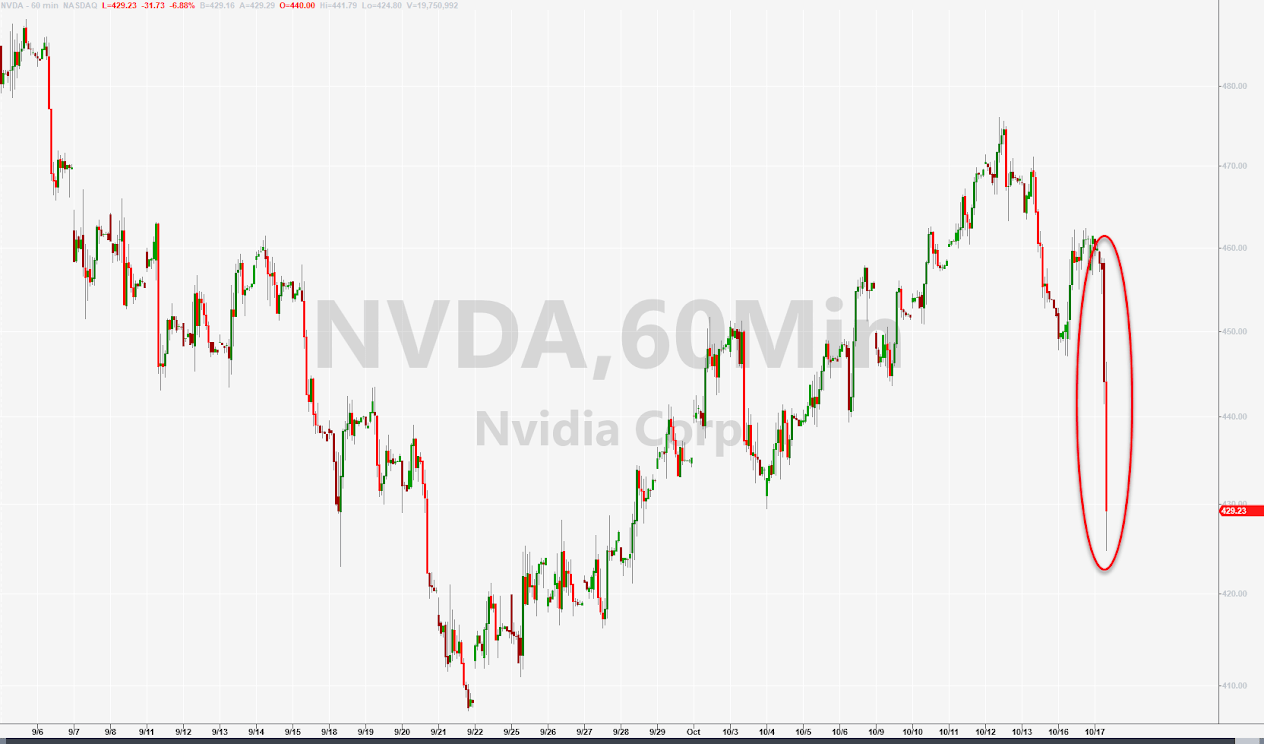
Chip stocks tumbled pre-market, led by shares of Nvidia, after a US official confirmed that exports of the company’s A800 and H800 chips will be restricted for sale to China, Bloomberg reports. The chips were specifically created for export to China following restrictions introduced by the Biden administration in October of 2022.

The rules restrict exports of chips to foreign arms of companies headquartered in China, Macau and other regions – however chips designed for consumer applications such as gaming, smartphones or laptops are not subject to the requirement.

According to report, the US Treasury Secretary, Commerce Secretary and National Security Advisor all notified China that the update to the Oct 2022 rule on chips and chip tools would impact exports of said newer chips.

The new rules also require companies to notify the US government before selling chips that fall below the controlled threshold, as Bloomberg reported earlier. Top-of-the-line chips are best for powering artificial intelligence models, a senior administration official said. But with a lot of money and a little jury-rigging, a whole class of slightly inferior chips could also be used for AI and supercomputing and therefore pose a national security risk, the official said.

The US wants to monitor that so-called gray zone activity, the official added, while declining to comment on the specific parameters of which chips will be affected. The administration will review company notifications within 25 days, the official said, to determine whether firms need a license to sell those chips to China. -Bloomberg

NVidia was down as much as 12% pre-market following the announcement, and as much as 7.2% during regular trade.

It’s difficult to draw a bright line between military and commercial technology,” said US Commerce Secretary Gina Raimondo ahead of the decision. “There are often dual-use technologies — and the same technologies that fuel commercial exchange, unfortunately, sometimes can also allow our competitors to modernize their military, surveil their citizens and solidify oppression.”

Semis are not happy in general:

Will history rhyme?

As we noted on Friday, Reuters reported that the Biden administration was targeting a loophole that has allowed developers in China to purchase chips from the infamous Huaqiangbei electronics area in Shenzhen, a city in southern China.

The sources reportedly claim that the additional rules on AI chips will come out this month and will apply restrictions previously applied only to the U.S.’s top players like Nvidia and AMD but more broadly to all companies producing similar materials in the market.

Over the summer, the U.S. government applied additional rules to its largest chip makers, including Nvidia, which currently leads the market in chip manufacturing. It asked the companies to curb exports of their high-level semiconductor chips to “some” Middle Eastern countries, among other small details.

The majority of Nvidia’s revenue comes from the U.S., China and Taiwan, while less than 14% comes from all other countries combined.

Reuters’ sources have said that the Biden administration is also trying to troubleshoot a loophole that allows Chinese parties access to U.S. cloud service providers like Amazon Web Services (AWS). According to the report, those solutions seem “less clear.”

In July, U.S. officials reportedly began their considerations on restrictions on access to cloud computing services such as AWS by Chinese companies in an effort to safeguard the country’s advanced technology.

The U.S. implemented its initial export controls on its most powerful semiconductor chip technology in October 2022.

On Monday, Chinese Foreign Ministry spokeswoman Mao Ning said during a regular press briefing in Beijing that China opposed “the US politicizing, instrumentalizing and weaponizing trade and tech issues.”

Tyler Durden
Tue, 10/17/2023 – 09:03