Hurricane Lee Strengthens To Cat. 5 Storm, Could Reach Winds Of 180 Mph; East Coast Impact Uncertain
Lee was only a Category 1 storm Thursday morning. In the last 24 hours, the hurricane traversing the warm Atlantic Ocean waters has doubled in wind speeds — now a dangerous Category 5.
Hurricane #Lee Advisory 11: Lee Becomes a Category 5 Hurricane. Dangerous Beach Conditions Expected to Develop Around the Western Atlantic Through Early Next Week. https://t.co/tW4KeGe9uJ
As of 0500 ET, Lee was about 630 miles east of the northern Leeward Islands, which are located in the northeastern Caribbean, and the storm was churning west-northwest at 14 mph with maximum sustained winds north of 165 mph. This is the first Cat. 5 storm of the 2023 Atlantic hurricane season.
“Additional strengthening is forecast today. Fluctuations in intensity are likely over the next few days, but Lee is expected to remain a major hurricane through early next week,” NHC wrote in an update.
NHC’s current forecast shows Lee could strengthen Friday and reach maximum sustained winds around 180 mph by the evening. This would be the strongest system in the Atlantic since Hurricane Dorian in 2019.
#Hurricane#Lee is forecast to reach a max intensity of 180 mph. Only seven Atlantic hurricanes in satellite era (since 1966) have had max winds >= 180 mph:
Computer models show Lee is expected to turn north early next week. But when that exactly happens is unknown.
“It is way too soon to know what level of impacts, if any, Lee might have along the US East Coast, Atlantic Canada, or Bermuda late next week, particularly since the hurricane is expected to slow down considerably over the southwestern Atlantic,” NHC said Thursday evening.
Since the beginning of the year, economic data has continued to defy the recession calls of 2022. Therefore, it is unsurprising that economic data surprised analysts’ more dire predictions last year. Of course, given the underestimation of the economy previously, the risk of overestimation is now a real possibility.
The upgrading of estimates also contributed to the discussion of the Federal Reserve’s need to raise the “neutral rate.”
The neutral interest rate is:
“The real rate (net of inflation) that supports the economy at full employment and maximum output while keeping inflation constant.“
(Note: There is no accurate measure of the neutral rate, and it cannot be observed directly. In other words, it is a guess.)
The issue, as always, is that economists are looking at lagging economic data to make assumptions about the future. However, after over 40 years of rising debt levels, economic growth remains slowing. As shown, as debt issuance increased after each economic crisis since the turn of the century, economic growth rates declined. (I have projected the increase in debt based on the average quarterly debt growth since 2018.)
While analysts become more optimistic about economic growth, the divergence of the economic data suggests increased risk to that outlook.
Production Comes First
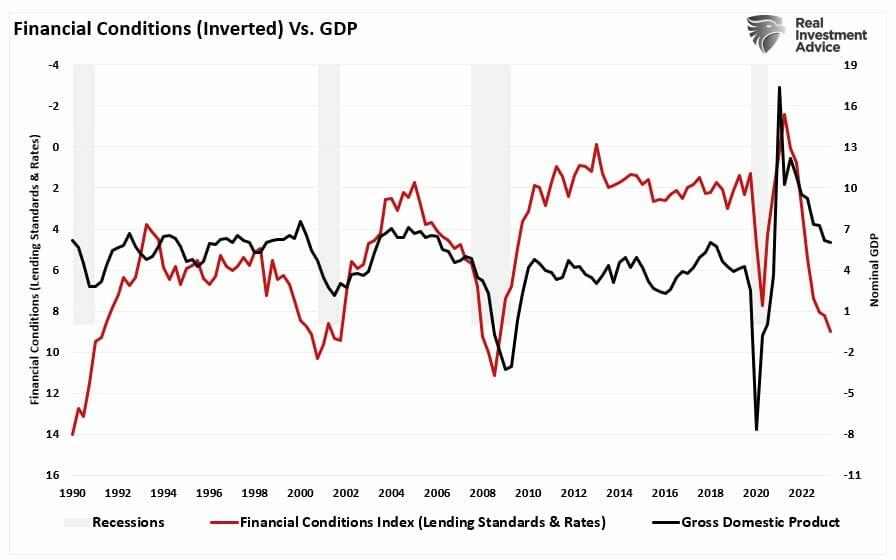
As is always the case, predicting a recession is incredibly difficult. The influence of monetary and fiscal policy, corporate actions, and other events can increase or delay the recessionary onset. Nonetheless, restrictive policies, such as higher interest rates and tighter lending standards, will curtail the consumption that drives economic growth. The chart below is a composite index of bank lending standards and interest rates versus GDP. The financial conditions composite is inverted to compare declines in economic activity better. Unsurprisingly, tight financial conditions always precede weaker economic growth rates and recessions.
Critically, what drives the economic cycle must be understood. We often speak of the consumption side of the economic equation; however, consumers can not consume without producing something first. Production must come first to generate the income needed for that consumption. As analysts increase earnings estimates, the earnings derived from corporate revenues are a function of consumer spending. Such is a crucial part of the cycle.
The Invisible Hand
Of course, if you bypass the production phase of the cycle by sending checks directly to households, you will get a strong surge in economic growth. As shown in the chart below, the massive spike in economic growth in the second quarter of 2021 directly resulted from those fiscal policies.
However, once individuals spent that stimulus, the economic activity subsided as the production side of the equation was still lagging. Here is the crucial point. For a household to consume at an economically sustainable rate, such requires full-time employment. While the media touts the “strong employment reports,” such is mostly the recovery of jobs lost during the economic shutdown. As shown, full-time employment as a percentage of the working-age population has only recovered to pre-pandemic levels.
In other words, we have NOT created millions of new jobs, as touted by the current administration, but rather only recovered the jobs lost and the increase in the working-age population since the economic shutdown. However, higher inflation and interest rates require more income to maintain the same growth rates.
The production side of the equation is now ringing a loud alarm.
The GDP & GDI Relationship
Let’s review the economic cycle equation once again.
It is a relatively simple economic concept that seems to elude the vast majority of mainstream analysts and, seemingly, the Federal Reserve itself. However, there are two measures of economic activity. The most common measure is GDP, which is simply the sum of Personal Consumption Expenditures (PCE), Business Investment, Government Spending, and Net Exports(Exports Less Imports)
The other less observed measure is Gross Domestic Income (GDI). The calculation of GDI is as follows:
GDI =Wages + Profits + Interest Income + Rental Income + Taxes – Production/Import Subsidies + Statistical Adjustments.
Therefore, given that GDI measures the income side of the equation (derived from production), it is logical that GDI should track pretty closely to GDP over time. Furthermore, it should be logical that deviations between production and consumption should indicate a shift in the economic underpinnings.
As shown below, in 2021 and 2022, real (inflation-adjusted) GDI supported economic growth. With $5 Trillion in stimulus supporting incomes, the consumption side of the equation rose. However, beginning in the 4th quarter of 2022 and persisting through the 2nd quarter of 2023, GDI has turned negative as all of the stimulative monetary measures have become exhausted. Yet, economic growth has increased sharply over that time frame.
The following chart is a bit clearer. I rebased both GDP and GDI to 100 in 2016. Again, logically, GDI and GDP should track closely to each other given the economic relationship. However, the deviation is apparent starting last year.
The question is whether this Is an anomaly or has it occurred previously.
GDI Sends A Recession Warning
The short answer is YES.
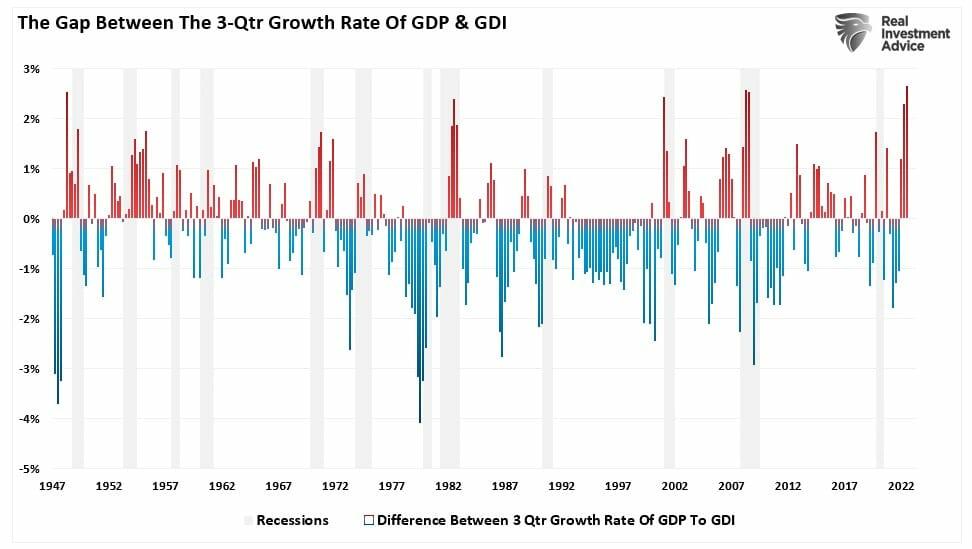
The chart below looks at real GDP and GDI back to 1947 and measures the deviation between the 3-quarter growth rates of each. With only the expectation being in the late 70’s, a recession followed each time GDP deviated from GDI. In other words, the economic activity eventually catches down to the primary driver of consumption: production. Currently, the deviation of GDP from GDI is the largest on record.
Given the wide range of other confirming indicators previously discussed, betting on the “avoidance” of a recession, particularly given such tight financial conditions, seems risky. Such was a point made in “Financial Conditions Are Tighter Than You Think.” To wit:
“As shown below, financial conditions, measured by the difference between the 10-year Treasury yield and the “neutral rate,” clearly reside in restrictive territory. Such has previously always preceded an economic downturn since 1980.”
However, even if you want to dismiss all of the other indicators discussed previously under the guise of “it’s different this time,” the recessionary warning sign sent by the spread between GDP and GDI should likely not be.
Sure, this “time could be different.” The problem is that, historically, such has not been the case. While we must weigh the possibility that analysts are correct in their more optimistic predictions, the probabilities still lie with the indicators.
‘Day Of Reckoning Arrives’ For Chevron As Australian LNG Workers Begin Strikes
Unionized employees at Chevron Corp.’s liquefied natural gas plants in Australia began partial strikes on Friday after talks about a new labor contract failed to materialize.
Bloomberg reported Offshore Alliance, which includes the Australian Workers Union and Maritime Union of Australia, began partial work stoppages around 1300 local time across the Gorgon and Wheatstone plants and the Wheatstone offshore platform in Western Australia. Last year, the three facilities accounted for 7% of the world’s LNG production.
Workers plan 20 different types of labor actions at the plants until mid-next week when full-blown strikes could start as early as Thursday.
“Despite the Offshore Alliance giving Chevron plenty of opportunity to sort out EBA’s across the 3 Chevron facilities, they will finally be facing their day of reckoning. Protected Industrial Action commences at 13:00 today,” Offshore Alliance wrote in a Facebook post.
The alliance said, “Chevron are demanding they be given special concessions in bargaining – a demand which we have put through the shredding machine,” adding, “Their bargaining performance has been the most inept effort of any employer the Union has dealt with in the past 5 years and our members have had enough.”
The unions concluded: “It’s game on, Chevron.”
A Chevron spokesperson told the Australian Financial Review it would “continue to take steps to maintain safe and reliable operations in the event of disruption at our facilities.” They said, “The unions continue to seek terms that are above and beyond equivalent terms with others in the industry, including in agreements recently reached.”
In response to the start of the partial strike, Benchmark EU natural gas futures jumped as much as 11% before paring some of the gains. US NatGas futures are up nearly 2%
Friday’s strikes “appear lower level, designed to create costs and inefficiencies for Chevron, but not yet impact production materially,” Saul Kavonic, an energy analyst at Credit Suisse Group AG, wrote in a note to clients.
“This is part of the unions ratcheting up the pressure on Chevron to make more compromises, and is all part of the negotiation ‘dance’ between the parties.
“If there is still little progress over the next week, then the situation could escalate to more serious consequences.”
Kavonic warned a complete shutdown of the LNG plants “simply cannot occur for long” as it would spark an energy crisis in Western Australia that would likely force the government to intervene.
The good news is that Europe’s NatGas storage is approximately 93% full, surpassing the typical seasonal averages. However, the downside is that Europe has reduced its dependence on cheap NatGas from Russia and now sources from global markets, exposing it to potential price volatility.
Donald Trump’s legal troubles, the possibility that Joe Biden will face an impeachment inquiry, and other stories related to the upcoming presidential election, caused the American media to miss a story of potentially greater significance.
This was the decision of the BRICS (Brazil, Russia, India, China, and South Africa), who formed their alliance to challenge US political and economic dominance, to induct six new countries into their group: Argentina, Egypt, Ethiopia, Iran, Saudi Arabia, and the United Arab Emirates.
One way the BRICS hope to achieve its goals is to undermine the foundation of US power: the dollar’s global reserve currency status. Brazilian President Luiz Inacio Lula de Silva called for BRICS nations to create their own currency, while India is pushing to have its trading partners, including Russia, trade in Indian rupees rather than US dollars. China and other BRICS countries have also reportedly taken steps to explore using gold instead of dollars for international trade.
After then-President Richard Nixon severed the link between the dollar and gold in 1971, Henry Kissinger negotiated a deal with Saudi Arabia where, in exchange for US diplomatic and military support, Saudi Arabia would use dollars for its dealings in the international oil market. The “petrodollar” is the backbone of the dollar’s reserve currency status. Early this year, Saudi Arabia signed a deal with Brazil to accept Brazil’s currency instead of dollars for oil purchases. If Saudi Arabia signs similar deals with other BRICS nations it will hasten the end of the dollar’s reign as reserve currency.
The rejection of the dollar is also being driven in large part by resentment over the “weaponization” of the dollar’s reserve currency status. The US government uses the dollar’s reserve currency position in order to force other countries to comply with US sanctions against the latest “designated Hitler.” Sanctions are an act of war, so by forcing other countries to follow US sanctions the US Government is dragging them into conflicts that are not in their national interests. It was inevitable that the arrogance of our foreign policy elite would eventually cause a backlash. The backlash started last year when the US demanded other countries join in sanctioning Russia, regardless of the effects of those sanctions on their own economies.
The movement to replace, or at least create alternatives to, the dollar is also driven by concern over the long-term effects of the massive US national debt. Despite the claims of both parties that the recent debt ceiling deals showed that Congress and the President were getting serious about being fiscal responsibility, the US $33 trillion debt is still poised to grow by as much as $115 trillion over the next 30 years. Congress and the President refuse to cut spending in any area. They can’t even manage to stop shoveling billions into the no-win war in Ukraine even though this spending is opposed by a clear majority of Americans.
Sadly it will take a shock like the rejection of the dollar’s reserve currency status and the resulting dollar crisis to force the US government and the people to take steps to kick their addiction to welfare-warfare spending and fiat currency.
This will mean some tough times ahead. However, the economic downturn may not last as long as people expect.
The good news is the crisis could lead to a return to limited constitutional government, a true free-market economy free of corporations and cronyism, a foreign policy based on peace and free trade, and a free-market monetary system.
Turbulent Times For Biden’s Offshore Wind Farms As Orsted CEO Warns: Abandoning US Projects A ‘Real Option’
The world’s largest offshore wind farm developer is preparing to walk away from US projects unless the Biden administration guarantees more support, Bloomberg reported.
“We are still upholding a real option to walk away,” Orsted CEO Mads Nipper told Bloomberg in an interview in London on Tuesday.
Nipper continued, “But right now, we are still working towards a final investment decision on projects in America.”
The Biden administration has touted offshore wind farms as an essential component of decarbonizing America’s grid, but soaring inflation costs have undermined the sector’s growth and left many projects dead in the water.
Under the Inflation Reduction Act, Orsted receives upwards of 30% tax credits, but more appears to be needed as a financial crisis is unfolding in the offshore wind power industry.
Nipper has asked the Biden administration to guarantee subsidies without the domestic content requirement and requested more time to overcome supply chain snarls in sourcing US-made materials.
“What we proposed was a grace period, say, so give us three to five years,” the CEO said, adding, “Right now, it can’t deliver.”
More from Bloomberg on Nipper, who warned offshore wind farm plays are ‘uninvestable’:
Orsted’s delays were triggered by bureaucratic uncertainties during the previous US administration and were intensified by supply-chain disruptions during the COVID-19 pandemic. Biden’s push on clean energy helped accelerate some plans, but high-interest rates and delays in procuring foundations, known as monopiles, for its wind turbines slowed developments even more.
Because final investment decisions weren’t made and the projects were being funded by the company’s balance sheet, the fact that long-term interest rates in the US soared above 3% means Orsted’s cost of capital is higher.
“For a company like ours, where the targeted range of returns is 150 to 300 basis points above our cost of capital, it has essentially made this extremely tough,” Nipper said.
Nipper said Orsted couldn’t have predicted the industry turmoil, yet an investor selloff saw the company lose $8 billion in value last week after impairments were booked on several US projects. Longer-term plans also are at risk, with developments near New Jersey and Delaware not investible right now, he said.
Last month, Nipper warned investors on a conference call: “The situation in US offshore wind is severe.” As we noted, “snarled supply chains, soaring interest rates, and easy money tax credits drying up” is a “warning sign the green energy revolution bubble is in trouble.”
Shares in Denmark-listed green energy giant have crashed in recent weeks on the mounting headwinds — now back to levels last seen in 2018.
The Biden administration’s ambitious goal of achieving 30 gigawatts of offshore wind energy capacity by 2030 appears to be in jeopardy. Even though the Inflation Reduction Act was supposed to ease inflation, a green energy crisis has emerged, as Orsted describes, that stems from inflation.
It seems so, given that Shell, Europe’s leading oil company, has discreetly set aside the world’s most expansive corporate initiative to create carbon offsets. Meanwhile, Europe’s ‘green tech’ future has been threatened due to waning investment flows.
Vaccine-acquired immune deficiency syndrome (VAIDS) is a new colloquial term coined by researchers and health practitioners since the COVID-19 vaccine rollout. Though not recognized as a medical condition, some experts believe the COVID-19 vaccines may impair or suppress immune responses.
While the new study does not use the term VAIDS, the researchers recognized “a general decrease in cytokine and chemokine responses” to bacteria, fungi, and non-COVID viruses in children after COVID-19 vaccination.
“Our findings suggest SARS-CoV-2 mRNA vaccination could alter the immune response to other pathogens, which cause both vaccine-preventable and non-vaccine-preventable diseases,” the authors of the paper published in Frontiers in Immunology wrote.
“This is particularly relevant in children as they: have extensive exposure to microbes at daycare, school, and social occasions; are often encountering these microbes for the first time; and receive multiple vaccines as part of routine childhood vaccination schedules.”
The researchers from the Murdoch Children’s Research Institute and Royal Children’s Hospital in Melbourne, Australia, took blood samples of 29 children, both prevaccination and after two Pfizer mRNA doses.
They found that blood samples postvaccination had a lower cytokine response to non-COVID pathogens compared to prevaccination. This reduced immune response was particularly persistent for non-COVID viruses. Blood samples taken at six months showed some children still had low responses for hepatitis B virus proteins and proteins that mimic a viral infection; however, cytokine responses had increased for bacterial exposures.
Immune responses to COVID-19 proteins—including spike proteins and their S1 and S2 subunits—and nucleocapsid proteins remained high after vaccination.
Professor Retsef Levi, specializing in risk management and health systems at the Massachusetts Institute of Technology (MIT), posted on X (formerly known as Twitter) that the study “adds to cumulative evidence suggesting adverse immune alteration” by COVID-19 vaccination. Family physician Dr. Syed Haider and immunologist and computational biologist Jessica Rose both connected the study’s findings to VAIDS.
Rebuttal
Marc Veldhoen, an immunologist specializing in T-cell responses and the head of a laboratory at Instituto de Medicina Molecular in Portugal, challenged the study’s findings.
In an X thread, Mr. Veldhoen highlighted flaws in the study, including the lack of controls, meaning children who were not vaccinated, to compare against the subject group on their innate immune responses to other pathogens.
“Without a non-vaccinated control group, at least another vaccine control group (to claim specificity), much larger numbers of subjects, and cellular composition data, [the study authors’] conclusion is speculation, and unlikely to hold,” Mr. Veldhoen wrote.
Accumulation of Studies Suggesting Decreased Immunity After Vaccination
The study is one of many suggesting declined immune response after COVID-19 vaccination.
A preprint study in 16 adults inoculated with the Pfizer mRNA vaccines had similar findings of a reduced innate immune response in participants exposed to pathogenic fungi. The same paper also found long-term changes in innate immune cells.
The Epoch Times reported on a January study out of Germany that showed multiple mRNA vaccinations induce a “class switch” in the type of antibodies formed against the spike protein and other COVID-19 proteins.
U.K. businesses and homeowners could be jailed for up to a year or fined £15,000 for non-compliance with new energy efficiency regulations proposed by the Conservative government, which have been described by critics as a “massive expansion of the state and its power over our lives.”
The Energy Bill, which returned to parliament for its third reading this week, outlines several new requirements homeowners must adhere to in relation to Net Zero, the government’s commitment to being carbon neutral by 2050.
For the first time, individuals face criminal charges for failing to comply with measures designed to reduce the country’s carbon footprint.
One such draconian regulation states that household appliances such as fridges, washing machines, and heat pumps must be fitted with smart functions that can be controlled by “any persons carrying out load control,” namely the National Grid, which oversees the majority of electricity transmission and distribution in Britain.
The Government’s Energy Bill stipulates that any smart functions in your fridge, freezer, dishwasher, washing machine, tumble dryer and heat pumps must enable them to be controlled by the National Grid. https://t.co/D2gAOYcR8g
The vast majority of households in the country will not currently comply with the new measures outlined in the bill, meaning homeowners will be compelled to pay out significant sums to transform properties and make them “energy-efficient” or potentially face criminal charges for so-called “non-compliance.”
The bill has angered a number of backbench Conservative MPs who have threatened to rebel against the legislation, with some claiming it is the latest installment in the government’s “cult-like” obsession with Net Zero.
“We cannot impoverish our country to meet some, well, I’d like to call it in some cases almost cultish policy until we can afford it. Until it works, that’s when I think we should adopt all these policies,” said Richard Drax, the Conservative MP for South Dorset.
Others went further, with Tory MP Craig Mackinlay telling the Commons, “I have to say, I absolutely despise this Bill. This is going to be the first time that we are potentially criminalizing people in this country for not being adherent to this new code of Net Zero.”
He urged the government to tread lightly in its proposal to potentially throw fellow citizens in prison for a year “for an unknown offense of the future relating to Net Zero.”
“I’m a Conservative for freedom, not to put people in prison for not adhering to this Net Zero religion,” he said later in an interview with GB News.
‘This is truly a horrific bill, it allows all sorts of intrusive powers and I would it was scrapped an we start again.’
Craig Mackinlay MP shares his thoughts on a new energy bill that is set to enter the Commons later today.
Sir John Redwood, more diplomatically, expressed his concern that “by being unduly restrictive and particularly by the threat of civil and even criminal penalties on some of their conduct,” the government risks “antagonizing” the general public.
“Throughout this Bill, we are creating cost and regulation and penalties and obligations. We need to keep people with us and we risk losing them if we put undue burdens on them,” added former Business Secretary Jacob Rees-Mogg.
Commenting on the third reading of the bill by lawmakers on Tuesday, conservative broadcaster Nigel Farage was scathing in his criticism of the legislation.
“There are unbelievably provisions in this bill that would allow for the creation of criminal offenses if businesses and individual householders don’t tell the truth or don’t meet new energy requirements for their houses,” he told viewers.
“It seems to me to be truly extraordinary. You could be prosecuted for providing false information about your house’s energy efficiency,” he added, calling the move a “massive expansion of the state and its power over our lives.”
Energy Minister Andrew Bowie told fellow lawmakers that the bill is “world-leading” legislation that “will deliver for this country cleaner, cheaper, and more secure energy.”
Poland’s Deputy Prime Minister Jarosław Kaczyński told a group of arms manufacturers that Warsaw will have Europe’s strongest land force within two years through a series of weapons purchases.
Warsaw believes increasing military spending to three percent of GDP and expanding its military to 300,000 personnel will make the Polish Army so powerful it cannot be challenged.
Kaczyński issued a letter to the International Defense Industry Exhibition being held in Poland this week. “In two years, we will have the strongest land army in Europe,” he said. “[The Polish Defense Minister] emphasized that the strength of the army is not just, and not primarily, its size but also its equipment, modernity, and innovation.”
Warsaw announced plans to significantly increase weapons spending last year. Next year, Polish military expenditures are expected to hit at least three percent of GDP. Some Polish officials hope the number could be pushed to as high as five percent of GDP in coming years.
Poland will spend the added funds on a sequence of massive weapons acquisitions, including multi-billion-dollar purchases of Apache Helicopters, Abrams Tanks, and HIMARS. Additionally, Warsaw plans to expand its military to 300,000 soldiers.
Polish officials claim the massive military buildup is an effort to prevent war:
“The Polish army must be so powerful that it does not have to fight due to its strength alone,” said Polish Prime Minister Mateusz Morawiecki.
Defense Minister Mariusz Błaszczak remarked, “We want peace, and if we want that we must prepare for war – in connection with that, we are strengthening the Polish Army.”
However, some experts believe the policy will weaken Poland economically. Polish military expert Robert Czulda, a Resident Fellow at the Casimir Pulaski Foundation, said, “It seems highly likely that such a large scale of planned orders is largely driven by a political populism, aimed at gaining popularity here and now, rather than to be a real, comprehensive, and well-thought-out plan for harmoniously strengthening the armed forces,” he wrote.
“Poland should ensure that these procurement programs are sustainable and affordable in the long term. The country should avoid a risk of overspending, which now seems very high.”
Paris has become the first capital in Europe to say goodbye to rental electric scooters, following a referendum in the city earlier this year which saw 90 percent of voters support a ban – although there was only an 8 percent turnout of Parisians eligible to vote.
In France, rental battery powered scooters were used by just 8 percent of respondents in the past year.
Germans and Swedes were slightly more likely to have used them at 13 percent and 16 percent, respectively, with Vietnam apparently leading the world’s most miserable places to walk with 17% of the respondents using the machines.
In Japan, where regulations have been more stringent on the topic than in Europe (at least until recently), only two percent of respondents said that they had used them in the past year.
According to Statista’s Market Outlook, global revenue for the e-scooter sharing market is projected to reach US$1.813 Billion in 2023 with an annual growth rate (CAGR 2023-2027) of 11.61 percent, resulting in a projected market volume of US$2,813.00m by 2027.
The five key players of 2022 were Lime (making up 14 percent of the global market share), Lyft (13 percent), Bird (11 percent), Bolt (9 percent) and Tier (9 percent).
The thousand-year-old genocide of Armenians at the hands of Turkic peoples has reached a new level. Several watchdog organizations — including the International Association of Genocide Scholars, Genocide Watch, and the Lemkin Institute for Genocide Prevention — are accusing Azerbaijan of committing genocide against the 120,000 Armenians living in Nagorno-Karabakh. Historically known as Artsakh, this ancient Armenian region was brought under Azerbaijani rule in 2020.
Modern day hostilities between Armenia, an ancient nation and the first to adopt Christianity, and Azerbaijan, a Muslim nation that was created in 1918, began in September 2020, when Azerbaijan launched a war to capture Artsakh. Although it had been Armenian for more than 2,000 years and its population still remains 90% Armenian, after the dissolution of the USSR, the “border makers” granted it to the Republic of Azerbaijan, hence the constant warring over this region.
Once the September 2020 war began, Turkey quickly joined its Azerbaijani co-religionists against Armenia, even though the dispute did not concern it. It dispatchedsharia-enforcing“jihadist groups” from Syria and Libya — including the pro-Muslim Brotherhood Hamza Division, which once kept naked women chained and imprisoned — to terrorize and slaughter Armenians.
One of these captured mercenaries later confessed that he was “promised a monthly $2,000 payment for fighting against ‘kafirs’ in Artsakh, and an extra 100 dollar[s] for each beheaded kafir.” (Kafir, often translated as “infidel,” is Arabic for any non-Muslim who fails to submit to Islam, which makes them de facto enemies.)
These Muslim groups committed massive atrocities (here and here). One included raping an Armenian female soldier and mother of three, before hacking off all four of her limbs, gouging out her eyes, and sticking one of her severed fingers inside her private parts.
The war ended in November 2020, with Azerbaijan gaining control of a significant portion of Artsakh.
Then, on December 12, 2022, Azerbaijan sealed off the humanitarian Lachin Corridor — the only route between Artsakh and the outside world. A recent report by the Dutch journalist Sonja Dahlmans summarizes the current situation:
“In the extreme southeastern part of Europe, known as the Caucasus, a silent genocide is looming. The Lachin Corridor that connects Armenia to Artsakh, the region in Azerbaijan where mainly Christian Armenians live, has been closed by the government for eight months. Supermarket shelves are empty; there is hardly any food, fuel, or medicine for the 120,000 Armenian Christians who live there, including 30,000 children and 20,000 seniors.
“At the time of this writing [Aug. 24, 2023], a convoy of food and medicine has been standing in front of the border since July 25 [a month], but the International Red Cross is not allowed access to the inhabitants of Artsakh. According to journalists living in the area, most residents only get one meal a day. People in Artsakh queue for hours at night for bread, waiting for their daily rations. At the same time, sources within Artsakh report shooting at Armenians trying to harvest the land…
“[I]n all probability bread will also soon be unavailable due to the shortage of fuel… Bakers can no longer heat their ovens. Last week, a 40-year-old Armenian man died of malnutrition. A pregnant woman lost her child because there was no fuel for transport to the hospital.”
Separate reports tell of 19 humanitarian trucks “loaded with some 360 tons of medicine and food supplies” that have been parked for weeks and prevented from crossing.
This is not the first time Turks starve Armenians to death (as this 1915 picture of a Turkish administrator taunting emaciated Armenian children with a piece of bread makes clear).
On August 7, 2023, Luis Moreno Ocampo, former Chief Prosecutor of the International Criminal Court, framed the situation:
“There is an ongoing Genocide against 120,000 Armenians living in Nagorno-Karabakh, also known as Artsakh.
“The blockade of the Lachin Corridor by the Azerbaijani security forces impeding access to any food, medical supplies, and other essentials should be considered a Genocide under Article II, (c) of the Genocide Convention: ‘Deliberately inflicting on the group conditions of life calculated to bring about its physical destruction.’
“There are no crematories, and there are no machete attacks. Starvation is the invisible Genocide weapon. Without immediate dramatic change, this group of Armenians will be destroyed in a few weeks.
“Starvation as a method to destroy people was neglected by the entire international community when it was used against Armenians in 1915, Jews and Poles in 1939, Russians in Leningrad (now Saint Petersburg) in 1941, and Cambodians in 1975/1976.”
Similarly, after going on a fact-finding mission to Armenia, former U.S. Ambassador-at-Large for International Religious Freedom Sam Brownback referred to the blockade as the latest attempt at “religious cleansing” of Christian Armenia:
“Azerbaijan, with Turkey’s backing, is really slowly strangling Nagorno-Karabakh. They’re working to make it unlivable so that the region’s Armenian-Christian population is forced to leave, that’s what’s happening on the ground.”
Muslim regimes regularly make life intolerable for Christian minorities, apparently to force them to abandon their properties and leave. A few weeks ago, the president of Iraq revoked a decade-old decree that granted Chaldean Patriarch Cardinal Louis Raphael Sako powers over Christian endowment affairs. “This is a political maneuver to seize the remainder of what Christians have left in Iraq and Baghdad and to expel them,” said Diya Butrus Slewa, a human rights activist from Ainkawa. “Unfortunately, this is a blatant targeting of the Christians and a threat to their rights.”
In Artsakh, the situation seems to be worse: just as no one can get in, apparently no one can get out. Azerbaijan is holding those 120,000 Armenians captive, starving and abusing them at will.
Brownback, in his testimony, said that this latest genocide is being “perpetrated with U.S.-supplied weaponry and backed by Turkey, a member of NATO.” If the U.S. does not act, “we will see again another ancient Christian population forced out of its homeland.”
— Ruzanna_A 🇦🇲 #StopArtsakhBlockade (@avaruza) March 25, 2021
Not only has U.S. diplomacy been ineffective for the besieged Armenians; it has actually exacerbated matters by allowing the Azerbaijanis to continue their atrocities. According to one report:
“[T]he only thing the Washington-backed talks appear to have produced is the emboldenment of Azerbaijan’s aggression….
“For over eight months, the region’s 120,000 Indigenous Armenians—who declared their independence in the early 1990s following escalating violence and ethnic cleansing by Azerbaijan—have been deprived access to food, medicine, fuel, electricity, and water in what is nothing less than genocide by attrition….
“The same week peace talks began in Washington, Baku [capital of Azerbaijan] tightened its blockade by establishing a military checkpoint at the Lachin Corridor. When Washington-based talks resumed in June, Azerbaijan began shelling the region. In the months since, the International Committee of the Red Cross has been denied access to Karabakh—and later reported that an Armenian patient in its care had been abducted by Azerbaijani forces en route to Armenia for treatment.
“This is the predictable consequence of Washington’s insistence on negotiations amid Azerbaijan’s blockade of Artsakh and occupation of Armenian territory. It has signaled to Baku that its strategy of coercive diplomacy is working, disincentivizing de-escalation, and forcing Armenia to negotiate with a gun to its head…
“Washington has also actively strengthened Azerbaijan’s position by indicating support for Artsakh’s integration into Azerbaijan. Given Azerbaijan’s state-sponsored dehumanization of Armenians, the litany of human rights abuses perpetrated during and since the 2020 war, and its own disastrous domestic human rights record—it is impossible to imagine Armenians could ever live freely under Azerbaijan’s rule.
“For Azerbaijan, this disingenuous participation in negotiations has allowed it to uphold the veneer of cooperation while engaging in conduct that has immeasurably set back the prospects of a durable peace.”
Clearly, negotiating simply bought the Azerbaijanis more time in which to starve the Armenians, and possibly another way for the United States to pretend it was “doing something” without actually doing anything — apart from allowing more savagery.
Indeed, part of the façade of diplomacy is that Azerbaijan insists that the Christian Armenians of Artsakh are being treated no differently than Muslim Azerbaijanis — since all are citizens of Azerbaijan. One report sheds light on this farce:
“Azerbaijani President Ilham Aliyev and other officials have declared that the Armenians of Nagorno-Karabakh are citizens of Azerbaijan, seeming to back prior statements of Azerbaijani authorities pledging to guarantee the rights and security of ethnic Armenians.
“But actions speak much louder. The First Nagorno-Karabakh War three decades ago arose following waves of anti-Armenian pogroms. Azerbaijan is now one of the most repressive and autocratic countries in the world, scoring among the lowest in the world on freedom and democracy indexes—in stark contrast to Armenia and Nagorno-Karabakh.
“Aliyev (who inherited his post from his father) has confessed to having started the Second Nagorno-Karabakh War in 2020, and proudly admitted that a generation of Azerbaijanis has been brought up to deeply despise Armenians (here and here). He denies the Armenian Genocide (alongside Turkey) and negates the existence of Armenians as a nation, including their history, culture, and right to be present anywhere in the region.
“No Armenian, not even a foreign national of ethnic Armenian descent or anyone with an Armenian sounding name, is allowed to enter Azerbaijan.
“The results are clear: nearly every Armenian who fell into Azerbaijani captivity after the 2020 war has been persecuted, imprisoned, tortured, mutilated, decapitated or murdered. None of these acts has ever been punished. To the contrary, those who kill Armenians receive medals and are glorified in Azerbaijan. It is no wonder that Armenians are petrified and cannot fathom living under Azerbaijan’s authority.”
Aside from the Lachin Corridor crisis, a recent 12-page report documents the systematic destruction of ancient churches, crosses, Christian cemeteries, and other cultural landmarks on land — Artsakh — that historically belonged to the world’s oldest Christian nation, Armenia.
One example is the Holy Savior Cathedral in Shushi, Artsakh. First, Azerbaijan bombed the church during the 2020 war, an act Human Rights Watch labeled a “possible war crime.” Then, after the war, with Azerbaijan having seized the area, officials claimed to be “restoring” the church, when in fact its dome and cross were removed, making the building look less like a church. As one report notes:
“The ‘case’ of Shushi is indicative of the well-documented history of Armenian cultural and religious destruction by Azerbaijan. From 1997 to 2006, Azerbaijan systematically obliterated almost all traces of Armenian culture in the Nakhichevan area, which included the destruction of medieval churches, thousands of carved stone crosses (“khachkars”), and historical tombstones.”
“[A]n Armenian church in Artsakh… disappeared after Azerbaijan’s victory in the second Nagorno-Karabakh war (2020). During the victory, Azerbaijani soldiers pose on top of the church shouting ‘Allahu Akbar’… [T]he church has been completely wiped out and only a few stones remain as a reminder…
“The Western press rarely writes about the Nagorno-Karabakh conflict. Most reactions follow the line that it is not a religious conflict, but a claim by two countries over a disputed territory. Given the many examples that exist in which precisely religious buildings, tombs and inscriptions are systematically destroyed, it is difficult to maintain that this is the case. “
One of the main reasons that Armenia finds itself standing alone against this genocidal onslaught is due to the West’s “desire to maintain favorable relations with Azerbaijan given its role as a European energy partner [and this] has outweighed any purported commitment to upholding human rights—bolstering Azerbaijan’s aggression.”
It is these same priorities that have made Russia, once the defender of all Orthodox Christian nations in the East, more apathetic than might be expected. According to another report:
“Azerbaijan was able to impose this blockade because Russian peacekeepers allow them to do so. The Russians are there as part of a ceasefire agreement ending the Second Nagorno-Karabakh War. The same agreement, inked by Russia, Armenia and Azerbaijan in 2020, guarantees access along that now-blocked road. Although Russia is often portrayed as Armenia’s patron, the reality is more complicated. Russia’s largest oil company owns a 19.99% share of Azerbaijan’s largest natural gas field. It is not so surprising then that Armenians in Artsakh demonstrated against Russian inaction after the killings of their police officials.”
Longtime Armenian-activist, Lucine Kasbarian, author of Armenia: A Rugged Land, an Enduring People, sums up the situation:
“We who are Armenian, Assyrian, Greek and Coptic bitterly know just how this will end. It’s deja vu all over again. Again and again, we’ve seen the deceit and brutality, received the chilling reports, warnings, graphic videos, open letters and petitions from alarmed genocide scholars. But alas, NATO, Islamic supremacism, gas and oil are going to take precedence over life and liberty once again unless high-powered vigilantism can save the day.”