75.4 F
Chicago
Monday, August 31, 2026
Home Blog Page 3410

Clean Energy Exploitations & The Death Spiral Of An Auto Industry

0
Clean Energy Exploitations & The Death Spiral Of An Auto Industry

Authored by Mike Shedlock via MishTalk.com,

Biden is so wrong, even the liberal Guardian sees it. But it’s full speed ahead with massive subsidies for something counterproductive…

Ronald Stein at the Heartland institute says Unsold Electric Cars May Be Signaling a Death Spiral for the Auto Industry

As the future is fast approaching, virtually all the automobile manufacturers, through government mandates to reduce the emissions of their fleet of vehicles, are going all-in to only manufacture EV’s in the coming years. To meet low emissions for their fleet of vehicles, we’re most likely going to see fewer and fewer hybrids as the auto industry manufacturers need to eliminate the gasoline engines in hybrids to meet those lower emission targets.

The problem is that manufacturers are loading up the “supply chain” with EV’s on dealer lots, but they’re not seeing the “demand” for EV’s coming from the public.

Demand Flop Reasons

  • driving range,

  • vehicle reliability,

  • price,

  • the availability of electricity for the buildout of the charging infrastructure,

  • charging time,

  • the cost and lifespan of batteries and their environmental impact,

  • the actual impact EVs will have on reducing carbon emissions,

  • the growing statistics about uncontrollable fires of lithium batteries in EV’s,

  • problems with battery recycling and end-of-life management,

  • concerns that the EV free ride of usage of highways and not paying fuel taxes is about to end with the Vehicle Mileage Tax (VMT), i.e., more costs for the EV owners of the future,

  • concerns that home chargers are destined to follow the UK and be on separate meters so that EV charging will be at higher rates to help stabilize the electrical grid, again more costs for the EV owners of the future.

None of the above is new except perhaps that last bullet point. I have written about the above concern list many times, but it is an excellent synopsis.

Additional Problems

Another problem for the automobile industry is convincing the buyers that its ethical, moral, and socially responsible to buy an EV, especially since most of the exotic mineral and metal supplies to build the batteries are being mined in developing countries with limited environmental regulation nor labor regulations.

Interestingly, the 2021 Pulitzer Prize nominated book “Clean Energy Exploitations – Helping Citizens Understand the Environmental and Humanity Abuses That Support Clean Energy does an excellent job of discussing the lack of transparency to the world of the green movement’s impact upon humanity exploitations in the developing countries that are mining for the exotic minerals and metals required to create the batteries needed to store “green electricity”. Complimentary to the book is a  2-minute clip from Michael Moore’s 2020 documentary film, Planet of the Humans, that’s been viewed by more than 14 million, that illustrates how so-called green electricity is made

It’s not often I agree with Michael Moore on anything, but his video ought to be an eye opener for those who mistakenly believe EV will do anything for the environment.

The video start at the 36:44 mark, a good spot for the exploitation that goes into producing the minerals needed for EVs and how solar energy is destroying the desert.

California Leads the Way

  • Most states lack the year-round temperate climate that Californians enjoy, the distribution of EV ownership throughout the nation should be a concern to the auto industry. With 40 percent of the EV’s in America being in California, that leaves the other 60 percent being among the other 49 States, or approximately 1+ percent per State.

  • To support the State’s EV growth, California imports more electricity than any other US state,  more than twice the amount of Virginia, the second largest importer of electricity. California typically receives between one-fifth and one-third of its electricity supply from outside of the state.

  • The other 49 states have virtually non-existent EV charging infrastructures, and a few of them may be exporting their electricity to California!

UK Madness

  • As of May 30, 2022, in the UK, new home and workplace chargers being installed must be smart” chargers” connected to the internet and able to employ pre-sets limiting their ability to function from 8 am to 11 am and 4 pm to 10 pm.

  • In addition to the nine hours a day of downtime, authorities will be able to impose a “randomized delay” of 30 minutes on individual chargers in certain areas to prevent grid spikes at other times. 

  • The UK Electric Vehicles (Smart Charge Points) Regulations 2021 came into force on June 30, 2022. All home installed electric vehicle chargers are required to be separately metered and send information to the Smart meter data communications network. Potentially this legislation allows the electricity used for charging EVs to be charged and taxed at a higher rate than domestic electricity. The technology enacted also enables the rationing of electricity for EV charging because the government can decide when and if an EV can be charged, plus it also allows the EV battery to be drained into the grid if required.

Carnage of Child Labor and Ecological Destruction ‘Elsewhere’ acceptable to Wealthy Countries

Next, please consider Carnage of Child Labor and Ecological Destruction ‘Elsewhere’ acceptable to Wealthy Countries, also by Ronald Stein.

The Administration is laser-focused on ending the “climate crisis” by switching to “clean” electricity. It has few qualms about importing the critically needed materials from foreign countries, primarily China – regardless of economic, defense, national security, ecological or human rights implications. It just wants the dirty aspects of “clean” electricity far away and out of sight.

In California, Governor Gavin Newsom has been vocal about his commitment to reducing greenhouse gas emissions in the state. However, some of his recent actions of “leaking” emissions to other countries violate many sections of the written legal framework of The California Environmental Quality Act (CEQA) and California Global Warming Solutions Act (AB32).

The silence is deafening from billionaires like Bill Gates, John Kerry, Mark Zuckerberg, George Soros, Michael Bloomberg, and President Biden.Through the encouragement of tax incentives and subsidies to go to EV’s and electricity from wind and solar, they are providing financial incentives to China, who already controls the supply chain for the minerals and metals to go green, furthering our total dependence on China to achieve the green goals of America.

The wealthy country elites continue to demonstrate their lack of ethical, moral, and social responsibilities, by using subsidies that encourage the continued exploitations of people with yellow, brown, and black skin and the environmental degradation occurring elsewhere, out of view of those living in wealthy countries,” says Stein.

The destruction, however, is not just elsewhere.

How an Oasis Becomes a Dead Sea

The Guardian comments Solar Farms Took Over the California Desert: ‘An Oasis Has Become a Dead Sea’

Kevin Emmerich worked for the National Park Service for over 20 years before setting up Basin & Range Watch in 2008, a non-profit that campaigns to conserve desert life. He says solar plants create myriad environmental problems, including habitat destruction and “lethal death traps” for birds, which dive at the panels, mistaking them for water.

He says one project bulldozed 600 acres of designated critical habitat for the endangered desert tortoise, while populations of Mojave fringe-toed lizards and bighorn sheep have also been afflicted. “We’re trying to solve one environmental problem by creating so many others.”

Madness in Michigan

Last week a reader called me regarding use of solar panels in Michigan. Since he began fighting such projects a few years ago, he has been targeted by IRS audits.

The harassment continues despite him winning the battles.

Michigan is probably one of the worst places to place solar. I suggested to my reader to look up Michigan cloudiness. Check this out.

A 2013 study concluded that over a 31-year period, Michigan winters are filled with clouds more than 50% of the time. That means the months of December, January and February are quite cloudy. Places like Wisconsin, however, are less than 30% cloudy on average in the winter.

A 2023 update shows it’s even worse. PBS reports Michigan winters are super cloudy and getting worse.

For nearly two weeks, clouds blanketed large swaths of Michigan, occasionally accompanied by rainfall that transformed our winter wonderland into a muddy mess.

The bad news is gloomy, muddy winters could become increasingly normal in Michigan as climate change chips away at Great Lakes ice cover, strengthening the forces that drive lake effect clouds, rain and snow.

And how much of the time would those solar panels be covered in snow?

Even with subsidies, there is no way solar projects in Michigan can possibly work.

Solar Energy Is Not Cheaper

I am sick of all these lies about solar being cheaper. On a new facility, in sunny place, it might appear so on the surface. But that ignores the fact that existing plants are up an running and will need to be mothballed, if and when there is storage capacity to deal with the inconvenient issue that sun does not shine at night.

Destruction of productive facilities for something only marginally better makes little sense. And it makes no sense at all when one factors in required grid updates, child labor exploitation, and also the destruction of US deserts, the latter discussed in detail below.

What to Expect When Politicians Try to Pick Technology Winners

On May 25, with a spotlight on the EU, I commented on What to Expect When Politicians Try to Pick Technology Winners Part 1

Biden’s Solar Push Is Destroying the Desert and Releasing Stored Carbon

The Left ignored environment destruction, even in the US.

On May 28, 2023, I noted Biden’s Solar Push Is Destroying the Desert and Releasing Stored Carbon

Biden is so clearly wrong, even the extremely liberal Guardian sees it. But it’s full speed ahead with massive subsidies for something counterproductive for the goal.

Electric Vehicles for Everyone?

On July 19, I asked Electric Vehicles for Everyone? If the Dream Was Met, Would it Help the Environment?

My follow-up post was What Do MishTalk Readers Think About “Electric Vehicles for Everyone?”

Math Does Not Add Up

The EV math does not add up in the EU or here. But the Economic and Monetary Union (EMU), better known as the Eurozone, has economic debt brakes and budget rules that make matters more painful for the 20 EMU countries.

In the US, deficits pile up as do the economic impacts of a massive wave of Bidenomic regulations and mandates.

We pretend that deficits don’t matter and mainstream media not only looks the other way, but is in on the act with countless fearmongering stories.

Inflationary Madness Marches On

On August 17, I commented Yet Another Biden Regulation Will Increase Costs and Promote More Inflation

It involves a new Biden regulation that will increase the price of all government projects. Click on the link for details.

Rooftop Solar Panel Madness

The one place where solar might makes sense is roof top solar panels. But even there, we have environmental madness, taxing the hell out of panels, making them too expensive to use.

For discussion, please see The Cost of Soup is About to Increase, Thank President Biden

The above article discusses soup and solar panels. Soup is the sideline.

US policy is so convoluted that we aim to put solar where it makes no sense at all, and kill the idea where it does.

Meanwhile, If you actually believe you are doing something positive for the environment by buying a Tesla, you are an environmental fool.

*  *  *

Subscribe to MishTalk Email Alerts.

Tyler Durden
Mon, 08/21/2023 – 21:00

‘Egregious’: Biden’s Favorite Super PAC Has $12 Million Accounting Discrepancy

0
‘Egregious’: Biden’s Favorite Super PAC Has $12 Million Accounting Discrepancy

President Biden’s favorite political action committee (PAC), Future Forward, has some ‘splainin’ to do – after a $12 million “discrepancy” was found in its financial disclosures, the Washington Free Beacon reports.

According to the 2021 filings, Future Forward claimed it received a mere $3.4 million in contributions from its dark-money sister entity, Future Forward USA Action. However, the latter group declared to the IRS that it had funneled a whopping $15.3 million to the Super PAC in the same year. The $12 million delta is not only puzzling but raises red flags that could trigger a federal probe. Kendra Arnold, the executive director of the watchdog group Foundation for Accountability and Civic Trust, didn’t mince words: “This situation calls for an investigation.” And that’s putting it mildly.

Of note, the White House has endorsed Future Forward as the “pre-eminent super PAC” supporting Biden’s reelection bid.

This revelation could turn into a PR disaster for Biden, especially as he gears up for the 2024 elections. Remember, Future Forward has amassed a war chest of nearly $400 million in the last five years to fuel Democratic ad campaigns in crucial battleground states. Much of this has been filled by its dark-money affiliate, Future Forward USA Action, which operates under a veil of secrecy.

And of course – Biden, a hypocrite and a liar, decried dark money last September, labeling it a “serious problem facing our democracy.” A few months later, his deputy chief of staff, Jennifer O’Malley Dillon, was singing praises for Future Forward’s “key role” in his reelection bid.

When asked about the $12 million gap, both Future Forward and its dark money arm provided crickets.

“Future Forward USA Action admitted to making over $3 million in earmarked political contributions, where they apparently obscured the true super PAC donor’s identity by routing the money through the nonprofit,” GOP election lawyer Charlie Spies told the Beacon. “The U.S. DOJ has sent people to prison for this sort of illegal activity, and the FEC has imposed major fines on conservative organizations accused of less blatant earmarking.”

From 2018 to 2020, Future Forward’s reporting contained even more discrepancies. In one instance, the Super PAC claimed it had no dedicated staff and had never reported any payroll expenditures to the FEC. Instead, it used staff from its dark money affiliate. And yet, the numbers don’t add up—again. In 2020, Future Forward reported $467,204 in in-kind staff contributions from the dark money arm, which in its IRS filings claimed it provided only $67,479 worth of in-kind staff time. The two amounts should match.

According to nonprofit attorney Jason Torchinsky, such discrepancies could lead to “substantial fines,” as FEC penalties are often assessed based on the amount in dispute. Paul Kamenar, an attorney with the National Legal and Policy Center watchdog group, is pushing for an “independent audit” and an “investigation and possible enforcement action by both the IRS and the FEC.”

There must be an independent audit of both groups for these egregious discrepancies and an investigation and possible enforcement action by both the IRS and the FEC,” said Kamenar.

Tyler Durden
Mon, 08/21/2023 – 20:40

IRGC Warns “Expect To Be Struck Back” As US Starts Offloading Tanker Suspected Of Carrying Iranian Oil

0
IRGC Warns “Expect To Be Struck Back” As US Starts Offloading Tanker Suspected Of Carrying Iranian Oil

Authored by Charles Kennedy via OilPrice.com,

  • An oil tanker that is suspected of carrying Iranian oil has begun to offload oil near Texas, a development that is sure to lead to an escalation in tensions between the U.S. and Iran.

  • Iran’s Revolutionary Guard had warned that those involved in the offloading of the cargo from the Suez Rajan “should expect to be struck back.” 

  • The tanker’s arrival in Texas was likely the result of a deal between the Biden Administration and the owners and operators of the vessel.

A tanker suspected of carrying Iranian crude oil has offloaded near Texas, the AP reports, adding the cargo was offloaded on another tanker.

The U.S. seized the Suez Rajan in April this year, prompting quick retaliation from Iran, which seized a Chinese-owned, Turkish-operated tanker that was loaded with crude for delivery to Chevron.

Iran claimed that the tanker collided with an unidentified Iranian vessel just hours prior to its seizure, with several crew members reportedly falling overboard while others were left injured. The tanker then fled the scene and ignored radio calls for eight hours before a court ordered its seizure.

The Suez Rajan, according to an FT report from June, had received a license from the U.S. Treasury Department to import Iranian crude into the United States. Its cargo is some 800,000 barrels of crude and, per an unnamed former member of the Biden administration, its arrival in Texas was likely the result of a deal that got struck between the administration and the owners and operators of the vessel.

That deal appears to not have involved Iran, however. The AP reports that Iran’s Revolutionary Guard had warned that those involved in the offloading of the cargo from the Suez Rajan “should expect to be struck back.” 

The Suez Rajan was never officially seized by American forces, the AP recalls. The tanker sat for months off the coast of Singapore after an activist group sounded an alarm that it was carrying Iranian crude, and then it suddenly set off for the U.S. Gulf Coast. Two tanker seizures from Iranian forces followed in the Persian Gulf.

At the time, a senior Iranian military official warned against offloading the cargo of the Marshall Islands-flagged vessel.

“We hereby declare that we would hold any oil company that sought to unload our crude from the vessel responsible and we also hold America responsible,” Read Admiral Alireza Tangsiri, commander of the Revolutionary Guard’s naval section said.

This latest development comes at a particularly sensitive moment in U.S.-Iranian relations, with the two countries negotiating over five Iranian-Americans being held in Tehran, billions of dollars in frozen Iranian assets, the supply of Iranian drones to Russia, and a broader military buildup in the Gulf.

Tyler Durden
Mon, 08/21/2023 – 19:40

“US Is On The Brink of Catastrophic War That Could Easily Destroy Us” – Col. Douglas MacGregor Tells Tucker Carlson Why The Ukraine War Must End Now

0
“US Is On The Brink of Catastrophic War That Could Easily Destroy Us” – Col. Douglas MacGregor Tells Tucker Carlson Why The Ukraine War Must End Now

Tucker Carlson on Monday published an interview with former Trump administration official Col. Douglas Macgregor (Ret.), who explained why the war in Ukraine has put the United States on the brink of a ‘catastrophic war that could easily destroy us.’

Carlson begins with a bold statement: “pretty much everything that NBC and The NYTimes have told you about the war in Ukraine is a lie.”

“‘The Russian army is incompetent’ – they claim. ‘Ukraine is a Democracy!’ ‘Vladimir Putin is Hitler and he’s trying to take over the world!’ ‘Thankfully, the Ukrainians are winning.’

“Every claim is false, the last one especially,” said Carlson, adding “the Ukrainian army is not winning – in fact, it’s losing badly. Ukraine is being destroyed. Its population is being slaughtered.”

“Most American know nothing about Ukraine,” Macgregor continued, adding that “if they knew anything about the history of Eastern Europe, they would all say ‘get out!’… because the wars and the blood and the hatred that’s been fought over for centuries is something we can’t sort out.”

Macgregor’s comments grow more ominous in their tone as the discussion continues. He notes that President Biden has enabled ‘combat pay’ which implies there are American forces on the ground in Ukraine. “It would be a mistake to think that the Russian forces do not know where they are,” the retired colonel explains, pointing out that the Russians are sending a message with recent precision missile strikes near the borders of Poland and Moldova: “if you think you can hide from us, if you come in here, if you cross these borders, we will annihilate you.”

We need to come to terms with these realities because we can’t defeat it,” he remarked reflecting on the fact that people have called him ‘unpatriotic’ for his comments. He summed the situation in Ukraine up rather succinctly: “if we press this war with Russia in Central East Europe, it will reach us here in the United States.”

According to Macgregor, “The smartest thing we can do is end this war now,” adding “The Russians will never tolerate NATO forces on Ukrainian soil.”

“Ukrainian forces are in piecemeal fashion, surrendering to the Russians, not because they don’t want to fight; it’s because they can’t fight anymore, they have so many wounded they can’t evacuate them …  we’re going to see this army that we have spent so heavily on, melt away.”

When it comes to the equipment being used to fight, MacGregor said that “a lot of the equipment we sent over there is quite frankly, obsolete… its very old, it’s not new.”

“Integrated air defenses will knock virtually everything that flies out of the sky,” he said, adding “We will then fall back on a nuclear deterrent – a tactical nuclear weapon that says ‘if you keep advancing, we’ll have to use a nuclear weapon.’ We don’t want to go there, because the notion that there are so-called tactical nukes ‘oh, it’s just a little nuke, so that won’t precipitate a nuclear war’ – the use of any nuclear weapon is going to precipitate an escalation very rapidly,” he said.

Carlson ends by asking Macgrgeor about the “leftist American man dressed as a woman” that is now the mouthpiece of Ukraine…

Tyler Durden
Mon, 08/21/2023 – 19:21

Should The Fed Declare Defeat And Move On?

0
Should The Fed Declare Defeat And Move On?

Authored by Mike Shedlock via MishTalk.com,

The Wall Street Journal author Jason Furman fires the opening salvo by mainstream media pleading for higher inflation targets…

Total Credit Market Debt Owed courtesy of the Fed, annotations by Mish

The Fed Should Carefully Aim for a Higher Inflation Target

Please consider The Fed Should Carefully Aim for a Higher Inflation Target by WSJ author Jason Furman

The Federal Reserve has appropriately focused on a single objective for a year and a half: getting inflation down. While the war isn’t won, and I fear the hardest battles may be ahead, it is necessary to think about what victory would entail. In the short run, the Fed should be aiming to stabilize inflation below 3%. If it can achieve this goal, then it should shift to a higher target range for inflation when it updates its overall strategy around 2025.

If the Fed were adopting an inflation target from scratch, it would likely choose a target above 2%. A higher target inflation rate has costs, especially the time and attention people spend trying to account for how much their current dollars will be worth in a year or 10. But a higher target also has the benefit of helping cushion the economy against severe recessions.

If the Fed were adopting an inflation target from scratch, it would likely choose a target above 2%. The Fed, however, isn’t starting from scratch. The 2% inflation target, which was formalized in 2012 and has been reiterated innumerable times, has had some real benefits. People expected inflation around 2%, and for the most part that’s what they got. If inflation expectations hadn’t been so well anchored, the disinflation over the past year would have been much more painful.

There are two prerequisites for a successful transition. The first is to make clear that the Fed isn’t raising the inflation target merely to avoid the pain of getting inflation down. The second prerequisite is that if the Fed raises the inflation target, it needs to stick with it. It wouldn’t work to announce, say, a new target range for inflation of 2% to 3% and end up with 3.5% inflation. It would threaten the Fed’s credibility.

Mr. Furman, a professor of the practice of economic policy at Harvard, was chairman of the White House Council of Economic Advisers, 2013-17.

No Benefit to Inflation

There is no economic benefit to inflation. However, it does create winners and losers, with the winners being those with first access to money, especially the banks, the politically well connected, and the already wealthy.

I have discussed this many times before but it’s worth repeating again. Routine consumer price deflation is a benefit. It’s credit deflation resulting from the bursting of asset bubbles that is very damaging.

That’s not just my opinion, it’s the opinion of the Bank of International Settlements (BIS). 

Historical Perspective on CPI Deflations: How Damaging are They?

For discussion, please see Historical Perspective on CPI Deflations: How Damaging are They?

Concerns about deflation – falling prices of goods and services – are rooted in the view that it is very costly. We test the historical link between output growth and deflation in a sample covering 140 years for up to 38 economies. The evidence suggests that this link is weak and derives largely from the Great Depression. But we find a stronger link between output growth and asset price deflations, particularly during postwar property price deflations. We fail to uncover evidence that high debt has so far raised the cost of goods and services price deflations, in so-called debt deflations. The most damaging interaction appears to be between property price deflations and private debt

Deflation may actually boost output. Lower prices increase real incomes and wealth. And they may also make export goods more competitive.

Once we control for persistent asset price deflations and country-specific average changes in growth rates over the sample periods, persistent goods and services (CPI ) deflations do not appear to be linked in a statistically significant way with slower growth even in the interwar period. They are uniformly statistically insignificant except for the first post-peak year during the postwar era – where, however, deflation appears to usher in stronger output growth. By contrast, the link of both property and equity price deflations with output growth is always the expected one, and is consistently statistically significant.

The exception to the general rule was the Great Depression but, that was also an asset bubble deflation coupled with consumer price deflation.

In their attempts to fight routine consumer price deflation, central bankers create very destructive asset bubbles that eventually collapse, setting off what they should fear – asset bubble deflations.

Economists fail to see that asset inflation matters, not just CPI inflation. That’s another point Furman fails to understand. The Fed has blown several assets bubbles of increasing amplitude in a foolish attempt to create more inflation while totally ignoring massive inflation in housing and other financial matters.

Most economists have no idea how to even measure inflation and/or focus only on consumer inflation. The result has been problem after problem.

Inflation Expectations

Furman’s noise about inflation expectations is also a hoot. Fed studies and common sense both show inflation expectation theory to be total nonsense.

Second Fed Study Concluded Inflation Expectations Theory is Nonsense

Also consider A Fed Economist Concludes the Widely Believed Inflations Expectations Theory is Nonsense.

Here are some excerpts from the actual study:

The direct evidence for an expected inflation channel was never very strong. Most empirical tests concerned themselves with the proposition that there was no permanent Phillips curve tradeoff, in the sense that the coefficients on lagged inflation in an inflation equation summed to one.

In addition, most standard tests of the new-Keynesian Phillips curve suffer from such severe potential misspecification issues or such profound weak identification problems as to provide no evidence one way or the other regarding the importance of expectations (much the same statement applies to empirical tests that use survey measures of expected inflation).

What little we know about firms’ price-setting behavior suggests that many tend to respond to cost increases only when they actually show up and are visible to their customers, rather than in a preemptive fashion.

It is far, far better and much safer to have a firm anchor in nonsense than to put out on the troubled seas of thought. John Kenneth Galbraith (1958).

Few things are harder to put up with than the annoyance of a good example. Mark Twain, The Tragedy of Pudd’nhead Wilson (1894)

One should not need a study to prove the obvious. And it’s obvious that inflation expectation theory is nonsensical.

The reason has to do with the way inflation is calculated. 

What Can the Fed Do About the Price of Food, Medicine, Gasoline, or Rent?

CPI Weights from BLS chart by Mish

Stupidity Well Anchored: Absurdity of Inflation Expectations in Graphic Form

I discussed the silliness of inflations expectations theory in Stupidity Well Anchored: Absurdity of Inflation Expectations in Graphic Form

Inflation Expectations Q&A

Q: If consumers think the price of food will drop, will they stop eating out?

Q: If consumers think the price of food will drop, will they stop eating at home?

Q: If consumers think the price of natural gas will drop, will they stop heating their homes and stop cooking to wait for the event.

Q: If consumers think the price of gas will drop, will they stop driving or not fill up their car if it is running on empty?

Q: If consumers think the price of gas will rise, can they do anything about it other than fill up their tank more frequently?

Q: If consumers think the price of rent will drop, will they hold off renting until that happens?

Q: If consumers think the price of rent will rise, will they rent two apartments to take advantage?

Logically speaking, since the vast majority of the CPI is inelastic, and some of “everything else” is also inelastic, how can expectations matter at all? A Fed study concluded the same thing.

Asset Irony

People will rush to buy stocks in a bubble if they think prices will rise. They will hold off buying stocks if they expect prices will go down.

People will buy houses to rent or fix up if they think home prices will rise. They will hold off housing speculation if they expect prices will drop.

The very things where expectations do matter are the very things the Fed ignores.

Economic Wizards and Their Targets

Furman wants the Fed to stabilize targets below 3 percent then aim for something higher later. What is magic about 2 percent, 3 percent or any other number, given the fact there is no benefit to inflation at all?

The strive for inflation in a disinflationary world created massive asset bubbles and led to global wage arbitrage, outsourcing, and just in time manufacturing.

Now, we have gale force inflationary winds blowing stiffly in our face thanks to deglobalization, decarbonization, and inane energy policies of the Biden administration.

Don’t Worry It’s Only Temporary

The push for 3 percent, 4 percent, whatever percent is of course only temporary just as Nixon’s trashing the gold standard in in 1971 was only temporary.

We still pay the costs of that temporary move. In fact, all of the boom-bust cycles and exponential increase in debt dates to that event.

It would behoove economists to understand that point.

Bottom Line is More Inflation

Not only does Biden demand more clean energy, he also demands consumers pay the maximum amount for it, despite that being counterproductive to the main goal. For discussion, please see The Cost of Soup and Solar Panels is About to Increase, Thank President Biden

And president Biden has latched on to prevailing wages as discussed in Yet Another Biden Regulation Will Increase Costs and Promote More Inflation

No one has bothered to do any analysis of how the push to EVs does not scale or the infrastructure costs to achieve the goal even if the idea did scale.

My readers are far better informed than these alleged economic wizards. For discussion, please see What Do MishTalk Readers Think About “Electric Vehicles for Everyone?”

But, “It is far, far better and much safer to have a firm anchor in nonsense than to put out on the troubled seas of thought.”

That’s what made Furman the perfect choice for President Barack Obama’s chair of the Council of Economic Advisers (CEA). And as you can see, he still has the magic touch.

*  *  *

Subscribe to MishTalk Email Alerts.

Tyler Durden
Mon, 08/21/2023 – 19:00

Trump’s Georgia Bond Conditions Revealed By Judge

0
Trump’s Georgia Bond Conditions Revealed By Judge

Former President Donald Trump will have to post bond of $200,000 under a set of release conditions outlined by Fulton County Superior Court Judge Scott McAfee.

The Georgia state-level court also set release conditions that include restrictions on co-defendant or witness intimidation, which includes a requirement that Trump refrain from communicating with any co-defendant about the facts of the case without going through an attorney.

According to the ‘witness intimidation’ section, Trump is not to make an direct or indirect threat against co-defendants, witnesses, unindicted co-conspirators or victims, including “posts on social media or reposts of posts made by another individual on social media.”

According to constitutional law professor Jonathan Turley, the Georgia indictment is “dangerous,” and “essentially criminalizes challenges to elections.”

Trump and 18 co-defendants were indicted by a grand jury on August 14 over alleged efforts to overturn the results of the 2020 US election. He faces 13 charges, including Georgia’s Racketeer Influenced and Corrupt Organizations (RICO) Act, as well as Solicitation of Violation of Oath by Public Officer and other conspiracy charges, according to the Daily Caller.

Tyler Durden
Mon, 08/21/2023 – 18:40

Actually, Joe, All Your “Objectives” Were Failures

0
Actually, Joe, All Your “Objectives” Were Failures

Authored by Victor Davis Hanson via American Greatness,

“Name me a single objective we’ve ever set out to accomplish that we’ve failed on. Name me one, in all of our history. Not one!”

-President Joe Biden, August 16, 2023

Joe Biden in one of his now accustomed angry “get off my grass” moods dared the press to find just one of his policies/objectives that has not worked. Silence followed.

Perhaps it was polite to say nothing, given even the media knows almost every enacted Biden policy has failed.

Here is a summation of what he should instead apologize for.

Biden in late summer 2021 sought a 20th anniversary celebration of 9/11 and the 2001 subsequent invasion of Afghanistan.

He wished to be the landmark president that yanked everyone out of Afghanistan after 20 years in country. But the result was the greatest military humiliation of the United States since the flight from Vietnam in 1975.

Consider the ripples of Biden’s disaster. U.S. deterrence was crippled worldwide. China, Russia, Iran, and North Korea almost immediately began to bluster or return to their chronic harassment of U.S. and allied ships and planes. We left thousands of allied Afghans to face Taliban retribution, along with some Western contractors.

Biden abandoned a $1 billion embassy, and a $300 million remodeled Bagram airbase strategically located not far from China and Russia, and easily defensible. Perhaps $50 billion in U.S. weaponry and supplies were abandoned and now find their way into the international terrorist mart.

All our pride flags, our multimillion gender studies programs at Kabul University, and our George Floyd murals did not just come to naught, but were replaced by the Taliban’s anti-homosexual campaigns, burkas, and detestation of any trace of American popular culture.

Vladimir Putin sized up the skedaddle. He collated it with Biden’s unhinged quip that he would not get too excited if Putin just staged a “minor” invasion of Ukraine. He remembered Biden’s earlier request to Putin to modulate Russian hacking to exempt a few humanitarian American institutions. Then Russia concluded of our shaky Commander-in-Chief that he either did not care or could do nothing about another Russian invasion.

The result so far is more than 500,000 dead and wounded in the war, a Verdun-stand-off along with fortified lines, the steady depletion of our munitions and weapon stocks, and a new China/Russia/Iran/North Korean axis, with wink and nod assistance from NATO Turkey.

Biden blew up the Abraham accords, nudged Saudi Arabia and the Gulf States over to the dark side of Iran, China, and Russia. He humiliated the U.S. on the eve of the midterms by callously begging the likes of Iran, Venezuela, Russia, and Saudi Arabia to pump more oil that he had damned as unclean at home and cut back its production. In Bidenomics, instead of producing oil, the president begs autocracies to export it to us at high prices while he drains the nation’s strategic petroleum reserve for short-term political advantage.

Biden deliberately alienated Israel by openly interfering in its domestic politics.

He pursued the crackpot Iran Deal while his special Iranian envoy was removed for disclosing classified information.

No one can explain why Biden ignored the Chinese balloon espionage caper, kept mum about the engineered Covid virus that escaped the Wuhan lab, said not a word about a Chinese biolab discovered in rural California, and had his envoys either bow before Chinese leaders or take their insults in silence—other than he is either cognitively challenged or leveraged by his decade-long grifting partnership with his son Hunter.

Yet another Biden’s legacy will be erasing the southern border and with it, U.S. immigration law. Over seven million aliens simply crossed into the U.S. illegally with Biden’s tacit sanction—without audits, background checks, vaccinations, and COVID testing, much less English fluency, skills, or high-school diplomas.

Biden’s only immigration accomplishment was to render the entire illegal sanctuary city movement a cruel joke. Given the flood, mostly rich urban and vacation home dwellers made it very clear that while they fully support millions swarming into poor Latino communities of southern Texas and Arizona, they do not want any illegal aliens fouling their carefully cultivated nests.

Biden is mum about the 100,000 fentanyl deaths from cartel-imported and Chinese-supplied drugs across his open border. He seems to like the idea that Mexican President Obrador periodically mouths off, ordering his vast expatriate community to vote Democratic and against Trump.

Despite all the pseudo-blue collar dissimulation about Old Joe Biden from Scranton, he has little empathy for the working classes. Indeed, he derides them as chumps and dregs, urges miners to learn coding as the world covets their coal, and studiously avoids getting anywhere near the toxic mess in East Palestine, Ohio, or so far the moonscape on Maui.

Bidenomics is a synonym for printing up to $6 billion dollars at precisely the time post-Covid consumer demand was soaring, while previously dormant supply chains were months behind rebooting production and transportation. Biden is on track to increase the national debt more than any one-term president.

In Biden’s weird logic, if he raised the price of energy, gasoline, and key food staples 20-30 percent since his inauguration without a commensurate rise in wages, and then saw the worst inflation in 40 years occasionally decline from record highs one month to the next, then he “beat inflation.”

But the reason why more than 60 percent of the nation has no confidence in Bidenomics is because it destroyed their household budgets. Gas is nearly twice what it was in January 2021. Interest rates have about tripled. Key staple foods are often twice as costly—meat, vegetables, and fruits especially.

Biden has ended through his weaponized Attorney General Merrick Garland the age-old American commitment to equal justice under the law. The FBI, DOJ, CIA, and IRS are hopelessly politically compromised. Many of their bureaucrats serve as retrieval agents for lost Biden family incriminating laptops, diaries, and guns. In sum, Biden criminalized opposing political views.

Biden has unleashed the administrative state for the first time in history to destroy the Republican primary front runner and his likely opponent. His legacy will be the corruption of U.S. jurisprudence and the obliteration of the American reputation for transparent permanent government that should be always above politics, bribery, and corruption.

If in the future, an on-the-make conservative prosecutor in West Virginia, Utah, or Mississippi wishes to make a national name, then he has ample precedent to indict a Democrat President for receiving bad legal advice, questioning the integrity of an election, or using social media to express doubt that the new non-Election-Day balloting was on the up-and-up, or supposedly overvaluing his real estate.

The Biden family’s decade-long family grifting will likely expose Joe Biden as the first president in U.S. history who fitted precisely the Constitution’s definition of impeachment and removal—given his “high crimes and misdemeanors” appear “bribery”-related.

If further evidence shows he altered U.S. foreign policy in accordance with the wishes from his benefactors in Ukraine, China, or Romania, then he committed constitutionally-defined “treason” as well.

Defunding the police, and pandemics of exempted looting, shoplifting, smashing, and grabbing, and carjacking merit no administrative attention. Nor does the ongoing systematic destruction of our blue bicoastal cities, Los Angeles, New York, Portland, San Francisco, Seattle, and Washington, D.C. All that, along with the disasters in East Palestine or Maui are out of sight, out of mind from a day at the beach at Biden’s mysteriously purchased nearly 6,000 square-foot beachfront mansion.

Biden ran on Barack Obama-like 2004 rhetoric (“Well, I say to them tonight, there is not a liberal America and a conservative America — there is the United States of America).”

And like Obama, he used that ecumenical sophistry to gain office only to divide further the U.S. No sooner than he was elected, we began hearing from the great unifier eerie screaming harangues about “semi-fascists” and “ultra-MAGA” dangerous zealots, replete with red-and black Phantom of the Opera backdrops.

What followed the unifying rhetoric was often amnesties and exemptions for violent offenders during the 120 days of rioting, looting, killing, and attacks on police officers in summer 2020.  In contrast, his administration lied when it alleged that numerous officers had died at the hands of the January 6 rioters. In addition, the Biden administration mandated long-term incarceration of many who committed no illegal act other than acting like buffoons and “illegally parading.”

The message was exemptions for torching a federal courthouse, a police precinct, or historic church or attempting to break into the White House grounds to get a president and his family—but long prison terms for wearing cow horns, a fur vest, and trespassing peacefully like a lost fool in the Capitol.

Finally, Biden’s most glaring failure was simply being unpresidential. He snaps at reporters, and shouts at importune times. He can no longer read off a big-print teleprompter. Even before a global audience, he cannot kick his lifelong creepy habit of turkey-gobbling on children necks, blowing into their ears and hair of young girls, and squeezing women far too long and far too hard.

His frailty redefined American presidential campaigning as basement seclusion and outsourcing propaganda to the media. And his disabilities only intensified during his presidency. Biden begins his day late and quits early. He has recalibrated the presidency as a 5-hour, 3-day a week job.

If Trump was the great exaggerator, Biden is our foremost liar. Little in his biography can be fully believed. He lies about everything from his train rides to the death of his son to his relationship with Biden-family foreign collaborators, to vaccinations to the economy. Anytime Biden mentions places visited, miles flown, or rails ridden, he is likely lying.

Biden continues with impunity because the media feels that a mentally challenged fabulist is preferrable to Donald Trump and so contextualizes or ignores his falsehoods.

Never has a U.S. president fallen and stumbled or gotten lost on stage so frequently—or been a single small trip away from incapacity.

So, yes, Biden’s initiatives have succeeded only in the sense of becoming successfully enacted—and therefore nearly destroying the country.

Tyler Durden
Mon, 08/21/2023 – 18:20

Goldman Explains How SHTF (Or Not) If Congress Can’t Avoid Latest Looming Shutdown

0
Goldman Explains How SHTF (Or Not) If Congress Can’t Avoid Latest Looming Shutdown

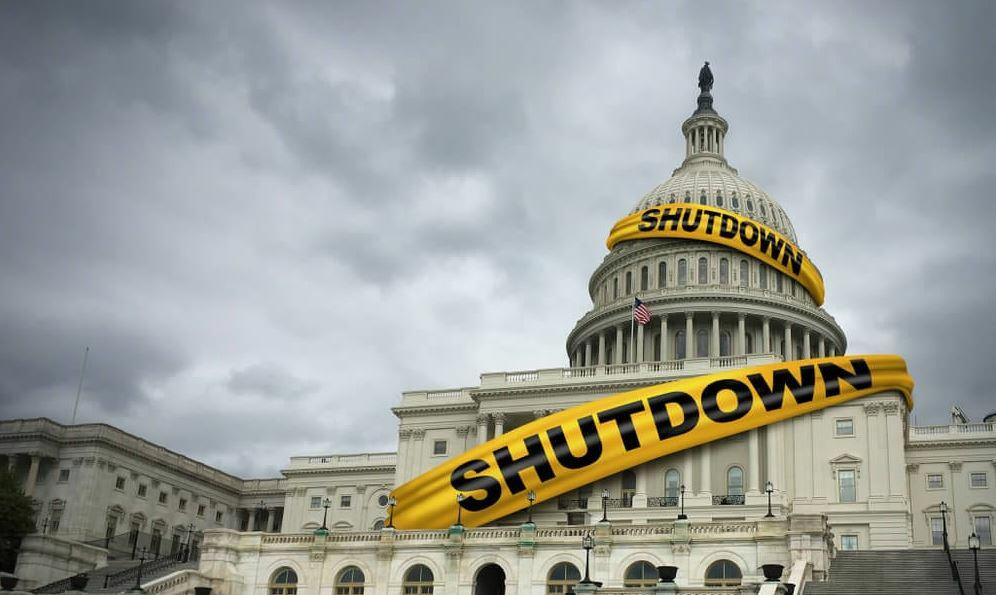
With yet another government shutdown looming (Money is projected to run out Sept. 30), echoes of panic are beginning to reverberate throughout the mainstream media and Washington DC over the possibility of yet another government shutdown.

But before anyone burns their hand on the stove again, Goldman’s Alec Phillips puts the potential fallout in context.

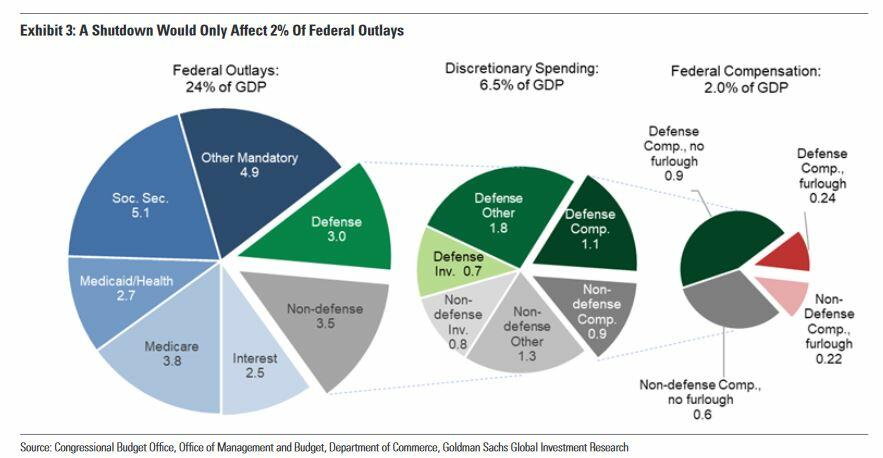
In a nutshell – since the rules for government spending under a shutdown are clear, and shutdowns have occurred in the past, the economic hit is more predictable. And while federal spending is equal to almost a quarter of GDP, the impact of a shutdown is much smaller, for four key reasons:

  • It’s All About the Discretionary Spending: Federal outlays are broadly categorized into discretionary spending (like defense), mandatory spending (Medicare, Social Security), and interest on public debt. Only discretionary spending takes a hit during a shutdown. This represents around 6.5% of GDP.

  • Not All Departments Are Created Equal: Depending on the funding approved by Congress, some departments may remain open while others shut down. Prolonged shutdowns have often spared the Department of Defense, which accounts for roughly half of discretionary spending. This time around, since none of the 12 standard appropriations bills have passed, the shutdown would be across the board, but still limited to discretionary areas.

  • Low Impact on Investment and Goods: Shutdowns mainly affect federal employment rather than investment or purchases of goods and services. Federal pay is roughly 2% of GDP, and a shutdown would primarily result in reduced work by federal employees, thereby affecting only about 0.5% of GDP.

  • Most Federal Employees Would Still Be Working: Out of 2.3 million civilian federal employees, approximately 800k would be furloughed. Essential services continue, and active-duty military personnel would remain in place.

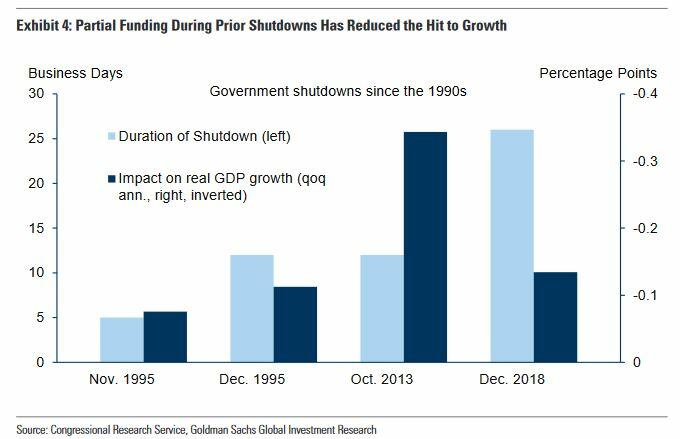
What’s more, market reactions to government shutdowns have become increasingly muted given that despite the high odds of a shutdown, funding typically arrives at the 11th hour via a “continuing resolution” to provide temporary funding at the start of the Oct. 1 fiscal year, which eventually translates to longer-term spending bills. A failure to do either leads to a shutdown – which looks likely at this point.

And while a shutdown would likely ‘briefly hit consumer confidence,’ given the modest economic and market effects, it would have little effect on monetary policy unless it’s a prolonged shutdown starting in October, in which case there’s an incremental addition to the argument that the FOMC might stay on hold at its November meeting (as Goldman expects). In the past, the FOMC has downplayed the economic impact shutdowns – focusing instead on the potential impacts to the reporting of economic data.

As Phillips notes;

A government shutdown looks more likely than not later this year. At the start of the year we noted a good chance of a government shutdown and made it the base case following the debt limit deal in June, in light of the thin House majority and disagreement on spending levels. The odds of a shutdown appear at least as high now as they did then.

A shutdown occurs if Congress fails to pass annual spending bills. Funding typically comes first via a short-term “continuing resolution” to provide temporary funding at the start of the fiscal year (Oct. 1) and then eventually through full-year spending bills. A failure to pass either leads to a shutdown.

Prior shutdowns have occurred either due to disagreement on the level or distribution of spending, or a dispute over extraneous issues that one party wants to address in spending legislation. At the moment, both types of risks are in play.  

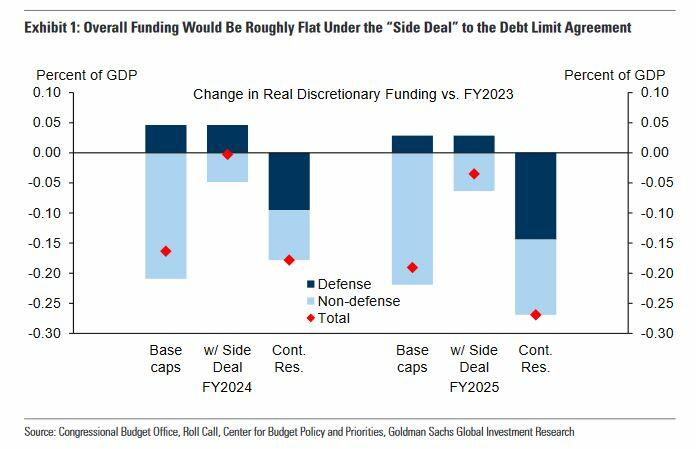
In theory, the “Fiscal Responsibility Act” (FRA) Congress passed in June to raise the debt limit should have ended the debate on spending levels. The FRA included three relevant provisions:

1. Spending caps limit funding for FY2024-25. If Congress appropriates above the caps, across-the-board cuts (“sequestration”) bring spending back down. While the caps limit spending, Congress must still pass spending bills to provide the funding.

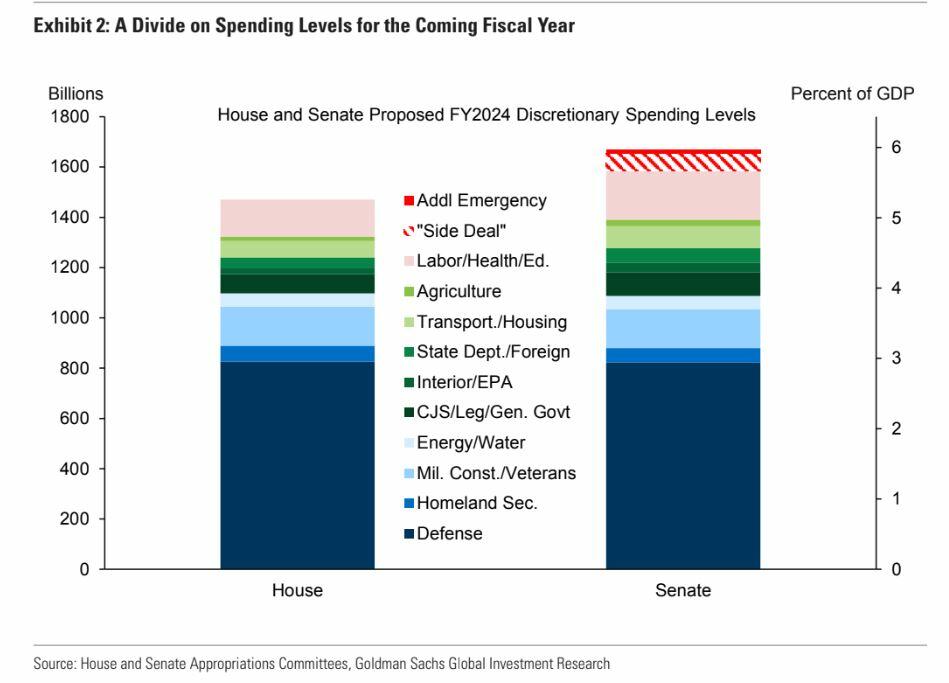
2. A “side deal” to the FRA would allow Democrats to add back most of the non-defense funds that would be cut under the caps deal. However, Congress must still pass spending bills to effectuate these changes.

3. An automatic cut to 1% below the FY2023 level takes effect if Congress has not passed all 12 full-year spending bills before Jan. 1, 2024 and is still operating under a continuing resolution. As shown in Exhibit 1, defense would be cut below the caps, while non-defense would rise slightly above the capped level, but would still represent a modest cut compared to the “side deal”.

*  *  *

Of note, last week House Speaker Kevin McCarthy floated a short-term government funding bill to avoid shutdown this fall, according to NBC News.

He [McCarthy] believes Congress will have to pass a short-term government funding bill to avoid a shutdown this fall, two sources with knowledge told NBC News.

The remarks reflect a growing recognition that Congress doesn’t have enough time to reach a full-year funding deal before money runs out on Sept. 30. Lawmakers are on a monthlong August recess and return in September, just a few weeks before the deadline.

While McCarthy now privately agrees Congress needs to buy time to reach a funding deal, it’s not clear how much they’ll push for. One Republican lawmaker said McCarthy, R-Calif., indicated he didn’t want to set a deadline that pushes Congress up against the Christmas holiday. A second GOP source didn’t recall McCarthy specifying a length of time for the stopgap bill.

In short, according to Goldman, the chances of at least a brief shutdown occurring are high, but its impact is expected to be limited and largely reversible.

Tyler Durden
Mon, 08/21/2023 – 15:40

Permian Merger With Earthstone Creates $14-Billion Delaware Basin Producer

0
Permian Merger With Earthstone Creates $14-Billion Delaware Basin Producer

By Charles Kennedy of OilPrice.com

Permian Resources has signed a deal to buy Earthstone Energy in an all-stock deal valued at $4.5 billion, which is expected to create a $14-billion premier producer in the Delaware basin in the Permian, the companies said on Monday.

The value of the all-stock deal is inclusive of Earthstone’s net debt.

Under the terms of the transaction, each share of Earthstone common stock will be exchanged for 1.446 shares of Permian Resources common stock.

The deal is expected to boost Permian Resources’ position as a leading Delaware Basin independent E&P operator with more than 400,000 Permian net acres, and pro forma production of around 300,000 barrels of oil equivalent per day (boed), the companies said.

The transaction will boost cash flows and will be immediately accretive to Permian Resources’ returns to shareholders. The company plans to increase its quarterly base dividend by 20% to $0.06 per share beginning with its first-quarter 2024 dividend.

“After evaluating over $20 billion of potential transactions during the past twelve months, we firmly believe the acquisition of Earthstone represented the best transaction for Permian Resources. It checks all the boxes, enhancing shareholder value while improving upon an already best-in-class company,” said James Walter, Co-CEO of Permian Resources.

The transaction is the latest of a series of deals in the Permian, which returned in the second quarter as the hottest spot for the U.S. upstream deal-making market.

During the second quarter, U.S. upstream mergers and acquisitions boomed with $24 billion transacted in 20 deals, with the Permian returning to its usual position as the center of M&A activity, Enverus Intelligence Research (EIR) said in a quarterly report last month.

Chevron’s purchase of primarily DJ-focused producer PDC Energy was one notable exception to this Permian-centric quarter, Enverus said.

“The second quarter saw a thunderous return to Permian M&A after a relatively quiet start to the year,” said Andrew Dittmar, director at Enverus.

Tyler Durden
Mon, 08/21/2023 – 15:25

Treasury Yields Soar To 16 Year High As 30Y Mortgage Rates Near 21st Century High

0
Treasury Yields Soar To 16 Year High As 30Y Mortgage Rates Near 21st Century High

The selloff in the bond-market resumed with a vengeance on Monday, pushing 10-year yields to a 16-year high, as traders dumped duration ahead of Friday’s Jackson Hole meeting where concerns are rising that – in a repeat of last year’s shock and awe – Powell may warn more work needs to be done to contain inflation.

The selloff pushed up yields on nominal Treasuries as well as on inflation-protected paper, or TIPS, suggesting that investors are bracing for the risk that monetary policy will remain elevated.

Yields on 10-year TIPS jumped over 2% for the first time since 2009, extending its ascent from year-to-date lows near 1%. Not long after, the yield on 10-year Treasuries without that protection surpassed October’s peak, climbing as much as 9 basis points to 4.35%, a level last seen in late 2007.

The 10-year real yield has risen sharply from around 1.5% in mid-July and just above 1% earlier this year. On Monday, the 30-year real yield rose 6 basis points to 2.15%. Treasury market volume was 75% of usual activity and was potentially exacerbating the price action.

The ongoing sharp repricing in duration is extending the major shift that has raced through the bond market over the past two weeks as the odds of a recession seemingly recede amid such ludicrous economic reading as an Atlanta Fed GDPNow which pointed to Q3 GDP growth of 5.8%, coupled with the trademark of “Bidenomics”: war-level budget deficits which have pushed the supply of Treasury debt in Q3 to a near-record $1 trillion, the second highest on record after the $2.8 trillion sold in Q2 2020 to offset the global Covid lockdowns.

That’s driven investors to sharply push up rates on longer-term debt, which had tumbled deeply below short-term ones on fears that the economy was poised for a contraction.

“The move higher across the curve over the last few weeks has really been all on the real-yield side,” Zachary Griffiths, senior fixed-income strategist at CreditSights, told Bloomberg citing a “higher Fed policy rate or better growth expectations, with little shift in breakeven inflation expectations.”

According to Bloomberg, the movements have fanned expectations that the US bond market is closing the door on the post-financial crisis era of ultra-low rates, anticipating that the Fed will hold interest rates elevated for longer than markets had expected. The movement has come even as the swaps market is still pricing in that the Fed is likely done with its rate hikes and will be easing policy next year.

“The continued better-than-expected economic data has made it like we are almost contemplating a new reality that we haven’t had for quite some time, where rates could potentially be quite higher for quite longer,” Griffiths said. “That’s the big thing driving real yields.”

Of course, as always happens on Wall Street, once everyone believes something the opposite happens, and with the help of a deflationary shockwave about to erupt from China, the $1 trillion the US is about to spend on debt interest…

… not to mention the inevitable Housing crash, because a housing market can only sustain these mortgage rates for so long, it’s only a matter of time before rates crash.

And speaking of mortgage rates, after briefly dipping at the end of 2022, the eruption in 10Y yields has pushed the 30Y Mortgage rate to a mindblowing 7.6%, the highest level since 2001 and just shy of the the highest in the 21st century. As a reference, mortgage rates hit a record low just over 2 years ago, when they troughed at 2.80% in Feb 2021.

There is little hope of immediate respite: bond investors are bracing for upcoming auctions of 20-year bonds and 30-year TIPS, that have smaller investor bases than other Treasury products. Demand will be closely followed for any hint the current rout is nearing an end, or perhaps has further room to run, according to Bloomberg’s Michael Mackenzie.

The debt sales arrive before the Fed’s annual gathering at Jackson Hole, with the market anticipating a hawkish tone from Chair Jerome Powell when he speaks Friday.

“The technicals are with the bond bears,” said Andrew Brenner, head of international fixed income at NatAlliance Securities. But, he added, “in a slow August, illiquid holiday week, they have nothing to fear as the world expects Powell to be hawkish.”

Tyler Durden
Mon, 08/21/2023 – 15:05