

69.4 F
Chicago
Thursday, August 27, 2026
Home Blog Page 3466

Trump Indicted (Again) For ‘Efforts To Overturn 2020 Election’; DeSantis Defends

Trump Indicted (Again) For ‘Efforts To Overturn 2020 Election’; DeSantis Defends

Update (1834ET): As reactions to Trump’s latest indictment roll in, one notable defender is Florida Governor Ron DeSantis, who tweeted that he would, as president, “end the weaponization of government, replace the FBI Director, and ensure a single standard of justice for all Americans.”

DeSantis added that DC is a “swamp,” and that it’s “unfair to have to stand trial before a jury that is reflective of the swamp mentality.”

*  *  *

Another day, another indictment aimed at keeping former President Trump out of the Oval Office.

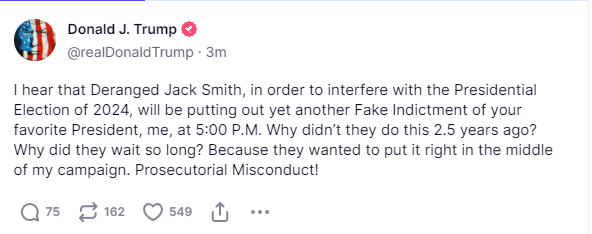
“I hear that Deranged Jack Smith, in order to interfere with the Presidential Election of 2024, will be putting out yet another Fake Indictment of your favorite President, me, at 5:00 P.M,” Trump wrote Tuesday on Truth Social. “Why didn’t they do this 2.5 years ago? Why did they wait so long? Because they wanted to put it right in the middle of my campaign. Prosecutorial Misconduct!” he continued.
And on Tuesday, Jack Smith did just that – indicting Trump yet again for his efforts to overturn the results of the 2020 presidential election.

The indictment focuses on schemes by Trump and his allies to subvert the transfer of power and keep him in office despite his loss to Joe Biden.

Trump has been indicted on four counts:

The Conspiracy

From on or about November 14,2020, through on or about January 20,2021, in the District of Columbia and elsewhere, the Defendant, DONALD J. TRUMP, did knowingly combine, conspire, confederate, and agree with co-conspirators, known and unknown to the Grand Jury, to defraud the United States by using dishonesty, fraud, and deceit to impair, obstruct, and defeat the lawful federal government function by which the results of the presidential election are collected, counted, and certified by the federal government.

The purpose of the conspiracy was to overturn the legitimate results of the 2020 presidential election by using knowingly false claims of election fraud to obstruct the federal government function by which those results are collected, counted, and certified.

Special Counsel Jack Smith gave a lame speech following his latest ‘win’ (that surely won’t actually help Trump, right?)

Watch:

The Defendant, his co-conspirators, and their agents made knowingly false claims that there had been outcome-determinative fraud in the 2020 presidential election.

These prolific lies about election fraud included dozens of specific claims that there had been substantial fraud in certain states, such as that large numbers of dead, non-resident, non-citizen, or otherwise ineligible voters had cast ballots, or that voting machines had changed votes for the Defendant to votes for Biden.

These claims were false, and the Defendant knew that they were false.

In fact, the Defendant was notified repeatedly that his claims were untrue—often by the people on whom he relied for candid advice on important matters, and who were best positioned to know the facts –  and he deliberately disregarded the truth.

Read the full docket below:

It’s the third criminal case brought against the former president as he seeks to reclaim the White House.

*  *  *

As we detailed earlier, on Monday, Trump called the indictments “election interference” and “prosecutorial misconduct,” adding that they’re being used to distract from investigations into the Biden family’s own dealings with foreign nationals.

“The Radical Left Democrat Thugs shouldn’t be allowed to investigate me during, and in the middle of, my campaign for President. Why didn’t they file these ridiculous charges 2.5 years ago?” Trump wrote, adding “They waited because they wanted to illegally and negatively influence the 2024 Presidential Election, arguably the most important Election in the history of the USA. We are going to take our now Third World Nation (Airports, Elections, Roads/Highways, Borders, etc.) and, MAKE AMERICA GREAT AGAIN. BE STRONG!”

Trump’s defenders jump into action

Yesterday was an awful day for the @JoeBiden crime family,” tweeted former Arizona Gubernatorial candidate Kari Lake (R), referring to bombshell allegations against the Biden family over international corruption. “The regime desperately needs a distraction for their Pravda Press to spread.”

Watch as they indict @realDonaldTrump again to change the narrative.

Meanwhile, Bloomberg reports that Trump is “burning through money on legal fees so fast that it risks leaving him short of cash just when he will need it most — in a potential general election rematch against President Joe Biden next fall.”

The former president raised $54 million from donors in the first six months of the year – more than any other Republican candidate, but that his legal bills are emptying his coffers nearly as fast as he fills them.

Nearly half of Trump’s January-to-June haul went to lawyers, $25.5 million, draining cash reserves left from the midterm cycle, according to Federal Election Commission filings. A person familiar with the finances of Trump’s committees said legal expenses were actually closer to $40 million.

Two entities, Save America and Make America Great Again PAC — which is separate from MAGA Inc. — are footing his legal fees. They ended June with only $4.2 million cash on hand, about enough to cover another month’s worth of costs. The expenditures forced Save America, which donated $60 million in 2022 to Trump’s super PAC, to ask for a refund. It got $12.3 million back.

To keep the entities paying his legal fees funded, Trump will have to divert about half the money he raises through a joint fundraising committee. From January to June, the joint fundraising committee transferred $29.2 million to Trump’s campaign and $2.2 million to his leadership PAC and ended June with $5.7 million cash on hand. The remainder was spent on fundraising expenses. -Bloomberg

“The weaponized Department of Justice has continued to go after innocent Americans because they worked for President Trump,” said campaign spokesman Steven Cheung. “To protect these innocent people from financial ruin and prevent their lives from being completely destroyed, the leadership PAC contributed to their legal fees.”

Trump, meanwhile, can continue to tap his allied super PAC, Make America Great Again, Inc, which had $31 million at the end of June after depleting 44% of its cash in the first six months of 2023.

More via the Epoch Times;

Mr. Trump said on July 27 that his lawyers had met with the Justice Department and had a “productive meeting,” and that “an indictment of me would only further destroy our country.”

Jurors were seen entering a courthouse Thursday morning, and news reports had claimed an indictment could come as soon as that same day.

More than 1,000 people have already been charged with Jan. 6-related offenses.

Multiple Cases

Mr. Trump is facing another investigation in Georgia, where Fulton County Superior Court Judge Robert McBurney on Monday rejected Mr. Trump’s bid to disqualify Fulton County District Attorney Fani Willis from prosecuting the case.

The criminal investigation centers around a phone call Mr. Trump made to Republican Georgia Secretary of State Brad Raffensperger in 2020, asking about the number of votes for him in the state.

“I just want to find 11,780 votes, which is one more than we have,” then-President Trump said to Mr. Raffensperger.

Ms. Willis maintains that Mr. Trump tried to illegally overturn the results of the presidential election in the state of Georgia. Mr. Trump says the investigation is “strictly a political witch hunt.”

Mr. Trump’s legal team argued that she had a partisan interest in the case, which should disqualify her. Judge McBurney wrote that the team failed to show Ms. Willis was biased in her actions.

The case will be heard on Aug. 10.

Meanwhile, Georgia Gov. Brian Kemp has been contacted by Mr. Smith’s office, presumably about the Jan. 6 case.

Mr. Smith is also in charge of the Mar-a-Lago case concerning classified documents, in which he last week announced three new charges.

Special counsel Jack Smith delivers remarks on a recently unsealed indictment against former President Donald Trump at the Justice Department in Washington on on June 9, 2023. (Alex Wong/Getty Images)

Last week, the special counsel charged Mr. Trump with willful retention of national defense information and two charges in connection to the claims that he told a Mar-a-Lago worker to delete security tapes to prevent a grand jury from seeing them. In that filing, the Department of Justice (DOJ) named Mar-a-Lago staffer Carlos De Oliveira as a third defendant in the complaint.

On Sunday, Mr. Trump denied all three charges.

Mar-a-Lago security tapes were not deleted,” Mr. Trump wrote on Truth Social. “They were voluntarily handed over to the thugs, headed up by deranged Jack Smith. We did not even go to court to stop them from getting these tapes. I never told anybody to delete them. Prosecutorial fiction & misconduct! Election interference!”

“They knowingly accuse you of a fake crime, a crime that they actually make up, you fight these false charges hard, and they try and get you on ‘obstruction,’” Mr. Trump wrote. “We are dealing with sick and evil people!”

Alina Habba, spokesperson and attorney for Mr. Trump, told Fox News in a July 30 interview that Mr. Trump never directed an employee to delete tapes.

“When he has his turn in court, and when we get to file our papers, you will see that every single video, every single surveillance tape that was requested, was turned over,” Ms. Habba said. “If President Trump didn’t want something turned over, I assure you, that is something that could have been done. But he never would act like that. He is the most ethical American I know.

The new superseding indictment that came out, which they tried to get another headline for President Trump, was facts that said that President Trump did what? What was the obstruction of justice because no tapes were deleted. He turned them over; he cooperated as he always does. But they would like the American public to believe in these bogus indictments that there are some facts that say that President Trump was obstructing justice.”

Mr. Trump has pleaded not guilty to all charges and maintains that as president, he had the right to take the documents as well as the right to declassify them. The case is set to go to trial in May 2024.

Tyler Durden
Tue, 08/01/2023 – 17:40

“Arbitrary… Outdated!” – Yellen Outraged After Fitch Cuts USA’s AAA-Rating

“Arbitrary… Outdated!” – Yellen Outraged After Fitch Cuts USA’s AAA-Rating

Update (1750ET): Treasury Secretary Yellen is pissed, calling the downgrade “arbitrary” and “outdated.”!

I strongly disagree with Fitch Ratings’ decision. The change by Fitch Ratings announced today is arbitrary and based on outdated data. Fitch’s quantitative ratings model declined markedly between 2018 and 2020 – and yet Fitch is announcing its change now, despite the progress that we see in many of the indicators that Fitch relies on for its decision. Many of these measures, including those related to governance, have shown improvement over the course of this Administration, with the passage of bipartisan legislation to address the debt limit, invest in infrastructure, and make other investments in America’s competitiveness.

Fitch’s decision does not change what Americans, investors, and people all around the world already know: that Treasury securities remain the world’s preeminent safe and liquid asset, and that the American economy is fundamentally strong.

Over the past few years, the United States has undergone a historically fast economic recovery from a deep recession. Today, the unemployment rate is near historic lows, inflation has come down significantly since last summer, and last week’s GDP report shows that the U.S. economy continues to grow. The American economy remains the world’s largest and most dynamic economy, with the deepest and most liquid financial markets in the world. To build on this, President Biden and I have been focused on making critical investments in our country’s core economic strength and productive capacity. 

President Biden and I are committed to fiscal sustainability. The most recent debt limit legislation included over $1 trillion in deficit reduction and improved our fiscal trajectory. Looking forward, President Biden has put forward a budget that would reduce the deficit by $2.6 trillion over the next decade through a balanced approach that would support investments for the long-term.” 

Perhaps she should read this…

*  *  *

In the middle of the debt-ceiling ‘crisis’ in May, with Fitch, Moodys and DBRS all threatening to do what S&P boldly did in 2011 and downgrade the US should the debt ceiling crisis lead to a technical default, China’s leading rating agency, China Chengxin International Credit Rating decided not to wait, downgrading the USA’s rating by one notch, to AA+ from AAA, citing high inflation and the widely watched debt-ceiling stand-off.

Today, Fitch decided to get off the pot and join S&P and Chengxin, downgrading USA’s Long-Term Foreign-Currency Issuer Default Rating (IDR) to ‘AA+’ from ‘AAA’.

Key Rating Drivers

Ratings Downgrade: The rating downgrade of the United States reflects the expected fiscal deterioration over the next three years, a high and growing general government debt burden, and the erosion of governance relative to ‘AA’ and ‘AAA’ rated peers over the last two decades that has manifested in repeated debt limit standoffs and last-minute resolutions.

Erosion of Governance: In Fitch’s view, there has been a steady deterioration in standards of governance over the last 20 years, including on fiscal and debt matters, notwithstanding the June bipartisan agreement to suspend the debt limit until January 2025. The repeated debt-limit political standoffs and last-minute resolutions have eroded confidence in fiscal management. In addition, the government lacks a medium-term fiscal framework, unlike most peers, and has a complex budgeting process. These factors, along with several economic shocks as well as tax cuts and new spending initiatives, have contributed to successive debt increases over the last decade. Additionally, there has been only limited progress in tackling medium-term challenges related to rising social security and Medicare costs due to an aging population.

Rising General Government Deficits: We expect the general government (GG) deficit to rise to 6.3% of GDP in 2023, from 3.7% in 2022, reflecting cyclically weaker federal revenues, new spending initiatives and a higher interest burden. Additionally, state and local governments are expected to run an overall deficit of 0.6% of GDP this year after running a small surplus of 0.2% of GDP in 2022. Cuts to non-defense discretionary spending (15% of total federal spending) as agreed in the Fiscal Responsibility Act offer only a modest improvement to the medium-term fiscal outlook, with cumulative savings of USD1.5 trillion (3.9% of GDP) by 2033 according to the Congressional Budget Office. The near-term impact of the Act is estimated at USD70 billion (0.3% of GDP) in 2024 and USD112 billion (0.4% of GDP) in 2025. Fitch does not expect any further substantive fiscal consolidation measures ahead of the November 2024 elections.

Fitch forecasts a GG deficit of 6.6% of GDP in 2024 and a further widening to 6.9% of GDP in 2025. The larger deficits will be driven by weak 2024 GDP growth, a higher interest burden and wider state and local government deficits of 1.2% of GDP in 2024-2025 (in line with the historical 20-year average). The interest-to-revenue ratio is expected to reach 10% by 2025 (compared to 2.8% for the ‘AA’ median and 1% for the ‘AAA’ median) due to the higher debt level as well as sustained higher interest rates compared with pre-pandemic levels.

General Government Debt to Rise: Lower deficits and high nominal GDP growth reduced the debt-to-GDP ratio over the last two years from the pandemic high of 122.3% in 2020; however, at 112.9% this year it is still well above the pre-pandemic 2019 level of 100.1%. The GG debt-to-GDP ratio is projected to rise over the forecast period, reaching 118.4% by 2025. The debt ratio is over two-and-a-half times higher than the ‘AAA’ median of 39.3% of GDP and ‘AA’ median of 44.7% of GDP. Fitch’s longer-term projections forecast additional debt/GDP rises, increasing the vulnerability of the U.S. fiscal position to future economic shocks.

Medium-term Fiscal Challenges Unaddressed: Over the next decade, higher interest rates and the rising debt stock will increase the interest service burden, while an aging population and rising healthcare costs will raise spending on the elderly absent fiscal policy reforms. The CBO projects that interest costs will double by 2033 to 3.6% of GDP. The CBO also estimates a rise in mandatory spending on Medicare and social security by 1.5% of GDP over the same period. The CBO projects that the Social Security fund will be depleted by 2033 and the Hospital Insurance Trust Fund (used to pay for benefits under Medicare Part A) will be depleted by 2035 under current laws, posing additional challenges for the fiscal trajectory unless timely corrective measures are implemented. Additionally, the 2017 tax cuts are set to expire in 2025, but there is likely to be political pressure to make these permanent as has been the case in the past, resulting in higher deficit projections.

Exceptional Strengths Support Ratings: Several structural strengths underpin the United States’ ratings. These include its large, advanced, well-diversified and high-income economy, supported by a dynamic business environment. Critically, the U.S. dollar is the world’s preeminent reserve currency, which gives the government extraordinary financing flexibility.
Economy to Slip into Recession: Tighter credit conditions, weakening business investment, and a slowdown in consumption will push the U.S. economy into a mild recession in 4Q23 and 1Q24, according to Fitch projections. The agency sees U.S. annual real GDP growth slowing to 1.2% this year from 2.1% in 2022 and overall growth of just 0.5% in 2024. Job vacancies remain higher and the labor participation rate is still lower (by 1 pp) than pre-pandemic levels, which could negatively affect medium-term potential growth.

Fed Tightening: The Fed raised interest rates by 25bp in March, May and July 2023. Fitch expects one further hike to 5.5% to 5.75% by September. The resilience of the economy and the labor market are complicating the Fed’s goal of bringing inflation towards its 2% target. While headline inflation fell to 3% in June, core PCE inflation, the Fed’s key price index, remained stubbornly high at 4.1% yoy. This will likely preclude cuts in the Federal Funds Rate until March 2024. Additionally, the Fed is continuing to reduce its holdings of mortgage backed-securities and U.S. Treasuries, which is further tightening financial conditions. Since January, these assets on the Fed balance sheet have fallen by over USD500 billion as of end-July 2023.

ESG – Governance: The U.S. has an ESG Relevance Score (RS) of ‘5’ for Political Stability and Rights and ‘5[+]’ for the Rule of Law, Institutional and Regulatory Quality and Control of Corruption. Theses scores reflect the high weight that the World Bank Governance Indicators (WBGI) have in Fitch’s proprietary Sovereign Rating Model. The U.S. has a high WBGI ranking at 79, reflecting its well-established rights for participation in the political process, strong institutional capacity, effective rule of law and a low level of corruption.

Additionally, they warn that the following could lead to more negative ratings actions…

  • Public Finances: A marked increase in general government debt, for example due to a failure to address medium-term public spending and revenue challenges;

  • Macroeconomic policy, performance and prospects: A decline in the coherence and credibility of policymaking that undermines the reserve currency status of the U.S. dollar, thus diminishing the government’s financing flexibility.

All hail Bidenomics.

Tyler Durden
Tue, 08/01/2023 – 17:26

This Pro-Mask “Study” Is Why You Should Never “Trust The Science”

This Pro-Mask “Study” Is Why You Should Never “Trust The Science”

Authored by Kit Knightly via Off-Guardian.org,

Last week it was reported that the Australian state of Victoria may be considering “permanent” facemask mandates to achieve “zero-Covid”.

Now, we don’t need to get into the personal liberty implications of such a law, or  the near-infinite supply of evidence that masks don’t work to prevent the transmission of respiratory disease.

They don’t work, they never worked. Mandating them was a political move designed to make the fake Covid “pandemic” appear real, and their continued use is a symptom of brainwashing or a by-product of chronic virtue signaling.

The mask debate, such as it was, is over.

No, the only aspect of this development worth talking about is the “evidence” used to support the position – and trust me, the quotes are entirely justified.

The “study” which claims to demonstrate the benefits of permanent masking was published in the Medical Journal of Australia last week and titled “Consistent mask use and SARS‐CoV‐2 epidemiology: a simulation modelling study”.

“Simulation modelling study” is very much the key phrase there. For those who don’t know,  “simulation modelling studies” involve feeding data into a computer programme, then asking it to form conclusions.

Clearly, they are only as reliable and useful as the data you use. In fact, you can very easily make them produce any result you want by feeding in  the “right” (bad) data.

In this particular modelling study they started out by telling the computer that cloth masks reduce transmission by 53% and respirators reduced it by 80%:

Odds ratios for the relative risk of infection for people exposed to an infected person (wearing a mask v not wearing a mask) were set at 0.47 for cloth and surgical masks and 0.20 for respirators

Essentially, they told their computer that masks prevent disease…and then said “ok, computer, since you now know masks prevent disease  – what would happen if everybody wore them all the time?”

The computer then told them – obviously  – that nobody would get sick.

Because they made it logically impossible for it to say anything else.

But there’s a bit more to it.

The next layer of interest is where they got their input data from.

After all there have been dozens of studies done on masks over the years, 98% of which say masks don’t work.

So, did our guys they choose a peer-reviewed real-time control trial relying on lab-tested double-blind results?

Perhaps one of the dozen or so such trials listed in our 40 facts article?

Did they maybe average the results of multiple studies?

No, they used a phone survey.

One phone survey.

This phone survey, published last year and conducted in late 2021.

In this *ahem* “scientific study”, they had people randomly call up those who had recently been tested for “Covid”, ask them “did you wear a mask?” and then published the conclusion – “masks reduce transmission by 53%” – as if they meant something.

Interestingly, if you scroll down to the “affiliations” section you can see that one of the authors is a Pfizer grant recipient.

Rather more troublingly – and for some reason not mentioned as a conflict of interest – is that the whole study was produced by the California Board of Public Health.

California had already had a mask mandate in place for almost a year before this “study” was even started.

What we have here is not “science” it’s a computer model based on the results of a subjective phone survey conducted by a government agency with a vested interest. It is entirely meaningless, and yet is published in journals and cited by “experts”, perhaps even used as the basis of introducing new laws.

This is how “The ScienceTM” works. And, although Covid has maybe opened many people’s eyes to this issue, it is far from unique to “Covid”. You are just as likely to find this kind of “research” published on any topic – especially those that serve a political purpose – and have been for years if not decades.

Stanford Professor of evidence-based medicine,  John Ioannidis wrote a paper called “Why Most Published Research Findings Are False”, and that was back in 2005.

This has nothing to do with the “pandemic”, and everything to do with the difference between science and “The Science”. So let’s examine that distinction.

“Science” is an approach to the world. A rational method for gathering information, testing new ideas and forming evidence-based conclusions.

“The Science” is a self-sustaining industry of academics who need jobs and owe favours.

An ongoing quid pro quo relationship between the researchers – who want honors and knighthoods and tenure and book deals and research grants and to be the popular talking head explaining complex ideas to the multitudes on television – and the corporationsgovernments and “charitable foundations” who have all of those things in their gift.

This system doesn’t produce research intended to be read, it creates headlines for celebrities to tweet, links for “journalists” to embed, sources for other researchers to cite.

An illusion of solid substantiation that comes apart the moment you actually read the words, examine the methodology or analyse the data.

Self-reporting surveys, manipulated data, “modelling studies” that spit-out pre-ordained results. Affiliated-authors paid by the state or corporate interests to provide “evidence” that supports highly profitable or politically convenient assumptions.

This mask study is the perfect example of that.

Interlacing layers of nothing designed to create the impression of something.

That’s why they want you to trust it, rather than read it.

Tyler Durden
Tue, 08/01/2023 – 16:45

Banks, Bonds, & Bullion Battered As Dollar Rips To Start August

Banks, Bonds, & Bullion Battered As Dollar Rips To Start August

Yields surged higher today, despite dismal economic data, as supply (corporate and govt) dominated along with positive employment signals from the PMIs (although the JOLTs data was shitshow and should have trumped any positives from PMIs). The dollar also ripped higher… on a bad data day (to start the month) as PMIs were abysmal around the world (and non-USD fiat weakness means USD fiat strength).

Global Manufacturing PMIs and Global Stocks seem to be in disagreement…

Source: Bloomberg

“probably nothing…”

Equity markets were broadly under pressure today early on but the ubiquitous short-squeeze lifted them off the lows. The Dow ended higher

Another day, another short-squeeze…

Source: Bloomberg

It’s now been 40 days since the S&P had a down 1% day…

Source: Bloomberg

And of course, bankrupt trucker Yellow was up over 150% today – hitting $5.00, its highest since Oct 2022 – massively higher from the 43c lows late-last week…

And WTF is this!!!!

Banks were dumped today…

Treasuries were clubbed like a baby seal during the European session and the selling pressure abated after Europe closed. The long-end notably underperformed…

Source: Bloomberg

Bloomberg’s Alyce Andres offers 10 reasons why bond investors are so bearish today.

  1. The US refunding projections for Wednesday are skewed higher after the Treasury increased borrowing estimates Monday

  2. The technical break of 4% in 10s was meaningful and provided some momentum as yields retest recent highs ahead of the refunding announcement and Friday’s jobs report

  3. Foreign real money sold 10-year futures contracts right out of the gates today in New York, while cash desks noted similar accounts exited longs in 5s

  4. Relative-value accounts sold in both 5s and 20s against 2s

  5. Financial-linked corporate bond issuance slowed today, lessening the need to receive in swaps

  6. Month-end is out of the way — lessening the need for indexing demand

  7. With the adjustment in duration, investors are preparing for for convexity sales. Dealer desks say it has yet to materialize but easily could

  8. Pressure also seen in mortgage-backed securities, with hedge fund sales due to the shift in duration. Weakness in MBS can often lend to hedging flows in Treasuries. Dealers report the recent money manager bid looks a bit tired in MBS

  9. Commodity Trading Advisors and speculative accounts remain short and are willing to let those winning trades ride — feeling no pressure to unwind

  10. Liquidity is low, exaggerating price action

10Y yields topped 4.00% and 30Y yields ripped up to their highest since Nov 2022

Source: Bloomberg

The yield curve (2s30s) steepened notably today (less inverted)…

Source: Bloomberg

The dollar extended its rebound from mid-July’s plunge (retracing almost 70% of the drop)…

Source: Bloomberg

We also note that The Dollar Index is closing in fast on key technical levels…

Source: Bloomberg

Bitcoin dumped and pumped back above $29k…

Source: Bloomberg

Gold tumbled back below $2000 today…

WTI hit $82 today, back at OPEC-Cut highs from April…

Finally, Mr.Biden may have a problem (well let’s be honest, this is but one of many)…

Source: Bloomberg

Retail gas prices are set to explode (and that won’t help the “inflation is defeated” narrative).

Tyler Durden
Tue, 08/01/2023 – 16:00

Strong Investment Demand For Physical Gold Continued In Second Quarter

Strong Investment Demand For Physical Gold Continued In Second Quarter

Via SchiffGold.com,

Investment demand for physical gold was up by 20% in the second quarter compared to last year, continuing a trend we’ve seen over the last 12 months. This helped push overall gold demand up 7% year on year when including over-the-counter (OTC) sales and stock flows.

Coin and bar demand came in at 277.5 tons in Q2, a 6% increase over the same quarter last year, according to the World Gold Council Gold Demand Trends for Q2. Gold bars accounted for 162.9 tons of that demand. That was a 6% drop compared to the second quarter of ’22. Coin demand came in at 88.9 tons, a 25% increase year-on-year.

Second-quarter coin and bar demand was 4% above the five-year quarterly average.

Extremely strong demand for physical gold in Turkey and more broadly in the Middle East helped drive gold coin and bar demand higher. Demand in that region offset weak demand in the Eurozone.

We saw this strong demand for physical gold despite a record LBMA gold price that averaged $1,976 per ounce during the quarter. This was a 4% increase over the previous record set in Q3 2020.

A 21.3-ton decrease in gold ETF holdings pulled down overall investment demand to 256.1 tons, but it was still 20% higher compared to the second quarter of last year. The drop in ETF holdings happened despite two straight months of ETF inflows in April and May.

Overall, total second-quarter gold demand fell by 2% compared to Q2 2022 excluding stock flows and OTC transactions. This was partially due to a slowdown in central bank gold buying. Although central banks continued to add to their gold holdings in the second quarter, big sales by Turkey pulled down the net total increase.

When you factor in strong over-the-counter (OTC) gold demand, overall demand was up 7% year on year to 1,255 tons.

OTC trades take place directly between two parties. According to the World Gold Council, hard data on the OTC market is not readily available. It is estimated by factoring in changes to inventories on commodity exchanges, any unobserved changes in fabrication inventories, and any statistical residual.

Industrial gold demand lagged in Q2 due to continued weakness in the consumer electronics market.

Jewelry consumption managed a modest improvement despite the high gold price environment. It was up 3% year-on-year to 476 tons.

Excluding OTC transactions, gold demand was down 6% through the first half of 2023 at 2,062 tons, but when you factor in the strong OTC market, demand was up 5% to 2,460 tons.

Tyler Durden
Tue, 08/01/2023 – 15:30

BREIT Hit By Ninth Consecutive Month Of Redemptions; Plans Pivot To AI Data-Centers

BREIT Hit By Ninth Consecutive Month Of Redemptions; Plans Pivot To AI Data-Centers

Blackstone has limited investor redemption requests from its $68 billion real estate trust for high-net wealth investors for eight consecutive months while storm clouds continue to gather over commercial real estate markets.

According to a letter obtained by Bloomberg, Blackstone Real Estate Income Trust (BREIT) recorded investor outflows of $3.7 billion in July — the lowest redemption requests since the run on the fund began in November 2022. However, BREIT only returned about $1.3 billion, or approximately 34% of what was requested — as it continues to gate redemption to prevent massive outflows. 

“This structure was designed to both prevent a liquidity mismatch and maximize long-term shareholder value.

“A shareholder who began submitting repurchase requests when proration began has received approximately 94% of their money back and the semi-liquid structure is working as intended,” according to the letter.

BREIT has been working through redemption requests for the last eight months. We have provided a detailed account of the panic out of BREIT as CRE markets come under pressure in a high-rate environment: 

Remember when BREIT received a $4 billion bailout cash infusion from the University of California earlier this year?

Late January, Blackstone President Jonathan Gray told Financial Times that BREIT was experiencing a “backlog” of redemption requests. 

Redemption requests surged in Spring:

Bloomberg said BREIT had sold CRE assets to raise capital: 

BREIT has sold $12 billion of real estate assets since the beginning of 2022, generating $2.5 billion of profit during its ownership, according to Blackstone. Recent transactions include an $800 million sale of a Texas hotel, and a $2.2 billion deal to offload a self-storage business. 

Financial Times report spun the negative asset sales story into a puff piece about how BREIT prepares to “invest billions in data centers to feed the artificial intelligence boom.” 

BREIT should prioritize meeting redemption requests and quelling the ongoing panic withdrawals before capitalizing on the AI boom.

We’ve pointed out (“New “Big Short” Hits Record Low As Focus Turns To $400 Billion CRE Debt Maturity Wall“) that the regional banking crisis kick-started CRE turmoil. JPMMorgan Stanley, and Goldman Sachs have all joined the CRE gloom parade. 

Also, thank the Federal Reserve’s aggressive rate hikes for the CRE mess. 

Tyler Durden
Tue, 08/01/2023 – 15:10

It’s Year 5 Of The Biden Crime Family Coverup

It’s Year 5 Of The Biden Crime Family Coverup

Authored by Frank Miele via RealClear Wire,

A truism that came out of the Watergate scandal is that often the coverup is worse than the crime. But that is not the case in the unraveling Bidengate scandal. The alleged crime here is so bad that it is probably the worst ever committed by an American president.

Yet the coverup should be studied, too. It deserves superlatives for its longevity, inventiveness, and sheer audacity. The strategy has been simple: deny, deflect, destroy. Deny the facts. Deflect with distractions, and when all else fails, work tirelessly to destroy Trump, who was among the first to raise questions about the Biden family’s shady dealings. At Year 5, it may be the most successful coverup in modern history, especially since so many of the facts have been in plain sight for the entire time.

So what exactly is Bidengate? A decade-long influence-peddling scheme that saw Joe Biden, the former vice president, using his son Hunter as a conduit for millions of dollars in payoffs from foreign entities in Ukraine, China, and elsewhere in exchange for favorable treatment. The most famous instance of this scheme was the millions of dollars paid to Hunter Biden for his role as a board member of the corrupt Burisma energy company in Ukraine. Even Hunter acknowledged that his only qualification for being on the board was his last name.

Trading on one’s name to gain employment is not a crime in itself, but using your father’s public office to influence U.S. policy is definitely against the law – especially when the clout is used to protect your corrupt foreign employer.

That’s just what happened in March of 2016 when Vice President Biden threatened to withhold $1 billion in U.S. aid to Ukraine if prosecutor general Viktor Shokin were not immediately fired. Biden even bragged about this escapade a few years later when he told the story to the Council on Foreign Relations.

It’s hard to know whether Biden’s threat to withhold aid was approved by the State Department or whether it was “on the fly” diplomacy, but we do know that Shokin has publicly stated that he was fired because he was investigating Burisma’s alleged corruption, and that after he was fired there was no further substantial investigation of Burisma. Quid pro quo.

Another famous mantra from the Watergate era is “Follow the money.” It almost makes you think Biden was taunting his accusers, quipping to a reporter on June 8, “Where’s the money?” when asked about allegations of corruption.

That’s what we want to know,” the reporter should have demanded, but of course there was no follow-up question. There never is.

Biden’s cheeky response suggests he had reason to think that he could count on the source of any ill-gotten wealth being kept private. And he may have had good reason for that belief.

On July 20, a little more than a month after Biden asked “Where’s the money?”, Sen. Chuck Grassley released an unclassified FD-1023 FBI informant form alleging that Biden and his son Hunter had split a $10 million payment from Ukrainian oligarch Mykola Zlochevsky, the owner of Burisma. Among the many intriguing breadcrumbs in that document was the informant’s claim that the payment to the Bidens was so well disguised that it would take years to uncover:

Zlochevsky responded he did not send any funds directly to the “Big Guy” (which [the FBI source] understood was a reference to Joe Biden). [The source] asked Zlochevsky how many companies/bank accounts Zlochevsky controls; Zlochevsky responded it would take them (investigators) 10 years to find the records (i.e. illicit payments to Joe Biden).

So that’s one possible answer to Joe Biden’s taunt: “Where’s the money?” Perhaps it’s well-hidden.

There are so many flashing red warning lights in the Biden scandal that a casual observer would be forgiven for assuming he was in Amsterdam. Case in point: The FBI informant reported in his June 2020 statement that Zlochevsky had called Joe Biden the “Big Guy” in 2019. That’s the same gangster nickname that one of Hunter Biden’s business associates used to refer to Joe in an infamous email on the “Laptop from Hell” when discussing what percentage of capital equity was being held by Hunter for Joe in a Chinese investment scheme. The laptop was in FBI hands since December 2019, but the email in question wasn’t circulated in public until the New York Post published it on Oct. 15, 2020. The informant’s use of the phrase prior to that time is strong circumstantial evidence that the FBI’s trusted human source was indeed privy to confidential and damning information about Biden.

But what’s truly maddening about the Biden coverup is just how long it has lasted while more and more evidence has mounted. Recent congressional hearings unearthed a trove of detail about bank payments to Biden family members, and IRS whistleblowers have laid bare the protection racket that the FBI and DOJ have been running for the Bidens. Most of that is just confirmation of what we already knew.

Remember, the first time most Americans heard about the Bidens’ bribery schemes was in September 2019 when the transcript of a phone call between President Trump and then-new Ukrainian president Volodymyr Zelensky was released. In it, Trump raised the issue of former Vice President Biden’s alleged corruption and asked Zelensky to cooperate with U.S. authorities by “looking into” rumors of criminal activity by the Bidens.

Imagine if Congress had opened an inquiry then into the question of Hunter Biden’s huge salary for sitting on the board of Burisma Energy, the company controlled by oligarch Zlochevsky. Hunter Biden might be in prison now, and his father would have retired to Delaware to live out his final years in shame.

Instead, Democrats in Congress put Trump on trial for daring to notice that which must not be named – the influence-peddling scheme run by Joe Biden and his kin. The impeachment was America’s crash course on Ukrainian corruption, but somehow the mainstream media missed the story and tried to convince the public that Biden was the victim. They hid the evidence then, just as they did last week when Hunter Biden’s sweetheart plea deal fell apart.

The Democrat-adjacent media seem to have a hard time understanding the case against Hunter Biden – and Joe Biden – even after five years. It’s not uncommon to hear cable news anchors lamenting that the Republicans are persecuting Joe and that they haven’t proven the president did anything wrong.

Either they don’t understand the meaning of the word proven, or they don’t understand our system of justice. It is not the job of Congress or reporters to prove anything, but rather to investigate and unearth evidence. For anyone who has eyes to see, there is a mountain of evidence against both Hunter and Joe Biden. But what we are still waiting for – what the nation is waiting for – is justice. To get that, we need a prosecutor who will present the evidence to a jury and ask for a verdict. Then and only then will the president’s guilt be proven or unproven.

How many more years do we have to wait?

Tyler Durden
Tue, 08/01/2023 – 14:50

Russian Crude Shipments Tumble To Lowest Since January As Urals Price Jumps To $65, Breaching Embargo Cap

Russian Crude Shipments Tumble To Lowest Since January As Urals Price Jumps To $65, Breaching Embargo Cap

A few weeks ago, we reported that Russian crude oil exports are finally starting to show signs of decline.

Since then, the slowdown in Russian outbound flows has accelerated substantially, and as Bloomberg’s Julian Lee reports, Russian seaborne crude flows in the four weeks to July 30 slid to the lowest since early January, as Moscow continues to cut supply to international markets.

Russia’s four-week average crude shipments fell by 154k b/d to 2.98m b/d, down by 905k b/d from their peak in mid-May and 400k b/d below the level seen in February.

… even as the more volatile weekly shipments jumped, rising w/w by 548k b/d to 3.28m b/d, although a lot of the weekly swing is due to seasonality.

As a reminder, February was the baseline month cited when the Russian government announced a 500k b/d output cut that was due to come into effect in March. While the cut was clearly delayed, Russian seaborne flows are now clearly in compliance with Russia’s output cut.

A breakdown of Russian flows by destination shows that Indian supplies have dropped sharply, followed by a more modest decline in China shipment, even as shipments to “unknown” countries in Asia have picked up.

Where there was no pick up, was in Russian flows to Europe…

… and there certainly won’t be a pick up any time soon, as the average price for Russia’s Urals crude export blend soared 16.4% m/m to $64.37/bbl in July, the Finance Ministry said in a statement.

That price is far above the G-7 price cap for Russia’s oil, set at $60/bbl (see “In “Victory” For Moscow, Russia Defies Sanctions By Selling Oil Above Western Price Cap” for more). And while the July price of Urals was nearly 18% down y/y from $78.41/bbl in July 2022, it means that virtually all Urals supply is now verboten to western clients, who will be afraid of consequences should they violate the embargo.

Tyler Durden
Tue, 08/01/2023 – 14:30

Deception By Redaction: More FBI FISA Abuses, This Time Using Fake News In The Washington Post

Deception By Redaction: More FBI FISA Abuses, This Time Using Fake News In The Washington Post

Authored by Paul Sperry via RealClear Investigations,

The FBI’s efforts to mislead a federal court in order to wiretap an adviser to the Trump campaign were more extensive than previously reported, according to classified documents described to RealClearInvestigations.

FBI Director Christopher Wray just last month told Congress he has instituted reforms in response to FISA surveillance abuses, yet at the same time he appears to have tried to hide the full extent of those abuses under redactions. 

The embattled bureau tried to hide its misconduct by redacting information about its actions under the guise that it involved sensitive intelligence information. RCI has learned that at least some of the redacted material, included in a “Classified Appendix” to Special Counsel John Durham’s final report, has nothing to do with protecting “sources and methods” and other “sensitive” investigative techniques.

Instead, it covers up additional improper behavior by the FBI brass, which initiated and signed off on all four of the Foreign Intelligence Surveillance Act applications to spy on former Trump adviser Carter Page and his contacts within the Trump campaign and presidency in 2016 and 2017.

For example, the FBI tried to justify continuing to spy on Page in early 2017 by indicating to the secret FISA court that it had verified a rumor about Page receiving dirt on Hillary Clinton from the Russian government and facilitating a “well-developed conspiracy of cooperation” with the Kremlin to swing the 2016 election in Trump’s favor. But the bureau had corroborated no such thing. Its source was a front-page report in the Washington Post – one the newspaper later retracted after determining it was false, according to two former U.S. officials who have seen the original, unredacted FISA applications and described the passages to RCI. 

The embarrassing revelation hasn’t been previously reported thanks to redactions blacking out references to the Washington Post article in the still-partially classified applications. The officials confirmed to RCI that the censored section covers up the FBI’s reliance on the bogus Post story, published in March 2017, as purported evidence supporting probable cause to continue spying on Trump’s former aide. In the sections of the FISA renewal applications blacking out references to the Post, the officials said, the FBI claimed the underlying text was “sensitive information.” The officials spoke on the condition of anonymity because they were not authorized to discuss still-classified sections of the FISA warrant affidavits.

The FBI’s references to the Post story are contained in the April and June 2017 FISA applications. These applications were so tainted by bad information, politics, and glaring exculpatory omissions that after an inspector general’s probe, the Justice Department years later had to secretly concede to a federal surveillance court that they were “insufficient” to establish probable cause to spy on Page and therefore “were not valid”

FBI Director Christopher Wray recently told Congress he has instituted a number of reforms in response to the FISA surveillance abuses, yet at the same time, he appears to have tried to hide the full extent of those abuses under redactions.

An FBI spokeswoman said, “We decline comment on this matter.” Attempts to reach Durham, who has closed his office looking into FBI malfeasance, were unsuccessful.

The false 2017 front-page Washington Post story used to continue spying on Carter Page. Full article here.

This is not the only instance in which the FBI misrepresented unconfirmed news reports to secure authorization to spy on the Trump campaign. The bureau’s FISA applications also referenced a September 2016 Yahoo News account to substantiate the false claim that Page had met with Kremlin officials in Moscow during the presidential campaign.

That Yahoo article by Michael Isikoff said the allegations had been confirmed by a “well-placed Western intelligence source.” Isikoff later revealed that the source, former British intelligence agent Christopher Steele, had concocted the false allegation about Page in a series of now-debunked memos financed by Hillary Clinton’s campaign. Hence, Steele was “corroborating” his own shoddy work. Instead of following the law and verifying this material before including it in the FISA application, the FBI simply repeated it as fact. In 2018, Isikoff said it was “a bit beyond me” why the bureau referenced his article. 

The officials who spoke to RCI said the inclusion of the since-retracted Post story may be even more egregious because it was unsourced, which should have sent red flags flying at the FBI. Post reporters said a key source of the dossier’s allegations was a Belarusian-American businessman named Sergei Millian. The Post, however, provided no source for this blockbuster claim, which Millian vociferously denied.

The FBI’s reliance on the false Post story was “an act of desperation,” noted one of the officials. In late March 2017, he said the FBI’s Crossfire Hurricane team investigating possible collusion between the Trump campaign and Russia faced a dilemma. A court deadline to reapply for a warrant to spy on Page was fast approaching, and it still hadn’t verified the sourcing for the key “conspiracy” charge against him and the Trump campaign. 
 
Moreover, agents had reason to be skeptical about the information, which formed the cornerstone of their case.  

Over the previous two months, the FBI had conducted a series of interviews with Igor Danchenko, a Russia-born Washington-based researcher who helped compile Steele’s dossier of derogatory information about Trump’s alleged ties to Russia, including the core “conspiracy” assertion. During the debriefings, Danchenko confessed he couldn’t be sure his alleged source, Millian, actually told him what he attributed to him about Page in the dossier. 

The FBI needed the explosive allegation to be true because it was the heart of the factual information supporting probable cause to electronically monitor Page as a supposed Russian collaborator under the authority of the Foreign Intelligence Surveillance Act. The FISA law, initially enacted in 1978 and broadened in the aftermath of 9/11, is now under intense scrutiny on Capitol Hill in light of previously exposed FBI abuses of the congressionally granted surveillance power. The bureau included the information in earlier requests for wiretaps, but they were set to expire in early April 2017. To justify renewing them another 90 days, the FBI was under pressure to show FISA judges additional evidence to support its suspicions about Page. Validating Millian as the main source of the dossier was critical, but the agents had come up empty, developing no evidence that corroborated the allegations.

Just in time, the Washington Post published a story online on March 29, 2017, that supposedly “confirmed” Millian was the source of the allegations against Page and the core claim of a Trump-Kremlin conspiracy. The strangely unsourced article carried the headline, “Who is ‘Source D’? The man said to be behind the Trump-Russia dossier’s most salacious claim: The story of Sergei Millian.” The next day, the Post ran the same story on Page One of the paper, but under the headline: “Insider or opportunist? A wild card in Russia story: Businessman said to be source of spy dossier’s salacious claim about Trump.” The above-the-fold article appeared just eight days prior to the April 7 deadline the FBI faced to resubmit an application to the FISA court for a fresh warrant to secretly monitor Page.

In its April 7 affidavit requesting a renewal of the warrant, FBI headquarters advised the FISA court that the Post had confirmed that Millian was the source for the dossier’s allegation that the Kremlin was “feeding” the Trump campaign “very helpful” dirt on Clinton through Page. It also cited the article to buttress the dossier’s linchpin allegation of a “conspiracy of cooperation” between the Trump campaign and the Russian leadership, according to the two officials who have seen what is behind the blacked-out section of the sworn affidavit, which runs more than 100 pages. The references to the Post appear on page 22 of the FISA document.

As a result, the FISA court renewed the wiretaps. It approved them again on June 29, 2017, based in part on the same supposedly corroborative Washington Post article, according to the two officials, who have also seen the original, unredacted June application. On the strength of essentially fake news, surveillance court judges permitted the FBI to continue to vacuum up all of Page’s communications through Sept. 22, 2017.

The Post was forced to retract its story in November 2021 when Durham proved in a court filing that Danchenko had never actually spoken to Millian and simply invented him as his source — and therefore made up the “conspiracy” allegation and everything else he attributed to Millian. A week after Durham debunked the Millian hoax, Washington Post Executive Editor Sally Buzbee said the Post could no longer stand behind the accuracy of the story and ordered the newspaper to print a retraction.

But in 2017, the story served the FBI’s purposes, even as agents came to doubt the Millian sourcing because of Danchenko’s dissembling (yet, agents nonetheless swore to the FISA court that Danchenko had been “truthful and cooperative”). Headquarters had to hang on to the slim chance it could be true because the Millian-sourced allegations were central to their case for spying on the Trump campaign. Without them, the case would have collapsed. Former FBI officials say it’s highly unlikely the bureau would have been able to convince the spy court to continue to grant permission to monitor Page.

The FBI also relied on other allegations sourced to Millian as both “Source E” and “Source D” in the Steele dossier, including the made-up story that Russian President Vladimir Putin had a compromising sex tape of Trump cavorting with prostitutes in a Moscow hotel. The entire dossier turned out to be a series of invented rumors or outright fabrications that the FBI knew at the time were underwritten by the Hillary Clinton campaign as political opposition research.

FBI veterans who have sworn out affidavits for FISA wiretaps told RCI they have never known the bureau to cite media stories as evidence to corroborate leads or support probable cause to obtain such all-invasive warrants from the spy court.

“Absolutely not,” said former assistant FBI Director Chris Swecker. “I signed scores of FISA orders as they moved up the chain of command from the field office up to headquarters for final approval. None of them included that type of information, which is absolutely malpractice and incompetence, or worse.”

“Never, ever, ever,” added 27-year FBI veteran special agent Michael Biasello. “The FISA verification process known as the Woods Procedures was created to eliminate this problem, but [then-FBI Director James] Comey’s hand-picked bunch at headquarters did not follow them. They were a bunch of arrogant investigators relying on erroneous and tainted information from Washington reporters rather than a traditional, responsible investigation gathering the facts.”

Biasello said resorting to using such a murky newspaper story to backstop the main thrust of the FBI’s surveillance case suggests its case was more of a political fishing expedition than a legitimate national security matter. He added that the FBI and DOJ are now trying to cover up the full breadth of their FISA scandal through unjustified redactions and classifications.

The FBI and DOJ refuse to fully declassify the documents, which Senate Republicans managed to release to the public in 2020, albeit with large sections blacked out. Whole pages of the renewal applications remain secret, even though the Foreign Intelligence Surveillance Court invalidated the warrants in the wake of a scathing 2019 inspector’s general report. The IG found the spy warrants were based on allegations fabricated by Clinton-funded researchers and had omitted exculpatory information proving the innocence of Page, a former U.S. Navy lieutenant, whom the FBI knew was working for U.S., not Russian, intelligence.

Special Counsel Durham did not uncover what’s lurking beneath the FISA redactions in a recently released report of his four-year criminal investigation of FBI misconduct in the Russiagate probe. He explained that because of the “sensitive and classified nature” of certain “portions” of the FISA applications, he was compelled to discuss them only in a Classified Appendix to the report. He said the classification effort was “coordinated” with the FBI.

In other words, much of the FBI’s wrongdoing remains shielded from public view.

Unusual Handling by Washington Post

The way the Post corrected its story was highly unusual.

Instead of appending a correction, the paper, which won a Pulitzer Prize for its Trump-Russia reporting, removed all references to Millian as the dossier’s source in online and archived versions of the original article, including all citations cataloged in the Lexis-Nexis database of news articles. It also took down a video that accompanied the story. The paper then reposted a new article with a different headline – “Sergei Millian: High-level access to Trump or unwitting bystander?” – but under the same bylines of Tom Hamburger and Rosalind Helderman, who shared the controversial 2018 Pulitzer (although the Millian article was not part of its entry).

The new version of the story contains an “Editor’s Note” noting the date when the original was published, but oddly, it does not link to it. In a story the Post ran reporting on its “unusual step of correcting and removing large portions” of the article, it also failed to link to the original version of the article and only linked to the retooled one. The original version has been scrubbed from Google and Twitter.

Journalism historians say they are not aware of another major newspaper making wholesale changes to a story four years afterward and republishing an edited version of the story.

In a statement to RCI, a spokeswoman for the Post shrugged off criticism. “The Post handled this correction with complete transparency,” said Kathy Baird, the paper’s chief communications officer. “As you can see in the Editor’s Note, portions of the story and an accompanying video were removed and the headline was changed,” she added. “This is consistent with the principles and practices we follow when issuing corrections for our readers so that all published information is up-to-date and accurate.”

Another curious aspect of the story is how it got through Post editors without any sourcing or attribution. Normally such a sensitive story, which potentially libeled Millian, would require intense scrutiny, if not a legal review. 

Millian shared emails with RCI showing he tried to steer the Post reporters off the story, insisting it was “a vicious lie” and a smear campaign against him and the incoming Republican president. But the newspaper nonetheless reported he was the source for the most explosive parts of the dossier and never printed his rebuttals at length after reaching out to him by email. The Post did note that Millian denied in a Russian TV interview having “any compromising information” about Trump, and that Trump aides “vehemently” rejected claims Millian had close ties to Trump. (The Post’s description ‒ “vehemently” ‒ appears in the FBI’s application, the two officials told RCI, but the word is hidden under a redaction, the only word blacked out in the sentence. There is no explanation provided for censoring “vehemently” in the document, but the officials posit the FBI was worried it would too easily connect to the Post story if left unredacted.)

“The liberal press never printed my statements,” Millian said. “They all just went along with Steele’s lies.” After the Post story ran, Millian said he demanded retractions from the paper, arguing its article was “reckless” and “defamatory,” but the Post refused to retract it or run a correction or clarification until November 2021, when Durham exposed the lies in an indictment.

After I demanded the Washington Post to retract, they informed me that they believe their source and will not delete the story,” he added. “I asked who is their source? They did not answer who.”

Whoever it was, the Post had great faith in it and felt confident enough in its authority to run a story without citing any sources to back up its supposed scoop that Millian was behind the most explosive claims in the dossier.

Did it come from the FBI or officials working with the FBI? Again, the Post and FBI are mum. “We do not disclose information on our sources,” the Post’s Baird said. However, the Post was talking to federal investigators at  the time.

On April 11, 2017, just four days after the FISA warrant was re-approved, the Post broke the story about the FBI surveilling Page under the headline, “FBI obtained FISA warrant to monitor former Trump adviser Carter Page,” and attributed the story to “law enforcement and other U.S. officials.” It added: “This is the clearest evidence so far that the FBI had reason to believe during the 2016 presidential campaign that a Trump associate was in touch with Russian agents,” helping the FBI justify its unprecedented investigation of the Trump campaign.

Current FBI Director Wray has said the bureau “regrets the errors and omissions” in the FISA applications, and he has promised to reform how agents seek such warrants under the spy program. In the meantime, Wray has been lobbying Congress to renew FISA authority before it expires at the end of the year, arguing it’s a critical tool for protecting Americans from foreign terrorists and spies.

Comey: Applications ‘as Thick as My Wrist’

But critics on the Hill warn the FBI is also using the tool for political purposes.

Lawmakers note the FBI knew it was highly unlikely that Page could be a threat to national security because he had previously helped its counterintelligence agents capture and imprison a real spy from Russia. Page even helped the CIA monitor Russia. The FBI withheld from the court Page’s history of cooperating with U.S. intelligence ‒ and even illegally doctored a CIA email to show otherwise. So why the apparent frame-up? Internal text messages suggest key headquarters officials pushing for the FISA wiretaps, including the official who led the Crossfire Hurricane investigation, Peter Strzok, were biased against Trump and were motivated to “stop” him from becoming president. They also developed an “insurance policy” in case he won. Maintaining wiretaps that would allow headquarters to eavesdrop on political communications well into Trump’s presidency might have been part of that policy.

Civil libertarians say FISA judges can be easily manipulated by politically biased or corrupt agents because of the special way the court is set up.

The powerful Foreign Intelligence Surveillance Court that authorizes the FBI to intercept the communications of suspected threats – including U.S. citizens like Page – is highly secretive and opaque. Unlike other federal courts, it lets agents petition judges to monitor targets without defense lawyers present. So FISA court judges hear only the government’s side of the case, inviting the kinds of abuses witnessed in the Trump probe.

Page was never charged with espionage or any crime. He told RCI that he has received “numerous death threats that directly resulted from the false allegations” that he was a traitor.

The FBI would not say if it has sequestered the 11 months of intercepts it collected from Page so agents cannot misuse the private information.

Wray’s predecessor, James Comey, approved the first three FISA warrant applications to spy on Page before he was fired by President Trump in May 2017. Speaking at an FBI conference just five months before he okayed the initial October 2016 FISA application, Comey claimed he took great pains to avoid abusing such surveillance powers.

“Every morning I review the stack of requests that we’re about to send to the federal court to seek permission to wiretap people ‒ for a limited period of time ‒ in our national security investigations,” Comey said in May 2016. “Those applications are often as thick as my wrist or thicker. It is a huge pain in the neck to get permission to bug somebody in the United States, and that’s the way it should be. That’s constraint. That’s oversight. That’s power being checked.” 

Tyler Durden
Tue, 08/01/2023 – 12:50

Biden Launches “Beta Version” Of Revised Student Loan Repayment Plan

Biden Launches “Beta Version” Of Revised Student Loan Repayment Plan

By Naveen Athrappully of Epoch Times

The Department of Education has started the process of enrolling student loan borrowers into its Saving on a Valuable Education (SAVE) plan, just weeks after the U.S. Supreme Court quashed the Biden administration’s attempt to forgive billions of dollars in student loans.

SAVE is an Income-Driven Repayment (IDR) plan.

“A beta version of the updated IDR application is now available and includes the option to enroll in the new SAVE Plan—the most affordable repayment plan yet,” says the Student Aid website. “We’re accepting applications now to help us refine our processes ahead of the official launch. If you submit an IDR application now, it will be processed and will not need to be resubmitted.”

“The application may be available on and off during this beta testing period. If the application is not available, try again later. You will receive an email confirmation after you have applied.”

On June 30, the U.S. Supreme Court voted in a 6–3 decision to strike down the Biden administration’s controversial student loan forgiveness plan, which would have canceled as much as $20,000 for around 40 million borrowers, resulting in a massive $800 billion tax-payer commitment.

Following the SCOTUS ruling, Mr. Biden promised he would pursue a “new way” to circumvent the decision. On the same day as the ruling, the Department of Education (DOE) announced the SAVE plan.

At present, the DOE offers four Income-Driven Repayment plans for students to pay off their debts—Revised Pay As You Earn Repayment Plan (REPAYE Plan), Pay As You Earn Repayment Plan (PAYE Plan), Income-Based Repayment Plan (IBR Plan), and Income-Contingent Repayment Plan (ICR Plan).

The SAVE plan is intended to replace the REPAYE plan, which is one of the most widely used of the four existing plans. The remaining three will be phased out or limited by the DOE.

Borrowers who are already enrolled in the REPAYE plan or recently applied for it will automatically be transferred to the SAVE plan. There is no need to reapply for such borrowers.

Debt Cancelation in Another Form

According to the SAVE plan, borrowers with undergraduate loans will only make payments equal to 5 percent of their discretionary income rather than 10 percent. The Biden administration estimates this would save borrowers roughly $1,000 annually.

In addition, loan forgiveness will be available for borrowers with balances of $12,000 or less after 10 years of repayments, down from the earlier 20-year repayment requirement.

The SAVE plan has attracted criticism for the burden it will add to government expenditure. The DOE’s own estimates has costs at $138 billion over a decade.

However, the Congressional Budget Office’s estimates arrived at $230 billion, while the Foundation for Government Accountability calculated the cost to likely come to $471 billion.

In an interview with The Epoch Times, Caleb Kruckenberg, an attorney at Pacific Legal Foundation, called the SAVE plan as just another form of debt cancellation.

“What they’re saying is, we’re not transferring any debt, we’re just changing the terms of repayment on the amount you have to repay everything,” he said.

“But at the same time, if you look at the policy, it’s saying, well, from a large number of borrowers, your monthly payment is going to be $0. And after a certain number of payments, we’ll forgive your loans.

“I mean, that’s a more complicated way of saying we’re canceling debt,” he said.

SAVE vs REPAYE, Restarting Student Loan Repayments

The SAVE plan makes three significant changes compared to REPAYE. First, it raises the income exemption from 150 percent above the poverty line to 225 percent. As such, borrowers making $32,800 or less will not have to pay any amount as monthly repayment under the plan.

Continue reading here at the Epoch Times

Tyler Durden
Tue, 08/01/2023 – 12:35
