56.4 F
Chicago
Tuesday, March 10, 2026
Home Blog Page 3813

Is Following ESG Criteria Breaking The Law?

0
Is Following ESG Criteria Breaking The Law?

Authored by Kevin Stocklin via The Epoch Times (emphasis ours),

One problem for CEOs who direct their companies to follow the goals of environmental, social, and governance (ESG) criteria is that in doing so, they may be breaking the law. According to legal experts, ESG initiatives can cause companies to break antitrust, civil rights, and Employee Retirement Income Security Agency (ERISA) laws.

The way ESG is being implemented is completely antidemocratic, which is to say that they are just flouting laws,” George Mason University law professor Todd Zywicki told The Epoch Times. “They’re flouting democratically elected laws and bringing things about that are often illegal.”

A judge’s gavel. (Dreamstime/TNS)

Violation of Antitrust Laws

According to a report titled “Liability Risks for the ESG Agenda” (pdf), by Washington D.C. law firm Boyden Gray, companies that take part in coordinated actions against other companies or industries could be violating U.S. antitrust laws. The report states, “Federal law prohibits companies from colluding on group boycotts or conspiring to restrain trade, even to advance political or social goals.”

It cites the Sherman Act of 1890, which prohibits “every contract, combination … or conspiracy in restraint of trade or commerce.” Supreme Court Justice Thurgood Marshall wrote on this subject, commenting that “antitrust laws in general, and the Sherman Act in particular, are the Magna Carta of free enterprise. They are as important to the preservation of economic freedom and our free-enterprise system as the Bill of Rights is to the protection of our fundamental personal freedoms.”

Hundreds of the world’s largest corporations have signed joint pledges through international clubs such as Climate Action 100+, the Glasgow Financial Alliance for Net Zero (GFANZ), the Net Zero Banking Alliance, the Net Zero Asset Managers Alliance, and others to reduce the use of fossil fuels.

GFANZ, which includes 550 global corporations as members, states that “all members have independently committed to the goal of net zero by 2050, in addition to setting interim targets for 2030 or earlier and reporting transparently on progress along the way.” GFANZ banking members include Bank of America, Citibank, JPMorgan Chase, Wells Fargo, BlackRock, Morgan Stanley, and Goldman Sachs.

Climate Action 100+ includes 700 investment companies representing $68 trillion in assets; it also includes 166 companies with a combined market capitalization more than $10 trillion. Among the hundreds of members of Climate Action 100+ are some of the world’s largest and most powerful companies, including Boeing, BP, Caterpillar, Chevron, Dow, Exxon, Ford, Honda, Lockheed Martin, Mercedes, Nestle, Nissan, PepsiCo, Proctor & Gamble, Raytheon, Siemens, Coca Cola, Toyota, United Airlines, American Airlines, Walmart, BlackRock, State Street, Goldman Sachs, Fidelity, PIMCO, and Allianz. It also includes America’s largest state pension funds, such as CalPERS, CalSTRS, New York City Pension Funds, and New York State Common Retirement Fund.

The Boyden Gray report notes that the argument that ESG advocates make—that companies which follow ESG guidelines are better investments —“relies heavily on bandwagon effects.” In other words, if enough asset managers collaborate to shift their investments toward ESG-compliant companies, the shares of those companies become more valuable; and even more so if governments subsidize industries like wind and solar, while punishing fossil fuel companies.

Violation of Civil Rights Laws

Beyond antitrust, another area where ESG may run afoul of America’s laws is where the push for racial and gender equity violates the Civil Rights Act of 1964, which prohibits discrimination on the basis of race, color, sex, religion, or national origin. In step with ESG social justice goals, United Airlines announced in April 2021 that it would set racial and gender quotas when hiring pilots.

The company stated that “our flight deck should reflect the diverse group of people on board our planes every day. That’s why we plan for 50 percent of the 5,000 pilots we train in the next decade to be women or people of color.”

A number of recent court rulings have underscored the validity of U.S. laws regarding racial discrimination. In June 2021, a federal judge ruled that the Biden administration’s farming grants, which gave preference to racial minorities, were illegal. In a separate case, the courts ruled that COVID-relief grants by the Biden administration that excluded white restaurant owners were also illegal.

But America’s civil rights laws go beyond government policy to include private industry as well, opening companies up to lawsuits from employees. In August, for example, American Express became the latest company to face an employee lawsuit for racial discrimination. Brian Netzel, a decade-long employee who was fired in 2020 on what he claims are racial grounds, stated in his class-action lawsuit that American Express “gave preferential treatment to individuals for being black and unambiguously signaled to white employees that their race was an impediment to getting ahead in the company.”

In October 2021, a white male employee was awarded $10 million by a jury that agreed with his claim that he was fired as part of a race-based policy by his employer, Novant Health. After five years of positive work reviews, David Duvall was fired “without warning or cause as part of an intentional campaign to promote diversity in its management ranks; a campaign [Novant] has boasted about publicly,” his suit stated.

“It’s been well known for decades that quotas are illegal,” Zywicki said. “But when you start looking at things like racial sensitivity training, they’re engaging pretty much in rampant stereotyping, negative stereotyping of certain groups, and they are engaging in rampant preferences for others. All of this runs pretty clearly up against existing civil rights laws.”

Diversity, Equity, and Inclusion (DEI) programs, a component of ESG, are coming under fire, both as mandatory employee training and as hiring criteria.

It was reported on Nov. 2 that University of North Carolina’s School of Medicine “forces applicants, students, and professors to constantly prove their commitment to the tenets of diversity, equity, and inclusion as a prerequisite to advancement, rather than basing such decisions on merit alone.” This was based on a report by a nonprofit called Do No Harm, which charged that one of UNC’s main criteria for hiring and promotion of teachers was “a positive contribution to DEI efforts.”

Stanley Goldfarb, the chairman of Do No Harm, stated in a letter to the school that “it is inappropriate to require that candidates for promotion and tenure demonstrate their commitment to a political ideology. Forcing candidates to declare their support for DEI when many undoubtedly oppose it would compel dishonesty.” This report comes amid a case before the U.S. Supreme Court wherein UNC was charged with having unconstitutional race-based admission standards.

Violation of Fiduciary Laws

A third area where ESG clashes with U.S. law regards the legal obligation of fund managers and corporate executives to act in good faith and in the best interests of investors and shareholders.

The Employee Retirement Income Security Act, passed in 1974 to address corruption and misuse of pension money, requires that private pension fund managers invest “solely in the interests of participants and beneficiaries.” It set what is called a “prudent expert” standard of care for fund managers and allows fund beneficiaries to sue managers for failing to uphold this standard.

While ERISA applies to corporate pension funds, many U.S. states have applied similar language to public pension funds. Currently, 24 states forbid ideological investing for their public pension funds, including ESG.

An August letter to BlackRock, signed by 19 state attorneys general, for example, charged that BlackRock had a “duty of loyalty” to state pensioners who invested in its funds and that “your actions around promoting net zero, the Paris Agreement, or taking action on climate change indicate rampant violations of this duty, otherwise known as acting with ‘mixed motives.’”

In response, BlackRock wrote that “one of [its] most critical tasks as a fiduciary investor for our clients is to identify short- and long-term trends in the global economy that may affect our clients’ investments.” The letter states that “governments representing over 90 percent of global GDP have committed to move to net-zero in the coming decades. We believe investors and companies that take a forward-looking position with respect to climate risk … will generate better long-term financial outcomes.”

State attorneys general disagreed, stating that despite climate-change rhetoric, “governments are not implementing policies to require net zero … In particular, the United States has not implemented net-zero mandates. Despite doing everything in his power at the beginning of his presidency to shut down fossil fuels, even President Biden is appearing to reverse course given the harm his inflationary policies have inflicted on the American people.”

In October, Swiss bank UBS downgraded the shares of BlackRock, stating that “as [BlackRock’s] performance deteriorates and political risk from ESG has increased, we believe the potential for lost fund mandates and regulatory scrutiny has recently increased.”

In addition to the risk that ESG asset managers violate their fiduciary duty to investors, there is also the risk that corporate managers violate their duty to act in the best interest of the shareholders of the company.

Read more here…

Tyler Durden
Sat, 11/05/2022 – 14:30

Biden Betrayed As CNN, NYT Fact Checkers Set Stage For Downfall

0
Biden Betrayed As CNN, NYT Fact Checkers Set Stage For Downfall

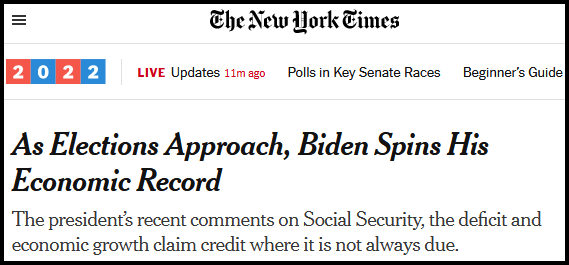
Last week, the New York Times wrote a puff piece which framed President Biden’s numerous gaffes during a Florida rally as ‘verbal fumbling.’

Biden conflated the war in Ukraine with the Iraq war, then lied when he said he got the two confused because his son Beau died in Iraq.

The same day, the White House was called out by CNN‘s Daniel Dale over a now-deleted tweet claiming “Seniors are getting the biggest increase in their Social Security checks in 10 years through President Biden’s leadership,” when in fact – as Dale noted, “The size of Social Security checks is linked, by law, to inflation. This year’s increase is unusually big because the inflation rate is unusually big.”

And while the White House deleted the Tweet, Biden repeated the claim twice last week. As The Blaze notes;

  • Speaking in Florida on Tuesday, Biden said, “And on my watch, for the first time in 10 years, seniors are getting an increase in their Social Security checks.”
  • Then at a campaign rally, Biden said on Tuesday, “On our watch, for the first time in 10 years, seniors are getting the biggest increase in Social Security checks, period.”

There’s a lot that’s wrong with that declaration. First of all, this will be the seventh increase in a row. Second, increases are routine because they happen automatically — based on changes to a particular calculation of the Consumer Price Index (CPI-W), and not the actions of the president. 

What makes Biden’s boast especially preposterous is that it ultimately points to the fact that what’s happened “on his watch” is 40-year-high price inflation.

Fast forward four days, and both CNN and the New York Times have gone scorched earth on Biden, in what appears to be a’ coordinated effort’ to distance mainstream Democrats against a President who’s become an increasing liability with batshit crazy comments, obvious confusion, and several recent sniffings.

On Friday, the Times took Biden and his White House to task for a series of false statements about the state of the economy and what Biden has done for it.  

For example, Biden routinely positions himself as an unprecedented cutter of budget deficits, as he did recently in Syracuse:

“This year the deficit, under our leadership, is falling by $1.4 trillion. Ladies and gentlemen, the largest ever one-year cut in American history on the deficit.” 

Not so fast, says the Times

Left unsaid was the fact that the deficit was so high in the first place because of pandemic relief spending, including a $1.9 trillion economic aid package the president pushed through Congress in 2021 and which was not renewed. Mr. Biden was in effect claiming credit for not passing another round of emergency assistance.

What the Times didn’t point out was that Biden and the Democratic Congress have teamed up to significantly increase deficits over the budget horizon, as illustrated by the Manhattan Institute‘s Brian Riedl:   

Fact check leads White House to delete tweet, then the spin begins…

Hilarity ensued over the Social Security self-own, as Twitter users “added context” that demolished the boast… causing Elon Musk to tweet; “The system is working.” 

After the White House deleted the tweet, press secretary Karine Jean-Pierre said, “Look, the tweet was not complete. Usually when we put out a tweet we post it with context, and it did not have that context.”

What’s particularly damning about the Social Security brag is that, rather than bubbling up in spontaneous Biden remarks — always a nail-biting experience for his team — this was part of a prepared speech. That speaks volumes about the collective economic wisdom of his controllers.  

The Times also hit Biden for saying — off the cuff — that he pushed student debt forgiveness through Congress, where “I got it passed by a vote or two.” 

Though many were quick to brand this a “lie,” when you consider he personally instituted debt forgiveness via an executive order that was many months in the making, it’s more likely it was the latest example of his accelerating mental decline.

Not surprisingly, the Times couldn’t bring itself to explicitly raise that possibility, but did note that Biden’s assertion was “perhaps the most head-scratching” of his false economic statements, as it was “starkly at odds with the reality,” especially when his executive order is now facing multiple court challenges.

The Times then called out misleading or false communications about economic growth, gas prices and inflation in general. 

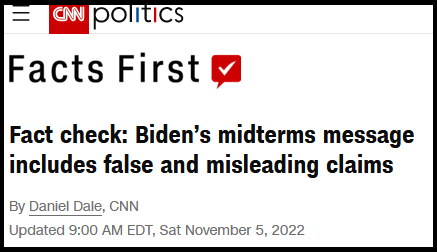
CNN, meanwhile, put out the following piece Saturday morning:

They ding Biden on the Social Security propaganda and lying about corporate taxes.

Biden repeatedly suggested in speeches in October and early November that a new law he signed in August, the Inflation Reduction Act, will stop the practice of successful corporations paying no federal corporate income tax. Biden made the claim explicitly in a tweet last week: “Let me give you the facts. In 2020, 55 corporations made $40 billion. And they paid zero in federal taxes. My Inflation Reduction Act puts an end to this.”

But “puts an end to this” is an exaggeration. The Inflation Reduction Act will reduce the number of companies on the list of non-payers, but the law will not eliminate the list entirely.

That’s because the law’s new 15% alternative corporate minimum tax, on the “book income” companies report to investors, only applies to companies with at least $1 billion in average annual income. (There are lots of nuances; you can read more specifics here.) According to the Institute on Taxation and Economic Policy, the think tank that in 2021 published the list of 55 large and profitable companies that avoided paying any federal income tax in their previous fiscal year, only 14 of these 55 companies reported having US pre-tax income of at least $1 billion in that year.

In other words, there will clearly still be some large and profitable corporations paying no federal income tax even after the minimum tax takes effect in 2023. The exact number is not yet known. -CNN

CNN then called out Biden for lying about the national debt and the deficit, the unemployment rate, his student debt cancellation scheme, gas prices, Chinese President Xi Jinping, and the Trump tax cuts.

What’s going on here?

Tyler Durden
Sat, 11/05/2022 – 14:00

Ukraine Starlink Terminals Reportedly Go Dark Over Funding Issues, CNN Claims

0
Ukraine Starlink Terminals Reportedly Go Dark Over Funding Issues, CNN Claims

More than 1,000 Starlink satellite internet terminals for Ukraine’s military to boost communication channels on the modern battlefield went dark, reported CNN, citing two sources familiar with the outage. This report comes even though Elon Musk has pledged to continue funding Starlink operations in the war-torn country. 

The outage has affected 1,300 Starlink terminals that Ukraine purchased from a British company earlier this year and used in combat-related operations. Each terminal costs $2,500 per month, with the batch costing $3.25 million per month.

Before the terminals went offline, Ukraine’s Ministry of Defense requested their British counterparts pick up the monthly bill several weeks ago, which amassed to a whopping $20 million since the 1,300 terminals were deployed in March. 

But since no one picked up the outstanding bill, the terminals all went dark on Oct. 24, according to one person briefed on the situation. They said this had sparked a “huge problem” for Ukraine’s military since the terminals are the primary communication link on the battlefield. 

Starlink’s parent company SpaceX penned a letter to the Pentagon in September, informing it could no longer maintain the service in the war-torn country unless it received funding. 

Musk recently tweeted the Ukrainian “operation has cost SpaceX $80 million and will exceed $100 million by the end of the year.”

Musk estimated that the 25,000 Starlink terminals in Ukraine would cost his company $400 million over the next 12 months. 

By mid-Oct., Musk appeared to change his mind in a tweet, in which he said: 

“The hell with it … even though Starlink is still losing money & other companies are getting billions of taxpayer $, we’ll just keep funding Ukraine govt for free.” 

However, one senior defense official told CNN that the Pentagon is actively negotiating with SpaceX to get the much-needed resources to keep Starlink operational in Ukraine. 

Tyler Durden
Sat, 11/05/2022 – 13:00

TSA To Continue Requiring COVID-19 Vaccine Proof For Non-US Citizens To Enter Country

0
TSA To Continue Requiring COVID-19 Vaccine Proof For Non-US Citizens To Enter Country

Authored by Mimi Nguyen Ly via The Epoch Times,

The U.S. Transportation Security Administration (TSA) has extended its COVID-19 vaccine proof requirement for non-U.S., nonimmigrant citizens flying to enter the United States, making the United States the only western country and among the few remaining countries in the world still to require such proof for entry.

The latest TSA security directive (pdf) states that effective to at least Jan. 8, 2023, aircraft operators must require each non-U.S., nonimmigrant citizen to present paper or digital documentation for “proof of being fully vaccinated against COVID-19,” or documentation proving the person is excepted from taking the vaccine, before boarding a flight to the United States.

A “nonimmigrant” means not a U.S. citizen, U.S. national, lawful permanent resident, or traveling to the United States on an immigrant visa.

According to the Centers for Disease Control and Prevention (CDC), being fully vaccinated means having had an accepted single-dose vaccine or a second dose of an accepted 2-dose series at least 14 days ago. A booster dose is not needed to meet the requirement.

It comes after the Biden administration in June dropped its requirement for air travelers entering the United States to test negative for COVID-19, meaning a person with the disease could still be allowed into the country, provided they have proof of vaccination.

The latest security directive largely matches that of the previous TSA security directive (pdf) that was made effective from Nov. 8, 2021, and is to expire on Nov. 8, after which the new directive will take effect.

Few Countries Still Require Vaccine Proof

While the vast majority of countries have dropped COVID-19 vaccine proof requirements for entry, the United States and a few other countries around the world continue to require them for non-citizens, with no alternate avenues for the unvaccinated such as requiring proof of immunity against COVID-19, a negative test, or a quarantine period instead.

These other countries include Pakistan, Indonesia, Ghana, and Liberia.

In the latest security directive, the TSA maintained language saying that the policies, alongside the CDC’s technical instructions and President Joe Biden’s Proclamation issued in October 2021, “are intended to limit the risk that COVID-19, including variants of the virus that causes COVID-19, is introduced, transmitted, and spread into and throughout the United States.”

The policies will “advance the safety and security” of travelers, government workers, and air travel industry workers while allowing the world’s economies to recover from the effects of the COVID-19 pandemic, the TSA security directive reads.

Vaccines Do Not Prevent Transmission

COVID-19 policies and restrictions have shifted in recent months in the United States, to no longer differentiate vaccinated and unvaccinated in mitigation measures, amid acknowledgement by officials and the general population that COVID-19 vaccines do not or no longer prevent transmission.

In July, the CDC adjusted its mask guidance to require people to wear masks in some areas even if they are fully vaccinated against the virus that causes the disease. At the time, CDC Director Rochelle Walensky told reporters that new research from several U.S. states and other countries “indicate that on rare occasions some vaccinated people infected with the Delta variant after vaccination may be contagious and spread the virus to others.”

The CDC in early August had made revisions to its COVID-19 prevention guidance such that it no longer differentiates based on a person’s vaccination status, because “breakthrough infections occur, though they are generally mild, and persons who have had COVID-19 but are not vaccinated have some degree of protection against severe illness from their previous infection.”

CDC Director Rochelle Walensky in August had noted that COVID-19 vaccines can no longer prevent transmission. She told CNN in an interview: “Our vaccines are working exceptionally well. They continue to work well for Delta with regard to severe illness and death, they prevent it. But what they can’t do anymore is prevent transmission.”

Waning Efficacy

The COVID-19 vaccines have proven increasingly ineffective to protect against infection and showed waning efficacy in protecting against hospitalization and severe illness amid newly-emerging variants. This prompted the governments of many countries to recommend boosters and subsequent boosters throughout the COVID-19 pandemic.

Meanwhile, the new bivalent boosters from Pfizer-BioNTech and Moderna, which were intended to enhance protection against Omicron and its different subvariants, haven’t been tested in humans at all. While the updated boosters triggered higher levels of antibodies than the old boosters when tested on mice, the trials didn’t provide any efficacy estimates for protection against infection or severe illness.

The CDC and its partner, the U.S. Food and Drug Administration, have aggressively promoted vaccination during the pandemic, even when little evidence supports the vaccines. The agencies have also repeatedly refused to release COVID-19 vaccine safety data, The Epoch Times previously reported.

The Epoch Times has found that officials in the United States are continuing to spread misinformation about COVID-19 vaccines, including unsupported or misleading statements about vaccine effectiveness and safety.

Tyler Durden
Sat, 11/05/2022 – 12:30

Manchin Massacres Biden Over “Outrageous” Coal Plant Closure Comments, “Divorced From Reality”

0
Manchin Massacres Biden Over “Outrageous” Coal Plant Closure Comments, “Divorced From Reality”

Senator Joe Manchin is pissed after President Biden said his administration would ‘shut down’ all of America’s coal plants and replace them with ‘wind and solar’ – comments that couldn’t come at a worse time for Democratic candidates in battleground states that are home to blue-collar Americans and the coal plants they work in, given next week’s midterm elections.

Folks, it’s also now cheaper to generate electricity from wind and solar than it is from coal and oil. Literally cheaper. Not a joke. I was just — and so we can accommodate that transition,” Biden said last week during a speech at communications company ViaSat in San Diego County.

“I was in Massachusetts about a month ago on the site of the largest old coal plant in America. Guess what? It cost them too much money.  They can’t count. No one is building new coal plants because they can’t rely on it, even if they have all the coal guaranteed for the rest of their existence of the plant. So it’s going to become a wind generation. And all they’re doing is — it’s going to save them a hell of a lot of money, and they’re using the same transmission line that transmitted the coal-fired electric on.  We’re going to be shutting these plants down all across America and having wind and solar,” Biden continued.

As the National Review notes, “Biden’s message could disadvantage Democrats just three days before midterms, considering that many of the battleground states that will determine the balance of power in Congress are home to coal plants and the blue-collar Americans who work in them. Pennsylvania has 24 plants, Ohio has 15 plants, and Michigan has 13 plants.”

In particular, Biden’s comments stand to hurt Pennsylvania Senate Candidate John Fetterman, who has flip-flopped on Fracking between 2018 and 2022 – finally admitting during a debate last month that he’s for it.

Manchin is livid

“President Biden’s comments are not only outrageous and divorced from reality, they ignore the severe economic pain the American people are feeling because of rising energy costs, West Virginia Democratic Senator Joe Manchin fired back.

“Comments like these are the reason the American people are losing trust in President Biden,” he continued, adding “Let me be clear, this is something that the President has never said to me. Being cavalier about the loss of coal jobs for men and women in West Virginia and across the country who literally put their lives on the line to help build and power this country is offensive and disgusting.”

Of course, a pissed off Manchin won’t have anywhere near the same impact as it once did, assuming Republicans take back the House, Senate, or both chambers in next week’s midterm elections.

Tyler Durden
Sat, 11/05/2022 – 12:00

Russia Warns That World’s 5 Nuclear Powers Are On Brink Of “Direct Armed Conflict”

0
Russia Warns That World’s 5 Nuclear Powers Are On Brink Of “Direct Armed Conflict”

Authored by Tom Ozimek via The Epoch Times,

Russia’s foreign ministry said it fears that the world’s five declared nuclear powers are “on the brink of a direct armed conflict,” with Moscow warning of a catastrophic fallout and insisting that avoiding a clash is its top priority.

The Kremlin statement, issued on Nov. 2, accused Western powers of “encouraging provocations with weapons of mass destruction” and called on the West to stop or face the prospect of “catastrophic consequences.”

Western powers, by contrast, have accused Moscow of issuing repeated threats to use nuclear weapons as its invasion of Ukraine has faced setbacks and to pressure Kyiv into accepting concessions.

The Kremlin recently accused Kyiv of planning to use a radioactive “dirty bomb,” claims that Ukrainian authorities have denied.

‘Unpredictable and Dangerous Consequences’

Following a Ukrainian attack on Russia’s Black Sea fleet in Crimea last week, Russia’s foreign ministry issued a statement on Thursday warning the United Kingdom of “unpredictable and dangerous consequences” after earlier accusing London of helping Kyiv orchestrate a drone attack on its ships in the port of Sevastopol.

“Such confrontational actions by the British pose the threat of an escalation and can lead to unpredictable and dangerous consequences,” the ministry said in a statement.

The UK, which Russia has also accused of being involved in the Nord Stream pipeline explosions in September, is one of the world’s five major nuclear powers.

Meanwhile, Russia’s foreign ministry said in the Nov. 2 statement that it sees avoiding armed conflict between nuclear powers as a key objective amid simmering tensions over the Ukraine conflict.

“We are strongly convinced that in the current complicated and turbulent situation, caused by irresponsible and impudent actions aimed at undermining our national security, the most immediate task is to avoid any military clash of nuclear powers,” the ministry stated.

‘Nuclear War Cannot Be Won’

The Kremlin added that it continues to stand by a joint declaration issued in January, in which China, France, Russia, the United Kingdom, and the United States pledged to do everything in their power to avoid a nuclear clash.

“We affirm that a nuclear war cannot be won and must never be fought,” the January joint statement reads. “As nuclear use would have far-reaching consequences, we also affirm that nuclear weapons—for as long as they continue to exist—should serve defensive purposes, deter aggression, and prevent war.”

On the same day that the Kremlin issued the warning that the five nuclear powers are teetering on the verge of armed conflict, the Pentagon said the United States has not seen any signs that Russia is preparing to use nuclear weapons.

At the same time, Pentagon spokesperson John Kirby denounced Russia’s rhetoric around the potential use of nuclear weapons.

“We’ve been clear from the outset that Russia’s comments about the potential use of nuclear weapons are deeply concerning, and we take them seriously,” Kirby said. “We continue to monitor this as best we can, and we see no indications that Russia is making preparations for such use.”

Amid what he calls a “special military operation” in Ukraine, Russian President Vladimir Putin has on several occasions hinted at the possibility of a nuclear strike, while Kremlin officials have repeatedly said Russia’s military doctrine permits the use of nuclear weapons if the country’s territorial integrity is under threat.

Moscow has sought to portray its actions in Ukraine as preemptive by accusing the West of seeking to establish Ukraine as a military bulwark against Russia, allegations NATO and Kyiv have denied.

Tyler Durden
Sat, 11/05/2022 – 11:30

UK’s Jeremy Hunt Set To Float Excise Tax For EVs Starting In 2025-26

0
UK’s Jeremy Hunt Set To Float Excise Tax For EVs Starting In 2025-26

Live by the incentive to go “green”, die by the incentive to go “green”. 

In what can only be described as the ultimate irony, UK chancellor Jeremy Hunt is expected to put an electric vehicle excise tax in place by 2025-2026. So much for the “tax breaks for buying EVs” angle to saving the environment…

This month’s Autumn Statement will include the measures, according to FT, who said people familiar with the road tax is part of a larger plan to address a fall in motoring tax revenues caused by the shift to EVs, which leave out fuel-related taxes.

Fuel duty raises about £35bn, but the Treasury has warned that a growing number of EVs on the road could cause this number to plunge by £2.1bn by 2026-27. Ergo, a new excise duty on EVs could take place by 2025-2026.

More than 1 million EVs on the roads of the UK could wind up being affected. As is the case globally, sales of EVs continue to accelerate, with about 15% of new vehicles sold so far this year moving away from traditional ICE power. 

By the time the tax could be put into place, there is expected to be several million more EVs on the road. FT wrote:

Owners of most petrol and diesel cars pay £165 a year in road tax and continuing the VED exemption for the growing fleet of electric vehicles could cost the exchequer around £1bn a year by the middle of the decade.

Although the sums involved are not huge at this stage, the introduction of road tax on EVs is seen by Treasury insiders as evidence of a “direction of travel”, with more taxes likely to be levied on them in years to come.

The Treasury has also warned that reaching the country’s 2050 net zero carbon targets would lead to lower tax receipts from the “fuel duty, vehicle excise duty, landfill tax, the carbon price floor and the emissions trading scheme”.

More details will be made available when the Autumn Statement is published on November 17. 

Tyler Durden
Sat, 11/05/2022 – 11:00

“Challenging Environment”: Top German Investment Bank Cuts Bonuses As IPO Market Freezes

0
“Challenging Environment”: Top German Investment Bank Cuts Bonuses As IPO Market Freezes

2021 was a record-breaking year for the European merger and acquisitions industry. On the other hand, 2022 dealmaking has underwhelmed due to volatile and fragile markets because of the invasion of Ukraine in late February, the energy crisis, increasing risks of recession, and central banks tightening financial conditions to rein in elevated inflation. 

All these factors contributed to a dismal year for dealmaking for the German multinational investment bank, Berenberg Bank. As a return, Bloomberg said the bank told staff to expect poor bonuses at the end of the year. 

“Due to weaker markets, in particular the much weaker activity in equity issuance, bonuses are likely to be limited and targeted,” European Equities head Laura Janssens told Bloomberg in a response on Friday. 

Last year, the German investment bank recorded the best year since its founding more than four centuries ago. This year’s freezing of the European M&A market has forced it to trim costs to survive market volatility, an increasing interest rate environment, and a low investor appetite for new issues. 

Bloomberg pointed out the bonus cuts announcement comes three months after Berenberg reduced its investment banker workforce in London by 5%, or slashing 30 jobs. Over the summer, it cut 50 jobs in the US as the IPO market has also frozen across the Atlantic. 

“Due to the more challenging environment, we have moved early to right size our cost base and are confident about our prospects heading into 2023 and beyond,” Janssens said Friday.

Dealmaking conditions in the US are equally as bad. 

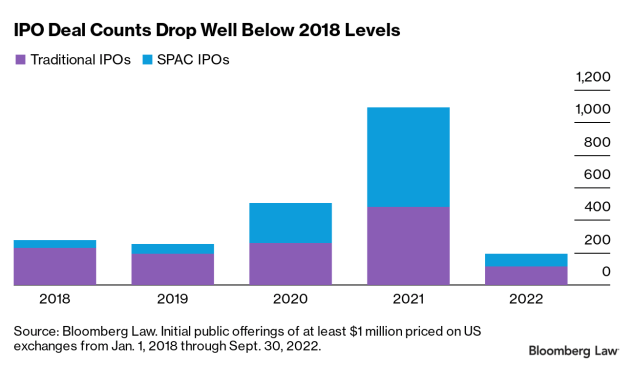
In the recently completed quarter, US IPOs were down 87.5%, and raised nearly 98% less capital compared to the first quarter of 2021, when new issues peaked. Only 52 companies went public in the US in Q3, raising $2.8 billion. — Bloomberg 

Reuters cited New York State Comptroller Thomas DiNapoli, who said Wall Street bonuses in 2022 are set to plunge 22% from last year’s figure. DiNapoli blamed challenging macroeconomic conditions that choked off demand for new issues. 

“The last two years of profits and bonuses fueled in part by the extraordinary federal response to the pandemic were not sustainable. “As the sector slows down in 2022, leading firms are reviewing staffing and office space needs and a prolonged downturn could negatively impact state and city coffers,” DiNapoli said.

JPMorgan’s latest “Flows & Liquidity” report sheds light on global dealmaking cratering this year. 

Also, IPO mentions in news stories across the web have dramatically fallen since the stock market frenzy during the Covid era

Global M&A trends point to further downside through early next year. A reversal for the industry will come when central banks pivot. 

Tyler Durden
Sat, 11/05/2022 – 09:55

Governor Of Dutch Central Bank States Gold Revaluation Account Is Solvency Backstop

0
Governor Of Dutch Central Bank States Gold Revaluation Account Is Solvency Backstop

By Jan Nieuwenhuijs of Gainesville Coins

The Governor of the Dutch central bank stated the gold revaluation account ensures the solvency of his central bank in an interview on television about prospective losses. The significance of this statement is that if any European central bank will cover losses by using its gold revaluation account in full, the ECB has to put a floor under the gold price. And if more losses need to be covered than the current gold revaluation accounts of European central banks allow, the ECB will need to revalue gold.

Introduction

A discussion has commenced in the Netherlands after Klaas Knot, Governor of the Dutch central bank (DNB), wrote a letter to Sigrid Kaag, Dutch Minister of Finance, on September 9, 2022. The letter is titled: “DNB foresees deterioration of capital position.” Knot warns Kaag of DNB losses due to interest rate hikes—decided by the European Central Bank (ECB) but applied by all National Central Banks (NCBs) of the Eurosystem. In recent years Quantitative Easing (QE) has made DNB, and all other NCBs, create an abundance in bank reserves to buy government bonds. Now the ECB is raising interest rates DNB has to pay banks more and more interest over their excess reserves. These expenditures cause DNB to suffer losses to the detriment of its capital position (equity). Note, all NCBs in the Eurosystem face similar challenges.

For this year DNB expects a small loss but for the years 2023 through 2026 a loss of €9 billion euros is expected. Though, it could be more. DNB’s equity is currently €11.3 billion. If the losses exceed €11.3 billion, DNB’s equity will become negative. Although it’s possible for a central bank to operate under negative equity, it does hurt credibility—a central bank’s most valuable asset. And once credibility is lost people will dump the currency issued by said central bank.

For this reason, Knot wants to discuss with the Dutch state (DNB’s sole shareholder) the possibilities of funding a recapitalization of DNB. In other words, if taxpayers can bail-out their central bank.

The Gold Revaluation Account as a Solvency Backstop

A gold revaluation account (GRA) is basically an accounting item that records the unrealized gains of a central bank’s gold. Because most of Europe’s monetary gold was accumulated during Bretton Woods at $35 dollars an ounce, the respective GRAs are substantial. Monetary gold in the Eurosystem is marked to market and the gold price today is much higher than $35.

Below is a simplified balance sheet of a central bank. On the asset side there are international reserves (gold and foreign exchange), a bond portfolio, and discount loans to commercial banks. On the liability side there is the monetary base (reserves and currency), a deposit account for the government, a GRA, and equity.

Interestingly, there is no limit on a GRA because gold is the only international reserve asset that can’t be printed. Denominated in fiat currencies, which can and are printed, the gold price doesn’t have a ceiling and it can inflate balance sheets likewise.

The GRA can be seen as equity but technically it isn’t at this point because it’s prohibited from being used. The current laws in the E.U. dictate: “there shall be no netting of unrealized losses in any one security, or in any currency or in gold holdings against unrealized gains in other securities or currencies or gold.” At this stage the GRA just swells and shrinks in sync with the rise and fall of the price of gold. But all this might change.

On Sunday October 30, 2022, Knot was interviewed by Buitenhof about DNB’s losses. When the solvency of DNB’s balance sheet was questioned Knot brought up the GRA.

Interviewer: So, what you’re saying is that the higher the interest rate by the European Central Bank, the more expensive it gets for us …

Knot: Yes, that is correct …

Interviewer: … and the more money is needed. Hold on, I want to finish my question, so we all understand. And the higher the probability the Dutch taxpayer has to pay to fix the balance sheet of the Dutch central bank of which I always thought, “that’s solid, it can’t fail.” This story is new to me.

Knot: The balance sheet of the Dutch central banks is solid because we also have gold reserves and the gold revaluation account is more than 20 billion euros, which we may not count as equity, but it is there.

Interviewer: But you don’t want to sell the gold?

Knot: No, we’re definitely not going to sell.

Using the GRA to cover losses doesn’t require selling gold, it requires changing the accounting rules. The reason it’s now prohibited from being used is because once fully run down a declining gold price will cause the GRA to become negative, eating into DNB’s net worth. The very thing DNB is trying to avoid. In the interview Knot thus appoints the GRA as a solvency backstop, but this implies putting a floor under the gold price.

This February I published an article about the possibility of European central banks revaluing gold and subsequently using their GRAs to cancel sovereign bonds as debt relief for governments. My analysis was based on an email exchange between me and the German central bank in which they stated they don’t rule out this possibility. In October I revealed that European central banks have equalized, proportionally to GDP, their gold reserves among each other in the past decades. This was done for all to enjoy the same relative gain in their GRAs when revaluing gold. According to my assessment, revaluing gold will only be done in an insurmountable crisis. After the gold revaluation sovereign debt would be cancelled, the gold price stabilized, and the eurozone effectively moves towards a new version of a gold standard.

In the 1930s GRAs had been used for several purposes. After devaluing against gold central banks eventually re-pegged their currencies to gold at a higher price, leaving GRAs to be used as they saw fit. As far as I know, no central banker has openly discussed using a GRA—to cover its own losses or cancel sovereign bonds—since Bretton Woods. Remarkably, in Buitenhof it wasn’t the interviewer that brought up the GRA, it was Knot! Since the word is out, central banks in Europe officially stand ready to change the rules and use their GRAs to guarantee their own solvency. In addition, once the rules are changed, it allows them to revalue gold and bail-out their governments too.

In final, the current trend is clear: financial challenges, caused by unconventional monetary policy, lead to more focus on gold’s role in overcoming these challenges. And I will be closely monitoring these developments.

Tyler Durden
Sat, 11/05/2022 – 09:20

In U-Turn, Bulgarian Parliament Votes Overwhelmingly To Send Arms To Ukraine

0
In U-Turn, Bulgarian Parliament Votes Overwhelmingly To Send Arms To Ukraine

For eight months, Bulgaria has been among a few holdout EU members, Hungary also foremost among them, which have refused to join NATO allies in shipping weapons to Ukraine for the war effort against invading Russian forces. 

But the eastern European country which sits across the Black Sea from Russia has signaled a big U-turn on the arms ban, with lawmakers in parliament voting Thursday to greenlight weapons transfers to Kiev.

The vote was overwhelming in favor: “The 175-49 vote in favor of the measure marked a rare moment of consensus among Bulgaria’s deeply divided political spectrum,” writes US state-funded RFERL. 

Shutterstock image

Members of parliament reportedly argued that sending weapons and parts to Ukraine would provide Bulgaria with the opportunity to modernize its weapons stock. This is to include “heavy guns” sent to Ukraine. 

Politico notes that a political bloc seen as “Russia-friendly” had long blocked efforts to do more to help Ukraine’s military. “This comes after the parliament previously blocked such a move amid opposition from the Russia-friendly Socialist party, then a coalition partner in the government,” the report says. 

“The newly adopted motion asks the Cabinet to launch talks with NATO allies to replace or boost defense capabilities in exchange for more quickly freeing up its Soviet-era military equipment,” Politico adds. 

At this point, the policy shift leaves Hungary as the only NATO country to refrain from supplying arms to Ukraine – something not expected to change anytime soon under Viktor Orbán, also given the country’s deep energy dependency on Russia. 

Bulgaria has thus far provided arms only indirectly via third party countries purchasing the weaponry, estimated at over €1 billion worth so far throughout the conflict. 

Tyler Durden
Sat, 11/05/2022 – 08:45