The Department of Health and Human Services (HHS) is examining electromagnetic fields, Health Secretary Robert F. Kennedy Jr. said on Sept. 17.
The department issued a request for researchers and others to provide input on the impact of electromagnetic field (EMF) exposure, including radiation from radiofrequencies, as it works to figure out the current evidence base and craft recommendations for schools and families.
Concern about the potential health effects of the exposure “has increased, particularly in relation to children, schools, and long-term cumulative exposure,” Kennedy wrote in the document. “At the same time, scientific literature is extensive, technically complex, and not always easy for policymakers or public health stakeholders to interpret.”
Evidence submitted by the public can include peer-reviewed studies, government reports, and industry data, he said. Individuals can also share experiences of health effects they believe may be associated with exposure to EMFs. They should outline the types of technology involved, the nature and duration of the exposure, the health effects, and any treatment that was sought.
Comments will be accepted for 30 days, starting on Sept. 21.
Kennedy, a lawyer, has been involved in litigation involving electromagnetic fields, including a case against the Federal Communications Commission that resulted in a court in 2021 finding the agency’s decision to keep in place 1996 wireless radiation limits was arbitrary and capricious because it “failed to provide a reasoned explanation for its determination that its guidelines adequately protect against the harmful effects of exposure to radiofrequency radiation unrelated to cancer.”
The ruling, from the U.S. Court of Appeals for the District of Columbia Circuit, ordered the agency to properly review information regarding health effects from exposure to wireless radiation.
Children’s Health Defense, which Kennedy once chaired, recently brought a new case challenging the commission’s apparent failure to comply with the order.
The agency has until later in September to reply. It states on its website that “no scientific evidence currently establishes a definitive link between wireless device use and cancer or other illnesses.”
Kennedy told a conference in Washington on Thursday that filings to the court that led to the win included more than 10,000 studies.
“But there are still gaps in knowledge, and we’re filling those,” he said. “HHS is reviewing the regulatory landscape, and we will release a report this fall.”
The report will include evidence submitted in response to the request for information, Kennedy said.
“We’ve opened the process to the public because these questions deserve rigorous science, transparency, and answers,” he said.
Iran Submits Conditions For Ending War With US Via Qatar, Awaits Trump Response
Iran has announced Saturday that its Supreme National Security Council has submitted Tehran’s conditions for ending the war with the United States via Qatar, and that it awaits the Trump White House’s response.
“We are in contact with the Qatari intermediary who conveyed our conditions to Washington to end the war, and we are awaiting a response from President Trump,” the supreme council’s secretary Mohsen Rezaei said.
But he warned that if Washington doesn’t comply, the Islamic Republic is ready for a “decisive war”. The conditions, according to his summary, features–
“the end of the war on all fronts, the release of frozen assets and the end of the naval blockade.”
“Iran has become convinced of the need to change its strategy towards Washington following the US withdrawal from the memorandum of understanding,” Rezaei explained in words given to Al Jazeera.
He blasted US and Israeli calculations which have been on display through over six months of war as “flawed” and asserted that the conflict was ultimately instigated by Netanyahu.
“Iran knows the US military’s vulnerabilities and is more prepared than ever to counter its air strikes,” Rezaei stated. He went on to claim that Iranian forces recently tested an anti-ship missile near a US aircraft carrier.
“Iran is serious about defense,” the high-ranking Iranian security official continued, and “if attacked, will strike US bases and Washington’s interests in the region with greater force.”
Meanwhile, President Trump continues to shut down critics of his “little excursion” in the Middle East, which is increasingly an obvious quagmire from which the US is seeking to extricate itself, by saying that high fuel prices don’t matter in light of the potential for Iran obtaining a nuclear weapon.
Interestingly, at the same time Iran continues to seek to demonstrate it is not bent on achieving nuclear weapons status.
Iran complies with a fatwa issued by the late Ali Khamenei prohibiting the development of nuclear weapons and has not yet decided to withdraw from the Treaty on the Non·Proliferation of Nuclear Weapons.
“We still adhere to the fatwa of the late supreme leader and have not changed our nuclear doctrine, but we do not know what will happen in the future. We have not yet made a decision to withdraw from the Non·Proliferation Treaty, and this issue depends on Washington’s behavior,” said Mohsen Rezaei
However, according to Rezaei, the actions of the United States and Israel allow Iran to withdraw from the treaty.
The Iranian official in the fresh remarks also addressed the escalating Saudi-Yemen war. He described that the Houthis seek a peace settlement with Saudi Arabia, and suggested a broader US-Iran deal would facilitate that.
Of course, Tehran at the same time knows that the Houthi advance along the Red Sea coast has only increased Iranian leverage over global energy – given the Yemeni rebels are now in easter shooting distance of the vital Bab Al-Mandab Strait. Iranian advisers are likely coordinating with the Shia Ansar Allah movement as it battles the Saudi coalition.
Nearly 60 Democratic members of Congress signed a letter to sound an alarm: Black Americans are being found hanging, including some from trees, in a wave of possible “modern-day lynchings.”
Their letter to the Justice Department and FBI stated, “The series of deaths raise significant suspicion of foul play given the role of lynching in our nation’s history.” Rep. Ayanna Pressley called it a “national crisis.” Rep. Alexandria Ocasio-Cortez, who signed the letter, tweeted about “widespread modern-day lynchings” and “racial terror.”
Every suspicious death deserves investigation. But history is not evidence. What are the facts?
Demartravion “Trey” Reed, 21, was found hanging at Delta State University in Cleveland, Mississippi. The medical examiner found no foul play and ruled the death suicide. His family confirmed that his girlfriend said Reed sent suicidal texts the previous night.
In Raleigh, North Carolina, a 32-year-old black man was found hanging downtown. Video showed him acting alone with a cord. His mother said he suffered mental health problems.
Juliana Nzita, 16, was found on church property in Charlotte. Investigators found no defensive wounds, assault, foul play or outside involvement.
Justice Kai James, 21, was found hanging at a Job Corps center in Albany, Georgia. Authorities called it suicide.
Kyle Bassinga, 21, was found hanging in Cobb County; video showed him entering the woods alone. Authorities called it suicide.
To’Nea Nicole Miller, 27, was found hanging in Miami’s Gwen Cherry Park. Authorities called it suicide.
Jerard “Jay” Jackson, 28, was found near a trail in Rothbury, Michigan. Authorities called it suicide.
Tasia Fortune, 29, was found hanging behind an abandoned house in Jackson, Mississippi. Her death was ruled homicide. Police arrested Jarques Ratliff, a 51-year-old black man who knew her. His motive is unknown.
According to Centers for Disease Control and Prevention data, more white Americans than black Americans die by suicide by hanging, and whites do so at a higher per-capita rate. In 2020, 10,573 white Americans and 916 black Americans died by suicide by hanging, strangulation or suffocation. The age-adjusted rates were 4.6 per 100,000 for whites and 2.0 for blacks.
This blacks-being-lynched hysteria recalls the supposed epidemic of racism-driven black church burnings in the 1990s. The mainstream media pushed the narrative of organized white terrorists torching black churches across America. Then-President Bill Clinton created a national task force.
The investigation found no national racist conspiracy. From 1995 through September 1998, authorities investigated 670 arsons, bombings or attempted bombings involving houses of worship. Two hundred twenty-five involved predominantly black churches. Most did not. Of the 106 suspects arrested for arson at black churches, 68 were white, 37 were black, and one was Hispanic.
Some fires were indeed racist crimes, but the sweeping media narrative was false. America had again been stampeded into believing white racism had suddenly and everywhere reared its head.
Meanwhile, these so-called leaders ignore the elephant in the room.
They ignore the epidemic of black children born without a father married to and living with their mother, despite overwhelming evidence that two-parent families improve economic, behavioral and educational outcomes.
They ignore the crisis of K-12 schools in urban America, where most black fourth graders are not proficient in reading or math. Leftist politicians and teacher unions control and defend public urban schools.
They ignore black-on-black crime. In 2023 more than half of the nation’s homicide victims were black, and of those victims, nearly 90 percent of the identified offenders were black.
They ignore the effect of illegal immigration on black joblessness and wages. A U.S. Commission on Civil Rights investigation found that illegal immigration has tended to increase the supply of low-skilled labor and depress both wages and employment rates for low-skilled American workers – a disproportionate number of whom are black men. Research presented to the commission estimated that the immigration influx from 1980 through 2000 reduced the employment rate of low-skilled black men by 8 percentage points. Other research estimated that immigration cost the average American man without a high-school diploma approximately $1,800 annually in reduced wages.
Black truth-tellers who identify these problems are smeared as “Uncle Toms” and “sellouts.” The Ku Klux Klan could not have designed a more destructive arrangement.
If black leadership malpractice were a crime, many politicians would be staring at life without the possibility of parole.
Views expressed in this article are opinions of the author and do not necessarily reflect the views of The Epoch Times or ZeroHedge.
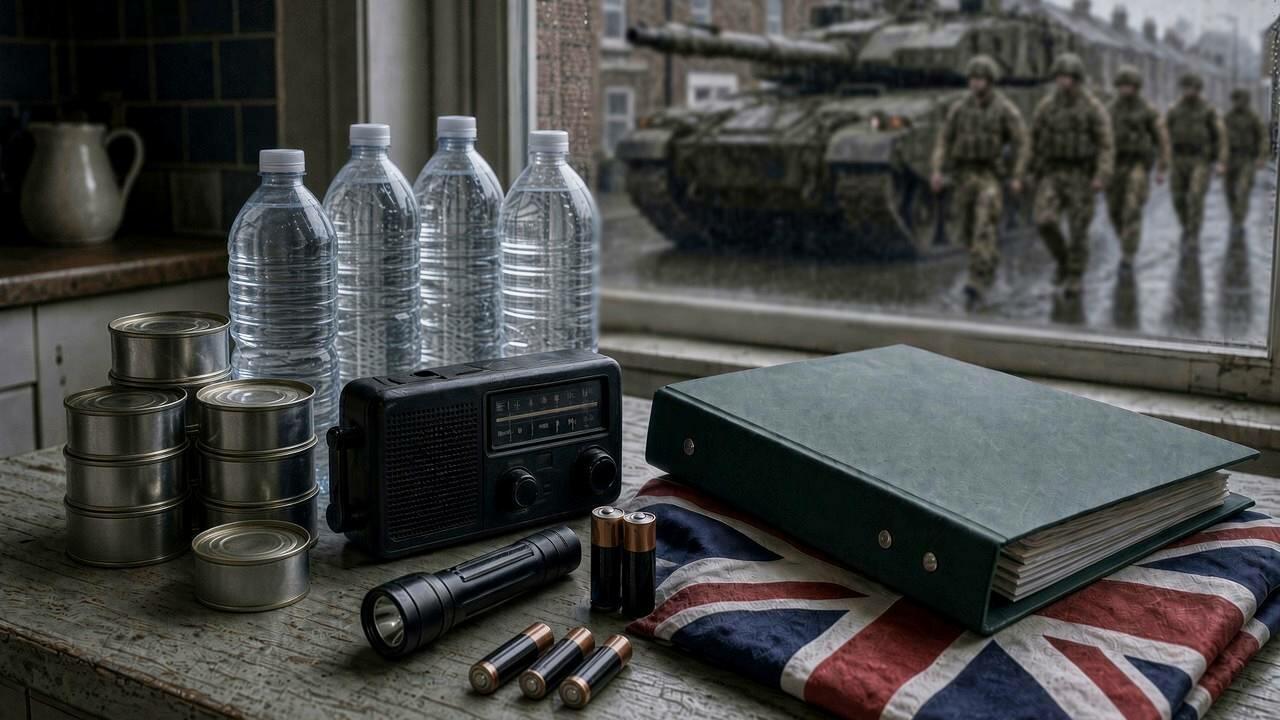
The British government is dusting off a classified Cold War manual, telling households to stockpile tins and bottled water at home, while state media is putting out articles debating whether the country is mentally prepared for war.
The classified Government War Book is being rewritten for the first time since 2004. The old document set out how ministries would keep food moving, communications open and government itself functioning if conflict reached the homeland.
After the Cold War it was mothballed. It is now being revived as part of a Home Defence Programme that officials say will align military and civilian responses if international hostilities hit the UK mainland.
?? Britain is dusting off its old “war book” and telling the public to start preparing for the possibility of serious disruption, including keeping canned food and drinking water at home.
The government is updating emergency plans that haven’t been revised in decades, while the…
Households are being told to prepare to go without power, water or the internet. The Cabinet Office checklist is blunt: bottled water, non-perishable food, essential medicines, a first-aid kit, a torch, a power bank, spare batteries and a wind-up or battery radio.
One official, speaking to the Financial Times, insisted the campaign would not be “duck and cover.” “There will be practical advice on things you can do to improve domestic resilience, like having some bottled water and tinned food. It will be common sense, not scaremongering.”
Britain Rewrites Its 22-Year-Old ‘War Book’ as Families Told to Stockpile Food and Waterhttps://t.co/JWfxDnly4H
Chief Secretary Darren Jones put the same line to MPs: “The government will do all it can and we are well prepared – but we can all play our part to keep ourselves and our loved ones safe. This campaign will help the public to take small but important steps to be prepared in case of emergencies and disruption – be that severe weather or a cyber-attack, which can impact access to power, water, or phone signal.”
The plans are due to be stress-tested in 2027 in Exercise Albiston Shadow, described as the largest home defence drill in decades. Ministers and hundreds of officials will role-play a multi-day crisis built around hybrid attacks – cyber disruption, sabotage, interference and disinformation – rather than tanks on Whitehall. Some home-defence work has reportedly been pulled forward from 2035 toward 2030.
Armed Forces minister Louise Sandher-Jones framed the whole package around Moscow: “Russia is not only a threat to NATO’s eastern flank. It is a direct threat to the UK homeland and these exercises, together with important measures like updating our ‘War Books’, will help prepare us to meet that threat, as well as showing the British public how seriously we are taking it.”
Chief of the Defence Staff Sir Richard Knighton has said the same in plainer language. “In my 35-year career, this is the most dangerous period that I have known.” He added that “the risks and threats to this country are greater than I have known since the Cold War,” that Russia is “probing, challenging, testing our defences,” and that “society and all of us” may have to accept “different choices and different priorities.”
The BBC this week pushed the mood further. “War may be coming. Are we psychologically ready?” asked correspondent Allan Little, noting the stockpile drive and the War Book rewrite.
Historian Margaret MacMillan told the BBC: “It’s not the tanks you need to worry about. It’s the cutting of cables on the ocean floor. It’s the hacking into systems on which so many things depend.” After 80 years without war on British soil, she said, “I don’t think we are psychologically prepared.”
Retired general Sir Richard Shirreff compared the moment to “those Edwardian summers before 1914, when there was a lot of talk of war but the notion of actually going to war seemed so far-fetched as to be beyond belief.”
That is the version of events ministers talk about in public. It is not the only reading.
In 2025, Professor David Betz of King’s College London, a specialist in modern and unconventional war, argued that Whitehall is hardening the homeland against domestic fracture while using a Russian invasion narrative as political cover.
Pointing to the 2025 National Security Strategy line that Britain must “actively prepare for the possibility of the UK homeland coming under direct threat,” Betz said the apprehension is real – and internal.
“But that’s not external in origin, that’s internal, and that has to do with the way our society is now configured, it is highly fractured.” He described “low trust, highly fractured, and highly politically factionalised which is leading us increasingly inevitably into civil conflict.”
On the invasion talk he was dismissive: “The fact of the matter is there is a great distance between us and Russia… we are not militarily threatened in a direct way on the ground by any obvious external enemy, even Russia… one of those is not occupying the village green with Russian soldiers, that simply, frankly, is a rather bizarre assertion.”
The politically unsayable part, in his account, is this: “What they’re concerned about is domestic conflict, and they perfectly understand this, but that’s completely politically toxic for them to say so publicly.” A citizen force to guard infrastructure sold as anti-Russian preparation is, he said, “a logically absurd proposition, but it is convenient as a pretext.”
Elon Musk has also said as much. In a July clash with The Economist‘s Zanny Minton Beddoes he called civil conflict in Britain a “reckoning” on present trends. “If you have a large and growing, rapidly growing, group of people whose beliefs are antithetical to western beliefs, at some point there will be a reckoning.”
Beddoes reached for the “far right” smear. Musk’s reply: “No, I support the NORMAL people. What you call the far right FALSELY.” He added he is “against rape and murder” and “against the imposition of rules and laws that are contrary to what we’ve come to accept in the West.”
Stockpiles, War Books and “whole of society” drills fit a foreign hybrid-war briefing. They also fit a state that no longer trusts continuity of basic services in a low-trust, factional country – and will not name the policies that produced that state.
The contradiction is sitting in plain sight. Days ago the same government posture that talks up existential danger was still starving the force that would have to fight.
The British Army has been ordered to pause most “non-essential” collective training for UK-based units on standby – live-fire work, armour and Apache drills – because the Ministry of Defence’s day-to-day budget cannot cover fuel and ammunition at current prices.
Only a sliver of units are deployed. The surface fleet has shrunk from nearly 50 fighting vessels two decades ago to around 22. Defence spending rises on paper are eaten by inflation. Welfare spending is up 16 per cent in five years. The military is told not to raid health or education to fill a hole of roughly £1.4 billion a year.
A state that cannot fund tank training is not “war-ready.” A state that tells families to buy their own water while it funds mass settlement and the welfare load that follows is not serious about cohesion either. Sir Richard wants “different choices and different priorities.” Those choices keep landing on tins in the cupboard, not on borders, remigration or a force that can actually fight.
Andrew Michta, a strategic studies professor, told the BBC the deeper problem is mental as much as material: “The UK is also largely disarmed and, most importantly, mentally. There is no readiness for what’s happening because the policy elites are not addressing their publics in a way that would honestly state the gravity of the situation.”
The gravity they will name is Moscow. The gravity they will not name is a society they helped pull apart, then briefed to stockpile against the dark. The War Book can be rewritten. The cover story writes itself.
14-Country Maritime Defense Alliance Moves Closer To Deploying To Red Sea, Gulf Of Aden
With Saudi shipping traffic in the Bab al-Mandeb Strait under unprecedented peril, the recently-launched Multinational Maritime Defense Coalition is moving closer to deploying ships to ensure freedom of navigation in the Red Sea, the Saudi Ministry of Defense announced on Friday.
Formed on July 30 at the initiative of Saudi Arabia, the Multinational Maritime Defense Coalition comprises 14 countries: Saudi Arabia, Kuwait, Bahrain, Qatar, Pakistan, Turkey, Egypt, Jordan, Yemen, Bangladesh, Nigeria, Sudan, Djibouti, and Somalia. Representatives from 41 countries and the European Union, including 154 naval officers and officials, attended the coalition’s fourth planning meeting at the Saudi Western Fleet Command in Jeddah.
“The Alliance is currently working on integrating capabilities and preparing for operational implementation and actual presence in the maritime operations area, following its achievement of the Initial Operational Capability stage,” the Saudi Defense Ministry said. The undertaking is organized to encompass joint training, intelligence-sharing, and — most importantly — maritime security operations. The entity is headquartered in Riyadh, Saudi Arabia, and commanded by Saudi Major General Abdullah Al-Shahri.
On Friday, Al-Shahri told reporters the coalition will confront any threat to maritime navigation, but it’s far from clear how much impact it will have.The fact that the entity has been the topic of very little conversation amid the growing economic crisis emanating from the Middle East suggests the markets are profoundly skeptical.
“We have seen several maritime security initiatives before, including those established during the piracy crisis in the Gulf of Aden,” International Crisis Group’s Ahmed Nagi told al Jazeera last month. “While some of these initiatives had political significance, many struggled to translate their objectives into tangible results on the ground.”
Saudi Arabia has invited European states to join the coalition, but they’ve thus far been reluctant to join. In July, diplomats told the New York Times the Europeans wanted to see how the coalition’s schemes and expectations developed before taking the plunge. When it formed, the coalition stressed that it was “purely defensive and not targeting any country.”
The coalition was formed just 10 days after Yemen’s Ansar Allah movement — nicknamed “the Houthis” after its founder — announced a blockade on Saudi-related shipping in the Red Sea. Earlier this month, Ansar Allah achieved a stunning battlefield success by seizing the remainder of Yemen’s Red Sea coast it hadn’t yet controlled — by the group’s claim, some 2,000 square miles. The lightning blitz put well-armed Ansar Allah forces directly beside the Bab al-Mandeb Strait, and on islands that command it. Though frequently called “rebels,” Ansar Allah — “Defenders of God” — controls Yemen’s capital and territory in which some 80% of Yemenis live.
Following the west-coast setback for Ansar Allah’s Saudi-backed opponents, the kingdom was dealt another major blow when Iraqi militias struck Saudi Arabia’s east-west pipeline, which had been serving as a critical export outlet amid the near-closure of the Strait of Hormuz. With the pipeline requiring repairs that will take weeks if not months, Saudi Aramco has started cancelling October crude oil delivers to Europe.
Des Moines, Iowa, ranked first and Los Angeles ranked last in Realtor.com’s inaugural report grading the 100 largest U.S. metros on housing affordability and homebuilding activity.
The results highlighted how local zoning and permitting can affect housing affordability in different areas.
The real estate platform’s first Metro Affordability and Homebuilding Report Card, released on Sept. 16, showed that Des Moines received an “A+” grade with a score of 83.4, the highest among the 100 metros analyzed, reflecting its strong residential construction activity and affordability.
The city has a median listing price of $349,903, with the monthly mortgage payment requiring 27.5 percent of a median-income household’s income, below the commonly cited threshold of 30 percent.
The calculation assumed a 10 percent down payment and a 30-year fixed-rate mortgage with a 6.5 percent interest rate.
At the other end of the list, Los Angeles received an “F” grade with a score of 12, leaving it at the bottom of the 100-metro ranking.
The median listing price in the city stands at $1.129 million, requiring a household earning the median income to spend 84.4 percent of its income on the monthly mortgage payment on a typical home, according to the report.
Meanwhile, the report said that local housing policies can help explain the gap between the highest- and lowest-performing metro areas in new home construction and affordability.
“Beyond land availability, the biggest difference between the ‘A’ metros and the ‘F’ metros is local housing policy, especially related to zoning and permitting,” Realtor.com senior economist Joel Berner said in the report.
“The ‘A’s share regulatory flexibility and streamlined approval processes, while the ‘F’s are locked in restrictive land-use frameworks.”
The report noted that Des Moines had a permit-to-population ratio of 1.85, meaning the city was issuing permits for new homes at a rate 85 percent higher than the national average relative to its population.
By contrast, Los Angeles’ ratio of 0.47 meant that the city was permitting less than half the national average relative to its population.
“The combination of extreme affordability pressure and limited new supply placed it at the bottom of the class,” the report noted.
Along with Los Angeles, New York City, Providence, Rhode Island, Honolulu, and Boston also had failing grades.
For example, Berner said, Boston has four times as many pages of zoning law as Austin, Texas, and 79 percent of its land is zoned, compared with just 15 percent in Austin.
Minimum parking mandates apply to 88 percent of land in Boston, while in Austin, the requirement is 37 percent.
Boston also has less land that allows unrestricted accessory dwelling units, limiting the supply of smaller, more affordable homes.
“The contrast between Austin and Boston makes clear that the rules governing what can be built can be just as consequential as the land available to build on,” Berner added.
Those top-ranked metros with less restrictive zoning and permitting also include: Raleigh, North Carolina; Columbia, South Carolina; Houston; and Indianapolis.
Regionally, the South and Midwest performed best for both new construction and affordability, while the Northeast and West lagged.
The report attributes the difference to more available and lower-cost land in the South and Midwest, in addition to more flexible zoning and permitting policies.
“Homebuilding and affordability are inseparable, and if we want to improve affordability in a lasting way, we need to build more homes,” Realtor.com chief economist Danielle Hale said in the report. “The metros at the top of these rankings show that buyers benefit most when communities pair homes that are attainable for today’s local earners with enough new construction to support tomorrow’s demand.”
In its Sept. 16 report, the National Association of Home Builders (NAHB) and the Wells Fargo Housing Market Index found that builder confidence in September hit the lowest level since September 2025.
“Buyer traffic has weakened across much of the country, largely because of rising mortgage rates,” NAHB Chairman Bill Owens said in the report.
The average 30-year fixed mortgage rate was 6.95 percent for the week ending Sept. 17, up from 6.76 percent the previous week and 6.26 percent a year earlier, according to Freddie Mac.
Owens also said builders continue to face higher material costs, rising energy prices, and ongoing labor shortages.
NAHB chief economist Robert Dietz added that 42 percent of builders rated current lot availability as “poor,” and 38 percent as just “fair.”
According to Realtor.com, the United States remains short of more than 4 million homes, putting financial strain on first-time homebuyers.
Trump-Xi Summit Cheat Sheet: New Deals, Extended Trade Truce, But No Breakthrough?
The White House released an itinerary for next week’s Trump-Xi meeting, including plans for Trump to greet Chinese President Xi Jinping at Joint Base Andrews. Ahead of the summit, Bank of America analysts outlined modest expectations, telling clients they see “little scope for a major trade breakthrough.”
Bloomberg reports that Trump will welcome Xi at Joint Base Andrews on Wednesday, opening a visit that includes bilateral talks and a White House state dinner on Thursday.
Trump and Xi will be at the White House on Thursday for a military review in the Rose Garden. First Lady Melania Trump and Xi’s wife, Peng Liyuan, will attend a separate event in the Washington metro area, with details yet to be announced.
That evening, Trump will host Xi for a state dinner in the East Room. Both presidents are scheduled to deliver opening remarks to guests, including technology and finance executives.
Bank of America China and Asia economist Anna Zhou penned a preview of next week’s Trump-Xi meeting, saying both sides are expected to extend their trade truce and announce new commercial deals.
Zhou expects a one-year extension of the existing trade agreement, which expires Nov. 10, alongside additional Chinese purchases of US goods and targeted tariff relief.
“We expect the Trump-Xi summit with the most likely outcome being an extension of the existing trade ceasefire, supplemented by additional Chinese purchases and limited tariff reductions on non-sensitive products,” Zhou said.
She added, “We see little scope for a major trade breakthrough or a substantive new framework for AI-chip licensing. The reported participation of Chinese CEOs is a constructive signal, but it should be treated cautiously unless it produces concrete purchases, investments or market-access commitments.”
Zhou’s cheat sheet on what to expect next week:
Separately, JPMorgan analyst Feng Zhu previewed next week’s summit for clients, saying neither side will offer a “grand bargain,” but that he expects “more deals.”
Zhu expects:
We expect limited stabilization, with strategic stability a key measure of success.
Iran and strategic waterways offer the clearest geopolitical upside, despite tensions over China’s links to Tehran.
The economic package should exceed May’s but remain narrow: tariff restraint, a renewed rare earth truce, limited chip licensing, additional purchases, and selective investment.
On AI, a risk-management dialogue is more likely than a binding governance agreement.
The likely outcome is strategic accommodation within managed decoupling, not partnership or a grand bargain.
With just days until the summit, tensions are rising, but the meeting remains on track, so far…
They were right, but along with love must come marriage.
But marriage rates have plummeted, especially among young men.
A Pulitzer Prize-worthy story by Sean Salai of The Washington Times crunches all the numbers. To say they are worrisome would be a vast understatement.
– In 2025, nearly twice as many men ages 18 to 39 were unmarried as were married.
– There were 30.4 million unmarried men ages 18 to 39 in 2025, up 47 percent from 20.7 million in 2000.
– In the same period, married men in this age range dropped by 15 percent, from 18.1 million to 15.4 million. “Such men are more likely to be lonely, prone to deaths of despair and unhappy,” according to Brad Wilcox, a University of Virginia sociologist.
– Forty-two percent of working-class men are unmarried, according to educational psychologist Donna R. Turner. In 1980, 73 percent of working-class men were married.
I could go on and with these depressing statistics.
But I believe the decline in marriage and children is a threat to the American future much more dangerous than even the national debt, climate change, cancer or foreign aggression.
Family is the essential organizing unit in America. We’re not to live in Soviet-style communes where the authority figure is “Big Brother.”
Every study shows that the decline in marriage among young men is tied to alcoholism, violent crime, drug abuse, pornography, depression, isolation, less economic success and suicide.
Are women to blame?
Certainly. Study shows that as women have become more career oriented, they are having a harder time “marrying up.”
Generation X and millennials have become choosier in finding a mate and more likely to have children alone, if they have them at all.
“Women have less structural need for marriage than past generations did,” said Angelica Gianchandani, a New York University finance instructor. “Rising income and education give many women a financial independence marriage once provided, and donor sperm and fertility treatment have decoupled motherhood from a partner altogether.”
Women are much less likely to be religious today than in decades past. So holy matrimony is less of a lifetime priority or moral obligation.
We do know that when women raise children without a father in the home – for whatever reason – their kids, especially their sons, are less successful. It’s a particular problem for black women to find a suitable mate when so many young black males are incarcerated.
I’m thrashing for explanations and solutions to this deeply troubling social trend. Obviously, we are not returning to the “Father Knows Best” norms of the 1950s or 1960s.
But recovery starts with admitting we have a problem. I would suggest that President Donald Trump announce a national bipartisan commission on “Rediscovering Love, Marriage and Parenthood.”
One last stat to underscore the urgency of turning around these trends:
The latest Census Bureau data indicate that 47 percent of households were headed by married couples last year, down from 78.8 percent in 1949.
That trend MUST be reversed to advance America’s economic prosperity and human happiness.
Views expressed in this article are opinions of the author and do not necessarily reflect the views of The Epoch Times or ZeroHedge.
Syria Rejects Desperate Saudi Plea To Deploy Militants To Yemen
Provocative rumors have been flying all week that Saudi Arabia has recruited Syrian militants to fight the Houthis in Yemen, at a moment the Iran-aligned rebel groups is said to be rapidly gobbling up more territory, especially along the Red Sea coast.
The claim has been especially strong in Lebanese media, after prominent Al-Akhbar reported this week that hundreds of Syrian fighters were recently transferred to southern Saudi Arabia, including fighters who took part in the Jolani/HTS-led fight to topple Bashar al-Assad in December 2024. However, it’s unclear if the alleged fighters have Syrian state backing (whether on a covert level or not), or if they could be there on their own initiative as mercenaries.
The Saudis had provided strong covert support, along with other Gulf states, to the over decade-long effort overthrow of Assad, and so Riyadh could now being calling in favors from Damascus.
The phenomenon of Syrian mercenaries and foreign fighters transferred in large numbers to other broader conflict theatres is not without precedent, as many are still said to be in Libya.
However, their deployment in Yemen might not yet be a reality, and it could just be that Saudi officials have pitched it as just an idea or possibility, amid the ongoing appeal also for more help from Western allies including the US and Britain.
On Friday Turkish media is reporting that Damascus has rejected the alleged Saudi plea to send Syrian militants for fighting in Yemen. According to Turkiye Today:
Syrian sources who spoke to Türkiye Today said Saudi Arabia had in recent months sought fighters to meet its military needs in Yemen, but that the Syrian government had “politely” rejected a request to organize and deploy a Syrian force against the Houthis.
“This issue has been exhausted and is over. The Saudi request was made several months ago. Syria politely turned it down, saying it was focused on its own military organization process and did not intend to enter a conflict as a third party,” one of the sources said.
However, the same sources indicated the Sharaa/Jolani government would not prevent Syrians as individuals from traveling for the purpose of assisting the Saudi coalition.
Separate reports this week have speculated that Turkey could get involved in the fight for Yemen on Saudi Arabia’s behalf based on the recently inked Mecca Defense Pact. But that too is simply at the level of unfounded rumor at this point.
The same Turkish media report underscores, “Claims that Türkiye had played a role in transporting or organizing Syrians for deployment to Yemen were also rejected by Turkish sources.”
Who would have thought that rising fuel prices caused by an Ansarallah Houthis attack on a Saudi Arabia pipeline may topple the Ahmad Al Sharaa regime in Syria?
The unnamed sources said: “We have no involvement in this matter. Syria and Saudi Arabia are sovereign countries.” As for Turkish media, the reports of Damascus slamming the door on Riyadh ring true given post-Assad Syria is facing serious problems on many fronts, especially internal unrest and large demonstrations this week over fuel price hikes. It doesn’t have the military power or resources to get much involved in Yemen at this stage.
But on the other side of this, it also remains true that the Turkish government has long sought to use Syrian militants as fodder for its grander designs in places like North Africa.
This is the transcript of a lecture given in London last night to the Global Warming Policy Foundation by Sir Richard Dearlove, the former head of MI6, titled ‘Energy Security: Blowing in the Wind’. The full lecture is available to watch on YouTube.
A summer of drought and record temperatures has discomforted the country: parched ground, overheated public transport, sleepless nights and a distorted and obsessive media. It is a distracting backdrop for a lecture on energy security – ‘climate change’ must be the most repeated phrase of the last three months since the first heatwave of the summer back in May. To step out of this context will seem like a heresy to the ideologues of Net Zero. Are you blind to the disturbing evidence around us, they will ask. However, the extreme weather events of the last 90 days are not a logical place to start a debate about energy security. We must take a strategic view free of prejudice, and put aside emotionally charged, only partly scientific convictions about climate change.
There are so many of them – for example Lord Deben’s endless preaching from his ‘countryside crusader’ soapbox in Country Life, the frequent BBC interviews with Met Office scientists. However, I am pleased that the media debate is not entirely one-sided and that some heavyweight voices are striking a counterbalance. For example, this from a very recent Washington Post op-ed: “Nations are finally realizing they cannot afford to shun any power source for ideological reasons” – written in the context of a striking revival of interest in nuclear power.
Of course, I am not a scientist, and I do not have formal technical qualifications; but I did spend 38 years in the intelligence service, where one gets some practice in weighing up intelligence of various kinds, and for more than 20 years since have been one of its speaking heads. National security and the geopolitics of national security are my thing. Very few share my depth of experience – successes and failures.
My principal aim in this lecture is to lay bare the vulnerabilities in our national energy stance – note my reluctance to use the word policy. I do not think that government has an energy policy; perhaps it has a climate policy (which raises the question of whether it is actually possible to have a climate policy or whether such a policy falls into the category of extracting sunbeams from cucumbers). For analytical expertise and strategic analysis, I am indebted to Dr John Constable and to Professor Gwythian Prins. Their contributions to this lecture are extensive.
As my title suggests, the UK’s climate stance/policy currently lacks security anchors; and the answer, my friends, is certainly not blowing in the wind. It has been more a finger in the wind. As a country we have been drifting and we are dangerously exposed. The most pressing threat to this country is not man-made climate change as Ed Miliband and now Miatta Fahnbulleh, avidly supported by legions of so-called experts, would have us think. There is no simple link between canceling Rosebank and stopping wildfires. To believe such a thing is the height of naïvety, or ignorance of the science, or conviction akin to religious belief.
National security is three dimensional. There is the direct threat mounted against us by hostile states – the easiest to understand. Then there are the vulnerabilities created by shortcomings in our infrastructure and policies and subject to exploitation by our enemies and competitors. The third dimension is from threats that we have failed to identify accurately and for which there is little or no defensive preparation. Putin’s Russia characterizes the first, our neglect of defense expenditure the second, and the Covid pandemic (lab made and not zoonotic as some of us alerted Boris Johnson in early 2020) the third.
Extreme weather and climate change are a natural hazard and are a huge disruptive threat for which we should and do make contingencies – like the Thames Barrier. Mankind has always had to live with these disruptions, dictating patterns of human settlement and how, over centuries, we have planned and built. The belief that we might exercise a degree of control over the climate is an understandable aspiration but common sense, which accepts that we cannot control the weather, would suggest it remains beyond human reach. The recent earthquake in Venezuela or the falling mountain in Tibet should remind us that our exposure to the forces of nature is not something we can control – only sometimes partially mitigate.
By all means include natural hazards in a list of national security threats (as the British Cabinet Office does) but do distinguish them as being separate from those that emanate from hostile nations and entities.
The two issues on which I will focus in this lecture are: the vulnerabilities of our energy infrastructure, and their actual and potential exploitation by foreign powers that do not share our national interest. I am not qualified to argue the case on climate science about which so many here are expert. I am therefore sticking to the areas closest to my own expertise.
When I was C (chief of MI6) I had the unusual experience of meetings with hostile international players – the Russian leadership, the PRC leadership and Qaddafi amongst others. I do not need to go into the purpose of those meetings here. However, it is worth recording a conversation with the Chinese general who was then head of the 2PLA – the all-powerful Military Intelligence Service of the PRC to which Deng Xiaoping had granted primacy in the Chinese intelligence community.
I should first explain the significance of that conversation. The Chinese Communist Party leadership shares many of the characteristics of a cult, albeit one that has seized control of a whole country – it claims infallibility in doctrine whilst proclaiming its leaders to be faultless scientists of human affairs. It therefore extirpates ruthlessly any cult that seeks to challenge its infallibility within the PRC. However, it is also ideologically attuned to exploiting the cults of its enemies not only to weaken them from within but also to make them a vehicle for their own baleful influence. The methodology is built into the PRC’s DNA because it is so sensitive to its own vulnerabilities.
The focus of the general’s concern was the activities of Falun Gong in the UK and Europe amongst the Chinese diaspora. The Falun Gong movement witnessed huge growth in China in the 1990s until it was subject to a massive campaign of suppression. The PRC saw the cult as a direct challenge to the authority of the Communist Party, with which it shared certain conspiratorial, organizational and ideological characteristics.
In the democratic West we are thoroughly familiar with the fashionable cults and movements that blow through society. Only those that espouse violence are subject to legal suppression. Their durability is variable and so is the extent to which they capture serious political attention. Remember CND, the campaign against the deployment of cruise missiles in Europe, the various emanations of Palestinian terrorism, the radical terrorist groups in Germany and Italy in the 1970s. To these I would now add climate catastrophism and its associated greening and anti-carbon fuel movements – and you will have others in mind like Black Lives Matter and the pro-Hamas Palestinianism so evident recently on our streets.
Climate catastrophism has built major bridgeheads in the public mind, in the media and in the political domain. It is also a driver of the Net Zero bandwagon. Challenging this edifice, despite its shaky foundations, has been difficult – though a shift in the Overton window does now allow a little more space for a talk such as this one.
What is beginning to be well documented by academic research is the extent to which the movements which were spawned during the Cold War, like CND and radical terrorist groups like the Red Army Faction, were exploited by Soviet Active measures which used them ruthlessly to try to undermine and weaken the West. Their support for and penetration of them was methodical and extensive. Those skills are alive and well today in Russia and China. The SVR and 2PLA have large departments focused on active measures supported by other whole-government initiatives.
The PRC’s capability needs explanation. Perhaps more important than 2PLA, with which it works closely, the Chinese Communist party’s United Front Work Department counts 40,000 employees and 600,000 in affiliated organizations and together has a budget in the low billions of dollars. The department’s purpose is to shape a world favorable to the PRC’s interests. It has seen an important revival of its role under Xi’s rule. You may recall the case of the Chinese lawyer Christine Lee’s unlimited travel and entertainment largesse which was lavished around Westminster – a classic example of UFWD influence.
Helpfully, the Chinese Communist Party likes to publish its doctrine. One example is the 1999 paper written by two second intelligence officers titled ‘Unrestricted Warfare: assumptions on war and tactics in the age of globalization’, which describes the efficacy not of physical disarmament of the enemy but of its moral disarmament. You can see therefore why Xi Jinping has himself described the UFWD as “China’s magic weapon”.
On a recent visit to Spain (Pedro Sanchez the Spanish PM sees China as a favored partner) I asked a group of Spanish MPs if they knew about the UFWD. Not one of them knew of it or understood its role – yet Spain at the moment is one of the main focuses of its European activity. Perhaps we are slightly more alert in the UK, but there is no harm at all in raising awareness further.
The Russian threat is actual and immediate. It requires less explanation because it is so obvious. Putin’s Russia sees itself already engaged in gray warfare with the West on account of our support for Ukraine. It is prepared to carry out attacks without consideration of the political risk. The Russian agency that conducts this conflict is mainly the GRU, Russian military intelligence – equipped and trained to carry out acts of sabotage behind enemy lines. Its various attacks in Europe have been widely publicized.
I would, in the context of this talk, draw particular attention to just one of its capabilities. As the Cold War ended Russia nonetheless continued to invest heavily in developing its underwater warfare resources. The intelligence about this back in the early 2000s was striking; and today we understand better why the Soviet Union, even as it disintegrated, had the foresight to invest in the capability to interfere with undersea cables, pipelines and electricity grid interconnectors. The evidence of its aggressive intentions is incontrovertible.
It may surprise you that I am not going to dwell on the manifest illogicalities of our current energy circumstances: the extreme Net Zero targets; the deprecation of intrinsically cheap conventional energy; the excessive subsidies to renewable electricity; the refusal to exploit our own fossil fuel resources; the grid’s struggle to manage an increasingly stochastic generation profile; the poor thermodynamic quality of renewables; and the growing dependence on imports in distressed circumstances. The list is long and familiar to all of you – and the point of this lecture is to develop a fresh perspective on the nation’s energy security.
I urge our leading politicians to take very careful note. We are not the victims of a conspiracy to make us vulnerable. We have quite casually done this to ourselves. We have as a nation negligently wandered close to a cliff edge and the adversaries I have described stand ready to help us over it; and the fragility of the present international order enhances the risk. “Do not distract your enemy whilst he is making a mistake,” was Napoleon’s famous dictum. The leaders of the CRINK alliance are smirking at our lack of realization about what we allowed our energy sector to become.
John Constable has introduced me to some frightening statistics. Comparing energy flow data for 1974 and 2025, it shows industrial final consumption has fallen by about 70% in absolute terms, from 41% to 14% of the national total, whilst transport rose by 76% to become the largest single sector. Only 50 years ago the UK was still a major industrial power. Iron and steel manufacturing, once substantial, has all but completely disappeared (when I went to university in 1963 my mother, who unusually had a career, was about to retire as Chef de Cabinet to the chairman of the United Steel Companies).
Three consequences follow. The country has lost the industrial capacity to reproduce its own energy system, so that uncertain access to equipment and spares (for example generators and transformers) is a graver and more chronic danger than a temporary shortage of gas. Deindustrialization also means that the UK has lost the large interruptible load that once allowed a shortage to be absorbed by factories rather than households (remember the three-day week). Furthermore, in ceasing to manufacture, it has exported its exposure to the energy systems of its suppliers, some of whom are strategic adversaries.
Our foreign policy is therefore fettered, and could even be held to ransom – does the Foreign Secretary, the arch prophet of Net Zero, have any grasp of the country’s predicament? His present obsession with new West Bank Israeli settlements (whilst Kyiv incidentally is being torn apart by Russian missiles) suggests that his attention is elsewhere.
The economic and social character of the country has of course changed enormously in 50 years. What was a heavy-duty production system has become a consumption center. The current pattern of our energy consumption shows that we move about and buy things, largely imported things. We do not manufacture as we once did. In the process we have inadvertently destroyed the circularity which largely assured our energy security. The energy system required industrial output and industrial output required energy.
That kept us sane and kept us on the rails. So, in complacently deindustrializing we have not merely lost an industry, we have lost the capacity to rebuild the energy system itself. Large-scale transformers ordered today now take two years to arrive, (before 2020 it was seven to 14 months), generators up to three years, and the grain-oriented electrical steel (GOES), for which there is no real substitute, comes largely from China, whose production capacity now dwarfs any other state. Europe has just two producers of that steel remaining, both plagued by reductions and closures as China undercuts the market. Britain and its allies do retain the capacity to design and assemble the apparatus on which the grid depends, but the material without which none of it can be built is being concentrated in the hands of the very country which the Director General of MI5 has identified as the most serious threat to Britain’s national security.
Some power sector manufacture still remains in the hands of reasonably friendly powers, but in a tight corner there may be practical limits to friendship, and in any case, there will be a queue.
The PRC leadership thinks long-term, and it does not have to worry about re-election, only about its survival. One of its policies, pursued with great success, has been to build dependencies not just in its own regional sphere of influence but globally. We have seen the leverage that its domination of the production of rare earths has secured, and we have watched how Huawei (a company closely associated with the PLA) has knocked out its foreign competitors and spread its communications technology around the world. London Transport has also recently started to purchase Chinese electric buses, made of course with the benefit of large state subsidies, all of them subject to software control by the manufacturer.
The idea that ‘Your No. 22 isn’t running today because the vehicle has just been immobilized by the manufacturer’ is faintly comic, but the weakening of the electricity grid is of another order – let us say because failing equipment could not be replaced. Water, sewage, gas networks, rail and underground transport, traffic lights and communication are all mains-connected. Such peacetime dependencies give China strategic leverage, and in a crisis, it gives it weapons of mass disruption which could literally bring a country to a standstill. In the documentation for the 20th Party Congress, Xi Jinping talks of China achieving global domination by 2045; we should take the threat seriously because the methodology for doing it is being put in place under our very noses.
The bulk of my professional experience was on the front line of the Cold War. We used to make the following assumptions: that the country’s war-fighting potential resided in its industry, that our most vulnerable link was the fuel chain (mostly then carried by sea) and that our industrial base could be rebuilt and repaired – a question of time and organization rather than capability.
The terms of that equation have fundamentally changed. We have very little industry left to protect and we cannot rebuild non-existent industries which lie in foreign jurisdictions beyond our reach. And consequently, the state cannot, through emergency command and control, promptly rebuild what it loses, because the industries are now in other jurisdictions and beyond its reach. It can join the queue, or it can beg. Furthermore, a consumer-led energy society is exposed to breakdown when failures occur. It cannot temporarily switch power consumption away from industry to keep home fires burning.
Saying that the current energy policy is mad or grounded in the religion of climate change does not really get us very far – simply into shrill arguments that deepen the disagreement. What I have tried to do, with a great deal of help, is to take the argument back towards a national Grand Strategy for energy, one which recognizes that we live in a tense and hostile world where the greatest danger is not climate change. If a present or future government can evaluate and plan its exposure to energy risks – for example, identifying single points of failure dependent on foreign manufacture and building contingencies around them – then we could be on track towards a more security-aware energy policy. It might also engender a more balanced assessment of the thermodynamic value of the national fuel mix.
We have talked blithely about ‘powering past coal’ but no major industrial power has in reality abandoned coal for heavy industry, China in particular, and in fact we remain dependent on the products of those economies. This is a difficult message for many of our politicians to accept.
Might we make it easier for them if, for a start, we introduce a concept of national security exceptions to Net Zero – a quarter way house until sanity returns and the country is ready to embrace a balanced energy policy.
In this context there is also a compelling case to do all that we can to rebuild the strategic industries we require to ensure that we can defend our island fortress and be a reliable ally to friendly democracies around the world. This is a subtle matter – the state is almost certainly not the best agent for this undertaking – and it would probably take at least a generation, but the legacy benefits would be enduring. The first responsibility of government is the safety of the nation.
However, successive governments have forgotten this, and Britain is now caught in an energy trap of its own making. As with rebuilding our armed forces, it will take a significant national effort to extract us and bring us back to a position of safety. The task is urgent. The Government should have this amongst its very top priorities. Instead, we are being urged to remove a few thousand rough sleepers from our streets – a laudable feel-good objective but not exactly of strategic importance to the destiny of the proud nation that is Great Britain.
Sir Richard Dearlove is Chair of Board of Trustees of University of London and a former head of the British Secret Intelligence Service (MI6). This transcript was first published on the GWPF website.