74.7 F
Chicago
Wednesday, August 12, 2026
Home Blog Page 465

Italian Diplomatic Sources Deny Talks With Iran To Open Hormuz

Italian Diplomatic Sources Deny Talks With Iran To Open Hormuz

Update(1140ET): Italy denies talks with Iran, but still nothing official on a public level from government ministers:

No negotiations are under way with Iran to guarantee safe passage through the Hormuz Strait for Italian ships or oil tankers, an Italian Foreign Ministry source has told Reuters, denying a report in The Financial Times.

“In their diplomatic contacts, Italian leaders want to favour the conditions for a general military de-escalation, but there is no under-the-table negotiation aimed at preserving only some merchant ships at the expense of others,” the source said.

* * *

Amid very confused and mixed messaging coming from Washington over the status and future fate of Hormuz oil transit, the EU is trying its hand at a solution.

France ⁠and ⁠Italy have ​opened ‘tentative’ talks ‌with Iran ‌seeking ⁠to ⁠negotiate a deal to ​guarantee safe ​passage for their tankers ⁠through vital strait which remains a crucial chokepoint for stalled global crude transit, the ​Financial ⁠Times reports Friday, citing people briefed on ⁠the efforts.

This comes as US Secretary of War Pete Hegseth said in a Friday morning Pentagon briefing there is “no clear evidence that Iran has laid mines” in the Strait. This contradicts an avalanche of reporting from earlier this week which said at least a dozen mines were laid.

The two key overnight and morning headlines which have most impacted oil markets remain confirmed India-Iran talks for safe passage, and now EU efforts to do the same…

Regardless, it’s more than obvious that the waterway is de facto shut – with perhaps the exception of some Chinese or possibly an Indian vessel being allowed through – also amid persisting threats of rocket and drone attacks.

According to the Financial Times, “European capitals have opened the tentative discussions in an attempt to restart oil and gas exports without expanding the conflict, three officials briefed on the talks told the FT, as shipping companies look to western navies to provide potential escorts for their tankers.”

“France is one of the countries involved in the talks, two of the officials said,” the report continues. “The first official said Italy had also made attempts to open discussions with Tehran on the issue.”

As for whether the war expands or not, that’s in no way under Europe’s control – but remains something pertaining only to Israel, the United States, and Iran – the main players in the conflict.

The case for some shred of optimism or hope? However, Trump and Hegseth’s bellicose tones on Friday morning, vowing to keep ramping up military action over Tehran, underscores continued extreme uncertainty:

Meanwhile the Trump administration has sought to push back against reporting by CNN and others which alleges war-planners didn’t actually take into account that attacking Iran would result in Hormuz’s closure or blockage.

Here’s how Hegseth responded to the charge on Friday morning – while trying to paint a general picture that the mainstream media is clouding the picture, and just trying to make Trump ‘look bad’:

“This is always what they do, hold the strait hostage. CNN doesn’t think we thought of that? It’s a fundamentally unserious report,” Hegseth said. “The sooner David Ellison takes over that network, the better.”

Skeptics have pushed back against Pentagon and White House claims of lengthy preparations and plans to use military force to clear the Strait of Hormuz, and yet now 13 days into a war with Iran and there’s been no US action in the waterway, and not so much as a single US naval escort that anyone is aware of.

Source: Yeni Safak

So far there does seem to be a constant flow of words on the issue coming from the White House and Pentagon – and yet a clear strategy still hasn’t been articulated, much less clear action taking shape.

Tyler Durden
Fri, 03/13/2026 – 11:39

Job Openings Unexpectedly Surge By Almost 400K: Biggest Increase Since 2024

Job Openings Unexpectedly Surge By Almost 400K: Biggest Increase Since 2024

Is the mini recession in the US job market ending? 

After slumping in late 2025, it has been a rocky road for the US labor market, especially after the February payrolls print shocked with how bad it was. But according to the latest JOLTS job openings and turnover report published by the BLS moments ago, by the time the February NFP picture was taking place, the seeds of a recovery may have been planted already thanks to a surge in US job openings, which rose by 396K in January, the biggest increase since Nov 2024, to 6.946 million from 6.550 million and the highest since last October.

Looking at the details, we find the the biggest increases were in finance and insurance (+184K), which is odd for a sector about to be swept by the private credit crisis. Other sector that saw a big jump in job openings were Trade, Transportation and Utilities, driven by a 130K increase in retail trade jobs; Private education and health services job opening also jumped by 123K, while Leisure and Hospitality increased by 185K. Professional and business services was the only major sector to see a sharp drop in job openings.

The jump in job openings means that after hitting a 5 year high, the labor demand deficit was cut in half, and in January there were 422K fewer job openings than unemployed workers, a big drop from the 953K the month prior.

Despite the jump in openings, the shift wasn’t big enough to change the openings to unemployed ratio, which remained at 0.9x, the lowest it has been since 2021.

And another indication that the labor market slump may be ending, after slamming hard at the end of 2025, both the number of hires and quits has rebounded, although it is still too early to determine if this is a regime change or just a dead cat bounce.

Overall, today’s JOLTs report was unexpectedly strong and should put to rest some of the fears sparked by last Friday’s catastrophic jobs report.

Tyler Durden
Fri, 03/13/2026 – 10:39

Pentagon Confirms All 6 Crew Dead As Pro-Iran Iraqi Militants Claim They Downed US Refueling Plane

Pentagon Confirms All 6 Crew Dead As Pro-Iran Iraqi Militants Claim They Downed US Refueling Plane

Update(1030ET): The Pentagon has just confirmed two additional deaths in Thursday’s downing of a KC-135 refueling tanker aircraft over Western Iraq. This brings the total deaths to six in the incident, which marks the single deadliest aerial event for the US side in the war.

US: ALL CREW MEMBERS OF KC-135 LOSS IN IRAQ CONFIRMED DECEASED

The Pentagon has further reiterated its stance it was not enemy or friendly fire.

* * *

The overnight confirmation that a US KC-135 went down over Western Iraq marks the single deadliest aerial incident suffered by the United States since the start of Operation Epic Fury. A Friday morning Pentagon briefing has confirmed that four of the six crew members on board have died, as rescue efforts for the two other service members continue.

“The circumstances of the incident are under investigation,” it said in a statement on Friday. The Pentagon and US CENTCOM have sought to emphasize the KC-135 aircraft was not downed “due to hostile fire or friendly fire,” adding that it had crashed at about 2pm Eastern Time (19:00 GMT).

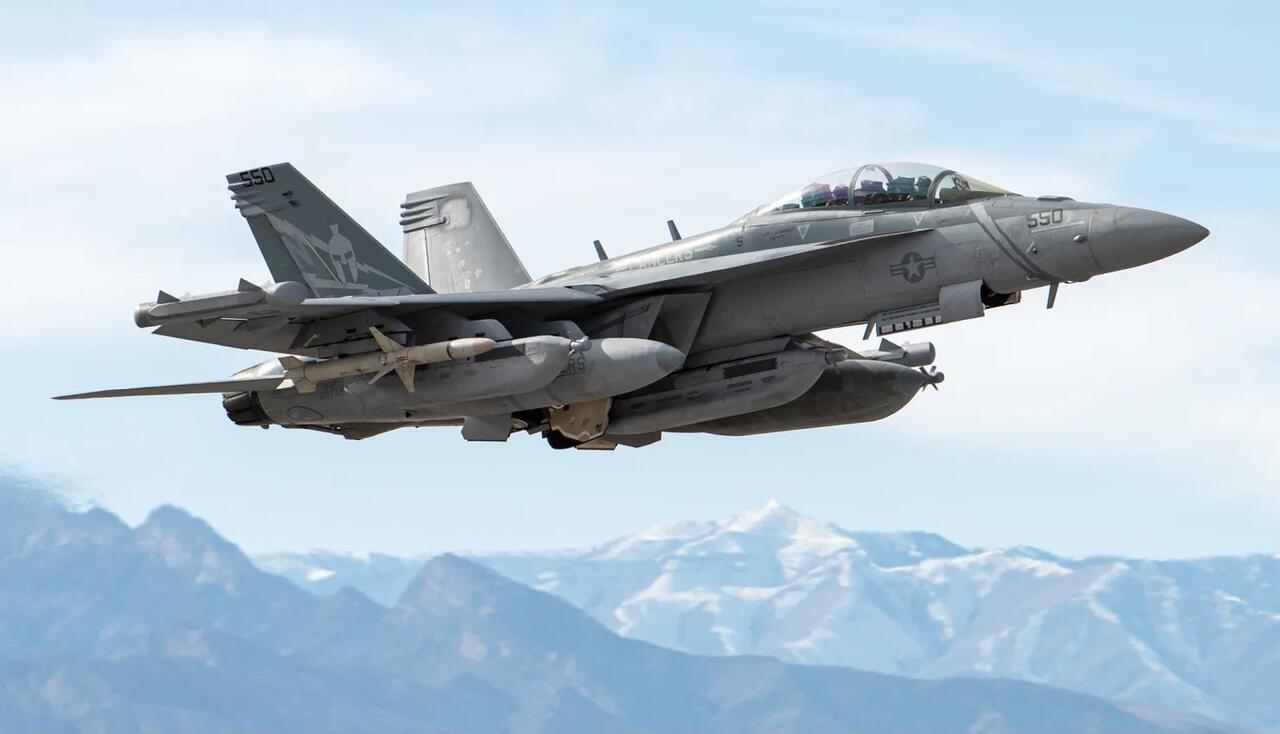
Illustrative: USAF image

CENTCOM further said it had occurred in “friendly airspace” (of Iraq) but was operating in connection with Operation Epic Fury against Iran.

Adding to the confusion in terms of precisely what happened, the incident appeared to involve two planes, possibly colliding or engaging in close maneuvers, with the second plane – possibly damaged – having “landed safely” in Israel.

The initial official statement CENTCOM issued Thursday evening said:

U.S. Central Command is aware of the loss of a U.S. KC-135 refueling aircraft. The incident occurred in friendly airspace during Operation Epic Fury, and rescue efforts are ongoing. Two aircraft were involved in the incident. One of the aircraft went down in western Iraq, and the second landed safely.

The identities of the service members were being withheld, pending notification of their families.

Pro-Tehran forces have contradicted the whole narrative, claiming instead that they shot the Air Force refueling jet down.

Already Iraqi Shia militia groups have been attacking US bases in Iraq, and are now claiming responsibility for the refueling tanker attack, per CBS:

A group of Iranian-backed militias that collectively refer to themselves as the Islamic Resistance in Iraq claimed Friday that they had caused the deadly crash of an American KC-135 refueling tanker plane in western Iraq, and hit a second aircraft of the same kind. 

The Islamic Resistance in Iraq, in a second claim issued online Friday, said it had “targeted, with appropriate weapons, a second KC-135 aircraft belonging to the American occupation in western Iraq during the past twenty-four hours. Its crew managed to escape after it was hit, and it made an emergency landing at one of the enemy’s airports.”

There’s already been a build-up of skepticism over the ‘accident’ claims surrounding a growing list of curious battlefield episodes among many pundits.

Still, there’s plenty of speculation of what could have caused such a major aerial accident – if it proves such:

Al Jazeera’s Rosiland Jordan, reporting from Washington, DC, said the information shared by CENTCOM is still vague on exactly what happened, despite announcing that the aircraft was not shot down by allies or enemies.

“It looks as if this may have been a refueling attempt or operation, and then this air tanker went down,” she said.

Before the aircraft crash, the US military had reported that seven service members had died in the ongoing military campaign, and an eighth died in Kuwait from a “health-related incident” during a medical emergency.

War Secretary Pete Hegseth said in a Friday morning Pentagon press briefing while confirming the deadly refueling tanker incident that “bad things can happen.”

The second apparently damaged tanker made an emergency landing in Israel. Purported photos at Ben Gurion Airport of the aircraft:

“War is hell,” he said. “War is chaos.” He further hailed the plane’s crew as heroes and said that “their sacrifice will only recommit us to the resolve of this mission.” He added: “But war in this context and in pursuit of peace is necessary.”

Tyler Durden
Fri, 03/13/2026 – 10:33

“Massive Culling” Imminent For Alt Managers, Soros Fund CEO Warns

“Massive Culling” Imminent For Alt Managers, Soros Fund CEO Warns

Authored by Lance Roberts via RealInvestmentAdvice.com,

Dawn Fitzpatrick says overallocated LPs, frozen distributions, and mounting margin-call risk are converging into a sector-wide shakeout. Such will eventually separate survivors from the casualties. I used Claude to source data on private credit and equity fundssources disclosed at the end.

In July 2024, I penned an article entitled “Private Equity: Why Am I So Lucky,” which began with:

“Lately, I have been getting many questions about investing in private equity. Such is common during raging bull markets, as individuals seek higher rates of return than the market generates. Also, during these periods, Wall Street tends to bring new companies to market to fill the demand of the investing public. Private equity is always alluring, as is the tale of someone who bought the company’s shares when it was private and made a massive fortune when it went public. Who wouldn’t want a piece of that?”

The private equity (PE) business is huge. When I say huge, I mean $4.4 trillion huge.

However, as we warned then, the risks have come home to roost. The private equity and private credit industry is heading into a gut-wrenching period of consolidation. That, according to one of Wall Street’s most influential investors, Dawn Fitzpatrick, CEO of Soros Fund Management. She told attendees at Bloomberg Invest this week that a “massive culling” of alternative asset managers is coming. And that the industry has no one to blame but itself.

Speaking with Bloomberg’s Lisa Abramowitz on Tuesday, Fitzpatrick delivered a blunt diagnosis. For a decade, private managers gorged on cheap money, inflated valuations, and investor enthusiasm for one of the greatest financial expansions ever. Now, she argues, the bill is coming due. “Investors are overallocated to private assets,” she said. “Their private equity is not cash flowing,” and the compounding pressures of frozen exits, extended hold periods, and surging secondary market activity are exposing the structural fragility at the heart of the alternative investment complex.

The Liquidity Reckoning

Fitzpatrick’s comments crystallize a slow-motion crisis that has been building since the 2022 rate-hiking cycle. What seemed irrelevant at the time has now made the exit environment suddenly hostile. The traditional private equity model was simple. Buy a company, leverage it, improve operations over a 3- to 5-year holding period, then sell or IPO it. However, that model has stretched into something unrecognizable. Median hold periods, which stood at 4.2 years in 2010, ballooned to 6.8 years by 2023. They are getting even longer since. Furthermore, the asset class defined by its ability to generate compounding cash-on-cash returns has increasingly become a warehouse of paper gains.

The numbers are stark. According to MSCI research, US private equity funds delivered annualized returns of just 5.8% between 2022 and 2025. That was less than half the S&P 500’s 11.6% over the same period. For investors who sacrificed liquidity and accepted illiquidity premiums, the trade has spectacularly misfired.

A World Of Hurt

Fitzpatrick’s diagnosis wasn’t limited to returns. The real crisis, she argued, is structural. The pensions, endowments, wealth funds, and family offices that seed private vehicles have been caught in a vice they made. For the last decade, they aggressively shifted portfolios toward private assets in pursuit of higher returns. Now, many find themselves overexposed, illiquid, and unable to meet future capital calls without selling positions at significant discounts.

This is the so-called “denominator effect.” That is where falling public equity valuations inflate the proportional weight of private holdings in a portfolio. The result was widespread overallocation across pensions and endowments during the 2022 public market selloff. While public equity recoveries have since eased that mechanical pressure for some, the underlying liquidity problem persists. Notably, private equity is not generating the cash distributions investors need to rebalance and redeploy capital.

According to McKinsey’s 2026 Global Private Markets Report, five-year rolling distributions-to-paid-in capital as a share of AUM hit its lowest recorded level in 2025. That is a consequence of a backlog of unsold portfolio companies that has been accumulating since exits froze in 2022. Data from Bain & Company shows that the GPs attracting capital today are those that delivered steady distributions. Firms like Thoma Bravo, which closed a $24.3 billion flagship fund in 2025, and Bain Capital, which closed a $14 billion vehicle are examples.

For the rest, the window is narrowing fast.

The Secondary Surge and What it Signals

One of the most telling symptoms of the liquidity crisis has been the explosive growth of the secondary market. Secondary transaction volume hit a record $240 billion in 2025, up 48% from the prior year, according to Jefferies. GP-led continuation vehicles, mechanisms that allow managers to hold onto assets longer while offering existing investors an exit option, now account for $115 billion of that total. That number has more than tripled in five years, from $35 billion in 2020.

To some, the surge in continuation vehicles reflects creative financial engineering by GPs navigating a difficult exit environment. To others, including Fitzpatrick, it raises pointed questions about who these structures are really serving. About 30% of surveyed LPs in a McKinsey study described assets in continuation vehicles as “distressed” or “challenged.” According to Fitzpatrick, the managers who survive the shakeout will be those who return capital as promised. Those who don’t will be those funds that find ever more elaborate ways to extend their fee-generating relationships with aging assets.

Private Credit – The Hidden Fuse

If the PE liquidity crunch is the industry’s visible problem, Fitzpatrick’s most pointed technical warning is for private credit. The $1.8 trillion market that has absorbed enormous capital flows over the last decade is now sitting on an underappreciated time bomb.

The concern centers on a mechanism that has received relatively little public attention. The banks that are lending against private credit funds’ own portfolios. As the value of private credit loans gets reassessed, whether by rising defaults, falling collateral values, or increased regulatory scrutiny on the banks themselves, those lenders could begin demanding more collateral from the credit funds.

“Once they do that, those private credit funds are going to have to come up with cash to meet those margin calls.” – Fitzpatrick

Morgan Stanley itself warned in a February 2026 report that approximately 50% of software sector loans in private credit carry lower credit ratings (B- or lower), signaling elevated default risk, and over 80% are issued by private, sponsor-backed companies.

However, Goldman Sachs Asset Management’s global co-head of private credit, Vivek Bantwal, pushed back on at least part of the concern. He argues that withdrawal limits on retail-facing private credit vehicles were “features and not bugs,” protecting funds from fire-sale dynamics. However, the events of this past week are certainly testing that thesis as those very mechanisms are being triggered at multiple funds simultaneously.

Lastly, Ares Management CEO Mike Arougheti, while dismissing UBS’s most extreme 15% default-rate forecast for private credit as “absolutely wrong,” acknowledged that some portfolios saw loss rates of 8% to 10% during the 2008 financial crisis. That is a data point that takes on new resonance in the current environment.

Notably, the events of the past week validate Fitzpatrick’s warning in real time. She warned about the “gating” potential on March 3rd. Since then:

  • BlackRock’s $26 billion HPS Corporate Lending Fund capped withdrawals at 5% after shareholders requested 9.3% of shares, returning roughly $620 million of the $1.2 billion investors sought.

  • Cliffwater’s $33 billion flagship private credit vehicle, the second-largest retail-facing private credit fund, capped redemptions at 7% in Q1 after investors sought to pull a record 14% of shares — one of the largest withdrawal requests ever seen in the $1.8 trillion market.

  • Morgan Stanley’s North Haven Private Income Fund, with nearly $8 billion in assets, returned around $169 million — less than half of what investors requested — after capping redemptions at 5%.

  • JPMorgan Chase has begun marking down the value of loans in private credit fund portfolios and restricting its lending to those funds, resulting in $22.2 billion of exposure to the sector.

JPMorgan’s markdowns primarily affect loans to software companies, which the bank views as increasingly vulnerable to AI disruption. Because these loans serve as collateral when private credit funds borrow from banks, lower valuations directly reduce the financing those funds can access — precisely the mechanism Fitzpatrick described.

Who Gets Culled and Who Survives

Fitzpatrick’s warning lands in a market already exhibiting sharp bifurcation. McKinsey’s 2026 Global Private Markets report found that about 40% of dry powder available for deployment has been sitting unused for more than two years. That is a signal that GPs are struggling to find deals at prices that work. Fundraising, meanwhile, has become increasingly winner-take-all. The managers pulling in commitments are concentrated among scaled platforms with demonstrated distribution records. However, smaller and emerging managers face an existential squeeze.

Apollo’s Marc Rowan offered a complementary, if blunter, verdict on the risk landscape.

“People made choices: if you wanted a higher dividend, you could take more risk. That felt really good on the way up. That’s not going to feel so good on the way down.”

But, Ares’ Arougheti held the line on private credit’s long-term structural merits. He argued that diversified, multi-strategy platforms with rigorous underwriting will prove out the asset class even as weaker players stumble. He noted that firms that manage across private equity, credit, real assets, and infrastructure have natural hedges and capital-recycling advantages that pure-play credit shops lack entirely.

The Road Ahead

For Fitzpatrick, the next 18 to 24 months represent a painful but ultimately necessary correction. The industry that, in her view, over-promised and under-delivered on the most fundamental commitment any investment manager makes: returning capital. The macro backdrop: geopolitical turbulence, AI-driven disruption to software valuations, and an uncertain rate environment, amplifies the pressure without being its cause. The cause, she argues, is structural. There were too many managers, too much capital raised at peak valuations, too many continuation vehicles propping up stale assets, and a performance record that, net of fees, no longer justifies the illiquidity premium being charged.

For institutional investors now trapped in the denominator’s grip, the path forward is constrained. Capital calls from existing commitments continue even as distributions dry up. Selling on the secondary market provides exit options, but at increasingly steep discounts. The Bain & Company chair of global private equity practice put a sobering timeline on the resolution: “We’re talking about a 5-plus year problem,” he noted earlier this year, drawing a parallel to the years it took to work through the Great Financial Crisis backlog.

Fitzpatrick’s verdict, in the end, is a market-efficiency argument dressed in the language of capital allocation: the managers who survive will be those who earn their keep. The ones who didn’t — who built empires on fee income and rolled assets forward indefinitely — will face a reckoning as LP patience runs out and capital concentrates among proven performers. In her framing, it is not a crisis but a correction. For the managers who can’t make that distinction about themselves, it amounts to the same thing.

Tyler Durden
Fri, 03/13/2026 – 10:30

Inflation Fears Fade As War Drags UMich Sentiment Lower

Inflation Fears Fade As War Drags UMich Sentiment Lower

After rebounding solidly in January and February, expectations were for a modest decline in UMich Sentiment in preliminary March data and analysts were right but the 55.5 print (from 56.6 prior) was better than the 54.8 expected.

  • Current Conditions actually improved, surprising to the upside (57.8 vs 56.6 prior vs 54.9 exp)

  • Expectations fell more than expected (54.1 vs 56.6 prior vs 54.5 exp)

Current Conditions are at their highest level since October while expectations are at their lowest since November.

Source: Bloomberg

Interviews for this release were collected between February 17 and March 9, with about half completed after the start of the US military conflict in Iran.

Interviews completed prior to the military action in Iran showed an improvement in sentiment from last month, but lower readings seen during the nine days thereafter completely erased those initial gains.

“A broad swath of consumers across incomes, age, and political affiliation all reported declines in expectations for their personal finances, down 7.5% nationally,” according to UMich Surveys Director Joanne Hsu.

Despite the worries noted by UMich about gasoline prices, inflation expectations continued to slide…

With Democrats fear bias continuing to fade…

Note that for both time horizons, interviews completed after February 28th exhibited higher inflation expectations than those completed before that date (see chart, right panel).

If the war is still going on by month-end, expect inflation fears to surge (via the Democrats), because of this nonsense (h/t @MikeZaccardi via FundStrat)

Why did UMich suddenly starting weighting their survey to Democrats when Trump was elected?

Tyler Durden
Fri, 03/13/2026 – 10:13

In Scramble To Open Up Hormuz, France & Italy Open Talks With Iran After India’s Request

In Scramble To Open Up Hormuz, France & Italy Open Talks With Iran After India’s Request

Amid very confused and mixed messaging coming from Washington over the status and future fate of Hormuz oil transit, the EU is trying its hand at a solution.

France ⁠and ⁠Italy have ​opened ‘tentative’ talks ‌with Iran ‌seeking ⁠to ⁠negotiate a deal to ​guarantee safe ​passage for their tankers ⁠through vital strait which remains a crucial chokepoint for stalled global crude transit, the ​Financial ⁠Times reports Friday, citing people briefed on ⁠the efforts.

This comes as US Secretary of War Pete Hegseth said in a Friday morning Pentagon briefing there is “no clear evidence that Iran has laid mines” in the Strait. This contradicts an avalanche of reporting from earlier this week which said at least a dozen mines were laid.

The two key overnight and morning headlines which have most impacted oil markets remain confirmed India-Iran talks for safe passage, and now EU efforts to do the same…

Regardless, it’s more than obvious that the waterway is de facto shut – with perhaps the exception of some Chinese or possibly an Indian vessel being allowed through – also amid persisting threats of rocket and drone attacks.

According to the Financial Times, “European capitals have opened the tentative discussions in an attempt to restart oil and gas exports without expanding the conflict, three officials briefed on the talks told the FT, as shipping companies look to western navies to provide potential escorts for their tankers.”

“France is one of the countries involved in the talks, two of the officials said,” the report continues. “The first official said Italy had also made attempts to open discussions with Tehran on the issue.”

As for whether the war expands or not, that’s in no way under Europe’s control – but remains something pertaining only to Israel, the United States, and Iran – the main players in the conflict.

The case for some shred of optimism or hope? However, Trump and Hegseth’s bellicose tones on Friday morning, vowing to keep ramping up military action over Tehran, underscores continued extreme uncertainty:

Meanwhile the Trump administration has sought to push back against reporting by CNN and others which alleges war-planners didn’t actually take into account that attacking Iran would result in Hormuz’s closure or blockage.

Here’s how Hegseth responded to the charge on Friday morning – while trying to paint a general picture that the mainstream media is clouding the picture, and just trying to make Trump ‘look bad’:

“This is always what they do, hold the strait hostage. CNN doesn’t think we thought of that? It’s a fundamentally unserious report,” Hegseth said. “The sooner David Ellison takes over that network, the better.”

Skeptics have pushed back against Pentagon and White House claims of lengthy preparations and plans to use military force to clear the Strait of Hormuz, and yet now 13 days into a war with Iran and there’s been no US action in the waterway, and not so much as a single US naval escort that anyone is aware of.

Source: Yeni Safak

So far there does seem to be a constant flow of words on the issue coming from the White House and Pentagon – and yet a clear strategy still hasn’t been articulated, much less clear action taking shape.

Tyler Durden
Fri, 03/13/2026 – 09:50

Ten Maersk Ships ‘Trapped’ In Persian Gulf

Ten Maersk Ships ‘Trapped’ In Persian Gulf

Authored by Stuart Chirls va Freightwaves.com,

The closure of the Strait of Hormuz by Iran has effectively trapped 10 Maersk ships in the Persian Gulf, its chief executive said.

In separate interviews with CNN and the Wall Street Journal, Vincent Clerc said the Danish carrier’s ships “cannot get out,” are “stuck in the Upper Gulf” and cannot leave the region.

As a safety measure, Clerc said the vessels have been grouped offshore and away from ports under attack. At least one ship is under contract to the U.S. government’s Military Sealift Command, according to data on maritime identification websites.

Even if a ceasefire allowed vessel traffic to begin moving, Clerc said it would take a week to 10 days for the world’s second-largest liner (MAERSK-B.CO) to resume normal operations.

Clerc’s comments underscore the frustrations of shipping lines who have requested and repeatedly been denied naval escorts by the Trump administration. Carriers have been told in briefings that the Strait is still too dangerous for transit. 

Iran on Wednesday used unmanned boats to attack two tankers, and also deployed missiles and drones to attack ports, airports and other landside targets in the Gulf region. A ONE container ship sustained damage from unidentified projectiles.

Maersk is prioritizing the safety of crews, ships, and customers’ cargo, said Clerc, and will only restart voyages if that safety is guaranteed.

Shipping executives gathered in Connecticut for an industry conference said that the Iran war has idled 10,000 merchant crew and hundreds of vessels in the Persian Gulf. Mariners have little choice but to stay with their ships, since most airlines have suspended flights into and out of the area.

Maersk, like others major carriers, has suspended or re-routed some services to and from Gulf states and is rerouting vessels via alternate hubs, to stage cargo until the strait is re-opened. It has also assessed shippers with a number of emergency surcharges.

The closure of Hormuz and related disruptions in the Red Sea have had “profound” effects on global shipping and supply chains, Clerc said, and that Maersk is in “uncharted territory.”

Bunkering terminals in Asia and the Middle East could risk running dry amid the disruption of fuel supply chains, and he warned added costs for diversions and delays will be passed on to customers.

Tyler Durden
Fri, 03/13/2026 – 07:20

Bessent Greenlights Sale Of Russian Oil At Sea To “Promote Stability In Global Energy Markets”

Bessent Greenlights Sale Of Russian Oil At Sea To “Promote Stability In Global Energy Markets”

In a statement late Thursday on X, U.S. Treasury Secretary Scott Bessent announced that the U.S. will allow countries to purchase Russian crude oil already at sea. The move aims to temporarily boost global supply availability, as the IEA warned earlier that the Middle East conflict has sparked one of the worst energy shocks on record.

“To increase the global reach of existing supply, @USTreasury is providing a temporary authorization to permit countries to purchase Russian oil currently stranded at sea,” Bessent said.

He continued, “This narrowly tailored, short-term measure applies only to oil already in transit and will not provide significant financial benefit to the Russian government, which derives the majority of its energy revenue from taxes assessed at the point of extraction.”

UBS analyst Nana Antiedu told clients earlier this morning that about 124 million barrels of Russian-origin oil were at sea across 30 locations worldwide.

More specifically, Bloomberg analysts said about 30 Russian tankers are in Asian waters and may be available for purchase. These tankers carry about 19 million barrels of Russian crude and 310,000 tons of refined products.

Bloomberg data show these Russian tankers are signaling “for orders” or, in other words, have no clear destination yet. They could be unloaded in Singapore or Malaysia.

Robert Rennie, head of commodity research at Westpac Banking, was quoted by Bloomberg as saying, “Of course, any supply helps, but this is a smaller help than it looks.”

Rennie estimated that of the 125 million to 150 million barrels of Russian crude on the water, about a third is off China and is likely to end up in storage, while 30 million to 40 million barrels are in India and are likely to be consumed there.

Rennie said the rest is in the Mediterranean and the Atlantic. “We are only really talking about replacing maybe four or five days of lost Gulf exports. Sure, it helps, but it is no panacea,” he added.

Bessent’s office also issued India a 30-day waiver at the beginning of the month so that New Delhi could buy Russian oil at sea to build reserves and cushion against an oil shock.

Brent crude futures are largely unchanged from when Bessent posted on X overnight. President Trump said the U.S. has “plenty of time” in the Iran war. Brent hovers around $100/bbl as of 0630 ET.

The Trump administration has taken several steps to combat triple-digit Brent and WTI prices, including the planned release of 172 million barrels from the U.S. SPR. The release is part of a much larger 400-million-barrel SPR dump worldwide, agreed upon by the 32-nation IEA. This comes as the IEA warned about the worst-ever energy shock to hit the world. Also, the Trump administration is waiving a century-old law that requires U.S. ships to transport goods between American ports, so that domestic supplies can be shifted around more quickly.

Tyler Durden
Fri, 03/13/2026 – 06:55

‘Societal Time Bomb’ – Explosive German Police Study Finds Nearly Half All Muslims Under 40 Has ‘Islamist’ Attitudes

‘Societal Time Bomb’ – Explosive German Police Study Finds Nearly Half All Muslims Under 40 Has ‘Islamist’ Attitudes

Via Remix News,

A newly released study by the German Federal Criminal Police Office (BKA), nearly 50 percent of Muslims under the age of 40 in Germany hold “Islamist” views, with these Muslims expressing an attraction to Islamism, a preference for Sharia law over the German Basic Law, and harboring anti-Semitic prejudices.

The findings, described as “explosive in nature,” were featured in the latest edition of the “Motra Monitor.” The study reports that as of 2025, Muslims in Germany under the age of 40 (45.1 percent) hold “latent or manifestly Islamist attitudes.“

Some German politicians have already voiced their views on the study’s release. Wolfgang Kubicki, a prominent politician in the Free Democrats (FDP) and former MP, stated on X: “This study should set off all the alarm bells. It is a societal time bomb. We must not only talk about migration, but also about integration and religion. The policy of naively looking away has favored this development. The naivety must stop.”

He further stated that “anyone who demands a caliphate is an enemy of democracy. Enemies of democracy without German citizenship must leave the country. Neighborhoods where ghettoization provides fertile ground for radicalization must be restructured. Islamic associations without a clear demarcation from extremists must not be interlocutors for politics. Germany must act secular and self-confident.”

He further called for an end to headscarves in schools and other state institutions “not to harass or suspect the wearers, but to make it clear that the only binding source of our values is the Basic Law.”

Beyond rising crime rates, terrorism offenses, and demographic change, the soaring numbers of Muslims in Europe also raise fundamental questions about worldview and society.

The “Motra monitor,” a monitoring system tracking radicalization, spans 598 pages. It is published by the BKA and receives funding from several entities, including the Federal Ministry of the Interior and the Ministry of Family Affairs. While the report addresses various forms of extremism, including right-wing movements, it places a significant focus on Islamist extremism.

Evidence of these tensions surfaced in the summer of 2025 when “young Muslims and radical left-wing Germans occupied the Gutenberg Memorial in Frankfurt to demonstrate against Israel, some of them willing to use violence.“

The study’s researchers highlight a concerning core demographic, noting that “manifest Islamist attitudes are most prevalent among Muslims under 40, at 11.5 percent.“

In this context, “manifesto“ indicates that a person’s radicalization toward Islamism is already clearly evident and pronounced.

Further complicating the social landscape is a much larger group identified by the authors as having “latently Islamism-savvy attitudes.” This segment has seen a massive increase since 2021. The research group writes that “this amounts to 33.6 percent for those under 40 in 2025.“

While “latent” suggests these Islamist attitudes are present, the radicalization has not yet become openly visible. Combined, these two groups account for “45.1 percent“ of all under-40 Muslims in Germany.

Renowned Islamism researcher Prof. Susanne Schröter, who conducted most of her research into Islamism at the Institute of Ethnology at Goethe University Frankfurt and served as the director of the Frankfurt Research Center for Global Islam until 2025, said to Bild: “Islamism-savvy means that Muslims consider Islamist interpretations of Islam to be correct, are attracted to Islamist organizations close to the Muslim Brotherhood or Salafism, prefer Sharia to the Basic Law, and usually also have anti-Semitic prejudices.”

The BKA study suggests that the radicalization of young Muslims accelerated significantly following the Hamas terrorist attacks on Oct. 7, 2023.

Germany is far from the only country seeing the rise of Islamism within the populace. A sobering study from the prestigious polling service Ifop from last year shows that hardline views are growing amongst Muslims in France, including an emphasis on the laws of Islam being placed over those of the state, particularly among young Muslims. At the same time, Christianity is collapsing in France.

Among Muslims in general, 44 percent polled say they “respect the rules of Islam” as being more important “than respect for French laws.” For those aged 15-24, 57 percent believe the rules of Islam are more important than “respect for French laws.”

Some 38 percent of French Muslims approve of all or part of Islamist positions, doubling the figure of 19 percent in 1998, underlines Ifop.

Correspondingly, the share of Muslims who want Islam to modernize has fallen from 48 percent in 1998 to 21 percent today. When Ifop requested respondents to choose between the Civil Code and Sharia law on “an important subject in your family, such as ritual slaughter, marriage or inheritance,” 49 percent of Muslims chose to respect French laws, down from 62 percent in 1995. The consumption of alcohol among Muslim men has also fallen sharply, from 46 percent in 1989 to only 26 percent today.

Today, 33 percent of Muslims residing in France — French citizens or foreign nationals — feel sympathy for one of the Islamist movements, a figure that rises to 42 percent among young people. Within this population, 3 percent have sympathy for the most radical and bloody ideology, jihadism.

Read more here…

Tyler Durden
Fri, 03/13/2026 – 06:30

Feminist Monster Film “The Bride” Is Biggest Box Office Bomb Of 2026

Feminist Monster Film “The Bride” Is Biggest Box Office Bomb Of 2026

According to polls, around half of the US population identifies with feminism and feminist activism (though, this stat is in steep decline among Gen Z men).  But if this is truly the case and there is such a large population of feminist allies out there in the ether, why don’t they ever show up to movie theaters to support films with blatant feminist messaging? 

The obvious conclusion is that the public has been lied to and there is no vast feminist movement.  It’s a paper tiger, a fantasy, a mirage. 

We have seen this reality play out time and time again over the past few years as the American populace has now awakened to Hollywood’s woke propaganda agenda.  Almost every instance of a new film or streaming series being exposed as far-left in its content results in financial failure.  There is no audience for these projects.   

The entertainment industry has resorted to masking feminist propaganda behind popular branding and false marketing in order to trick consumers into theater seats (the Barbie movie comes to mind), but these successes are few and far between.  Such projects might have a small, niche market on militant progressive streaming services like Netflix, but they still call for a bare bones budget and minimal marketing on dedicated woke media platforms. 

Around 20 years ago, feminist art house flicks, LGBT dramas and race based commentaries were made for around $10 million a pop and were relegated to festivals like Sundance and Cannes.  At these exclusive events they would garner ample and pompous applause from uppity New York and LA socialites and then fizzle into obscurity where they belong.

Today, major studios are spending upwards of $150 million in production and marketing costs to make and distribute the same kinds of film school garbage, and they are losing their shirts. 

A recent example is aging actress and amateur director Maggie Gyllenhaal’s feminist monster film “The Bride”, which latches onto the public domain story of Frankenstein (every movie must be a remake or a reboot to get greenlit these days). 

The project was given a production budget of $90 million and a marketing budget of $65 million – A total of $155 million spent to bring the dead plot to life.  In its opening week, The Bride has brought in around $14 million in global box office receipts, and keep in mind, half those revenues go to theaters.  

It’s a unmitigated disaster; the biggest theatrical flop of the year and it probably won’t be beat in 2026.  That said, anyone with any sense could have predicted this movie’s downfall. 

The story follows a woman possessed by the spirit of Mary Shelley, who is back from the dead to tell the story of “the bride” she had always meant to tell.  She says she was “held back by the patriarchy” from writing the tale, but now you get to see it on the big screen for $20 per ticket and $50 for popcorn and soda.  Lucky you.

The woman is, of course, murdered by evil men and then brought back to life by a scientist who is seeking a companion for the Frankenstein Monster (played by Christian Bale), who is lonely after 100 years of being an angry “incel”.

The story then devolves into a college girl’s self indulgent fan fiction of the Bride of Frankenstein, mixing elements of Sid and Nancy with Bonnie and Clyde.  The main character and her male sidekick go on a killing spree, which inspires other women across the country to commit copycat crimes and murder the “men who wronged them”.

There is nothing new or groundbreaking about the concept.  From “Thelma and Louise” to the movie “I Shot Andy Warhol”, there are hundreds of movies and TV shows affirming the feminist notion that women are immune to accountability. In other words, if a women does something evil, we must assume she has a good reason.  Or, women are allowed to do evil as long as they perceive themselves to be victims. 

The Bride is yet another tired version of this ongoing feminist trope of women being “empowered” by psychopathy.  Not only that, but it regurgitates the leftist extremist fantasy of becoming some kind of Marxist martyr and triggering a bloody mob frenzy.  The fundamental motivation of these stories is narcissistic in nature; a desperate desire to be so adored and worshiped that people would gleefully destroy or kill to honor your name.  

The theatrical apparatus is still being bombarded with woke content into 2026 despite dismal audience attendance because most of these movies were approved and started filming during the Biden Administration when studios thought the woke indoctrination machine was well protected.  The Bride received approval in January of 2024 and started filming that same year.  A lot has changed since then. 

For now, entertainment productions are plummeting (down 60%) and Hollywood is lost.  They centered their entire business model around the woke agenda and now they have no idea how to restructure and create real content again.  It is likely these companies will collapse in due course, making way for newcomers with better ideas, greater talent and less political zealotry.   

Tyler Durden
Fri, 03/13/2026 – 05:45