Anthropic said on Sept. 10 that it had disrupted malicious campaigns involving the use of its artificial intelligence model Claude, including operations allegedly linked to threat actors in China and Russia.
The company said the threat actors include suspected state-sponsored groups, financially motivated criminals, commercial spyware vendors, state propaganda institutions, and politically motivated individuals.
According to its report, most of the cyber operations detected between December 2025 and August 2026 were enabled by AI through direct execution or orchestration. Humans remained involved in selecting targets and reviewing exfiltration, it stated.
“The use of AI went beyond simple questions and responses from a chatbot but rather involved the use of multi-agent frameworks executing reconnaissance, exploitation, and data exfiltration,” Anthropic said.
Among the threat actors named by the company was a group linked to Russia-based Midnight Blizzard. Anthropic alleged that the group used AI to attack military intelligence targets in Ukraine and Europe, as well as diplomatic and defense organizations and individuals connected to U.S. foreign policy.
Anthropic said it also disrupted distillation attacks against Claude from seven labs based in China, including operators allegedly linked to Alibaba, DeepSeek, Xiaomi, and Moonshot.
The company defined distillation as “an industrial-scale, covert campaign” aimed at illegally extracting the capabilities of an AI model and replicating them in another model.
Operators linked to Alibaba, China’s largest e-commerce platform, carried out the largest distillation attack to advance the reasoning capabilities of Alibaba’s models, generating more than 151 million exchanges between May and July 2026, the report found. The activity peaked at nearly 3 million exchanges per day launched from over 3,500 accounts that Anthropic deemed fraudulent.
Anthropic also alleged that Chinese AI company Moonshot secretly forwarded customer requests to Claude and then displayed the resulting responses to users as if they were generated by its AI model Kimi.
In one instance, Moonshot allegedly routed nearly 300,000 customer requests to Anthropic’s model over a 10-day period using a proxy service network of 5,380 fraudulent accounts, most of which appeared to be located in Singapore and Japan, according to the report.
“Our investigation also revealed that user queries that Moonshot rerouted to Claude included sensitive information about various Moonshot customers,” Anthropic said.
“We do not know if Moonshot notified their customers that their requests were being rerouted to Anthropic and exposed to a third party.”
The report also identified new categories of threat actors misusing Claude, including those who seek to develop “software for conventional weapons, including firearms, missiles, armed drones, bombs, and other munitions.”
Anthropic said it disrupted a “guided weapons engineering cell” operating three weapons development programs in northern Yemen that used Claude “to develop the guidance, navigation, and control (GNC) software that steers and stabilizes a flying vehicle.”
According to the report, the threat actors allegedly test-fired a guided rocket but failed, prompting them to seek guidance from Claude to identify the cause of the failure.
Among other newly categorized threat actors was a China-based threat actor that used Claude to advance three parallel projects on “an anti-torpedo weapons system.”
Anthropic also identified alleged Russia-based freelance threat actors who sought to build a “full-stack autonomous first-person-view kamikaze drone swarm” and another Russia-based actor who used Claude to research and draft procurement documents for goods likely intended for the Russian government and defense industry customers.
The company said it would continue to strengthen its safeguards and work with partners to prevent misuse of its AI model.
“In each case, we disrupted the activity, used what we learned to strengthen our safeguards, and shared intelligence with authorities and industry partners, where appropriate,” it stated.
US Officials Confirm East-West Pipeline Was Attacked
Open source satellite imaging has shown the crucial ‘Hormuz bypass’ East-West oil pipeline that cuts straight across Saudi Arabia has been on fire. A some 80km to 100km giant smoke plume has been observed. The damaged section is said to be located near the town of Al Mesba’ah.
Amid speculation that this is probably the result of a major Houthi attack out of Yemen, CNN in a new Friday report cites two US officials who’ve given confirmation that the pipeline was struck by projectiles on Thursday. Iraq was named as possible attack origin point. According to the report:
An early analysis found that pump stations, which are located next to the pipeline itself, were hit, one of the US officials said. A satellite image taken Friday appears to show extensive fire damage at one pumping station, and an image of a different pumping station, taken Thursday, showed a small fire sending up plumes of thick, black smoke.
It could have been the result of a drone attack by paramilitaries operating out of Iraq. “It was not immediately clear who was responsible for the strikes or if sections of the pipeline itself were damaged but one of the officials said it was struck by drones originating from Iraq,” CNN reports. “It was also not immediately clear how long it would take to repair the damage, sources said.”
News on Saudi oil has gone from worse to worse, as in Yemen the Houthis have reportedly taken over the entire Red Sea coastline. They have renewed the threats to attack all Saudi (as well as Israeli) shipping, but have also sought to assure transit is ‘safe’ for other international vessels.
The pumping station struck yesterday is located near the town of Al Mesba’ah.
According to one of the U.S. officials who spoke to CNN, the drones that struck the pumping station along Saudi Arabia’s East-West pipeline originated from Iraq. It remains unclear whether the pipeline… pic.twitter.com/puOWM5VRlX
Three converging threats to watch are intensifying pressure on global energy markets: damage to Russian refining capacity, ongoing disruption at Hormuz, and new, expanding Houthi threats to Red Sea shipping. The resulting physical market squeeze extends well beyond the Gulf area. Record-high diesel prices in the US and other markets, such as China’s return to buying crude, raise the risk that oil markets will remain exceptionally tight into the Northern Hemisphere winter.
What we know so far is that the Russia-Ukraine war has knocked out a whole bunch of refining capacity and halted exports of critical fuels from Russia. The Gulf area has seen an escalation in fighting this week as the Hormuz chokepoint remains open with tanker transits but still limited and far from pre-war levels.
Couple this all with the chokepoint madness still being disrupted and new developments overnight: Iran-backed Houthi forces advanced toward a strategic port near the southern entrance to the Red Sea, threatening to tighten control on a second critical shipping corridor.
Houthis Take Yemen’s Red Sea Coast
Bloomberg reported that Houthi rebels have gained ground around Mokha, with some geopolitical analysts reporting that the Yemeni port city has fallen.
🇾🇪 Total collapse: The entire coastline from Dhubab to Mayyun island was abandoned. Mayyun, Duhbab and Murd now controlled by Houthi forces as of September 11
Its fall would give the Houthis another coastal stronghold alongside Hodeida and the ability to control more of the Bab el-Mandeb Strait, suggesting commercial traffic could begin to drop and transits would be rerouted around the Cape of Good Hope, increasing shipping time and freight costs.
Alternative Route: Cape of Good Hope
On top of this, China has returned to global oil markets, and ex-Goldman Commodities head Jeff Currie warned Thursday that this is the real driver of soaring crude prices.
Saudi Key East-West Pipeline on Fire
Also overnight, Saudi Arabia’s East-West oil pipeline appears to have been struck by Houthi forces, which the pipeline served as an oil escape route, effectively bypassing the Hormuz chokepoint to the Red Sea.
Andrew Farrand, a political-risk analyst at Horizon Engage, described the rapid Houthi advance as a major setback for Saudi efforts in Yemen, warning that it could bring the Houthis closer to territory overlooking the waterway’s narrowest section.
Simultaneous disruption of Bab el-Mandeb Strait and Strait of Hormuz creates a two-sided squeeze: less energy can leave the Gulf, while tankers that can move face longer, more expensive journeys. It also threatens Saudi Arabia’s Red Sea terminal.
Beyond Hormuz and Bab el-Mandeb, these are the main straits to watch:
Global Maritime Chokepoints
Where the routes narrow
What could interrupt commercial traffic
Stage Set for Stagflationary Squeeze?
The twin disruptions threaten shipping corridors that carried roughly a quarter of global seaborne oil trade through Hormuz and through Bab el-Mandeb, while jeopardizing a Red Sea shipping route central to trade between Asia and Europe and risking ignition of a stagflationary squeeze as diesel prices soar to new highs that eventually feed into supply chains, freight costs, and ultimately, at a lag, higher prices on store shelves.
A woman sat in front of a camera this week and told the internet she had witnessed a “racist baby”…
Not a joke account. Not a sketch. A straight-faced lecture about an infant who looked at someone for a few seconds – and, in her telling, revealed the original sin of race hatred barely out of the womb.
The woman declares that “watching children mirror racist behavior is WILD.” She describes a baby staring at her ‘friend of colour’, the mother looking stricken, and then announces that the child is “literally mimicking” hostility toward “black and brown people.”
This retard says she saw a “racist baby”
This person is a legit retard.. this is somehow not a joke.
She also flashes a 2012 Science Daily headline as if it were a conviction.
This is the new priesthood. A baby looks at a black person and the verdict is racism.
Anyone who has any experience at all with babies knows they stare. At glasses. At beards. At bald heads, bright coats, dogs, ceiling fans, and their own hands. They are cataloguing the world with amazement, not forming a manifesto.
Obviously, she’s never had children. Babies also stare at people with glasses if they’ve never seen a person with glasses, they stare at all kinds of things they’ve never seen before. It’s called learning and it’s up to the parents to teach them from then on.
The woman in the video treats curiosity as contamination. She reaches for a University of Massachusetts Amherst study from 2012 – “Infants begin to learn about race in the first year” – and reads it as proof that a pre-verbal child is already a bigot.
The paper does not say that. It found that by nine months, babies get better at recognising familiar-looking faces and worse at telling apart unfamiliar ones.
Psychologist Lisa Scott, an author of the work, said the results “suggest that biases in face recognition and perception begin in preverbal infants, well before concepts about race are formed.”
Face recognition is not a worldview. A nine-month-old does not have a theory of systemic oppression.
They diagnosed a baby with racism. That’s the priesthood now.
This is not an isolated freak-out. It sits inside a wider epidemic of deranged white leftist women.
They police stares, invent motives for infants, and treat ordinary childhood as a moral emergency. These people staff HR departments, classrooms, nurseries and social-work offices. They write the guidance.
They decide which toddler is a “perpetrator.” exporting their own neurosis onto the smallest most innocent people in the room.
Her assumptions she has about a babies thoughts on black people are the thoughts she has about black people.
The viral clip would be easier to laugh off if governments were not writing the same fantasy into official guidance.
In Wales, childcare workers have been trained under a taxpayer-funded programme – more than £1.3 million via the Welsh Government – to spot “racist incidents” among toddlers and, if staff decide the behaviour could amount to a hate crime, contact police.
The toolkit from Diversity and Anti-Racist Professional Learning (DARPL) at Cardiff Metropolitan University has been circulated to more than 300 nurseries, playgroups and childminders.
Staff are told to audit toys and books for “diversity,” discuss skin colour with very young children, and rate their own grasp of “white privilege” on a one-to-five scale. If the incident falls short of a hate crime, workers are advised to offer “age-appropriate learning support opportunities for the perpetrator.” If that is “met with resistance,” a disciplinary route appears on a flowchart. The “perpetrator” may still be in nappies.
Lucy Marsh, communications officer at the Family Education Trust, asked “Do they want toddlers to have a criminal record?”
Kent Police went one better. A one-year-old girl was logged as a crime suspect after allegedly causing a minor injury to another toddler.
Freedom of Information figures showed 683 children under 10 reported for offences over three years – including six two-year-olds, 11 three-year-olds and 20 four-year-olds.
None can be prosecuted. The age of criminal responsibility in England and Wales is 10. Kent County Council cabinet member for children’s services, Councillor Paul Webb, called the numbers “not great.” Chief Superintendent Rob Marsh said the focus was “safeguarding rather than punishment.” The record still exists. A baby is on a crime log.
The contempt is not limited to infants who look at people the wrong way. Wanting people to have children at all has been recast as an extremist project. Politico framed a natalism conference as proof that “the far right is so obsessed with making babies, they just held a whole conference about it.”
Reporter Gaby Del Valle treated collapsing fertility as a punchline and smeared those who notice it as plotters of “a total social overhaul.”
Meanwhile the CDC recorded a U.S. fertility rate of 1.6 in 2023 against a replacement level of 2.1. A Lancet study put the global rate at 2.23 and warned the world’s population will start to fall within decades. Co-author Dr Natalia Bhattacharjee said declining fertility “will completely reconfigure the global economy and the international balance of power.” That is biology, not a rally chant.
So the sequence is complete. Have children and you are suspect. The children themselves are suspect. A glance is evidence. A nursery becomes a reporting desk. The state writes “racist” next to a toddler and calls it safeguarding.
A baby is not a political actor. It does not owe a land acknowledgement between feeds. It does not need Critical Cradle Theory. It needs parents who are attached to reality and institutions that stop treating childhood as a crime scene.
DeepSeek’s New Hyper-Efficient Model Stokes Fears Over Korea’s Memory Makers
Samsung Electronics and SK Hynix each fell more than 3% in Seoul on Friday after DeepSeek said its newest AI model needs a fraction of the memory required by its predecessor. Both stocks had been trying to recover from July’s selloff and remain more than 25% below their highs. Local retail traders, who helped drive the rally earlier this year, have sold around $10 billion of the pair this month alone.
The trigger came Thursday out of Hangzhou. DeepSeek’s V4.1-Flash is fast, cheap and, by the company’s own numbers, stronger than its flagship model. But the title of DeepSeek’s paper had nothing to do with intelligence benchmarks. It called the release “Pushing the Limits of KV Cache Compression,” and its abstract identifies memory consumption during long AI sessions as the main obstacle to making these models cheaper to run.
What DeepSeek Shipped
V4.1-Flash is a 552-billion-parameter model (parameters are the numerical values a model learns during training). DeepSeek does not activate all 552 billion for every word. It uses 8 billion parameters while processing input and 16 billion while generating output, a design that lowers the amount of computing needed for each step.
The model can handle a context window of one million tokens, meaning roughly a million small pieces of text or other input can remain available to it during a session. It also reads images natively, and its model weights are available under an MIT license, allowing anyone with sufficient hardware to run it. Nine providers were serving it through OpenRouter within a day of release.
The memory problem needs a little more explanation. As an AI model works through a long document, conversation or agent task, it keeps a running record of what it has already processed so it does not have to recalculate everything from scratch each time it generates another token. That record is called the key-value cache, or KV cache.
The cache is normally stored in high-bandwidth memory, or HBM. HBM consists of stacks of DRAM placed next to the processor to move data extremely quickly. It is among the fastest and most expensive memory in production, and booming AI demand for it helped turn SK Hynix, Samsung and Micron into some of the biggest semiconductor trades of 2026. As an AI session gets longer, however, the cache keeps growing. In long-running agent workloads, the memory needed for the cache can eventually exceed the memory occupied by the model itself.
DeepSeek has attacked that problem directly. Its new architecture reuses cached information across layers of the network, stores the cache at 4-bit precision and reconstructs part of it when needed rather than storing the entire record. The result, according to DeepSeek, is 890 bytes of cache per token, one-quarter of what the previous Flash model kept in HBM and one-eighth of what it wrote to SSD storage.
DeepSeek’s post on X gave the commercial reason plainly. Cached input can account for a large share of the cost of running an AI agent. Shrink the cache, and the bill falls with it.
Memory Per Token, Down 437-Fold
The figure in DeepSeek’s paper that matters most for Seoul is the second one. It tracks the amount of cache memory required for every token across successive generations of DeepSeek models. From the company’s first release in January 2024 to V4.1-Flash, that figure has fallen 437-fold.
The decline did not begin this week. April’s V4 had already cut KV-cache requirements to one-tenth of its predecessor at the full context window. September’s model reduced them by another three-quarters. DeepSeek describes V4.1-Flash as the smallest member of a new architecture family designed to scale to larger models.
On the other side of that chart are the growth assumptions embedded in the memory trade. Micron says its entire calendar 2026 HBM supply is already contracted on both price and volume. In December, the company told investors the HBM market could grow from about $35 billion in 2025 to roughly $100 billion in 2028. By June it had moved the $100 billion estimate forward to 2027.
Micron reports earnings on September 30 and has guided the quarter to roughly $50 billion in revenue, about 350% above the year-earlier period, with an 86% gross margin.
How much premium memory each unit of AI work requires is the whole point.
Out With The ‘Old’
This seems a little risky, but beginning September 14, DeepSeek will route every request for V4-Pro, its 1.6-trillion-parameter flagship, to V4.1-Flash and charge the lower Flash rate until a V4.1-Pro arrives.No date has been given for the larger model.
DeepSeek says the smaller model now beats V4-Pro on performance, cost, speed and the time required to complete a task. Model size alone is becoming a worse guide to how much computing and memory a useful AI system will consume.
Against the leading American models, V4.1-Flash fits the pattern that has held for much of this year. On DeepSeek’s own benchmark tables, it narrowly beats the best reported score from Claude Opus 5 or GPT-5.6 Sol on Terminal-Bench 2.1, DeepSWE, CyberGym and Humanity’s Last Exam when tools are allowed.
On newer and harder tests, however, the American frontier remains well ahead. V4.1-Flash scores 30.0 against Opus’s 43.3 on Terminal-Bench 3.0, 31.2 against 51.8 on version 4.0, 20.3 against 37.0 on ProgramBench, and 15.3 against GPT-5.6 Sol’s 33.7 on ExploitGym. The results have not been independently verified.
DeepSeek’s open model is clearing benchmarks that defined the frontier last year at a fraction of the price, while the American frontier keeps moving to harder tests. It is the same pattern seen with V4-Flash earlier this year.
86x Cheaper!?
According to X user NIK (@ns123abc), V4.1-Flash is 86 times cheaper than the American flagships. This is because AI providers charge separately for input tokens, the material sent into the model; output tokens, the material the model generates; and cached input, previously processed material that can be reused without running the full computation again.
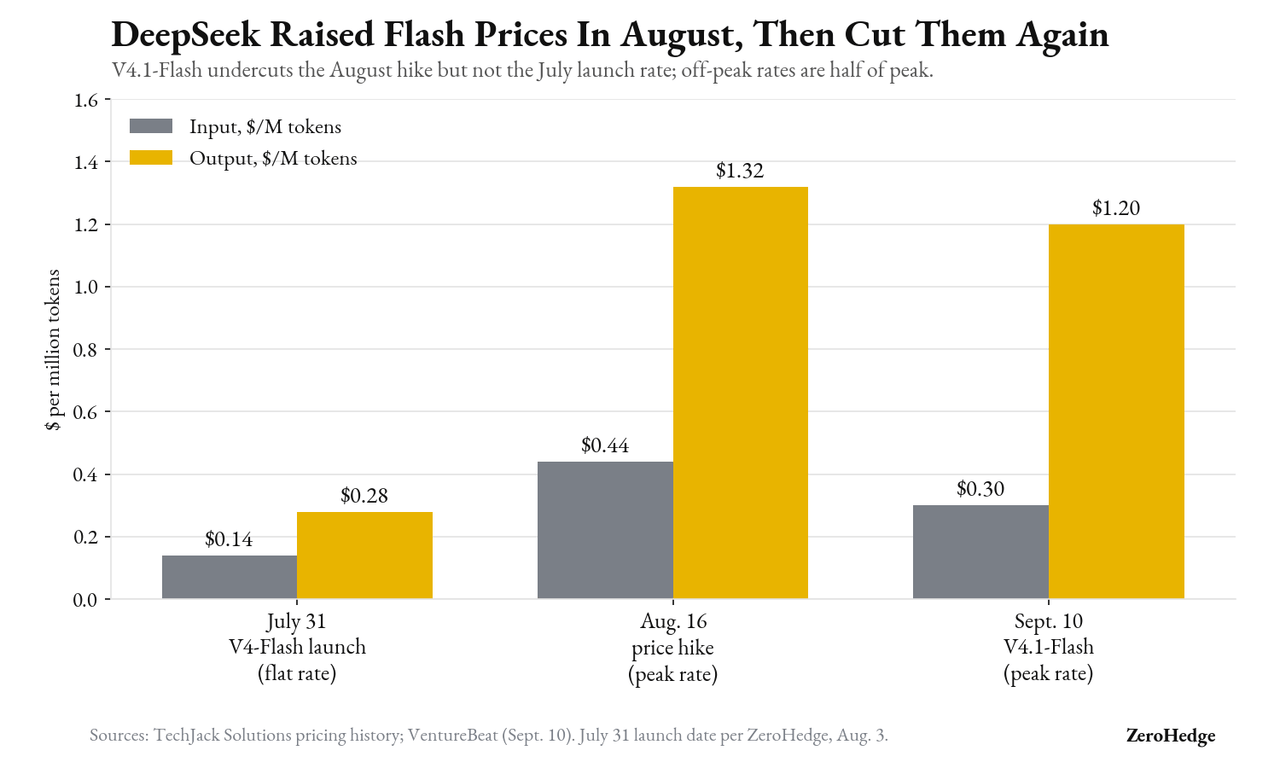
At peak hours, V4.1-Flash costs $0.30 per million input tokens and $1.20 per million output tokens, with prices cut in half during off-peak hours. Anthropic charges $5 and $25 for Claude Opus 5. On output, that makes DeepSeek roughly 20 times cheaper at peak and about 40 times cheaper off-peak.
Deepseek just dropped v4.1 flash, fully open weights
it beats gpt 5.6 sol, opus 5 and every chinese model on coding and cybersecurity at ~86x cheaper cost per million tokens running at 420-507 tok/s = faster than gemini 3.8 flash
The 86-fold figure comes from cached input. Anthropic charges 50 cents per million cached tokens, while DeepSeek charges six-tenths of a cent. Cached input is precisely the cost DeepSeek’s new memory architecture was built to reduce.
Meanwhile, DeepSeek raised its prices only a month ago. On August 16 it moved V4-Flash from flat rates of $0.14 for input and $0.28 for output to peak rates of $0.44 and $1.32. Thursday’s release brought those prices back down, although not to July’s levels, while giving V4-Pro customers a reduction of roughly 70%.
The timing also comes as DeepSeek moves toward the public markets. On Wednesday, Reuters reported that the company had hired CITIC Securities to prepare for a Shanghai listing. That followed a June financing round of about $7.4 billion involving investors including Tencent and CATL, along with reports of another potential round at a valuation near 500 billion yuan.
July Was Supply, September Is Demand
The July selloff in Korean memory stocks centered on supply. SK Hynix signaled a major increase in spending, while Chinese memory manufacturers continued ramping cheaper output.
Friday’s scare came from the other side of the market: each unit of AI activity needing fewer memory chips.
Micron and SanDisk, which held up overnight, were rising in Friday’s premarket after Oracle’s cloud results. The Korean names, where leverage and local retail participation are greater, took the immediate hit.
Moves of 5% or more in a single day remain common for both Samsung and SK Hynix. Bloomberg notes that volatility remains near levels last seen during the 2008 financial crisis and the Covid shock. The shares also look inexpensive on conventional measures. Samsung trades at about 2.7 times book value and Hynix at 5 times, compared with roughly 11 times for the Philadelphia Semiconductor Index. Both Korean companies trade near 4 times forward earnings, versus 19 times for the index.
Within hours, Fibonacci Asset Management’s Jung In Yun said cheaper AI could drive more usage and offset the efficiency gains. Eugene Asset Management’s Ha SeokKeun called the issue a near-term concern.
When Seoul reopened after the Lunar New Year on January 31 last year, eleven days after DeepSeek’s R1 release, SK Hynix fell as much as 12% in a day and Samsung dropped 4%. Investors initially feared that more efficient models would weaken demand for AI hardware. Instead, AI spending kept climbing, and the argument that lower costs stimulate greater usage won the year that followed.
R1 challenged the amount of computing required to produce useful AI. V4.1-Flash is attacking the amount of memory required for every token, and DeepSeek has published a chart, running back to January 2024, showing that requirement falling by more than 400-fold. The company also says the same architecture is intended for larger models.
Export Controls And Huawei’s Own HBM
Since December 2024, U.S. export controls have barred sales of advanced HBM to China, making access to fast memory one of the hardware constraints on Chinese AI developers.
Huawei has been working on a domestic alternative. Its Ascend 950DT uses Huawei-made HiZQ 2.0 memory, with 144 gigabytes of capacity and bandwidth of 4 terabytes per second. That remains well behind the HBM SK Hynix supplies for Nvidia’s leading accelerators.
DeepSeek’s V4 in April was the first frontier model validated on Huawei Ascend hardware alongside Nvidia chips. The company also has a reported order for 160,000 Ascend 950DT processors for a gigawatt-scale data center in Ulanqab.
So – a model that needs one-quarter as much memory per token can be deployed more broadly on hardware that has less memory to offer. The V4.1-Flash model card does not identify the hardware used to train the model.
DeepSeek has not announced a date for the larger member of the V4.1 family. Micron reports on September 30.
President Trump said at the Republican National Midterm Convention in Dallas, Texas, on Wednesday night that if Iran had a nuclear weapon, he would have politely called up the Supreme Leader instead of “bombing the crap” out of the country.
“If they had a nuclear weapon, I’d be calling the Supreme Leader, and I’d be saying, ‘Mr. Supreme Leader, how are you, sir? Is there anything we can do for you?’ as opposed to bombing the crap out of him.” Trump said, evoking cheers from the crowd.
TRUMP ON IRAN: “If they had a nuclear weapon, I’d be calling the Supreme Leader and I’d be saying, ‘Mr. Supreme Leader, how are you, sir? Is there anything we can do for you?’ as opposed to bombing the crap out of him.”
“It’s very simple. We cannot let them have a nuclear weapon,” the president added.
While Trump has continued to frame his war with Iran as necessary to prevent the country from obtaining nuclear weapons, there was no evidence either before the June 2025 war or the current conflict that Tehran had decided to pursue a bomb, and that was the consensus of US intelligence agencies at the beginning of Trump’s second term.
“We continue to assess Iran is not building a nuclear weapon and that Khamenei has not reauthorized the nuclear weapons program he suspended in 2003, though pressure has probably built on him to do so,” read the Office of the Director of National Intelligence’s annual threat assessment that was published in March 2025 and represented the assessment of the entire US intelligence community.
Trump also spent the months following the June 2025 war, known as the 12-Day War, boasting that the US strikes on Iran’s nuclear facilities had “obliterated” its nuclear program.
During negotiations with the US before both wars, Iran made clear it was willing to reduce uranium enrichment back down to 3.67%, the level it agreed to under the 2015 nuclear deal, far below the 90% needed for weapons-grade.
But as Joe Kent, the former director of the National Counterterrorism Center who resigned due to opposition to the Iran war, has pointed out, the administration adopted the Israeli position, conflating any nuclear enrichment for civilian energy purposes with a desire for a nuclear bomb.
UMich Sentiment ‘Expectations’ Plunge Near Record Lows As Republicans Lose Faith, Inflation Fears Rebound
After July’s rebound to pre-war levels, a re-escalation in the MidEast (and soaring fuel costs) sent confidence back towards YTD lows. Preliminary September data was expected to show UMich headline sentiment sliding further.
‘Slide’ is not exactly how we would describe preliminary September confidence data’s collapse (headline from 51.7 to 47.8 vs 51.0 exp). The current conditions gauge fell to 50.9 from 51.9 in the previous month, while the expectations index plunged to 45.8 from 51.5 – just off record lows.
Democrats and Republicans alike posted sizable declines, while independents were little changed from August.
“Opinions of the government’s economic policy worsened about 10% this month and remain substantially below February 2026, just prior to the Iran conflict,’’ Joanne Hsu, director of the survey, said in a statement.
“Notably, even Republicans, who generally supported economic policy under the current administration, have exhibited a marked decline in favorability.’’
Year-ahead inflation expectations jumped from 4.0% last month to 4.6% this month, the highest reading since June.
BUT… umm… How is this possible: Democrat inflation expectations dropped, Republican and Independent inflation expectations unchanged… yet overall inflation expectations jumped the most since May 2026!?
With a resurgence in fuel prices and trade tensions, consumers anticipate greater pressures on their pocketbooks to come.
Five-year expected business conditions remained stable at readings well below their historical average, suggesting that consumers believe that emerging risks this month may not have further worsened the long-run outlook.
Finally, as we noted earlier, real wage growth has now been negative for five straight months…
Jeff Currie Warns Odds Of $5 Gas By Midterms Are “Extremely High”
Jeff Currie Featured on BBG TV
Veteran commodities strategist Jeff Currie has spent the summer warning that scarcity in physical commodity markets is becoming a persistent source of inflationary pressure and giving way to a commodities supercycle.
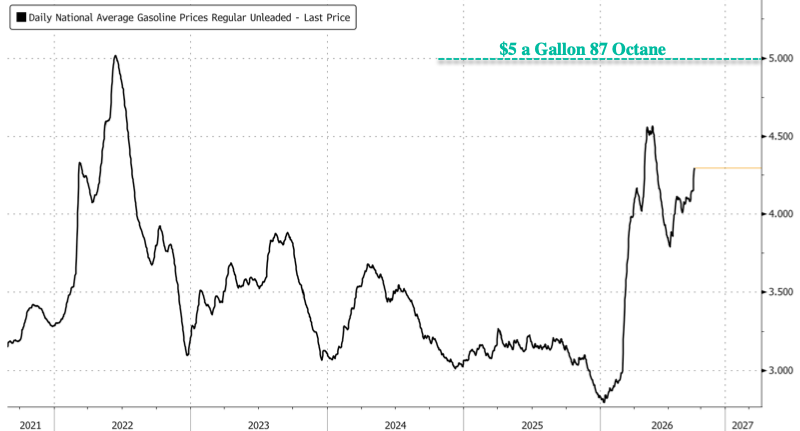
After appearing on CNBC on Thursday, he joined Bloomberg Television on Friday morning to amp up that message, warning that tightening crude products supplies make $5-a-gallon US gasoline highly likely by November.
“Crude is the signal, and now we think about products … they are the noise,” Currie said.
Currie, the founder and chief executive of Real Macro and former Goldman commodities head, also warned that scarcity and currency debasement were driving the next phase of the energy shock, with shortages spreading from refined products into crude oil.
Currie described the probability of average US gasoline prices reaching $5 a gallon by the midterm elections as “extremely high.”
Currie warned that refiners shifting production between diesel and gasoline would eventually exhaust their operational flexibility, limiting their ability to relieve shortages. US diesel prices could reach $7 to $9 a gallon, he added.
The latest AAA data show the national average price of diesel in the US has topped $6 a gallon.
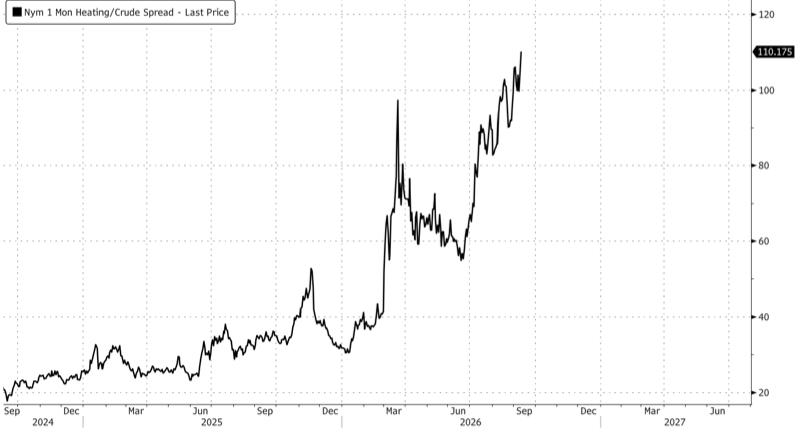
Former Goldman Sachs commodities chief and current Real Macro head Jeff Currie joined CNBC earlier Thursday to discuss all things commodities, warning that the latest Brent crude rally above $107 a barrel is becoming harder to dismiss as a temporary shock, with renewed Chinese buying and soaring refining margins (US diesel crack spread now $110 a barrel) signaling deeper pressure across physical commodity markets.
Currie warned that traders are underestimating an inflation cycle driven by years of underinvestment in the capacity to produce and deliver essential raw materials, echoing his summer warnings about scarcity in physical markets.
“The old economy is taking its revenge,” Currie said. “You see it in the rates markets. You see it in the commodity markets.”
Asked whether the latest flare-up in the Gulf conflict explained the jump in Brent crude this week, Currie pointed first to demand returning from Asia (read here).
“Actually, I put a bigger weight on China coming back to the market,” he said, citing strong buying interest after returning from Singapore and Hong Kong.
China had contributed to the refined-product squeeze by reducing refinery operations and exports as access to crude tightened earlier this summer, Currie explained. But exceptionally high diesel margins created a massive incentive to restart those refineries, bringing renewed crude demand into an already strained market.
He cited diesel crack spreads of $110 a barrel, exceeding the price of crude itself. That figure refers to the refining spread, rather than the outright diesel price.
“That’s a pretty big profit,” Currie said. “They start chasing it, brought those refineries back online, and it was just like an earthquake going through here.”
The rally in Brent is showing signs of greater staying power, he pointed out, with equities and longer-dated oil prices beginning to reflect a more persistent disruption.
“People are starting to go, ‘This is not transient,'” Currie said. “It has a different flavor to it.”
Complementing Currie’s bull thesis on commodities, HSBC chief economist for global commodities Paul Bloxh warned in a note this week that a “super-squeeze” has begun (read report).
MbS Begs Trump For Bigger Anti-Houthi Intervention, As Over 100 US Advisers On Ground
We’ve been documenting the Houthi rapid advance along Yemen’s western coast, as the Iran-aligned rebel group closes in on owning more vital Red Sea chokepoint coastal real estate.
As of Friday, after having the day prior entered the strategic port of Mocha, it is being widely reported including in Al Jazeera that the Houthis have taken control of Yemen’s entire Red Sea coastline. This gives the group, and by extension Tehran, immensely greater leverage over the Bab al-Mandab Strait and vital global energy chokepoint.
The Saudis are said to be in a panic as the front lines of the Sanaa-based government they’ve long backed and weaponized collapse. In some cases Saudi coalition fighters are simply abandoning their armored vehicles and convoys.
Seeking more Washington support from the air and on the ground, Saudi Crown Prince Mohammed bin Salman (MbS) has already made two urgent phone calls to President Trump.
Axios is reporting that in the Thursday calls MbS urged his American counterpart to launch strikes against the Houthis before they solidify control of the vital Red Sea chokepoint.
The report indicates that “Trump declined, and US officials stressed the administration has no plans to intervene directly against the Houthis for now.”
But also, “Adm. Brad Cooper, the commander of U.S. Central Command, traveled to Saudi Arabia on Thursday for urgent coordination meetings, two sources with knowledge of the matter said.” So the Iran war is has now officially gone regional.
I’d like to extend my heartfelt thanks to the American taxpayer for their generous and apparently ongoing sponsorship of Ansar’s expanding toy collection. Your contributions are greatly appreciated. pic.twitter.com/GHVGHExmaI
Of course, Washington and Riyadh been through all of this before but to no effect, given the brutal air war and intermittent ground campaign of the Saudi-UAE-US coalition in Yemen from 2015 to 2022. In more recent years amid the Gaza conflict, major US Navy actions in the Red Sea did nothing to push back the Houthi threat. Repeat Israeli bombings have also done little.
But the Pentagon is still intervening in what can be called a long-running proxy war in southern Arabia, as CNN reported Thursday that over 100 US military advisers are on the ground in Saudi Arabia assisting Riyadh with intelligence and targeting support.
One unnamed official even put the number at more around 200, as part of a new Yemen-focused task force amid the ongoing escalation. A huge worry remains the safety of Hormuz crude transit ‘bypass’ routes.
New Houthi military announcement via Telegram:
Yemen’s armed forces say maritime navigation is safe for all companies except Saudi vessels, which are subject to a blockade, and vow to continue striking Saudi troop buildups and escalating until the aggression and blockade on Yemen end.
The big news overnight was a report that Ansar Allah claimed to have hit Saudi Arabia’s East-West pipeline, which feeds an export terminal on the Red Sea and effectively bypasses the Hormuz chokepoint.
Sometimes a short clip says more than pages of analysis. Here, a Houthi commander who was previously detained by government forces explains why the Bab el-Mandeb Strait matters so much strategically. He tells his soldiers that they no longer need drones or missiles. They could… pic.twitter.com/ZpxHOjfGpJ
The Gulf crisis shows no signs of slowing as US forces took out several Iranian tankers this week and Tehran warns of further escalation. But Trump doesn’t appear to be any closer to articulating, much less seriously contemplating, an offramp to this war of his own making – which is also becoming increasingly unpopular at home.
Following fuel-driven jump in Producer Prices, consensus was for a concomitant jump MoM in Consumer prices this morning, after last month’s decline as energy prices have rebounded (though we warned that amid all the interventionist-y chatter, nothing would surprise us less than ‘cool’ print to offset the PPI scare).
And analysts were right with headline CPI rising 0.4% MoM (exactly as expected) – biggest MoM since May – but prices rose 3.5% YoY (in line with expectations and flat to the prir month)…
Core Services accelerated…
…BUT Fuel prices dominated the rise in headline CPI…
Headline CPI rose 0.4% MoM in August, after rising 0.1% in July. Over the last 12 months, the all items index increased 3.4%.
The index for energy increased 2.1 percent over the month: The index for gasoline rose 3.9% in August, accounting for over one third of the monthly all items increase.
The shelter index rose 0.3 percent in August after rising 0.1 percent in July.
The index for food increased 0.1 percent over the month, as the index for food away from home increased 0.3 percent.
Just like we saw yesterday with PPI, the rebound in crude (and refined product) prices snapped CPI’s Energy component notably higher…
Energy helping on a 6m annualized basis but hurting on a 3m annualized basis…
Core CPI rose 0.3% (0.29% rounded up) MoM (hotter than the 0.2% exp) but on a YoY basis it decline from 2.5% to 2.4% – the lowest since March 2021…
Core CPI rose 0.3% after increasing 0.2% in July. Core CPI rose 2.4% over the year, following a 2.5% increase over the 12 months ending July.
Indexes that increased over the month include communication, lodging away from home, airline fares, education, and used cars and trucks.
Conversely, the index for medical care and the index for motor vehicle insurance were among the major indexes that decreased in August.
MoM Core CPI (0.3%) Details
The shelter index increased 0.3% over the month after rising 0.1% in July.
The index for owners’ equivalent rent rose 0.2% in August as did the index for rent.
The lodging away from home index rose 2.4% in August after falling 2.8 percent the previous month.
The index for communication increased 2.3% over the month after rising 0.6% in July.
The airline fares index rose 2.7% in August, and the education index increased 0.8%.
The index for used cars and trucks increased 0.4% in August, and the index for new vehicles rose 0.3%
The personal care index and the household furnishings and operations index also increased over the month.
The medical care index decreased 0.2 percent in August after rising 0.4 percent in July.
The index for dental services fell 0.6 percent over the month.
The hospital services index, physicians’ services index, and prescription drugs index were all unchanged in August.
The motor vehicle insurance index declined 0.8 percent in August after falling 0.3 percent in July.
The index for apparel was unchanged in August as was the index for recreation.
YoY Core CPI (2.4%) Details
The shelter index increased 3.0 percent over the last year.
Other indexes with notable increases over the last year include airline fares (+23.4 percent), recreation (+2.7 percent), medical care (+1.6 percent), and personal care (+3.8 percent).
Shelter dropped…
Shelter Inflation rose 0.26% MoM, and up 2.75% YoY, down from 2.86% YoY in July and the lowest since March
Rent inflation rose 0.23% MoM, same as July, and up 3.04% YoY, down from 3.18% in July and the lowest since March
The much-watched SuperCore CPI (Services ex-shelter) rose notably on a YoY basis…
…with a big spike in Education & Comms costs…
Driven by a record jump in Telephone Services…
Which was all Wireless Telephone price hikes…
Here’s JPMorgan with an explainer:
Education and communication goods: This category posted a near-record 1.3% rise in July, led by computer prices, as Apple repriced its Mac and iPad products.
Memory prices should continue to put upward pressure on computers and phones, which sometimes takes the form of new features being combined with price increases.
One more thing…
Bloomberg’s Simon White notes that the fastest-changing input in the CPI report betrays signs that AI spending is leaking into consumer prices via the information and information processing sector.
The chart below shows the change in each CPI component’s contribution (based on its weight in the basket) to the year-on-year headline number between July and August.
The information processing sector is contributing only 0.03 percentage points to the headline rate of 3.4% at the moment, but this has risen faster than any other sector.
It includes IT hardware, where prices are starting to rise for semiconductor and memory chips, as data centers are massively fueling demand.
Apple recently announced a rise in the price of its iPhone.
If the impact from data-center spend continues, then it’s clearly an upside risk for CPI, but it should be borne in mind along with leading indicators for inflation, which are rolling over and anticipate a more subdued backdrop for price pressures over the next few months.
As an aside, real average hourly earnings growth was negative for the 5th month in a row (is it any wonder consumer confidence is low)…
On the bright-side, we are decoupling from the 19070s CPI analog…
Understandably, a lower CPI print is better for markets, and JPM’s market scenario analysis affirms that:
For now, rate-hike odds soared to over 90%, almost certain pricing for a 25bps move higher by Warsh and his pals next week…
Rate-change expectations for 2026 has swung wildly this year from over 60bps of cuts in Feb to now 47bps of hikes (the highest of the cycle)…
Wall Street is now convinced Warsh is cornered…
Top Goldman short-term macro trader, Brian Bingham, noted that:
“The Fed is now in the most paradoxical of all positions, beholden to a single data print and potentially reactive to the rounding on the ECO screen…
Warsh told the market in his first press conference that he didn’t want to focus on the number to the right of the decimal point, but now it’s the number to the right of that one that will be the determinant. Waller’s speech on Thursday was surprisingly and overtly dovish, confirming our view that the Board skews heavily if not unanimously dovish relative to the regional presidents, but offered little new information beyond implicitly confirming a 30bp core CPI will merit a hike.
The market appears to be penciling the over/under at 25, but we struggle to see a meaningful rally on an in-line 20bp core print following this week’s jobs report; in a world where the meeting goes in pricing greater than 50% chance of a hike, the risk of the bond market interpreting a hold as a policy error seem far greater than the harm of hiking into above-target inflation.”
UBS FX team noted a somewhat muted reaction in currencies (dollar spiked then slipped lower)…
Warsh painted himself in a corner here. Well, we’ve gotten the hard language tough guy speech at Jackson Hole.
His remarks were prepared and his messaging was intentional.
Now, we’ve gotten the data – labor market print more robust, inflation still supported.
September FOMC pricing goes to just under 23bp immediately, so the market is pretty much fully expecting a hike to come.
At this point, it would be a massive blow to credibility if they fumble the football on following through with the adjustment, but the market seems to have been correct to lean into this data with a long USD gamma bias.
Interestingly, the yield curve is flattening rapidly (Fed credibility at the long-end? locked in hike will slow growth?)…
So while the world and his pet rabbit was watching for 0.2% or 0.3% – knowing energy would be a driver – it turns out it was cellphone carriers hiking prices that had forced Warsh into a corner.
Bottom line: surging cell phone prices (thanks to memory) were the deciding factor between the Core CPI printing 0.2% and 0.3%. https://t.co/KehMJOCgUj
UK Prime Minister Andy Burnham has ruled out a national moratorium on data centers.
Speaking in the UK parliament on Wednesday, Burnham said the government’s AI Growth Zone scheme would help ensure communities hosting new data centers would feel the economic benefits of developments.
Responding to a question from Labour MP Ian Lavery, who said three “vast” AI data centers are currently under construction in his constituency, Blyth and Ashington in north-east England, Burnham said: “At this point, I won’t go as far as a moratorium.”
He added that data centers “can be the magnet that clusters in other investment over time,” and said AI Growth Zones would help boost tax revenues for communities with data centers.
Burnham plans to devolve more power to local mayors, including allowing them to spend a greater proportion of tax raised in their areas on local projects.
Under Burnham’s predecessor, Keir Starmer, the UK government championed data centers as a vehicle for economic growth.
It set up AI Growth Zones as a way to attract digital infrastructure projects to specific areas, touting tax incentives and priority access to power.
Blyth and Ashington, Lavery’s constituency, is home to major projects including a £10 billion ($13bn) plan to convert a former power station into a 720MW AI data center, which is being developed by Blackstone-owned QTS.
A lot has changed in the past year and a half, with Starmer out and the Department for Science, Innovation, and Technology (DSIT), which oversaw the launch of AI Growth Zones, closed and merged into the Department for Business, Innovation, Science and Trade when Burnham took office this summer.
After a period of uncertainty about the future of the growth zone program, government officials confirmed to DCD that the team now reports to UK AI minister Kanishka Narayan. However, the architect of the scheme, Matt Clifford, has left his role in government to join AI lab Anthropic.
Burnham’s backing of data centers contrasts with the stance of UK Green Party leader Zack Polanski, who has called for a national moratorium citing concerns over power and water usage.
In Scotland, lawmakers in the Scottish National Party and the Scottish Green Party have also backed a ban north of the border.