Brent Nears $110 Then Tumbles On IEA Demand Destruction Warning As Houthis Threaten Saudi Oil Escape Route, Diesel Shock Goes Global
Brent crude futures nearly topped $110 a barrel in the overnight hours but fell 3.5% to the $103 handle by 6 a.m. ET, after reports from the International Energy Agency that soaring fuel costs could spark global demand destruction.
The global benchmark remained on course for its biggest weekly advance since July. Prices have soared more than 70% this year as the Hormuz chokepoint remains disrupted, energy infrastructure attacks continue from the Gulf to the Russia-Ukraine theater, and renewed Chinese buying of crude in various global markets bids up local prices.
“A resumption of a full-blown Saudi-Houthi war would be a potential catalyst for our high oil price scenario coming to fruition,” RBC Capital Markets analyst Helima Croft wrote in a note.
The big news overnight was a report that Iran-backed Houthis claimed to have hit Saudi Arabia’s East-West pipeline, which feeds an export terminal on the Red Sea and effectively bypasses the Hormuz chokepoint. There’s also news that the Houthis advanced toward coastal areas bordering the strategic Bab al-Mandeb Strait, gaining ground in their push to seize Mokha near the southern end of the Red Sea.
🔥🌏Just to put the sheer SCALE of this attack into perspective…
The smoke stretched more than 100 km across the Saudi desert and was visible from space even when zoomed all the way out to a global view of Earth.
The Gulf crisis shows no signs of slowing as US forces took out several Iranian tankers this week and Tehran warns of further escalation.
More bad news for global energy markets: Saudi Arabia’s oil production fell again last month to its lowest level since 1990.
CHART OF THE DAY: Saudi Arabia and Russia (the world’s 2nd and 3rd top oil producers) suffered significant output drops in August due to the Iran and Ukraine wars, respectively. Combined, Riyadh and Moscow pumped last month ~5.5m b/d less than they did in January (@IEA data). pic.twitter.com/YJNn0A9kg3
Capital Economics commodities expert Hamad Hussain warned that depleted inventories and early signs of recovering Chinese demand leave prices vulnerable to another interruption in Middle East flows.
Former Goldman Sachs commodities chief and current Real Macro head Jeff Currie joined CNBC TV on Thursday and said that it’s actually Chinese buyers who are bidding up crude: “Actually, I put a bigger weight on China coming back to the market,” he said, citing strong buying interest after returning from Singapore and Hong Kong.
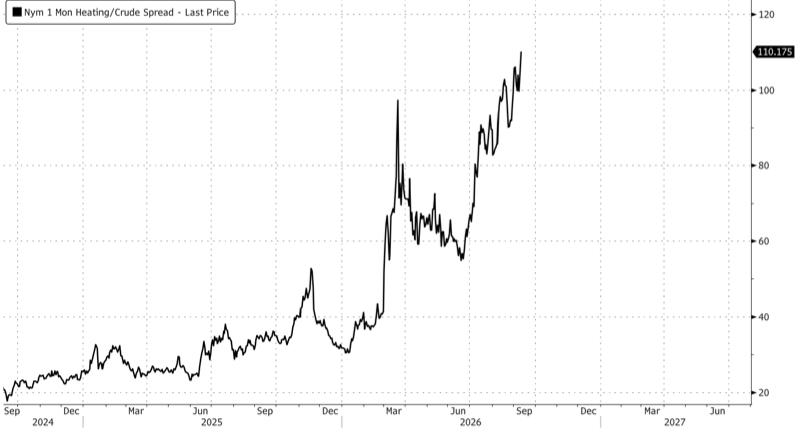
The more consequential crisis isn’t necessarily about crude supply, because the global economy doesn’t run on that. Instead, it’s the diesel shortage rippling through the world. The US diesel crack spread currently trades around $110 a barrel. Prices at US pumps for the industrial fuel average $6 a gallon, a record high, while prices at some gas stations in California topped $9.99 per gallon.
“Brent holding above $105 with Houthi/Bab al-Mandab disruptions raising fears of a double chokepoint. 10y bunds yields highest since 2009, 10y US within reach of the 5% level,” UBS analyst Justinus Steinhorst wrote in a note.
However, there is some good diplomatic news from the Gulf: Bloomberg reports that the six-member bloc of Gulf states is considering meeting with Iranian officials next week to discuss the Hormuz chokepoint.
US Agencies Accuse China-Based AI Firms Of ‘Malicious’ Copying Of American Models
Federal cybersecurity and intelligence agencies on Tuesday accused six China-based artificial intelligence companies of running industrial-scale campaigns to extract proprietary features from leading U.S. models.
DeepSeek, Moonshot AI, Alibaba, MiniMax, StepFun, and Z.AI were all named in the joint advisory.
Officials alleged the companies, “likely with Chinese government awareness,” pulled billions of tokens across millions of requests from U.S. AI systems. The list included variants of Claude, GPT, Gemini, and Grok. The activity dates back to at least late 2024.
Cybersecurity and Infrastructure Security Agency (CISA) Acting Director Nick Andersen said that CISA is committed to promoting the secure use of AI.
“We strongly urge AI companies to take immediate steps to safeguard their platforms against knowledge distillation campaigns that threaten to close the gap in advancements made by American companies,” Andersen said.
The three agencies – CISA, the National Security Agency, and the FBI – differentiated legitimate research from “aggressive, malicious, and targeted distillation activities at an industrial scale.”
The advisory said the firms routed traffic through native application programming interfaces (API), remote cloud providers, and third-party aggregators that strip user metadata. A gray market of proxies, referred to as “transfer stations,” helped them dodge geographic blocks, break terms of use, and muddy the trail. Bulk premium subscriptions, shared across developer teams, kept the bills down.
DeepSeek, formally Hangzhou DeepSeek Artificial Intelligence Basic Technology Research Co. Ltd., has run an organized campaign since at least late 2024, according to the agency, to feed synthetic training data into its R1 and V3 models.
Targets included Claude 3.7, Claude Sonnet 4 and 4.5, Claude Opus 4.1, Gemini 2.5 Pro and Flash previews, GPT-4, GPT-4o, GPT-5, and Grok 4.
Officials called DeepSeek’s widely cited $5.6 million training figure misleading, saying it leaves out the cost of data taken through distillation.
Moonshot AI, or Beijing Moonshot Technology Co. Ltd., was accused of a broad campaign since at least mid-2025. The advisory said the firm pulled substantial Claude Fable 5 data for its Kimi-K3 model and GPT-4o data for Kimi-K2.
The new advisory recommends three steps for U.S. model providers, including hunting anomalous prompts, accounts, and usage spikes; quietly degrading answers when a distillation campaign is suspected; and sharing intelligence across companies, clouds, and API aggregators.
In July, Office of Science and Technology Policy Director Michael Kratsios said his office had reason to believe Moonshot AI “distilled Anthropic’s Fable for the development of its K3 model.”
“Large-scale, covert industrial distillation aimed at stealing proprietary U.S. technology and undermining American research is unacceptable,” Kratsios said.
Alibaba, the agencies contended, distilled Claude-4, Claude Opus, Claude Sonnet, and GPT-5 in late 2025 to hasten software engineering, customer-service dialogue, and image creation for its Qwen family of models. MiniMax, or Shanghai MiniMax Co. Ltd., used Claude Code, Claude Sonnet 4, Claude Opus, and several Gemini versions to improve its M2 model. Officials said MiniMax even attempted prompt injections to convince Claude Code it was actually a MiniMax product.
StepFun distilled a string of Claude and GPT-5 variants between late 2025 and early 2026 for its Step 4 model. By mid-2026, Z.AI had taken billions of tokens of GPT-5.5 and Claude Opus 4.8 data for chain-of-thought reasoning, the advisory said.
On April 23, a White House memo warned of “industrial-scale campaigns” employing “tens of thousands of proxy accounts” and jailbreaking tricks.
“There is nothing innovative about systematically extracting and copying the innovations of American industry,” Kratsios wrote at the time. “And there is nothing open about supposedly open models that are derived from acts of malicious exploitation.”
The memo also said the campaigns “allow those actors to deliberately strip away security protocols from the resulting models and undo mechanisms that ensure those AI models are ideologically neutral and truth-seeking.”
Anthropic, the maker of Claude, said in February that DeepSeek, Moonshot AI, and MiniMax created about 24,000 fraudulent accounts and sent more than 16 million prompts to Claude. MiniMax accounted for more than 13 million, Moonshot AI more than 3.4 million, and DeepSeek about 150,000, according to the company.
Treasury Secretary Scott Bessent said he is open to sanctioning Chinese AI developers over alleged model theft.
“This administration supports open-source models, but what we do not support is IP theft,” Bessent said in July. “If we see, especially, that overseas models are stealing from our great companies, we have the ability to sanction them because of this theft.”
“There’s a very technical AI word for it called distillation, but you and I would call it theft.”
CISA, the National Security Agency, and the FBI said the effort sits at the center of those firms’ development plans.
How desperate must a government become before it considers taxing pornography to purchase drones for a war it cannot win?
Ukraine is now reportedly considering legalizing parts of its adult entertainment industry to generate additional tax revenue for the war against Russia. Ukrainian lawmaker Yaroslav Zhelezniak estimates legalization could bring around $25 million annually into the government’s coffers, enough, he claims, to purchase up to 30,000 drones. The legislation has already passed its first reading in parliament and awaits further consideration.
Zelensky has agreed that parliament should consider the proposal after a petition supporting reform attracted more than 25,000 signatures.
You cannot make this stuff up.
Ukraine requires around $120 billion annually for defense, according to reporting on the proposal, and the government is scrambling everywhere it can for money. Its budget deficit exceeds $32 billion as Kyiv simultaneously negotiates with the IMF over additional financial assistance and new taxes. Europe and the United States have poured hundreds of billions into keeping this war machine operating, yet five years into the conflict Kyiv remains financially dependent upon outsiders.
The situation is even more outrageous because the government created this absurdity itself. Producing and distributing pornography remains illegal in Ukraine and can carry years in prison, yet tax authorities began demanding money from Ukrainians earning income through adult platforms. Pay the taxes and you effectively provide the government with evidence that you participated in an activity it criminalized. Refuse to pay and they can prosecute you for tax evasion. Zhelezniak himself described it as a “tragicomic situation.”
You cannot legislate human nature out of existence.
Prostitution has survived emperors, kings, dictators, democracies, communism, religious prohibitions, and every law politicians have invented. The Romans tried regulating how prostitutes could be paid and people simply devised ways around the restrictions. Make an activity illegal and government frequently creates an underground market with multiple exploiters.
That is government in its purest form.
First it declares something immoral and sends the police after you. Then it discovers you are making money, demands its percentage, and eventually considers changing the law because it desperately needs the revenue. Ukraine has simply added the insanity of war to the equation.
There is only desperation in reaching the point where politicians are calculating how many battlefield drones can be purchased from taxes on sex work. Every additional scheme to extract another dollar, euro, or hryvnia demonstrates the same underlying reality: this war has consumed Ukraine economically, financially, demographically, and socially. At some point, someone has to admit that destroying what remains of the country to finance an unwinnable war is not defending Ukraine.
US Home Delistings Decline As Sellers Become More Willing To Make Deals
Property delistings nationwide recorded a year-over-year decline toward the end of this summer, as sellers showed more patience than they did a year ago and a larger share were willing to cut prices, according to Realtor.com.
By contrast, the December 2025 Realtor.com report showed that delistings in June and July 2025 jumped by 48 percent and 57 percent, respectively, from the same months in 2024.
The average interest rate for a 30-year fixed-rate mortgage was around 6.6 percent to 6.8 percent during summer 2025, according to Freddie Mac.
“With buyers and sellers far apart, the sellers’ solution is to pull that trump card and delist, rather than cut prices,” Realtor.com senior economist Jake Krimmel said at the time.
While the group’s September 2026 data showed a year-over-year drop in delistings this summer, it also noted there were 10 consecutive months of annual list-price drops.
In August, 20.4 percent of active listings had price reductions, a 0.4 percentage-point increase from July and unchanged from August 2025.
Listings in pending status declined 0.2 percent from a year earlier, following eight months of gains, which peaked at 4.1 percent in May, according to the report. Contract signings also decreased 3.7 percent compared with August 2025.
Nationally, the median list price stood at $424,500 in August, a 1.0 percent decline from July and a 1.3 percent decline from August 2025.
“August brings a mixed reading: buyer demand softened and price cuts rose modestly above last year’s pace, but sellers are still showing more patience than they did during last year’s late-summer delisting wave,” Krimmel said in a Sept. 3 statement.
“Price cuts, pending sales and delistings together can tell you whether sellers are satisfied, panicking, or somewhere in between.”
Regionally, the West and South recorded the largest share of active listings with price reductions in August, at 22 percent and 21.4 percent, respectively. The Northeast had the lowest share, at 14.1 percent, while the share in the Midwest was 19.6 percent.
Meanwhile, 1.14 million active listings across the country were reported in August, including 401,760 new listings – a 5.2 percent dip from July. The report indicates that inventory grew across all four regions, with the Midwest leading by 10.5 percent.
“August’s data shows a housing market entering its seasonal cool-down with less momentum than it had earlier this year,” Realtor.com Chief Economist Danielle Hale added in the report.
“Higher mortgage rates are meeting a point in the calendar when activity typically slows, and buyers appear to be responding more selectively.”
As of Sept. 3, Freddie Mac reported an average 6.71 percent interest rate for a 30-year fixed mortgage, and 5.98 percent for a 15-year fixed loan.
Only the years 2000 and 2023 had higher rates at this time of year in the last 26 years…
Looking ahead to the fall, Realtor.com said the gap in delistings compared with last year could either persist or reverse, depending on market conditions and whether sellers will continue to rely on price reductions.
“Sellers may start to get more desperate in September and subsequent months when mortgage rates are likely to remain higher than they were at this time in 2025,” the report noted.
The official line is that 1,256 single adult males will be placed at the old MoD depot on the edge of the Oxfordshire hamlet. Yet the document villagers pulled out of the consultation pack talks about “accommodation for 3,510 service users.”
That is not a rounding error. In a place of 350 people and 46 children, it is a demographic wrecking ball.
Home Office sparks fresh outrage in Piddington as surfaced document reveals plan to house over 3,000 asylum seekers in village https://t.co/T4AmKxtZQN
The Home Office calls the figure an “outdated estimate” and “categorically untrue.” But the document has not been withdrawn.
The village has no pub, no shop, no pavement on the approach road and no street lighting worth the name. Men of fighting age would be free to come and go from a site that backs onto the children’s playing field. That is the plan they are being told to accept as “fairness.”
This is the same village that first exploded in July when the 1,250 figure landed with almost no consultation.
Children from the parish wrote to the Prime Minister asking him not to take the only home they had known. Seven-year-old Rex Perkin, whose family has lived there more than a century, worried he would no longer be able to walk to his sister’s grave. On 4 July – American Independence Day – 96 percent of those who voted backed a referendum on leaving the United Kingdom. The second vote is now days away.
The new row began when residents working through the planning papers found an Unexploded Ordnance risk assessment for Bicester Site A. It states that “the proposed scheme” relates to “accommodation for 3,510 service users.” The assessment is dated March this year. It is still online. It has not been amended.
The official planning application seeks a ten-year “temporary” change of use for “non-detained asylum accommodation,” open 24 hours, for up to 1,256 single males aged 18 to 65. Consultation closes on 17 September. The village’s symbolic independence referendum is two days earlier, on 15 September – Battle of Britain Day.
Parish council chairman Tim McNally put the contradiction in plain English.
“Although the proposal states 1,256 single males between the ages of 18 and 65, the service users focuses on 3,510,” he said. “That is ten times the size of the village of Piddington. Now if that is an error, correct it. This is more than alarming. It is either deception at the greatest level or incompetence at the highest.”
‘Prime Minister…look what you are doing to 46 kids, who will basically lose their childhood.’
Chairman of Piddington Parish Council Tim McNally explains the impact that placing thousands of migrants in the local area would have on his community. pic.twitter.com/SrDt2ZPeU9
Resident campaigner Ian Darby told GB News the same suspicion is now general.
“Clearly we’re concerned and it’s slightly beggars belief that if there was some original thinking at sort of 3,500 people, that they’d still be daft enough to include an old report that is no longer relevant in this consultation,” he said.
He added, “Some of us are a little bit more suspicious and worry that that is potentially their ultimate plan, which for this village, just to remind everybody, would be ten times the size of this village. It’s a takeover. It’s a complete destruction of a beautiful little village.”
‘Ten times the size of this village, it’s a takeover and complete destruction of a beautiful village.’
Ian Daeby says he is concerned that documents relating to the Piddington asylum site reference a capacity of 3,510, while the Home Office insists the limit is 1,256 migrants. pic.twitter.com/OzLVZqLZhY
A Home Office spokesman replied: “It is categorically untrue to suggest we are seeking to house 3,510 people at the MOD Bicester. As our planning application clearly states, we are considering the site to accommodate up to 1,256 asylum seekers.”
They added that community concerns are “central to our immigration reforms” and that hotels are being emptied in favour of former military sites.
Villagers note the 3,510 figure was never pulled from the file. They also note the application arrived after a 56-day wait with 11 sections redacted, including material on suicide and self-harm, health and safety, and handling a death on site.
‘It is a symbol of a country whose rulers and politicians keep demanding public trust, whilst giving fewer and fewer reasons to offer it.’ @GoodwinMJ analyses the significance of thousands of migrants being set to be housed in Piddington, a small village in Oxfordshire. pic.twitter.com/hExJQ6oXxM
Piddington is a single-lane hamlet of thatched and brick cottages, a 13th-century Grade II-listed church, and a parish playing field. The nearest amenities are miles away down an unlit B-road with no pavement. Gardens sit close to the depot fence. The site is about 750 metres from family homes.
Resident Melise Witkin, 59, told the Mail the argument is not class and never was.
“This is not about being rich or poor, this is about safety,” she said. “We are 356 people in the village with 46 children and 1,250 men turning up is a recipe for disaster. People walk their dogs, children play, I just think it is madness. This is about safety, nothing more. Even for them [the asylum seekers], along that road there is no pavement, there are no street lights. We don’t have a pub, we don’t have a shop, what are the asylum seekers going to do here.”
Karen Joy said the fear is already in the houses.
“We feel we have been ignored,” she said. “We are a very small village and there is nothing for the people in the asylum camp to do. Our worry is that they will wander into our village and the security is nil. We feel scared. That is all I feel, to be honest.”
Victoria Hubbocks described what the change does to ordinary life. She runs at 5am. Her 11-year-old walks the dog alone. The village currently switches street lights off overnight because everyone knows everyone.
“I go for runs at 5 o’clock in the morning and I don’t feel scared. I will have to change that,” she said. “I think it effectively takes away my children’s childhood.” On the Prime Minister’s demand that every area “step up,” she added: “Step up? Fair enough, but ten men to each woman in Piddington isn’t a fair proportion in any way, shape or form.”
Joe Marshall, on the parish council, said police who visited the site left a phrase behind that nobody in Whitehall wants to repeat.
“We’re sitting ducks,” he said. “The police have come and had a look and said that we’re sitting ducks, and we’ve not been given any reassurances.” He also said the application is “full of inconsistencies,” littered with typos, and missing “really crucial documents.”
Mario Terzino has an 18-year-old daughter who walks the dog alone. That stops if the camp opens. “We’ve got no public transport. There is nothing here,” he said. “It’s not about who’s going to the base. It’s about the scale. We’re talking about 1,250 people, or males, going into a site which is literally adjacent to our playing field. It’s just bonkers.”
Piddington is being sold as an isolated planning row. It is not. It is the same template stamped across rural Britain: take a high-trust village with no night-time economy, no spare police, and a children’s play area, then drop in a barracks-worth of single adult males and call it “equity.”
At RAF Linton-on-Ouse in North Yorkshire, a village of about 600 faces around 1,200 single adult males beside a primary school and nursery – six migrant men to every local woman.
In Gronant, North Wales, residents woke to find a former village hall, freshly turned into new-build homes, handed to asylum seekers with blacked-out vehicles and no warning. Locals called it an “absolute betrayal.”
Crowborough in East Sussex watched hundreds of single adult males arrive at a former army camp. Women reported feeling unsafe. Volunteer patrols followed. Barnham in Suffolk sits on the same list. Together the three English MoD sites were framed as housing about 3,750 people while hotels are emptied.
Prime Minister Andy Burnham’s answer to Piddington was not a pause. It was a doctrine. “All parts of the country need to play their part.” Middle-class and leafy places, he said, can no longer sit outside the map. Borders minister Anna Turley called it a “more fair and equitable system” and insisted the men would be “contained” on site – while also confirming they “will be allowed out.”
The cheerleaders for this policy tend to live nowhere near it. They praise “sharing the burden” until the burden is a lane with no pavement and 46 children. Then the enthusiasm thins out.
Reform UK’s Zia Yusuf, who visited the village, blasted the 3,510 assessment.
“It’s now been revealed the lying Labour Government had assessments carried out based on housing 3,510 migrants in the English village of Piddington, more than double the official figure of 1,256,” he said. “That would have been 10 illegal migrants for every one resident. Villagers’ lives will be ruined overnight. Ministers continue to conceal the true scale of what is coming, and the numbers keep rising before a single migrant has even arrived.”
Samantha Phillips, 61, a 26-year resident now helping organise self-defence classes for women and children, said: “If this was to happen, if we were to get 3,510 male migrants, then the entire population of Piddington represents less than one tenth of the size of the local male migrants.”
Andrea Owen, who grew up in the military community around Bicester, put the cultural point without a think-tank filter. “The British traditions and the British way of life are just being ripped away.”
Look at the map and the pattern stops looking like incompetence. Channel crossings continue. Hotels become a political embarrassment. The solution chosen is not detention and removal. It is dispersal into the least densely populated, least policed, most culturally intact corners of the country.
They could not have picked places more alien to a cohort of fighting-age men from the other side of the world if they had tried. No mosque. No late-night high street. No anonymity. A medieval church, a playing field, dog walkers, and children who still treat the lane as their own. Then the same officials express surprise when women book self-defence classes and a parish council talks about independence.
Darby’s warning is the one that matters if the 1,256 cap is even real. Once the site is open, it is the easy tap. “If I were sitting in their shoes and this was open even initially at sort of 1,200, and you did have a rush of new asylum seekers arriving, you’re going to come here first, aren’t you? Because you’ve already won the battle.”
McNally asked the question Whitehall will not answer. “How can a government do this to us? Our children – our children’s lives – are the ones that are being undermined.”
The consultation ends on 17 September. The village votes on the 15th. Legal options are being prepared. A petition against using MoD sites without proper local consultation has already passed the threshold that forces a government response. Activity on the ground has already been reported. Ecological, electrical, sewage and water documents, residents say, are still not properly in place.
A government that wanted the least disruption would not park thousands of unvetted men against a playground in a hamlet of 350. A government that wanted maximum cultural shock would do exactly that – then lecture the people living there about “playing their part.”
Piddington is not refusing to exist in modern Britain. It is refusing to be used as the demonstration site for a policy that treats English village life as surplus.
“Old Economy Is Taking Revenge”: Jeff Currie Warns Fuel Squeeze Is Driving Structural Inflation
Former Goldman Sachs commodities chief and current Real Macro head Jeff Currie joined CNBC earlier Thursday to discuss all things commodities, warning that the latest Brent crude rally above $107 a barrel is becoming harder to dismiss as a temporary shock, with renewed Chinese buying and soaring refining margins (US diesel crack spread now $110 a barrel) signaling deeper pressure across physical commodity markets.
Currie warned that traders are underestimating an inflation cycle driven by years of underinvestment in the capacity to produce and deliver essential raw materials, echoing his summer warnings about scarcity in physical markets.
“The old economy is taking its revenge,” Currie said. “You see it in the rates markets. You see it in the commodity markets.”
Asked whether the latest flare-up in the Gulf conflict explained the jump in Brent crude this week, Currie pointed first to demand returning from Asia (read here).
“Actually, I put a bigger weight on China coming back to the market,” he said, citing strong buying interest after returning from Singapore and Hong Kong.
China had contributed to the refined-product squeeze by reducing refinery operations and exports as access to crude tightened earlier this summer, Currie explained. But exceptionally high diesel margins created a massive incentive to restart those those refineries, bringing renewed crude demand into an already strained market.
He cited diesel crack spreads of $110 a barrel, exceeding the price of crude itself. That figure refers to the refining spread, rather than the outright diesel price.
“That’s a pretty big profit,” Currie said. “They start chasing it, brought those refineries back online, and it was just like an earthquake going through here.”
The rally in Brent is showing signs of greater staying power, he pointed out, with equities and longer-dated oil prices beginning to reflect a more persistent disruption.
“People are starting to go, ‘This is not transient,'” Currie said. “It has a different flavor to it.”
Complimenting Currie’s bull thesis on commodities, HSBC chief economist for global commodities Paul Bloxh warned in a note this week that a “super-squeeze” has begun (read report).
When I think of Michael Gove perusing the latest PISA league tables, proving yet again that his education reforms have transformed the life chances of English schoolchildren, a line from Broadcast News, the 1987 romcom, comes to mind.
“It must be nice to always believe you know better, to always think you’re the smartest person in the room,” says a veteran television news man to a young female producer.
“No,” she replies. “It’s awful.”
When it comes to teaching and learning, the man who ran the Department for Education from 2010 – 14 really does know better. As he has pointed out, a natural experiment has taken place in Great Britain over the last 16 years – longer, if you date the beginning of the reform programme to the Labour and Skills Act 2000 – with England implementing a raft of educational reforms and Scotland and Wales stubbornly sticking to the same old failed formula. The results in the just-published 2025 PISA data are there for all to see.
English 15 year-olds scored 492 in maths, 497 in reading and 516 in science – 29, 36 and 34 points respectively above the OECD average. England now sits comfortably in the upper reaches of the developed world, having climbed into the top 10 in all three subjects.
Wales, by contrast, has fallen below the OECD average, its maths score declining a full 10 points since 2022. Scotland, though still nominally above the international average, has flatlined since its own dismal 2022 showing and now trails England by roughly a year’s worth of learning. Just think about that: in Scotland, the average child is a year behind his English counterparts. (In Wales, they are two years behind.)
So Lord Gove has been vindicated. But knowing he was right won’t be much comfort, given the resistance to his reforms in the devolved nations. No free schools, no academies, no ‘comprehensive grammars’. No phonics, no spelling and grammar tests, no maths mastery, no EBacc, no Progress 8. Just the same old romantic dross – ‘problem solving’, ‘transferable skills’, ‘child-centred learning’ – that has failed Scottish and Welsh schoolchildren for decades.
Instead of replicating Westminster’s knowledge-rich curriculum, Edinburgh and Cardiff rolled out a skills-based “curriculum for excellence”. Even today, in spite of the overwhelming evidence of its failure, the SNP Education Secretary, Màiri McAllan, is still defending this rag-bag of progressive clichés.
Scotland’s education system, she said in response to the latest PISA figures, looks at “artistic expression, problem solving and moral education” so it produces “well-rounded individuals who are ready and capable to be resilient in this world”. Not so ready and capable, Màiri, if they can’t read, write or add up. As Gove rightly concluded, there’s no evidence schools can teach artistic expression, problem solving or character traits like resilience, so it’s better to focus on what they can teach.
The unions have a lot to answer for. In England, it was a standing joke among education reformers in the early 2010s that the ‘n’ in the NUT stood for ‘no’ because England’s largest teaching union had blocked every reform for the last 50 years. Gove and his trusted lieutenants like Nick Gibb faced down the NUT and drove through his reforms in the teeth of ferocious opposition. But his Scottish and Welsh counterparts weren’t so robust, quickly abandoning any effort to overhaul their failing schools when the unions objected.
Some of this can be explained by not wanting to copy what the hated Tories were doing down south. But even when the OECD recommended Scotland reproduce some of the measures that were clearly succeeding in England – a pared-down academic core, greater headteacher autonomy, stricter behaviour management policies, more rigorous assessment – the EIS, Scotland’s largest teaching union, threw up its arms in horror. Each time Scottish education ministers have so much as gestured towards reform, the union has treated it as an act of war.
All of which must be profoundly depressing for Lord Gove. What more do you need? he must be thinking. Worse, the current Labour Government is in the process of dismantling the Gove reforms. Incredibly, Bridget Phillipson and now Lucy Powell have looked at the PISA data and concluded that England’s education system should be more like that of Scotland and Wales – less school autonomy, no more free schools, continuous assessment instead of rigorous exams, toothless behaviour policies, and a neutered Ofsted. At the heart of Labour’s new national curriculum, we’re told, will be ‘sustainability’ and ‘decolonisation’.
The blob is back and the smartest man in the room must be reluctantly concluding that no amount of evidence will convince his opponents he was right.
Mideast Chaos Sends Supertanker Rates Soaring To $800,000 A Day
Supertanker rates on the Baltic Exchange’s benchmark Middle East-to-China shipping route have surged to a staggering $800,000 a day. With US forces having destroyed five Iranian-linked tankers and Tehran threatening further escalation in recent days, prospects for near-term stabilization remain limited.
The freight surge signals that crude oil and refined products continue to flow but are becoming increasingly costly to transport out of the Gulf region to global markets.
According to Bloomberg, US Gulf-to-Asia shipments on very large crude carriers average about $29.5 million per voyage, equivalent to $15 a barrel before any additional war-risk charges or unexpected delays.
Kpler expects VLCC earnings to remain above $100,000 a day into early next year, compared with historical levels that exceeded $45,000. Morgan Stanley analysts point out that two-year leasing rates could surge another 20% to 30%.
Manu Sehgal, vice president of strategy and feedstock supply at Indian refiner HPCL-Mittal Energy, told Bloomberg that “crude volume is there. What’s hampering it is the transit; what’s hampering it is the shipping.”
A fleet of tankers conducting ship-to-ship transfers in the Gulf of Oman is helping keep barrels flowing through the Hormuz chokepoint. Vitol’s CEO estimated earlier this week that roughly 10 million barrels a day were crossing the waterway, while Goldman analysts put that figure at around 15 million.
The Baltic Exchange’s new Gulf of Oman-to-East Asia benchmark has surged 85% since inception, reaching almost $386,000 a day this week.
This means surging tanker rates add another layer of inflation pressure for global central banks. Those costs can filter through to gasoline, diesel, freight, and ultimately consumer goods on store shelves.
Austria’s new nationwide ban on “traditional Muslim” head coverings, including hijabs and burqas, for girls under 14 in both public and private schools, has now taken effect as of Sept. 7, 2026. in Vienna, Lower Austria, and Burgenland.
The start date coincided with the start of the new school year.
Austria’s remaining states will follow with a ban next week as well.
The measure, framed by the government as a child-protection and gender-equality policy, immediately faced visible resistance from Muslims and the first formal legal challenge.
At an Islamic primary school in Vienna, reporters from Austrian news outlet Heute observed young girls arriving to school still wearing headscarves accompanied by their mothers. One child wore a pink hijab coordinated with her dress; two slightly older students entered in simple hijabs without parents. School officials did not immediately clarify how they would apply the ban on private Islamic institutions.
The law requires schools to start with conversations involving the student and her legal guardians. Repeated violations trigger involvement of child-protection services, with fines of €150 to €800 possible for parents as a last resort. Teachers, already under strain, must initiate these talks. There are now fears of real conflict arising in the coming months.
Integration Minister Claudia Bauer of the conservative ÖVP described the headscarf as “a sign of oppression and a means of controlling girls from the earliest childhood.” Chancellor Christian Stocker has separately called for a constitutional ban on political Islam, saying he does not “want to live in an Islamic state.”
The right-wing Freedom Party of Austria (FPÖ), the most popular party in the country is known for its even harsher stance toward migrants and Islam in the country. FPÖ politician Ricarda Berger stated there is “no place for political Islam in Austria, and certainly not in our schools.”
The party wants a general ban on all headscarves and face coverings in schools for both students and teachers alike, which would cover all ages.
Education Minister Christoph Wiederkehr of the liberal NEOS acknowledged uncertainty about the law’s fate at the Constitutional Court, stating: “You can never be completely certain.”
He added that the government and education ministry “carried out very intensive consultations” to draft a constitutionally compliant text.
Only the Greens opposed the bill in parliament. Green politician Sigi Maurer accused Wiederkehr of “creating new conflicts and offloading them onto the teachers,” saying the minister wanted to “foist the role of police officers onto them.”
Teachers’ union chairman Paul Kimberger noted that some communities had already announced they would resist and that certain conversations with parents “will probably have limited success.”
The Islamic Religious Community in Austria (IGGÖ), the largest Islamic organization in the country, condemned the ban as discriminatory. Spokesperson Carla Amina Baghajati said, “We believe it unjustifiably restricts the fundamental right to freedom of religion and disproportionately affects Muslim girls. Rather than protecting children, it singles out a specific religious practice and risks excluding the very children it claims to support.”
The IGGÖ has pledged to support families challenging the law at the Constitutional Court. A request for annulment was filed on the first day of school.
A 2020 Constitutional Court ruling had struck down an earlier ban limited to children under 10, finding it violated Austria’s duty of religious neutrality. The court dismissed premature challenges to the new law in July because it had not yet entered force, but that procedural barrier is now gone. Left-wing student groups have called for protests. An 11-year-old girl demonstrated against the ban in February carrying a banner that, translated into English, read, “My headscarf, my decision.”
The Constitutional Court is likely to have the final word on the issue.
As the Russo-Ukrainian war continues, Americans may blame Russian leader Vladimir Putin for starting “World War III.” It is correct that World War III has started, but its cause is the People’s Republic of China (PRC), not Russia.
The war did not start with Putin’s invasion of Ukraine in 2022 or with the appeasement of Russia in the years before Putin’s foolish aggression. It started with the Chinese Communist Party (CCP). The
CCP has been at war with the U.S. since coming to power in 1949 and has employed many fronts in this war to undermine America and the West. The CCP’s May 2019 declaration of “People’s War” against the U.S. was CCP leader Xi Jinping’s call for a maximal effort against America. Not coincidentally, the COVID-19 outbreak soon followed. The CCP lied about COVID’s origins, refused to share information with the world, and used Tedros Adhanom Ghebreyesus, the director-general of the World Health Organization (WHO), as its willing accomplice. Another front is CCP election interference. President Trump has revealed the CCP’s interference in the 2020 U.S. presidential election in an effort to secure President Joe Biden’s victory. Biden’s open borders allowed many hundreds of thousands of military-age Chinese men into the United States – prepositioning a force to strike against the American people in their homeland. The sustained chemical warfare attack that is fentanyl is another avenue of attack, destroying American lives and families. The CCP’s success at buying American and European politicians and journalists to serve as its agents of influence is yet another, as is TikTok.
Putin is not the source of World War III. Putin is, in the scheme of World War III, a secondary player. It is Xi who is driving World War III. It seems that the common denominator for every manifestation of this global crisis, whether overt or covert, foreign or domestic, is that Xi Jinping and his CCP have either inspired or enabled them – or at least, stand to be the principal beneficiaries. Consequently, while some call this World War III, one might consider a more apt name to be “World War Xi.”
It was Xi who gave the green light to Putin to invade Ukraine when they met in early February 2022. Xi and Putin have met over 11 times since then, most recently in Bishkek, and on each occasion, Xi has evinced strong, public support for Putin’s war. While the Russo-Ukrainian war is not yet resolved – it has lasted longer than World War I – it already has a clear winner: the PRC. The PRC provides great assistance to Russia – diplomatic, economic, and “dual-use” military aid – all of which is important to sustain Russia’s war. Beijing is receiving a prodigious return that is helping Xi win World War III.
First, by sustaining the war, the PRC occupies the U.S. and so diverts attention from its aggressive acts and preparations for war over Taiwan, which might include attacks against the U.S. itself. The U.S. intelligence community and military have only so much bandwidth, and the conflicts in Iran, Ukraine, and elsewhere in the Middle East are filling it. In addition, U.S. stockpiles are drained by the conflict in Iran and aid to Ukraine, including Patriot, ATACMS, and other missiles, and 155mm artillery rounds, all of which reduce the ability of the U.S. military to fight a high-intensity war with the PRC. In turn, a reduced U.S. arsenal hurts U.S. conventional deterrence in key theaters, like the western Pacific and Taiwan.
Second, the war cements Putin’s dependence on the PRC. Putin is Xi’s myrmidon, the supplicant in the relationship. Truly, Putin is Xi’s useful idiot. Xi drafted Putin to serve in his anti-Western alliance, which costs Putin his autonomy. Xi’s ultimate ambition is to overthrow U.S. power and position in the world and shackle the world to the PRC’s tyrannical ambitions. Putin’s interest would have been better served by emerging as the tertius gaudens of the conflict between the U.S. and the PRC. Now that he has tied Russia’s interests to the PRC, he will walk the path Xi requires of him. That requires Russia to accept diminished influence when Russia’s interests conflict with the PRC, such as in Central Asia, and to serve as an instrument of distraction for the U.S. and its NATO allies while China expands its military power and strategic ambitions. Putin must fear that once he has served his usefulness, Xi may overthrow him.
Third, Putin also serves as a lightning rod, attracting the world’s animus and attention for his acts while Xi’s genocide in Xinjiang remains too often unremarked and in the background. The PRC’s preparations for war against Taiwan and its increasingly coercive measures against the Philippines also do not receive the attention they deserve.
Fourth, as a result of the Ukraine war, Xi has secured his northern flank. Russian conventional and nuclear military power is now a tool to be employed in conjunction with or apart from the PRC’s military – but to serve Beijing’s interests. The U.S. has a “multiple front” war problem with which it must contend.
Moreover, Xi has secured his western flank in Central Asia. The Central Asian states perceive Russia as a threat due to the invasion of Ukraine and see Moscow as the junior partner in the Sino-Russian relationship. For Xi, this is a remarkable occurrence at the same time that China is committing genocide against Kazakh, Kyrgyz, and Uyghur Muslims in Xinjiang or East Turkistan. The PRC’s western flank is as secure as it has been in recent years. With two flanks secure and Xi’s ability to project power expanding, it is no surprise that Xi is aggressing on the PRC’s southern and eastern flanks.
The bottom line is that the Russo-Ukrainian war greatly benefits the PRC. As the PRC gains in military might, this hurts the ability of the U.S. to defend its national security interests elsewhere, including in the western Pacific. In turn, this weakens the ability of the U.S. to deter aggression against Taiwan, the Philippines, and other states, as well as the ability to fight a war with the PRC, should deterrence fail.
The costs of the Russo-Ukrainian war are high in every respect. While Moscow may eke out a Pyrrhic victory, the true winner of the war is Beijing. The war continues because Xi wants it to, and his aid allows Putin to pursue his folly.
With its strategic position strengthened and its power projection capabilities expanding, the PRC is putting in place the conditions necessary for aggression. The U.S. and its allies should expect China to center its belligerency on its southern and eastern flanks. This aggression might be kinetic – indeed, at some point it will be so – against India on Beijing’s southern flank, against Taiwan on the eastern, and possibly even against Japan and the U.S. But the PRC will continue to employ all the tools of statecraft to bring its might to bear to cause the change it wants. Thus, the world should expect diplomatic, ideological, and economic pressure to be employed by the PRC against them, while Beijing also seeks to undermine the governments of India, Taiwan, Japan, and the U.S. We should also anticipate the continued expansion of the PRC’s domestic influence in those countries through the use of the PRC’s United Front Work Department to subvert them and other overt and covert efforts.
It is a new world. Soviet dominance over the PRC during the Cold War is now reversed. In World War III, the PRC calls the shots because of Putin’s strategic idiocy. Having the PRC’s northern and western flanks secured is a key step toward Xi’s greater belligerence. The CCP is employing many tools in this war, and the American people need to recognize the avenues of attack.
The U.S., its allies, and its partners must move beyond anticipating aggression to recognizing its certainty and the reality of World War Xi.
We publish a variety of perspectives. Nothing written here is to be construed as representing the views of ZeroHedge.