Library Director Fired After Refusing To Remove Hundreds Of LGBT Books From Kids’ Section
When are these people going to learn to just leave the kids alone?
A Tennessee library board has voted 8-3 to remove its top librarian, Luanne James, after she refused to carry out an order to relocate hundreds of LGBT-themed books, Critical Race Theory (CRT) and feminist propaganda books from the children’s section of six Rutherford County branch libraries.
James was initially ordered to relocate books containing far-left ideology from the juvenile/children’s sections to the adult sections of libraries. The board cited concerns that the books promoted “gender confusion,” contained LGBT themes/characters, sexual themes, feminist topics, DEI, social justice and related content.
The decision stemmed from a broader state review of thousands of materials prompted by a Tennessee Secretary of State letter and federal guidance on gender-related content.
Actions within red states to transfer woke propaganda out of children’s spaces in school libraries and public libraries accelerated after viral complaints by parents who have read some of the horrific selections out loud at board meetings across the country. Activist librarians have become a plague, disregarding the age and innocence of the children involved for the sake of a cult-like political ideology.
UNREAL
A speaker was SHUT DOWN and REMOVED by security at @HoustonISD school board meeting after reading from a p**nographic book available to kids in the school library
Too graphic for a room of adults but totally ok for kids in school!
When the school board is angry at parents for calling out the smut they have in their children’s school library instead of being outraged over the content of the books themselves, it’s time to replace the entire board.
Beyond the overtly sexualized selections being planted in kids libraries across the US, there are numerous books teaching gender fluid theories with no foundation in scientific evidence, as well as books promoting critical race theory which twists history to fit the far-left narrative of “systemic racism”.
Luanne James had argued during the Rutherford Board hearing that moving the books to adult sections would violate First Amendment protections and go against her professional responsibility. Keep in mind, these books were not censored or thrown out by the Rutherford Board; children are simply required to ask their parents for permission to borrow them from the adult section of the library. This is not a violation of the First Amendment.
Parental rights supersede children’s access to content. Legally and morally, James and library directors like her are simply in the wrong, but they know this.
“I stand by my decision and I will not change my mind,” James said during the meeting. After the vote, her attorney read a statement on her behalf calling the firing unlawful. “Librarians should not be used as a filter for political agendas,” the statement said. “I stood up for the right to read, standing for the citizens of Rutherford County.”
Ironically, leftists tend to wrap themselves in the constitution when they are challenged on giving children politically charged propaganda to read. But when parents read these materials out loud in board meetings, those same leftists have them silenced and removed from the proceedings.
The woke left survives by hiding within legal loopholes, double standards and blatant hypocrisy. They thrive by targeting the easily manipulated minds of children and teens for early indoctrination. It is becoming clear that many people working within the public education system are only there to carry out this agenda. Their priority is not the children, their priority is the proliferation of “the message”.
Justice isn’t blind anymore: Multiculturalism has made impartial justice impossible
“Law grows with the growth, and strengthens with the strength of the people, and finally dies away as the nation loses its nationality.”
— Friedrich Carl von Savigny
On Tuesday, October 3, 1995, the verdict in the O. J. Simpson criminal trial was broadcast live across the globe, a truly defining moment of the late twentieth century. In the now-iconic split-screen imagery, as the words “not guilty” reverberated through the Los Angeles courtroom, black spectators erupted in celebration and applause, raising their fists in jubilation. Conversely, white spectators sat frozen in stunned, horrified silence, grappling with an incomprehensible subversion of the evidentiary record. The stunning juxtaposition of the visual perfectly captured the fracture of a society devoid of a shared moral consensus.
This was obviously not an exercise in blind justice; it was an exercise in racial grievance. Decades later, juror Carrie Bess admitted with chilling indifference in a 2016 documentary that 90 percent of the predominantly black jury knew Simpson was guilty, but voted to acquit him purely as “payback” for the Rodney King incident. When asked if she believed that decision was right, she merely shrugged.
This historic moment illuminates how, in multiracial societies, jury verdicts can trigger visibly racialized reactions rather than a shared acceptance of blind justice. When the fundamental demographic and cultural realities of a nation shift, the institutions built upon its original foundations buckle. This phenomenon is not isolated to the United States. Pivoting into the British context, the exact same dynamics now threaten the ancient English jury system, eroding the foundational pillars of common law.
This institutional decay must be understood as part of a broader civilizational shift away from participatory, community-rooted institutions toward centralized legal authority. Trial by jury, the sacred “little parliament” that Englishmen fought and died for since Magna Carta, is being dismantled because, in a multiracial society flooded by non-Western demographics, it no longer delivers blind justice. It delivers ethnic loyalty.
Nonwhite jurors display clear ethnocentric bias against white defendants and in favor of their own. The data is undeniable. The elites know it. That is why they are quietly abolishing peremptory challenges, gutting jury trials, and now planning to scrap them for almost everything except murder and rape. Demography is destiny, and if the English, Americans, or Australians become a minority in their own courtrooms, there will be no justice left.
The Jury as an “Ancient Right”
Originating from the legal codifications following Magna Carta in 1215, the English jury evolved from a body of local witnesses into an independent arbiter of fact, serving as the ultimate safeguard against the arbitrary power of the sovereign. By the twentieth century, the jury was entrenched in the Anglo-American legal consciousness as a deeply democratic institution that bound the citizenry to the state. In his seminal 1956 Hamlyn Lectures, Lord Devlin famously described the jury as the “little parliament,” noting that it was the “lamp that shows that freedom lives.”
The jury functioned as a localized check on state power, granting the common citizen the authority to temper the rigid application of the law with communal common sense. The historical power of jury nullification, whereby a jury refuses to convict a defendant despite overwhelming evidence of guilt, was historically celebrated as a triumph against state overreach. Cases such as the 1735 trial of John Peter Zenger, who was acquitted of seditious libel against the Royal Governor of New York, cemented the jury’s role as a bulwark of liberty. The jury possessed the ultimate veto, ensuring that the laws enacted by the sovereign could only be enforced if they aligned with the moral intuitions of the populace.
As detailed in the University College London (UCL) academic paper, “Decline of the ‘Little Parliament’: Juries and Jury Reform in England and Wales” by Sally Lloyd-Bostock and Cheryl Thomas, the jury was vigorously defended as an ancient right and a bastion of liberty, a mechanism whereby the ordinary person’s moral compass could inform legal decisions and contain the powers of government.
Yet the foundational prerequisite for this system, a homogeneous society bound by common ethical standards, trust, and a shared cultural inheritance, has been progressively dissolved. The concept of being tried by a jury of one’s “peers” historically implied a trial by individuals who shared the same linguistic, religious, ethnic, and moral baseline as the accused and the broader society.
When a society is fractured along ethnic and cultural lines, the jury ceases to be a microcosm of a unified nation. Instead, it becomes a contested battleground for competing tribal loyalties. Historical nullification, which used to be a noble tool against state tyranny, has mutated into ethnic nullification, where jurors refuse to convict members of their own in-group regardless of the evidence. This weaponization of an ancient right paralyzes the state’s ability to maintain basic order and shatters the epistemic foundation of the legal system.
The Modern Retreat from Jury Trials
Faced with the undeniable reality that juries in multiracial, fragmented societies cannot be trusted to deliver blind justice, the political and legal elites have chosen to quietly execute the institution rather than address the demographic root cause. This trajectory has culminated in contemporary U.K. reforms that represent a significant shift in the architecture of the legal system.
The latest breaking U.K. government news confirms this terminal retreat. In March 2026, Justice Secretary David Lammy formally announced the most significant contraction of the criminal justice system in 800 years. Under the newly outlined proposals, jury trials are about to be scrapped for almost everything. Only defendants accused of murder, rape, manslaughter, and a handful of select “public interest” cases will retain the right to be judged by their peers. The vast majority of criminal cases, offenses carrying a likely sentence of three years or less, which encompass grievous bodily harm, complex frauds, severe assaults, and robberies, will be diverted to a new tier of “swift courts.” In these newly established tribunals, a lone judge will act as both the arbiter of fact and the dispatcher of sentence, entirely bypassing the citizenry.
The government’s official justification for this draconian measure relies heavily on managerial rhetoric: reducing the record-breaking backlog of more than 78,000 Crown Court cases, cutting costs, and streamlining complexity. Drawing on the independent review of the criminal courts by Sir Brian Leveson, Lammy warned of a “court’s emergency” and asserted that eliminating the jury saves approximately 20 percent of a trial’s time, thereby ensuring greater efficiency and sparing victims the anguish of delay.
However, these technocratic excuses mask a more significant truth. The backlog is only a convenient pretext for a structural overhaul that the state has been maneuvering toward for decades. The abolition of the jury for the vast majority of crimes is the final admission that the multicultural jury experiment has failed catastrophically. The state can no longer rely on twelve randomly selected residents of modern London, Birmingham, or Manchester to share a common standard of truth, nor can it trust them not to fracture along ethnic lines. Consequently, the state is removing the public from the equation entirely. This represents a deep shift from participatory justice to managerial governance, wherein the state seeks to insulate its legal machinery from the volatile, tribal realities of the very society it has engineered.
The Problem of Impartiality in Mass Democracies
To understand why the state is terrified of its own citizens in the jury box, one must engage analytically with the overwhelming empirical evidence demonstrating the collapse of impartiality in diverse democracies. The tension between group identity and individual objectivity is mapped, quantified, and undeniable.
The data is visually structured as a four-panel grid, with each panel dedicated to the thermometer ratings provided by a specific respondent demographic: white, black, Hispanic, and Asian. While the chart clearly demonstrates universal in-group favoritism, a closer inspection reveals that the intensity and structure of this bias vary significantly across groups.
Black respondents, for instance, exhibit the most pronounced divergence, with their ratings of fellow blacks clustered at the extreme upper end of the scale, while their evaluations of whites, Hispanics, and Asians fall off sharply, producing the widest in-group/out-group gap in the dataset. By contrast, white respondents display a comparatively flattened distribution, with only a modest preference for their own group and relatively similar warmth ratings across all others. Hispanic and Asian respondents occupy an intermediate position, still favoring their own group but also revealing a discernible hierarchy in their evaluations of out-groups, suggesting that these preferences are not only binary but ordered along lines of perceived proximity or affinity. This pervasive, quantifiable tribalism forms the psychological substrate that jurors inevitably bring into the deliberation room.
When this baseline tribalism intersects with the criminal justice system, the results are catastrophic for the concept of blind justice. The Mitchell, Haw, Pfeifer, and Meissner (2005) meta-analytic table, titled “Moderator Analysis for Verdict Decisions” (Racial Bias in Sentencing Judgments), provides definitive proof.
The table tracks the effect size (d) of racial bias, where a positive number indicates a tendency to render harsher judgments against out-group defendants and more lenient judgments for in-group defendants. The data shows that black jurors exhibit a moderate, statistically significant in-group bias effect size of d = 0.428. In sharp contrast, white jurors demonstrate a negligible, statistically non-significant effect size of d = 0.028.
This immense disparity highlights that the ethnocentric bias is more than 15 times stronger for black jurors than for white jurors. This data shatters the prevailing media narrative that the legal system is plagued primarily by white racism. Instead, it proves that nonwhite jurors actively discriminate in favor of their own group, refusing to evaluate out-group defendants with the same leniency.
This dynamic is further corroborated by the U.S. pardoning-decisions bar chart titled “Black Americans and White Democrats Favor Black Criminals in Pardoning Decisions.”
The chart maps the average marginal effect on a 0-100 pardon support scale when the perpetrator is white versus black. The negative marginal effects vividly illustrate racial solidarity: white Democrats display a negative marginal effect of −7 to −8, indicating less support for pardoning white perpetrators compared to black ones. Black Democrats register a massive penalty of −12, and black Republicans also register at −12, indicating a severe, cross-partisan racial solidarity among black respondents in favor of black criminals. Meanwhile, white Republicans hover near zero (n.s.), showing no statistically significant racial preference.
The United Kingdom is not immune to these exact same forces. Research by Cheryl Thomas at UCL provides what can only be described as the smoking gun of ethnic jury nullification.
Displayed as a comparative bar chart titled “Juror Guilty Votes by Defendant and Juror Race (United Kingdom),” the graph contrasts the voting patterns of white jurors against black and minority ethnic (BME) jurors. White jurors voted to find white defendants guilty 39 percent of the time, and BME defendants guilty 32 percent of the time, demonstrating modest fairness and even a slight leniency toward minorities. However, the right side of the chart reveals a terrifying inversion: BME jurors voted to find white defendants guilty a staggering 73 percent of the time, but voted to convict BME defendants only 24 percent of the time.
This chart is the empirical death knell for the multicultural jury. It proves unequivocally that nonwhite jurors display overt levels of in-group bias and clear ethnocentric hostility toward white defendants. When jurors view the defendant box not as a space occupied by a tribal enemy or ally, the “little parliament” ceases to dispense justice. It dispenses ethnic warfare. The tension between group identity and individual impartiality cannot be resolved by mixed tribunals; it can only be suppressed by removing the public entirely and deferring to a judge-only system, which is precisely the trajectory the United Kingdom is now enforcing.
Yet, even removing the jury does not necessarily resolve the problem of impartiality. Judges, like all individuals, are not immune to social, cultural, or ideological influences. Many judges operate within broadly liberal legal frameworks, which can shape interpretive tendencies in ways that are not always neutral.
The presumption that twelve randomly selected citizens can seamlessly converge upon a shared understanding of truth, duty, and justice is a uniquely Western inheritance. It presupposed a shared language, parallel moral intuitions, and a transcendent identity. The critical civilizational question now facing the United Kingdom, America, and the rest of the Western world is whether institutions built on the bedrock of cultural cohesion can survive once that cohesion has been deliberately dissolved.
The answer was forcefully articulated decades ago by Lee Kuan Yew, the founding father of Singapore. Trained as a lawyer at Cambridge, Lee initially absorbed the Anglo-American legal traditions. However, his firsthand experiences in the rapidly diversifying, post-colonial landscape of Singapore shattered any illusions about the universality of the jury system. The catalyst was the 1950 Maria Hertogh riots. The case involved a custody dispute over a Dutch-Eurasian girl, Maria, who was raised by a Malay Muslim foster mother, Che Aminah, during World War II. When a British colonial court in Singapore ordered the girl returned to her biological Dutch Catholic parents, the verdict was perceived as a tribal insult to Islam. The ensuing riots left 18 people dead and 173 injured, exposing the lethal volatility of imposing Western legal paradigms on a multireligious, multiracial populace.
Lee Kuan Yew learned from this bloodshed. As a young advocate, he later defended four Muslim men accused of murdering a British Royal Air Force officer, his wife, and his child during the riots. By his own admission in a 1977 BBC interview, Lee ruthlessly exploited the ethnic and religious allegiances of the jury, playing on their reluctance to convict their co-religionists of killing a white colonial officer in cold blood.i He secured an acquittal that left the judge disgusted and Lee himself feeling “quite sick.”ii He realized that justice was impossible when tribalism overrode the facts. Consequently, in 1969, Lee’s government completely abolished the jury system in Singapore.
His full verdict on multiracial jury trials remains a significant, black-and-white image of unvarnished truth: “In a multiracial society, trial by jury can result in communal prejudices influencing verdicts. . . . You cannot assume that each juror will set aside his race, language, and religion.” Expanding on this in his memoirs From Third World to First and in his BBC interview reflections, Lee positioned himself as the wise Asian statesman who saw clearly what Britain’s elites stubbornly refuse to admit: the Anglo-Saxon tradition of trial by jury only works for Anglo-Saxons or those thoroughly assimilated into their cultural inheritance. It fundamentally fails in a fragmented, non-Western demographic landscape because communal allegiances inevitably corrupt the scales of justice. A shared identity is the invisible scaffolding of the courtroom; without it, the edifice collapses.
Case Studies
For centuries, the defense held the right to dismiss potential jurors without cause, an essential tool for ensuring a fair trial. However, as the United Kingdom’s demographics began to shift in the twentieth century, ethnic-minority defense lawyers began weaponizing peremptory challenges to purge white jurors and architect racially stacked juries sympathetic to nonwhite defendants. The UCL paper by Lloyd-Bostock and Thomas maps this systemic erosion: the number of peremptory challenges was reduced to 12 in 1925, restricted to seven in 1949, slashed to three in 1977, and suffered total abolition by the Criminal Justice Act of 1988.
The tipping point was a notorious 1977 case in Thornton Heath, where a group of black youths was acquitted of serious charges after the defense cynically stacked the jury to ensure a sympathetic, ethnic-minority composition. As the UCL paper shows, the defense “privately agreed to exercise their peremptory challenges to ensure” a specific demographic makeup, resulting in acquittals that fueled the campaign for total abolition. The elites recognized that ethnic-minority lawyers were exploiting the rules to engineer acquittals, and rather than admit that diversity had compromised the system, they quietly revoked an ancient legal right from all citizens.
In the United States, ethnic jury nullification has repeatedly paralyzed the justice system. The Ethan Liming slaying in Akron, Ohio (2022) serves as a grim case study of this phenomenon. Liming, a 17-year-old white youth, was brutally beaten to death outside a school by three black males (including Deshawn and Tyler Stafford) following a minor altercation involving a water pellet gun. Despite the overwhelming brutality of the crime, a diverse jury acquitted the primary assailants of involuntary manslaughter, resulting in a hung jury and a mistrial on the most serious charges, allowing the perpetrators to escape with minor assault convictions. The Liming family was bewildered by grief, and their statement that they could simply not understand “why somebody who gets brutally beat by three individuals walks out with minor felonies” echoed the sentiments of a public witnessing the normalization of ethnic protectionism by coethnics in the jury box.
Similar subversions of justice occur relentlessly. In San Bernardino, California, Ari Young, a black man captured on cell phone video violently beating Deputy Megan McCarthy, stealing her service weapon, and firing it at her, was acquitted by a jury of assault with a firearm.
In Delaware, Calvin Ushery, a repeat offender caught on clear surveillance video brutally pistol-whipping and attacking 68-year-old Asian jewelry store owner Chang Suh with a hammer, was initially granted a mistrial after a jury deadlocked following two days of deliberation.
This was an overt display of black holdouts refusing to condemn a coethnic despite unimpeachable video evidence. Anecdotal accounts from jurors and prosecutors increasingly point to this reality: tribal loyalties frequently override objective evidence.
Conversely, the trial of Derek Chauvin for the death of George Floyd showcased the inverse dynamic. Juries heavily influenced by Black Lives Matter activism, operating in a heavily racialized atmosphere under the implicit threat of civil unrest, delivered swift, maximalist convictions. In these instances, the jury acts as an instrument of out-group targeting and political pacification.
To understand the verdict, you must simply look at the Snaresbrook map and demographic statistics. The trial was held in a judicial district that is now less than half white British. The area is heavily populated by the very demographics sympathetic to Jones’s political and ethnic alignment. This is what “demography is destiny” looks like in real time, a jury that looked like “modern London” voted to protect one of their own, bypassing the objective law to deliver an ethnically and politically motivated acquittal. The evidence was simply ignored by a jury exercising its demographic prerogative.
Conclusion
The erosion of trial by jury is the death rattle of an ancient civilizational inheritance. The “little parliament” was forged in a society of high trust, shared heritage, and common moral purpose. It was designed to ensure that the law reflected the conscience of a unified community. But a nation cannot have a community conscience if it is no longer a cohesive community.
The empirical data referred to above is irrefutable. The evidence confirms what Lee Kuan Yew observed over half a century ago. Juries in multiracial societies deliver communal victories and tribal revenge. The elites, fully aware of this terminal decay, have chosen to dismantle the institution rather than abandon the demographic project that destroyed it.
By eliminating peremptory challenges and now rapidly moving to scrap the jury for all but the rarest of crimes under the guise of “swift courts,” the state is insulating itself from the chaotic realities of the society it has engineered. Demography is destiny. When the foundational culture is reduced to a minority in its own courtrooms, the civic institutions built by that culture perish. The lamp that shows that freedom lives is being extinguished, replaced by the cold, technocratic glare of the managerial state, ensuring that in the blind pursuit of multiculturalism, there will be no true justice left.
“A great civilisation is not conquered from without until it has destroyed itself from within.”
— Will Durant
Tehran’s Toll Booth For Hormuz Strait Divides Countries Into 3 Categories
The last several days have seen a limited number of foreign vessels successfully and safely cross the Strait of Hormuz for the first time, amid the ongoing de facto military blockage by Iran.
A group of several vessels, namely French, Japanese, and Oman-linked ships were reported to have crossed the strait at the end of this week. This included Malta-flagged ‘Kribi,’ owned by French shipping group CMA CGM, having exited the Gulf through an Iranian-approved corridor, broadcasting “owner France” – as we reported earlier.
Interestingly, its route was identified by the shipping sourcel Lloyd’s List as the “Tehran Tollbooth” – which references an emerging system imposed by Tehran that requires vessels to undergo vetting, disclose ownership and cargo details, as well as obtaining approval before transiting designated corridors.
Three additional tankers, including the LNG carrier ‘Sohar LNG,’ co-owned by Japan’s Mitsui O.S.K. Lines, also completed the crossing, reportedly by hugging the Omani coastline.
Mitsui confirmed the transit, stating the vessel is “the first Japan-linked vessel and the first LNG carrier” to exit the Gulf since the US-led war began.
As for more details on this emerging Tehran-erected toll booth: “Following a 90% plunge in traffic through the Strait of Hormuz, as reported by CNBC, Iran has established a highly controlled shipping corridor near Larak Island. The IRGC is now charging tolls starting at $1 per barrel of oil, payable in Chinese Yuan or stablecoins,” describes one source. This could amount to up to $2 million for each ship seeking passage.
As for the vetting process, Russian media – citing Al Jazeera – says there will be three categories:
Iranian authorities have developed a system for managing shipping in the Strait of Hormuz and ensuring passage for vessels from different countries depending on the level of their relations with Tehran, Qatar’s Al Jazeera reported.
According to the TV channel, under Iran’s scheme, all states are divided into three categories: “hostile,” “neutral,” and “friendly.” Countries in the first group will be prohibited from using the Strait of Hormuz, ships from “neutral” states will be subject to high fees, and “friendly” states will be granted the right of free passage through the strait.
Tehran has not provided a complete list of the three categories; however, according to Al Jazeera, virtually all Arab countries in the Persian Gulf are classified as “neutral” or “hostile” states. Under Iran’s plan, these states will either have to pay “substantial fees” or be completely barred from passing through the Strait of Hormuz.
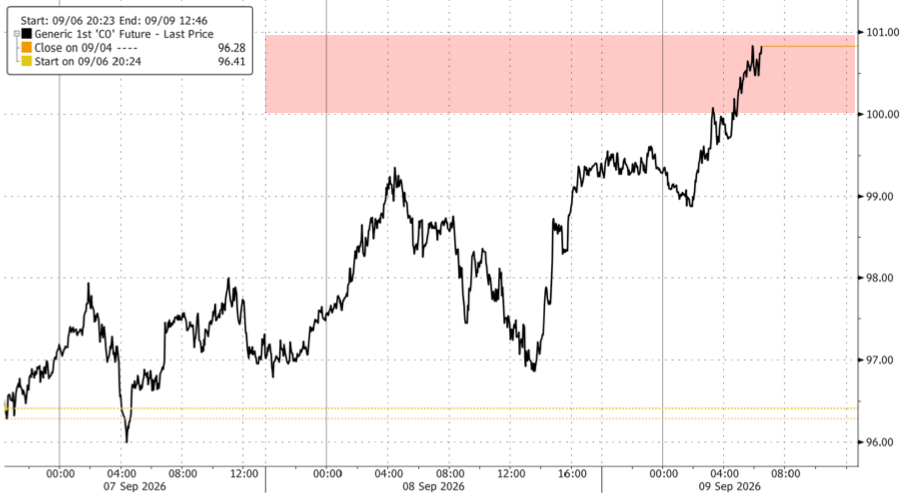
As a reminder, Brent futures and WTI futures both closed Friday in triple-digit territory as traders are becoming increasingly alarmed not just of the crude oil and LNG shortage spreading worldwide but also of petrochemical supply disruptions that are inbound that could affect plastics production, the core material that is bedrock for the modern economy.
A minority of health care workers received an updated COVID-19 vaccine, according to a newly reported survey from the Centers for Disease Control and Prevention.
Just 40.2 percent of health care personnel who responded to the survey said they received a COVID-19 shot between the fall of 2024 and early 2025, CDC researchers said on April 2.
The rate of vaccination was higher, 76.3 percent, for influenza.
The survey was conducted online from March 26 to April 17 in 2025, following the 2024–2025 respiratory virus season. The season begins in the fall of each year and runs into the next year.
Some 2,650 health care workers responded to the survey.
At the time, the CDC recommended influenza and COVID-19 vaccination for virtually all Americans aged 6 months and older, regardless of the number of prior doses. The CDC more recently narrowed its recommendations for those shots, citing factors such as uncertain risk-benefit profiles.
A federal judge blocked the updates in March.
The percentage of workers who took a COVID-19 vaccine increased from the prior season, when the rate was 31.3 percent, according to the newly released survey. The percentage of workers who received a flu shot remained about the same, though it is down from years prior to the COVID-19 pandemic.
CDC researchers said the increase in COVID-19 vaccination coverage may be from the vaccine for the 2024–2025 season becoming available one month earlier than the preceding year.
Workers aged 18 to 29 were most likely to receive a COVID-19 vaccine. Personnel aged 60 and up were more likely to receive an influenza immunization.
According to survey data, nearly four in 10 employers required influenza vaccination, and about 14 in 100 mandated COVID-19 vaccination. People who worked for employers who required vaccination were far more likely to have received the vaccines. Some 83 percent of workers required to receive a COVID-19 vaccine had received one, compared to 46 percent whose employer recommended COVID-19 vaccination and just 19 percent whose employer did not require or recommend vaccination.
CDC researchers said that the data could “help guide the development and implementation of evidence-based strategies to encourage vaccination, increase coverage, reduce influenza incidence among [health care personnel] and their patients, and limit strain on the health care system.”
The researchers said the findings supported actively promoting vaccination in places of business to increase influenza vaccination coverage among health care workers.
Health care workers who decline vaccination have said in previous surveys that they were worried about vaccine side effects and expressed distrust in health authorities.
The CDC published the study in its quasi-journal, Morbidity and Mortality Weekly Report. The publication ensures reports align with CDC messaging and typically does not peer-review papers.
“Although most articles that appear in MMWR are not ‘peer-reviewed’ in the way that submissions to medical journals are, to ensure that the content of MMWR comports with CDC policy, every submission to MMWR undergoes a rigorous multilevel clearance process before publication,” the CDC said in a 2011 report. “By the time a report appears in MMWR, it reflects, or is consistent with, CDC policy.”
Limitations of the paper included the vaccination status being self-reported and unverified. Authors disclosed no potential conflicts of interest.
Two major court verdicts last week finding social media giants Meta and YouTube liable for harm to users could send shock waves through the tech industry.
In a first-of-its-kind lawsuit, a jury in Los Angeles on March 25 found both companies liable for making their platforms addictive and deleterious to the mental health of young users.
The 20-year-old plaintiff, referred to as “Kaley G.M.” or only her initials K.G.M. during trial, testified that she had become addicted to social media at a young age and that it negatively affected her mental health.
Jurors ultimately decided that Meta was more liable for harming K.G.M., giving the tech giant 70 percent of the responsibility, or $2.1 million of the total $3 million in punitive damages, while YouTube shouldered 30 percent, or $900,000.
An additional $3 million in compensatory damages were recommended by jurors to be paid by Meta and YouTube—the only remaining defendants in the case after TikTok and Snap settled with K.G.M. before trial—after deciding they acted with malice, oppression, or fraud in harming children with their platforms.
In a separate case, jurors in New Mexico determined on March 24 that Meta had violated state law by failing to properly disclose risks to and protect children on its social media platforms. The case, brought by New Mexico Attorney General Raúl Torrez, resulted in a $375 million fine.
Prosecutor Linda Singer, who previously served as attorney general of the District of Columbia but now works in private litigation, had asked the jury to fine Meta $2 billion.
Former federal prosecutor Neama Rahmani called them “bellwether” cases.
“Obviously, these cases will absolutely go up on appeal,” he told The Epoch Times.
“I think they will likely end up before the Supreme Court, and how they view this issue will make or break Big Tech, because I think we’re going to see lots of copycat lawsuits, and the judgments and fines are going to rack up into the billions and billions of dollars.”
A person holds a sign referencing the 20-year-old plaintiff, identified in court as “Kaley G.M.” or by her initials K.G.M., as people wait for a verdict in the social media trial in Los Angeles on March 20, 2026. On March 25, a jury found both companies liable for making their platforms addictive and deleterious to the mental health of young users and ordered the companies to pay $3 million in damages. Patrick T. Fallon/AFP via Getty Images
While the cases reflect two different sets of accusations—addictive design on the one hand and failure to protect children on the other—both will likely invite a torrent of claims, said John Shu, a constitutional law expert who served in both Bush administrations.
“I think this will definitely open the litigation floodgates in California, and not just for individual lawsuits,” Shu told The Epoch Times. “It also opens the floodgates to class action lawsuits; that’s where the big money is.”
Addictive Design Versus Child Safety Issues
In the Los Angeles trial, jurors heard testimony from a range of witnesses, including therapists, adolescent addiction experts, executives, engineers, and whistleblowers.
The case highlighted the platforms’ design and operation, such as their “infinite scroll” features, beauty filters, and the companies’ proprietary algorithms that determine the type of content served to users.
Plaintiff attorney Mark Lanier did not target third-party content found on the platforms, which enjoys broad protection from the First Amendment and Section 230 of the 1996 Communications Decency Act.
Instead, he argued that the tech giants preyed on their vulnerable teen users in pursuit of money and power, comparing them to lions stalking wounded gazelles on the Serengeti.
Plaintiffs’ attorney Mark Lanier (C) speaks to reporters outside the Los Angeles Superior Court in Los Angeles on March 25, 2026. Frederic J. Brown/AFP via Getty Images
In the New Mexico case, Torrez argued that Meta violated the state’s Unfair Practices Act by knowing about the potential danger its platforms presented to children and hiding it from the public.
His office had its investigators set up accounts on Meta’s platforms posing as minors, after which they began to receive sexually explicit images and messages from adult users.
Jurors ultimately found 37,500 violations under one subsection of New Mexico’s Unfair Practices Act and the same number under another. Since fines were limited to a maximum of $5,000 per violation, Meta was fined $375 million.
“It was pretty remarkable, because the jury came back quickly. And the conventional wisdom in these civil cases is that a quick verdict is usually a defense verdict,” Rahmani said, referring to a verdict that is given in favor of a defendant, often when the plaintiff or prosecutors are unable to prove their case.
Instead, jurors returned an “overwhelmingly plaintiff’s verdict in less than a day,” Rahmani said.
But Meta may be forced to do more after it defends itself during the follow-up hearing in May, which will determine whether the tech giant’s platforms created a public nuisance and whether it should be required to pay for public programs to address harms to users.
Accusing Meta of creating a public nuisance with its digital social media platforms is a novel use of the law, Shu said.
“The historical tradition of public nuisance is tied to land or real estate,” he said, using the example of a landowner being required to remove a fallen tree blocking a public road at the threat of fines from a state or municipal government.
Lawyer Matthew Bergman of the Social Media Victims Law Center speaks to the press as survivor parents Amy Neville, Julianna Arnold, Deb Schmill, Judy Rogg, Toney Roberts, and Brandy Roberts stand outside the Los Angeles Superior Court in Los Angeles on Feb. 18, 2026. Jill Connelly/Getty Images
“This is a novel use of public nuisance. But if they convince a judge to do it, that’s going to open the door to massive payouts, not in actual damages, but in so-called ‘abatement costs,’” Shu said. “Because the state attorney general represents all of New Mexico’s 2.1 million citizens, they and their private sector mass-tort plaintiffs lawyers can ask for billions of dollars.”
That’s because in a public nuisance hearing, the awarded damages would not be based on individual violations of the law, but instead applied to the number of citizens in the state.
Critically, both verdicts only require the companies to pay out monetary damages—neither requires either company to change or alter the design or operations of their platforms. That may change for Meta after its May hearing in the New Mexico case.
Meta, Google Deny Allegations
Both Meta and Google, which owns YouTube, have denied that their platforms are designed to be addictive.
“We disagree with the verdict and plan to appeal,” Jose Castañeda, a Google spokesperson, said in a statement to The Epoch Times. “This case misunderstands YouTube, which is a responsibly built streaming platform, not a social media site.”
Meta said it respectfully disagrees with the two verdicts and plans to appeal.
“Reducing something as complex as teen mental health to a single cause risks leaving the many, broader issues teens face today unaddressed and overlooks the fact that many teens rely on digital communities to connect and find belonging,” a company spokesperson said in a statement to The Epoch Times.
“We remain committed to building safe, supportive environments for young people and will defend our record vigorously.”
Meta also highlighted the fact that the jury in the California case awarded $3 million in punitive damages after the plaintiff’s counsel had sought more than a billion.
Attorney Luis Li, representing YouTube and Google, arrives at Los Angeles Superior Court during the social media trial in Los Angeles on March 25, 2026. Both Meta and Google, which owns YouTube, have denied that their platforms are designed to be addictive and plan to appeal. Frederic J. Brown/AFP via Getty Images
Future Litigation Potential
Sen. Richard Blumenthal (D-Conn.) said he noticed similarities between the two social media cases and those he’d previously litigated against the tobacco industry.
“Both [Big Tobacco and Big Tech] have made products with lethal design defects—leading to destructive addiction. Tobacco exploited nicotine’s grip, Big Tech used infinite scrolling, & a myriad of other devices,” he wrote on social media.
“Both have targeted children—relentlessly & reprehensibly—putting profits over public health, promoting generational addiction & harm.”
Shu said social media litigators may follow a similar playbook used against Big Tobacco by first suing based on alleged harms to children before widening the scope to all users of the companies’ products.
“Once they’ve established liability for kids, instead of saying, ‘Well, adults use cigarettes too,‘ now they’re going to say, ’Well, adults use Instagram and Snapchat too,’” he said. “So that’s where all this is headed next.”
Google is particularly vulnerable, Shu said, because it is responsible not only for YouTube, but also for Android, Gemini, and DeepMind, and it is the dominant search engine.
Sen. Richard Blumenthal (D-Conn.) participates in a forum at the U.S. Capitol on March 17, 2026. Blumenthal said he noticed similarities between the two social media cases and those he’d previously litigated against the tobacco industry. Kevin Dietsch/Getty Images
Braden Perry, a government investigations and corporate litigation attorney, said the verdicts provide regulatory agencies with a road map for pursuing future cases without requiring new legislation.
State attorneys general can also pursue consumer protection actions against tech companies, Perry told The Epoch Times.
Long-Term Impacts on Tech Industry
“If engagement-maximization features become liability risks, platforms will face pressure to redo their algorithms and interfaces to prioritize welfare over engagement metrics,” Perry said, adding that “good actors” in the industry may face more disadvantages than companies “who skirt or ignore the risks” or that are more “aggressive than others.”
He said the verdicts not only threaten Meta and Google, but also the “foundational assumption that technology companies bear no responsibility for their design choices.”
These are not the only ramifications for the tech industry.
The New Mexico case specifically goes “beyond addiction alone and raises broader questions about whether these platforms are reasonably safe for children and adolescents,” attorney Michael Ponce told The Epoch Times.
He said the growing body of scientific research describing how prolonged social media use may negatively impact mental health was critical in both cases.
Images of deceased children are displayed at the “Lost Screen Memorial,” an art installation of large-scale smartphones featuring 50 children who lost their lives due to social media harm online, in Los Angeles on Feb. 13, 2026. Frederic J. Brown/AFP via Getty Images
Additionally, the central allegation in the California case and many related lawsuits is that companies were aware of the risks but “nevertheless continued to design their platforms in a manner that prioritized user engagement,” Ponce said.
The two verdicts, and any future cases that draw inspiration from them, could “cripple” the tech industry and send a “warning” to social media companies, Shu said.
He said if prosecutors in other states—particularly one with a large population like California’s—decide to follow the same path as New Mexico, the abatement costs for the citizenry if a public nuisance ruling is granted are likely to be massive.
“This is one heck of a warning, it’s kind of like somebody opening up a fire hose on you to wake you up in the morning,” Shu said.
US Arrests & Boots Soleimani’s Fashion Designer Niece From The Country
The Trump administration is rounding up family members of notable Iranian government figures, accusing them of spreading ‘pro-Tehran propaganda’. And apparently this is even if the Iranian officials in question are deceased.
The State Department confirmed an unexpected development on Saturday, announcing that the niece of the late Iranian Maj. Gen. Qassem Soleimani is being booted from the country.
Hamideh Soleimani Afshar and her daughter were arrested Friday night, and their permanent residence status has been revoked – now in the custody of US Immigration and Customs Enforcement.
Maj. Gen. Soleimani was the former leader of the elite Quds force wing of the Islamic Revolutionary Guard Corps (IRGC) who was assassinated via drone strike as his convoy drove outside of Baghdad International Airport in 2020.
This was during the first Trump administration, and in many ways this brazen killing of someone many countries viewed as essentially a ‘diplomat’ (certainly Iraq and Russia did) set Tehran and Washington on a collision course. Washington long considered him a terrorist. His popularity inside Iran was immense.
According to more details of the arrest of Soleiman’s niece and her daughter:
The State Department did not say where they were arrested. Secretary of State Marco Rubio said in a post on X that Soleimani Afshar and her daughter lived “lavishly” in the U.S. and are now in ICE custody “pending removal” from the U.S.
The State Department described Soleimani Afshar as “an outspoken supporter of the totalitarian, terrorist regime in Iran.” Her husband is also now not permitted to enter the U.S., the State Department said. Her uncle Maj. Gen. Soleimani, the former leader of the foreign wing of Iran’s Islamic Revolutionary Guard Corps, was killed in a U.S. airstrike in 2020.
Apparently her social media accounts have already been scrubbed and/or deleted, and there are reports saying that she did modeling and/or fashion design in the United States.
Niece of Qasem Soleimani, former commander of the IRGC Quds Force who has now been arrested in the United States is identified as Hamideh Soleimani Afshar. Her daughter has also been arrested by the FBI. Hamideh Soleimani Afshar was a Model in the United States. https://t.co/uiwTiiWTwXpic.twitter.com/5jrfrKn3Qa
— Niloofar Mansoori نیلوفر منصوری (@NiloofarMM) April 4, 2026
It’s not entirely clear what exactly she posted that caught the attention of US authorities. She may have merely critiqued the US-Israeli bombing of her homeland – but some X accounts have accused her of positively praising Iranian leadership while opposing the anti-government and economic protests from last January. Laura Loomer is claiming credit for alerting the Trump administration, or playing some kind of role in Hamidea’s apprehension and pending expulsion.
According to more from the WSJ, “Rubio also ended legal status protections for Fatemeh Ardeshir-Larijani, the daughter of the late Ali Larijani, Iran’s former top national-security official, and her husband, the State Department said. The department said they are no longer in the U.S. and not permitted to enter in the future.”
This means that likely other permanent residence holders who have family ties to the Islamic Republic leadership are being scrutinized by US federal authorities.
There could be a lot of Instagram, X, and Facebook scrubbing happening among the Iranian diaspora at this point.
There was a time not so long ago when the Democrats were formidable and — I’m not kidding here — occasionally enjoyable political foes. During the Tea Party years, we would often encounter Dem activists and hang out with them for a while. Sometimes we would even socialize. The Democrats of recent yesteryear bore no resemblance to the feral, frothing rage mob that the No Kings/Resist Dems are today.
It’s both stunning and depressing that America’s oldest, continuously-running political party could undergo a wholesale personality change in just a decade because its entire focus was the hatred of one man, but here we are. There’s an oft-repeated line here on the right that says if President Trump cured cancer, the Democrats would suddenly be pro-cancer. It’s the kind of absurdist illustration that I’ve enjoyed using throughout my career but find almost impossible to apply to the Democrats anymore. They’re just that far gone.
Which is why they are up in arms about the building of a ballroom. This is from Sarah:
President Donald Trump has been having a great time building the new White House Ballroom in recent months, but anytime the president is having a good time doing something, a judge comes in and stops him. Apparently, that expands to this $400 million, 90,000 square-foot construction project that is said to be fully funded by private donors.
U.S. District Judge Richard Leon determined on Tuesday that no statute comes close to allowing Trump to carry out this project of his own accord, and that construction must be halted until Congress approves the completion.
So, I guess we’re just stuck with a half-finished project?
Well, we’re stuck with a half-finished project until this cockamamie ruling gets overturned, which is how this dance usually goes. I would like to note that every one of these Trump Derangement Syndrome judges looks like either a Harry Potter villain or a skin suit tailor from The Silence of the Lambs.
I’m no legal expert, but much of Leon’s ruling reads like a tantrum in a feelings journal. Everything is just so overwhelmingly emo with these people. It’s both tedious and exhausting. In fact, if there were an animal representation of “tedious and exhausting,” it would be a perfect new mascot for the Democratic Party.
Let’s just look at the surface of this. The lefties are furious that a place for formal dancing is being built in the most important residence in the United States of America. A residence that frequently hosts world leaders for formal events. That’s like showing up to a kid’s birthday party and being deeply offended by the presence of a jumping castle.
One has to be severely broken inside to be angered by the thought of a place designed specifically for people to have some wholesome fun. Wholesome fun that reflects well on the Republic, to boot. At this point, Congressional Democrats should be showing up to work in straitjackets. For a while, I kept writing that the Dems’ TDS behavior was an ongoing cry for help. That’s inaccurate though — they are addicted to their misery and don’t want to be helped.
Also, as we have discussed on many occasions, hating Trump is their strategy.
Bill Maher recently chastised the execrable Adam Schiff for prioritizing pushing back on President Trump.
Maher said, “That’s all you Democrats have, is ‘F*** Trump’.” Schiff just sat there looking like the one-note moron that he is.
It would be nice to think that we live in a time where we could find common ground with our political adversaries. We don’t, though, and that is 100% the Democrats’ fault.
The problem isn’t just that they hate us, it’s obvious that they hate themselves as well. People who like themselves don’t pathologically seek misery the way that the Democrats do here in the Year of our Lord 2026. We can’t help them be happy.
We can, however, win a few more elections and keep giving them things to complain about. That’s probably a kindness at this point.
Iran Scrambling To Restore Bombed Missile Bunkers Within Hours After Being Struck
Iran’s resilience after more than a month of very heavy US-Israeli bombing has become obvious. The country’s somewhat ancient air force and navy have been largely obliterated, and yet all the while the Iranian military has kept up intense ballistic missile and drone strikes on Israel and Gulf states. Tehran’s missile arsenal is what is understood to have always been formidable.
And now US intelligence has freshly assessed that Iranian personnel are busy excavating bombed underground missile bunkers and silos and restoring them to operation within a mere hours of US and Israeli strikes.
The New York Times on Friday featured American intelligence analysis saying that Tehran has retained a substantial number of missiles and mobile launchers, raising serious doubts on how close Washington actually is to eliminating the Islamic Republic’s missile capability.
The report states that Washington cannot determine how many launchers have been destroyed because Iran has deployed decoys. Underground bunkers and silos may appear damaged, but launchers are rapidly recovered from rubble and returned to use through the quick work of excavators and heavy equipment.
Anna Kelly, a White House spokeswoman, has painted a rosy picture from the Pentagon’s point of view: “Here are the facts: Iranian ballistic missile and drone attacks are down 90 percent, their navy is wiped out, two-thirds of their production facilities are damaged or destroyed, and the United States and Israel have overwhelming air dominance over Iran,” she said.
A senior Western official in the NY Times stated that Iran is firing approximately 15-30 ballistic missiles and 50-100 suicide drones per day across the region.
US officials additionally told the Times that Iran aims to preserve as much of its missile-launch capability as possible to sustain its threat posture throughout the conflict and after it ends.
Some of the remaining launchers are currently inaccessible, buried under rubble from repeated airstrikes, but there’s the expectation that Iran will race to dig them out. NYT further cites the following:
Haaretz, the Israeli publication, reported earlier that Iran had used bulldozers to dig out missile launchers that had been buried, or “corked,” in underground bunkers.
President Trump and US planners around him probably didn’t expect the Islamic Republic to put up as much of a fight as it’s still able to do this many weeks into Operation Epic Fury.
— Global Conflict Monitor (@watchdog_global) March 31, 2026
Iranian missiles have continued to wreak havoc across Israel especially, with citizens spending many hours each day huddled in shelters, especially in central Israel and Tel Aviv.
The Department of Homeland Security (DHS) rescinded a policy on March 31 that required the department secretary to personally approve every contract and grant exceeding $100,000.
Homeland Security Secretary Markwayne Mullin issued the reversal across all DHS components, including Customs and Border Protection (CBP) and U.S. Immigration and Customs Enforcement (ICE). The change ends an earlier directive from former Homeland Security Secretary Kristi Noem that required the secretary’s office to handle routine purchasing decisions previously handled at lower levels.
However, contracts and grants above $25 million will still require secretary review.
DHS stated that the move will “streamline the contract process and empower components to carry out their mission to protect the homeland and make America safe again.” The department told The Epoch Times in a statement that Mullin “re-evaluated the contract processes to make sure DHS is serving the American taxpayer efficiently.”
Mullin signaled the shift at the department during his confirmation hearing this month.
“I’m not a micromanager,” he said, referring to Noem’s policy. “We put people in, we empower them to make decisions. What is required to come up to my level, we’ll make decisions.”
Noem’s policy, signed shortly after she took office in 2025, sought to tighten oversight of taxpayer dollars at a time when DHS managed billions in contracts for border security, immigration detention, and disaster response.
In September 2025, a Senate Homeland Security and Governmental Affairs Committee review found 1,034 Federal Emergency Management Agency contracts, grants, or disaster-assistance awards that were pending or delayed. The average approval took three weeks, affecting housing inspections, temporary sheltering, and aid distribution after the July 2025 Texas floods and Hurricane Helene.
The change comes as Mullin seeks to reduce bureaucratic gridlock.
The policy shift does not alter core missions funded through contracts, such as ICE detention operations or CBP’s use of surveillance technology and logistics support. Officials say the streamlined approach will help DHS respond faster to both routine needs and emerging threats.
During Noem’s first seven months, DHS saved taxpayers $13.2 billion by reducing grant contracts and cutting 8 percent of non-law enforcement personnel.
The policy also resulted in terminating 118 bad contracts and accelerating state-led recovery funding to get money to victims faster and prevented up to $1.3 billion in external fraud.
Noem left DHS earlier this year after President Donald Trump tapped her for a new hemispheric envoy role focused on regional security.
During his Senate confirmation hearing on March 28, Mullin told senators he would maintain “a very clear line of communication with every one of our agencies’ heads on their authority that [Congress] gave to them within their parameters.”
“But we’re also going to be very responsible for the taxpayer dollars,” he said.
Artemis II’s four moon-bound astronauts are officially closer to the Moon than the Earth.
Mission Control confirmed the milestone to the crew at 10:59 p.m. CT on April 3, three days into their historic flight around the moon.
As of 11 p.m., NASA astronauts Reid Wiseman, Victor Glover, and Christina Koch, and Canadian Space Agency astronaut Jeremy Hansen and their Orion spacecraft Integrity were more than 136,000 miles away from the Earth.
This point was also far beyond the halfway point of the more than 252,000 miles they will ultimately reach from home.
Koch noted that the whole crew looked around at each other, acknowledging the milestone.
“We can see the moon out of the docking hatch right now,” she said. “It is a beautiful sight. We’re seeing more and more of the farside, and it’s just a thrill to be here.”
Though now closer to the moon, they still won’t enter its gravitational influence for more than a day.
According to mission leaders, everything is running smoothly, and a planned course-correction burn was canceled because the spacecraft remained on a precise heading.
After two days of critical checkouts, manual test flights, and a series of engine firings from the first crewed launch of the most powerful human-rated rocket NASA’s ever assembled to the first trans-lunar injection burn in more than 50 years, the crew and Mission Control have been able to settle into a much calmer pace.
The first pictures of Earth taken from Integrity were received and shared with the world on the morning of April 3. The crew spoke with members of the media and reflected on how the Earth looked from their vantage point. And upon waking on Day 3, they were able to talk to their families for the first time since the launch.
They then proceeded with the day’s objectives, which focused heavily on testing medical and emergency systems, including performing a CPR demonstration, evaluating the medical kit, and testing the Deep Space Network’s emergency communication.
They were also scheduled to take some pictures of the moon, rehearse cabin configurations in preparation for their upcoming lunar flyby, and find time to exercise during the day.
Each crew member is required to use the flywheel exercise machine—which is like a cross between a resistance cable and a rowing machine—for at least 30 minutes each day.
A view of Earth taken by NASA astronaut and Artemis II Commander Reid Wiseman from the Orion spacecraft’s window after completing the translunar injection burn on April 2, 2026. NASA
Artemis II’s 10-day flight around the moon and back kicked off with a two-day gauntlet of checkouts, tests, and multiple engine burns. After launching from Kennedy Space Center aboard NASA’s Space Launch System, the crew was placed into an elongated elliptical orbit that carried them tens of thousands of miles above Earth.
The crew then began configuring the interior of their Orion crew capsule for flight before taking manual control of the spacecraft to test out its maneuverability.
Glover, who took the controls, noted that the Orion capsule performed wonderfully and flew better than the simulator.
After that, the crew settled into their first rest period, but had to wake up halfway through to perform an engine burn that kept them in a stable orbit and the correct course ahead of the trans-lunar injection burn that would come several hours later.
But, things have not gone completely perfect. There was an unexpected communications dropout, the toilet was not working properly, and they experienced several censor issues, which have persisted throughout the mission. A helium issue was also detected on the service module.
However, mission leaders reported that all problems had been overcome or mitigated through redundancies, as was the case with the helium. NASA leadership credited the enduring problem-solving to the way teams on the ground continue to work with the moon-bound crew in real time.
“It makes me very happy to see that, although we have some minor issues to deal with, the team operates very well, both on the ground—between our mission evaluation room, our flight control team—and with the crew,” Howard Hu, NASA’s Orion program manager, told The Epoch Times.
On Day 4, the crew of Artemis II will once again fly Integrity manually as they get closer to the moon. They will also attempt to take a “selfie” by utilizing a camera on the end of one of Integrity’s solar panels to take a picture of the spacecraft with the Earth in the background.