61.8 F
Chicago
Tuesday, April 28, 2026
Home Blog Page 76

US Fighter Jet Shot Down In Iran, One Crew Member Reported Rescued

US Fighter Jet Shot Down In Iran, One Crew Member Reported Rescued

Update(11:55ET)The NY Times has cited US and Israeli officials who has given confirmation that a US fighter jet was downed and that a major rescue operation is underway, with the fate of the plane’s crew unclear:

The fate of the plane’s crew was unclear, as American officials scrambled to mount a search and rescue operation before Iran could get to any survivors, said the U.S. and Israeli officials, who spoke on the condition of anonymity to discuss military operations.

The situation creates a military and diplomatic challenge for the United States, as President Trump has threatened in recent days to bombard Iran “back to the Stone Ages.” Over the past 24 hours, the United States and Iran have been trading attacks on military and civilian infrastructure in the region.

The U.S. jet was an F-15E, U.S. officials said, which has a standard crew of two, and not one of the stealth fighters of more recent design. Just days ago, Defense Secretary Pete Hegseth said Iran’s air defenses were so degraded that the United States was sending B-52 bombers over the country; the F-15E is much smaller, faster and more agile, making it a tougher target.

There are also unconfirmed claims that a helicopter may have been shot down as it was engaged in the search and rescue mission. Supposedly state media has also issued a bounty for the capture of any US pilot by Iranian citizens.

Reports that a pilot has been located and rescued (unconfirmed early reporting):

Below: unconfirmed but widely circulating images…

In the meantime Iran’s parliament speaker and the man who appears to be de facto running the day-to-day of the country is trolling the United States:

Reports of people shooting at helicopters/planes with small arms from the ground:

*  *  *

Iranian media has announced that national forces have shot down a US fighter jet, and a US search and rescue effort is is active over Iran in an effort to locate two crew.

Israeli media as well as Axios are also reporting it, with emerging photos and videos suggesting it is an F-15 fighter jet. “Iranian state media published pictures and videos that allegedly show parts of the downed plane and one of the ejection seats,” Axios writes. Photos initially released via state Fars:

There are also emerging reports that Iran may have captured one of the pilots, while separately Israel’s N12 reports that the US has sent “large forces” to rescue the crew. Presumably this is an aerial mission, including spotter aircraft and helicopters – leading to potential greater exposure to ground fire.

It is possible that US Special Forces operators could also be involved in the rescue mission, but CENTCOM within the opening hours of the incident has not confirm anything.

A McDonnell-Douglas ACES II (Advanced Concept Ejection Seat) from a US Air Force F-15E Strike Eagle has been found by residents in Southern Iran, the whereabouts or status of the pilot and weapons officer is currently unknown:

DropSite News, which maintains sources inside Iran, writes the following:

An Iranian official told Drop Site News that a U.S. F-15 warplane struck by Iranian forces went down over southern Tehran Province, with intense fire reported at the crash site. The official said the nature of the strike prevented the pilot[s] from ejecting before the aircraft crashed. No remains have been found.

There have been images and footage also circulating showing very low flights by potential US military spotter aircraft, likely looking for surviving crew of the F-15.

A US Air Force HC-130J “Combat King II” Combat Search and Rescue (CSAR) Aircraft seen flying extremely low over the countryside of Southern Iran.

Evidence of low-flying helicopters deployed as part of the recovery efforts…

After more than a month of Trump’s Operation Epic Fury, the Pentagon has lost a slew of aircraft, including heavy refueling tankers, drones, and even three F-15s downed over Kuwait (which CENTCOM claimed was a ‘friendly fire’ incident). A stealth F-35 was also damaged, resulting in an emergency landing in a Middle East country.

Neither the US military nor the White House have immediately respond to requests for comment.

Tyler Durden
Fri, 04/03/2026 – 12:00

Senior Iranian Official Involved In Reaching Out To Vance Severely Wounded In Airstrike

Senior Iranian Official Involved In Reaching Out To Vance Severely Wounded In Airstrike

A top Iranian official who was involved in diplomatic outreach and indirect talks or messaging with the United States and Pakistani mediators was reportedly critically wounded in a US-Israeli strike. Kamal Kharazi, an 81-year-old senior adviser to Tehran and former foreign minister, lost his wife in the Wednesday strike on his home, state media has said.

Kharazi chairs Iran’s Strategic Council on Foreign Relations and has been viewed as a potential backchannel negotiator involving Islamabad, but now he’s been hospitalized with serious injuries, state media has also said.

“We have seen what looks like an assassination attempt against the former foreign minister, Kamal Kharazi … We don’t know why he’s been targeted. He has been gravely wounded, and his wife was killed,” said an Al Jazeera correspondent in Tehran.

Iranian officials described to Mehr News Agency that Kharazi was overseeing outreach to Pakistan tied to a possible meeting with US Vice President JD Vance. A potential Vance trip to Pakistan was initially reported as possibly being in the works late last month.

But Middle East Eye has reported that Kharazi was not seeing much room for diplomacy as US-Israeli actions escalate to attacks on Iranian infrastructure and energy:

He told CNN in March, “I don’t see any room for diplomacy anymore. Because Donald Trump had been deceiving others and not keeping with his promises, and we experienced this in two times of negotiations – that while we were engaged in negotiation, they struck us.”

If he succumbs to his wounds, Kharrazi would be the latest senior Iranian official killed since the war began.

In addition to Khamenei, top security adviser Ali Shamkhani, Revolutionary Guard commander Mohammad Pakpour, Armed Forces Chief of Staff Abdolrahim Mousavi, and Defence Minister Aziz Nasirzadeh were all killed on the first day of the war.

Ali Larijani, secretary of the Supreme National Security Council, was killed on 17 March, along with his son and one of his ⁠deputies. Intelligence minister and head of civilian monitoring, Esmail Khatib, was killed in an Israeli strike a day later.

Some analysts and pundits have accused Israel in particular of trying to sabotage any US-Iran talks, as the Netanyahu government wants to see complete regime collapse in the Islamic Republic.

Israel has also stood accused of seeking to create the conditions to lure the White House into authorizing ‘limited’ strikes which would inevitably become an open-ended war with no timeline.

Tyler Durden
Fri, 04/03/2026 – 12:00

Poison Ivey: Chicago Bulls Release Forward After He Speaks Out Against Pride Month

Poison Ivey: Chicago Bulls Release Forward After He Speaks Out Against Pride Month

Authored by Jonathan Turley,

This week, the Chicago Bulls waived guard Jaden Ivey for “conduct detrimental to the team.”

No, Ivey did not assault anyone or gamble on games.

He did not call for violence.

Ivey expressed his opposing religious beliefs, including criticizing the NBA’s Pride Month celebrations.

There is no question that private companies have the right to control employees’ on-the-job speech, including barring demonstrations such as kneeling during the national anthem. However, the Ivey controversy exposes the hypocrisy of sports associations and teams in the combination of corporate virtue signaling and athlete speech limitations.

Companies in various fields have asserted the right to condition contracts on the possibility of termination due to public behavior or comments that are detrimental to the company.

Notably, this was a player speaking off the basketball court who was deemed “detrimental” to the brand. The main concern is the lack of consistency. Actors such as Rachel Zegler have tanked their own movies to use their platforms to advance their own political viewpoints. Likewise, athletes have routinely espoused controversial views on racial divisions or law enforcement without losing their contracts. Recently, teams supported athletes espousing anti-ICE sentiments. In other words, it is not advocacy but the cause that these companies focus on when allowing or punishing speech.

At the same time, the NFL and NBA require players to wear and espouse views that some of them — like some in the nation — may oppose. Ivey was objecting that he does not feel that Pride Month is espousing “righteous” lifestyles. Ivey was not attacking the Bulls or the game. He was asserting that he does not support the virtues or values being endorsed by the company.

Many of us were offended by social media postings by Ivey in referring to Catholicism as a “false religion.” He also drew the ire of many by telling a fan that “God does not hear your prayer if you are a sinner.”

However, it appears that it was his criticism of the LGBTQ community and Pride Month that ended the matter with the NBA. Ivey objected to the advocacy required by the NBA, objecting “they proclaim it. They show it to the world. They say, ‘Come join us for Pride Month,’ to celebrate unrighteousness.”

The issue of “talent” becoming notorious has long been a focus of sports and entertainment contracts. Hateful or divisive public comments can impact a brand or corporate image. For example, a team does not have to continue an association with a racist spewing hateful remarks about fans.

The Ivey controversy should force a discussion of the countervailing responsibilities of the teams and the NBA. Some of us have previously criticized the virtue-signaling of associations like the NFL, with giant statements in the end zones and on players’ helmets. Many fans would like these teams to stop lecturing them and simply play sports. We do not need morality or civics lessons from the likes of NFL Commissioner Roger Goodell.

However, if the NFL and NBA are going to get into the business of shaping fans’ values, they may need to accept greater leeway for athletes who hold opposing values. Instead, they are expecting athletes like Ivey to effectively endorse approved values while barring them from expressing dissenting views.

This is not the first such controversy. Years ago, former coach Tony Dungy was the subject of a cancel campaign because he expressed his faith at a pro-life rally.

Former Washington Commanders defensive coordinator Jack Del Rio was punished for expressing a dissenting view of what happened on January 6th and what he viewed as the different treatment given to these cases, including excessive sentences.

Likewise, recently, Chicago Cubs player Matt Shaw was the target of a campaign to trade him after he attended the funeral of Charlie Kirk.

Sports organizations, like other businesses, have every right to bar protests and political statements at games. They should, however, apply the same standard to themselves. It is time to get virtue signaling and social statements out of sports. Teams need to stop picking sides on social and political issues while blocking opposing views from their athletes. Once out of the business of shaping public values and views, these teams will be in a better position to demand that athletes avoid controversial public statements that alienate fans or harm a brand.

Otherwise, teams could simply bar such commentary during games and allow athletes the same freedom of expression outside of the game that the teams enjoy during games.

None of this means that Jaden Ivey is right or admirable in his specific statements. It only means that, if teams want him to just play basketball, they should do the same.

Jonathan Turley is a law professor and the best-selling author of “Rage and the Republic: The Unfinished Story of the American Revolution.”

* * *

Tyler Durden
Fri, 04/03/2026 – 11:30

Hegseth Ousts Chief Of The Army As Iran War Persists

Hegseth Ousts Chief Of The Army As Iran War Persists

The Pentagon shake-up under Trump has not ended, as on Thursday Pete Hegseth has dismissed Army Chief of Staff Gen. Randy George, asking him to step down into early retirement.

The move is unusual, given this is the head of the Army and the United States is past the one-moth mark in Trump’s Operation Epic Fury. A reason hasn’t been given as to what amounts to Gen. George being effectively fired.

CBS writes, “One of the sources said Hegseth wants someone in the role who will implement President Trump and Hegseth’s vision for the Army.”

A top defense official has also said: “We are grateful for his service, but it was time for a leadership change in the Army.”

The chief of the Army is typically a four-year term, and already there’s speculation over who will be the likely candidate to lead next:

The current vice chief of staff of the Army, Gen. Christopher LaNeve, who was formerly Hegseth’s military aide, will likely be considered as a replacement. He previously served as the commanding general of the Army’s 82nd Airborne Division from 2022 to 2023.

The U.S. Military Academy at West Point posted photos on social media on Thursday of George, saying he “shared experience-driven guidance with cadets preparing to lead” during a visit.

There’s been some serious background controversy over the last weeks among top command ranks regarding the Trump admin’s preferences:

Defense Secretary Pete Hegseth is blocking the promotion of four Army officers to be one-star generals, a highly unusual move that has prompted some senior military officials to question whether the officers are being singled out because of their race or gender.

Two of the officers targeted by Mr. Hegseth are Black and two are women on a promotion list that consists of about three dozen officers, most of whom are white men, senior military officials said.

Mr. Hegseth had been pressing senior Army leaders, including Army Secretary Daniel P. Driscoll, for months to remove the officers’ names, military officials said. But Mr. Driscoll, citing the officers’ decades-long records of exemplary service, had repeatedly refused.

As for Gen. George, he was commissioned as an infantry officer out of US Military Academy in 1988 and saw deployments in Operation Desert Shield, Operation Desert Storm, Operation Iraqi Freedom, and Operation Enduring Freedom. He later served as vice chief of staff of the Army from 2022 to 2023, before being nominated by Biden to become Army chief of staff.

Tyler Durden
Fri, 04/03/2026 – 09:30

Cash Is King, Dowd Sees $10,000 Gold As The Credit Market “Is Starting To End The Party”

Cash Is King, Dowd Sees $10,000 Gold As The Credit Market “Is Starting To End The Party”

Via Greg Hunter’s USAWatchdog.com,

Wall Street money manager and financial analyst Ed Dowd of PhinanceTechnologies.com warned at the end of January that the “Credit Destruction Cycle” was showing up in something called private credit. 

Dowd was worried about extreme risk in the economy, especially with all the growth in lending in the last two years coming from private credit. 

Has this gotten better or worse? 

Dowd says, “It’s gotten worse, and it has spread…”

“The number if credit funds that have gated their investors keeps growing.  This is important because high net worth individuals, insurance companies and pension funds put millions of dollars in these private credit funds and now they want to redeem them, and there is a gate.  The last two years of loan growth in the economy was from banks loaning to private credit. . .. There have been earth shaking events in private credit land.  That started a cascading effect of people becoming worried about their private credit fund. 

Then, redemptions started, and some funds like Blue Owl have taken massive hits.  They had to gate their fund.  Apollo gated their fund.  Black Rock gated their fund, and KKR has gated their fund. 

So, there is a lot of gating going on. 

Basically, this is the beginning of the credit cycle rolling over. 

This starts in the most egregious sector, which looks like private credit. . .. 

So, the credit market is starting to end the party, and we are going to see this cascade throughout the whole economy.”

The Iran war just turbocharges the entire negative global scenario. 

Dowd says, “You layer on top of this the Iran war and that only hastens the whole thing unless there is a quick resolution.”

Isn’t Iran getting creamed financially speaking?  Dowd say:

“Financially speaking, yes, but we have no way to know what’s going on or who they are negotiating with.  It’s kind of an information black hole.  There is propaganda from our side and their side. 

My hope is that this is resolved as quickly as possible without troops on the ground. 

If we got that, and the Strait of Hormuz is opened rather quickly, there would be a rally in our markets, but the forces bearing down on the economy are going to happen regardless. 

There will be a temporary relief rally, but what I am predicting is still going to roll through the system. 

If there is no quick resolution, then this will hasten everything because there will be global demand destruction. 

This will hasten a global recession that I see coming no matter what.”

Dowd put out a report forecasting what’s coming in 2026.  Any way you cut it, not many will escape the pain, and there is a lot left to come in Dowd’s 2026 forecast.  Dowd says, “I am in a very conservative mood…”

“Our call from our economic report is risk assets are going to be under pressure. 

Cash is king in this scenario. . .. We think inflation is going to be coming down.  Even though we call this an oil price shock,  it’s not an inflation shock because demand destruction will eventually come. 

Inflation will go up in the near term, but inflation will roll over as everything else will roll over price wise, especially the housing part of the CPI.  That is already under pressure. 

Rents have been coming down, and home prices always follow.  It is now cheaper to rent a house than to own a house. 

Home prices are going to come down, and that will cause a recession in and of itself. 

You throw a bursting AI bubble on top of that and a Chinese economy that is going into the tank this year and you get a global recession…

…Let me remind you, private credit already started to have its problems before the war even started with Iran, and private credit is the canary in the coal mine.”

Dowd is still forecasting gold to hit $10,000 per ounce in the next few years (2030) and is also still bullish on silver long term.  Dowd goes into detail about the severe problems China is facing with its economy and does not see how it can be a global financial superpower anytime soon.  This is fascinating analysis on China’s financial situation that everybody should listen to.  (Order the full China report here.)   Like Martin Armstrong, Dowd is also a big fan of stocking up on food and water in case of supply chain disruptions.

There is more in the 47-minute interview.

Join Greg Hunter of USAWatchdog as he goes One-on-One with money manager and investment expert Ed Dowd as he explains why we are starting to see big trouble for the US economy.   Dowd predicted this was coming in January with his report called “US Economy Outlook 2026.”

Tyler Durden
Fri, 04/03/2026 – 09:00

March Jobs Shocker: Payrolls Soar By 178K Most Since 2024, Blowing Away All Estimates; Unemployment Rate Drops

March Jobs Shocker: Payrolls Soar By 178K Most Since 2024, Blowing Away All Estimates; Unemployment Rate Drops

We titled our nonfarm payroll preview post “a substantial bounce” and boy were we right: with consensus expecting a material rebound from February’s negative print (which was revised as usual worse, from -92K to -133K), what the BLS reported instead was a huge beat to expectations of a 65K increase, with March jobs reportedly rising by 178K, the biggest increase since December 2024.

The number was driven entirely by a surge in private workers which added 186K in March, far above estimates of 78K. Government workers continued to drop, sliding by 8K in March and now negative 8 of the past 9 months,

This was not only higher than all estimates but was a 3 sigma beat to the median forecast, something we haven’t seen in over a year.

In keeping with tradition, the previous month’s data was revised sharply negative, from -92K to -133K, despite expectations of an upward revision. Yet for once there was an upward revision in the historical data: the change in total nonfarm payroll employment for January was revised up by 34,000, from +126,000 to +160,000, and the change for February was revised down by 41,000, from -92,000 to -133,000. With these revisions, employment in January and February combined is 7,000 lower than previously reported. (Monthly revisions result from additional reports received from  businesses and government

A quick look at the Household survey shows that while the establishment survey posted a solid increase of 178K, the Household increase declined again, dropping by 64K, the 3rd month in a row.

This means that despite all attempt to revise away the impact of illegal immigration, it still lingers with total number of payrolls (Establishment) running well ahead of employed workers (Household).

There was more good news: the unemployment rate actually dropped from 4.4% to 4.3% amid expectations of an unchanged print. This was despite a drop in the actual number of employed workers (per the Household survey) but offset by an even bigger drop in the civilian labor force, which declined by almost 400K, from 170.483MM to 170.087MM.

While the unemployment rate dropped, the labor force participation rate slumped to a 5 year low, largely due to the halt of illegal immigration, helping keep unemployment depressed.

Among the major worker groups, the unemployment rate for people who are Asian (3.7%) decreased in March. The jobless rates for adult men (3.8%), adult women (4.0%), teenagers (13.7%), and people who are White (3.6%), Black (7.1%), or Hispanic (4.8%) all posted a modest sequential drop. 

There was some good news for the Fed too, with a 0.2% increase in monthly average hourly earnings, below the 0.3% est and down from 0.4% in February, the annual increase in hourly earnings was just 3.5%, the lowest in 3 years, and below estimates of a 3.7% increase. It appears that the most important metric for the Fed – hourly earnings – is starting to take on water.

A few additional highlights from the report:

  • The number of long-term unemployed (those jobless for 27 weeks or more) changed little at 1.8 million in March but is up by 322,000 over the year. The long-term unemployed accounted for 25.4 percent of all unemployed people in March. 
  • Both the labor force participation rate, at 61.9 percent, and the employment-population ratio, at 59.2 percent, both at multiyear lows 
  • The number of people employed part time for economic reasons, at 4.5 million, changed little in March. These individuals would have preferred full-time employment but were working part time because their hours had been reduced or they were unable to find full-time jobs. 
  • The number of people not in the labor force who currently want a job changed little at 6.0 million in March. These individuals were not counted as unemployed because they were not actively looking for work during the 4 weeks preceding the survey or were unavailable to take a job. 
  • Among those not in the labor force who wanted a job, the number of people marginally attached to the labor force increased by 325,000 in March to 1.9 million. These individuals wanted and were available for work and had looked for a job sometime in the prior 12 months but had not looked for work in the 4 weeks preceding the survey.
  • The number of discouraged workers, a subset of the marginally attached who believed that no jobs were available for them, increased by 144,000 in March to 510,000. 

Taking a closer look at the Establishment survey, in March job gains occurred in health care, in construction, and in transportation and warehousing. Federal government employment continued to decline. 

  • Health care added 76,000 jobs in March. Employment in ambulatory health care services rose by 54,000, reflecting an increase of 35,000 in offices of physicians as workers returned from a strike. Employment also increased in hospitals (+15,000). Over the prior 12 months, health care had added an average of 29,000 jobs per month. 
  • Employment in construction grew by 26,000 in March but had shown little net change over the prior 12 months.
  • Transportation and warehousing added 21,000 jobs, reflecting a gain in couriers and messengers (+20,000). Employment in transportation and warehousing is down by 139,000 since reaching a peak in February 2025.
  • Employment in social assistance continued its upward trend in March (+14,000), primarily in individual and family services (+11,000).
  • Federal government employment continued to decline in March (-18,000). Since reaching a peak in October 2024, federal government employment is down by 355,000, or 11.8 percent. Federal employees on furlough during the partial government shutdown were counted as employed in the establishment survey because they worked or received (or will receive) pay for the pay period that included the 12th of the month.
  • Employment in financial activities edged down by 15,000 in March, reflecting a loss in finance and insurance (-16,000). Employment in financial activities is down by 77,000 since reaching a peak in May 2025.

Employment showed little change over the month in other major industries, including mining, quarrying, and oil and gas extraction; manufacturing; wholesale trade; retail trade; information; professional and business services; leisure and hospitality; and other services.

As noted above, the best news was that government workers dropped again, now for the 6th straight month and 8 of the past 9.

Peeking below the surface of this month’s report, we find that the quality distribution was solid, with +335K full-time jobs added, offset by a 188K drop in part-time jobs.

Last but not least, one of the most closely watched series, that of native vs foreign-born (mostly illegal) workers showed the biggest monthly increase in foreign-born workers since January 2025, which suggests that the strength in today’s jobs report may have been derived from the one thing that Trump has been eager to do away with: illegal labor.

Tyler Durden
Fri, 04/03/2026 – 08:51

Liberal Council In UK Moves To Ban “Intimidating” National Flags

Liberal Council In UK Moves To Ban “Intimidating” National Flags

Authored by Steve Watson via Modernity.news,

In the latest salvo against British identity, a Liberal Democrat-run council has formally branded the simple act of flying the England flag an “act of intimidation and division” – and backed it up with a legal notice threatening residents with prosecution.

Oxfordshire County Council is pushing a county-wide crackdown by on the grassroots Raise the Colours campaign, which has been putting up Union Flags and St George’s Crosses in public spaces as a straightforward show of patriotism. The council’s message is clear: national symbols are now suspect.

The council issued the formal stop notice to the Raise the Colours group, warning that continued flag displays could lead to civil and even criminal proceedings. Council leader Liz Leffman charged that “The widespread installation of flags by Raise the Colours is not a sign of patriotism. It is an act of intimidation and division that is having a real and damaging impact on our communities.”

She added that residents and council teams removing the flags “had been subject to abuse and threatening behaviour” when challenging those installing them. “This is totally unacceptable,” Leffman said.

She added, “The council has a responsibility to act where behaviour undermines community cohesion and the safe and inclusive use of public spaces. That is why we are taking firm action. We won’t hesitate to take further legal steps where necessary to protect residents and support the cohesion of our communities.”

This comes just weeks after a leaked UK Government “social cohesion” strategy branded the flying of English, Scottish, and Union Jack flags as potential “tools of hate.”

The draft document explicitly claimed these national symbols were sometimes used “to exclude or intimidate” and stated that “the extreme right has tried to turn symbols of pride into tools of hate.”

Additionally, earlier this year councils across the country admitted spending over £100,000 of taxpayers’ money hiring contractors to rip down Union flags and St George’s crosses from lampposts.

Freedom of Information requests showed the true cost is even higher. Medway Council alone burned nearly £11,600 removing over 700 flags. Yet when ordinary Brits push back by flying them anyway, the state responds with legal threats.

The Raise the Colours campaign emerged directly from public frustration over mass immigration, grooming scandals, and taxpayer-funded hotels for illegal migrants. Rather than address those root issues, authorities are criminalising the visible symbols of the host culture. Flying the flag that represents the very nation these officials are supposed to serve is now labelled divisive.

Leffman and her Lib Dem colleagues are not protecting “inclusivity.” They are erasing it. British communities have every right to celebrate their heritage without being painted as extremists. The same councils that bend over backwards for every foreign flag and cultural demand suddenly discover “intimidation” when the St George’s Cross goes up.

This is the logical endpoint of years of institutional hostility toward British identity. First the Union Flag was quietly sidelined, then the St George’s Cross was mocked as “far-right,” and now councils are issuing legal notices to stop it altogether. The message to patriots is unmistakable: keep your head down or face the consequences.

Britain doesn’t need more lectures on “cohesion” from people who treat its flag as a hate symbol. It needs leaders who defend the right of citizens to be proud of their country without apology. Until that changes, groups like Raise the Colours will keep flying the flag – and more residents will notice exactly who is trying to stop them.

Your support is crucial in helping us defeat mass censorship. Please consider donating via Locals or check out our unique merch. Follow us on X @ModernityNews.

Tyler Durden
Fri, 04/03/2026 – 06:30

Germany’s Economy Minister Urges Nuclear Rethink As Energy Prices Surge, Growth Forecasts Slide

Germany’s Economy Minister Urges Nuclear Rethink As Energy Prices Surge, Growth Forecasts Slide

Germany’s Economy Minister Katherina Reiche has openly called for a fundamental reassessment of the country’s long-standing rejection of nuclear power, warning that heavy dependence on gas has left Europe’s largest economy dangerously exposed to repeated energy shocks.

Speaking at the launch of a new international investor conference aimed at drawing foreign capital into Germany, Reiche told the Financial Times that the decision by previous governments to phase out nuclear generation has eliminated any realistic alternative for reliable baseload electricity. “We need gas to secure our supply – that is the only baseload supply I have left,” she said. “Politically speaking, I have no alternative.”

Reiche, a senior figure in Chancellor Friedrich Merz’s Christian Democratic Union, made the remarks as fresh data highlighted the mounting costs of the nuclear exit, originally decided under Angela Merkel in 2011 and completed under Olaf Scholz. While the policy was accompanied by a massive push for renewables, it has left Germany more reliant on gas-fired power stations to keep the lights on when the wind doesn’t blow and the sun doesn’t shine.

Related:

European gas prices have risen more than 60 per cent since the outbreak of conflict in the Middle East, delivering the continent’s second major energy price crisis in under five years. Futures contracts for German electricity in May are trading at four times the level seen in France, Europe’s biggest nuclear producer, according to the energy exchange EEX.

Reiche urged Germany to stop sitting on the sidelines of Europe’s nuclear revival. France, Sweden and Poland are all either building new reactors or extending the life of existing ones, attracted by the technology’s ability to deliver large volumes of low-carbon, dispatchable power. “We can decide that we are not interested. Then we stick to gas and become more dependent on one energy source,” she said. “Or we can say that we are interested in technology again.”

With Germany’s renowned engineering expertise, Reiche argued the country should at minimum engage constructively in European nuclear projects and international forums. “Anyone standing on the sidelines simply commenting loses influence. You must be on the pitch if you want to play.”

The vulnerability of Germany’s gas strategy was brutally exposed after Russia’s 2022 invasion of Ukraine cut off pipeline supplies. Berlin was forced to pivot rapidly to liquefied natural gas, much of it from the United States, which now accounts for around 10 per cent of the country’s gas supply. Energy costs have remained stubbornly high ever since. In the second half of 2025, gas prices for private households were 79 per cent above 2021 levels, while electricity prices rose 23 per cent, official statistics show.

The latest price spike is already hammering industry and derailing growth forecasts. A consortium of leading German economic institutes warned on Wednesday that the energy shock would erase more than half the GDP growth previously expected for 2026. The new projection is just 0.6 per cent, down from 1.3 per cent in September, with 2027 growth seen at 0.9 per cent.

Reiche acknowledged the strain on energy-intensive sectors but insisted Germany faced no immediate supply shortages. She noted that Chancellor Merz, who heads a year-old coalition between the CDU and Social Democrats, has long described the nuclear phase-out as a “huge mistake.” While the government has ruled out restarting closed conventional reactors, it is now supporting research into small modular reactors and nuclear fusion. Merz has also pledged to end Germany’s previous opposition to nuclear power at EU level.

The renewed energy debate comes as Berlin battles to revive an economy weighed down by high costs, Chinese competition and structural weaknesses. Despite a €1 trillion decade-long infrastructure and defence spending package – the largest since reunification – growth remains elusive.

To counter the gloom, the government is hosting the first “Invest in Germany” summit in Berlin on 19-20 October. Reiche hopes the event, modelled on France’s “Choose France” initiative, will secure concrete investment pledges and reposition Germany as a stable, diversified alternative for global capital. “I don’t see a flight from the dollar … but we see a lot of inquiries from America,” she said.

Investors she speaks to recognise the country’s underlying strengths, she added: a powerful industrial base, well-capitalised small and medium-sized companies (Mittelstand) and strategic importance. “Germany is currently in a weak phase,” they tell her, “but … you are of great strategic interest to us.”

Whether a more pragmatic stance on nuclear power can help restore that interest – and ease the pressure on German households and factories – will be one of the defining tests for Merz’s government in the months ahead.

Whoops…

Tyler Durden
Fri, 04/03/2026 – 05:45

Foreigners Commit Nearly Half Of All Rapes In Austria, Syrians Largest Foreign Group Of Suspects

Foreigners Commit Nearly Half Of All Rapes In Austria, Syrians Largest Foreign Group Of Suspects

Via Remix News,

The number of rape suspects in Austria has more than doubled since 2015, with foreign nationals — and Syrians in particular — driving a disproportionate share of the increase. In addition, foreigners nare now responsible for nearly half of all rapes, a major increase from 2015 as well.

The figures, provided by Austria’s Interior Ministry in response to a request by Austrian newspaper exxpress, paint a striking picture of a decade-long trend.

The composition of those suspects has shifted markedly. In 2015, 250 of the 688 suspects were foreign nationals — 36.3 percent of the total. By 2025, that number had risen to 538, representing 46.9 percent of all suspects, despite foreign nationals making up only 20.5 percent of Austria’s population.

Reported rapes under section 201 of the Austrian criminal code rose from 826 cases in 2015 to 1,359 in 2024 — an increase of roughly 64.5 percent. The number of suspects rose in parallel, from 688 to 1,196.

Preliminary figures for 2025 show a slight decline to 1,147 suspects, but that still represents an increase of around 66.7 percent compared to 2015.

Austrian suspects also increased over the same period, from 438 to 609 — a rise of 39 percent.

Foreign suspects, however, rose by 115 percent, more than doubling.

The gap between the two trends has widened significantly over the decade.

Approximately 7 to 8 percent of Austrian citizens have a foreign background.

It remains unclear what percentage of this population has committed crimes like rape since Austria does not release that statistical information.

Austrian suspects are recorded simply as “Austrian” regardless of migration background — country of birth and parental origin are not captured.

Syrians now the largest group

Syrians are at the top of the list in terms of rape suspects. In 2015, just three Syrian suspects were registered for rape. By 2024, that number had reached 92, and in 2025 it climbed further to 101 — making Syrians by far the largest single group among foreign suspects. Roughly one in five foreign rape suspects is now Syrian.

Other nationalities with consistently elevated figures include Afghanistan, which has registered around 50 cases annually for several years, as well as Turkey and Romania.

The Freedom Party of Austria (FPÖ) has voiced concern about the limitations of Austria’s data collection. The data also does not break down perpetrators with full asylum and those with subsidiary protection status. As mentioned, the status of those Austrians with a migration background is also not captured.

FPÖ parliamentarian Christian Lausch, who has spent decades working as a prison guard at Vienna’s Josefstadt prison, notes that the absence of this vital data makes it harder to assess the true reality of rape in Austria

“Then you cannot work on the problems,” he said.

Read more here…

Tyler Durden
Fri, 04/03/2026 – 05:00

Iraq Revives Syria Land Route, Post-Assad, To Export Oil To Europe

Iraq Revives Syria Land Route, Post-Assad, To Export Oil To Europe

Via Middle East Eye

Iraq has restarted overland oil exports through Syria, marking a significant shift in regional energy logistics as the US-Israeli war on Iran continues to wreak havoc on traditional shipping routes through the Strait of Hormuz.

Ali Nazar, director general of Iraq’s state oil marketer Somo, said on Wednesday that the company had agreed to export 50,000 barrels per day of Basra medium crude via Syria to the Mediterranean, with plans to increase volumes. The crude will reach European markets through the Syrian port of Baniyas.

AFP/Getty Images

Syria’s state news agency SANA reported that fuel convoys had begun entering the country through al-Tanf crossing, signalling what it described as a renewed role for Syria as a transit hub. The Syrian Petroleum Company said it would store the shipments before transferring them to Baniyas for export.

Safwan Sheikh Ahmad, the company’s communications director, said the first convoy includes 299 tankers and called the move a “step toward restoring Syria’s role as a key energy corridor in the region”.

The operation is expected to generate revenue for Damascus and revive transit infrastructure damaged during years of civil [proxy] war. Syrian officials said the process demonstrates the country’s readiness to handle large-scale energy flows in line with international standards.

According to Reuters, Somo has also agreed to supply about 650,000 metric tonnes of fuel oil per month between April and June, with shipments transported overland through Syria.

Iraq has not relied on this route for decades. However, sources told Reuters that the aftermath of Syria’s war and the disruption caused by the Israeli-US war on Iran have made it a viable, albeit more expensive, alternative.

Muayyad al-Dulaimi, spokesperson for Anbar province in Iraq, told Al-Araby Al-Jadeed that the renewed use of the al-Walid crossing reflects an “exceptional step” driven by regional instability. He noted that an initial phase saw 101 tankers transport around 3.2 million litres of crude to Baniyas.

He said the move forms part of a broader strategy to secure alternative export routes as risks increase along key maritime corridors. While the volumes remain limited, al-Dulaimi stressed that the route helps sustain exports and ease pressure on state revenues.

Iraqi officials acknowledge the arrangement is temporary. Higher costs and logistical demands mean Baghdad will ultimately depend on restoring stability across its main export channels.

In early March, Iraq restarted crude exports from the Kirkuk oilfields to Turkey’s Ceyhan port after Baghdad and the Kurdistan Regional Government in northern Iraq struck a deal to resume flows. The state-run North Oil Company said shipments would begin with an initial capacity of about 250,000 barrels per day. 

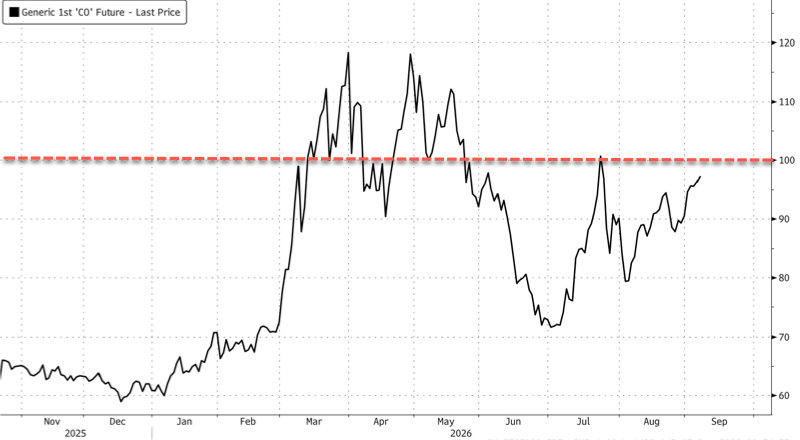
Global oil prices have surged since the start of the war on February 28 with the global benchmark Brent crude oil price briefly hitting $119 per barrel on Tuesday.

Tyler Durden
Thu, 04/02/2026 – 23:00