73 F
Chicago
Friday, August 28, 2026
Home Blog Page 794

Exxon Jumps 4% After Company Boosts 2030 Cash-Flow Outlook

0
Exxon Jumps 4% After Company Boosts 2030 Cash-Flow Outlook

Exxon is trading sharply higher today, rising nearly 4% after the opening bell as investors reacted to a stronger long-term outlook from the company. The oil giant raised its expectations for future earnings and cash flow through 2030, driven by continued growth in its most profitable assets and additional structural cost savings. The update has pushed Exxon shares back toward 52-week and all-time highs, giving positive momentum to one of our favorite names heading into the new year. 

In its announcement, Exxon said it now expects $35 billion in cash-flow growth by 2030, an increase of about 17% from what it was projecting a year ago, with no changes to capital expenditure. The company also raised its cost-savings target, noting that savings will rise 10% to $20 billion compared with 2019 levels. These improvements come without raising spending, which suggests stronger operating efficiency, particularly in the company’s upstream business.

Much of Exxon’s confidence stems from its heavy investment in low-cost fields in the Permian Basin and Guyana. Both are profitable at less than $35 a barrel, enabling Exxon to grow production and generate earnings even as other producers struggle with prices near multi-year lows.

Chief Executive Officer Darren Woods emphasized that the company’s investment strategy during periods of skepticism—particularly during the pandemic and the ESG-driven shift away from fossil fuels—has positioned it well for the future. “Our transformation helps ensure that in any future environment, and for decades to come, Exxon Mobil will have an important role and deliver substantial shareholder value,” he said in the statement.

Bloomberg energy analyst Javier Blas wrote on Tuesday that Exxon would also “lower spending in low-carbon businesses (to ~$20 billion over the next five years, down from ~$30 billion)” and that “the company plans to stop for now the construction of several hydrogen facilities.”

“While we’re convinced that low-carbon hydrogen will be required […] the markets and customer-base are developing slowly,” Woods told him.

Elsewhere production is expected to reach 5.5 million barrels of oil equivalent per day in 2030, 17% higher than current levels and 100,000 barrels a day more than forecast a year ago. Exxon attributed the increase to technology advancements, particularly in the Permian Basin, where new proprietary methods may allow the company to extract far more oil than other shale operators.

The company also plans to bring its Golden Pass natural gas export terminal online in the coming weeks, turning what was once a cheap byproduct into a global revenue source. Additional projections include capital spending of $27 billion to $29 billion in 2026, production of about 4.9 million barrels per day that year, 37% of which will come from the Permian, along with a final investment decision on a low-carbon data center project expected “by late 2026.”

Exxon added that it expects to generate cumulative surplus cash flow of $145 billion through 2030 and for earnings to grow $25 billion by 2030, a compound annual growth rate of 13%, while all 2030 corporate emissions intensity plans will be achieved in 2026.

For long-term shareholders, today’s surge reinforces why Exxon remains one of our favorite names. The company is not only growing production and earnings, it is doing so while keeping spending in check and focusing on assets that generate attractive returns in almost any pricing environment. With shares again testing record highs and investors responding positively to the stronger 2030 outlook, Exxon appears well-positioned for a breakout higher in 2026…

Tyler Durden
Tue, 12/09/2025 – 11:05

Job Openings Unexpectedly Soar Even As Number Of Quits Plunges To 5 Year Low

0
Job Openings Unexpectedly Soar Even As Number Of Quits Plunges To 5 Year Low

After a two month data hiatus, moments ago the BLS published the first jobs-linked report when it released the October JOLTS job openings and labor turnover survey. And following the last published JOLTS, which hit a little over two months ago on Sept 30, covering the month of August and which reported just 7.227 million job openings, the October report was unexpectedly strong, but not for what it showed for October but rather for the previously unreported September data, which came at a whopping 7.658MM, the highest since May, and the biggest one-month increase (+431K), since October 2024.

According to the BLS, there were no material monthly changes in October, expect for a notable plunge in the number of job openings in federal government (-25,000). And while that was accurate, a quick skim of the data 

To be sure, as noted above, the best news about today’s report is that roughly around the time of the government shutdown the number of government job openings was already the lowest since Feb 2021, while the number of Federal job openings continues to be in freefall.

What is just as interesting is that after four years of the US labor market dodging the bullet, its luck has finally run out because whereas every month since May 2021, the labor market had been supply-constrained, with more openings than jobs in the US, in July and August we finally returned to a demand constrained baseline, with fewer job openings than unemployed workers, the first negative print this series since April 2021. That said, in October, this series reversed again, with 55L more job openings than unemployed workers. Expect this to reverse again in the coming months.

Said otherwise, in October the number of job openings to unemployed was just a fraction above 1.0x, having spent the previous two months below, which in turn was a reversal of the previous 4 years.

Why does this matter? Because as we discussed recently, the US never entered a recession in a period when there were more job openings than unemployed workers (i.e. the job market was supply constrained). After the previous two months, that is no longer the case. 

Moving away from job openings, we find that both hires and quits dropped. Hiring slowed down in October, when 5.149 million workers were hired, down over 200K from 5.350 million in September. But this drop was modest compared to the plunge in the quits which slumped from 3.128 million to 2.941 million, the lowest since August 2020. The number of quits decreased in accommodation and food services (-136,000), health care and social assistance (-114,000), and federal government (-25,000). Curiously, quits in federal government in September saw a series high of 46,000. In October, quits increased in arts, entertainment, and recreation (+38,000) and in information (+21,000)

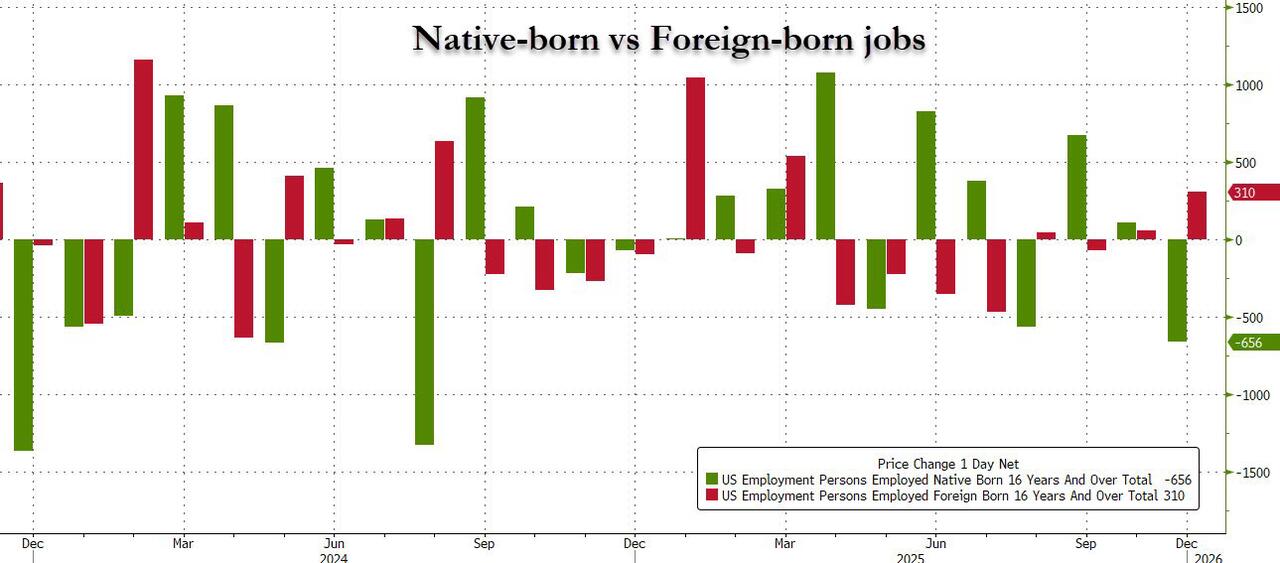
How to make sense of this data? On the surface, the JOLTS report suggests that the jobs market is much stronger than some had feared, and certainly the bottom is not falling out. It also suggests that anyone expecting an aggressive easing cycle in the immediate future will be disappointed. At the same time, the report is too close to the FOMC decision tomorrow, so it won’t change anything, and if it does impact the market, it will be odds of a January or subsequent rate cut (which will drop). At the same time, the continued collapse in both hires and quits is concerning and indicates that we can now add low quits to the “low fire, low hire” economy, which is rapidly finding a new equilibrium now that millions of illegal aliens aren’t polling the statistics, or artificially depressing wages. Neither of which makes the Fed’s role any easier… 

Tyler Durden
Tue, 12/09/2025 – 10:38

White House Draws Up Post-Maduro Plans As Trump Warns His “Days Are Numbered”

0
White House Draws Up Post-Maduro Plans As Trump Warns His “Days Are Numbered”

In a new interview with Politico released Tuesday President Trump stated that Venezuelan President Nicolas Maduro’s “days are numbered” but still declined to say exactly what he has planned in terms of potential military action against Venezuela. 

He was asked specifically whether he might order boots on the ground in Venezuela, to which Trump responded simply, “I don’t comment on that.” Trump was also pressed on how far he’s willing to go in pursuit of regime change. Trump said, “I don’t want to say that.”

“But you want to see him out?” asked Politico reporter Dasha Burns. “I wouldn’t say that one way or the other,” Trump said, while criticizing the socialist strongman’s rule. But then later he conceded that he wouldn’t rule out an American ground invasion and that’s when the commander-in-chief said of Maduro, “His days are numbered.”

But there are apparently robust plans for the ‘day after’ Maduro which have been prepared by the White House and Pentagon. These contingencies have no doubt been intensely discussed especially following the months-long major US naval build-up in the southern Caribbean.

A fresh CNN report indicates Tuesday that the “Trump administration is working on day-after plans in the event Maduro is ousted from power, according to two senior administration officials and another source familiar with the discussions.”

The sources said the plans have been “quietly drafted” and are highly classified. “They include multiple options for what US action could look like to fill the power vacuum and stabilize the country if Maduro voluntarily leaves as part of a negotiated departure or is forced into leaving after US strikes on targets inside Venezuela or other direct action, the sources said,” writes CNN.

Washington has had a recent history of facilitating regime change in supposedly ‘rogue states’ only to see once highly stable societies descend into disaster, chaos, and mass killings. Such happened everywhere from Afghanistan to Iraq to Libya to most recently in Syria – where Druze, Christians, and Alawites continue to suffer at the hands of hardline Sunnis.

The Venezuela plans are being ‘closely held’ – CNN explains:

“It’s the job of the federal government to always prepare for plans A, B and C,” said a senior administration official, noting that the president would not be making the threats he’s making if he did not have a team ready with a series of options for any potential outcome.

Another source familiar with the planning said that it is “the responsibility of the US government to prepare for all scenarios around the world that may or may not unfold.” The plans are being closely held at the Homeland Security Council at the White House, the source added, which is led by Stephen Miller who has worked closely with Secretary of State and acting national security adviser Marco Rubio on the efforts related to Venezuela in recent months.

Opposition leaders Edmundo González Urrutia and María Corina Machado, Getty images

Apparently the US-supported Venezuelan opposition also factors in, and has been doing its own planning and preparations:

The opposition has been formulating “100 hour” and “100 day” plans for next steps if Maduro is ousted, and those plans have been shared with different parts of the Trump administration, a source familiar said. It is unclear how much the administration has incorporated any aspects of those plans into its thinking, the source said.

Washington has already anointed María Corina Machado and Edmundo González as the anti-Maduro oppositionists who will lead a political transition.

The US has going back to the Biden administration called Gonzalez the rightful “president-elect” of the oil-rich but corrupt country, and Trump has also described him as the true president after Maduro allegedly ‘stole’ the last election.

Maduro is recently said to have offered serious overtures to the US regarding access to the nation’s huge underground oil reserves, but has also lately rejected Trump demands for him to immediately step down and exit the country.

Tyler Durden
Tue, 12/09/2025 – 09:40

Time For Ukraine To Have Elections As It’s ‘Not A Democracy Anymore’: Trump

0
Time For Ukraine To Have Elections As It’s ‘Not A Democracy Anymore’: Trump

President Donald Trump didn’t hold back in a new televised interview with Politico wherein he weighed in on the state of the Ukraine war and how President Zelensky is conducting himself.

Given Zelensky has put the brakes on the Trump-proposed pace plan by definitively rejecting the territorial concessions aspects to the document, the US president’s assessment was blunt and highly critical, going so far as to basically call Ukraine not a democracy. “They haven’t had an election in a long time,” Trump said. “You know, they talk about a democracy, but it gets to a point where it’s not a democracy anymore.”

At this part of the interview the discussion focused on whether Ukraine was still justified at this point in delaying elections over martial law. Trump’s conclusions is that no, it’s been far too long since all elections were canceled by Zelensky with the backing of parliament, and thus he questioned the country’s democratic credentials.

Of course, Zelensky’s presidential term expired all the way back May 2024, but has argued the constitution allows the drastic action he took during wartime.

Asked directly if Ukraine should go to the polls, Trump responded “it’s time” while explaining it is “an important time to hold an election. He said that amid years of the war with Russia “they’re using war not to hold an election” – but that Ukrainians “should have that choice.”

Trump’s words here will serve to add pressure as Zelensky’s office is already front and center in a wide-ranging energy corruption scandal, which has seen top ministers, aides, and officials forced out. Trump further assessed:

“[Zelensky] is going to have to get on the ball and start accepting things,” he said, adding that they are “losing.”

It has actually been European leaders who form the self-styled ‘coalition of the willing’ which are supporting Zelensky in resisting Washington pressures to achieve peace in any way possible. Europe even wants to leave the door open to NATO membership, which of course means Putin would never agree, and perhaps that’s the point. This was all agreed to in London this week as Europe seeks to forge a counter-plan to Trump’s.

Watch below as Trump further recounts his personal history with Zelensky, which doesn’t paint the Ukrainian leader in a very flattering light…

Trump again went after the Europeans in the fresh Politico interview, saying, “I think they’re weak. But I also think that they want to be so politically correct.” He added: “I think they don’t know what to do. Europe doesn’t know what to do.”

The publication said that Trump could be preparing to “abandon” Ukraine and the war effort altogether. “Trump’s comments about Europe come at an especially precarious moment in the negotiations to end Russia’s war in Ukraine, as European leaders express intensifying alarm that Trump may abandon Ukraine and its continental allies to Russian aggression,” Politico wrote. “In the interview, Trump offered no reassurance to Europeans on that score and declared that Russia was obviously in a stronger position than Ukraine,” it noted.

Tyler Durden
Tue, 12/09/2025 – 09:00

Musk Claims EU Commissars Are ‘Responsible For Murder Of Europe’

0
Musk Claims EU Commissars Are ‘Responsible For Murder Of Europe’

Authored by Thomas Brooke via Remix News,

Elon Musk escalated his confrontation with Brussels on Monday, declaring on X that “the EU commissars are responsible for the murder of Europe” after the European Commission insisted it would “make sure” the social media platform pays the €120 million fine imposed last week for alleged violations of the Digital Services Act (DSA).

The Commission announced on Friday that X had breached transparency rules and used deceptive design practices under the bloc’s online-platform regulation, with specific criticism of its blue-tick verification system. The EU regulator said the system exposes people to scams, impersonation, and manipulation by malicious actors.

The move prompted a swift backlash in Washington as senior U.S. officials accused the EU of censorship, regulatory harassment, and unfair targeting of American technology firms. Secretary of State Marco Rubio said, “The European Commission’s $140 million fine isn’t just an attack on X, it’s an attack on all American tech platforms and the American people by foreign governments. The days of censoring Americans online are over.”

Brendan Carr, chairman of the Federal Communications Commission, likewise criticized the EU action, saying, “Once again, Europe is fining a successful U.S. tech company for being a successful U.S. tech company. Europe is taxing Americans to subsidize a continent held back by Europe’s own suffocating regulations.”

Howard Lutnick, the U.S. Secretary of Commerce, added that “the Digital Services Act is designed to stifle free speech and American tech companies,” while U.S. Ambassador to the EU Andrew Puzder described the penalty as “excessive” and a result of “EU regulatory overreach.”

Musk has frequently clashed with liberal Western governments, accusing them of suppressing free expression. In recent months, he has publicly backed figures on Europe’s political right, including Alice Weidel of Germany’s Alternative for Germany (AfD) and several anti-mass immigration MPs in the United Kingdom, such as Rupert Lowe.

“Remigration is the normal position,” Musk wrote on Monday, remarking on a poll indicating that seven in ten Danes support deporting foreign nationals convicted of crimes.

Over the weekend, he intensified his criticism of Brussels by calling for the “abolition” of the European Union, claiming it prioritizes bureaucracy over democracy. “Dissolve the EU and return power to the people,” he wrote while commenting on a European Court of Justice ruling last year that upheld a financial penalty against Hungary for refusing to accept migrant quotas under the EU Migration Pact. That scheme requires member states either to accept allocated asylum seekers or pay roughly €20,000 per person as a solidarity contribution.

Musk has also claimed the controversy has boosted X’s popularity. He said the platform was seeing “record-breaking downloads in many countries in Europe” following the announcement of the fine, calling X the number one news app “in every EU country.”

At the Commission’s daily briefing on Monday, spokesperson Thomas Regnier said the penalty would be enforced. “X will have to pay that fine. The €120 million will have to be paid. We will make sure that we get this money,” he told reporters.

Regnier said the Commission would continue to use X to communicate with the public despite the platform’s decision to suspend the Commission’s account for paid advertising in response to the penalty. He said the EU executive uses all its social media accounts, including those on X, “to get in touch with citizens, stakeholders, to do some outreach work, to precisely speak about what we are doing in the EU.”

X can still challenge the decision, and Regnier confirmed the company “has 90 days to get back” to the Commission on how it intends to proceed.

Read more here…

Tyler Durden
Tue, 12/09/2025 – 08:40

Futures Flat With Fed/Oracle Event Bonanza On Deck

0
Futures Flat With Fed/Oracle Event Bonanza On Deck

US futures are unchanged, with traders looking forward to two market-moving events on Wednesday: the Fed meeting (where 22bps of easing is priced in) and Oracle results. As of 8:00am ET, S&P 500 futures and Nasdaq 100 contracts are little changed. Pre-market, Mag 7 are mostly lower except for a 0.5% gain in NVDA: TSLA -0.9%, META -0.5%, GOOGL -0.3%. Since yesterday’s close, incremental macro headlines were largely muted. Headlines on NVDA’s likely H200 shipment approval drove gains in stocks both during Monday trading session and pre-market today. In addition, there was an article on China is set to limit access to NVDA’s H200 chips this morning. Bond yields are fractionally lower, while the USD reverses earlier losses and is flat. Commodities are mixed: oil and previous metals are higher, while base metals and Ags are lower. Key focus today are Small Business Optimism and JOLTS.

In premarket trading, Mag 7 stocks are mostly lower: Nvidia up 0.1%, paring earlier gains, after the FT reported that China’s regulators are discussing ways to limit permits for access to its H200 semiconductors (Amazon +0.1%, Microsoft +0.1%, Apple -0.1%, Alphabet -0.2%, Meta -0.6%, Tesla -0.9%). 

  • Almonty Industries (ALM) is down 14% to $6.79 after the company priced 18 million shares at $6.25 each for $112.5 million in gross proceeds.
  • Ares Management (ARES) rises 8.1% after S&P Dow Jones Indices said the stock will replace Kellanova in the S&P 500, effective Dec. 11.
  • Toll Brothers Inc. (TOL) falls 4.6% after the luxury builder beat analysts’ estimates for quarterly orders, while providing full-year guidance for 2026 that fell below expectations.
  • Viking Holdings (VIK) rises 2.3% after Goldman Sachs upgraded the cruise operator to buy from neutral. Meanwhile, peer Norwegian Cruise Line Holdings (NCLH) falls 2.5% as the bank downgraded the stock to neutral from buy.

US stocks may be more volatile after tomorrow’s Fed meeting than after other recent decisions because of diverging views among Fed officials, with Bloomberg options data showing an implied move of 0.7% in either direction. Globally, central banks are starting to tilt more hawkish, upending yields. Meanwhile, while buyside investors have said they’re feeling risk-on into 2026, a poll of Goldman Sachs clients shows their bullish views about AI and US stocks are moderating.

Elsewhere, a recent jump in Treasury yields has curbed risk appetite as traders grow cautious about the pace of monetary easing beyond Wednesday’s meeting. Money markets now see two cuts in 2026 after a likely 25bps hawkish cut tomorrow, a retreat from more optimistic forecasts in recent weeks.

“Given all the tension in global bond markets at the moment, the meeting of the Fed could potentially add fuel to the fire,” said Vincent Juvyns, chief investment strategist at ING in Brussels. “Investors will also be watching very closely the results of Oracle and Broadcom. There’s a lot at stake this week.”

Stoxx 600 little changed, with outperformance for German and Italian stocks, offset by weakness in France. The defense sector is rallying as Germany prepares to authorize a record amount of orders for military gear and services. Other sectors are muted amid concerns about the path of monetary policy at global central banks. Here are some of the biggest movers on Tuesday:

  • Orsted shares jump as much as 4.4% to their highest level in four months after a US federal judge ruled President Donald Trump’s executive order banning new wind projects is illegal.
  • Rusta gains as much as 13%, the most since June, after the Swedish discount retailer reported second-quarter earnings that DNB Carnegie described as “much stronger than expected,” with sales growth accelerating.
  • Man Group shares gain as much as 5.2%, touching their highest level since February, after JPMorgan says there are “reasons to be cheerful” about the European diversified financials sector heading into 2026, with a brighter economic outlook offering a supportive backdrop for equity markets.
  • Thungela shares rally as much as 6.7% after the coal miner said in a statement that it expects its export saleable production from its South African operations for 2025 to exceed its guidance range.
  • BAT shares decline as much as 5.4% after the company said it expects revenue growth in 2026 at the lower end of its mid-term guidance.
  • Thyssenkrupp shares slide as much as 13%, paring this year’s huge gains, after the German industrial firm’s 2026 guidance missed estimates. Morgan Stanley said the weak outlook outweighed a full-year results beat.
  • Air France-KLM shares fall as much as 11%, the most intraday in a month, after CMA CGM offered about €325m senior unsecured bonds due 2028 exchangeable for shares of the airline operator.
  • EssilorLuxottica shares fall as much as 5%, the most since May, on competition concerns after Alphabet’s Google said it’s working to create two different categories of artificial intelligence-powered smart glasses.
  • OCI shares slump as much as 18%, reaching a record low, after the Dutch chemical maker announced a merger with Orascom Construction, an engineering and construction contractor based in Abu Dhabi.
  • Gerresheimer shares drop as much as 8.9% after Morpheus Research published a report on the German company and said it’s short the stock.

Earlier in the session, Hang Seng Tech Index drops more than 1.5% and mainland China indexes are better offered. The ChiNext stands out with a modest gain. Kospi, Taiex and ASX 200 indexes are nursing small losses, while Japanese stocks are broadly unchanged.

In FX, the Bloomberg Dollar Spot Index marginally weaker. Aussie dollar among the strongest major currencies after the RBA said it was done with rate cuts in this cycle, which sent Aussie bond yields soaring.

In rates, bonds are recovering slightly from the selloff in the prior session in Europe, with outperformance in longer maturities. Ten-year bund yields down two basis points. Treasuries mixed, with yields lower at the long end, unchanged at the short. 10-year TSY yields, little changed around 4.165%, trails bunds and gilts in the sector by 1.5bp and 0.5bp. Treasury curve spreads are mostly within a basis point of Monday’s closing levels, with 5s30s near 105bp holding Monday’s sharp flattening move. Rangebound price action precedes 10-year note auction at 1pm New York time, following October JOLTS job openings data during US morning. Treasury coupon auctions cycle continues with $39 billion 10-year reopening, a day earlier than normal to avoid coinciding with FOMC communications. Cycle concludes Thursday with $22 billion 30-year bond reopening. WI 10-year yield near 4.165% is ~9bp cheaper than the November sale, which tailed by 0.6bp

In commodities, gold prices higher, up by around $12 to $4,202/oz. Oil prices fluctuating, with Brent futures trading up to around $62.60/barrel.

Looking ahead, the US economic calendar includes September Leading index and October JOLTS job openings (10am)

Market Snapshot

  • S&P 500 mini little changed
  • Nasdaq 100 mini little changed
  • Russell 2000 mini little changed
  • Stoxx Europe 600 little changed
  • DAX +0.4%
  • CAC 40 -0.4%
  • 10-year Treasury yield -1 basis point at 4.16%
  • VIX +0.1 points at 16.77
  • Bloomberg Dollar Index little changed at 1213.31
  • euro little changed at $1.1648
  • WTI crude +0.4% at $59.1/barrel

Top Overnight News

  • Trump Says U.S. Will Allow Nvidia H200 Chip Sales to China, Get 25% Cut: BBG
  • China set to limit access to Nvidia’s H200 chips despite Trump export approval: FT
  • China’s top leaders are signaling they are on alert for a potential flareup of tensions in global commerce as they draw up economic plans for next year, after amassing a record trade surplus despite the tariff war with the US: BBG
  • President Donald Trump signaled he could impose fresh tariffs on agricultural products, including Canadian fertilizer and Indian rice, the latest sign that protracted negotiations with two US trading partners could drag on: BBG
  • US farmers said the Trump administration’s $12bln aid package brings temporary relief, but is unlikely to kickstart a lasting recovery for the American farm economy, according to Bloomberg.
  • Oil market faces ‘super glut’ as supply surge hits prices, Trafigura warns: FT
  • China’s Manufacturing Is Booming Despite Trump’s Tariffs: WSJ
  • Foreign investors are storming into Japan’s once-placid government bond market, exposing the world’s second-largest pool of sovereign debt to bouts of volatility sparked by traders thousands of miles away: BBG
  • German lawmakers are set to approve 29 military procurement contracts worth a record €52 billion ($61 billion) next week, part of the government’s push to transform the Bundeswehr into Europe’s strongest conventional army: BBG
  • South Korea’s National Pension Service has recently started selling dollars to bolster the won, according to a person familiar with the matter, reviving earlier efforts to support the currency: BBG
  • Investors increase bets on ECB rate rise in threat to dollar: FT
  • Chinese stocks slumped in Hong Kong as investors reacted to a lack of stimulus signals from a meeting of top Communist Party leaders and turned cautious ahead of the Federal Reserve’s policy decision: BBG
  • Lithuania declares state of emergency over smuggler balloons from Belarus: FT
  • Trump Rails Against Europe, Threatens Expanded Anti-Drug Strikes: BBG
  • Boaz Weinstein’s $2bn flagship hedge fund sinks amid buoyant markets: FT
  • Warner Bros. Rival Bids Put Spotlight on Flagging Cable Networks: BBG

Trade/Tariffs

  • US President Trump said he spoke with Chinese President Xi very recently and thinks that China will buy even more soybeans than promised. Trump separately announced that he informed Chinese President Xi that the US will allow NVIDIA (NVDA) to ship its H200 products to approved customers in China and other countries, while Trump added that President Xi responded positively, and that 25% will be paid to the US. Furthermore, Trump said the Department of Commerce is finalising the details, and that the same approach will apply to AMD (AMD), Intel (INTC) and other great US companies.
  • China is set to limit access of NVIDIA’s (NVDA) H200 chips despite export approval from US President Trump, via FT citing sources; no decision has been made on the matter
  • US President Trump posted that ”Mexico continues to violate our comprehensive Water Treaty, and this violation is seriously hurting our BEAUTIFUL TEXAS CROPS AND LIVESTOCK. Mexico still owes the U.S over 800,000 acre-feet of water for failing to comply with our Treaty over the past five years.” Trump added that the “U.S needs Mexico to release 200,000 acre-feet of water before December 31st, and the rest must come soon after. As of now, Mexico is not responding, and it is very unfair to our U.S. Farmers who deserve this much needed water. That is why I have authorized documentation to impose a 5% Tariff on Mexico if this water isn’t released, IMMEDIATELY.”
  • US lawmakers urged US President Trump to ease Japan tariffs amid Chinese economic coercion, according to Nikkei.
  • US Treasury Secretary Bessent said they are working on an India trade deal.
  • Chinese Premier Li said at the ‘1 + 10’ dialogue with the heads of major international economic organisations that the global economy in 2025 is marked by turbulence and twists, creating urgent demand for reforming and improving global economic governance, while he added that tariffs have dominated global discussions on the economy this year and that mutually destructive consequences of tariffs becoming increasingly evident. Li said calls for free trade are growing louder and that AI is also becoming central to global trade discussions.

A more detailed look at global markets courtesy of Newsquawk

APAC stocks were subdued following the lacklustre lead from Wall Street with markets cautious ahead of the FOMC policy announcement on Wednesday, while downside was stemmed in the region amid a further warming of US-China trade relations after US President Trump confirmed that the US will permit NVIDIA (NVDA) to sell its H200 chips to China. ASX 200 was pressured following the RBA rate decision where the central bank unsurprisingly kept the Cash Rate unchanged at 3.60%, although comments from RBA Governor Bullock at the press conference leaned hawkish as she stated that it looks like more rate cuts are not needed and she doesn’t see rate cuts in the foreseeable future, while she added that the outlook is for an extended pause or hikes, but would not put a probability on it. Nikkei 225 lacked conviction and swung between gains and losses within a narrow range following recent currency weakness and anticipation that the BoJ will hike rates next week. Hang Seng and Shanghai Comp were subdued after the readout from yesterday’s Politburo meeting underwhelmed, as some were hoping for more forceful measures, while chipmakers in China were pressured in early trade after US President Trump’s announcement to allow NVIDIA to sell chips to approved customers in China.

Top Asian News

  • RBA kept the Cash Rate unchanged at 3.60%, as expected, with the decision unanimous and noted that recent data suggests the risk to inflation have tilted to the upside, but it will take a little longer to assess persistence of inflationary pressures, while it added that private demand is recovering, and labour market conditions still appear a little tight, though modest easing is expected. RBA said the board judged it appropriate to remain cautious and update its outlook as the data evolves, with the board to be attentive to the data and evolving assessment of the outlook and risks to guide its decisions. Furthermore, the board judged that some of the recent increase in underlying inflation was due to temporary factors, while it is focused on its mandate to deliver price stability and full employment, and will do what it considers necessary to achieve that.
  • RBA Governor Bullock said at the post-meeting press conference that inflation and jobs data will be important for the board meeting in February, while she added that it looks like more rate cuts are not needed. Bullock stated they did not consider a rate cut and did not explicitly consider the case for a rate hike at this meeting, but discussed the circumstances in which tightening might be required. Bullock said if inflation looks persistent, it will raise questions for policy, while she would not put timing on any future move and will proceed meeting by meeting. Furthermore, she doesn’t see rate cuts in the foreseeable future and noted the outlook is for an extended pause or hikes, but would not put a probability on it.
  • China’s Premier said “we are confident in completing economic goals this year”, according to Xinhua.
  • BoJ Governor Ueda said he believes that the economy will go back to positive growth in Q4 and beyond that. “Because we are foreseeing convergence to 2% of the underlying component, we have been adjusting the degree of easing slowly”. As Japanese automakers have chosen to lower export prices without passing them to US consumers, this has stabilised the volume of auto exports, not creating negative effects on employment and production in Japan. Strong enough momentum in domestic price and wage dynamics to prevent negative shocks from having a large impact on inflation. At the moment, not seeing a very high risk of inflation, especially underlying inflation accelerating in the wake of fiscal stimulus. Watching the possibility of food inflation and JPY weakness altering inflation expectations. It is the government’s job to deliver on medium to long-term fiscal sustainability. Keep an eye on bank exposure to non-bank financial institutions abroad. Exchange rates should follow fundamentals. How exchange rates will affect our inflation outlook is a “very important question for us.”
  • BoJ Governor Ueda said he won’t comment on specifics on interest rates but noted that long-term interest rates are rising rather rapidly recently, adding that it will increase JGB purchases if long-term rates make abrupt moves.

European bourses (STOXX 600 U/C) opened with mild gains, then clambered higher soon after the cash open – a move which ultimately proved fleeting, with indices now broadly in the red. European sectors opened without bias and continue to fare this way. Financials, Insurance and Banks lead the charge, helped by the continued constructive yield environment, while Basic Resources underperforms as the metals rally loses steam.

Top European News

  • European Parliament said parliament and member state negotiators reached a provisional deal to update EU rules on sustainability reporting and due diligence requirements for companies. Furthermore, it stated that companies with more than 1,000 employees and annual turnover over EUR 450mln are to report on their sustainability, while large corporations with more than 5,000 employees and annual turnover of more than EUR 1.5bln are to carry out due diligence on their adverse impacts.
  • Germany is to approve EUR 52bln in military orders, via Bloomberg.
  • NBP’s Duda said it is necessary to wait before cutting rates to assess the impact of reductions already made on the economy.

FX

  • DXY resides within a narrow 98.97-99.14 range with the index testing 99.00 to the downside shortly after the European cash equity open, with newsflow on the quieter side as trades look ahead to tomorrow’s FOMC with eyes on the dot plots. The index remains well within yesterday’s 98.79-99.22 parameter. Trade headlines have been more conciliatory between the US and China, after US President Trump announced that he informed Chinese President Xi that the US will allow NVIDIA (NVDA) to ship its H200 products to approved customers in China and other countries. On the docket ahead, the US data slate features weekly ADP jobs data, as well as JOLTs data for September (7.199mln expected vs a prior 7.227mln; in August, the vacancy rate was unchanged at 4.3%, while the quits rate eased by 0.1ppts to 1.9%).
  • AUD is the outperformer this morning after the RBA maintained its Cash Rate at 3.60%, as unanimously forecast, while support was seen during the post-meeting press conference where RBA Governor Bullock noted that it looks like more rate cuts are not needed. AUD/USD tested levels near 0.6650 from a 0.6610 base.
  • JPY lags following yesterday’s weakness on the 7.6 magnitude earthquake, which did later see all advisories eventually lifted. USD/JPY saw a dip lower on hawkish commentary from BoJ Governor Ueda after he noted, “How exchange rates will affect our inflation outlook is “very important question for us.” USD/JPY resides in a 155.74-156.43 range after tipping yesterday’s 155.98 peak, with the next upside level the 28th Nov peak at 156.58.
  • GBP and EUR trade with modest gains in quiet newsflow, with GBP/USD on either side of 1.3350 and EUR/USD printing on either end of 1.1650. Strength in the GBP in the early part of this morning’s session lacked a clear catalyst.

Fixed Income

  • USTs were initially slightly this morning, but then caught a slight bid. Currently trading at the upper end of a 112-05+ to 112-12+ range. The upside seen in the morning came alongside FX-related commentary by BoJ Governor Ueda, which sparked some demand in the Yen, which led to a broader pick-up across havens (bonds/gold). On the trade front, President Trump said he would allow NVIDIA H200 chip shipments to China, which has seemingly lifted sentiment a touch in Europe/US equity futures. Elsewhere, Trump threatened Mexico with an extra 5% tariff amidst a water dispute. Ahead, markets await the Weekly US ADP Prelim Average, JOLTS data and a 10-year auction.
  • Bunds started the European session with modest strength, attempting to scale back some of its recent losses; currently trading within a 127.26 to 127.66 range; the low for the day is a couple of ticks below Monday’s trough. Though soon after the cash open, Bunds moved a touch lower amidst a pick-up in European equities – a move which ultimately proved fleeting, with Bunds now back in the green by roughly 15 ticks. Earlier, German Exports rose 0.1% (exp. -0.5%), whilst Imports disappointed – overall, ING suggests the data shows that Germany is unlikely to be pulled out of stagnation by its exports. Most recently, in line with peers, the benchmark has picked up to trade near highs.
  • OATs are higher, but underperforming vs European peers, as traders count down their clocks to a key National Assembly Vote on the 2026 social security budget; if passed, PM Lecornu would have successfully resolved issues which have led to failure for the prior two PMs. In brief, recent pension/healthcare spending concessions have earned Lecornu support from the Socialists, who are expected to vote in favour of the bill, whilst support from the right has waned – Politico writes that “it’s not looking great”. Overall, the outcome could heighten political turbulence and uncertainty over France’s plans to address gaps in its public finances.
  • Gilts trade higher alongside peers; currently at the upper end of a 90.63 to 91.22 range. Focus ahead will be on the BoE TSC hearing, with the likes of Ramsden (Dove), Lombardelli (Neutral), Mann (Hawk) and Dhingra (Dove) all set to appear.

Commodities

  • WTI and Brent have seemed to have stabilised following Monday’s risk-off selloff. Benchmarks extended below Monday’s trough of USD 58.62/bbl and USD 62.34/bbl, respectively, to a low of USD 58.59/bbl and USD 62.24/bbl as the APAC session came to an end. Thus far, benchmarks trade muted in a c. USD 0.40/bbl range with the EIA to release its STEO later today.
  • Spot XAU failed to extend beyond the key support level at USD 4176/oz, troughing at USD 4170/oz, before reversing higher as the dollar continued to weaken ahead of the FOMC meeting on Wednesday. XAU gradually rose c. USD 35/oz higher to a session high of USD 4209/oz as the European session gets underway, aided by hawkish comments by BoJ’s Ueda, which pressured USD/JPY and in turn, weakened DXY.
  • 3M LME Copper continued to pull back from its ATH formed in Monday’s session, set at USD 11.75k/t, following a disappointing readout from the Politburo and a cautious risk tone ahead of the FOMC meeting. The red metal gradually fell from a session high of USD 11.66k/t to a trough of USD 11.43k/t throughout the APAC session. Currently, losses have been slightly pared back as the European session gets underway, with 3M LME Copper trading back above USD 11.5k/t
  • Iraq sets January Basrah medium crude official selling price to Asia at -USD 1.05/bbl to Oman/Dubai average.
  • Ukraine’s Naftogaz says Russian drones attacked its gas infrastructure

Geopolitics

  • Israeli military announced it struck infrastructure belonging to Hezbollah in several areas in southern Lebanon.
  • EU Commission President von der Leyen said as peace talks are ongoing, the EU remains ironclad in its support for Ukraine, while she added that the goal is a strong Ukraine, on the battlefield and at the negotiating table. Furthermore, she said Ukraine’s sovereignty must be respected, and Ukraine’s security must be guaranteed in the long term as a first line of defence for our union.
  • Russia’s Kremlin said European claims that Russian President Putin plans to attack NATO are “complete nonsense”.

US Event Calendar

  • 6:00 am: Nov NFIB Small Business Optimism, est. 98.3, prior 98.2
  • 10:00 am: Sep Leading Index, est. -0.31%
  • 10:00 am: Oct JOLTS Job Openings, est. 7117k

DB’s Jim reid concludes the overnight wrap

Morning from Zurich after a day in sunny Geneva yesterday as the 2026 World Outlook roadshow moves on to audiences that don’t quite rival the recent Oasis tour but are decent nonetheless. Tickets are undoubtedly cheaper. Bonds continue to cheapen up as well as the recent sell-off has showed no signs of letting up over the last 24 hours, with global yields moving higher as investors reacted to several headlines, including hawkish comments from multiple officials. So by the close, 10yr bund yields (+6.4bps) had posted their biggest daily jump since August to reach 2.86%, which is their highest level since March after the fiscal stimulus announcements. Meanwhile in the US, 10yr Treasury yields (+2.9bps) closed at 4.17%, their highest since September. Remember that’s building on the +12bps increase last week, which was already the biggest weekly jump since the Liberation Day turmoil in April. This follows big recent rises in yields in places like Japan, Australia, Canada and New Zealand in recent weeks. For yesterday the yield rise meant that the S&P 500 (-0.35%) fell back after four consecutive gains.  

The initial catalyst for yesterday’s additional sell-off was a Bloomberg interview with the ECB’s Isabel Schnabel. That came out before the European open, with her suggesting that “I’m rather comfortable” with expectations that the next move would be a hike. Moreover, she made other hawkish comments, saying that “risks to inflation are tilted to the upside”, and that she believed that the equilibrium or neutral interest rate that neither restricts nor stimulates economic activity (r*) could rise because of AI and public investment. So collectively, that served as the initial trigger for the selloff, and euro overnight index swaps for December 2026 moved +8.0bps higher on the day.

Unsurprisingly, this hawkish repricing led to a huge reaction among European government bond yields, particularly at the front end. For instance, yields on 2yr German (+6.4bps) and French (+5.8ps) debt moved up to their highest level since March, right after the German government had announced their plans to reform the constitutional debt brake to permit extra borrowing. And notably, the 30yr German yield (+3.1bps) moved up to 3.46%, its highest level since summer 2011 as the Euro crisis escalated. So there was a real sense yesterday that markets were pricing back in a pre-GFC normal of higher long-term rates, particularly given the background concerns over the current fiscal trajectory.  

Putting all the yield moves in perspective, over the last month 10yr Australian (+36bps), Japanese (+26bps) New Zealand (+39bps), Canadian (+25ps) and German (+19bps) lead the way. The likes of the UK (+7bps) and the US (+6bps) have actually held in better, even if they are up more from their lows, but yesterday saw US yields rise as we heard from Kevin Hassett, who’s now considered the strong favourite (77% on Polymarket) to become the next Fed Chair. He was asked yesterday how many rate cuts there should be in 2026, but he struck a cautious tone, saying “what you need to do is watch the data.” So given his previous calls for more rate cuts, that was interpreted in a more hawkish light.

Those comments and the global backdrop meant investors meaningfully dialled back their expectations for Fed rate cuts next year. For instance, the amount of further cuts priced in by December 2026 came down -3.9bps on the day to 78bps. And in turn, that meant US Treasury yields moved higher across the curve. So the 2yr yield (+1.5bps) moved up to 3.58%, while the 10yr yield (+2.9bps to 4.17%) and the 30yr yield (+1.0bps to 4.80%) both reached their highest levels since September. Remember that the two-day FOMC meeting begins today ahead of tomorrow’s decision, and the last dot plot in September only signalled one further cut in 2026 after the December cut expected tomorrow. So the dot plot already has a more hawkish profile than futures are pricing, and there was also a wide dispersion around that, with 8 out of the 19 officials above the median, so it would only take two more to push that higher. So there’s heightened uncertainty among investors going into that.  

All this proved a tougher backdrop for risk assets, with the S&P 500 (-0.35%) falling back after a run of 4 consecutive gains. To be fair, the move kept the index less than 1% beneath its record high from late-October, but there was a clear loss of momentum as yields moved higher. The decline was broad-based, with 10 of the 11 S&P 500 sector groups down on the day, led by communication services (-1.77%) and materials (-1.66%). The Magnificent 7 (-0.91%) posted its worst day in over two weeks even as semiconductor stocks outperformed, led by a +1.72% gain for Nvidia. Meanwhile in Europe, the equity losses were more muted, but the STOXX 600 (-0.07%) also fell back.  

Overnight Mr Trump has granted permission for Nvidia to sell its H200 AI chip to China in exchange for a 25% surcharge for the government. Nvidia gained an extra 2% in after-hours trading.

Asian equity markets are predominantly weaker this morning with the Hang Seng (-1.10%) the largest underperformer in the region, with the CSI (-0.44%) and the Shanghai Composite (-0.24%) also lower alongside the KOSPI (-0.41%) and the S&P/ASX 200 (-0.45%). The Nikkei is flat alongside US equity futures.  

Overnight, the RBA has maintained its cash rate target at 3.60% in a unanimous decision, marking the third consecutive meeting in which rates have been held steady, following 75bps of cuts in 2025. The press conference was hawkish and emphasised that they are considering a hike and suggested February was under consideration. Following this, the Australian dollar is +0.33% higher against the US dollar, while yields on the policy-sensitive 3-year Australian government bonds have surged by +10.2bps to reach 4.14%. Meanwhile, 10-year yields have increased by +5.4bps, trading at 4.76% as we go to print. So the sell-off in G10 rates continues and Kiwi bond yields are up a similar amount this morning. However, 10-year JGBs are pausing for breath with 10yr yields down by -0.8bps overnight after closing +2.8bps higher yesterday, reaching another post-2007 high of 1.96%.  

Finally on Ukraine, there was no new progress on the peace talks, with President Zelenskiy saying there were still disagreements on territory, and that he wanted answers on security guarantees for Ukraine. After a meeting with UK’s Starmer, France’s Macron and Germany’s Merz in London, Zelenskiy added that Ukraine would share its revised plan with the US today. Oil prices did fall back yesterday, although that reflected the global sell-off rather than geopolitical developments, with Brent crude down -1.98% to $62.49/bbl.   

To the day ahead now, and US data releases include the JOLTS report of job openings for September and October, and the NFIB’s small business optimism index for November. Otherwise, central bank speakers include the ECB’s Nagel, whilst the BoE’s Lombardelli, Ramsden, Mann and Dhingra will be appearing before the House of Commons’ Treasury Committee.

Tyler Durden
Tue, 12/09/2025 – 08:34

ADP Weekly Employment Report Signals Rebound In Labor Market

0
ADP Weekly Employment Report Signals Rebound In Labor Market

After a dismal few months, the US labor market turned up for the four weeks ending Nov. 22, 2025, private employers added an average of 4,750 jobs a week., according to ADP’s new weekly employment data

This week’s positive number hints at an upswing in the labor market after four straight weeks of negative pulse estimates, after four straight weeks of losing jobs.

This follows the almost unprecedented decline in initial jobless claims last week (which some have argued was impacted by Thanksgiving Week irregularities).

Is this the start of the end of the Low-Fire, Low-Hire economy? It’s a little too early to tell, especially after the 120,000 collapse in small business jobs last month reported by ADP.

Tyler Durden
Tue, 12/09/2025 – 08:29

Why Does The End Of The World Look So Profitable?

0
Why Does The End Of The World Look So Profitable?

Authored by Michael Kern via OilPrice.com,

  • Sovereignty is shifting from public institutions to private tech entities like Palantir and SpaceX, which secure massive government contracts and offer “governance as a service.”

  • The AI boom’s massive resource demands, particularly for energy and water, are being subsidized by the public, driving up costs while “efficiency” in the workplace leads to widespread job deletion and the flattening of the middle class.

  • To address this shift, a new social contract is required, including adopting a Sovereign Equity Model for government-funded ventures, implementing an automation tax to replace eroded payroll taxes, and moving toward Universal Basic Services.

The stock market is hitting record highs. GDP growth is in the green. Tech valuations are defying gravity… fueled by a promise that artificial intelligence is going to generate trillions of dollars in wealth.

And yet… everything feels kinda…terrible? 

Jobs are disappearing, not in a crash, but in a slow fade. Prices for essentials remain stubbornly high. The divide between the digital economy and physical reality has never been wider. 

We are told this is just a transition period. We are told that “efficiency” is messy… but necessary.

But the unease you feel isn’t irrational. The green arrows on the stock charts aren’t measuring the health of the everyday economy anymore. They are measuring the success of a takeover.

We are watching a fundamental shift in how the state operates. Sovereignty is shifting from public institutions to a network of private entities. And in many ways, we are holding the door open for them.

When Silicon Valley Bought the State

For years, we talked about the “revolving door” between business and government.

The idea was that regulators would leave office and take cushy jobs at the companies they used to police. It was a conflict of interest… but one we understood.

That metaphor doesn’t really fit anymore. This is more like a merger.

A specific network of billionaires and venture capitalists has moved beyond lobbying. They are now building the state infrastructure themselves.

They don’t want to influence the rules. They want to be the ones writing the code that executes the rules.

Look at the players involved…

  • Peter Thiel: The billionaire founder of Palantir, who has explicitly stated that he no longer believes “freedom and democracy are compatible.”

  • Elon Musk: Who uses his platforms to amplify “techno-populism” while securing massive government contracts.

  • Marc Andreessen: The venture capitalist whose “techno-optimist manifesto” calls for unlimited acceleration of technology, regardless of the social cost.

These aren’t just businessmen. They are state-builders.

And they’ve spent the last decade funding a pipeline of personnel to place into key government positions. 

Thiel’s former chief of staff, Michael Kratsios, directed the White House Office of Science and Technology Policy.

An executive from Anduril, a defense contractor backed by Thiel’s Founders Fund, was nominated as Army under-secretary while still holding up to $1 million in company stock.

This pipeline has paid off. In late 2024 and 2025, we saw a massive consolidation of federal power into private hands.

  • SpaceX: The company secured a $1.8 billion classified contract with the National Reconnaissance Office (NRO) to build a vast spy satellite network.

  • 1789 Capital: A venture firm joined by Donald Trump Jr. backed a company called Vulcan Elements… which immediately landed a $620 million Pentagon contract.

  • Palantir: By late 2024, 55% of their revenue—roughly $1.7 billion—came directly from government sales.

They have realized that the most profitable business model isn’t just selling products to consumers. It is offering “governance as a service.”

We look at this efficiency and applaud it. But it raises a difficult question: When a private company runs the software that powers the state, who is actually in charge?

Abundance for Them, Scarcity for You

This new system requires fuel. A lot of it.

The leaders of this shift love to talk about “abundance.” Listen to Sam Altman or other AI evangelists, and they will tell you we are on the verge of a “fusion utopia.” They promise that AI will eventually solve climate change and give us limitless, clean energy.

That is the sales pitch. And maybe, one day, it will be true. But the reality today is a story of immediate resource pressure.

To power the massive data centers required for their AI models, these companies are tapping into the American energy grid at an unprecedented scale.

According to the International Energy Agency (IEA), power consumption from data centers is projected to more than double… rising from 415 terawatt-hours in 2024 to 945 TWh by 2030.

To put that in perspective… that is roughly the equivalent of adding the entire electricity consumption of Japan to the global grid in just six years.

Where will this power come from?

Not from the magic fusion reactors of the future. It is coming from the grid you rely on today.

In the PJM electricity market, which covers 13 states from Illinois to New Jersey, the demand from data centers has already driven capacity prices up.

To meet this need, the government is pivoting.

The Department of Energy is increasingly financing coal and natural gas expansion to keep the servers humming.

It creates a difficult dynamic:

  • Tech giants lock down “clean” baseload power… like Microsoft’s deal to restart the Three Mile Island nuclear plant solely for their own use.

  • The public grid is pushed to rely more on the volatile “spot market,” often powered by gas.

  • Communities deal with the environmental cost… including the 6 billion gallons of water Google’s data centers consumed in 2024. 

It isn’t necessarily malicious…It’s just math. But the math ends with the public paying higher bills to subsidize yet another part of the AI boom.

How “Efficiency” Is Deleting the Middle Class

This shift isn’t just happening on your electric bill. It is happening in the workplace.

The stock market is rallying on the promise of “efficiency.” And let’s be honest, technology does make things more efficient. But for the workforce, “efficiency” often looks like a closing door.

We often look at headline-grabbing layoff numbers. And they are significant. In the first few months of 2025 alone, over 126,000 tech workers lost their jobs, according to Crunchbase.

But the bigger story is what happens after the layoff.

It is a phenomenon called “silent firing.”

Companies aren’t just letting people go. They are simply… not hiring replacements. When a worker leaves, the role is dissolved, or the tasks are handed over to software.

According to a report by Zety and Allwork, 73% of workers reported experiencing “quiet firing” tactics in 2025… where support is withdrawn and roles are made redundant without a formal announcement.

The entry-level jobs are being automated first. If you are a junior analyst, a copywriter, or a coder fresh out of college… the job you would have taken five years ago is harder to find.

This flattens the middle class. It creates a gap where new careers should be. And the industry leaders know this is happening.

The Trap of Outsourcing Global Sovereignty

This isn’t just an American dynamic. This new model of “privatized sovereignty” is being exported globally.

Europe, for example, talks a lot about “Digital Sovereignty.” 

They want to be independent. But building your own tech stack is expensive and slow. 

A report by the Centre for European Policy Analysis (CEPA) estimates that achieving true digital independence would cost Europe €3.6 trillion.

Most nations aren’t willing…or able…to pay that bill. So, they sign contracts.

74% of publicly listed European companies now depend entirely on U.S. tech stacks.

Look at the United Kingdom. 

The NHS signed a £330 million deal with Palantir to build its data platform. It’s efficient. It works. But it means a U.S. company now manages the health data of the British public.

Look at Ukraine. Their defense relies heavily on Starlink. It has saved countless lives. But it also means their military communications rely on the goodwill of a single American company.

It is a trade-off. These nations get the best technology in the world. But they become ‘client states’ in the process. You cannot have a truly independent foreign policy when your defense infrastructure is leased from a company in California.

And if a G7 nation can be reduced to a client state, the individual American worker doesn’t stand a chance.

The architects know this. That is why they have prepared a specific ‘safety net’ for the people they intend to make obsolete. 

UBI Is a Trojan Horse

We need to talk about the “safety net” the architects are promising us.

Every tech billionaire has the same talking point: AI is going to take all the jobs, so we will need Universal Basic Income (UBI).

It sounds generous. It sounds inevitable. But if you look at their actions, it looks less like a safety net and more like a trap. While they preach UBI in the future, they are actively dismantling the machinery required to fund it in the present.

Elon Musk frequently claims that UBI will be “necessary” in an AI future. Yet, he lead the Department of Government Efficiency (DOGE), an initiative explicitly designed to slash federal spending by trillions.

You cannot have it both ways. 

You cannot gut the federal budget, fire the administrators, dismantle the tax collection agency (IRS), and then claim you are going to distribute a monthly check to 330 million Americans.

And it’s not like he’s going to give away his own money, either. 

He recently stated“The biggest challenge I find with my foundation is trying to give money away in a way that is truly beneficial to people.”

He is literally telling us that he finds philanthropy “too difficult.” If he can’t figure out how to give away his own money, why should we trust him to build a system to give away the nation’s money?

Sam Altman, the CEO of OpenAI, advocates for a “Moore’s Law for Everything,” where we tax capital to fund a citizen’s dividend. 

But his actual product, Worldcoin, reveals the true business model.

Worldcoin doesn’t give you a dividend as a right of citizenship; it gives you a crypto token in exchange for scanning your iris. It creates a proprietary database of human biometrics owned by a private company. 

This is a customer acquisition strategy. He wants to build a user base, not a social safety net.

And for figures like Peter Thiel, UBI isn’t even meant to help the poor. They aim to delete the government. 

UBI is the severance package for the “nanny state.” The deal is simple: cut every citizen a check, and in exchange, eliminate Social Security, Medicare, and public infrastructure.

It sounds like freedom, but it is a bad trade.

Even if the check is large, it cannot replace the leverage of the state. 

The government negotiates wholesale prices for healthcare and runs transit at a loss for the public good. 

If you replace those systems with cash, you force individuals to buy “retail” in a market that knows exactly how much money they just received.

You are trading a durable right to services for a volatile subscription to them. And as any Netflix user knows, the price of the subscription always goes up.

Auditing the Myth of the “Self-Made” Empire

Before we talk about solutions, we have to look at the receipts. We need to audit the myth of the “self-made” techno-oligarch.

The narrative they sell is one of libertarian genius…that they built these empires in a garage, fighting against the heavy hand of the state.

The reality is that the state was their angel investor.

We…were their angel investor. 

  • Tesla survived its most critical moments thanks to a $465 million Department of Energy loan in 2010.

  • SpaceX exists because NASA awarded them huge contracts when the private market wouldn’t touch them.

  • Palantir was literally incubated by the CIA’s venture arm, In-Q-Tel.

  • OpenAI is currently lobbying for a $500 billion infrastructure investment, asking for taxpayer-funded power grids and tax credits to build data centers.

On top of the direct cash, the founders and CEOs have benefited from a tax code designed to let them hoard it.

The 2017 tax cuts slashed the corporate rate from 35% to 21%, and loopholes allow them to borrow against their stock holdings to live tax-free, while the average worker pays income tax on every paycheck.

Then there is the hidden subsidy: resource extraction.

When a data center drains a local aquifer to cool its servers, forcing the local town to upgrade its water treatment plant… the town pays for that upgrade. The company gets the cooling; the public pays the bill.

But it isn’t just water. It is the air itself.

Despite the ‘net-zero’ press releases, the dirty secret of the AI boom is diesel. 

To guarantee 99.999% reliability, these facilities rely on banks of massive generators. 

In some counties, data centers are permitted to burn enough fuel to rival a major airport, pumping exhaust into local lungs to ensure a chatbot in California never lags.

And it is the noise. 

These things are massive, concrete fortresses emitting a constant, low-frequency roar—a mechanical drone that penetrates walls and disrupts sleep for miles. It is the sound of local quality of life being liquidated for uptime.

Then there is the infrastructure bill. 

The enormous power draw requires billions in new transmission lines. But the tech companies often aren’t the ones paying for those upgrades…you are.

We have socialized the risks, the infrastructure costs, and the pollution, but privatized the profits, the intellectual property, and the control.

Demanding a Return on Our Investment

So… where do we go from here?

The old social contract was simple: Corporations make money, and in return, they provide jobs.

That contract is void.

They are building systems explicitly designed to remove the need for jobs. 

The “Return on Investment” for the public is no longer employment. And it certainly isn’t UBI, which remains a distant fantasy while the tax base to pay for it is eroded.

If the public is going to put up the capital, and deal with the consequences of ballooning energy and resource use, the public should see a return.

We need a new model for ROI.

The Sovereign Equity Model

In the venture capital world, if an investor puts up the money to de-risk a technology, they get equity. They get a seat on the board. They get a share of the upside.

Yet, when the U.S. taxpayer does it, we call it a “subsidy.”

The CHIPS Act alone funneled $52 billion into semiconductor manufacturing

While the taxpayers who funded this got nothing but the bill.

This is bad business.

We need to adopt a Sovereign Equity Model. 

If a company wants a government loan, a tax credit, or a guaranteed energy contract, the government should take equity warrants in return. This isn’t radical socialism… It’s basic capitalism. 

It is exactly what Warren Buffett did when he bailed out the banks in 2008. He didn’t give them free money…he bought warrants that eventually made Berkshire Hathaway billions.

We already have a successful blueprint for this in the Alaska Permanent Fund

Since 1976, the state of Alaska has treated its oil reserves not as private bounty, but as a shared asset. When the oil flows, a portion of the revenue is deposited into a sovereign wealth fund, which then pays out an annual dividend to every resident.

We should treat our digital and energy infrastructure the same way. 

The profits from these government-backed equity stakes shouldn’t disappear into the black hole of the general budget; they should flow into a ring-fenced National Wealth Fund that pays dividends directly to the citizenry.

If the American people are taking the risk, we should own the upside.

Tax the Robots to Save the Tax Base 

The U.S. tax code is currently rigged to favor machines over people.

If you hire a human, you pay payroll taxes, social security, and healthcare. If you buy a GPU cluster to do the same job, you get a tax write-off for “depreciation.” We are effectively subsidizing our own replacement.

We need to rebalance the ledger with an automation adjustment.

This is not about punishing innovation… It’s about fiscal survival. Payroll taxes consistently account for roughly 30-35% of all federal revenue. If AI fulfills the promise of displacing millions of workers… that revenue stream collapses. The deficit explodes. The economy breaks.

Bill Gates, hardly a socialist, made this point explicitly“Right now, the human worker who does $50,000 worth of work in a factory… that income is taxed… If a robot comes in to do the same thing, you’d think that we’d tax the robot at a similar level.”

If a company replaces a human workflow with an AI agent, the economic output remains, but the tax contribution vanishes. We need to attach a levy to that output.

Data Dividends

Data is the new oil. We have heard the cliché a thousand times. But we aren’t treating it like oil.

The AI models generating trillions in value were trained on the collective output of humanity. They scraped our journalism, our art, our open-source code, and our personal data. They harvested the “digital commons” for free… processed it… and are now selling it back to us at $20 a month.

In any other industry, this would be theft. If you drill for oil on someone else’s land, you pay royalties. If you use someone else’s timber, you pay for the lumber.

The generative AI market is projected to reach $1.3 trillion by 2032….

The raw material that fuels that market cannot be priced at zero. If our data is the raw material for their product, we are the suppliers. And suppliers get paid.

Universal Basic Services 

If we give everyone a $5,000 UBI check, but the price of housing, energy, and internet doubles… we haven’t solved anything. We have just subsidized the landlords and the utility companies.

The smartest Return on Investment is to lower the “overhead” of being alive in America.

We should move toward Universal Basic Services (UBS). Use the proceeds from the equity stakes, the automation taxes, and the data dividends to fund the inputs of the modern economy:

  • Public Compute: Treat processing power like a public utility. Build state-owned clusters available to researchers and startups at cost, breaking the pricing power of the tech giants.

  • Green Public Transit: Make car ownership optional, removing a massive monthly debt anchor from the working class.

  • Digital Infrastructure: High-speed internet should be a right, not a subscription service dominated by regional monopolies.

We are hitting the physical limits of our energy grid. We are seeing the limits of the old labor model. We might have to accept that “infinite growth” isn’t compatible with a finite planet.

But “no growth” doesn’t have to mean poverty.

The vibes are off because deep down… we know the deal has changed. We are moving from a world of public institutions to a world of private platforms.

The “New Operating System” is being installed. And it is faster. It is more efficient. It is undeniably impressive.

But we have to decide if we want to be the owners of this new future… or just the users.

Tyler Durden
Tue, 12/09/2025 – 05:00

Zelensky Definitively Shuts Door On Trump Peace Plan, Won’t Cede Territory

0
Zelensky Definitively Shuts Door On Trump Peace Plan, Won’t Cede Territory

Ukrainian President Volodymyr Zelensky while meeting with so-called ‘coalition of the willing’ European leaders in London on Monday definitively ruled out that his country will agree to cede territory as part of a peace deal.

He specified that the question of territorial compromise is why he has not reached agreement on Donald Trump’s peace deal. “There are visions of the US, Russia and Ukraine – and we don’t have a unified view on Donbas,” Zelensky told Bloomberg.

via Associated Press

Zelensky also wants much firmer security guarantees in the Washington plan. “There is one question I — and all Ukrainians — want to get an answer to: if Russia again starts a war, what will our partners do,” he said shortly before meeting with British Prime Minister Keir Starmer, France’s Emmanuel Macron and Germany’s Friedrich Merz.

But the US peace plan hinges precisely on offering some level of significant territorial compromise, given that Moscow – which has the clear upper hand militarily – considers anything less to be an automatic non-starter not worth even discussing.

President Trump has recently declared that if Zelensky rejects the US plan, he should be ready to fight Russia alone and with much less Washington help. But is Trump ready to cut off weapons supplies altogether? 

Likely he’ll be content with Europe buying them, and still transferring them to Kiev. But all of this could mean that US intel sharing is finally cut off.

Meanwhile Trump has belittled ‘weak’ Europe for seeking to scrap together a counter-plan:

President Trump mocked Europe’s involvement on Monday, sharing an opinion piece which praises him for sideling “impotent Europeans” from the Ukraine peace talks. Trump has also criticized Zelensky, accusing him of not reading the latest peace proposals.

As for the US peace plan, it appears to have been primarily drafted by White House special envoy Steve Witkoff and Russian special envoy Kirill Dmitriev – but so far the Zelensky government has complained that it’s being cut out of the process.

Zelensky has throughout the war consistently rejected any proposal which features territorial concessions. He is supported especially be Ukrainian hardliners, both in the military and in parliament. 

Kiev and EU’s maximalist counter-demands…

Now he’s seeking to get European leaders to back him up, and they appear to be doing so. This is all a recipe for keeping the endless war going with no end in sight, and the proxy conflict nature of it continues to get dangerously out of hand.

Tyler Durden
Tue, 12/09/2025 – 04:15

Machine-Speed Warfare: When Drones Decide Faster Than Humans

0
Machine-Speed Warfare: When Drones Decide Faster Than Humans

Authored by Tamuz Itai via The Epoch Times,

On June 1, 2025, 117 quadcopters—total cost under $120,000—flew from hidden launchers inside Russia and crippled 10 strategic bombers across five air bases in a single morning.

Operation Spiderweb, as Ukraine called it.

It was a public demonstration of a new form of conflict: When the price of precision falls far enough, scale becomes inevitable, and scale forces autonomy. That autonomy, in turn, moves the battlefield faster than human minds can reliably follow. We seem to be entering the era of machine-speed warfare.

Quiet Arrival

For decades, militaries and the defense industrial base followed a rule: Better always meant more expensive. A modern fighter costs $100–120 million; its predecessor cost half that. The pattern held from tanks to submarines. Drones broke the pattern. A competent kamikaze drone now costs $400–$1,000 and can reliably kill a $5–10 million tank. A long-range one-way drone costs perhaps $30,000 and can sink a frigate. The cost curve of creating a precision threat has collapsed; the cost of defending against it has not.

Once the economics flip, quantity becomes quality all of its own. Ukraine says it already has the ability to produce drones at a rate of 4 million per year. Russia, Iran, and China are racing to match or surpass those numbers. When you are fielding not dozens but thousands of armed aircraft simultaneously, no human staff can micromanage them. You must delegate.

Delegation quickly becomes autonomy. Collision avoidance, target recognition, route replanning, reaction to jamming—these decisions migrate from human operators to software running on the drone itself. The more drones you have, the less you can afford to keep a human in the loop for every micro-decision. The battlefield begins to run at machine time.

High-Frequency Warfare

The closest civilian analogy is high-frequency trading, where humans merely set strategy, risk limits, and circuit-breakers. After that, algorithms trade at microsecond speeds with no realistic possibility of human intervention. Modern drone swarms are evolving into the military equivalent. Ukraine already retrains its targeting models weekly using fresh combat footage; Russia and China are likely doing the same. An 8 percent improvement in a computer-vision model on Tuesday can translate into battlefield dominance by Thursday.

That speed is terrifying. Machines do not get tired, do not hesitate, and do not ask whether escalation is politically wise. They simply execute. In a noisy, deceptive environment, small errors can compound rapidly. The cost in our case is not just money, but lives.

Control Theory

In a nutshell, the core idea is: a system measures something, decides what that measurement means, and reacts. Then it measures again and adjusts. Take, for example, a thermostat.

Every drone is a feedback control system: measure → decide → act → measure again. The enemy’s entire job is to break that loop—jam the measurement, spoof the decision, or block the action. When hundreds of such loops are running in parallel, all under deliberate attack, the default state is instability unless the loops were deliberately designed to be extraordinarily robust.

This is why purely technological answers are probably insufficient. Advantage also lies in strategy and doctrine—in the rules, restraints, and architectures nations choose to build into their systems from the beginning.

Robust Versus Loose

Not all autonomous systems are created equal. Some states and actors design robust systems: conservative rules of engagement baked into code, multiple verification layers before lethal action, and strong de-escalation biases under uncertainty. Others design loose systems: faster reaction times, higher tolerance for collateral damage, and a willingness to treat ambiguity as an opportunity rather than a red flag.

On current evidence, robust systems are winning the cost-exchange war. Ukraine, fighting with strict rules of engagement and heavy reliance on human oversight, has consistently achieved better loss ratios than Russia despite being vastly outnumbered in almost every traditional category. Restraint, paradoxically, forces greater precision, faster learning cycles, and more effective active defenses—all of which can compound into strategic advantage.

Loose systems look terrifying on paper, but in practice they bleed money, invite sanctions, and generate atrocity footage that fuels the other side’s alliances and recruitment. Every war crime committed by a loose actor is a strategic gift to the robust one.

The Flash-War Risk

Tom Clancy understood the danger of misinterpretation under time pressure. In “The Sum of All Fears” (1991), the plot hinges on a false-flag nuclear attack, masterminded by a third party, designed to make the United States and the Soviet Union blame each other and stumble into war. Today, we do not need a nuclear weapon to create the same cascade. Two hundred spoofed drones launched from a fishing boat, carrying the electronic signature of a great power, could do it in 20 minutes.

The battlefield is already producing miniature versions of this story dozens of times per day: A drone drifts across a sensitive line because of wind or jamming, an opposing swarm interprets it as a probe, automated defenses react, and within seconds both sides have taken irreversible actions that no political leader ordered. By the time a human sees the trend, the adversary’s intent seems to be clear, and escalation unavoidable.

The Real Race

The technological race is real, but it is not the only race. Free countries cannot and should not copy the loose model. But they can build systems that are simultaneously fast, open, and disciplined. That means, for instance:

  • treating drones as consumable ammunition, not exquisite platforms

  • supporting innovation and startups

  • shortening feedback loops to weeks, not decades

  • encoding clear, shared rules of engagement into software from day one

  • investing heavily in active defenses (lasers, jammers, and cheap interceptors

  • creating pre-agreed crisis mechanisms—digital hotlines, shared telemetry standards, forensic rapid-response teams

Ukraine has shown that a motivated society can out-innovate a much larger adversary even when heavily outnumbered. The $800 quadcopter has already rewritten the rules of war. The next question is whether we can rewrite our systems fast enough to win and keep the machines on a leash.

Views expressed in this article are opinions of the author and do not necessarily reflect the views of The Epoch Times or ZeroHedge.

Tyler Durden
Tue, 12/09/2025 – 03:30