Submitted by Thomas Kolbe
Eleven years have passed since Angela Merkel opened the floodgates of migration to chaos. The European Union, already firmly in the grip of statists and numerous left-wing currents, has since become almost unrecognizable. The advance of Islamization and the dissolution of established urban milieus, traditions and cultures are progressing and contributing to the disintegration of European societies.
What is particularly striking is the emergence of a kind of Islamo-Marxist movement, a fusion of radical socialist social ideals with a Sharia-based reinterpretation of society – as long as it is directed against the bourgeois West and the civilizational achievements of old Europe. Migration from North Africa and the Middle East is the united Left’s battering ram against the remnants of bourgeois European societies.
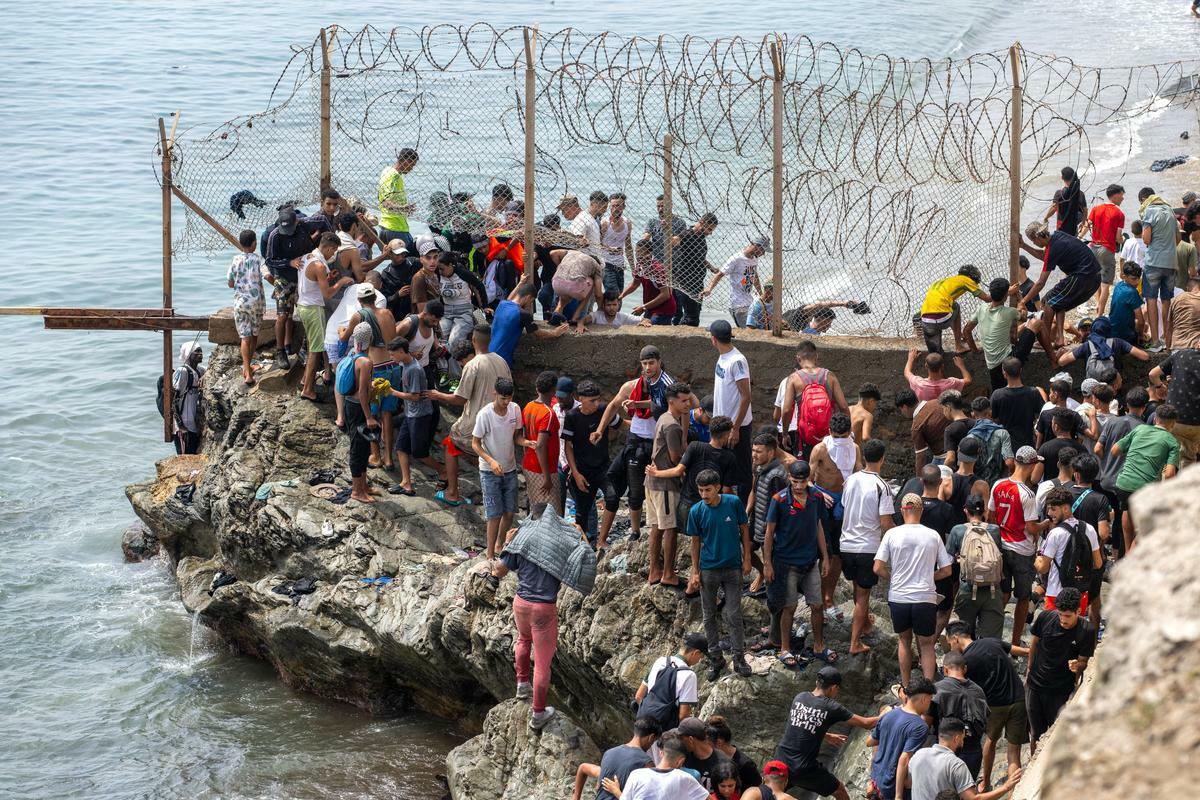
Against an increasingly tense backdrop came the Ceuta crisis: the invasion of more than seventy thousand mostly young men, tolerated as a triviality by the Spanish government – initially portrayed by the mainstream media, in a desperate attempt, as a kind of party invasion, later as a wave of poverty migration, and finally, with some reluctance, as an organized and aggressive political act. In the end, one sober conclusion remains: The European Union has no effective border protection whatsoever. Its organization Frontex is a band-aid, hastily stuck onto the gaping wound of a migration policy that, in reality, has made mass migration a goal of the left-wing consensus.
Spain’s Prime Minister Pedro Sánchez is one of the leading proponents of the EU’s political mainstream. The socialist, whose government only a few weeks ago registered 1.3 million applications to legalize immigrants residing illegally in the country – more than twice as many as originally expected – has also accepted a ruling by the Supreme Court that has effectively turned the sea route into a safe route to Spain: Only those who forcibly cross border fences may be sent back; anyone who lands by boat already enjoys state privileges. Sánchez has become a bridgehead for illegal migration into the EU – a Merkel multiplier, if you will.
At least we now have clarity: The Ceuta crisis exposes the dividing line between the socialists in the EU and the slowly but surely emerging national-conservative front.
What happened? During the night of July 31, around 72,000 people, most of them young men, crossed the border from Morocco into the Spanish enclave of Ceuta. According to Spanish figures, around 70,000 of them left the territory again within a few days – officially “voluntarily.” Madrid described the situation as being under control; in reality, it was a capitulation to sheer numbers.
The Spanish government’s complete failure caused considerable anger, particularly in Rome. Italian Prime Minister Giorgia Meloni reacted on the very day of the chaos and suspended the Schengen Agreement with regard to Spain. She spoke of shocking images from Ceuta and announced via X that Italy would not stand idly by and would, if necessary, take extraordinary measures to protect its own country from negative consequences. Her Foreign Minister Antonio Tajani ultimately implemented the closure of the Schengen area to Spain, citing the threat to national security.
A reaction from Madrid was not long in coming. One week later, on August 9, Spain turned the tables and has since been carrying out checks on travelers arriving from Italy at internal borders, ports and airports – officially, the measure is limited until September 7. The justification is cynical, if not comical, given that it comes from Spain, Europe’s migration chaos country: Persistent pressure from irregular migration from Italy had prompted the response, the government in Madrid announced.
Meloni seized the opportunity and, together with Denmark’s Social Democratic Prime Minister Mette Frederiksen, initiated an open letter to the EU institutions, signed by 22 member states, calling for a coordinated response to illegal migration and stronger EU external borders. The message from the two politicians: They will not accept uncontrolled migration into Europe and are themselves now pursuing a stricter immigration policy.
The two politicians may thus be outlining the one viable option for the future of the European Union: A jointly financed and highly professional system for protecting the EU’s external border would be one of its pillars alongside a deregulated internal market – external security and free competition within. The EU could be placed on a new foundation if it concentrated on its core responsibilities and abandoned the moralizing path of ever-growing bureaucracy. For now, however, national law stands in the way.
The socialist Sánchez will do everything he can, much like the German government, to ensure that the flow of migration does not stop. Too much is at stake: new voter potential and the conviction of the united Left that, in a globalized world, no national cultural enclaves should be tolerated. It is the heartfelt concern of all those on the Left to whom, significantly, Angela Merkel – politically socialized in East Germany – gave voice and political expression.
The dispute over Ceuta describes the dividing line between the socialist forces within the EU and the emerging national conservatives, whose informal spokesperson appears to be Italy’s prime minister. Certainly, the electoral defeat of Hungarian Prime Minister Viktor Orbán was an important victory for supporters of open borders, mass migration and globalism. His successor, Péter Magyar, has since been working under enormous pressure to dismantle Fortress Hungary and bring the country back into the migration flow.
This does not change the fact that national-conservative voices are making themselves heard in almost every country of the European Union, demanding a return to reason, to European values and, above all, to a border regime that is known to be the very foundation of statehood: A state without borders is not a state, but a settlement zone, a product of chaos – a volatile entity that sinks into the waves of poverty and crime faster than even the Left could imagine.
* * *
About the author: Thomas Kolbe, born in 1978 in Neuss/ Germany, is a graduate economist. For over 25 years, he has worked as a journalist and media producer for clients from various industries and business associations. As a publicist, he focuses on economic processes and observes geopolitical events from the perspective of the capital markets. His publications follow a philosophy that focuses on the individual and their right to self-determination.
Tyler Durden
Thu, 08/13/2026 – 03:30