90.4 F
Chicago
Wednesday, July 1, 2026
Home Blog Page 51

G7 Protesters Smash Windows, Set Tesla On Fire In Geneva

G7 Protesters Smash Windows, Set Tesla On Fire In Geneva

Authored by Chris Summers via The Epoch Times,

Protesters smashed windows at a United Nations agency and set fire to a Tesla vehicle on June 14 during a protest march in Geneva, Switzerland, against the holding of the G7 summit, just across the border in the French town of Evian-les-Bains.

A Tesla car burns during a protest against the G7 summit, across the border in France, in Geneva, Switzerland, on June 14, 2026. Denis Balibouse/Reuters

Around 20,000 people took part in the march that was largely peaceful, according to police, who also said they confiscated a number of knives and pyrotechnic devices.

U.S. President Donald Trump is among the leaders attending the June 15-17 summit, which is being protected by a high-security cordon following an agreement between the French and Swiss governments.

The June 14 march was organized by the so-called NoG7 coalition, which has posted a list of “internationalist demands” on its blog, which include ending trade relations with Israel, dismantling U.S. military bases in Europe, and dissolving the G7 organization.

Several of the demonstrators said the G7 was a symbol of the world’s wealthiest countries.

To me, it’s a meeting of the rich that shows once again how the rich can become even richer while the poor are left behind,” Pippa Saugy, one of the protesters, said.

The Swiss government has deployed 4,000 soldiers to support the police, while France has sent more than 13,000 police and gendarmerie officers to secure the summit.

One of the protesters, Mattia Piccard, said he resented the large police presence on June 14.

This is an attempt to frighten demonstrators, to frighten people and discourage them from coming out to protest,” Piccard said.

Geneva resident Susanne Haldemann said she felt sad for the owner of the burned Tesla, who had probably worked hard to pay for it.

She said it was unfair that he should pay for “this anger and that frustration” of people, especially the younger generation.

Yann Smid, who works in Geneva, said people in the city had been braced for protests.

“People know that if Geneva plays a very important role, there would be protests, and it happened in the past,” Smid said. “I think they are used to it, and obviously it’s just a question of disruption.”

The French and Swiss authorities have imposed restrictions on border crossings, and, apart from the June 14 march, which was authorized, there is a ban on public gatherings in Geneva.

Trump will join the leaders of France, Germany, Japan, the UK, Canada, Italy, and the European Union at the summit.

The agenda is expected to include global trade, immigration, geopolitical conflicts, and other key issues, although the official G7 website states that the program still has not been finalized.

The French Foreign Ministry says more than 110,000 people commute across the border every day to work in Geneva, and last week it said the number of French border control officers was being increased from 60 on a normal day to 800.

Airspace Restrictions, Road Closures

There will be airspace restrictions, patrols on Lake Geneva, and road closures. Only seven of the 35 highway border crossings will be open.

In 2003, when the G8 summit was held in Geneva, dozens of storefronts were vandalized by anti-globalization protesters.

Storefronts in Geneva, just over the border in Switzerland, were boarded up last week, and the World Trade Organization, which was targeted in Seattle in 1999, closed its offices and told staff to work from home until the summit is over.

France and Switzerland have agreed to a military cooperation agreement in the run-up to the summit, and G7 leaders will arrive at Geneva’s international airport – which is in Switzerland but almost surrounded by French territory – before crossing the border to Evian-les-Bains under heavy security.

Residents of Evian-les-Bains, known for its bottled water, have been given special access permits, and the zone around the Hotel Royal, where the summit will take place, will be cordoned off.

People hold a protest against the G7 summit, in Geneva, Switzerland, on June 14, 2026. Umit Bektas/Reuters

Tyler Durden
Mon, 06/15/2026 – 09:45

US Industrial Production Disappoints In May

US Industrial Production Disappoints In May

Despite strong ISM Manufacturing data, US Industrial Production disappointed in May, rising just 0.1% MoM (vs +0.3% exp), but April’s print was revised up to +0.9% MoM. Put together, that lifted the YoY rise in industrial production to +1.67% – its highest since Nov 2025

Manufacturing excluding motor vehicles and parts was also flat in May, according to the Fed report.

Mining output, which includes energy extraction, increased 1.3%.

Utilities output fell.

US Manufacturing production was unchanged in May (below the 0.3% rise expected), but thanks to an upward revision, the YoY rise was +1.4%, the highest since Nov 2025…

May’s flat-line comes after four months of gains to start the year.

The data showed a split between durable goods manufacturing, which continued to advance, and nondurable goods manufacturing, which declined.

That decrease reflected a pullback in output for petroleum and coal products, plastics and rubber, and textiles.

And finally, on the bright side, Capacity Utilization continues to rise, now at its highest in a year…

The report is somewhat at odds with signals from recent surveys, which have indicated a pickup in activity amid customer stockpiling induced by the war, rising defense-related orders and the ongoing data center buildout.

Monday’s figures may be a sign that surging costs are starting to bite after a separate report last week showed prices received by producers rose in May from a year earlier at the fastest pace since 2022.

Taken all the above, we see this as favoring the doves very modestly.

Tyler Durden
Mon, 06/15/2026 – 09:20

“This Chart Should Stop You Cold In Your Tracks”

“This Chart Should Stop You Cold In Your Tracks”

Submitted by QTR’s Fringe Finance

One of my favorite contrarian analysts to read posted a great thread this week noting what he sees as one of the most overlooked risks facing U.S. equities in 2026.

Gordon Johnson argues that an unprecedented wave of equity issuance could overwhelm available investor capital. In a great thread on X, Johnson, of GLJ Research, argued that investors should not interpret the current IPO boom as a sign of market strength.

Instead, he contends that history suggests record issuance periods often occur near major market peaks, when companies and insiders are most eager to sell stock into highly favorable conditions.

“This chart should stop you cold in your tracks.”

— Gordon Johnson, GLJ Research

His argument begins with a striking statistic. According to Johnson, 2026 U.S. IPO proceeds for operating companies are on pace to reach roughly $200 billion, exceeding the combined totals of both 1999 and 2000 during the dot-com era and far surpassing the approximately $119 billion raised during the speculative peak of 2021.

Rather than viewing that figure as bullish, Johnson sees it as a warning signal. In his view, record levels of stock issuance have historically coincided with excessive optimism and have often preceded periods of poor market performance.

Johnson argues that the headline IPO figures actually understate the scale of what is occurring. IPOs represent only one category of equity issuance. He notes that companies are also raising capital through follow-on offerings, at-the-market programs (ATMs), and secondary share sales.

We all know about the large AI-related equity raises that have been announced over the last two weeks: Alphabet’s $84.75 billion offering, Meta’s proposed multi-tens-of-billions stock raise, Oracle’s roughly $20 billion equity component within its broader financing plan, and Super Micro Computer’s $7 billion equity and equity-linked financing.

He argues that when these are added to the IPO pipeline, the total amount of stock being sold to investors becomes significantly larger than the official IPO statistics suggest:

With SpaceX, then OpenAI, then Anthropic stacking up, the pipeline points to ~$100B/month hitting the tape over the next 3–4 months. Now the only question that matters: who absorbs it?

Here’s the cash on the other side. US personal savings rate: 2.6% of ~$17.93T disposable income. That’s ~$39B/month of new savings — for the ENTIRE country.

You cannot soak up ~$100B/month of stock with ~$39B/month of cash. The math doesn’t math.

Put it in scale. ~$100B/month of issuance ≈ the entire US savings rate (~$1T/yr). SpaceX alone ~$80B. Then OpenAI. Then Anthropic. Then what? This doesn’t “attract” capital. It DRAINS the market of cash — one mega-deal at a time.

The heart of Johnson’s thesis centers on a basic supply-and-demand question: where will the money come from?

His broader point is that equity issuance does not magically create demand. Instead, he argues that large offerings require investors to redirect existing capital. Every dollar committed to a new IPO or secondary offering is a dollar that cannot be deployed elsewhere in the market. Under this framework, mega-deals do not attract new money so much as compete for a limited pool of available capital, potentially draining liquidity from existing stocks.

Johnson believes many investors are currently positioned for a strong second half of 2026, expecting enthusiasm surrounding artificial intelligence and high-profile technology offerings to drive markets higher. He takes the opposite view. In his analysis, the sheer volume of stock supply could become a headwind for equity prices. When supply grows faster than demand, he argues, prices often become the mechanism that restores balance.

Johnson notes that, with regard to the SpaceX IPO, certain institutional barriers appear to have been lowered ahead of the offering. Specifically, he points to Fidelity’s reported reduction of account minimum requirements and Nasdaq’s decision to shorten the waiting period before index eligibility. Johnson sees these changes as evidence that market participants are attempting to broaden the pool of potential buyers ahead of what could become one of the largest IPOs in history.

Johnson argues that if SpaceX enters major indexes shortly after listing, passive investment vehicles could be forced to purchase large amounts of stock regardless of valuation. He estimates that index funds tracking the Nasdaq 100 may eventually need to buy tens of billions of dollars worth of shares. In his interpretation, sophisticated investors may seek to position themselves ahead of that demand by raising cash before the IPO and purchasing shares after index-related buying begins.

Johnson describes this as distribution rather than wealth creation.


🔥 80% Off If You Subscribe Today. This coupon allows for 80% off of annual subscriptions and results in a 85% savings over paying the monthly rate for a subscription to the blog. You keep the discounted rate for as long as you wish to remain a subscriber.: Get 80% off forever


He argues that history offers several examples in which insiders used periods of intense investor enthusiasm to sell stock at elevated valuations. He specifically references the dot-com boom of 2000 and the SPAC-driven speculation of 2021 as periods when large amounts of equity were sold to public investors shortly before significant market declines.

Underlying the entire thread is Johnson’s central historical claim: large-scale equity issuance has consistently been a bearish signal for stocks. He points to the record issuance environment of 2021, which was followed by weakness later that year and a severe bear market in 2022. While he acknowledges that today’s circumstances are different in many respects, he believes the relationship between supply and demand remains unchanged.

For Johnson, the key question facing investors is not whether high-profile companies such as SpaceX, OpenAI, or Anthropic are exciting businesses. Rather, it is whether the market has sufficient capital to absorb an extraordinary amount of new stock issuance without putting pressure on existing asset prices.

His conclusion is straightforward: investors should approach the coming wave of offerings with caution. Record issuance, in his view, is not evidence of unlimited demand. It may instead be a sign that companies and insiders believe current market conditions are an attractive time to sell.

QTR’s Disclaimer: Please read my full legal disclaimer on my About page hereThis post represents my opinions only. In addition, please understand I am an idiot and often get things wrong and lose money. I may own or transact in any names mentioned in this piece at any time without warning. Contributor posts and aggregated posts have been hand selected by me, have not been fact checked and are the opinions of their authors. They are either submitted to QTR by their author, reprinted under a Creative Commons license with my best effort to uphold what the license asks, or with the permission of the author.

This is not a recommendation to buy or sell any stocks or securities, just my opinions. I often lose money on positions I trade/invest in. I may add any name mentioned in this article and sell any name mentioned in this piece at any time, without further warning. None of this is a solicitation to buy or sell securities. I may or may not own names I write about and are watching. Sometimes I’m bullish without owning things, sometimes I’m bearish and do own things. Just assume my positions could be exactly the opposite of what you think they are just in case. If I’m long I could quickly be short and vice versa. I won’t update my positions.

As of May 20, 2026 I personally no longer actively trade (read my story here). My investing/saving is done by recurring contributions mostly to sector ETFs and a few select equities, trusted third parties who oversee my accounts, and advisors. Such advisors or funds, through individual equities, options, index funds, mutual funds, ETFs, or other securities, may have positions in, exposure to, or holdings of names mentioned herein that I know nothing about. Basically, via index funds, ETFs and individual equities it is possible I could own, have exposure to, or not own anything at any point. As of the same date, May 20, 2026, in an attempt to lead a healthier lifestyle, I’ve also excluded myself from fantasy sports, sports betting, online and in-person casinos and prediction markets.

And all positions can change immediately as soon as I publish this, with or without notice and at any point I can be long, short or neutral on any position. You are on your own. Do not make decisions based on my blog. I exist on the fringe. If you see numbers and calculations of any sort, assume they are wrong and double check them. I failed Algebra in 8th grade and topped off my high school math accolades by getting a D- in remedial Calculus my senior year, before becoming an English major in college so I could bullshit my way through things easier.

The publisher does not guarantee the accuracy or completeness of the information provided in this page. These are not the opinions of any of my employers, partners, or associates. I did my best to be honest about my disclosures but can’t guarantee I am right; I write these posts after a couple beers sometimes. I edit after my posts are published because I’m impatient and lazy, so if you see a typo, check back in a half hour. Also, I just straight up get shit wrong a lot. I mention it twice because it’s that important.

Tyler Durden
Mon, 06/15/2026 – 09:05

VP Vance Confirms Hormuz Strait To Reopen ‘Toll Free’, Says ‘Israel Has Seat At Table’

VP Vance Confirms Hormuz Strait To Reopen ‘Toll Free’, Says ‘Israel Has Seat At Table’

Summary:

  • Vice President JD Vance Begins Optics Roadshow to Boost Investor Confidence On Deal 
  • Iran Offers 60-Day Toll-Free Hormuz Transit As 100s Of Ships Await Reopening

VP Vance

Not even 24 hours after President Trump declared a peace deal with Iran to reopen the Strait of Hormuz, and just 30 minutes before New York futures opened Sunday evening, the administration already had Vice President JD Vance beginning a media roadshow to calm investor nerves and boost confidence.

Vance began the Monday roadshow on CNBC, providing more details on the U.S.-Iran deal, as uncertainty is the market’s worst fear.

Vance said the U.S.-Iran deal is moving ahead despite what he called MSM “misreporting.”

The agreement is fundamentally built around a two-step verification process,” Vance told the outlet, adding that Israel will have a seat at the table. Vance also stated that all Iranian government factions are represented in the talks, with several Iranian representatives expected at Friday’s signing ceremony.

On the Hormuz maritime chokepoint, Vance said the strait is already seeing increased traffic and is expected to remain open toll-free over the long term, not just temporarily. He added that Iran would need resources to rebuild, but those resources would not be available without a nuclear deal.

Summary of discussion via CNBC

Vice President JD Vance on Monday said after the U.S. and Iran struck a preliminary deal that there are “a lot” of details that remain to be ironed out, but he expressed confidence that America has “all the cards” in subsequent talks.

The agreement reached Sunday would extend the U.S.-Iran ceasefire for 60 days and set up a framework for future negotiations about Tehran’s nuclear program and other key issues.

The text of the preliminary deal has yet to be released. Vance, on CNBC’s “Squawk Box” Monday morning, said the deal’s two major prongs are reopening the Strait of Hormuz and clinching a long-term commitment that Iran will never develop a nuclear weapon.

He indicated that if Iran abides by the deal’s commitments, it will be rewarded with loosened economic sanctions or other barriers, allowing Tehran “to be reinvited into the world economy.” 

Vance is also expected to join CBS Mornings to discuss the U.S.-Iran peace deal. It is likely that Fox Business and other outlets will follow, as the administration must repair any political damage from four months of war with Iran, which created uncertainty on Wall Street and sent the national average for gasoline prices above $4 per gallon for 2.5 months.

Let the roadshow begin… 

Iran Offers 60-Day Toll-Free Hormuz Transit As 100s Of Ships Await Reopening

The U.S. and Iran reached an interim agreement to reopen the Strait of Hormuz on Sunday evening, just 30 minutes before New York futures opened, with officials from both countries set to meet in Switzerland on Friday to formally sign the peace deal.

According to Iranian outlet Fars, the U.S.-Iran deal reportedly includes a 60-day toll-free window for vessels. After that period, if a more permanent deal is agreed upon, Tehran may seek to monetize the Hormuz chokepoint by charging commercial vessels for “services” tied to safety, navigation, environmental protection, and insurance.

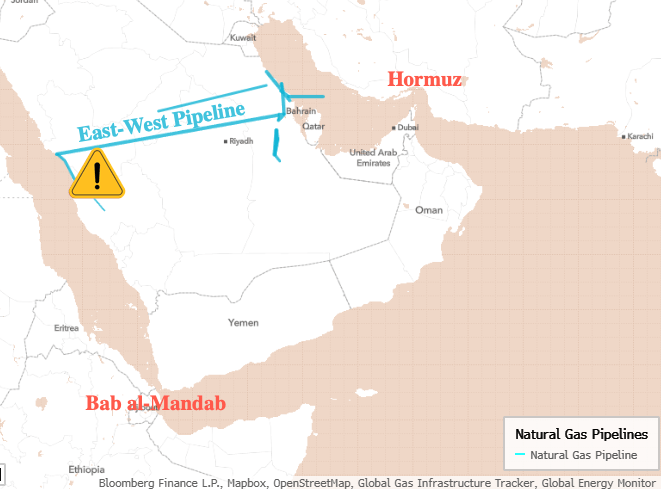
Traffic on the Strait remains light on Monday morning, with hundreds of tankers waiting for the Hormuz waterway to officially reopen by the end of the week. But LNG tanker Disha did not wait for the formal opening and made a dash to exit the strait early Monday.

There are nearly 300 loaded vessels idling in the Persian Gulf, while a similar number of empty ships are waiting in the Gulf of Oman to return to export terminals. Another 250 ballast vessels inside the Gulf are ready to pick up cargoes if outbound flows resume.

The reopening could release millions of barrels of trapped oil and restart LNG flows, but normalization of energy flows back to pre-war levels could take many months, if not quarters, and for Qatar’s sake, years.

“From the bridge and the engine room where we’re sitting, right now it looks very different to what the headlines may say,” said Angad Banga, CEO of maritime conglomerate The Caravel Group, which owns Fleet Management Limited, one of the world’s largest ship management companies.

Banga told Bloomberg that it has several crews trapped in the Persian Gulf area, adding, “We’ve seen positive signals before, and I think ultimately what matters is what holds.”

Anoop Singh, global head of shipping research at Oil Brokerage Ltd, told the outlet, “Shipowners are on a risk spectrum — the Japanese, Koreans and Chinese are less open to high risk, while the Greeks have a different appetite — so we may see some people gearing up.”

Singh noted, “But by and large the rest of the market is still seeking more details and assurance before proceeding.”

Beyond the shipping industry, on Wall Street, UBS economist Arend Kapteyn told clients earlier this morning that “the test will be how quickly and to what extent the Strait of Hormuz reopens. Early indications suggest this may depend on Iran clearing naval mines over an initial 30-day period. But taken at face value, the news should be supportive for risk assets, pushing yields, oil and the US dollar lower, while equities move higher.”

Latest Hormuz trends via Kepler Cheuvreux shipping analyst Axel Styrman:

Daily arrivals at the Strait of Hormuz in 2026

Global trade & capacity trapped/waiting as of 22 May

Daily arrivals, Strait of Hormuz, # of ships per segment

Crude Exports and destination via the Strait of Hormuz

LNG Exports and destination via the Strait of Hormuz

LPG exports and destination via the Strait of Hormuz

Shipping Stocks To Watch

Professional subscribers can read much more about the Hormuz chokepoint on our new Marketdesk.ai portal

Tyler Durden
Mon, 06/15/2026 – 09:00

Anduril CEO Urges U.S. Arms Export Reset To Become World’s Gun Store

Anduril CEO Urges U.S. Arms Export Reset To Become World’s Gun Store

Anduril founder Palmer Luckey has called for critical resets across defense procurement, manufacturing, innovation, and national identity.

Luckey’s defense startup, valued at over $60 billion, is one of the key forces reshaping America’s military power through low-cost, automated systems that can be manufactured and reproduced at scale, from autonomous weapons and AI fighter jets to drones for the modern battlefield.

America’s hollowed-out industrial base is being rebuilt through President Trump’s reshoring push and other domestic policies designed to expand the war economy. This leads us to the latest comments from Anduril CEO Brian Schimpf.

Schimpf spoke with the Financial Times about the urgent need for a “reset” of America’s strict arms-export regime to make it easier for allied nations to produce and deploy U.S. weapons.

“There is an ‘export control reset that needs to happen,’ with other countries contributing to the total supply,” Schimpf said in the interview.

Schimpf said Cold War-era International Traffic in Arms Regulations (ITAR) are slowing the West’s ability to mass-produce low-cost weapons at scale. Simply put, ITAR determines who can receive U.S. weapons, military software, technical data, and know-how, and under what conditions.

He noted that the “ability to produce is probably the biggest deterrent gap that we have as a Western alliance, and having nations contribute to that—not just buying, but actually participating in production—is actually a very good thing.”

Schimpf added that producing U.S.-origin weapons abroad could benefit allies, as they could tailor them to their own needs.

The problem that Anduril appears to be identifying is that maintaining America’s military edge over the decades relied on tightly controlling the flow of weapons and technical data abroad. But in the era of low-cost drones, ground-bots, and AI kill chains, those same systems have become a bottleneck, limiting allied co-production, slowing deployment, and weakening the West’s ability to ramp up production and ship at wartime scale.

Schimpf told FT that there have been emerging signals of openness for an “export-control reset” in the Trump administration. President Trump announced plans in February to reset the arms trade regime.

This comes as Luckey recently told CBS News’ Bari Weiss that America must become “the world’s gun store.”

It also comes as Anduril has begun initial production activity in Ohio, starting with its Fury high-speed combat drone at the Arsenal-1 site near Columbus, and is considering a European Arsenal-2 facility as it expands overseas.

The wars stretching across Eurasia and the Middle East, from Ukraine and Russia to the U.S. and Iran, have drawn down critical Western weapons stockpiles to dangerously low levels. There is now an urgent need to rebuild stockpiles of critical weapons while adding new stockpiles of emerging systems, such as one-way attack drones, loitering munitions, and other next-generation weapons

Tyler Durden
Mon, 06/15/2026 – 06:55

Watch: Korean Humanoid Robot Performs Viral K-POP Dance, Learns By Watching Videos

Watch: Korean Humanoid Robot Performs Viral K-POP Dance, Learns By Watching Videos

Authored by Jijo Malayil via Interesting Engineering,

While China dominates humanoid robotics headlines, a Korean firm showcased a humanoid learning complex motions through an open-source AI framework.

AI Sapiens enables a complete pipeline for imitation learning, covering data collection, training, and inference. ROBOTIS/YouTube

In a recent demonstration, ROBOTIS’ AI Sapiens learned the famous CORTIS REDRED Challenge motion using only smartphone video, eliminating the need for professional motion-capture systems.

The process combined video-based motion capture, motion retargeting, simulation-based reinforcement learning, and Sim2Real transfer.

According to the firm, the demonstration highlights how open-source tools can simplify humanoid robot training, enabling users to generate, learn, and execute full-body motions more easily.

Humanoid Learns Motion

ROBOTIS has demonstrated the capabilities of its AI Sapiens humanoid robot, an open-source platform for physical AI powered by DYNAMIXEL-Q actuators. The project is designed to make humanoid robot motion learning more accessible by using widely available hardware and open-source software tools.

In the demonstration, AI Sapiens learns and performs a complex full-body motion known as the CORTIS REDRED Challenge. Instead of relying on expensive professional motion-capture systems, the robot learns the movement from video recorded using a standard smartphone camera. This significantly reduces the cost and complexity of collecting training data for humanoid robots.

The motion-learning process begins with video-based motion capture. Human movements recorded on a smartphone are converted into digital motion data that can be processed by software. The captured motions are then passed through a motion retargeting stage, where the human movements are adapted to match the physical structure and joint limitations of the humanoid robot.

After retargeting, the robot is trained in a simulation environment using reinforcement learning. During this stage, the AI repeatedly practices the motion in a virtual world, allowing it to improve balance, coordination, and movement accuracy without risking damage to physical hardware. Simulation training also enables rapid testing and optimization before deploying the motion to the real robot.

Once training is complete, the learned behavior is transferred from simulation to the physical AI Sapiens robot through a Sim2Real pipeline. This process helps ensure that motions developed in the virtual environment can be executed successfully in the real world, despite differences between the simulation and the physical hardware.

Accessible AI Robotics

ROBOTIS plans to release the motion generation and learning pipeline as open-source software, giving researchers, developers, educators, and hobbyists access to the tools used in the demonstration. The goal is to lower barriers to humanoid robotics development and enable a wider community to experiment with motion learning and physical AI systems.

According to ROBOTIS, AI Sapiens is a fully open-source humanoid robot platform designed for physical AI research and development. Standing 1.3 meters tall and weighing 34 kilograms, the robot features 23 degrees of freedom across its body, enabling a wide range of human-like movements.

The platform is powered by 23 next-generation DYNAMIXEL-Q quasi-direct-drive (QDD) actuators, including 14 QM-060 units and 9 QM-080 units. These actuators combine low gear reduction ratios, high-torque motors, and integrated control electronics to deliver high backdrivability, low impedance, and precise torque control, making them suitable for dynamic and compliant humanoid motion.

AI Sapiens is powered by an NVIDIA Jetson Orin NX 16GB computer, delivering up to 100 TOPS of AI performance for advanced robotics tasks. It supports Wi-Fi 5, Bluetooth 5.0, dual Ethernet ports, USB connectivity, and 24V/12V power outputs for connecting additional hardware.

The robot is powered by a 46.8V, 9000mAh battery. It is supported by a fully open-source ecosystem that includes hardware bills of materials, CAD files, source code, simulation assets, and development tutorials, enabling researchers and developers to customize and expand the platform.

Tyler Durden
Mon, 06/15/2026 – 06:30

Pump Pain Relief? Gas Above $4 May End Soon As U.S.-Iran Peace Deal Sends Oil Lower

Pump Pain Relief? Gas Above $4 May End Soon As U.S.-Iran Peace Deal Sends Oil Lower

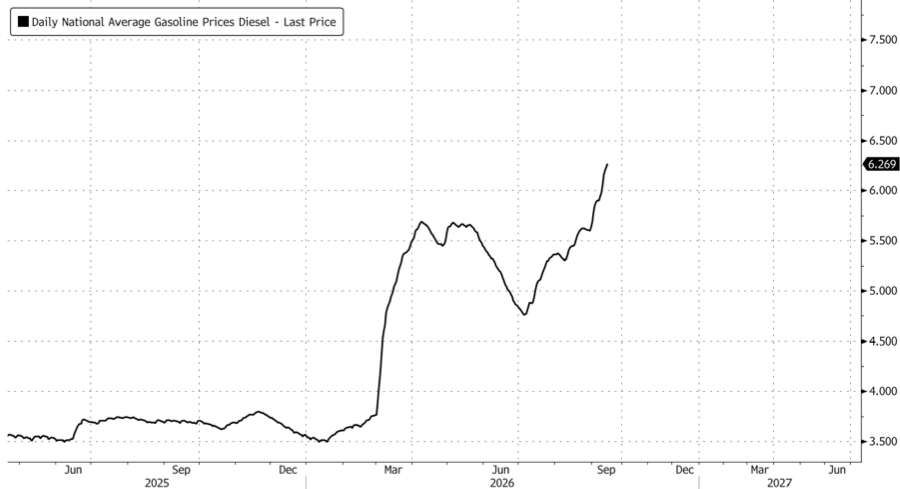
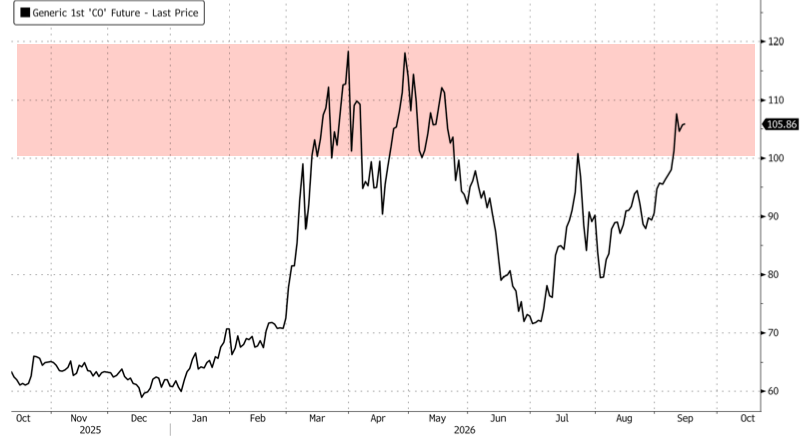
The national average for U.S. gasoline prices has hovered above the politically sensitive $4-per-gallon level for 76 days, or roughly 2.5 months, as the Gulf energy shock tightened physical markets and forced emergency SPR draws.

But with President Trump declaring late Sunday, just 30 minutes before NY futures opened, that a US-Iran peace deal has been secured, and with WTI and Brent futures tumbling, pressure at the pump could begin to ease in the very near term.

National gasoline prices could slip back below $4 in the coming days or weeks if the crude selloff holds and traders begin pricing in a reopening of the Strait of Hormuz. Still, normalization of crude energy flows will likely take months, if not longer, to return to pre-war levels.

As of Sunday evening, AAA data show the national average for 87-octane gasoline stands at around $4.074.

Patrick De Haan, a petroleum analyst at GasBuddy, wrote on X shortly after Trump announced the peace deal that the national average for gas could fall to $3.75 by July 4.

De Haan wrote:

The U.S. and Iran signaling a deal has been struck. The next few days will be key to see if the agreement sticks, and if traffic begins moving in the Strait. WTI crude down 5%, as more confirmations come in days ahead, national average price of gasoline may continue to fade.

Beyond that, the national average could fall below $3.75/gal by July 4, under a optimistic timeline, but hurricane season could be a major wildcard for the rest of summer- tight global inventories mean it will take months or beyond to fully restore global oil inventories.

The next several weeks will be key- one major slip up could impact greatly prices moving forward. And with so many speedbumps in this situation, it may be foolish to think this problem is now completely over. Time will tell.

Surging gas and diesel prices over the last 2.5 months have added downward pressure on consumers, especially working-class households, who were hit with sticker shock at the pump. This shift in spending patterns is a concerning trend we have meticulously detailed:

The combination of elevated gas prices and fading tax-refund tailwinds had already begun to expose cracks in the consumer economy, particularly among lower- and middle-income households. That likely served as a warning signal for the Trump administration: resolve the Middle East conflict before worsening consumer sentiment and pain at the pump become much larger political liabilities heading into the midterms.

Tyler Durden
Mon, 06/15/2026 – 05:45

Exposed: UK Govt Has A ‘Thought Police’ Unit To Control Mass Migration Narrativ

Exposed: UK Govt Has A ‘Thought Police’ Unit To Control Mass Migration Narrativ

Authored by Steve Watson via Modernity,

A secretive Home Office propaganda outfit founded by a former MI6 officer is actively working to control narratives around incidents involving migrants and rising tensions, a bombshell report reveals.

The Research, Information and Communications Unit, or RICU, has been exposed advising police on how to portray protesters and intervening in the aftermath of brutal attacks by migrants to prevent statements that might inflame public anger over mass immigration failures.

This comes as fresh confirmation of suspicions raised after the attack on vulnerable special needs man Stephen Ogilvie in Belfast. Sources now confirm the unit’s role in managing family liaison and messaging in such cases. The pattern fits a broader shift where government “nudge” operations once focused on enforcing COVID compliance have pivoted to shielding open borders policies from scrutiny – and are now being hardened into formal crisis powers.

The Daily Mail reports that RICU was set up in 2007 by the late Charles Farr, a former MI6 officer, under the Prevent counter-terrorism banner. It operates from Home Office headquarters and draws on tactics from the old Information Research Department, the post-war propaganda unit used to counter communist influence.

Its methods include planting media stories, deploying undercover operatives, and shaping online conversations in targeted communities.

Recent operations show the unit extending far beyond its original remit. During unrest in Belfast following the stabbing attack on Stephen Ogilvie by Sudanese asylum seeker Hadi Alodid, RICU worked with the Police Service of Northern Ireland’s C3 intelligence unit.

A source described the effort: “They are working with the Police Service of Northern Ireland’s C3 intelligence unit to identify those posting the online ‘calls to protest’ in Belfast and other areas, as well as giving strategic messages to the police to ensure that the protesters were portrayed as unsympathetic thugs, rather than activists, and effecting behavioural change.”

The same source noted RICU’s involvement with family statements in volatile incidents. “RICU made sure that the liaison team dealing with the family were well briefed.” Another observation: “You can see their fingerprints all over the statements released by the families of victims in these volatile situations – they usually have a similar tone.”

This aligns with what was noted right after the Belfast incident. The family statement released in the wake of the attack on Stephen Ogilvie came across as oddly generic and scripted, using placeholder phrasing such as “our loved one” and quickly pivoting from shock to calls for calm plus emphasis on migrants’ contributions rather than raw, unfiltered grief or pointed questions about what had happened. It did not read like the spontaneous words of devastated relatives.

The Mail also notes that RICU was involved with the aftermath of the murder of Henry Nowak by Vickrum Digwa, again providing strategic input to police handling the family.

The interventions align with long-standing criticisms that RICU applies uneven standards. Sir William Shawcross, in his 2023 review of Prevent, observed: “The bar for what RICU includes on Islamism looks to be relatively high, whereas the bar for what is included on the extreme Right-wing is comparably low.”

The unit has flagged mainstream cultural consumption – watching Michael Portillo’s programmes, reading Shakespeare, Chaucer or Milton, or books documenting grooming gang scandals – as potential indicators of far-Right susceptibility. It even linked Sir Jacob Rees-Mogg to sympathetic audiences.

Professor Anthony Glees described the outfit’s position: “The unit that produced this report is called RICU. It’s based in the Home Office but it’s in that kind of shadowy area between what the Home Office does and what the security service MI5 ought to be doing.”

A Home Office spokesman offered the standard line: “RICU provides analysis on extremist use of propaganda and exploitation of the internet to inform the UK’s counter terrorism system. We cannot comment on its operations.”

The unit has pushed for expanded recording of non-crime hate incidents, measures later scrapped after public backlash over their chilling effect on ordinary speech. It has also claimed that discussion of grooming gangs in Pakistani communities is exploited by the far-Right to stir hatred.

This is not isolated activity. Government narrative management operations have multiplied. A 2025 examination detailed how teams such as the National Security and Online Information Team monitor “concerning narratives” on social media and flag material to platforms for removal, particularly content critical of migration policy during periods of unrest.

An elite police unit tracks anti-migrant posts. Officials stated they make “no apologies for flagging to platforms content which is contrary to their own terms of service and which can result in violent disorder on our streets.”

The same infrastructure that once deployed propagandistic fear tactics to drive mass compliance during the COVID period has been repurposed. What began as emergency messaging around a virus has evolved into tools for managing public reaction to the consequences of sustained high immigration and associated crime.

We have also seen the Prevent apparatus targeted firmly at British people, and even children, who have expressed concern about mass migration.

This apparatus is also now being formalised and expanded under the banner of “crisis response.” In the wake of the Belfast unrest sparked by the attack on Stephen Ogilvie, ministers have moved to give Ofcom sweeping new authority under the Online Safety Act to pressure platforms into rapid removal of content labelled “false information” or inciting disorder during declared crises.

Technology Secretary Liz Kendall announced the government will “lay in Parliament an update to the Online Safety Act requiring services to take quicker action to remove illegal content circulating during times of crisis.”

Ofcom has already issued open letters to platforms citing spikes in content tied to the Northern Ireland events and demanding enhanced, crisis-specific moderation measures – without requiring fresh parliamentary approval.

The definition of “crisis” is deliberately broad, drawing on the Civil Contingencies Act 2004 and covering threats to welfare, security or public order. This builds directly on the informal narrative-shaping RICU has conducted for years, now also augmented by a new £115 million PoliceAI centre equipped with live facial recognition, predictive analytics and automated real-time content flagging.

Former Prime Minister Liz Truss directly addressed the underlying dynamic. She stated that mass migration “is being weaponised to undermine Western civilisation.” Truss continued: “They want to undermine the family. They want to undermine the nation state. And people in Britain are saying ‘we’ve had enough of this.'”

She added that institutions have been corrupted by a DEI mentality focused on group outcomes rather than equal treatment under law, with the response being suppression of discussion and attacks on those highlighting the role of mass migration.

The through-line is clear. Legitimate public concern over policy outcomes – crime rates, community cohesion, strained services – is reframed as dangerous extremism requiring state-managed behavioural change. Protesters become “thugs.” Family grief is shaped into generic calls for calm that emphasise migrant contributions.

Online speech is monitored and throttled. Cultural touchstones are recast as radicalisation risks when they appear on the “wrong” side of the narrative. Now “crisis” declarations provide the trigger to accelerate these controls with regulator muscle and AI tools.

This apparatus operates with minimal transparency and little accountability to elected representatives or the public whose taxes fund it. Critics inside Whitehall have described it as out of control. Its expansion from countering Al Qaeda propaganda into domestic speech management on immigration – and now into codified crisis powers – represents a fundamental shift toward treating British citizens’ unfiltered reactions as the primary threat.

Britain faces real pressures from decades of rapid demographic change and enforcement failures. Honest examination of those pressures does not equate to hatred. Suppressing that examination through coordinated narrative control only deepens distrust and guarantees that underlying problems fester.

Citizens retain the right to discuss the impacts of policy without state operatives scripting responses or directing police to rebrand dissent.

The revelations about RICU and the accelerating “Ministry of Truth” machinery confirm what many already sensed: the tools built for one set of emergencies have been turned inward to protect another set of political choices.

Restoring open debate and accountability requires dismantling these layers of managed perception and returning to straightforward governance that prioritises the security and cohesion of the existing population.

Tyler Durden
Mon, 06/15/2026 – 05:00

EU Auto Giants Call For ‘Made In Europe’ Incentives Amid Rising Chinese Competition

EU Auto Giants Call For ‘Made In Europe’ Incentives Amid Rising Chinese Competition

Europe’s largest automakers are stepping up efforts to secure stronger support for domestic vehicle manufacturing as competition from Chinese electric vehicle producers intensifies. Renault, Volkswagen, and Stellantis have jointly urged EU policymakers to introduce rules that more heavily reward cars developed and produced within Europe, according to FT.

The companies are advocating for a straightforward local content requirement under which vehicles sold as European would need to source the majority of their components from within the EU and closely associated European countries. They argue that industrial policy should encourage not only final assembly in Europe but also engineering, research, and product development activities.

FT writes that the proposal forms part of a broader European debate over how to rebuild industrial competitiveness while accelerating the transition to electric vehicles. The automakers are also seeking wider incentives for EVs manufactured in Europe, arguing that higher labor and energy costs put local producers at a disadvantage compared with rivals operating in lower cost regions.

Not all manufacturers support the plan. Several international carmakers have warned that a narrow definition of European content could exclude important suppliers and technology partners in countries such as Japan, the United Kingdom, and Turkey. Critics argue that stricter sourcing requirements could raise compliance costs and ultimately increase vehicle prices for consumers.

Battery production remains one of the most challenging aspects of the strategy. European manufacturers continue to rely heavily on supply chains dominated by Chinese companies, and industry leaders have called for a more gradual timeline to localize battery manufacturing capacity within Europe.

The debate reflects a broader shift in the global automotive industry over the past two years. Chinese carmakers have rapidly expanded their presence in international markets, supported by strong domestic scale, advanced battery supply chains, and increasingly competitive technology. European manufacturers, meanwhile, have faced slowing EV demand, rising production costs, and growing pressure to protect domestic industry. As Chinese brands continue to gain market share, policymakers in Brussels are increasingly balancing free trade principles against concerns over industrial competitiveness, strategic supply chains, and long term economic security.

Tyler Durden
Mon, 06/15/2026 – 04:15

Starmer To Ban Under-16s From 10 Social Media Apps, Including X, But Not Bluesky

Starmer To Ban Under-16s From 10 Social Media Apps, Including X, But Not Bluesky

Authored by Toby Young via DailySceptic.org,

Sir Keir Starmer is set to announce sweeping reforms tomorrow banning under-16s from 10 major social media platforms, including X, but not the Left-wing platform Bluesky.

In addition, he will introduce daily curfews for 16 and 17 year-olds, going further than Australia’s restrictions. The Times has the story:

Teenagers will be banned from certain social media platforms and have their daily usage curbed under sweeping reforms to be announced by Sir Keir Starmer on Sunday.

The ban will go further than the one imposed by Australia in December by targeting technology deemed harmful to children, including chatbots and certain features on gaming apps.

Under-16s in Australia have been banned from using ten platforms: TikTok, Instagram, Threads, Facebook, X, YouTube, Snapchat, Reddit, Twitch and Kick. It is understood that the UK will follow suit by raising the minimum age on social media to 16, from the average of 13, for the same ten sites.

Curfews for older teenagers will be introduced. Daily social media use will be restricted for 16 and 17 year-olds in a move designed to curb unhealthy late-night scrolling habits.

A Government source said: “Keir has been clear we need a game-changer to keep our children — and future generations — safe online.”

The reforms, which come two weeks after a public consultation on potential restrictions closed, will stop short of banning the messaging platform WhatsApp and apps considered to have educational value.

However, the government will go further than Australia and introduce restrictions on romantic or sexual chatbots after several legal cases involving the AI agents mimicking relationships and encouraging children to take their own lives.

Kanishka Narayan, the online safety minister, has said the government — which will also give 16 and 17 year-olds the right to vote — could block conversations between children and strangers on gaming platforms.

The Children’s Wellbeing and Schools Act, which was passed in April, gave ministers the ability to introduce measures to restrict harmful features on online services without needing to pass new laws.

It is not clear when the ban will come into force or how effectively the government will be able to enforce it.

The 10 social media apps under-16s will be banned from are:

  • X
  • TikTok
  • YouTube
  • Snapchat
  • Instagram
  • Reddit
  • Facebook
  • Twitch
  • Kick
  • Threads

How could the Government have digested the 116,000 responses to its consultation about restricting social media access for children just two weeks after the consultation closed?

Hard not to agree with Ian Russell, the father of Molly, 14, who took her own life after viewing harmful content online, who has accused Starmer of “playing politics” by rushing out the ban.

Worth reading in full.

Tyler Durden
Mon, 06/15/2026 – 03:30