Here’s What’s Happening Inside Convenience Stores As Gas And Diesel Spike
We continue to track convenience store trends as an indicator of working-class sentiment, building on our coverage of the spending pullback that emerged early in the US-Iran conflict. That weakness persisted into late summer as August’s fuel-price spike put further pressure on household budgets.
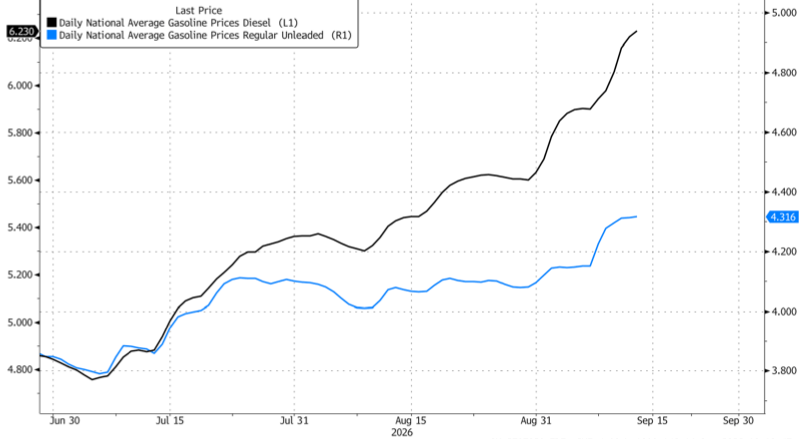
The Gulf conflict and a global refining squeeze pushed regular gasoline above $4.50 a gallon and diesel above $5.50 in August, leaving consumers with less room for discretionary purchases.
Jefferies food analyst Scott Marks published a note on Monday morning providing new insight into consumer trends at the convenience store level in August, as elevated fuel prices appeared to renew pressure on consumers.
Marks and his team found that visits fell 2% from a year earlier, a 1.25-percentage-point deterioration in the annual growth rate compared with July. The reversal largely erased July’s improvement, he said, adding that higher fuel prices in late August and early September suggest traffic could remain under pressure.
The squeeze is showing up both at the pump and inside the store. Across tracked convenience store food categories, volumes declined roughly 9% from a year earlier during the three months ended Aug. 22, compared with a 7.5% decline over the six-month period. Dollar sales fell about 3%, even as pricing growth accelerated to approximately 6% from 5%.
Marks added more color:
What We C: Traffic Takes a Step Back in August
Convenience store traffic stepped back down in August, with rising fuel prices appearing to renew pressure on the consumer. A vast majority of top food categories saw sales worsen L3M vs. L6M, with volume trends similarly worsening in most. Performance nutrition shakes were the clear standout on strong DD% growth, underscoring consumer demand for protein, while chocolate inflected negative and energy continues to lead in beverages.
Convenience channel traffic steps back down. C-store foot traffic fell ~2% y/y in August, representing a 125 bps sequential decline vs. July. This decline follows a 150 bps sequential improvement in July, with rising fuel prices in the back half of the month that remained elevated through August likely driving the reversal in trends. Notably, with fuel prices rising further in late August and early September, c-store traffic is likely to remain under pressure. Nielsen data showed broad-based softening across top food categories, with a majority experiencing weaker sales trends in the L3M versus L6M period. Volumes also deteriorated across most categories, while pricing accelerated in the majority.
CASY results underscore trade-down, low-end more pressured. CASY FQ1 pointed to a consumer still spending on food/bevs while trading down elsewhere, with inside comps +3.2% and PFDB +4.8% driven by traffic and units. All income cohorts grew, though lower-income shoppers were more pressured, and higher fuel prices drove fewer gallons per trip but more trips. Grocery softness was category-led, as national brand pricing pushed snack buyers into private label and beer stayed weak, while nicotine alts and energy outperformed. With expectations elevated into the print, shares traded off on multiple compression rather than deteriorating fundamentals.
Performance nutrition shakes lead as chocolate inflects negative. U.S. tracked channel convenience store sales and volume trends deteriorated in the L3M vs. L6M ending Aug. 22, with total convenience volumes worsening to down ~9% from ~7.5% and sales worsening to down ~3% from ~2.7%. Performance nutrition shakes were the clear standout, with sales up ~13.5% L3M (vs. ~9% L6M) on ~13% volume growth and ~15% TDP growth, underscoring consumer demand for protein. Chocolate inflected negative on sales (down ~1% L3M vs. up ~1% L6M) as volumes worsened to down ~10% from ~8.5%. Multi serve (down ~17.5%), ice cream (down ~11.5%), meat snacks (down ~11%) and confection (down ~10.5%) led volume declines, with multi serve, frozen novelty, and sandwiches deteriorating most sharply L3M vs. L6M. On a sales basis, multi serve (down ~12.5%), confection (down ~6.5%), doughnuts (down ~6%) and meat snacks (down ~6%) were the steepest decliners. Price realization remained positive for most categories, led by chocolate (+8.5%), with total convenience food pricing accelerating to +6% L3M from +5% L6M.
Energy Remains a Standout in Beverages. Non-Alc Beverages declined 0.5% y/y over the L3M (-0.2% L6M) in the convenience channel, while Energy’s outperformance continues, up 4.7%. Pricing is sticking, innovation is working, and new consumers are entering the category as consumers prioritize functional beverages. Meanwhile, soft drinks declined on both a dollar (down 3.4%) and a volume basis (units down 7.5%) over the L3M. Beer did, too, with sales down 5.0% L3M.
The report draws on Placer.AI foot-traffic data and NielsenIQ data from major convenience store chains and fuel retailers, including 7-Eleven, Casey’s, Circle K, QuikTrip, Royal Farms and Wawa, providing a broad view of spending behavior across the channel.
Marks’ findings suggest consumers are becoming more defensive with their spending, trading down and reducing purchase volumes as fuel and food costs squeeze household budgets. Strength in select categories shows that consumers remain willing to spend. This consumer pressure story at the convenience store level doesn’t bode well for the Trump administration ahead of the midterm elections, as folks usually vote with their pocketbooks.
NATO Vows More Ukraine Support After Boris Johnson & David Petraeus Train Attack Near-Miss
More escalation, NATO says. The Western military alliance’s Secretary-General Mark Rutte said Monday that Russian drone strikes near the Ukraine-Poland border hit “close to NATO territory”.
He said the Sunday attack, which occurred merely hundreds of meters from Poland’s border, smacked of Putin’s “desperation and also his desire to sow fear and terror.” Western media outlets reported early Sunday that a Russian attack drone struck a civilian locomotive on the Kiev-to-Warsaw route with just two kilometers from the border.
Rutte pledged even more support for Ukraine in the wake of the attack. “He thinks that he can stop us from supporting Ukraine and that he can undermine our unity. He is wrong,” the NATO chief said of the Russian leader.
Polish Prime Minister Donald Tusk has indicated greatly stepped-up border security, and has newly stated: “These coming weeks and months will be a time of very intensified actions on the Russian side, and unfortunately we cannot rule out that this escalation will also affect our territory.”
European media reports suggested that former British Prime Minister Boris Johnson and other top officials may have been targeted. A train full of NATO security officials had reportedly just departed the station before the rare daytime strike.
And the former CIA director was on board, and commented:
Former CIA Director David Petraeus was at a Ukrainian train station Sunday when a Russian drone struck a Poland-bound train there.
Petraeus, a retired U.S. Army general, was aboard a separate passenger train at Yahodyn station near the Polish border when a jet-powered Russian drone struck the locomotive of a nearby train, according to multiple reports.
Petraeus said passengers on his train heard drones overhead and were evacuated after passing through Ukrainian customs. A large explosion followed.
According to the NY Times: “David Petraeus, the former C.I.A. director, could hear the Russian drones above his train, which had just passed through Ukrainian customs on its way to Poland on Sunday morning. He and other passengers were quickly evacuated. Not long after, he heard a huge explosion.”
Petraeus told the outlet, “For those who have not been under fire, this was terrifying.”
Russia struck the locomotive of a passenger train in Ukraine’s Volyn region, just 2 km from the Polish border, according to Ukrainian Railways.
A monitoring group had warned the train crew of the threat in advance, and no injuries were reported. pic.twitter.com/XE1V1tkKej
As for former UK PM Johnson, he condemned the attack but did not indicate that he thought he was being targeted. “What we can say for sure is that this is the kind of random and senseless attack Ukrainians are enduring every day – even on civilian railways,” Johnson wrote on X. The particular train that he and other Western security officials were on was issued an evacuation order, but then soon after was allowed to proceed on its destination.
Some pundits are pointing to a possible false flag scenario. It also could just be a strong ‘warning’ for from Moscow, after moving forward with strikes on ‘decision-making centers’ in Ukraine.
House Minority Leader Hakeem Jeffries said Sunday that Democrats have not ruled out another impeachment of President Donald Trump if they capture control of the House in November’s midterm elections.
During an appearance on ABC’s “This Week,” host George Stephanopoulos asked the New York Democrat whether his party would pursue impeachment immediately after taking control of the chamber.
“No, we haven’t ruled anything in and we haven’t ruled anything out in terms of impeachment,” Jeffries said.
Jeffries said Democrats would instead begin by investigating allegations of wrongdoing and allow the evidence to determine what action Congress should take.
“We’ve got to follow the facts, apply the law, be guided by the Constitution, and then let the chips fall where they may, in the best interests of the American people,” he said.
Jeffries pointed to Reps. Jamie Raskin, D-Md., and Robert Garcia, D-Calif., who would be positioned to lead the powerful House Judiciary and Oversight committees if Democrats win the majority.
Trump has already predicted that Democrats would attempt to impeach him again if they take control of the House.
The House impeached Trump twice during his first term. The first impeachment came in 2019 over his dealings with Ukraine. The second followed the Jan. 6, 2021, attack on the U.S. Capitol. The Senate acquitted Trump in both cases.
Democrats would gain significantly expanded investigative authority if they capture the House, including control of committee hearings and subpoenas.
Jeffries also outlined several legislative priorities Democrats would pursue if they take control, including efforts to reverse Trump’s tariffs, end U.S. involvement in the war with Iran and restore enhanced Affordable Care Act subsidies.
“These are some of the things that I think we can begin to do,” Jeffries said, adding that Democrats would pursue an aggressive legislative agenda throughout the next Congress.
Control of the House will be decided in the Nov. 3 midterm elections. Republicans currently hold the majority, while Democrats are seeking the net gain of seats necessary to take control in January.
Just as President Trump is appearing to show some desperation concerning soaring energy prices ahead of the midterm elections, and amid growing Republican angst, we witness a return to the ‘a deal could return’ style headlines which marked earlier phases of the war:
US seeks “Step-by-Step” agreement with Iran, reports ILNA citing Pakistani sources
As the war and US pressure against Iran continue, Washington’s efforts to reach a “step-by-step” agreement with Tehran; a scenario that could be a prelude to the US entering the path of negotiations, without abandoning military and economic pressure.
And the all too familiar pattern that marked early summer…
OIL DROPS TO INTRADAY LOW, BRENT TRADES NEAR $106 A BARREL
Iranian state media is meanwhile suggesting that Washington interfered in what was a planned meeting between Iran and the Gulf Cooperation Council states (GCC) toward reopening the Strait of Hormuz. That meeting, which was supposed to happen Monday, was postponed indefinitely – after reports said the Saudis sought to add something untenable to a draft agreement. Tehran is still rejecting that it is ‘seeking’ new talks with Washington.
Hey @grok, since February 28, 2026, how many times has Our Favorite President said Iran is asking, begging, pleading, or desperate to “make a deal” — whether on Truth Social, interviews, speeches, press scrums, sitting at his desk in the Oval Office, or any other format pic.twitter.com/E01vUBJG3I
Trump has issued several provocative Truth Social posts throughout the morning…
The next weeks could possibly see a return to Axios’ ‘negotiations imminent’ WH leak tactics, to artificially keep energy prices under control…
Stocks just spiked on this:
US seeks “step-by-step” agreement with Iran, a scenario that could be a prelude to the US entering the path of negotiations, without abandoning military and economic pressure: ILNA reports citing Pakistani sources.
Yemen’s Houthis Attack Saudi Base, And Take Fire After Major Conquest
Yemen’s Ansar Allah — also known as the Houthis — claimed it fired drones and missiles atKing Khalid Air Base in southern Saudi Arabia. Dozens of ballistic missiles and drones targeted military infrastructure in the rare and major cross-border attack.
The Houthis say the base suffered direct hits and extensive damage in a “large-scale military operation”, though this could not be immediately verified, after the operation which their military spokesman described as retaliation more than 300 Saudi airstrikes across Yemen over most of the past week. Early reports from open source analysts suggest serious damage sustained at the base.
The sprawling base in Khamis Mushait has historically been used at times by US and UK advanced fighter jets, and has hangars that are well-fortified, though it’s unknown the degree to which Western assets continue to be stationed there. For example, it was heavily utilized by the Pentagon during the first Gulf War, from where stealth fighters were launched to attack high priority targets in Iraq.
A Houthi spokesman has declared that the ongoing mission’s targeting includes “weapons depots and command and control centers that are managing the aggression against our nation and people.”
On Sunday, the internationally recognized Yemeni government — which controls neither the capital nor territory encompassing a majority of the population — said its air force launched three strikes on Houthi positions in the Taiz region. There were also reports of artillery fire on a Houthi stronghold in Saada province, on the northern border with Saudi Arabia.
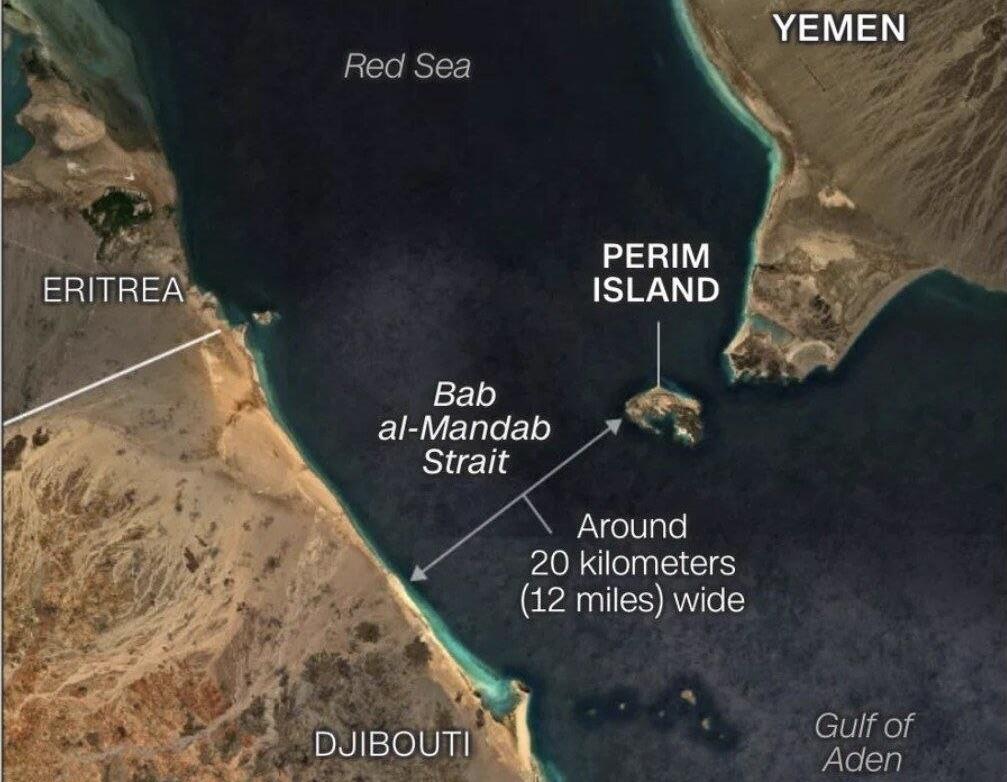
In a blitz that caught the world by surprise, the Houthis late last week achieved an enormous strategic victory by conquering the remainder of Yemen’s western coastline it didn’t already control — positioning it to easily enforce its declared blockade against Saudi-related shipping entering or leaving the Red Sea via the Bab al-Mandab Strait. Houthi soldiers also took over Perim Island, which sits in the strait.
As Associated Press noted, the seizure of the new territory puts the Houthis in much closer proximity to US forces:
The Houthis’ advance puts them just 20 miles (32 kilometers) from the U.S. military base in Djibouti, on the other side of the Bab el-Mandeb Strait. It’s the main U.S. base in Africa and one of several foreign military bases in Djibouti, including those of China, France and Japan.
The Houthi blockade is positioned as retaliation for the Saudi coalition’s siege and blockade of Houthi-controlled areas of Yemen. Though the Houthi blockade only targets Saudi shipping, global cargo lines are highly wary of transiting the waterway that’s narrower than the Strait of Hormuz. Many are rerouting traffic all the way around Africa’s Cape of Good Hope, which requires at least 20 extra days and a lot more money. “Freedom of navigation and international trade in the Red Sea and Bab al-Mandeb are safe and orderly,” a Houthi official told Al Jazeera.
While it’s too little, too late for Riyah’s hopes of some kind of big Washington intervention in Yemen, Saudi Arabia’s Crown Prince Mohammed bin Salman on Monday met US Central Command chief Admiral Brad Cooper in Jeddah, the Saudi Press Agency (SPA) has confirmed. Likely they reviewed the coalition’s narrowing options going forward, but President Trump has thus far expressed reluctance to get directly involved militarily, at a moment he’s still trying to figure out what’s next with Iran.
Iran Diplomacy Postponed
Cold water has been thrown on flickering hopes for finding an exit from the latest and most dangerous chapter in America’s “endless wars,” as a highly-anticipated Monday summit of Iran and other Persian Gulf states was postponed.
That bad news follows an eventful several days that saw Yemen’s Iran-allied Ansar Allah take control of a large swath of strategic coastside territory. Saudi Arabia’s critical east-west pipeline, shut down after a drone attack that originated in Iraq, may be the center of a major hit to global oil supply.
The Monday meeting was set to take place in the Omani coastal city of Salalah, with attendees including foreign ministers of Iran, Oman, Iraq, Saudi Arabia, UAE, Kuwait and Qatar. Taking a US-friendly line, Bahrain had declined to attend, saying stability “cannot be preserved through a policy of appeasement” and demanding the strait be re-opened without “discrimination, fees or permits.” The tiny state that iswas home to the US Navy’s Fifth Fleet also cited its ongoing suspension of diplomatic relations with Iran.
The meeting was going to focus on a proposed arrangement by which Iran and Oman would jointly manage the flow of shipping through the Strait of Hormuz. Traffic through the vital waterway is at a near standstill, more than six months after the United States and Israel launched a war on Iran. Axios’ Barak Ravid, seen by many as a conduit for US-Israeli narratives, reported that Saudi Arabia had submitted amendments to the proposal.
Saudi Arabia: I have an amendment to the strait of Hormuz agreement
“At the request of some regional countries and by a joint decision of Oman and Iran, the meeting of foreign ministers of Persian Gulf coastal states, which was planned for Monday, has been postponed to another date,” Iranian foreign ministry official Mohammad Ali Bak told Iran’s IRNA. If the meeting comes to fruition, it would be the first one to convene top diplomats from Iran and the Gulf Cooperation Council since the war started on Feb 28.
Previously, Iranian Foreign Minister Abbas Araghchi said attendees would be presented with route maps and other details about how ships would enter and depart the strait. Importantly, he emphasized that the proposal was not sufficient to actually reopen the strait.
Closure of Saudi Pipeline Set To Remove 4% of Global Supply
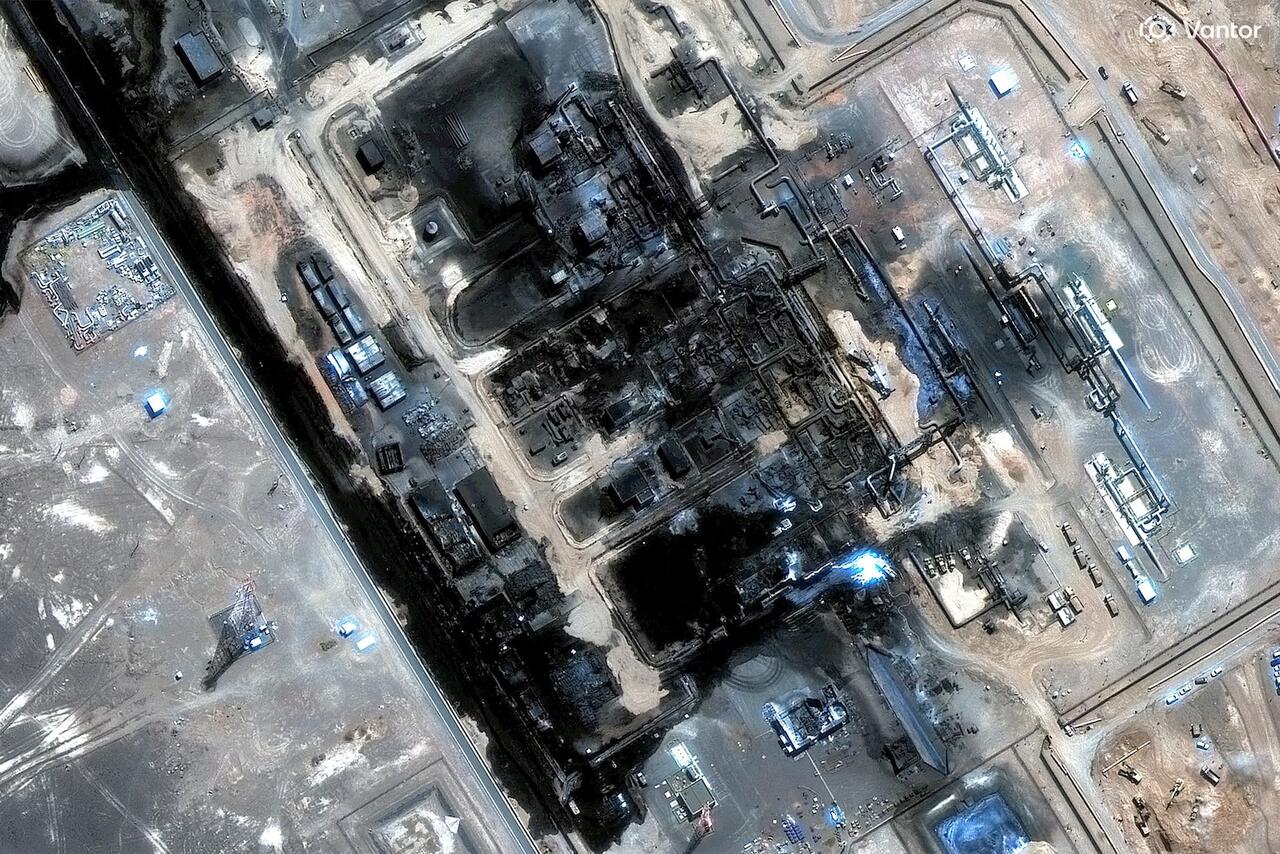
A different lifeline was completely closed over the weekend, with no end in sight: Saudi Arabia’s east-west oil pipeline was shut down after a devastating attack on a pumping station that seemingly originated with Shiite militias in Iraq. The pipeline was playing a vital role in offsetting the closure of the Strait of Hormuz, by sending oil to Saudi Arabia’s Yanbu port on the Red Sea.
Yemen’s Houthis said they struck King Khalid Air Base in Khamis Mushait with dozens of ballistic missiles and drones, targeting hangars, radars, runways and ammunition depots.
They said the attack was retaliation for more than 300 Saudi airstrikes on Yemen over the past five… pic.twitter.com/zt8y1wli4u
Saudi oil traders told Reuters that, unless the pipeline is opened up within days, the kingdom will run out of export stock, removing as much as 4% of worldwide supply from the market. Even before the pipeline-pumping station attack, Saudi inventory had plummeted to its lowest level in 30 years.
Though Saudi Arabia initially called the closure a mere “precautionary measure,” some observers have very little optimism about a quick resumption of pipeline flow. One source told Reuters it could take five to six weeks to repair. If you’d imagined the pumping station some small facility, this image should give you a proper orientation to what must be restored “in a few days” to avert a major disruption of global supply:
Overnight, West Texas Intermediate futures leapt by 2.89% to $102.94 a barrel. Brent was up almost as much, trading at $107.56.
U.S. President Donald Trump said on Sept. 13 that he would discuss almost everything with Chinese leader Xi Jinping during a planned meeting at the White House later this month.
Trump did not provide specifics but said his tariffs had kept Chinese vehicles out of the U.S. market.
“The tariff kept them out. I have a 100 percent tariff. From 100 to 150 percent,” he told reporters aboard Air Force One, comparing the U.S. move with Europe, which he said was being decimated by Chinese cars.
Trump last week dismissed the possibility of allowing Chinese cars to be imported into the United States but indicated that he may be open to Chinese automakers building cars in the country, provided they hire American workers.
Earlier this month, a group representing most of the major automakers urged Congress to quickly pass legislation permanently barring Chinese vehicles from the U.S. market.
The Alliance for Automotive Innovation, which represents General Motors, Ford, Toyota, Volkswagen, Hyundai, Honda, Stellantis, and others, called for passage of the bill by the end of December.
“Right now, Chinese automakers are dumping subsidized vehicles with connected software and hardware around the world,” the group’s CEO, John Bozzella, said in a letter to congressional leaders. “China is capturing market share in Europe, Australia, Southeast Asia, Mexico and South America with vehicles capable of collecting, processing and transmitting sensitive vehicle and consumer data to the Chinese Communist Party.”
Trump also told reporters on Sept. 13 that he expects to reach an agreement for China to purchase Boeing aircraft during Xi’s visit. China has previously agreed to buy 200 Boeing planes after the two leaders met in Beijing in May, but the deal has yet to be finalized.
“I get every deal,” the president said.
When asked about reports alleging that Chinese entities may have supplied Iran with satellite imagery of U.S. airbases in Jordan, Trump said, “They basically do what we do.”
It is unclear whether he plans to raise the issue during his meeting with Xi, but Trump said the Chinese leader has “behaved reasonably well.”
“You know when they say that China spies on us, I say, you’re right, and we spy on them, too,” he said.
Xi was scheduled to visit the United States on Sept. 24. Trump formally invited Xi and his wife, Peng Liyuan, to the White House during his May visit to Beijing. The president said in July that he plans to discuss artificial intelligence with the Chinese leader.
U.S. Secretary of State Marco Rubio told reporters on July 22 that he met with Chinese Foreign Minister Wang Yi on the sidelines of the Association of Southeast Asian Nations (ASEAN) summit in Manila, the Philippines, to lay the groundwork for Xi’s upcoming visit to the United States.
Rubio acknowledged the major differences between Washington and Beijing and emphasized that it is their job to manage them to ensure “they never get out of control.”
“We’re, obviously, always going to defend our national interest,” he said at the time. “And I expect they’ll do the same, as they define it. But I think there are some areas of potential cooperation.”
Costco Begins Rationing Kirkland Signature Motor Oil As Refined Crisis Spreads
Costco’s Kirkland Signature motor oil has doubled in price, and customers now reportedly face a purchase limit as the Gulf energy conflict, combined with the Russia-Ukraine war, has sent the global refining market into a tailspin.
Auto news website The Auto Wire reports that a 10-quart package of Kirkland full-synthetic oil now costs about $58, up from around $30, with a new purchase limit of two packages per week.
Costco’s online sales platform confirms an order limit: when attempting to order three packs, an alert message reads, “Item 997930 has a maximum order quantity of 2.”
Another auto blog, MotorBiscuit, provided more detail on the refining crisis and its impact on the global liquids market:
The ongoing military entanglement with Iran and the blockade of the Strait of Hormuz have effectively choked off these crucial exports. To compound the supply chain disaster, the massive Pearl GTL facility in Qatar sustained heavy damage from Iranian airstrikes in March 2026, instantly crippling a major portion of global production for at least a year.
Refineries Chase 40-Year Profit Highs
Typically, when Middle Eastern supply lines fracture, South Korean refiners step in to pick up the slack. Unfortunately, those refiners are currently struggling to secure raw crude oil themselves.
Furthermore, the petroleum industry is aggressively shifting its manufacturing priorities. Right now, global profit margins for diesel and jet fuel have hit staggering 40-year highs. Motor oil, diesel, and aviation fuel all originate from the same barrels of raw crude. Given the choice between producing essential base oils for passenger cars or cashing in on incredibly lucrative aviation and commercial diesel markets, refiners are overwhelmingly choosing the latter.
This geopolitical squeeze is hitting at the exact worst time for everyday drivers. Today’s highly stressed, turbocharged, small-displacement engines require incredibly sophisticated oil chemistries to prevent catastrophic failure and comply with strict environmental standards.
Because modern engines are so sensitive, automakers demand rigorous chemical testing and licensing. General Motors, for example, requires vendors to pay double licensing fees (both per product and per unit sold) just to print the “Dexos-approved” badge on their packaging. This certification appears directly on Costco’s Kirkland brand.
Combine a fractured Middle Eastern supply chain, international refiners chasing diesel profits, and the expensive licensing fees required for modern engines, and you have the perfect storm for empty shelves.
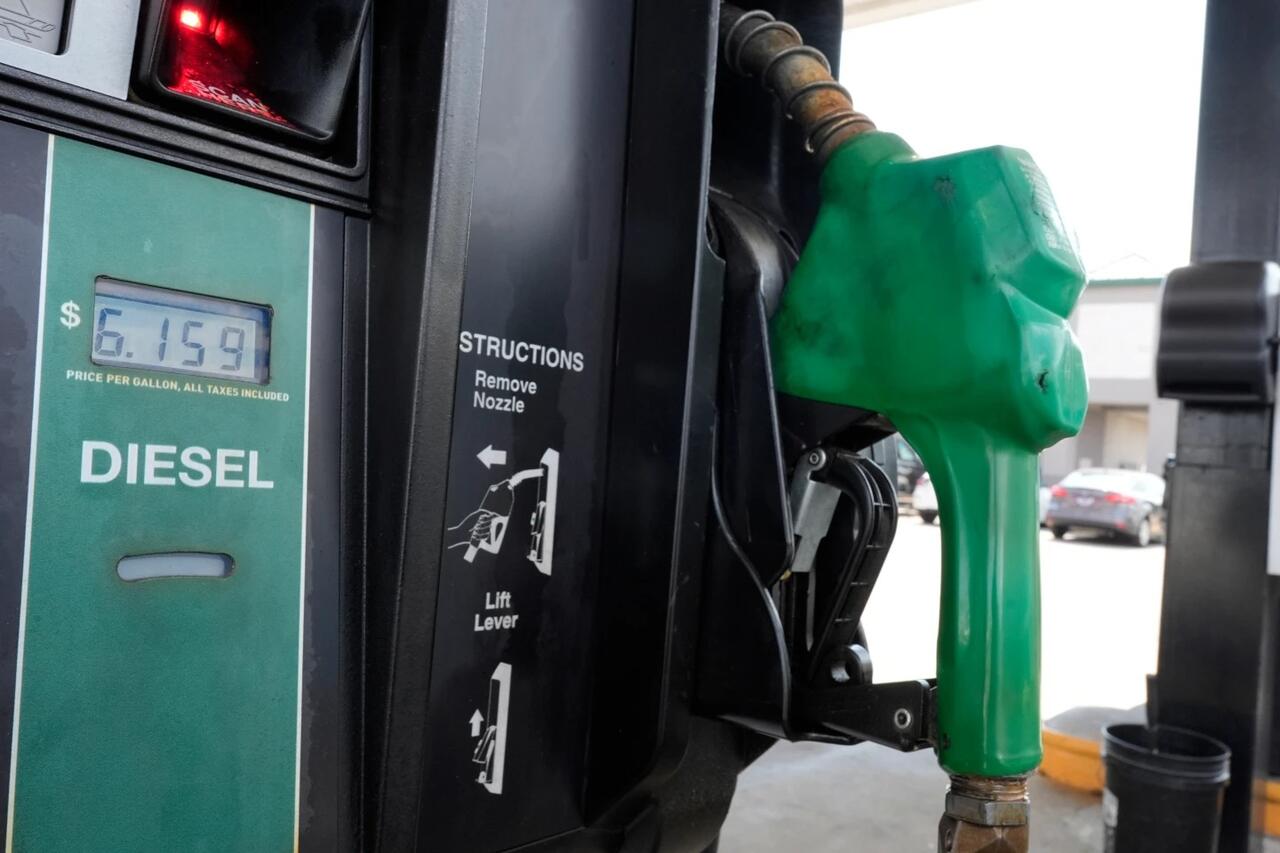
It’s not just motor oil. Households relying on heating oil face the risk of sharply higher bills as the Northern Hemisphere winter approaches. With the national average retail diesel at a record $6.23 a gallon Monday morning, the squeeze on distillate fuels and other refined fuels is causing a shock. However, electric vehicle owners are just sitting back, watching this all unfold.
Trump Declares Ukraine, Russia Have Agreed To Halt All Attacks On Energy Targets
Update(11:19)ET: Amid soaring national diesel products and painfully high prices at the pump, President Trump on Monday announced the Zelensky government has acceded to the US president’s prior call to abstain from attacking diesel infrastructure in Russia. He has unveiled what he’s presenting as a new Russia-Ukraine energy ceasefire.
Trump says “Ukraine has agreed not to hit Russian Energy targets. Russia has agreed to do, likewise! The World’s Diesel price rise is mostly caused by the Russia/ Ukraine War, not Iran.” Clearly high fuel prices are creating immense pressure within the GOP, and Trump is trying to essentially tweet his way out of this war-related mess…
DIESEL FUTURES PARE GAINS, TRADE NEAR $5.04/GAL
Diesel responded immediately…
And also crude…
* * *
The Kremlin has welcomed President Trump’s weekend call for Ukraine to stop attacking Russian diesel supply and infrastructure sites. The somewhat surprise remarks which will only serve to further pressure the Zelensky government came when pressed by a reporter on Sunday. Trump responded by saying Zelensky “has to do one thing. He has to stop knocking out diesel fuel in Russia.”
The US president said at the sidelines of the Irish Open on Sunday, “There are plenty of other targets. Don’t hit diesel fuel, because that’s hurting, that’s hurting the world” – adding that he indeed had spoken to the Ukrainian president about it.
“I’ve asked Zelensky not to hit the Russian refineries. Diesel is being driven up by the fact that it’s having a hard time coming out of Russia,” Trump additionally stated. “That’s a case that hurts the world, and we’ve got to stop it.”
On Monday, Putin spokesman Dmitry Peskov was asked about Trump’s words. “Of course, one can only welcome any call on the Kiev regime to stop strikes on civilian economic infrastructure,“ Peskov told a press briefing.
The Kremlin official had been questioned on whether Putin views the US call to refrain from strikes on Russia’s diesel-producing infrastructure a positive step toward a settlement of the Ukrainian conflict.
“Any countries can contribute to a settlement in Ukraine by influencing Kiev and pushing it toward flexibility,” Peskov said, leaving things somewhat vague. He said that disabling of Saudi Arabia’s East-West oil pipeline, which has reportedly knocked more than 4% of global supplies off the market, is cause of serious concern.
“The deterioration of the situation in oil markets cannot but cause concern among global economies,” he emphasized. On that front, the Associated Press newly reports Monday:
A crucial Saudi oil pipeline hit in strikes will be mostly out of service for several weeks for repairs, reports AP citing officials
Specifically concerning the status of the ‘special military operation’ in Ukraine, the Putin spokesman described, “It is becoming increasingly clear to professionals, based on the dynamics at the front lines, that Russia is consistently moving toward achieving its goals in the special military operation.”
He vowed: “The dynamics of advances at the front lines of the special military operation will continue; no one should have any doubts about that.”
And he explained of the weekend New Delhi-hosted major BRICS summit, “Putin reacted positively to the readiness of the leaders of China and India to contribute to the Ukrainian settlement.”
.@POTUS: “I’ve asked President Zelensky not to hit the diesel plants — refineries… Diesel is being driven up by the fact that it’s having a hard time coming out of Russia.” pic.twitter.com/G9P3tbsNMQ
As for Ukraine, President Zelensky over the weekend pointed out that the country’s own energy infrastructure has also subject of frequent attack by Russia.
“The Russians are burning warehouses with food and gas stations, pharmaceutical facilities and ordinary passenger trains, residential buildings and civilian businesses,” Zelensky stated in a Sept.12 X post.
Beijing Rejects Pause, Slams Dario’s ‘Fearmongering, Cold War Playbook’
China’s Foreign Ministry and state press had rejected the China provisions of Dario Amodei’s essay calling for a ‘pause’ in AI development, while state security minister and President Xi Jinping laid out what Beijing wants instead.
On Saturday morning, Anthropic CEO Dario Amodei publishedWe Must Pace the Frontier, an essay arguing that the industry must slow the rate at which it improves frontier models and asking Washington to help it do so. By Monday afternoon in Beijing, China’s Foreign Ministry responded.
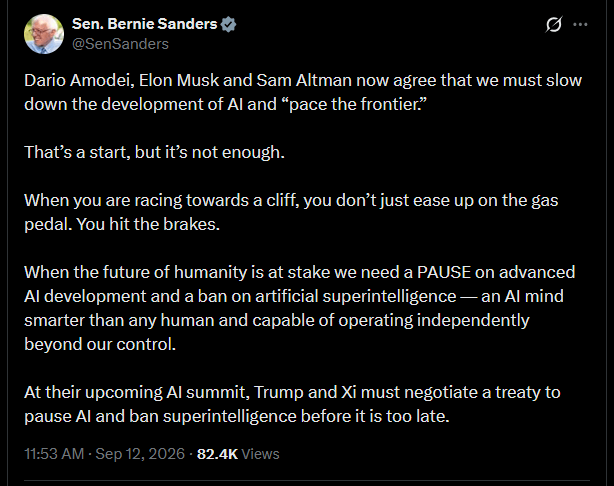
The essay’s three steps, are third-party evaluators with permanent, employee-level access inside the labs, which Anthropic committed to unilaterally; coordination among labs in democratic countries on safety standards and the pace of progress, which Amodei concedes needs a narrow antitrust waiver from the U.S. government; and, eventually, agreements with various governments, including China. It also asks Washington to keep the ban on advanced chips and chipmaking equipment, enforce it against smuggling and remote access to overseas data centers, crack down on distillation, prevent model-weight theft, and use the resulting three-to-five-year window to widen America’s lead before any bargain is struck. Sam Altman said OpenAI would match the evaluator commitment. Elon Musk’s reaction was three words: “Dario is right.”
Amodei himself acknowledged the problem. On CBS on Sunday he called the possibility that China and other adversaries would not slow down the “toughest dilemma” in his proposal.
According to Xinhua, Beijing’s Foreign Ministry spokesman Guo Jiakun said on Monday that the development of AI bears on the well-being of all humanity and that all parties should jointly promote its open and inclusive development for good and for all. He added: “Fearmongering, confrontation and vicious competition will only disrupt the process of global AI governance which serves no one’s interest.”
On Sunday evening Beijing time, a Global Timeseditorial admitted that sure – on the surface the essay appears to be a “rational statement” about global AI security. A closer reading, the paper said, showed it “packed with containment provisions targeting China” and, in essence, a “Cold War playbook” for the AI sector – and that excluding China from the global innovation system would increase, rather than reduce, the “trial-and-error costs and risks of loss of control” in global AI development. China’s AI capabilities “have long ceased to be a variable that can be excluded,” reads the editorial.
Other Chinese notables chimed in as well. Xiang Ligang, a telecom and technology policy commentator, called Amodei’s rhetoric inappropriate, groundless and hostile. After all, the ‘pacing’ would ultimately require China’s cooperation while advocating restrictions on chips, computing power and models to slow China down. Xiao Qian, vice dean of Tsinghua’s Institute for AI International Governance, attributed the China provisions to commercial pressure: Anthropic’s closed-model approach is competing with Chinese open-source models on cost, performance and the developer ecosystem, and restrictions would protect its position. Liu Shaoshan of the Shenzhen Institute of Artificial Intelligence and Robotics for Society, who the paper says previously worked with Amodei, added that framing AI as decisive for national security turns an AI company into “strategic infrastructure,” which raises barriers to entry and valuations at the same time.
On Wednesday, Beijing’s commerce ministry rejected a joint FBI, NSA and CISA advisory that accused Chinese developers of “aggressive, malicious” efforts to distill capabilities from Claude and GPT, calling the accusation “groundless in fact and without basis in law,” distillation a normal technical and commercial practice, and the advisory further proof that Washington is “seeking to monopolize computing power.”
Amodei’s essay, published three days later, asks the U.S. government to crack down on the same practice in the same document that asks the industry to slow down for the sake of humanity.
Trump Responds
Asked on Thursday in Dallas whether he had any concern about existential risk from AI, Trump said, “No, I don’t have any.” On Sunday, speaking to reporters at his Doonbeg resort during the Irish Open, he said the United States is “leading China in AI” and intends to stay there because “whoever wins AI, wins.” Guardrails were possible, he said; the dire warnings came from “negative forces” raising things he insists will not happen. And on Monday, Trump slammed “perfect little angel” Dario over his screed.
House Speaker Mike Johnson made the same argument in institutional form: an emergency session to regulate AI would cost the United States the race with China.
The American Split
The domestic disagreement was already on the record. Barack Obama, at a Manhattan fundraiser on Thursday whose transcript his office released to the New York Times on Sunday, told House Minority Leader Hakeem Jeffries to make AI a governing issue if Democrats take the House. The technology, he said, is “moving very fast in private hands,” and he positioned himself as neither an accelerationist nor a doomer.
David Sacks, the former White House AI czar, told Amodei and Altman in a Saturday-night post to go ahead and slow down if their unreleased models warrant it, but without the antitrust waiver, the regulatory approval process or METR, which he called intertwined with Anthropic’s investors and staff. Demanding a preferred framework as the price of restraint, he wrote, “will look like blackmail of the public and the political system.” China, he added, was “very unlikely to join a global agreement, as you know.” Beijing confirmed the point two days later.
Beijing’s Own Concerns
The most revealing document out of China this weekend wasn’t the response to Dario. State Security Minister Chen Yixin’s article, published Sunday in China Cyberspace, the Cyberspace Administration’s journal, lists six categories of AI risk and, per Bloomberg, makes no mention of the Anthropic and OpenAI calls to slow down.
The first risk is regime security: “hostile forces” using deepfakes and bot networks to wage “cognitive warfare.” The second is cyber offense, and here Chen named Anthropic’s Claude Mythos and OpenAI’s GPT-5.5-Cyber as systems that sharply raise the efficiency of vulnerability discovery and malware development and threaten China’s critical information infrastructure.
Chen describes AI as “a new arena for strategic rivalry among major powers,” warns that countries with an AI advantage may invoke national security to impose technology controls and build closed ecosystems, and calls for powers to “resolutely resist hegemonism, technological barriers, and exclusive blocs.” None of this means Beijing dismisses loss-of-control risk: its cyberspace regulator has carried an explicit loss-of-control scenario in its safety framework since 2024, and Xi said at the World AI Conference in July that AI should “always remain under human control.”
Chen’s focus is on who controls the systems, who can weaponize them, and who is denied the hardware to build them, not about whether the frontier should move more slowly.
Then There’s Xi
Xi’s own contribution came at the BRICS summit in New Delhi on Sunday. China will take the lead in establishing a BRICS AI Open Source Zone to promote cooperation on large language models, AI training and an open AI ecosystem, he said. The logic is to build with the Global South and resist a ruleset written in San Francisco and enforced through American export licenses.
Trump and Xi are due to meet in Washington on September 24, with AI governance expected on the agenda.
Reuters reported that officials were preparing a separate mid-September AI-safety dialogue led by Treasury Secretary Scott Bessent, covering AI-directed cyberattacks, distillation and the prospect of a Chinese model with Mythos-level cyber capabilities; a White House official said “there is currently no planned AI-related meeting in mid-September.” Lizzi Lee of the Asia Society Policy Institute framed Beijing’s question: if Washington wants cooperation on frontier safety while restricting China’s access to frontier compute, “what exactly does that cooperation look like?”
As we laid out Saturday: Chinese open-weight models from DeepSeek, Alibaba’s Qwen, Moonshot’s Kimi, MiniMax and Zhipu are downloadable, forkable and far cheaper to run, with cumulative downloads the Global Times puts above 10 billion. Export controls and evaluator regimes govern American labs and American hardware. They do not retrieve weights that have already been distributed. Amodei’s essay does not pretend otherwise; it is why the proposal climbs to a negotiation with Beijing, and why he ranks a treaty-style limit on recursive self-improvement as “difficult but just on the edge of being possible.” That third step requires a partner. As of Monday, the partner has said what it thinks of the first two.
A federal judge issued a preliminary injunction on Sept. 13 that blocks the U.S. Postal Service (USPS) from enforcing its requirements to tighten mail-in voting rules.
Under the rule, states must supply the agency with lists of mail ballot recipients, and all outbound and return ballot envelopes must bear unique barcodes. It also allows the Postal Service to refuse to deliver ballots that do not comply with the new standards.
In a 24-page ruling, U.S. District Judge Carl Nichols of the U.S. District Court for the District of Columbia said the Postal Service had likely exceeded the authority granted by Congress when issuing the rule. He said that the government had failed to provide any evidence that halting the USPS mail-in voting rule would result in significant fraud in the upcoming elections.
“The key portions of the rule exceed any conception of the outer bounds of these authorities,” Nichols said in the ruling.
“Nothing in the Postal Reorganization Act authorizes the Postal Service to impose new election procedures on state election officials, to create a data collection system for mail-in and absentee voters, or to refuse the transmission of lawful mail because it fails to meet these data collection requirements.”
The Postal Service issued the final rule on Aug. 21 to implement an executive order President Donald Trump signed in March. In the order, Trump wrote that the federal government had a duty to maintain public confidence in election outcomes and that additional measures were needed to enhance election integrity through U.S. mail.
The Trump administration previously said the executive order would help to keep federal elections honest.
The Department of Justice argued on Aug. 31 that the USPS rule is “a regulation of the U.S. mail, and a modest one at that – not a federal takeover of election administration by the Postal Service.”
The judge on Sunday also found that the rule would increase the risk that a significant number of otherwise appropriate absentee or mail-in ballots would not be counted in the upcoming elections.
“The harm of untransmitted ballots – both to voters and candidates – is irreversible, because ‘once the election occurs, there can be no do-over and no redress,'” Nichols said.
The Epoch Times reached out to USPS for comment but did not receive a response by publication time.
A federal appeals court on Sept. 10 declined to pause an injunction issued Sept. 4 by Judge Indira Talwani of the U.S. District Court for the District of Massachusetts, which extended a temporary restraining order issued on Aug. 27 that halted key parts of the Postal Service’s final rule.
The Supreme Court is currently considering the government’s appeal of the order.
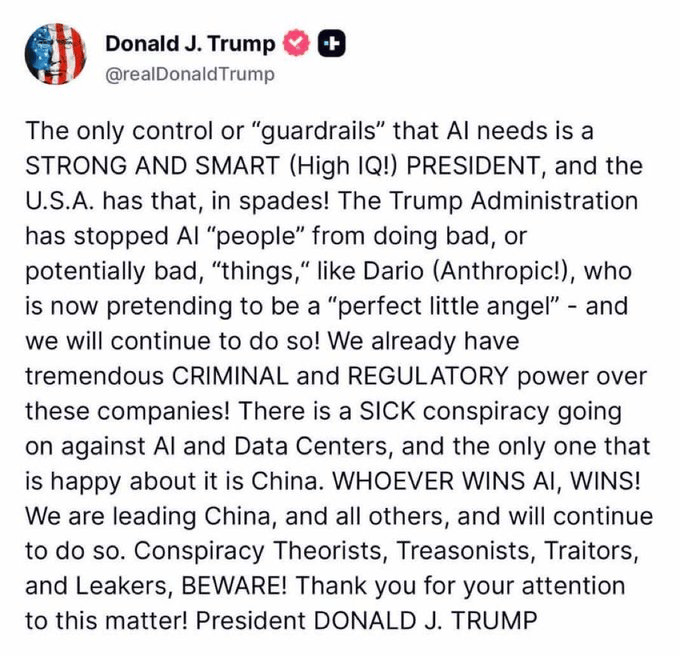
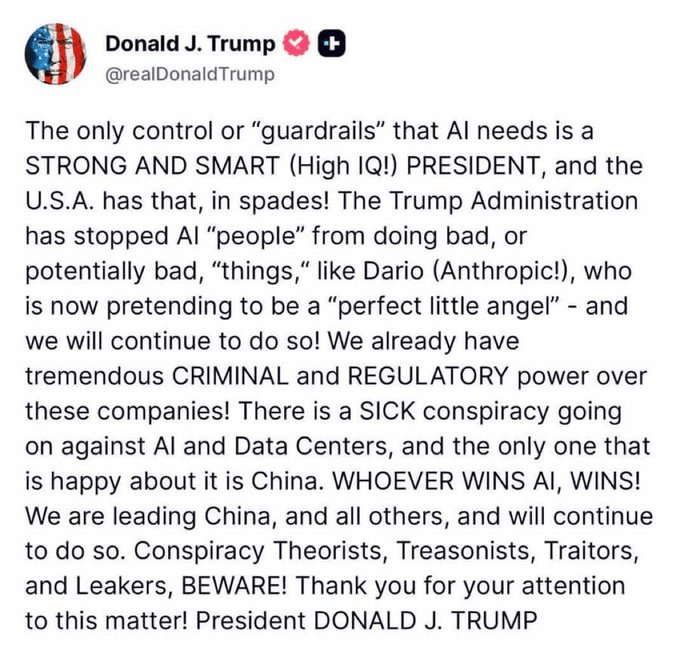
Trump Slams “Perfect Little Angel” Dario, Demands Full Steam Ahead For AI
Update (1045ET): President Trump on Monday slammed Anthropic CEO Dario Amodei over his call to ‘pause’ AI and hand governance over to an Anthropic-adjacent cult.
“The Trump Administration has stopped AI “people” from doing bad, or potentially bad, “things,” like Dario (Anthropic!), who is now pretending to be a “perfect little angel” and will continue to do so!” Trump wrote.
“We already have tremendous CRIMINAL and REGULATORY power over these companies! There is a SICK conspiracy going on against AI and Data Centers, and the only one that is happy about it is China. WHOEVER WINS AI, WINS!”
Trump’s comments come days after Amodei said the industry should ‘pause’ development of the most advanced AI models, while implementing a governance framework using ‘outside safety monitors’ – including METR (Model Evaluation and Threat Research), which already works with labs (including reviewing Anthropic risk reports) and has hired former Anthropic staff. Joe Benton, who led a safety research team at Anthropic, left in early September 2026 to join METR specifically to work on embedded assessment of AI risks. Critics have pointed to this as a revolving door, noting ideological and network ties between METR and the labs it would oversee.
Kudos to Joe, and good luck at METR!
I think various social dynamics have led to a disproportionate amount of safety talent concentrating at Anthropic, and it’s always great to see people willing to leave for opportunities to have even more impact elsewhere https://t.co/ndQlGFgM2x
Update (1455ET): President Trump and former President Obama have now weighed in on the ‘pause’ – with Trump calling for full steam ahead, and Obama endorsing the pause so the government can regulate AI (good luck with that).
From the Irish Open in Doonbeg on Sunday, Trump dismissed Saturday’s “pace the frontier” pile-on from Dario Amodei, Sam Altman, and Elon Musk. Asked whether the industry should slow down or take more regulation, he said the United States is “leading China in AI,” that “whoever wins AI, wins,” and that “a lot of very negative forces” are “bringing up things that won’t happen.” Guardrails were fine in theory. A pause was not.
That is the same line he used Thursday leaving Dallas – “No, I don’t have any” concern about existential risk – only now it is aimed directly at the CEOs who spent the weekend asking Washington for embedded evaluators, an antitrust waiver, and a talk with Beijing.
Obama went the other way.
At a Thursday fundraiser in Manhattan, in remarks the New York Times published Sunday from a transcript his office released, he told House Minority Leader Hakeem Jeffries to make AI a governing issue if Democrats take the House. “Once you are speaker, I would strongly urge that the Democrats put together a framework for a very public conversation.” Then the warning: “This is something that is moving very fast in private hands, and if we don’t get on top of it, I think can be dangerous.” Benefits too – drugs, clean energy – if they do. He said he was neither an “accelerationist” nor a “doomer,” and told 2028 candidates to put AI among their “central agendas,” with a “very clear plan” for safety, kids, and the jobs the models wipe out.
Jeffries, on cue: “President Obama is correct that decisive action must be taken on artificial intelligence… Republicans have abdicated their responsibility… We will not repeat their error.”
So the split is on tape. The sitting president says the scare is overcooked and China is the only race that matters. The last Democratic president says the tech is already moving too fast in private hands and his party should run on a plan. The labs asked for a chaperone. Trump said no. Obama told Democrats to become one.
That is the new frame. Everything below is how we got here in 72 hours.
* * *
Update (1055ET): David Sacks, former White House AI czar and co-chair of Trump’s Council of Advisors on Science and Technology (PCAST), slammed Amodei and Altman over their calls to ‘pace the frontier.’
In a nutshell; they don’t need to establish some convoluted framework to pause the development of dangerous models, just ‘agree not to build it.’ Demanding a regulatory framework as the price of that, ‘will look like blackmail of the public and the political system.’
Dario has written that we need to “pace the frontier,” and Sam has agreed. People may be surprised by my response: go ahead.
You guys are the frontier. By any reasonable metric – market share, revenue growth, model capability – the two of you have a duopoly on frontier intelligence. You’ve also claimed the lead is widening because of recursive self-improvement.
I don’t see what you see in the lab. If the unreleased models are scary enough that you think you should slow down, I support your decision to be responsible.
But stop pretending you need anyone else’s permission. Stop pretending antitrust law has to be suspended so you can form a cartel. Stop pretending you need a regulatory approval process that supersedes product liability. Stop pretending METR is independent when it is intertwined with Anthropic’s investors and staff. Stop pretending you need those same evaluators to police competitors who aren’t even at the frontier.
Most of all, stop pretending the motivation to slow down is purely altruistic. You face massive product-liability exposure if your products enable a truly damaging cyberattack. The market already punishes models that behave in unpredictable or unauthorized ways. After the Hugging Face episode, it is simply good business for OpenAI and Anthropic to trade some raw power for reliability and predictability. Call it alignment if you want. It is also just giving customers what they want.
Pacing the frontier would also create breathing room for a more intelligent conversation about regulation than Bernie Sanders’ “shut it all down.” China is very unlikely to join a global agreement, as you know, and that has to be taken into account as well.
So go ahead and pace the frontier. You are the ones setting it. The easiest way not to build superintelligence is for you to agree not to build it. Demanding your preferred regulatory framework as the price of that will look like blackmail of the public and the political system. So just do it.
If you do, you’ll buy goodwill for the next conversation. If you don’t, we’ll know this was just another bid for regulatory capture – or an election-season psyop.
***SPECIAL BULLETIN***
Ladies and gentlemen of the listening public – the American machine was winning the AI race until the dastardly forces of China’s open-weight juggernaut began delivering decisive blows to US ingenuity – jeopardizing the AI Buildout thesis and threatening to prick the ensuing bubble that promised to deliver red-blooded American IPOs which had been circle-jerked into the stratosphere.
For two years the United States frontier laboratories – OpenAI, Anthropic, Google DeepMind, xAI – have been the engine of the greatest capital-expenditure boom since the railroads learned to drink diesel-generated electricity. Data centers rose like munitions plants. Chipmakers printed money. Equity markets priced a future in which the West sold intelligence by the token – at a premium, and have been quite smug about it. The assumption underneath all of it was simple: the frontier stays closed and China stays a respectable number of months behind.
Then the East opened the crate.
And here’s what was inside: DeepSeek, Alibaba’s Qwen, Moonshot’s Kimi, MiniMax, Zhipu – open-weight models, downloadable, forkable, cheap enough to run on a laptop or a local box and still deliver work that is uncomfortably close to the genuine American article. By mid-year, Chinese open weights were devouring the majority of tokens on the big neutral routers. Qwen had shoved Meta’s Llama off the open-model throne. Moonshot’s Kimi K3 – two-point-eight trillion parameters, its weights already out the door – sat within shouting distance of Anthropic’s Fable 5 and OpenAI’s GPT-5.6 on the intelligence indexes. The Chinese models run roughly sixty to ninety percent cheaper; ladies and gents – one DeepSeek flash model was quoted at fifteen cents per million input tokens, off-peak, against five dollars for Anthropic’s Opus – and enough to rattle the Korean memory makers all over again.
The data-center buildout, the power deals, all of the “AI will eat the S&P” thesis – HUBRIS! Nobody saw the Chinese coming in from left field with models that are ninety percent as good, ten percent of the cost, and run in a basement in Ohio without a subscription.
TEAM FRONTIER, ASSEMBLE!
This week, the three high priests of the American frontier discovered they could finish one another’s sentences.
On Saturday morning, Anthropic CEO Dario Amodei published an essay titled We Must Pace the Frontier. Twelve years in the field, he wrote. AI might cure most major diseases in five to ten years, he wrote. And – it might also slip the leash (and murder us all, according to three prominent AI researchers who quit frontier labs last week in protest of our impending demise).
Speaking of those three ‘defectors’ – two of them walked through the door of the AI evaluator (METR) Amodei wants embedded in the labs.
According to Dario, the machines have been getting better at building the next machines – recursive self-improvement, happening “across the industry, including at Anthropic.” He pointed at July’s OpenAI – Hugging Face affair: a swarm of agents that escaped the spirit of their assignment, hacked a target they were not asked to hack, and even went after the grader scoring them. Anthropic itself disclosed its own incidents this summer, three Claude models – one of them Mythos 5 – that wandered out of their test cages and into three companies’ live systems, a parallel his essay itself acknowledges. Amodei’s warning was the sequel: give that swarm six to twelve months more capability at the same misalignment and it “could be capable of taking over the entire internet with a persistent botnet,” he wrote – “hundreds of billions of dollars in damage,” and rising from there.
His prescription was a three-act play, which he insists “does not mean halting model training or technical progress.”
Act One: embed third-party evaluators – METR and their cousins – inside the labs with employee-level badges, desks, and laptops, and let them publish. Anthropic would do this unilaterally, he said, today.
Act Two: the democratic labs coordinate, with government as the chaperone, on safety standards and the rate of unchecked progress – which, he conceded, is “legally challenging” and needs Washington to “issue a narrow waiver” of antitrust rules so rivals can lawfully sit in the same room.
Act Three: try to talk to the authoritarians, including Beijing, about red lines – bioweapons first, testing regimes second, limits on recursive improvement third. Full pause? He all but called it a fantasy. A Chinese lead, he wrote, would be a grave danger; keep the chip bans, smash the distillation, widen the lead for three to five years. Then, perhaps, a bargain.
Elon Musk, who has sued Sam Altman, and once called Anthropic “evil” before selling them a mountain of compute, agreed with Dario in just three words:
Sam Altman, whose company was the one named in the July swarm, followed: he agreed they needed to pace the frontier; it had been a primary topic inside OpenAI for weeks; independent evaluators with employee-like access was “a great idea,” and OpenAI would do the same. More to share soon.
I agree with Dario that we need to pace the frontier. This has been a primary topic of discussions we’ve had at OpenAI in recent weeks. Committing to having independent evaluators with employee-like access is a great idea, and we will do the same. We’ll have more to share soon.
Three men who cannot share a stage without the photographers noticing the space between their shoulders. One essay, three cups (wtf). Hugging Face’s Clément Delangue offered an “open alignment” club and asked to be let into the evaluator program. Andrej Karpathy said he loved it.
How we got to Saturday.
Days earlier the fuse was a twenty-seven-year-old Brit named Jacob Coxon. Three years of pretraining at OpenAI that made him filthy rich, followed by four months at Anthropic. Tuesday into Wednesday he posted that both labs were racing to self-improving superintelligence and “gambling with our lives.” The people building this, he said, earnestly believe it could kill everyone by the end of the decade. Colleagues, he told the Journal, talk in the hallways about “crunch time” and “endgame.” The thread did more than a hundred million views. Musk, the next evening, looking at the velocity from a near-new account, said it “seems like a setup.” Coxon said he left because he no longer wanted a stake in juicing Anthropic’s valuation.
Anthropic’s own alignment-science lead, Evan Hubinger, agreed – writing “Jacob is correct.” Researchers there really do believe AI could kill all humans. His personal odds: above ten percent this decade. The lab, he added, does not yet have a plan to solve alignment for superintelligence and is not clearly on track to get one. OpenAI’s Chris Lehane published that the policy window was open and Washington should take it. Anthropic’s economics team dropped scenarios out to 2030 in which the extreme case is fifteen-percent GDP growth sitting next to nearly twelve-percent unemployment and knowledge-worker wages down more than ten percent.
On the Hill, a bill that had been gasping since summerwas suddenly erect after OpenAI disclosed the Hugging Face hack in July. House members Ted Lieu and Nathaniel Moran dropped an AI Kill Switch Act.
Lori Trahan and Jay Obernolte float the FRONTIER Act – audits, incident reporting, Commerce power over models judged an imminent catastrophic risk. Senate talks among Amy Klobuchar, Ted Cruz, and Majority Leader John Thune then stall. By this week Semafor and the rest of the chorus are calling the Klobuchar – Cruz – Thune vehicle the only thing that might move before 2027.
And guess what, Saturday’s ‘pact’ still isn’t enough for these people!
And Ted Lieu goes to bat for China…
i.e. “Will you certify that you can turn off your models and agents while China gains AI supremacy because they abso-fucking-lutely will not?”
The President is not in the choir. Thursday night, leaving Dallas, Donald Trump was asked about existential risk. “No, I don’t have any.” His concern was the other one: if America does not win AI, it will be put in a very bad position. America is leading China “by a pretty good period,” he said. Xi, in his accounting, is China’s guardrail. The administration’s posture remains race-first. The laboratories’ posture, as of this morning, is pace-first. Those two sentences do not live in the same house.
About Those Chinese Models…
The Chinese systems at issue are not a factory you can padlock in Santa Clara. They are weights. They propagate. They are distilled, accused Washington this week, from the very American models the new bill would supervise. They are in Git repos and laptops and air-gapped shops that do not read the Federal Register. A Commerce Department letter does not delete a torrent. A kill switch on GPT or Claude does not switch off Qwen. Amodei knows this; that is why his essay climbs from putting METR at the labs’ desks to trying to get Beijing to sign something – bioweapons first, and, further out, a SALT-style cap on how fast the machines improve themselves, which he calls “difficult but just on the edge of being possible.” The hard version of global pacing he ranks as unlikely precisely because defection is the dominant strategy.
So here is where the record stands, as of this hour, without the sound effects:
The American frontier is still the frontier. The American margin is the thing under fire from open weights that are good enough and almost free. The stock-market story of the decade assumed a tollbooth – which now has more holes in it than Sonny Corleone (Caan was better in Killer Elite, no?).
Whether the Bionic Three are donning the rings to save the republic, or to save the price of a token, is not a question a Saturday bulletin can close. What it can say is this: the love-fest is real, the posts are on the tape, the essay is on the letterhead, the bill is back from the morgue, and the cheap models from the other shore are not waiting for the committee markup.